Posts Tagged ‘impunity’

The killing of Oscar Romero – El Salvador’s ‘turbulent priest’ – written up after 36 years

January 18, 2017

Tom Sandborn wrote in the Vancouver Sun of 7 January 2017 review  of the book “Assassination of a Saint: The Plot to Murder Oscar Romero and the Quest to Bring His Killers to Justice“, by Matt Eisenbrandt, published by University of California Press.

Sainthood and civil torts
Book cover: Assassination of a Saint: The Plot to Murder Oscar Romero and the Quest to Bring His Killers to Justice

It took a single bullet to kill Oscar Romero, but his legacy has outlived many who plotted his murder and he may soon be officially named a saint by the Catholic Church. Assassination of a Saint is an exciting, dramatically paced account of his murder by a right wing death squad and the painstaking and eventually successful efforts to expose some of the men behind the Archbishop’s death.

In El Salvador in 1980, Romero, the Archbishop of San Salvador, had been elevated to his position in part because the cabal of land owners and politicians that controlled the tortured Central American state saw him as unlikely to pose uncomfortable moral challenges to their power. But Romero was fast becoming a problem for the elites…. he was condemning the war of right wing terror being waged against the Salvadoran people by the army, police and paramilitary death squads, all of whom took orders and funding from the country’s ruling class and inspiration from a particularly bloody minded brand of Cold War anti-Communism….

During the three years he spent as Archbishop, Romero was gradually radicalized by the suffering inflicted on the poor of his country by the official and unofficial death squads. In the end, he condemned the state and ruling class sponsored murders and called on soldiers and policemen to refuse the orders to turn their guns on Salvadorans standing up for their freedom. “No soldier,” he thundered from the altar, “is obliged to obey an order contrary to the law of God.” That call for conscientious disobedience was the last straw. The decision was made that the “turbulent priest” must die.

On March 24, 1980, a sniper in a van parked outside the church fired a rifle once, striking Romero in the chest as he said mass and killing him. The assassination made the Archbishop a beloved martyr among the poor, and kicked off a new round of civil war and bloodshed. For decades, no one was held to account for the public murder.

The Assassination of a Saint is the compelling story of how a rag-tag band of idealistic lawyers collaborated with Salvadoran exiles to identify one of the killers, Alvaro Saravia. Because the assassin was found to be living in the United States, the legal team, working out of the San Francisco offices of the Center for Justice and Accountability, was able to file a civil suit against him under an obscure American law, the Alien Torts Act, for damages incurred by Romero’s killing. In the course of that effort, they brought to light much of the hidden history of the Romero murder, meeting with witnesses and accomplices in the crime and uncovering much more about the archbishop’s death than had been known before.

Matt Eisenbrandt was a member of the legal team, and he has written a fast paced, informative and dramatic account. …Before they were successful in that effort in 2004, the crusading lawyers experienced a series of dramatic meetings with perpetrators and potential witnesses, tense moments, mysterious phone calls, frightening visits to El Salvador and years of exhaustive research. Their win was a triumph for human rights defenders, and this book is a powerful account of how that victory was won. 

Tom Sandborn lives and writes in Vancouver. He has been involved in human rights activism for over five decades. He welcomes feedback and story tips at tos65@telus.net.

Source: Sainthood and civil torts

‘FOR THOSE WHO DIED TRYING’ Photo Exhibit on human rights defenders in Thailand by Protection International

January 16, 2017

exhibit 2

Protection International opened the photo exhibition, ‘For those who died trying’ on the Place des Nations in Geneva on Monday, 9 May 2016. The exhibition run from 9-11 May and presented the photographs of 37 murdered or abducted human rights defenders in Thailand. It has toured or will be touring various countries (e.g. Thailand, Brussels, Pamplona) and as from 22 January 2017 a small town in the Netherlands, Dordrecht (www.defendersindordrecht.org), houses the images.

The project looks to remember those who died defending human rights and protecting the environment by placing a portrait of the human rights defender, where possible, at the exact place he or she was murdered or abducted. It is vital, for the victims and their families, that their fight and their death is not forgotten and left un-recognised. Ultimately, those responsible must be brought to justice. Recognising those who died trying as HRDs and a better administration of justice are critical steps to end these killings.

More information can be downloaded here: ‘For those who died trying’ photo exhibition.

see related: https://humanrightsdefenders.blog/2016/12/02/new-on-line-memorial-to-remember-killed-human-rights-defenders/amp/


Greece: MPs of Golden Dawn far-right party attack minority rights defenders – no police action

January 10, 2017

On 6 January 2017 the International Secretariat of the World Organisation Against Torture (OMCT) requested urgent intervention in the following situation in Greece.

OMCT-LOGO Read the rest of this entry »

Front Line launches its 2016 Report on Human Rights Defenders at Risk

January 9, 2017


After a short break, this blog resumes its job of selecting and summarizing events related to Human Rights Defenders. 2016 was a horrible year for HRDs and the launch of the annual report of Front Line Defenders confirms this by reporting that “more than 1000 human rights defenders were killed, harassed, detained, or subjected to smear campaigns and other violations in 2016″.

Download the Report

According to the report, 281 human rights defenders were murdered in 25 countries, 49 percent of whom were defending land, indigenous and environmental rights. Front Line Defenders found that in the vast majority of cases, killings were preceded by warnings, death threats and intimidation which, when reported to police, were routinely ignored. In addition to killings, over half of the cases reported by Front Line Defenders in 2016 concerned criminalisation, a tactic which the organisation calls “the first choice of governments to silence defenders and to dissuade others”.

For other post on Front Line last year, see: https://humanrightsdefenders.blog/category/front-line/page/4/

Two remarkable women rights defenders from Mexico: Olga Guzmán and Stephanie Brewer

December 15, 2016

OMCT-LOGOpublishes a series of 10 profiles human rights defenders to commemorate International Human Rights Day, 10 December 2016. Here two women HRDs from Mexico: Olga Guzmán and Stephanie Brewer: Read the rest of this entry »

New on-line memorial to remember killed human rights defenders

December 2, 2016


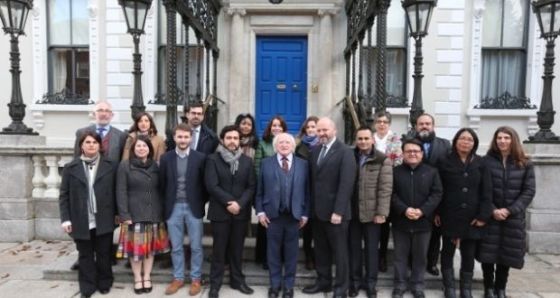
President Michael D Higgins with international activists and NGO representatives in Dublin at the launch of the Human Rights Defenders Memorial. Photograph: Conor McCabe

Irish President Michael D Higgins with international activists and NGO representatives in Dublin at the launch of the Human Rights Defenders Memorial. Photograph: Conor McCabe

Rachel Flaherty reports in the Irish Times of 24 November on the launch of an on-line Memorial o honour human rights defenders who have been killed The online memorial would be a tool to track investigations and advance the struggle for justice for human rights defenders. The Human Rights Defenders Memorial (HRD Memorial) has been set up by Dublin-based Front Line Defenders as an online international and interactive database. It will detail all the human rights defenders who have been murdered around the world since 1998. The Front Line Defenders organisation has estimated 3,500 have been murdered since then.

A coalition of 20 national and international human rights organisations jointly coordinated the project. Contributors included human rights groups from Colombia, Honduras and the Philippines, which Front Line Defenders said are ranked among three of the deadliest countries in the world for human rights defenders. The organisation said other countries included among the worst in terms of killing and physical attacks against human rights defenders included North KoreaChinaRussiaEgyptSaudi Arabia and Zimbabwe.

Andrew Anderson, executive director of Front Line Defenders, said the memorial sent a message the human rights community was stronger than any one person. “It will not be deterred, and its leaders will not be forgotten,” he said. “This is not random violence. This is the calculated elimination of those who speak out to defend the rights of the most vulnerable. Autocrats and powerful economic interests think that if they kill an activist, they kill a movement. The goal of the HRD Memorial is to prove them wrong.”

http://www.irishtimes.com/news/social-affairs/new-online-memorial-honours-human-rights-defenders-1.2881256

https://www.frontlinedefenders.org/en/statement-report/celebrating-those-who-were-killed-defending-human-rights


Marcos burial decision causes controversy in Philippines

November 17, 2016

ABS-CBN News reported on 13 November 2016 on an interesting protest in the Philippines. A group of black-clad lawyers and human rights defenders trooped to the Bar examinations Sunday to protest the Supreme Court’s ruling allowing the burial of late dictator Ferdinand Marcos at the Heroes’ Cemetery. Led by the National Union of Peoples’ Lawyers (NUPL), the group mounted their “Black to Block” protest with chants of “Marcos no hero, no honor” in front the bar exam venue. [Voting 9-5 with one abstention, the SC last week ruled that President Duterte’s move to allow the burial of Marcos at the Libingan ng mga Bayani did not break any laws nor did it show a grave abuse of discretion.]

In an open letter, the NUPL reminded the bar examinees of their duty to use their knowledge and skills to defend justice …..The country needs good lawyers, especially now that “the law is being downtrodden and diminished by skewed reinterpretation”. “Our rage is as dark as the night; our memory just as long. We will continue to rage as we mourn. But we will help change things. Who knows, we might, with the power of the people scorned, even be able to put sense in the heads of the gods and show their way clear.” Concluding their letter, the NUPL told aspiring lawyers, “Do well in the bar examinations. But be mindful what this is all for. From your ranks may also come those who will exorcise the demons in our midst, dead or living. Your people — and Lady Justice — are waiting for you.

The protesters earlier urged bar examinees to show support for Sunday’s mass action by wearing black shirts, but most of the bar candidates were dressed in their school colors.

In the meantime, the group has filed another motion asking the court to hold in abeyance or refrain from executing any plans on the burial pending the finality of the SC ruling.


http://news.abs-cbn.com/news/11/13/16/lawyers-rights-advocates-mourn-marcos-burial-at-bar-exams

Gordon says PH should help poor, not focus on Marcos burial | ABS-CBN News

Dimitris Christopoulos elected as the new President of the FIDH

August 29, 2016
As FIDH President, Christopoulos will work towards the implementation of the priorities decided by FIDH's member organisations.

Greek academic Dimitris Christopoulos has been elected president of International Federation for Human Rights (FIDH). He succeeds Iranian lawyer Karim Lahidji who headed the international human rights NGO for the last three years. The vote was held during the 39th FIDH Congress in Johannesburg where its 178 member organisations from 120 countries were gathered to elect the new International Board and determine the main orientations for the next three years.

Fight against terrorism, economic interests and the rise of extremism have precipitated the respect of human rights in depths that we thought had been definitively consigned to the past. Rarely, rights of citizens have been so flouted. It is urgent, and more than ever necessary, that civil societies and activists from the entire world be heard again. Let’s resist and act.” said Christopoulos, right after being elected.  The fight against impunity will be at the centre of  Christopoulos’ mandate, as will be the mobilization for the respect of human rights in the framework of the economic globalization.

The newly elected International Board is composed of 22 activists from 21 countries, representing all together five continents.

Source: SABC News – Dimitris Christopoulos elected FIDH president:Saturday 27 August 2016

Role of Human Rights Defenders critical for post-accord justice in Colombia says Mary Lawlor

July 12, 2016

Mary Lawlor has only  just announced her departure (see announcement published yesterday) and already an article on Colombia of 11 July 2016 shows what insights we may miss in the future. The link between the peace process and the role of human rights defenders in Colombia was referred to in earlier posts [e.g. https://thoolen.wordpress.com/2015/09/11/human-rights-defenders-squeezed-by-geo-politics-the-cases-of-colombia-iran-and-cuba/]  Mary Lawlor here welcomes the agreement as historic, offering the Colombian people an opportunity to make a break with the endemic violence of the past. The direct reference to the protection of human rights defenders in the peace agreement is one more reason to celebrate. Here the piece in full:

Human Rights Defenders Critical for Post-Accord Justice in Colombia

Read the rest of this entry »

African human rights defenders defend the ICC against attacks by their governments

July 6, 2016

Human rights defenders from across Africa clarify misconceptions about the International Criminal Court (ICC) and highlight the need for African governments to support the court in a video released on 6 July 2016 by 21 African and international nongovernmental organizations. [see also: https://thoolen.wordpress.com/2013/11/18/the-fight-against-impunity-for-international-crimes-in-africa-no-free-pass-for-leaders-say-human-rights-defenders/]

In January 2016, the African Union (AU) gave its Open-Ended Committee of African Ministers on the ICC a mandate to develop a “comprehensive strategy” on the ICC, including considering the withdrawal of African member countries from the court. The committee met in April and agreed on three conditions that needed to be met by the ICC in order for the AU to agree not to call on African countries to withdraw from the court. These include a demand for immunity from ICC prosecution for sitting heads of state and other senior government officials – which is contrary to a fundamental principle of the court.

Human rights defenders from across Africa highlight the need for African governments to support the International Criminal Court in a video by 21 African and international nongovernmental organizations. The video features 12 African activists who raise concerns about AU actions toward the ICC.

It is not clear if the AU will consider any of the open-ended committee’s assessments and recommendations at its upcoming summit in Kigali, Rwanda, from 10 – 18 July.

The reasons why we supported the establishment of a permanent court as Africa have not changed,” says Stella Ndirangu of the International Commission of Jurists-Kenya. “The only thing that has changed is that now leaders are being held to account.”

To say that the ICC is targeting Africa, I think, is a misrepresentation of the situation,” says Angela Mudukuti of the Southern Africa Litigation Centre. “It’s more Africans making use of the court they helped to create.”

Six out of the nine African situations under ICC investigation came about as a result of requests or grants of jurisdictions by African governments – Côte d’Ivoire, Democratic Republic of Congo, Mali, Uganda, and the Central African Republic twice. Two other investigations in Africa, the Darfur region of Sudan and Libya, were referred to the court by the United Nations Security Council. In Kenya, the ICC prosecutor received the authorization of an ICC pretrial chamber to open investigations after Kenya repeatedly failed to investigate the 2007-08 post-election violence domestically. In January, the ICC prosecutor opened the court’s first investigation outside Africa, into Georgia, and is conducting several preliminary examinations of situations outside Africa – including in Afghanistan, Colombia, Palestine, and alleged crimes attributed to the armed forces of the United Kingdom deployed in Iraq.

The recommendations from the open-ended committee are the latest development in a backlash against the ICC from some African leaders, which has focused on claims that the ICC is “unfairly targeting Africa.” The backlash first intensified following the ICC’s 2009 arrest warrant for President Omar al-Bashir of Sudan for serious crimes committed in Darfur. While blanket immunity for sitting heads of state is available in some domestic jurisdictions, it has never been available before international criminal courts dealing with grave crimes. The AU, in 2015, adopted a protocol to give its continental court authority to prosecute grave crimes, but also, in a controversial provision, grants immunity for sitting heads of states and other senior government officials. That protocol will need 15 ratifications before coming into force, but has yet to be ratified by any country.

The video is endorsed by the following organizations that are part of an informal group that works to promote support for justice for grave crimes in Africa and beyond:

Africa Center for International Law and Accountability (Ghana)
African Centre for Justice and Peace Studies (Uganda)
Africa Legal Aid
Centre for Accountability and Rule of Law (Sierra Leone)
Centre for Human Rights and Rehabilitation (Malawi)
Children Education Society (Tanzania)
Club des Amis du Droit du Congo (Democratic Republic of Congo)
Coalition for the International Criminal Court (Burundi)
Coalition for the International Criminal Court (Global)
DefendDefenders – East and Horn of Africa Human Rights Defenders Project
Fédération Internationale des Ligues des Droits de l’Homme
Foundation for Human Rights Initiative (Uganda)
Human Rights Watch
International Commission of Jurists (Kenya)
Kenya Human Rights Commission
Kenyans for Peace with Truth and Justice
Legal Defense and Assistance Project (Nigeria)
Nigerian Coalition for the International Criminal Court
Réseau Justice Et Développement (Togo)
Southern Africa Litigation Centre
Southern Africa Centre for the Constructive Resolution of Disputes (Zambia)


Source: AU: Activists Challenge Attacks on ICC | Human Rights Watch