Jiang Tianyong, 46, who had taken on many high-profile cases including those of Falun Gong practitioners, Tibetan protesters and victims of the 2008 contaminated milk powder scandal, before being disbarred in 2009, received a two year jail sentence. He was convicted on the spurious grounds of “inciting subversion” on Tuesday. Jiang’s sentence is the most high-profile jailing since Xi confirmed his status as China’s most powerful leader in a generation at a Communist Party congress last month. Jiang’s family has been unable to contact him since his sudden disappearance last November en route from Beijing to Changsha, where he had gone to inquire about detained human rights lawyer Xie Yang.
“Jiang Tianyong has long been infiltrated and influenced by anti-China forces and gradually formed the idea of overthrowing the existing political system of the country,” the judge said. The court said he had gone abroad for training on how to accomplish the goal and “applied for financial support from foreign anti-China forces”.
German Ambassador to China Michael Clauss expressed “serious concerns about the lawfulness of the legal proceedings”, saying in a statement the trial’s circumstances “certainly called into question the fairness of the verdict”. Germany will “continue to take an active interest in his fate,” he added.
The United Nations special rapporteur on human rights, Michel Forst, has said he feared Jiang’s previous disappearance was in part retaliation for the lawyer’s assistance to UN experts.
Jiang’s sentence was “a textbook example of the Chinese authorities’ systematic persecution of those who are brave enough to defend human rights in China today,” said Amnesty International China researcher William Nee. It was likely to have a “chilling effect” on other activists, since the evidence used against him was so minimal: critical social media comments, attendance of overseas trainings, and showing moral support to other human rights defenders facing trials.
Jiang’s wife, Jin Bianling, said none of the lawyers she had hired were allowed to see him and she only learned in August that the court had appointed one. “I contacted him continuously, but as soon as he heard I was Jiang Tianyong’s wife, he would immediately hang up the phone,” Jin, who fled to the US in 2013, told AFP by telephone. Four wives of lawyers detained in the 709 crackdown who came to show support were harassed by plainclothes agents and also denied entry in Changsha. “When I heard all the charges they listed against him, I felt my husband was very righteous. They made me greatly admire him,” she said. “I think history will remember what my husband has done.”
The Jury of the Martin Ennals Award for Human Rights Defenders, the highest accolade in the international human rights moment, has just announced that Mohamed Zaree, a human rights lawyer from Egypt, has been selected as the 2017 Laureate. The announcement was made on 10 October at 18h30, during the annual ceremony in Geneva. You can still follow it through live streaming at this very moment: via: https://www.facebook.com/villegeneve.ch/.
Mohamed Zaree is a human rights activist and legal scholar whose work focuses on human rights advocacy around freedom of expression and association. He is also known for his role as the Egypt Country Director of the Cairo Institute for Human Rights Studies (CIHRS), which works throughout the Arabic speaking world. He assumed this role after government pressure on CIHRS prompted them to relocate their headquarters to Tunis in 2014.
The Egyptian government has been escalating its pressure on the human rights movement. Human rights NGOs and defenders are confronted with a growing wave of threats, harassment, and intimidation, legal and otherwise. Despite this, Zaree continues to lead CIHRS’ research, human rights education, and national advocacy initiatives in Egypt and is shaping the media debate on human rights issues. During this critical period for civil society, he is also leading the Forum of Independent Egyptian Human Rights NGOs, a network aiming to unify human rights groups in advocacy. Zaree’s initiatives have helped NGOs to develop common approaches to human rights issues in Egypt. Within the context of the renewed crackdown on Egyptian human rights organizations, he has become a leading figure in Egypt’s human rights movement. Zaree is currently facing investigation under the “Foreign Funding Case” and is at high risk of prosecution and life imprisonment. The “Foreign Funding Case” highly restricts NGO activities. Despite this, Zaree continues to engage the authorities in dialogue wherever possible, arguing that respect for human rights will increase stability in Egypt. Zaree has been under a travel ban since May 2016.
Martin Ennals Foundation Chair Dick Oosting stated: “Severe restriction of civil society’s space to express itself is what led Mohamed Zaree to advocate for human rights and fight for the freedom of association. He is still paying the price for his courageous acts, and we urge his government to lift the travel ban.”
The unique composition of the Jury of the MEA [a coöperation by 10 global human rights organizations, see www.martinennalsaward.org for more detail] makes this award the most important prize in the human rights world. It is supported by the City of Geneva.
The two other finalists also received Martin Ennals prizes:
Several newspapers (here the Indian Express) referred to the announcement of the RAFTO award 2017. On Thursday the Bergen-based group announced that the award has gone to human rights defenders Parveena Ahangar and Parvez Imroz for their campaign “to expose human rights violations, promote dialogue and seek peaceful solutions to the intractable conflict in Kashmir that has inspired new generations across communities.” The Rafto Foundation noted “Parveena Ahangar and Imroz Parvez have long been at the forefront of the struggle against arbitrary abuses of power in a region of India that has borne the brunt of escalating violence, militarisation and international tension.” For more on the Rafto award, see: http://trueheroesfilms.org/thedigest
Terming the award an acknowledgement from Europe, Imroz, human rights lawyers and the founder of the Jammu Kashmir Coalition of Civil Society (JKCCS) said, “This helps to remind us that the international community has taken note of our struggles and our work.” “The state extends its control over every aspect of this conflict…. Speaking truth to power is not easy in these circumstances. This award is a recognition of the civil society in Kashmir” [see also https://humanrightsdefenders.blog/2016/12/01/human-rights-defender-khurram-parvez-reluctantly-released-in-india/
On 7 August 2017 RFK Human Rights announced that Venezuelan human rights defender and Alfredo Romero has been named the 2017 laureate of the Robert F. Kennedy Human Rights Award. Romero has been fearless in his resistance to the increasing repression of the Venezuelan government. He has dedicated his life to protect all Venezuelans from arbitrary detention and other human rights violations through his work as Executive Director of Foro Penal Venezolano (FPV), a non-governmental organization that brings together over 200 pro-bono lawyers and 1,700 volunteers. The NGO won in 2015 already an award from the US State Department.[https://humanrightsdefenders.blog/2015/07/23/us-state-department-2014-human-rights-defender-award-to-azimjon-askarov-and-foro-penal/]
“I am very grateful for this Award, which I accept in honor of the struggle to achieve freedom for all Venezuelans,” Romero said. “The Award is a tribute to my family at Foro Penal Venezolano, which is united in its enduring commitment, conviction and heart, and above all, I accept it on behalf of the victims of repression by the Venezuelan government”.”
“Even as we celebrate Alfredo’s honor, Venezuelans are suffering under a repressive regime that is increasingly eroding all democratic principles,” Robert F. Kennedy Human Rights President Kerry Kennedy said. “Alfredo’s work is a testament to the optimism and hope that will ultimately triumph over violence and repression.”
“Hi, my name is Maria Torres. I come from Peru and I work as a lawyer for the International Institute on Law and Society. I became a lawyer because I wanted to fight against injustice. As a student, I travelled to the Amazon and I saw how indigenous people were suffering violations of their most basic human rights; and there was a lot of indifference from civil society. At that moment, I decided that I wanted to dedicate my life to this cause.It was really important that one of us in my organisation learns about UN mechanisms and that’s why I came to Geneva to attend ISHR’s training.”
Human Rights Watch (HRW) on Thursday 8 June 2017 called on Turkish authorities to immediately release Taner Kılıç, chair of the board of Amnesty International’s Turkey section, who has been under detention since June 6. It is heartening to see the two biggest NGOs coming to each other’ rescue from time to time. In February this year AI Israel co-signed a statement deploring the decision not to allow Omar Shakir of Human Rights Watch to take on his post [“We stand in solidarity with him and our colleagues at HRW.” – see https://humanrightsdefenders.blog/2017/02/26/israel-denies-work-permit-to-human-rights-watch-and-continues-harassment-of-hrds/]
The anti-terror unit of the Izmir police on Tuesday detained lawyer and human rights defender Kılıç together with 22 other attorneys as part of a witch-hunt targeting people linked to the Gülen movement. “Turkey should release Taner Kılıç, who is a tireless defender of human rights, known for his support for Amnesty International over many years,” said Hugh Williamson, Europe and Central Asia director at Human Rights Watch. “Detaining Kılıç on suspicion of terrorist offenses looks like a tactic aimed at discrediting his legitimate human rights work.”
Kılıç is a founding member of AI Turkey and has been chairman of its board of directors since 2014. He has also played a strong role in advocating for refugee rights as a lawyer and with domestic nongovernmental groups and others working on these issues. The European Union on Thursday expressed concern about the recent detention of Taner Kılıç.
(According to a report by the state-run Anadolu news agency on May 28, 154,694 individuals have been detained and 50,136 have been jailed due to alleged Gülen links since the failed coup attempt.
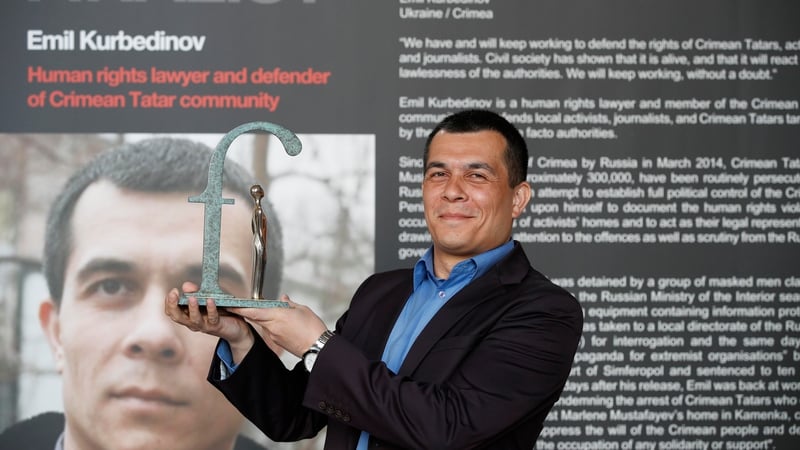
Emil Kurbedinov said ‘Winning an acquittal for my clients is almost impossible – but what I can do is show them that, despite the risks, I will not abandon them’
Emil Kurbedinov was at the ceremony in Dublin’s City Hall this morning to receive the Human Rights Defender At Risk award for 2017. According to Front Line Defenders, which has its global headquarters in Blackrock in Dublin, defending human rights activists and political prisoners in Crimea is some of the most dangerous work that any lawyer can undertake. Despite those risks, Mr Kurbedinov has spent years providing emergency legal response for the Crimean Tartar minority, which it maintains has been persecuted by Russian authorities.
In January of this year, Mr Kurbedinov was detained by representatives of Crimea’s Centre for Counteracting Extremism while on his way to represent a client whose house had been raided by police. A district court later sentenced him to ten days in detention on a charge of “propagandising for extremist organisations“.
The Executive Director, Andrew Anderson, said: “In the midst of a global crackdown on human rights defenders, the five finalists demonstrate the will to persist in the face of severe, often life-threatening risks.”
Willie Kimani, the Kenyan human rights lawyer who was murdered this year [https://humanrightsdefenders.blog/2016/07/03/body-of-disappeared-human-rights-lawyer-kimani-client-found-kenya-impunity/], was honoured with an award for his bravery in defending the poor and oppressed in Kenya. While receiving the award, Kimani’s widow Hannah Kimani said she had never imagined that his standing up for justice would eventually amount to his death. “No amount of words can explain who Willy was. He was one of a kind… with this award, it shows that his work was not in vain,” she said.
Executive Director Samwel Mohochi of the Kenyan chapter of the International Commission of Jurists said “We give it to him as recognition for the ultimate price he paid in performing his work as human rights defender and as a reminder to the risks that face all other human rights defenders”…“This will renew our commitment to all human rights defenders. It is an appreciation of the work he did”.
On 7 November 2016, the BBC, Reuters and other media reported that labour rights defender Andy Hall has left Thailand after a three-and-a-half year legal battle with a pineapple processing company accused, in a report he contributed to, of abusing its workforce. The dismissal of one set of charges against the British activist was confirmed by Thailand’s Supreme Court last week. But he was convicted in September on two other counts under sweeping criminal defamation and computer crimes laws and was given a three-year suspended prison sentence. He also faces civil complaints by the pineapple company, Natural Fruit, which is demanding around $12m in damages.
But it was mostly the prospect of further criminal charges over another group of workers he is supporting that persuaded Mr Hall that he should leave Thailand and not returner the time being. He and the 14 migrant workers from Myanmar – who have alleged abusive treatment at the hands of a farm which supplied the big Thai poultry processor, Betagro, with chickens – recently had defamation lawsuits filed against them. [see also: https://thoolen.wordpress.com/tag/andy-hall/]
Before he left Thailand Mr Hall told the BBC that he felt that the prospect of having to contest continuous lawsuits filed against him would make it impossible for him to defend migrant workers’ rights effectively. The situation for human rights defenders, he said in a statement made as he prepared to depart, has rapidly deteriorated in Thailand, with significantly increased risks.
The challenge confronting Mr Hall is one faced by many Thai activists as well. Defamation is a criminal charge that can carry a two-year prison sentence, often used alongside the even tougher Computer Crimes Act, which mandates a sentence of up to five years in prison.
Two years ago, the editors of a small newsletter, Phuketwan, were prosecuted by the Thai navy for an article in which they quoted a Reuters news agency report alleging Thai military involvement in human trafficking. They were finally acquitted last year, but the effort of defending themselves contributed to the newsletter being shut down.
In June this year three prominent human rights defenders were prosecuted under the same two laws by a unit of the Thai military over a report they took part in which alleged the use of torture against military detainees in southern Thailand.
On Thursday 3 November, the U.N. Human Rights office in Bangkok issued a statement praising the Supreme Court’s decision. But it also called on the Thai government “to drop charges against all human rights defenders who have been charged with criminal offenses for reporting human rights violations in accordance with its obligations under international human rights law.“
On 6 October EU Trade Commissioner Cecilie Malmström had strongly backed the British labour rights activist who helped expose labour abuses in Thailand, for which he received a three-year suspended jail sentence. Andy Hall met Malmström in Strasbourg, where MEPs also passed a strong resolution condemning Hall’s treatment under the military junta now running the country.
The University of Michigan’s 2016/17 Wallenberg Medal has been awarded to civil rights lawyer and social justice activist Bryan Stevenson. He is the executive director of the Equal Justice Initiative, an organization he founded in 1989 that focuses on social justice and human rights in the context of criminal justice reform in the United States. EJI litigates on behalf of condemned prisoners, juvenile offenders, people wrongly convicted or charged, poor people denied effective representation, and others whose trials are marked by racial bias or prosecutorial misconduct. Under Stevenson’s direction, EJI has handled hundreds of cases and spared the lives of 125 death row prisoners. Stevenson’s arguments have convinced the U.S. Supreme Court that juveniles in non-homicide cases may not be sentenced to life without parole. He is creating a memorial in Montgomery, Alabama, to commemorate the more than 4,000 persons who were lynched in 12 southern states between 1871 and 1950.
Stevenson is a professor of law at New York University, where he prepares students to consider the legal needs of those in resource-deprived regions. He has been a visiting professor of law at the U-M Law School. He wrote the prize-winning book “Just Mercy: A Story of Justice and Redemption” and has won numerous awards and honors, including Reebok Award (1989), the Gleitsman Award (2000). the MacArthur Foundation Fellowship Award Prize, the ACLU National Medal of Liberty, the Olaf Palme Prize for international human rights (2000), the Gruber Prize for International Justice (2009) and the Ford Foundation Visionaries Award.
Raoul Wallenberg was a 1935 graduate of U-M’s College of Architecture. As a Swedish diplomat Wallenberg saved the lives of tens of thousands of Hungarian Jews near the end of World War II.
NOTE: There are at least two other awards with Wallenberg in the title:
Raoul Wallenberg Prize (Council of Europe )
Raoul Wallenberg and Civic Courage Awards (USA), and there is
the Raoul Wallenberg Institute (Lund, Sweden)
The ceremony for Stevenson will take place on 7 March, 2017; after the medal presentation, Stevenson will give the 25th Wallenberg Lecture.