Posts Tagged ‘Human Rights Defenders’

Detainees in the Emirates held in prison even after completing their sentence

April 13, 2023

On 12 April 2023 Human Rights Watch reported that United Arab Emirates are continuing to incarcerate at least 51 Emirati prisoners who completed their sentences between one month and nearly four years ago.

The prisoners are all part of the grossly unfair “UAE94” mass trial of 69 critics of the government, whose convictions violated their rights to free expression, association, and assembly. UAE authorities are using baseless counterterrorism justifications for continuing to hold them past their completed sentences.

Prisoners in the UAE94 case have already suffered tremendously after years in prison following a grossly unfair trail,” said Joey Shea, United Arab Emirates researcher at Human Rights Watch. “Emirati authorities should free them immediately and finally put an end to this decade-long ordeal. Prominent UAE partners, including the United States and COP28 organizers, should press UAE authorities for their immediate release.”

The prisoners were among 94 people detained beginning in March 2012 in a wave of arbitrary arrests amid an unprecedented crackdown on dissent. The case had a chilling effect on freedom of expression, assembly, and association.

In July 2013, Abu Dhabi’s Federal Supreme Court convicted 69 of the defendants, sentencing 5 to 7 years in prison, 56 to 10 years, and 8 in absentia to 15 years, with 25 acquitted. The verdict could not be appealed, in violation of international law, because it was issued by the UAE’s highest court. As of March 2023, 51 had completed their sentences but remain imprisoned with no clear legal basis, according to Emirati activists and court documents. Some prisoners completed their sentences as early as July 2019.

At least four of the 51 received a Public Prosecution letter saying that they were on Munasaha during what was supposed to be their last three months in detention, activists and family members told Human Rights Watch. After three months, these detainees were taken in front of a judge, who determined they still held “terrorist thoughts” and ruled that they needed further “rehabilitation.”

Under article 48 of the counterterrorism law, the public prosecutor may place someone convicted of a terrorist offense in a counselling or Munasaha program in the prison where they were serving their sentence, under counselling center supervision.

The counterterrorism law sets no time limit for continued incarceration and instead requires the state security public prosecution to report to the court every three months. The court may order a person’s release if it finds that “his or her condition so allows.” It is not clear if the defendant has any right to attend the hearing or see or challenge the evidence used to justify their detention.

The decade of unjust imprisonment has had devastating consequences for the prisoners’ families. A family member said that the young child of one of the prisoners still does not understand why her father was in prison. “She asks me, we love our country and our leaders, why are they are doing this to my father?” the family member said.

Many prisoners are being held in the notorious al-Razeen prison, and many are alleged to be in solitary confinement. A family member said, “All the prisoners are suffering there, they don’t have their rights and it is very hard to visit them.” Another family member said: “Throughout the years, the conditions are getting worse.”

Visits are irregular and difficult to procure, the family members said. Families often drive for hours to the prison in the middle of the desert, only to be denied a visit with no explanation. Family members also said that phone conversations are often cut off mid-call with no explanation. Some prisoners have not been able to speak with their family members by phone for years.

Other family members said there have been months-long periods in which a prisoner, as one family member said, “totally disappeared” with “no calls, no nothing,” leading the family to believe that “maybe he is dead.” Prisoners are also often denied books and pictures.

The International Covenant on Civil and Political Rights (ICCPR) in article 15 prohibits retroactive criminal punishment. The United Nations Human Rights Committee, in its general comment on article 9 of the ICCPR, said, “if, under the most exceptional circumstances, a present, direct and imperative threat is invoked to justify the detention of persons considered to present such a threat, the burden of proof lies on States parties to show that the individual poses such a threat and that it cannot be addressed by alternative measures, and that burden increases with the length of the detention.”

“By arbitrarily extending the unjust sentences of peaceful critics using bogus counterterrorism justifications without due process, the UAE again shows its total disregard for the rule of law,” Shea said.

https://www.hrw.org/news/2023/04/12/uae-detainees-held-beyond-sentences
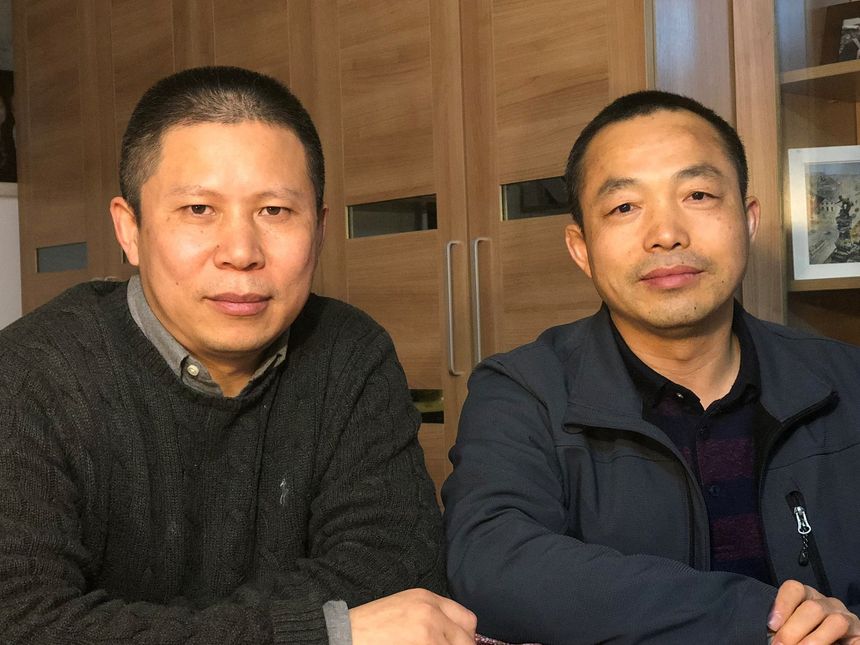
Xu Zhiyong and Ding Jiaxi, two human rights defenders in China, sentenced

April 11, 2023

The Network of Chinese Human Rights Defenders, on 10 April 2023 condemned the Chinese government’s sentencing of Ding Jiaxi and Xu Zhiyong, two of China’s most notable human rights defenders. “Their sentencing once again demonstrates the Chinese government’s hostility to peaceful advocacy of democracy and human rights, and marks a new low in the Chinese government’s human rights record,” said Ramona Li, Senior Researcher and Advocate for the group.

On April 10, the Linshu County Court sentenced Ding Jiaxi to 12 years imprisonment and 3 years deprivation of political rights, and Xu Zhiyong to 14 years imprisonment. The court, located in Shandong province, found both guilty of the crime of subverting state authority following closed-door trials.

The government consistently violated their rights under international and Chinese law throughout their detention and trial. Both Ding Jiaxi and Xu Zhiyong had been held in prolonged pre-trial detention for over three years, including periods in a form of incommunicado detention referred to as “residential surveillance in a designated location” where both were subjected to torture. Ding Jiaxi’s lawyers attempted multiple times to have the court dismiss his “confessions” as illegally obtained evidence because of they had been extracted under torture; the court rejected these motions.

Ding Jiaxi and Xu Zhiyong were refused access to lawyers for the first thirteen months of their detention, and their attorneys were refused copies of the files containing the information on which the charges were based. Witnesses cited by the prosecution, Wang Jiangsong and Dai Zhenya, publicly refuted testimony that the prosecution alleged they had provided. Family members said that authorities charged the two in Linshu county, far away from Beijing, to avoid public scrutiny of the case.

Ding Jiaxi and Xu Zhiyong were active in the New Citizens Movement, which promoted a form of civic engagement through grassroots advocacy for the implementation of the civil and human rights based on China’s laws and constitution. They were both detained amid a crackdown on human rights activists and lawyers following an informal gathering in southern Fujian province in December 2019.

Ding Jiaxi is also a Beijing lawyer who has provided support to many of the most marginalized and underprivileged groups in China, including education rights for the children of migrant workers and grassroots petitioners appealing to central government officials as a last resort to address wrongdoing by local officials. Xu Zhiyong was also a prominent lawyer who was an instrumental figure in pushing through legal reforms defending the rights of China’s internal migrant population. [see also: https://humanrightsdefenders.blog/2020/03/24/un-experts-alarmed-over-chinas-missing-human-rights-lawyers-victims-of-rsdl/]

In a pre-written statement released before his sentencing, Ding Jiaxiconnected his work to his belief in the possibility of China’s “peaceful, rational, and non-violent” transition from an authoritarian state. He wrote: “No matter the many who have doubted me or the difficulties and setbacks I’ve encountered, including physical torture that I’ve suffered, I will not part from my steadfast convictions.”

In his own statement, Xu Zhiyong described his hopes for a liberal democratic China with free elections, equal access to education and job opportunities, and social support for even the poorest to have “enough to live a dignified life.” He said he had simply “called on Chinese people to become real citizens,” and explained the urgency of doing so, saying “we cannot saddle the next generation with this duty.” [see also: https://humanrightsdefenders.blog/2014/01/24/xu-zhiyongs-closing-statement-to-the-court-a-remarkable-document/]

Both Ding Jiaxi and Xu Zhiyong should be immediately and unconditionally released per the recommendation of UN human rights experts, who have found that the two have been arbitrarily detained in violation of international law. UN human rights experts have further characterized the crime of “subversion of state authority” as being so broadly worded that charges under the crime fail to provide adequate due process to the extent that they are in violation of the Universal Declaration of Human Rights.

“The heavy sentencing of Ding Jiaxi and Xu Zhiyong is a travesty of justice. At every step, Chinese authorities have taken the wrong turn: from detaining them in secret, torturing them, falsifying witness testimony, putting them on trial in secret, and now this heavy sentence,” said William Nee, Research and Advocacy Coordinator for CHRD.

“Democracies and international organizations around the world must stop paying only lip service to human rights. They must take concrete and credible measures to gain the release of Xu Zhiyong and Ding Jiaxi, as well as the thousands of prisoners of conscience in China, in the Tibetan and Xinjiang regions and Hong Kong,” said Renee Xia, CHRD executive director.

https://www.nchrd.org/

https://www.theguardian.com/world/2023/apr/10/china-jails-two-leading-human-rights-lawyers-after-closed-door-trial

Front Line Defenders just published its global analysis 2022: new record of over 400 killings in one year

April 4, 2023

Front Line Defenders launched its Global Analysis 2022 on the situation of human rights defenders (HRDs) at risk around the world, an in-depth annual publication detailing the variety of risks, threats and attacks faced by HRDs around the world. Front Line Defenders’ Global Analysis 2022 gives a panorama of the threats faced by HRDs in all regions of the world. Despite an assault on human rights and the rule of law in many countries, human rights defenders (HRDs) showed remarkable courage and persistence in advocating for more democratic, just and inclusive societies in 2022. [see also https://humanrightsdefenders.blog/2022/01/17/at-least-78-human-rights-defenders-killed-in-colombia-in-2021/]

The report also names 401 HRDs killed in 26 countries in 2022 compared to 358 HRDs killed in 35 countries in 2021 – based on statistics by the HRD Memorial, a collective initiative of human rights organisations working to collect and verify data on the killings of HRDs each year.

“In a grim milestone, for the first time we saw more than 400 targeted killings of human rights defenders in 2022. While Latin America remained the deadliest region in the world for human rights defenders, we also saw a more dangerous landscape for defenders in the context of Russia’s full-scale invasion of Ukraine,” said Olive Moore, Interim Director of Front Line Defenders. ”These human rights defenders were deliberately targeted and killed because of their human rights work. Because they choose to speak out and challenge injustice, they paid for it with their lives.”

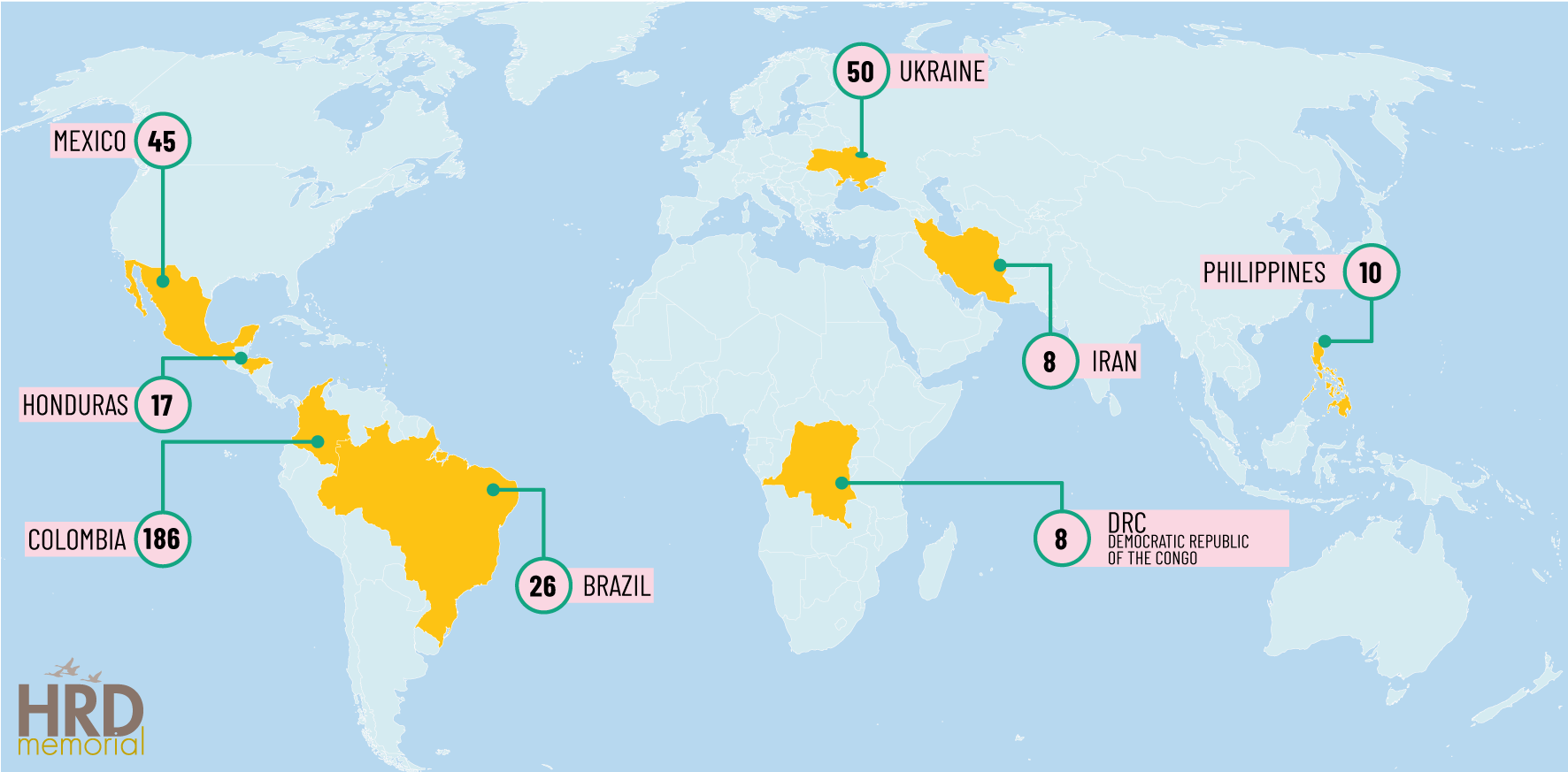
Five countries – Colombia, Ukraine, Mexico, Brazil and Honduras – accounted for over 80% of killings, according to HRD Memorial data. Colombia alone accounted for 46% of the total, with at least 186 killings documented and verified by HRD Memorial partner Somos Defensores to date. Defenders working on land, indigenous peoples’ and environmental rights were the most frequently targeted sector, accounting for almost half (48%) of the total killings.

In the context of Russia’s full-scale invasion of Ukraine, defenders engaged on humanitarian response and human rights journalists were also specifically targeted, with at least 50 documented killings by Russian military forces.

Wide array of threats

Global Analysis 2022 data is based on more than 1,500 threats and violations reported to Front Line Defenders, and is disaggregated by region, type of threat, sector of human rights work and gender.

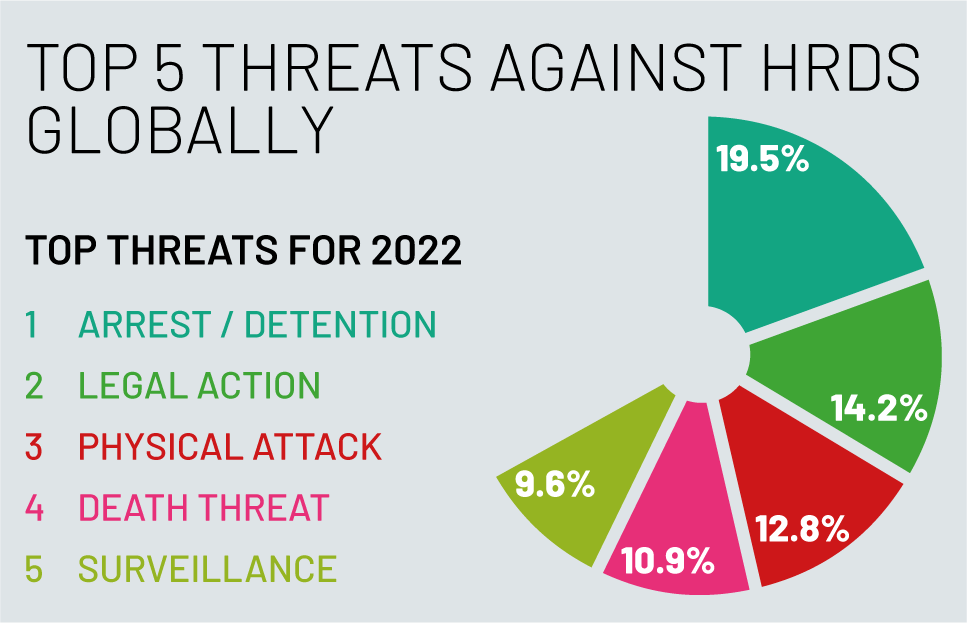
The main threats HRDs reported to Front Line Defenders in 2022 included: arrest or detention (19.5%); legal action (14.2%); physical attack (12.8%); death threats (10.9%); and surveillance (9.6%). In Asia and the Americas, death threats were the most frequent violation against defenders; in Africa it was arrest and detention; while in ECA and MENA it was legal action against HRDs.

Women HRDs (WHRDs) were frequently targeted with death threats, which accounted for the third most common violation against them. Physical violence was the most prevalent violation reported by trans and gender variant/gender nonconforming HRDs.

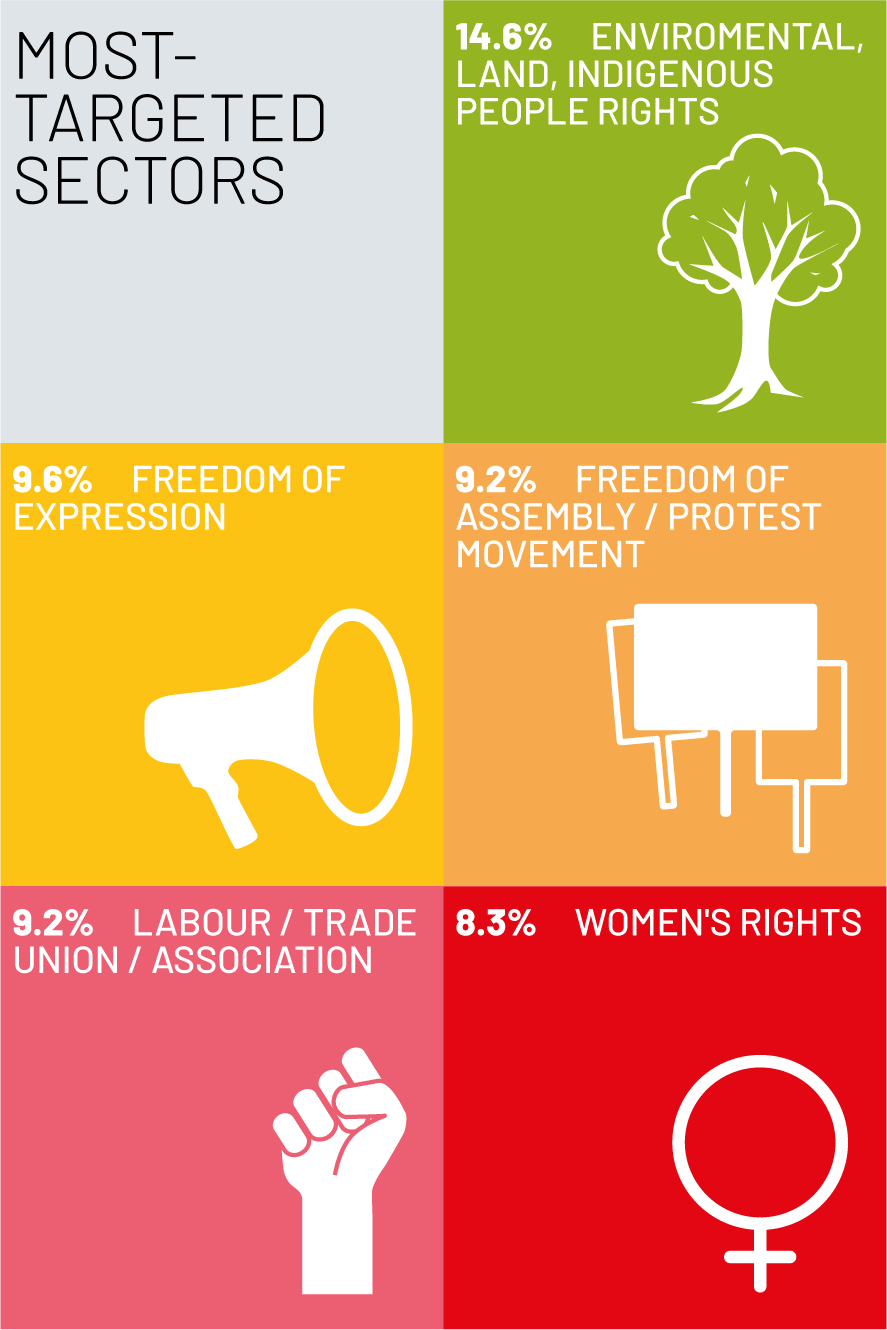
The five most targeted sectors of human rights defence were: environmental, land and indigenous peoples’ rights (11%); freedom of expression (10%); protest movement/ freedom of assembly (9%); women’s rights (7%); and impunity and access to justice (6%).

________________________________________________________________________________________________________________________________

About the data on killings: Front Line Defenders manages the collection of partner-verified data-sets under the HRD Memorial umbrella. The partners in the HRD Memorial are: ACI-Participa (Honduras); Amnesty International; Comité Cerezo (Mexico); FIDH; Front Line Defenders; Global Witness; Human Rights Defenders’ Alert – India; Karapatan (the Philippines); OMCT; El Programa Somos Defensores (Colombia); Red TDT (Mexico); and UDEFEGUA (Guatemala).

About the data on other violations against HRDs: This is derived from 1,583 reported threats and violations, based on Front Line Defenders’ urgent actions and approved grants between 1 January and 31 December 2022. For more details, see the Methodology section of the report.

for last year’s report, see: https://www.frontlinedefenders.org/en/resource-publication/global-analysis-2021-0

Download the Global Analysis 2022

https://www.theguardian.com/world/2023/apr/04/colombia-human-rights-defenders-killings-2022

The 2023 CIVICUS State of Civil Society Report is out

March 30, 2023

On 30 March 2023 the CIVICUS State of Civil Society Report 2023 was published. This is the world as captured by the report:

[for last year’see: https://humanrightsdefenders.blog/2022/06/29/civicus-state-of-civil-society-report-2022/]

Vast-scale human rights abuses are being committed in Ukraine, women’s rights have been trampled on in Afghanistan and LGBTQI+ people’s rights are under assault in Uganda, along with several other African countries. Military rule has been normalised in countries such as MaliMyanmar and Sudan, and democracy undermined by autocratic leaders in El SalvadorIndia and Tunisia, among others. Even supposedly democratic states such as Australia and the UK are undermining the vital right to protest.

But civil society continues to strive to make a crucial difference to people’s lives. It’s the force behind a wave of breakthroughs in respecting abortion rights in Latin America, most recently in Colombia, and in making advances in LGBTQI+ rights in countries as diverse as BarbadosMexico and Switzerland. Mass protests in response to the high cost of living have won concessions on economic policy in countries including Ecuador and Panama, while union organising has gained further momentum in holding big-brand companies such as Amazon and Starbucks to account. Progress on financing for the loss and damage caused by climate change came after extensive civil society advocacy. The events of the past year show that civil society – and the space for civil society to act – are needed more than ever.

Key findings

  • Civil society is playing a key role in responding to conflicts and humanitarian crises – and facing retaliation

Civil society is playing a vital role in conflict and crisis settings – including in conflicts in Ethiopia, Syria and Ukraine – providing essential services, helping and advocating for victims, monitoring human rights and collecting evidence of violations to hold those responsible to account. But for doing this, civil society is coming under attack.

  • Catastrophic global governance failures highlight the urgency of reform

Too often in the face of the conflicts and crises that have marked the world over the past year, platitudes are all international institutions have had to offer. Multilateral institutions have been left exposed by Russia’s invasion of Ukraine. It’s time to take civil society’s proposals to make the United Nations more democratic seriously – starting with the appointment of a civil society champion.

  • People are mobilising in great numbers in response to economic shock – and exposing deeper problems in the process.

As it drove a surge in fuel and food prices, Russia’s war on Ukraine became a key driver of a global cost of living crisis. This triggered a mass wave of protests in at least 133 countries – from Argentina to Indonesia and from Ghana to Kazakhstan – demanding economic justice. Civil society is putting forward progressive economic ideas, connecting with other struggles for rights, including for climate, gender, racial and social justice.

  • The right to protest is under attack – even in longstanding democracies

Many states, unwilling or unable to concede the deeper demands of protests have responded with violence, including in IranSierra Leone and Sri Lanka. The right to protest is under attack all over the world, including when people are mobilising to seek economic justice, democracy, human rights and environmental action. Civil society groups are striving to defend protest rights.

  • Democracy is being eroded in multiple ways – including from within by elected leaders

Economic strife and insecurity are providing fertile ground for the emergence of authoritarian leaders. In more democratic contexts, there are distinct trends of a further embrace of far-right extremism, and of the rejection of incumbency. In volatile conditions, civil society is working to resist regression and keep making the case for inclusive, pluralist and participatory democracy.

  • Disinformation is skewing public discourse, undermining democracy and fuelling hate

Disinformation is being mobilised, particularly in conflicts and during elections, to sow polarisation, normalise extremism and attack rights. Powerful authoritarian states and far-right groups are key sources, and social media companies are doing nothing to challenge a problem that’s good for their business model. Civil society needs to forge a joined-up, multifaceted global effort to counter disinformation.

  • Movements for women’s and LGBTQI+ rights are making gains against the odds

In the face of difficult odds, civil society continues to drive progress on women’s and LGBTQI+ rights. But breakthroughs have made civil society the target of a ferocious backlash. Civil society is working to resist attempts to reverse gains and build public support to ensure that legal changes are backed by shifts in attitudes.

  • Civil society is the major force behind the push for climate action

Civil society continues to be the force sounding the alarm on the triple threat of climate change, pollution and biodiversity loss. Civil society is urging action using every tactic available, from street protest and direct action to litigation and advocacy in national and global arenas. But the power of the fossil fuel lobby remains undimmed and restrictions on climate protests are burgeoning. Civil society is striving to find new ways to communicate the urgent need for action.

  • Civil society is reinventing itself to adapt to a changing world

In the context of pressures on civic space and huge global challenges, civil society is growing, diversifying and widening its repertoire of tactics. Drawing on its special strengths of diversity, adaptability and creativity, civil society continues to evolve. Much of civil society’s radical energy is coming from small, informal groups, often formed and led by women, young people and Indigenous people. There is a need to support and nurture these..

Interviews For more information or to arrange an interview, please contact: media@civicus.org 

https://www.civicus.org/index.php/media-resources/news/6339-civil-society-in-a-world-of-crisis-2023-civicus-state-of-civil-society-report

Call for Applications for September 2023 by Shelter City Netherlands

March 22, 2023

On 21 March 2023 Justice & Peace Netherlands launched a new call for applications for human rights defenders at risk to participate in Shelter City. The deadline for applications is 4 April 2023. Now extended to 11 April.

Shelter City is a global movement of cities, organizations and people who stand side by side with human rights defenders at risk. Shelter City provides temporary safe and inspiring spaces for human rights defenders at risk where they re-energise, receive tailor-made support and engage with allies.

From September 2023 onwards, several cities in the Netherlands will receive human rights defenders for a period of three months. At the end of their stay in the Netherlands, participants are expected to return with new tools and energy to carry out their work at home.

Visit to the ICC in The Hague, 2022

Journalists’ Safe Haven Initiative: Justice & Peace aims to promote the safety of journalists, and in particular women journalists, worldwide so that they can build new strategies and continue their important work for freedom of expression in their country of origin. With support from the Dutch Ministry of Foreign Affairs, Justice & Peace will be able to provide two additional temporary safe spaces per year in The Hague for journalists at risk and provide them with tailor-made support.

Justice & Peace and the Asser Institute have established a collaborative relationship to strengthen and support the capacity of local human rights defenders worldwide. In the context of the Institute’s Visiting Researchers Programme, the Asser Institute hosts one Fellow per year within the framework of the Shelter City initiative by Justice & Peace. The selected Fellow will carry out a research project during the three-month period and take part in other human rights relevant (research) activities of the Asser Institute. In line with these activities, closer to the end of the three-month period, the Fellow will have to present the relevant research findings in a public or closed event. The Fellow may also participate in other (public) events like lectures or (panel) discussions.

To be eligible for Shelter City, human rights defenders should meet the following conditions:

  • They implement a non-violent approach in their work;
  • They are threatened or otherwise under pressure due to their work or activism;
  • They are willing and able to return to their country of origin after 3 months;
  • They are willing to speak publicly about their experience or about human rights in their country to the extent that their security situation allows;
  • They have a conversational level* of English (limited spots are available for French or Spanish speaking human rights defenders);
  • They have a valid passport (with no less than 18 months of validity at the time of applying) or be willing to carry out the procedures necessary for its issuance. Justice & Peace covers the costs of issuing a passport and / or visa (if applicable);
  • They are not subjected to any measure or judicial prohibition to leave the country;
  • They are willing to begin their stay in the Netherlands around September 2023.

Note that additional factors will be taken into consideration in the final round of selection, such as the added value of a stay in The Netherlands as well as gender, geographic, and thematic balance. Please note that only under exceptional circumstances are we able to accept human rights defenders currently residing in a third country.

see also: https://humanrightsdefenders.blog/2022/04/20/shelter-city-netherlands-call-for-applications-for-september-2022/

To apply for Shelter City, use the online application form below. An independent commission will select the participants.

Apply for Shelter City

For more information, please contact us at sheltercity@justiceandpeace.nl.

Tunisia: The rule of law on the brink

March 16, 2023

On 7 March 2023 EuroMed Rights issued the following statement regarding the situation in Tunisia:

For several weeks now, Kaïs Saïed’s presidentialist regime has been conducting a relentless campaign of arrests, intimidation, denigration and targeted attacks against political opponents, journalists, trade unionists and civil society representatives, under the pretext of an alleged conspiracy to undermine state security, accusations of corruption or contacts with foreign diplomats. International trade union activists who have come to participate in activities of the Tunisian General Labour Union (UGTT), such as Esther Lynch, the General Secretary of the European Trade Union Confederation, have been expelled and any other trade union representatives are now persona non grata in Tunisia.

“These arrests based on the crime of opinion and the widespread repression of freedom of expression in all its forms constitute a serious breach of the rule of law. They raise fears of a return to the practices of the authoritarian regime that preceded the January 2011 revolution. The national dialogue that the UGTT has initiated in partnership with the Tunisian League for Human Rights (LTDH), the National Bar Association and the Tunisian Forum for Economic and Social Rights (FTDES), towards a roadmap to overcome the political, economic and social crisis, must be supported,” said Wadih Al-Asmar, President of EuroMed Rights.

A justice system at the orders

Accused of being “traitors” and “terrorists”, the opponents of the regime put in place, month after month, by President Kaïs Saïed since his power grab of 25 July 2021, are challenging the concentration of powers, in particular the supervision of the Ministry of Justice and the dismissal of many judges and prosecutors. Controlling the judicial power is a weapon that the Tunisian authorities no longer hesitate to use and abuse to silence critics.

“The rule of law in Tunisia is on the brink of collapse,” added Wadih Al-Asmar. “The presumption of innocence is being flouted. Moreover, to declare that anyone who exonerates those prosecuted would be considered an accomplice is a denial of the role and independence of judges and prosecutors. The ban on demonstrations and the desire to isolate Tunisian civil society from its international contacts are other symptoms of the regime’s autocratic drift.”

Attacks on migrants

On 21 February, President Kaïs Saïed continued his diatribe by calling for “urgent measures” against the “hordes” of sub-Saharan migrants, endorsing the conspiratorial theory of the “Great Replacement,” which asserts the existence of a plot to change the demographic composition of the country. As a result, racist and violent attacks, both official and unofficial, against migrants from sub-Saharan Africa continue, leading to arrests and deportations.

“Migrants have been expelled from their homes and fired from their jobs; children have been removed from their schools; women of sub-Saharan origin have been reportedly raped. Fear is growing among migrants who have been living in Tunisia, some for years, causing many families to leave the country to avoid facing violence,” said Rasmus Alenius Boserup, Executive Director of EuroMed Rights. “The European Union and its Member States, in their bilateral relations with Tunisia, must make clear that arbitrary repression and incitement to racial hatred are unacceptable, and should express solidarity with all those arrested, defamed and subjected to violence.”

And see also: https://www.hrw.org/news/2023/03/17/tunisia-talks-eu-should-privilege-human-rights-over-politics

Five Rights Defenders in Burundi should be released immediately

March 14, 2023
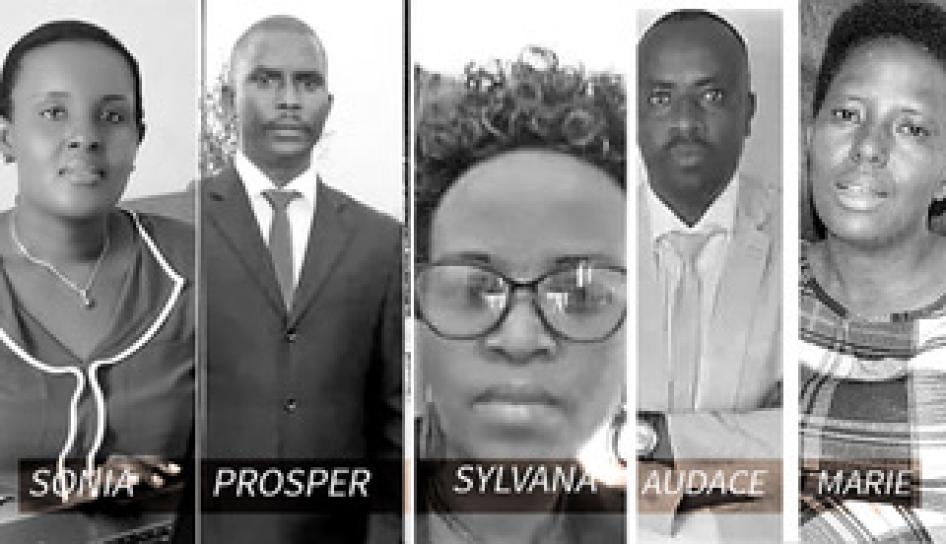
From the left to the right, Sonia Ndikumasabo, Prosper Runyange, Sylvana Inamahoro, Audace Havyarimana and Marie Emerusabe.
From the left to the right, Sonia Ndikumasabo, Prosper Runyange, Sylvana Inamahoro, Audace Havyarimana and Marie Emerusabe. © 2023 Private

Burundian authorities should immediately and unconditionally release five human rights defenders arbitrarily arrested on February 14, 2023, and drop the baseless charges against them, Amnesty International, the Burundi Human Rights Initiative, and Human Rights Watch said on 14 March 2023.

The five human rights defenders are accused of rebellion and of undermining internal state security and the functioning of public finances. The charges appear to relate only to their relationship with an international organization abroad and the funding they have received from this organization. Two of the defenders work for the Association of Women Lawyers in Burundi (Association des femmes juristes du Burundi, AFJB) and three for the Association for Peace and the Promotion of Human Rights in Burundi (Association pour la paix et la promotion des droits de l’Homme, APDH).

“The arrests of the five human rights defenders and the serious charges brought against them signal a worsening climate for independent civil society in Burundi,” said Clémentine de Montjoye, Africa researcher at Human Rights Watch. “If working in partnership with or receiving funding from international groups is treated as a criminal offense and a threat to state security, what little space was left for civil society to operate in Burundi will be closed.

On February 16, Martin Niteretse, Minister of Interior, Community Development and Public Security, accused the organizations of working with an international nongovernmental organization. Intelligence agents arrested four of the defenders – Sonia Ndikumasabo, president, and Marie Emerusabe, general coordinator, of AFJB; Audace Havyarimana, legal representative, and Sylvana Inamahoro, executive director, of APDH – on February 14 at Bujumbura’s Melchior Ndadaye Airport as they were preparing to fly to Uganda for a meeting with partners.

Prosper Runyange, the APDH land project coordinator, was arrested in Ngozi on February 14 and transferred to Bujumbura the next day. The five defenders were held at the National Intelligence Service (Service national de renseignement, SNR) headquarters in Bujumbura, then transferred to Mpimba central prison in Bujumbura, on February 17. On March 2, the high court of Ntahangwa in Bujumbura confirmed their pretrial detention.

The two organizations work on gender-based violence and land rights and are officially registered in Burundi. They help some of the most marginalized groups in Burundian society. The judicial authorities’ decision to pursue prosecution of the defenders, apparently solely on the grounds of their organizations’ partnership with and funding from an international organization, has triggered fears of another civil society crackdown in Burundi and undermines the president’s stated reform agenda, the organizations said. In October 2018, the authorities suspended the activities of most foreign organizations in Burundi and forced them to re-register, which included submitting documentation that stated the ethnicity of their Burundian employees.

The government policy, based on a law on foreign nongovernmental organizations, adopted in January 2017, caused some international organizations to close their offices in Burundi because they disagreed with government-imposed ethnic quotas and objected to the requirement to provide information on the ethnicity of their staff. Some said they feared that submitting this information could put their employees at risk of ethnic profiling and targeting.

The charges of endangering state security and rebellion against these five human rights defenders are absurd,” said Carina Tertsakian from the Burundi Human Rights Initiative. “If the authorities have questions about their sources of funding, these can be solved through normal administrative channels, as provided for by the law.”

During late President Pierre Nkurunziza’s third and final term, from 2015 to 2020, independent civil society and media were often targeted, and their members attacked, forcibly disappeared, detained, and threatened. Scores of human rights defenders and journalists fled the country and many remain in exile. There has been almost total impunity for these crimes.

Since President Évariste Ndayishimiye came to power in June 2020 and despite his promises to restore freedom of expression and association, the government’s hostility toward Burundi’s once thriving civil society and media remains. The arrests of the five rights defenders followed the conviction, on January 2, 2023, of an online journalist, Floriane Irangabiye, to 10 years in prison, on charges of “undermining the integrity of the national territory” in violation of her rights to free speech and to a fair trial.

These latest arrests and Irangabiye’s conviction reverse a brief moment of optimism after the acquittal and release, in December, of Tony Germain Nkina, a lawyer and former human rights defender who spent more than two years unjustly imprisoned on unsubstantiated charges of collaboration with a rebel group. Twelve human rights defenders and journalists in exile were convicted in June 2020 of participating in a May 2015 coup attempt. The verdict, which was only made public in February 2021, came after a deeply flawed trial during which the defendants were absent and did not have legal representation, flouting the most basic due process principles. The 12 were found guilty of “attacks on the authority of the State,” “assassinations,” and “destruction.”

The arrest of Ndikumasabo, Emerusabe, Havyarimana, Inamahoro, and Runyange appears to be designed to punish the human rights defenders and their organizations for collaborating with an international organization, obstruct their organizations’ activities, and intimidate other activists. Such behavior belies Burundian authorities’ claims that they respect human rights and further stains the image of openness and reform that they try to project internationally, the organizations said.

“Actions speak louder than words,” said Flavia Mwangovya, Deputy Regional Director at Amnesty International. “If the Burundian authorities want their human rights promises to be taken seriously, they should allow civil society to do its valuable work – including defending and assisting victims of human rights violations – without harassment.”

https://www.hrw.org/news/2023/03/14/burundi-free-five-rights-defenders

ISHR marking the 25th anniversary of the adoption of the UN Declaration on human rights defenders

March 11, 2023

To mark the 25th anniversary of the adoption of the UN Declaration on human rights defenders in 1998, the UN Special Rapporteur on human rights defenders, Mary Lawlor, will focus on successes achieved by human rights defenders in her upcoming thematic report to the Human Rights Council. The report will demonstrate how the work of defenders is crucial in helping achieve more just and equitable societies. 

This side event, which is co-sponsored by a number of States and organisations, including ISHR, will take place a day before the Special Rapporteur’s presentation of the report to the Human Rights Council and in addition to the Special Rapporteur herself, the panel will include a State representative who will outline how that State collaborated with defenders to bring about human rights gains. It will also include two defenders who will speak about successes they have achieved.

Speakers: 

  • Mary Lawlor, UN Special Rapporteur on the situation of Human Rights Defenders
  • Gustavo Gallon, Permanent Representative of Colombia to the United Nations Office at Geneva
  • Tara Houska, US-based citizen of Couchiching First Nation, Environmental & Indigenous rights defender
  • Daniel Goinic, Human Rights Program Director at Legal Resources Centre in Moldova

Moderator: Imogen Foulkes, BBC Correspondent in Geneva

Due to space limitation, registration is mandatory to attend the event in-person: please click here to register. 

The event will be live streamed on ISHR’s YouTube channel.

https://ishr.ch/events/success-through-perseverance-solidarity-25-years-of-achievements-by-human-rights-defenders/

For the report, see: https://ishr.ch/latest-updates/success-through-perseverance-and-solidarity-25-years-of-achievements-by-human-rights-defenders/

Bahrain does also “parliament washing”

March 11, 2023

Bahrain Revokes Human Rights Watch Visas; Government Using Global Parliamentary Meeting to Whitewash Repression.

Human Rights Watch Logo

On 10 March 2023 Human Rights Watch reported that staff members – who were to attend the 146th Inter-Parliamentary Union (IPU) Assembly – had their visas revoked. Denial of entry into Bahrain has happened to other HRDs before, see e.g. : https://humanrightsdefenders.blog/2012/01/20/hrfs-brian-dooley-refused-entry-into-bahrain/

Bahrain’s hosting of sporting and high-level international events is a transparent attempt to launder its decades-long campaign to crush political opposition and suffocate the country’s vibrant civil society,” said Tirana Hassan, Human Rights Watch’s acting executive director. “Its unilateral reversal of Human Rights Watch’s access to the IPU conference is a blatant example of its escalating repression. Governments, organizations with influence, and key officials should speak out loudly against Bahrain’s abuses so they are not complicit in its efforts to whitewash its horrific rights record.

Bahrain is hosting the meeting of the IPU, a global organization of national parliaments, from March 11-15. The organization’s slogan is “For democracy. For everyone,” and the theme of the 146th Assembly is “Promoting peaceful coexistence and inclusive societies: Fighting intolerance.” These statements are in stark contrast to the extensive record of serious human rights abuses in Bahrain that Human Rights Watch and other rights organizations have documented, Human Rights Watch said. This includes the continued detention of the prominent human rights activist and Danish-Bahraini dual citizen Abdulhadi Al-Khawaja. Al-Khawaja is reportedly suffering serious health problems while being denied adequate medical care. He is this year’s laureate of the MEA [see: https://humanrightsdefenders.blog/tag/abdul-hadi-al-khawaja/]

….. Two of Bahrain’s former parliament members are in prison for exercising their freedom of expression, and the government has forced many more into exile and stripped them of their citizenship.

On March 5, Bahrain hosted Formula One’s (F1) opening season race. Twenty-one groups, including Human Rights Watch, sent a letter to F1’s president to raise “serious concerns over F1’s ongoing role in ‘sportswashing’ amidst a deterioration in Bahrain’s human rights situation.” An F1 driver, Lewis Hamilton, recently said that he is “not sure [the human rights situation] has got better while we have been coming all these years” to countries like Bahrain and Saudi Arabia.

With local civil society severely restricted by Bahrain’s autocratic government, members of the IPU Assembly should live up to its organizational values and speak out on behalf of Bahrain’s victims of repression,” Hassan said.

https://www.hrw.org/news/2023/03/10/bahrain-revokes-human-rights-watch-visas

For those who missed it: relive the moving MEA 2023 ceremony

February 24, 2023

You can now relive the MEA ceremony which was held on 16 February 2023 and get inspired by the 2023 Laureates, three outstanding human rights defenders:

-Feliciano Reyna, Venezuela

-Delphine Djiraibé, Chad

-Khurram Parvez, Kashmir.

See also: https://humanrightsdefenders.blog/2023/01/19/breaking-news-laureates-of-the-mea-for-2023-announced/

The Ceremony was live-streamed directly from the Salle Communale de Plainpalais, Geneva, co-hosted with the City of Geneva.