 Bahrain’s crackdown on human rights defenders continued today with the arrest of another prominent figure, Naji Fateel. The arrest is the latest in a string of recent events calling into question the Kingdom’s claims of reform and progress. On 2 May 2013 at dawn, police arrested human rights defender Naji Fateel at his home in the village in north-west Bahrain. He is being held without formal charges at a location which is still unknown. Naji Fateel is a board member of the Bahrain Youth Society for Human Rights and a blogger who has been active in reporting human rights violations in Bahrain. The human rights defender gives daily speeches during marches in villages in which he discusses the importance of documenting violations and calls for people to form monitoring committees. Read the rest of this entry »
Posts Tagged ‘Human rights defender’
Another prominent Bahraini Human Rights Defender, Naji Fateel, arrested
May 3, 2013Bahrain’s crackdown on human rights defenders continued today with the arrest of another prominent figure, Naji Fateel. The arrest is the latest in a string of recent events calling into question the Kingdom’s claims of reform and progress. On 2 May 2013 at dawn, police arrested human rights defender Naji Fateel at his home in the village in north-west Bahrain. He is being held without formal charges at a location which is still unknown. Naji Fateel is a board member of the Bahrain Youth Society for Human Rights and a blogger who has been active in reporting human rights violations in Bahrain. The human rights defender gives daily speeches during marches in villages in which he discusses the importance of documenting violations and calls for people to form monitoring committees. Read the rest of this entry »Yoga and Human Rights: stretching for human rights defenders
May 2, 2013Sometimes my eyes fall on more esoteric contributions to the protection of human rights defenders. Let me share with you Mark Laham’s blog post for the Huffington Times of the 1st of May 2013 which calls for a “borderless” one-hour live online yoga class in honour of Nasrin Sotoudeh, the Iranian lawyer in jail, recipient of the Sakharov Award and Nominee of the MEA 2012. Mark got inspired – through AI – by what he read about Nasrin’s struggle and other brave human rights defenders around the world. “How does Nasrin’s story make you feel?” he asks, ” Me, I…I feel the need to do something that will create positive change for this woman and countless others like her.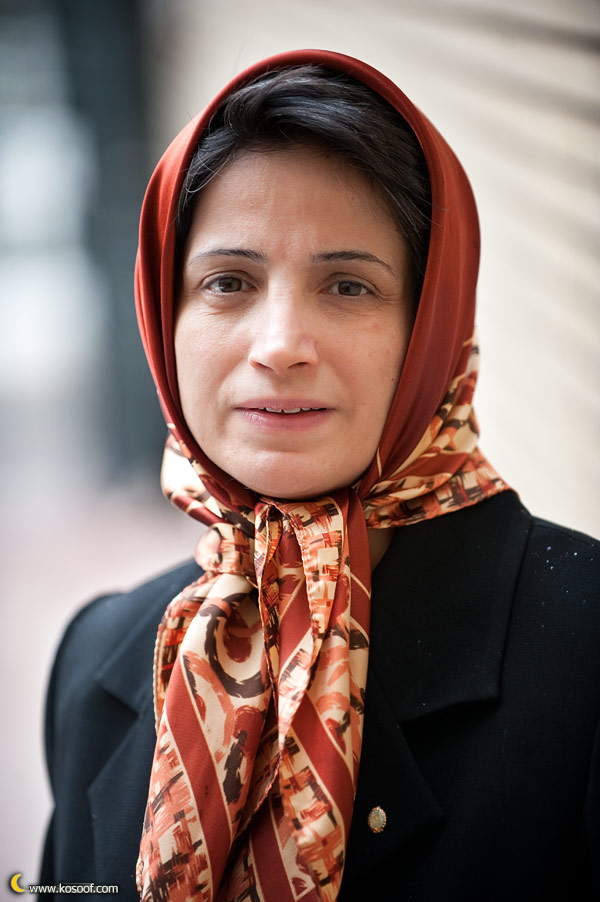 Read the rest of this entry »
York University’s Protective Fellowship Scheme for Human Rights Defenders at Risk.
April 30, 2013
(Professor Paul Gready at York University with Nagi Musa, a human rights activist from Sudan)
Sheena Hastings reports in the Yorkshire Post of 30 April 2013 on the programme offered by York University that lets human rights defenders stay on a fellowship that provides a safe haven and adds to their skills .
“In the few months that Nagi Musa has lived in York, he has not lost the learned panicky response to the odd creaking noise in the night, and he does still find himself scanning any group of people in case there’s someone who looks like a threat. He tends to position himself where he can see the nearest exit, too. Read the rest of this entry »
Frequently asked question: how do I become an international human rights lawyer?
April 27, 2013How do I become an international human rights lawyer? is the topic of an article by Hannah Gannagé-Stewart in the Guardian of Friday 26 April 2013. She rightly starts by stating that “the life of an international human rights lawyer is not all jet setting glamour”. Still, it is one of the most frequent questions put to me at the end of a lecture, often during the reception afterwards under 4 eyes: “I would like to work for human rights – what do you advise me?” is the usual opening line. My half-serious standard reply: “if your really want to work FOR human rights, I advise you to get very rich and donate half your wealth to the human rights movement“, is not always appreciated, but correct at the macro level as the shortage of funds is much more problematic than that of talent and devotion in the human rights movement. The question asked was of course situated at the micro level as in: “I want to work IN human rights (even if the pay is not very good)“.
The Guardian piece (although focusing on the UK) contains good, practical advice and most of it would be valid in other countries:
“Jet-setting round the globe, setting the worlds highest courts alight with spectacular oratory performances, radically changing the lives of the most vulnerable. Hell, theres probably a Nobel peace prize in there somewhere too right? Think again. There are actually very few lawyers who would describe themselves as international human rights lawyers, Read the rest of this entry »
Martin Ennals Award films on You Tube and VIMEO
April 25, 2013The Martin Ennals Award has from the beginning used film images to portray the work of human rights defenders. Most you can find through http://www.martinennalsaward.org or on:
YOU TUBE: http://www.youtube.com/user/martinennalsaward (the most recent ones but others to follow)
and
VIMEO: https://vimeo.com/martinennalsaward/videos (29 of them)
and the best is to subscribe to these channels so that they alert you when there is something new.
Freedom House celebrates EU Human Rights Defender Award for Ugandan journalist but with some exaggeration
April 25, 2013
(Photo credit: HRNJ-Uganda website)
Freedom House got carried away a bit when it published the following:
Freedom House would like to congratulate Ugandan human rights activist Geoffrey Wokulira Ssebaggala, on being awarded the European Union Human Rights Defender Award for the year 2012. Ssebaggala is one of the founding members of the Human Rights Network for Journalists-Uganda (HRNJ-Uganda) and has been its National Coordinator since 2009. He was honored for his efforts in defending media rights, recording and highlighting restrictions on freedom of expression and access to information, as well as attacks on journalists. Ssebaggala is certainly a most deserved winner, but when Freedom House states: “The European Union established the award to raise awareness about the work of individual human rights defenders (HRDs) around the world. [emphasis added]” it exaggerates quite a bit as is made clear by the EU delegation in Kampala in 2011 when it created the purely national award http://www.deluga.ec.europa.eu/index.php/delegation-activities-in-uganda/political-press-information/press-and-info/news-releases/182-new-new-new-eu-local-hrd-awards-nominations.
IFEX at the end of its congratulatory piece at least recognises the local character of the award. http://www.ifex.org/uganda/2013/04/24/award_freedom/
Freedom House Grantee Receives the European Union Human Rights Defender Award | Freedom House.


Annual Report 2013 of the Observatory focuses on the issue of funding of NGOs
April 24, 2013

In its 2013 Annual Report, the Observatory for the Protection of Human Rights Defenders focuses on a new setback impeding the work of human rights defenders. Access to funding, in particular foreign funding, is increasingly being hindered by governments, whose primary intentions are to silence human rights defenders. The Report of the Observatory, a joint programme of the World Organisation Against Torture (OMCT) and the International Federation for Human Rights (FIDH), provides a global review of the violations of NGOs’ right to funding via various forms of restrictions imposed by States. It provides a detailed picture of this as yet insufficiently studied problem. This analysis is illustrated by concrete cases in 35 countries.
As also highlighted by Maina Kiai, United Nations Special Rapporteur on the Rights to Freedom of Peaceful Assembly and of Association, in the Foreword to the Report, “The topic of this year’s Report is most pertinent as lately we have witnessed increased stigmatization and undue restrictions in relation to access to funding and resources for civil society organizations, in an attempt to stifle any forms of criticism […]”.
Based on the legal framework surrounding the right to access to funding and the embryonic jurisprudence on this subject, the Report seeks to foster an in-depth analysis of the negative impacts of these restrictive measures, and addresses recommendations to all stakeholders – beneficiaries, donors, governments and intergovernmental organisations.
As also highlighted by Maina Kiai, United Nations Special Rapporteur on the Rights to Freedom of Peaceful Assembly and of Association, in the Foreword to the Report, “The topic of this year’s Report is most pertinent as lately we have witnessed increased stigmatization and undue restrictions in relation to access to funding and resources for civil society organizations, in an attempt to stifle any forms of criticism […]”.
Based on the legal framework surrounding the right to access to funding and the embryonic jurisprudence on this subject, the Report seeks to foster an in-depth analysis of the negative impacts of these restrictive measures, and addresses recommendations to all stakeholders – beneficiaries, donors, governments and intergovernmental organisations.
Two of the three Final Nominees of the MEA this year (in Egypt and Russia) have to deal with these kind of restrictions.
For those who missed the publication when announced in February: Annual Reports : OBS Annual Report 2013: Violations of the right … – FIDH.
German Foreign Office promotes better networks for human rights in Latin America –
April 24, 2013Rule of law, freedom of the press, women’s rights – these were just a few of the issues recently discussed at a conference which brought together human rights defenders from Central America and the Caribbean. Twenty human rights defenders from 13 countries and representatives from the German embassies attended the event, which took place from 17 to 18 April in Panama and was organized by the Federal Foreign Office. Also participating were the Federal Government Commissioner for Human Rights Policy and Humanitarian Aid at the Federal Foreign Office, Markus Löning, and the Regional Director for Latin America and the Caribbean, Thomas Karl Neisinger.
The discussions were dominated by the key issues affecting the region, such as the rule of law and women’s rights. Special attention was given to the subject of coöperation between embassies and human rights defenders as well as building networks and strengthening regional civil society. Despite the different situations in countries such as Honduras, Costa Rica and Jamaica, many states in the region face similar challenges. Consequently it is especially important to improve civil society networks so that human rights defenders can learn from one another’s experiences and coöperate more closely in the future.
This event was the fourth regional human rights seminar organized by the Federal Foreign Office. This format is to be retained for future events, for example in Southern Africa in June 2013.
Auswärtiges Amt – Latin America – Better networks for human rights.
Philippine Military admits that Human Rights Defender Bayles was killed by them
April 23, 2013Karl Ombion, writing for Bulatlat.com, reports that in a court hearing on 18 April 2013 at RTC Branch 55, in Himamaylan City, Adjutant General Alexis Gopico and Lt. Col Ricardo B Bayhon positively identified the two suspects in the brutal murder of Philippine human rights defender Benjamin Bayles as military enlisted men. Edre Olalia, legal counsel of the victim’s family, and Secretary General of National Union of People’s Lawyers (NUPL), confirmed this report. Bayles was murdered 14 June 2010 by two suspects who claimed to be Roger Bajon and Ronnie Caurino when they were captured by Himamaylan police operatives hours after the incident. Olalia said “the confirmation, positive identification and specific personal pinpointing of the killers of activist Benjamen Bayles by top army officials as enlisted personnel under their command is a welcome development and a high point in making perpetrators of extra judicial killings accountable.” This is ultimately a product of public vigilance and pressure by human rights defenders aided also by conscientious legal work, Olalia stressed, but it remains to be seen if this leads to a deeper investigation, determination of other guilty parties, including possibly, superior officers. The accused who are lowly private first class personnel maybe sacrificial dispensable small fry to stop the investigation and let masterminds escape identification and prosecution.”“As in other cases, like that of Jonas Burgos, extra judicial killings and enforced disappearances and other rights violations, there is no closure until there is full justice for the victims,” Olalia concluded.

