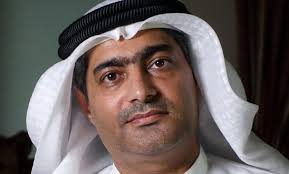
 Two Irish lawyers attempt to reach human rights defender Ahmed Mansoor, who is held incommunicado in United Arab Emirates, but in vain.
Today the Martin Ennals Foundation reports that on 26 February 2018, two lawyers from Ireland approached the Ministry of the Interior in the United Arab Emirates (UAE) to try to gain access to distinguished human rights defender Ahmed Mansoor, who has been detained since 20 March 2017 for his human rights activities. Mansoor, who received the Martin Ennals Award for Human Rights Defenders in 2015, is a member of the advisory boards of the Gulf Centre for Human Rights (GCHR).
Given the widely documented use of torture and solitary confinement by UAE authorities, and the lack of any independent information regarding Mansoor, there are grave fears for his safety. Numerous organisations have expressed concern that he may be tortured and subject to ill treatment in detention.
See also: https://humanrightsdefenders.blog/2017/03/28/ahmed-mansoor-under-arrest-emirates-under-pressure/
In Abu Dhabi, the Irish lawyers approached the Ministry of the Interior headquarters, which is the authority controlling and running prisons. The Ministry referred the lawyers to the police, who are not responsible for prisons. The police then advised them to approach the Al-Wathba prison, which they did, only to be told Mansoor is not being held there. The inability of the authority responsible to provide any information on Mansoor is remarkable given that he has been detained for almost a year.
The mission was mandated by GCHR, the Martin Ennals Foundation, Front Line Defenders, the International Service for Human Rights (ISHR) and the Observatory for the Protection of Human Rights Defenders, a partnership of FIDH and the World Organisation Against Torture (OMCT).
Background
Ahmed Mansoor was arrested by a dozen security officers at his home in Ajman in the pre-dawn hours of 20 March 2017 and taken to an undisclosed location. The security officials conducted an extensive search of his home and took away all of the family’s mobile phones and laptops, including those belonging to his young children. The family had no information about Mansoor until a statement was issued on the Ministry of Foreign Affairs website on 29 March 2017 saying that he was in detention in the Central Prison in Abu Dhabi. Since his arrest, his family were allowed to visit him only twice – on 3 April and 17 September 2017, and he has had no access to a lawyer.
In their public statements, the UAE authorities have said that Mansoor is accused of using social media websites to “publish false information that harms national unity.” On the day of his arrest, the UAE’s official news agency, WAM, announced that he was arrested on the orders of the Public Prosecution for Cybercrimes and detained pending further investigation on charges of “using social media [including Twitter and Facebook] sites to publish false and misleading information that harms national unity and social harmony and damages the country’s reputation” and “promoting sectarian and hate-incited agenda”. The statement classified these as “cybercrimes,” indicating that the charges against him may be based on alleged violations of the UAE’s repressive 2012 cybercrime law, which authorities have used to imprison numerous activists and which provides for long prison sentences and severe financial penalties
In the weeks leading up to his arrest, Mansoor had used Twitter to call for the release of activist Osama Al-Najjar, who remains in prison, despite having completed a three-year prison sentence in 2017 on charges related to his peaceful activities on Twitter; as well as prominent academic and economist Dr Nasser bin Ghaith, arrested in August 2015 and sentenced to 10 years in 2017. Both men have been convicted of charges related to peaceful messages they posted on the social media platform Twitter. Mansoor had also used his Twitter account to draw attention to human rights violations across the region, including in Egypt and Yemen. He had also signed a joint letter with other activists in the region calling on leaders at the Arab Summit who met in Jordan in March 2017 to release political prisoners in their countries.
As a result of his selfless and tireless efforts to defend the rights of migrants and Emirati nationals in the UAE, he had become a thorn in the side of the UAE authorities and consequently the object of years of government harassment and persecution.
Since his arrest, a group of United Nations human rights experts have called on the UAE to release Mansoor, describing his arrest as “a direct attack on the legitimate work of human rights defenders in the UAE.” They said they feared that his arrest “may constitute an act of reprisal for his engagement with UN human rights mechanisms, for the views he expressed on social media, including Twitter, as well as for being an active member of human rights organizations.” The experts include special rapporteurs on human rights defenders, on the promotion and protection of the right to freedom of expression and opinion, along with the Working Group on Arbitrary Detention and the Working Group on Enforced or Involuntary Disappearances.
The lengths the UAE authorities will go to silence Mansoor are shown by their efforts to hack his iPhone. In a widely documented case, the UAE were exposed after Mansoor’s suspicions were raised and he contact the Citizen Lab at the University of Toronto in Canada. Citizen lab released the following report: https://citizenlab.ca/2016/08/million-dollar-dissident-iphone-zero-day-nso-group-uae/
Mansoor, along with Dr Nasser bin Ghaith, and online activists Fahad Salim Dalk, Ahmed Abdul-Khaleq, and Hassan Ali al-Khamis were arrested in April 2011 and charged with “publicly insulting” UAE rulers. On 27 November 2011, a panel of four judges of the Federal Court found all five men guilty and sentenced Mansoor to three years in prison, and the others to two years. The four men were released the next day, after the UAE president, Sheikh Khalifa bin Zayed Al-Nahyan, issued a pardon.
For more information: khambatta@martinennalsaward.org or visit www.martinennalsaward.org




 Hans Thoolen on Human Rights Defenders and their awards