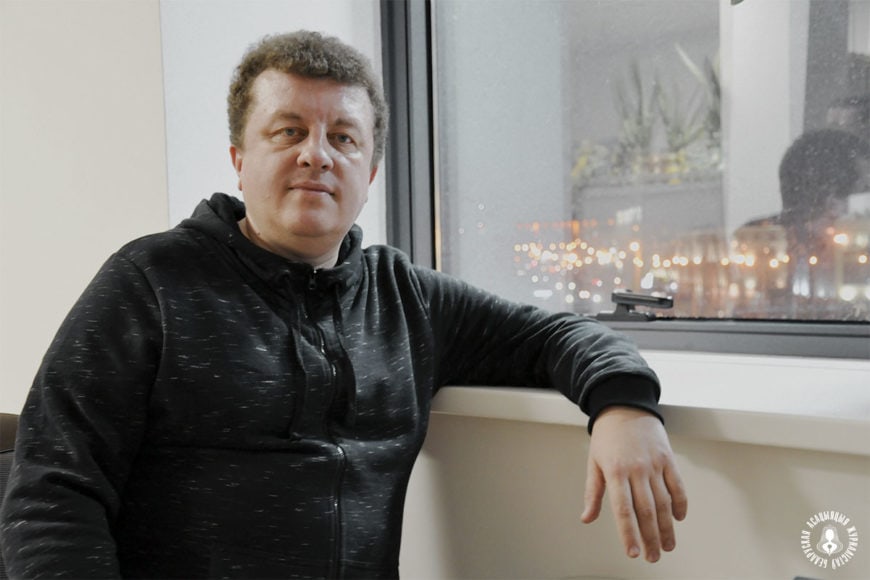
Aliaksandrau has long been a defender of freedom of expression in Belarus and beyond, having previously held positions at the Belarusian Association of Journalists, Index on Censorship, and Article 19 among other media and free speech organisations.
Aliaksandrau was detained in January 2021. The Investigative Committee, Belarus’s criminal investigation service, indicted him on public order offences, for which he was facing up to three years in prison. The charges stem from allegations that Aliaksandrau paid the fines of journalists and protesters whom authorities detained during last year’s pro-democracy protests, triggered by the highly disputed August 2020 presidential election. The Belarusian Investigative Committee and other law enforcement agencies wrongly equated this with financing unlawful protests.
On 30 June, Belapan reported that Aliaksandrau has now been charged with “treason to the state” based on the same set of allegations.
“More than €530,000 worth of fines were imposed on protesters between 9 August and the end of 2020. It is absurd to conflate efforts to help pay those fines with a public order offense, let alone treason,” the organisations said.
“Belarusian authorities created a new mark of tyranny by laying treason charges against Aliaksandrou. While we urge the release of all 529 political prisoners currently detained in Belarus, which include at least 15 journalists, we are at this point in time expressing special concern for Aliaksandrau. To date, he is the only detainee facing the fabricated charge of treason.”
“Aliaksandrau has already spent 172 days in prison for his alleged “crime”. We call for his immediate and unconditional release,” the organisations said.
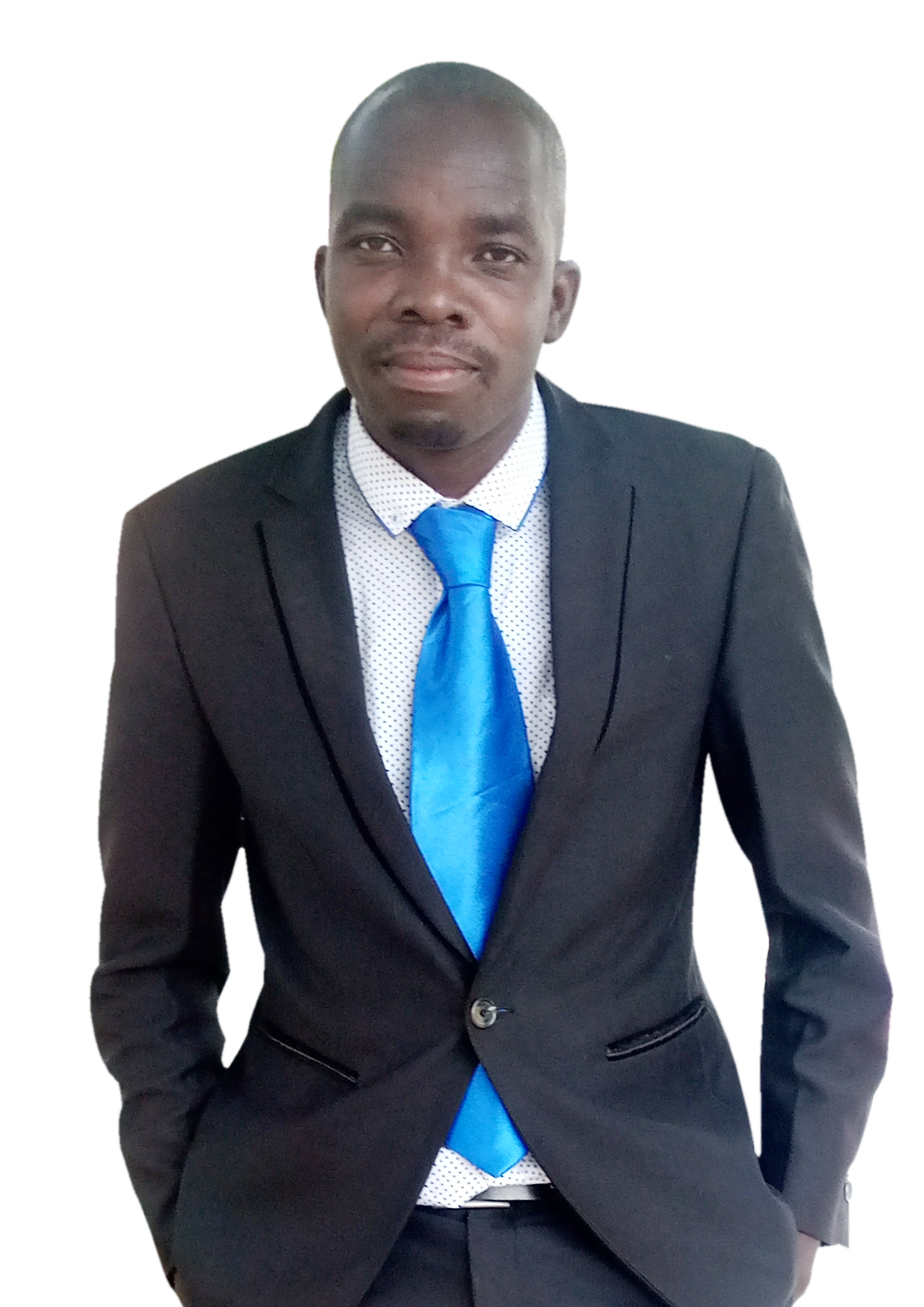
On 9 July 2021, Buzurgmehr Yorov, a Tajikistani human rights lawyer and outspoken critic of the government, risks to mark his 50th birthday behind bars. Yorov was wrongfully imprisoned in September 2015 and sentenced to 22 years on trumped-up charges. [see: https://www.trueheroesfilms.org/thedigest/laureates/00187e62-3527-4167-93e2-45c84b098562]. Human rights organisations CIVICUS and the International Partnership of Human Rights (IPHR) call for his immediate and unconditional release.
In 2015, Buzurgmehr was arrested after representing members and leaders of the banned opposition party, the Islamic Renaissance Party of Tajikistan (IRTP). Following his arrest, he was interrogated for ten hours and allegedly beaten. He was then detained for eight months before his trial began – during this time he was physically abused and held in solitary confinement on many occasions.
In a series of closed and unfair trials held between October 2016 and August 2017, the human rights lawyer was convicted on various charges, including overthrowing the government, inciting unrest, and insulting the President and government officials. Although his sentence was reduced by six years in November 2019 to mark the 25th anniversary of Tajikistan’s constitution, he is currently being held in the Strict Regime Prison Colony No.1 in Dushanbe.
“The Tajikistani authorities use intimidation, harassment, arbitrary arrest, threats and criminal prosecution to pressure independent lawyers to drop or refrain from taking up cases and issues considered to be politically sensitive. Burzurgmehr Yorov was brave enough to try to do his job despite this pressure. The international community should urge the Tajikistani authorities to implement UN recommendations and release him immediately,” said Brigitte Dufour, Director of IPHR.
Buzurgmehr has repeatedly been subjected to torture and ill-treatment in detention, including severe beatings and periods in solitary confinement. His family are particularly concerned about his health during the COVID-19 pandemic, as several fellow prisoners have contracted the virus and died.
Buzurgmehr Yorov has been a vocal critic of government abuse and has been awarded numerous international prizes in recognition of his contribution to democratic and civil rights in Tajikistan. After founding Sipar law firm in 2007, he frequently represented government critics and provided legal assistance to victims of human rights violations.
Buzurgmehr’s family recall one occasion before his detention – when the police demanded he accompany them to the station, Buzurgmehr replied, “Here, in the office of the bar, there are people who came from afar, from different parts of the country to see me. I will never make them wait just because I am urgently called to talk to the head of the Interior Ministry’s Department for Combating Organized Crime. Even if President Emomali Rahmon invites me to talk – until I fulfill my duties to clients, I’m not going anywhere.”
Buzurgmehr’s detention marks a concerning trend in Tajikistan, where independent lawyers are increasingly facing intimidation, harassment, arbitrary arrest, threats and criminal prosecution, in an attempt to stop them from taking on politically sensitive cases.
Buzurgmehr Yorov is one of the faces of CIVICUS’s international #StandAsMyWitness campaign, calling for the release of imprisoned human rights defenders across the world. Ahead of Buzurgmehr Yorov’s 50th birthday, CIVICUS and IPHR join calls for his immediate and unconditional release. The international community must continue to put pressure on the Tajikistani authorities to improve the situation of lawyers in the country and to respect fundamental rights.
Tajikistan is rated as ‘repressed’ by the CIVICUS Monitor, CIVICUS’s online platform that measures civic freedoms, including the freedoms of expression, association and assembly, in every country across the world.
IPHR: International Partnership for Human Rights (IPHR) is an independent, non-governmental organization founded in 2008. Based in Brussels, IPHR works closely together with civil society groups from different countries to raise human rights concerns at the international level and promote respect for the rights of vulnerable communities.
Burundian human rights activist Germain Rukuki was freed on Wednesday afternoon after spending four years in prison, his lawyer told the BBC Great Lakes.
Mr Rukuki was sentenced in 2018 to 32 years in jail on charges that included threatening state security and being part of an insurrection during protests in 2015 against former President Pierre Nkurunziza. He denied the charges.
Last week, a court of appeal in the city of Bujumbura reduced the sentence to one year – opening the path to his release.
Last December, President Evariste Ndayishimiye pardoned four journalists who had spent a year in prison for ‘undermining state security’ under his predecessor, charges that they denied.
After a year in power, President Ndayishimiye has been praised for positive moves toward human rights, freedom of press and reviving the country’s international relations.
But opposition in the country and international rights defenders deplore ongoing rights violations and political intolerance.
Ocen Ivan Kenneth is a Program Director at Foundation for Development and Relief Africa (FIDRA), with more than 10 years of experience working in the human rights field. Ivan’s ambitions for change focus on building inner peace, defending human rights and empowering local communities using theatre and storytelling. He creates a space where people from the community share their personal stories of trauma and resilience as well as identify mechanisms of healing.
“There may be times when we are powerless to prevent injustice, but there must never be a time when we fail to defend justice.” Ocen Ivan Kenneth Tweet
As an activist, Ivan has faced several challenges including personal threats that sometimes extend to his family and colleagues. His work with victims of conflict related sexual violence also at times takes a toll on him.
“I get moved when speaking to people whose human rights have been violated in some way, or those who have survived sexual violence, or those brutalised by militia. I can see the trauma in their eyes and hear it in their voices. It has always been the most difficult aspect of my job.”
Just like many other human rights defenders, the lack of adequate equipment and limited resources coupled with limited capacity and skills, plus legal restrictions curtail his ability to efficiently execute his work. Despite all these challenges, Ivan’s commitment to keep protecting and promoting human rights remains unwavering.
“After decades of armed conflict, now we are facing another attack, this time affecting our health and life. I am motivated because we are strong resilient workers. We keep resisting this new attack as we have always done by staying together, helping each other, and keeping our spirits high,” he says.
He believes that there should be more work done to support human rights defenders through building their capacity and expertise, strengthening their recognition, and protecting them from threats, risks, and reprisals particularly those who are marginalised or most at risk.
“I believe that current protection measures for human rights defenders in Uganda are insufficient. Particularly protection offered from the government mechanisms towards human right defenders is insufficient. A mechanism needs to be created and developed, and people working on other protection mechanisms for human rights defenders should truly address the different vulnerabilities for male and female human rights defenders.” Ocen Ivan Kenneth
Most recently, Professor Heyns was the was the Director of the Institute for International and Comparative Law in Africa at the University of Pretoria, and had also served as United Nations Special Rapporteur on extrajudicial, summary or arbitrary executions from 2010 to 2016. See: https://www.trueheroesfilms.org/thedigest/laureates/dfa7df54-3cb2-465c-9655-d139b5486591.
His friends and colleagues pay tribute to a giant of global human rights:
The Centre for Human RightsCHR, in its tribute, called him their “founding father, a trail-blazer, and a constant source of inspiration and encouragement. He was our dynamic initiator-in-chief. He played a pioneering role in positioning the Centre as a pan-African centre of excellence. Constantly brimming with new ideas and grand schemes, plans and projects, he propelled the Centre into new directions and challenged it to explore different dimensions. “To Christof, if something could be conceived, it could be achieved.”
On Monday, the CHR created a memorial page on Facebook in his memory which, within hours, contained hundreds of entries from all over the world. The reactions registered on Facebook, on WhatsApp groups and emails speak volumes about how highly Heyns the man, the mentor, the “rock star” and the lawyer was regarded.
Arnold Tsunga, chairperson of the Southern Africa Human Rights Defenders Network
“The sudden demise of Professor Christof Heyns is a real tragedy to us as a community of human rights activists in southern Africa. As a member of the United Nations Human Rights Committee his contribution to production of General Comment Number 37 on the right to peaceful assembly is invaluable at a time when we are experiencing democratic regression and authoritarian consolidation globally. He is irreplaceable and shall be sorely missed. May his soul rest in eternal peace.”
Raenette Taljaard, former politician and independent analyst
“Prof Christof Heyns was one of South Africa and the world’s great thought leaders and moral authorities on human rights. Beyond his contribution to academia, his work as a UN Special Rapporteur stands as a towering tribute to the right to life in a world where algorithms and lethal autonomous weapons can make life and death decisions that are core to who we are as humanity. His work will live on in the many principled human rights fighters and public intellectuals that have had the privilege to encounter him and to be mentored by him. He will be greatly missed.”
Jason Brickhill, human rights lawyer and former director of the Constitutional Litigation Unit at the Legal Resources Centre
“So very shocked and sad to hear that Christof Heyns has passed on. Such a gentle, wise and self-deprecating soul. I was lucky to be taught by him (about the African regional human rights system) and he supervised my master’s dissertation just over a decade ago. “He did so much to advance human rights in very real, meaningful ways, especially with his work on the African regional system (he was a true pan-Africanist!) and on the right to life at the UN. “He shared with me and other classmates his ‘struggle approach’ to human rights, which is still the foundation for how I think about the law’s role in the world. We will remember you, Christof, and carry with us the ideas that you shared.”
Faranaaz Veriava, head of the Basic Education Rights programme at SECTION27
“Around 1995 I was young and green in my first job, working in the Idasa Pretoria office. Ivor Jenkins, our director, talked me into meeting with a Moroccan delegation visiting the Centre for Human Rights at the University of Pretoria to discuss human rights law. Prof Christof Heyns hosted the delegation. I was probably terrible in that meeting but Prof Heyns was warm and encouraging and I became very interested in the work of the Centre. The next year I registered in the LLM programme at the centre which was a pioneering programme at the time for students all over Africa interested in human rights law. Later I would teach annually in that same programme. Much later, complete my doctorate through the UP law school and then teach at the law school myself. If Ivor Jenkins had not thrown me in at the deep end that day, I wonder if I would have any history with UP – a historically Afrikaans university – and that is now such a positive part of my life. RIP Prof Heyns, a warm and inspiring man and pioneer in human rights law.”
Alice Brown, former resident coordinator, Ford Foundation
“What sad news. I met Christof in the late 1980s through my work with the Ford Foundation. Christof was an innovative human rights academic who was a trailblazer for a number of important rights-focused training programs. In addition, in all my interactions with him over the years, I found him to be a very decent human being.”
Thuli Madonsela, former Public Protector, current law trust chair in social justice, University of Stellenbosch
“What a sad occasion. He was such a mensch, resolutely devoted to developing leaders to advance democracy and human rights in this continent. “The news of the passing of Christof Heyns hit me like a ton of bricks. I have known Christof for all my grown-up life. “A quintessential professional, Christoff invested a lot in developing leaders that are anchored in a sound knowledge and values system regarding human rights and democracy. He was passionate about the African continent and building scholarship in the continent on human rights, democracy and the rule of law. “The country, the continent and the entire world is poorer because of Christof Heyns’ untimely passing, yet richer because of the legacy he leaves behind. It is said leaders do not die, they multiply. Christof leaves pieces of himself among the many scholars he nurtured and policymakers he touched. May his great soul Rest In Peace.” Christof Heyns and the Outlaws — the rock and roll band of the Faculty of Law at the University of Pretoria. Formed in 2007, they always played at the annual Faculty Festival. (Photo: Yolanda Booyzen)
Bongani Majola, Chairperson of the SA Human Rights Commission
“We deeply mourn the untimely passing of Prof Christof Heyns, a giant in the promotion of human rights. Empowering young people has always been his passion. I first met him in the late 1980s/early 1990s when he and I ran a project that sought to open opportunities for final-year law students from the then historically black universities to find placements in commercial law firms. At the time, it was hard for many black law graduates to be admitted to articles of clerkship and even harder – almost impossible to get placed in commercial law firms.
“Another empowerment project that Christof Heyns employed significantly to empower the youth was the moot court competitions that he and his colleagues took beyond the borders of South Africa, the borders of SADC and beyond the boundaries of the African continent. Recently, he had taken the promotion of human rights to schools in the basic education environment, a project that he passed on to the South African Human Rights Commission once it had taken a firm hold among basic education schools.
“He was a visionary who believed in investing in the youth in order to build a strong human rights culture. The country has lost a true human rights activist. He will be sorely missed.”
Edwin Cameron, former Constitutional Court judge
Really terribly shocked and saddened by Christof’s sudden death yesterday. He was a meticulous, conscientious, persistent, courageous fighter for justice and human rights.
Rose Hanzi, director of Zimbabwe Lawyers for Human Rights
“Very very sad. Prof Heyns raised the African continent high with his contributions at the ACHPR [African Commission on Human and Peoples’ Rights] and UN.”
Muleya Mwananyanda, Amnesty International
“So saddened to learn of the death of Prof Christof Heyns. Many of you may know him. He was my teacher and I suspect a few others on this group. What a dedicated Human Rights Activist he was. Beyond teaching, he will be remembered for drafting the General Comment on Freedom of Assembly … he was until his death after a heart attack while hiking a member of the HRC. MHSRIP”
Steven LB Jensen, Danish Institute for Human Rights
“Oh no, this is so sad and shocking news. I met him twice – first in Lund for a two-hour conversation just the two of us and again at the Danish Institute for a meeting on collaborations between our institutions. He was a wonderful person and so easy to engage with. He will be sorely missed by many all around the world.” DM/MC
From Amnesty International staff:
Dr. Agnès Callamard, the new Secretary General of Amnesty International, said: “Christof Heyns was a brilliant human rights lawyer and thinker, gentle person…He leaves behind such an extraordinary legacy.”
Shenilla Mohamed, Executive Director of Amnesty International South Africa, said: “A mighty baobab has fallen! The untimely death of renowned human rights law expert, Professor Christof Heyns, is a devastating loss. In Africa the Baobab Tree is considered a symbol of power, longevity, presence, strength and grace. Professor Heyns was a baobab in the human rights world. A giant in his field, he fought hard for a just world. As Director of the Institute for International and Comparative Law in Africa, he was involved in a number of critical initiatives. His contributions included: Chair of the UN independent investigation on Burundi, leading on the drafting of UN human rights guidelines on peaceful assembly and the use of less lethal weapons. He also served as the UN Special Rapporteur on extrajudicial executions. Hamba Kahle Professor Heyns, Ke a Leboga, Enkosi, Ngiyabonga, Thank you for your service to humanity. You have left indelible footprints and we salute you!”
Sam Dubberley, Amnesty International’s Head of Crisis Evidence Lab, said: “Christof’s support for establishing a hub of Amnesty’s Digital Verification Corps at the Centre for Human Rights at the University of Pretoria was unequivocal. He gave time, advice and space for this project to emerge, and welcomed the Amnesty team on every visit to Pretoria despite his always frantic schedule. Christof made everyone feel valued, and was a source of energy and sage advice. How he will be missed.”
Netsanet Belay, Research and Advocacy Director of Amnesty International, said: “Words fail me to express the profound sense of loss with the sudden passing of Professor Heyns. Like many, I had the privilege of working with him and benefited much from his wisdom, mentorship and guidance. He was a rare breed, one of Africa’s great legal minds, a passionate human rights defender and a kind, passionate, humble person. He nurtured and cultivated a cadre of human rights experts and activists in Africa, including by transforming the human rights centre at the University of Pretoria into a world class institution that produced Africa’s leading human rights scholars and practitioners. His publications on various human rights issues in leading academic journals are testament to his brilliance, wisdom and dedication. He was a true pan-Africanist, as exemplified in his work to champion and strengthen the African Commission on Human and Peoples’ Rights. His passing is also a great loss to Amnesty International. As [recently] as last week we were working with Professor Heyns on the draft report by the African Commission on Human and Peoples’ Rights on the use of force by law enforcement officials in Africa. We shall strive to ensure his last vision [is seen] to fruition. Rest in peace dear brother!”
Rasha Abdul-Rahim, Director of Amnesty Tech, said: “It was devastating to hear of the passing of Professor Heyns. All my thoughts and prayers are with his family and friends. Not only was Christof a renowned human rights expert, he was fiercely justice-focused and an absolute joy and pleasure to work with. Christof wrote the seminal Human Rights Council report that put the human rights risks of autonomous weapons systems on the agenda. He was always extremely generous with his expertise and time. This is a huge loss for the human rights movement, and we will miss him deeply.”
Avner Gidron, Senior Policy Adviser on Amnesty International’s Law and Policy Programme, said: “I worked most closely with Professor Heyns on The Minnesota Protocol on the Investigation of Potentially Unlawful Death in 2016. It’s a practical tool for human rights defenders and advocates around the world seeking accountability for unlawful killings; and it is now a small, but important, part of Christof’s vast legacy. As well as his importance as a brilliant legal mind, scholar and activist, I will remember Christof for actually embodying human rights values: being an incredibly warm, generous and considerate human being. His death is a tremendous loss for the human rights movement, and an unimaginable tragedy for his family and friends.”
Simon Crowther, legal advisor at Amnesty International, said: “Christof was a legal giant who approached his work with kindness, humility, humour and immense intelligence. He will be greatly missed.”
Anja Bienert, Senior Programme Officer at Amnesty International Netherlands, said: “I first met Christof in 2013 and immediately felt connected to him: his sharp mind, the careful and perfectly articulated thoughts on the many pressing human rights issues, but more importantly, his warm and welcoming personality, with whom it was a pleasure to discuss. Since then, he was an ongoing source of inspiration to me and a great ally in the fight for greater protection of human rights. He constantly strove not just to write excellent publications, but to have a real impact for the respect of human rights across the world. We will miss him incredibly. It will be our mission to uphold his great legacy in the field of human rights.”
Ales Bialiatski laying flowers at a memorial to Aliaksandr Taraikouski, a protester who was killed during a demonstration on August 10, 2020. Credit: HRC Viasna
On February 16, Ales Bialiatski’s home and the offices of his human rights organisation Viasna in Minsk were raided by police. He was targeted along with more than 40 other human rights defenders, journalists and their relative in towns across the country, with reports of officials using excessive force while seizing phones, computers and credit cards.
Bialiatski, one of Belarus’ most prominent human rights defenders, says the authorities were looking for any evidence of organisations or journalists “financing” peaceful protests against the country’s president Alexander Lukashenko. The raids are the latest development in the government’s brutal crackdown on mass protests which have been ongoing in the country since Lukashenko claimed victory in a rigged election last August. [see also: https://humanrightsdefenders.blog/tag/ales-bialiatski/]
The authorities have recently opened a criminal case against Viasna and Bialiatski himself. A former political prisoner who spent nearly three years jailed in Minsk, he says that, by the time this article is published, he may once again be behind bars.
“Millions of people want change, and the answer of the government is repression,” says Bialiatski, speaking to Geneva Solutions from the Right Livelihood Foundation offices in Geneva. He and Viasna received the prestigious award in 2020.
Seven months on from the election, more than 33,000 people have been detained, and there are widespread reports of police brutality, arbitrary arrests, kidnapping, and torture of detainees.
The human rights situation in Belarus is, in Bialiatski’s words, “an absolute catastrophe”. “The situation is quite horrible because it’s not only human rights defenders that suffer,” he explains. “It’s all levels of society. Anybody who can think.”
Over half a year since the first protests broke out in the capital Minsk, he says the authorities are still tightening their grip on personal freedoms and carrying out grave human rights violations, targeting activists, journalists and anyone who opposes the regime. But the people of Belarus are not giving up.
What’s going on in Belarus? The government’s crackdown in Belarus follows mass protests in the country last summer after a fraudulent election in which Lukashenko, known as “Europe’s last dictator”, claimed to have won 80 per cent of the vote. The poll is widely accepted to have been rigged to extend his 25-year rule, prompting the largest demonstrations in the country’s history.
Elections in Belarus have never been considered free and fair by many international observers. Bialiatski has been working to advocate for democratic freedoms in the country since his early twenties, when the country was still under Soviet rule.
He founded Viasna in 1996, five years after Belarus gained independence from the Soviet Union and two years after Lukashenko came to power. The organisation’s initial aim was to help thousands of protesters arrested during mass pro-democracy rallies after Lukashenko brought in sweeping constitutional reforms that consolidated his authoritarian rule.
“[My colleagues and I] thought that this work would finish in a few years because the problem would disappear,” says Bialiatski. “But it’s been 25 years and there’s still work to do. It’s never ended. Unfortunately, the human rights situation never got better.”
Accusations of rigged elections, brutal suppression of civil rights and corruption have been hallmarks of Lukashenko’s half a century in power. However, Bialiatski says last year’s poll acted as a catalyst. It was then that Belarusian society finally “woke up” and demanded change.
Breaking the silence. In the run-up to elections in Belarus in 2020, a number of opposition figures became extremely popular, including former members of Lukashenko’s government and Sergei Tikhanovskya, a well-known blogger who travelled the country interviewing former loyal supporters of the ruler about why they had turned against him.
Although Lukashenko jailed or exiled many of his opponents, he did not see Sviatlana Tsikhanovskaya – who ran in the place of her husband when he was imprisoned – as a significant threat. However, Tsikhanovskaya became hugely popular, gaining the support of fellow opposition figures and attracting large crowds of supporters to her rallies.
Events in 2020 drastically impacted the Lukashenko’s loyal following and damaged his reputation. The country’s already dire economic situation was exacerbated by the Covid-19 crisis, which the ruler has fervently denied, refusing to bring in restrictions and joking that the virus could be fought with vodka and work in the country’s potato fields. “Lukashenko was laughing into the world’s face and denying the existence of the virus, while people all around were dying,” says Bialiatski.
Tsikhanovskaya was widely expected to win the vote in a landslide. Although independent polling is illegal in Belarus, making it difficult to measure her lead in the run up to the election, some independent exit polls conducted outside polling stations in foreign embassies on election day showed her to have received 79.69 per cent of the vote while Lukashenko received just 6.25 per cent.
When the government announced it had won 80 per cent of the vote, claiming that Tsikhanovskaya had received less than 10 per cent, Belarusians realised the election had been rigged. “It was an open lie in the face of the people,” says Bialiatski. “Of course there were rallies – nobody believed the result.”
“The very first mass protests on the street were a result of despair and disappointment and disagreement with this injustice that had happened in the country,” he adds.
Thousands of people took to the streets across the country to peacefully protest the result, but they were met with a brutal crackdown from authorities. In Minsk, which saw the worst of the violence, police and the army deployed water cannons, stun grenades and rounds of rubber bullets against protesters. Police vans were reportedly driven into crowds and hundreds were injured, with journalists and independent observers apparently targeted.
As reports circulated of extreme violence against protesters, including systematic torture of detainees by police and security forces, thousands more Belarusians rallied. Over 200,000 people took part in the largest protest in the country’s history, and there were hopes that the pressure may finally topple Lukashenko.
However, the result was an even more brutal crackdown, in which thousands were injured and arrested. “Unfortunately, the peaceful protests didn’t lead to a change of government as was hoped and expected,” says Bialiatski. “Instead, daily repressions started against different people at different layers of society, at different organisations and activists.”
Crackdown on human rights and freedom of speech. According to Viasna, over 2,300 criminal cases have been opened against human rights defenders and activists since the protests erupted in August 2020. In February alone, during the latest spate of arrests, a further 511 people were detained, 102 people received sentences and 49 people imprisoned.
There is currently a criminal case open against Viasna and Bialiatski himself for inciting “public disorder” through allegedly financing ongoing protests by paying the huge fines imposed on protesters. He says the latest raids in which police seized phones, laptops and credit cards were an attempt to collect evidence. “This is considered as financial proof against the regime,” he explains. “They are not allowing us to exercise our human rights protection work, which is our right.
“We are working all the time on the edge of the knife because [we] don’t know when this criminal case will take force and [we] will be sentenced for it,” he says.
It’s not just activists who are being targeted. According to Viasna, there are currently 258 political prisoners in the country, including journalists and bloggers. On 17 February, two journalists, Katsiaryna Andreyeva and Darya Chultsova, both of the Polish-funded Belsat TV channel, were convicted of violating public order and sentenced to two years in prison for covering the protests.
“They are looking for ‘criminals’ among those who help political prisoners and write about the struggle of Belarusians for freedom,” wrote Tsikhanovskaya on Twitter in response to the latest raids. Tsikhanovskaya was forced to flee to Lithuania following last year’s elections.
“But in search of criminals, they should look into the offices of the riot police, the GUBOPiK (interior ministry directorate) and all those responsible for the repression.”
A number of Bialiatski’s colleagues are incarcerated in the country’s jails, imprisoned for as little as sending food parcels to jailed protesters. A former political prisoner himself who spent nearly three years behind bars from 2011-2014, Bialitksi knows all too well how terrible the conditions in Belarus’ prisons can be. With widespread reports of detainees being tortured and subjected to brutal treatment, he says he’s deeply concerned for their welfare.
“How people are treated in Belarusian jails is not a humane way to treat people,” he says. “I really hope that my colleagues and my friends can survive it and I really hope that one day they will be released.”
Pressure from the international community. Last summer’s crackdown prompted western countries to impose sanctions on Minsk, but Lukashenko has refused to resign, bolstered by diplomatic and financial support from long-standing ally Russia. Tikhanovskaya, who remains in Lithuania after the country rejected the Belarusian authority’s request for her extradition, is leading a campaign to encourage external pressure on Belarus in the hope that tougher measures against the regime may succeed in toppling Lukashenko.
Her efforts could be paying off. In December, the EU imposed a third round of economic sanctions against key individuals and companies in Belarus, while in February the Biden administration expanded the list of senior officials in the country who are no longer welcome in the United States.
Tikhanovskaya has also created a Coordination Council, effectively a government in waiting, which is headed by Bialiatski. The council is drafting a new constitution and keeps in contact with key figures in Belarus to ensure that the exiled opposition does not become detached from those who are keeping up the pressure on Lukashenko from within.
The situation in Belarus is also being closely watched by the United Nations. Human Rights chief Michelle Bachelet recently presented her report on the aftermath of August’s elections to the 46th session of the Human Rights Council at the end of February. Bachelet warned of a “human rights crisis” in the country and called for an immediate end to the policy of systematic intimidation used by the Belarusian authorities against peaceful protesters and for the release of political prisoners.
Viasna has supported a number of other rights organisations including Amnesty International and Human Rights Watch in calling on the Human Rights Council to establish a new mechanism on Belarus. Bialiatski explains that the situation in the country must be kept high up on the international agenda if there is any hope of bringing down Lukashenko’s regime.
“It is very important to continue to exercise international pressure on Belarus, pointing out that human rights have to be preserved in the country,” he says. “This help of international society is required today – not tomorrow, today. Because tomorrow it might be too late.”
Hope for the future. Bialiatski says it is impossible to predict what the coming weeks, and even days, will bring to the people of Belarus. He says the latest crackdown has had a “very, very intimating result. People are scared. ”
“One thing is for sure,” he continues. “The administrative and criminal charges, and punishments and sentences against the activists and human rights defenders will get harsher. This I can guarantee. The current power is continuing to tighten the screws.
“I ask myself often how long the people can continue to bear this pressure, and if they will continue to bear it much longer.”
There are hopes that the spring could bring another wave of protests in Belarus. Speaking during a trip to Finland last week, exiled opposition leader Tikhanovskaya said she expected mass protest against Lukashenko to start up again soon after a lull in public demonstrations due to the authorities brutal suppression.
Bialiatski shares some of her cautious optimism. “The crisis has not gone, we are not beyond it,” he says. “The disagreement, disapproval and unhappiness of the people is so strong that I think there will be another breakout soon.”
He says that it is only a matter of time before Lukashenko loses his grip on Belarus – be it a result of peaceful protests, international pressure or the deteriorating economic situation in the country, although most likely a combination of all three. “This is the first time we have clearly seen that the current regime is in the minority and this gives us a significant certainty that the regime, the current power, cannot stay much longer,” he says.
After spending most of his life tirelessly working to uphold human rights in the face of relentless persecution at the hands of the Belarusian authorities, Bialiatski has managed to retain faith that his country will one day become a free democracy. What gives him hope that this could finally be the turning point in Belarus’s history? The country’s young people, he says, who have led the movement against Lukashenko.
“These young people in Belarus who strive for a change have totally different values to Lukashenko and his entourage,” he says. “And it’s difficult to change the minds of young people. They are born with it. They will keep on fighting. ”
The Danish government should renew and strengthen efforts to secure the immediate and unconditional release of prominent human rights defender and dual Danish-Bahraini citizen, Abdulhadi Al-Khawaja, 108 international and Bahraini rights groups said on 24 January 2021 in a joint letter to Prime Minister Mette Frederiksen of Denmark. As reported by the AhlulBayt News Agency (ABNA).
The human rights defender, Abdulhadi Al-Khawaja, 59, is serving a life sentence in Bahrain’s Jaw prison for his peaceful political and human rights activities, in violation of his right to freedom of expression. [see also https://humanrightsdefenders.blog/tag/abdulhadi-al-khawaja/]
“There is no doubt that the conviction and sentencing of Abdulhadi al-Khawaja was unfair and oppressive and tried to silence his prominent voice demanding the rights of Bahrainis,” said Joe Stork, deputy Middle East director at Human Rights Watch. “Al-Khawaja should not have had to spend a single minute behind bars, yet he has been unjustly detained for almost a decade.”
PEN America reported on 17 December 2020 that writer Tran Duc Thach was sentenced to 12 years in Vietnamese prison.
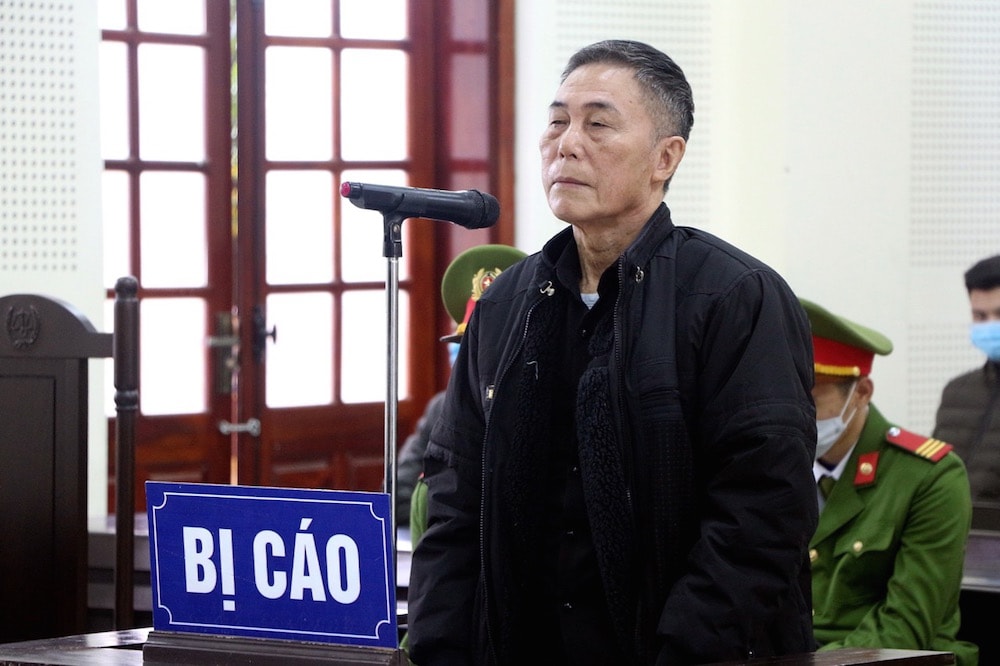
This picture taken and released by the Vietnam News Agency on 15 December 2020 shows Vietnamese writer Tran Duc Thach during his court trial in Nghe An province, as he was sentenced to 12 years in jail. -/Vietnam News Agency/AFP via Getty Images
Vietnamese writer Tran Duc Thach was convicted on charges of subversion under Article 109 of the country’s criminal code. He was arrested in April for Facebook posts criticizing corruption in government and human rights abuses in the country.
Poet, blogger, and human rights defender Tran Duc Thach was sentenced to 12 years in prison and three years probation. PEN America condemned the sentencing today as a repressive attack on free expression in the country. “This is a shocking and shameful outcome in a case that never should have been brought to trial in the first place. Thach should be celebrated for his civic engagement and advocacy, not subjected to mistreatment and imprisonment,” said James Tager, deputy director of free expression research and policy at PEN America. “This draconian sentence is another blatant violation of basic human rights and stifling of freedom of expression by the Vietnamese state in the name of national security. We call for his immediate and unconditional release.”
Thach was initially arrested on April 23 for “activities against the people’s government.” Authorities reportedly used several Facebook posts he published criticizing government corruption and human rights violations as the primary implicating evidence. During the trial, provincial prosecutors claimed that Thach’s activism and writings “threatened social stability, encroached upon national independence and socialism, reduced people’s trust in the political institution of the state of Vietnam, and infringed upon national security and social safety and order.”
Thach is a prolific writer, whose work includes his 1988 novel Doi Ban Tu (Two Companions in Prison), his memoir Ho Chon Nguoi Am Anh (A Haunting Collective Grave), and his poetry collection Dieu Chua Thay (Things Still Untold). His writing commonly deals with human rights issues within Vietnam. Thach is also co-founder of the Brotherhood for Democracy, a civil society group that has been repeatedly targeted by authorities for their activism, with several members of the group apprehended in recent years. Thach has faced repeated harassment for his writing and his activism.
Thach is just one of those who has been targeted by the Vietnamese government’s heightened campaign against internet personalities, rights advocates, and independent journalists, a campaign that has become more pronounced in the run-up to the country’s 13th National Congress scheduled for January 2021. According to the NGO Vietnam Human Rights Defenders, there have been 17 subversion-based convictions this year alone while 31 individuals are currently held in pre-trial detention. Additionally, the government has leveraged the pandemic to arrest dissidents on the pretext of public security and stifling COVID-related disinformation.
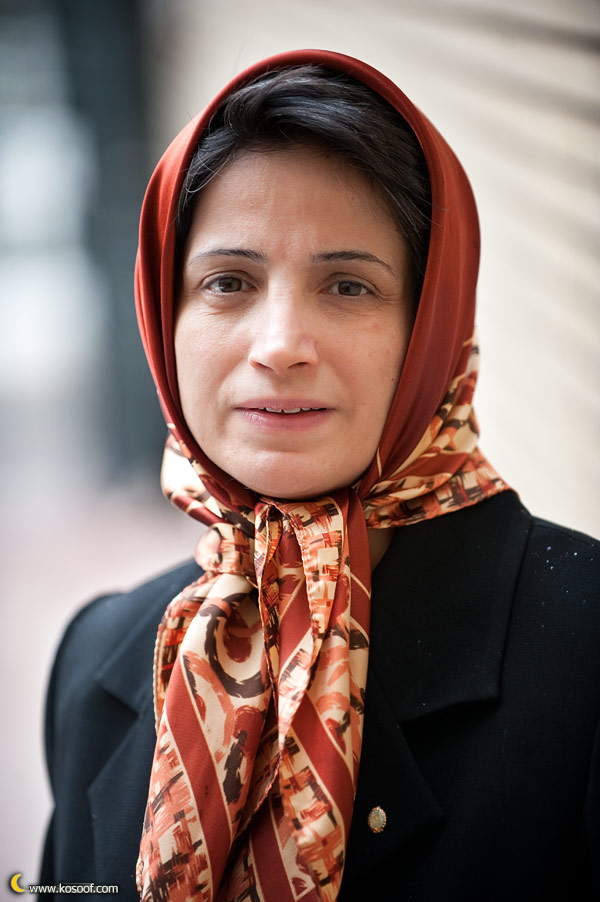
Many media outlets (here the Guardian) reported on Saturday 7 November 2020 that Iran has temporarily released Nasrin Sotoudeh, a prominent human rights lawyer who was jailed two years ago on spying and propaganda charges. Sotoudeh’s release followed warnings last month by human rights groups that her health had severely deteriorated after she staged a six-week hunger strike to demand the release of political prisoners and rights activists.
“Nasrin Sotoudeh … went on furlough with the agreement of the assistant superintendent of the women’s prison,” the judiciary’s Mizan news agency said, without giving further details.
Sotoudeh, 57, who has represented opposition activists including women prosecuted for removing their headscarf, was arrested in 2018 and charged with spying, spreading propaganda and insulting Iran’s supreme leader.
Sotoudeh has been recognised widely with seven major human rights awards.
 Buzurgmehr Yorov, a Tajikistani human rights lawyer (Photo supplied)