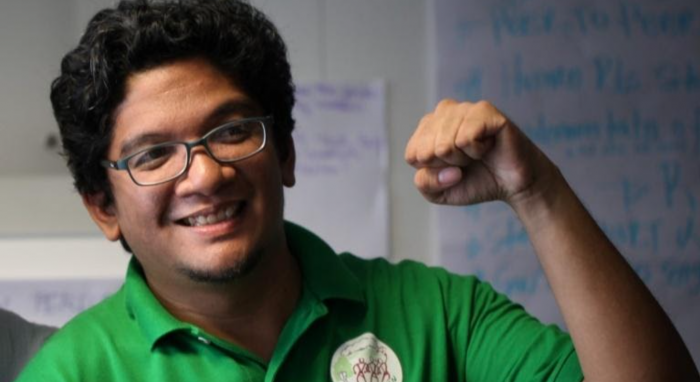
Human rights activist Nabeel Rajab gestures as he leaves a police station in Manama, Bahrain, on May 28, 2012. Rajab, who had been sentenced to five years in prison for tweets alleging abuse at Bahrain’s prisons, has been released amid the ongoing coronavirus pandemic HASAN JAMALI/AP
Nabeel Rajab, 55, wore a garland of white roses after his release, smiling while posing with his family for the first time since being detained in June 2016. Bahrain has been releasing inmates amid the pandemic, but largely had avoided freeing political prisoners. In September, a court denied Rajab’s request to serve out the rest of his sentence at home.
Rajab received a five-year prison sentence over tweets alleging torture at one of the country’s prisons and criticism of the Saudi-led war in Yemen. He separately received a two-year prison sentence over television interviews he gave that included criticism of Bahrain, a small island nation off Saudi Arabia that’s home to the U.S. Navy’s 5th Fleet. Fo rmore posts on Rajab, see: https://humanrightsdefenders.blog/tag/nabeel-rajab/
“Bahrain’s prisons remain crowded with peaceful human rights defenders and opposition leaders, whose lives are threatened by the government’s inadequate response to COVID-19,” said Husain Abdulla, the executive director of the group Americans for Democracy and Human Rights in Bahrain.
Amnesty International will soon (31 May 2020) challenge in a Jerusalem court a travel ban that the Israeli government imposed on its campaigner for Israel and Palestine, Laith Abu Zeyad.
On 26 May 2020 a group of local NGOs (Adalah – The Legal Center for Arab Minority Rights in Israel, B’Tselem, Bimkom – Planners for Planning Rights, Breaking the Silence, Gisha, HaMoked: Center for the Defence of the Individual, Ir Amim, Haqel – In Defense of Human Rights, Human Rights Defenders Fund, Physicians for Human Rights – Israel, The Association for Civil Rights in Israel, The Public Committee Against Torture in Israel Torat Tzedek, Yesh Din, Zazim – Community Action) issued a joint statement against the restrictionon movement of Laith Abu Zeyad, AI’s campaigner for Israel and Palestine: We stand in solidarity with our colleague from Amnesty International, Laith Abu Zeyad, and demand that Israel lift the movement restrictions barring him from leaving the Occupied Territories. His petition against the restrictions imposed upon him will be heard on 31 May 2020. Targeting Abu Zeyad is yet another example of Israel’s increased persecution and punishment of human rights organizations in recent years. This includes preventing international activists and human rights workers from entering the country and forming a ministry that creates blacklists and engages in censorship. Imposing draconian restrictions and denying millions of Palestinians freedom of movement have been a routine part of Israel’s occupation policy for 53 years. Israel comprehensively violates Palestinians’ right to travel abroad, while regarding its citizens’ rights to do so as fundamental. If it looks like political persecution and sounds like political persecution – it is political persecution, and it must stop.
In remarkable solidarity Omar Shakir, Human Rights Watch’ Israel and Palestine Director, wrote about the case in detail:
As a Palestinian from the West Bank, Abu Zeyad must obtain an Israeli-issued permit to enter significant parts of the West Bank under Israeli control, including East Jerusalem, and Israel itself. Yet Palestinians applying for permits face what the Israeli rights group B’Tselem describes as an “arbitrary, entirely non-transparent bureaucratic system.” Most can travel abroad only by land via Jordan through the Israeli-controlled Allenby Crossing. Israeli authorities denied Abu Zeyad a permit in September 2019 to enter occupied East Jerusalem, where he had hoped to accompany his mother, who needed cancer treatment, to a hospital just three kilometers from his home but on the other side of the separation barrier. She died there in December without her son by her side.
In October 2019, Israeli authorities at the Allenby Crossing barred Abu Zeyad from traveling to Jordan to attend a relative’s funeral, citing undisclosed “security reasons,” despite his never having been convicted for a security offense. Authorities provided no further information and designated the evidence as “secret,” meaning even his attorney will not be able to see it in court. And of course, without a permit to enter Jerusalem, Abu Zeyad cannot attend his own court hearing.
New Defense Minister and Alternate Prime Minister Benny Gantz, who warned in his campaign that the previous government’s attacks on independent institutions jeopardized the country’s future, can signal a new direction by lifting Abu Zeyad’s travel ban. He is empowered to do so as he holds the defense portfolio. Israel’s international friends should also find their voice. A government that kicks out a Human Rights Watch director and bans an Amnesty International campaigner from traveling without disclosing the reasons will not hesitate to go after others, much less end systematic rights abuse, unless there is greater global pressure.
Shady Habash, 24, was a film director and cinematographer (Instagram/@ShadyHabash)
On 2 May 2020 the Middle East Eye reported that Egyptian film director and photographer Shady Habashreportedly passed away in Tora prison in the capital Cairo on Friday, according to human rights organisations.
Habash, 24, had been in prison since March 2018 over directing a song mocking Egypt’s President Abdel Fattah el-Sisi. “Shadi got very sick in his prison cell, his [fellow] inmates cried for help for some time, but guards and officers had not intervened until his last breath,” said human rights advocate Abdelrahman Ayyash. Ramy Essam, who performed the song, said “Shady Habash has died. Shady was the kindest and bravest of people. He never hurt anyone. May God have mercy on him,” in a Facebook post. (re Essam see: https://humanrightsdefenders.blog/2019/05/15/2019-laureates-of-the-vaclac-havel-prize-for-creative-dissent-announced/]
Continuing Egypt’s revolution from exile: Ramy Essam and Ganzeer
[Habash and his colleague Mustafa Gamal were arrested following the release of Balaha, a song that indirectly poked fun at Sisi, the former defence minister who came to power after a military coup ousted president Mohamed Morsi in 2013. Essam, the singer who performed Balaha, is currently in exile in Sweden. The author of the song, Galal el-Beheiry, is also in jail. “Balaha” is a derogatory nickname for Sisi, in reference to a character from a classic Egyptian movie known for being a compulsive liar. A statement by Essam after Habash’s arrest said that the director “doesn’t have anything to do with the content and message of the song”. Charges brought against Habash and Gamal include membership of a “terrorist group,” spreading false news, abuse of social media networks, blasphemy, contempt of religion and insulting the military. They have both been in pre-trial detention pending investigations since their arrests.]
Human Rights Watch has estimated that more than 60,000 political prisoners have been languishing in Egyptian jails since Sisi became president in 2014. The former army general has routinely jailed critics, including secular and Muslim Brotherhood politicians, journalists, and human rights defenders. Hundreds have died in custody through medical negligence or other poor detention conditions.
Ilqar Mammadov speaks to reporters on April 23 in Baku.
Ilqar Mammadov, chairman of the Republican Alternative Party (ReAL), and Rasul Jafarov, a prominent human rights defender and board member of ReAL, were acquitted by the Azerbaijani Supreme Court on April 23 after serving years in prison on charges that they and their supporters said were politically motivated. The EU greeted the court’s decision to acquit the two men and said that it “expects Azerbaijan to live up to its international commitments.” [see also: https://humanrightsdefenders.blog/2018/02/10/after-3-year-gap-eu-and-azerbaijan-meet-again-but-human-rights-remain-precarious/]
Rasul Jafarov
“This judgement, which overturns their previous convictions, is a welcome step that finally fully implements the respective decisions of the European Court of Human Rights. The European Union expects Azerbaijan to live up to its international commitments and to continue to implement the remaining decisions of the European Court of Human Rights,” the EU statement said. Mammadov, who served more than five years of a seven-year prison term, fought for his full acquittal since his early release in August 2018. He was detained in February 2013 and charged with helping stoke unrest in the town of Ismayilli, northwest of Baku. He was sentenced to seven years in jail in March 2014. Mammadov and his supporters insisted the case against him was politically motivated.
Jafarov was arrested in August 2014 and in April 2015 he was sentenced to 6 1/2 years in prison after a court in Baku found him guilty of tax evasion, illegal entrepreneurship, and abuse of office. He denied the charges, saying they were politically motivated. Jafarov was granted early release in March 2016 and worked on his full acquittal since then. [https://humanrightsdefenders.blog/2016/03/18/azerbaijan-pardon-jafarov-ismayilova-aliyev/]
Members of the pro-democracy Civic party carry portraits of Gui Minhai and Lee Bo during a protest in Hong Kong. Photograph: Bobby Yip/Reuters
Lily Kuo reported for the Guardian on A Chinese court has sentenced the Swedish bookseller to 10 years in prison for “providing intelligence” overseas, deepening diplomatic tensions as Sweden demanded that China release him.
A court in Ningbo said on Tuesday that Gui had been found guilty and would be stripped of political rights for five years in addition to his prison term. The brief statement said Gui had pleaded guilty and would not be appealing against his case. The Swedish foreign minister, Ann Linde, told Radio Sweden: “We have always been clear that we demand that Gui Minhai be released so he is able to reunite with his daughter, his family and that demand remains…We demand immediate access to our Swedish citizen in order to give him all consular support that he is entitled to.”
“Gui appears to have been tried and convicted in secret, denying him any chance of a fair trial,” said Patrick Poon, a China researcher at Amnesty International, calling the verdict “deplorable” and based on unsubstantiated charges.
José Zalaquett was a prominent lawyer and academic, who fought for human rights, truth and justice worldwide.
Amnesty International and others announced on 17 February 2020 the passing of José Zalaquett (Pepe), one of the leading lights of the human rights movement in the last quarter of the 20th century.
He was born on 10 March,1942 and died on 15 February 2020. He initiated his human rights work as a law student campaigning for Salvador Allende in Chile. Upon Allende’s election as president in 1970, José Zalaquett served as cabinet minister, which he left for a post at the university. In 1973, General Augusto Pinochet launched a violent military coup which forcibly ousted the elected government of Allende and imposed a military dictatorship from 1973 to 1990. In that period, thousands of people were arrested, imprisoned, tortured, and killed. In the aftermath of the coup, José Zalaquett founded the Committee for Peace to help the victims of the military regime. Under Zalaquett’s leadership, the committee, later known as the Vicaría de la Solidaridad, was the foremost human rights organization operating in Chile throughout the dictatorship. The Vicaría defended hundreds of detainees and helped family members of the disappeared to demand legally the whereabouts of their loved ones. In retaliation for his work, José Zalaquett was imprisoned in 1975 and 1976, and sent into exile in 1976.
He left Chile with two military officers walking him all the way to his plane, where they sat him down and buckled his seatbelt. He moved first to France and then to the USA, where he joined Amnesty International to demand with many other Chilean exiles an end to Pinochet’s dictatorship and raise awareness internationally about the situation in his home country. Pepé, as he was known, became Chair of the International Executive Committee of Amnesty International, and later its Deputy Secretary General.
José Zalaquett was a prominent human rights lawyer who leaves behind an enormous legacy. His time with Amnesty International, as a Chair of the international Board and later as a Deputy Secretary General, was a gift for us. His wisdom and passion to fight for the rights of people have been an inspiration for Amnesty’s movement
Ten years later, he returned to Chile. In 1990 José Zalaquett was appointed to the National Commission on Truth and Reconciliation, and with his nine colleagues wrote a report on the fate of the victims of the Pinochet regime. As such, he became an internationally respected authority on truth and reconciliation, advising similar human rights commissions on three continents. From 2001-2005 José served as a Commissioner at Inter-American Commission on Human Rights, including a term as its Chairman. He was also member of the International Commission of Jurists and of the Presidential Advisory Commission on Transparency and Public Probity, and a board member of the Chilean chapter of Transparency International. José Zalaquett conducted human rights missions to numerous countries in Africa, the Americas, the Middle East and Southeast Asia, working on transitional justice issues. He wrote extensively about human rights in books, specialized journals and newspapers.
He was a prominent professor at different universities. José Zalaquett received honorary doctorates from the University of Notre Dame and the City University of New York. His awards include a MacArthur Foundation award (1990 to 1995), the UNESCO Prize for the Teaching of Human Rights (1994), the B’nai B’rith Human Rights Award, and the National Prize for Humanities and Social Sciences (Chile, 2003).
“José Zalaquett was a prominent human rights lawyer who leaves behind an enormous legacy. His time with Amnesty International, as a Chair of the international Board and later as a Deputy Secretary General, was a gift for us. His wisdom and passion to fight for the rights of people have been an inspiration for Amnesty’s movement,” said Sarah Beamish, Amnesty International’s Chair of the International Board.
Sister Dorothy Stang, a member of the Sisters of Notre Dame de Namur, is pictured in a 2004 file photo in Belem, northern Brazil. (CNS/Reuters)
12 February 2020 was the 15th anniversary of Sr. Dorothy Stang‘s assassination in the Amazon region of Brazil. The nun was 73 when she was murdered on 12 February, 2005, on an isolated road near the Brazilian town of Anapu. She had lived in the country for nearly four decades and was known as a fierce defender of a sustainable development project for the Amazon forest. The U.S.-born nun is remembered as a crusader for the poor and the landless and for her love of the land and the Amazon forest.
“She taught me how to be a missionary in Brazil; she was my mentor,” Sr. Rebeca Spires told Catholic News Service. Spires, who, like Stang, is a member of the Sisters of Notre Dame of Namur, said the first thing Stang gave her was Brazil’s land statute. “She was all about doing things within the law,” said Spires.
…She said that, in the early 2000s, Stang started to pressure public officials to combat land invasions by ranchers and large landowners, who wanted to take away areas occupied by smaller farms. The officials “became extremely irritated with her, with her persistence,” Spires said. “Although threatened with death, Dorothy never failed in her life’s mission, to fight for the poor of the land, so that they had their rights guaranteed and a dignified life,” read the statement issued by the Brazilian bishops’ Pastoral Land Commission to mark Stang’s death.Mary Cohen, a lawyer in Belem and a member of the Brazilian bishops’ justice and peace commission, was president of the human rights commission at Brazil’s lawyer association when Stang was in Anapu. Cohen remembered Stang’s determination, as the nun pushed and pressured government agencies into taking action. “She once slept on the steps of the INCRA (Institute for Agrarian Reform) so they would talk to her. She had a lot of determination, and that invigorated all of us,” said the lawyer. That determination made many people in the region angry. Trying to reduce the tension between landowners and peasants and their advocates, the lawyer’s association gave Stang a human rights award two months before she was killed.
“We thought that more media attention and recognition of her work would keep her safe, that they (landowners and ranchers) would be deterred. We were wrong,” said the lawyer. And although Stang’s assassination made international headlines and caused worldwide commotion, those who continue her work say the threats today to the landless and their advocates are even greater. “There are still a lot of people being threatened, and I wouldn’t want to jeopardize anyone’s life,” Sr. Jane Dwyer, a member of the Sisters of Notre Dame of Namur who worked closely with the murdered nun, told CNS.
Dwyer, who still lives in Anapu, told CNS she was uneasy about giving interviews over the telephone. She said that, since 2015, 19 landless, small-scale farmers had been assassinated over land conflicts in the area. “Nineteen in the last five years,” she said. “Of the 19 assassinations, in only one did authorities bring someone to justice,” added Spires, who works with the Brazilian bishops’ Indigenous Missionary Council in Belem. Cohen said those who speak out today against the rich and powerful in the region continue to be threatened. “Her successor, Father Amaro (Jose Amaro Lopes de Souza), continues to be threatened, and when they were unable to scare him off, they accused him of extortion and inciting violence among landless peasants,” she said…
“The synod document is titled ‘Querida Amazonia’ (Beloved Amazonia), which … embodies what Sister Dorothy spoke of her entire life: ‘Dear Amazon, we are here to defend you, to protect you. Dear people of the Amazon, we are here to help you in your fight, in your resistance, in the recognition of your rights.'”
On 30 December 2019 Front Line Defenders and others reported that Egyptian human rights defender Gamal Eid was assaulted outside his home on Sunday, 29 December 2019 by up to a dozen men. They beat him and when neighbors tried to intervene, they were threatened at gunpoint. After, the men dumped paint on Gamal Eid and threatened him to stop his human rights work. The human rights defender recognized one of the men as a “state security officer” who was with the men “giving orders and saying this is that he should be ‘disciplined’.”
Gamal Eid is a renowned lawyer and advocate of freedom of expression in Egypt. He is the founder and director of the Arab Network of Human Rights Information (ANHRI), which was established in 2003 to promote freedom of expression, campaign against censorship in the Middle East and North Africa, and provide legal assistance to journalists and internet activists.
Following the attack, Gamal Eid released a statement: “I think they do not want to repeat the scandal of torturing Julio Regeni to death, so they resorted to attacking me one time after another, to punish me, silence me and stop me from doing human rights work and my frequent criticism of the gruesome human rights violations, but again, silence and collusion are not our choices.”
“One Man’s War for Human Dignity: The Extraordinary Life of Kevin Boyle” is the title of a piece by Charles Norchi (law professor) in Global Geneva of 6 December 2019. It is about the new book by Mike Chinoy about the life and work of Kevin Boyle, the Northern Irish human rights activist: “Are You With Me? Kevin Boyle and the Rise of the Human Rights Movement”. It chronicles the life of a man who spanned civil rights in Northern Ireland and the human rights movement from the halls of academia to international organizations and tribunals.
Boyle, a scholar-teacher-advocate-counselor who, like Eleanor Roosevelt, occupied multiple roles in the human rights movement, played a significant role in helping to bring an end to this turmoil which also affected the United Kingdom itself, Ireland, Europe and the United States. Yet he remained an unsung hero, until this book.
…Chinoy delivers the reader to a front row seat of the late 20th Century human rights canvass – the Northern Ireland civil rights movement, advocacy before the European Court of Human Rights, academia, civil society and the flowering human rights movement. Boyle was at the forefront of it all. From his perch at the Queen’s University Law Faculty in Belfast, he drafted proposals for resolving the Northern Irish conflict. He also shone a light upon the abuses perpetrated by the British army and Northern Ireland police in a landmark case to the European Commission on behalf of seven Northern Irish men who were interned without trial, beaten and tortured. He mobilized international law on behalf of victims of torture, unjust imprisonment, discrimination and defended freedom of expression, belief and association.
Boyle with former Irish president Mary Robinson during her stint as United Nations High Commissioner for Human Rights in Geneva (1997-2002).
Boyle also guided Amnesty International’s campaign against apartheid in South Africa, and spearheaded efforts to defend Salman Rushdie as Director of Article 19. Yet he never neglected human rights teaching, because students were the future. So he Directed the University of Essex Human Rights Law Centre and was founding Director of the Irish Centre for Human Rights at the National University of Ireland at Galway. When President Mary Robinson became United Nations High Commissioner for Human Rights, she wisely appointed Boyle her chief legal advisor – so he moved to Geneva.
This human rights law professor, advocate and activist died of lung cancer at age sixty-seven. At the time my University of Maine School of Law colleague Orlando Delogu who taught with Boyle at Galway observed, “He was single minded in his defence of oppressed people. The breadth of his interests was quite amazing, but always behind the scenes, the use of law – never violence.” Boyle helped lay the foundation for expanded human rights protections across the planet and inspired generations of scholars and activists.
How did Chinoy choose the title for this book? Boyle was first a university teacher. While lecturing he would pause and ask his students, “Are you with me?” It was a two-fold question. Did they understand the material? And would they be with him on the front line in the fight for human rights? “Are you with me?”
Are You With Me? will be launched at Essex University on 19 March 2020, with book events to follow in Dublin, Belfast, London, Galway and Oxford. it can be pre-ordered through Lilliput Press: https://www.lilliputpress.ie/product/are-you-with-me”
Front Line Defenders reports that on 20 November 2019, the Public Prosecution in Chlef ordered the preventive detention of human rights defender Halim Feddal, after he was arbitrarily arrested on 17 November 2019. He had been taking part in a peaceful demonstration demanding the release of a number of Algerian political prisoners.
Halim Feddal is the founder and secretary general of the Algerian National Association Against Corruption (ANLC) which works on exposing and fighting corruption in Algeria. He is also a member of the Hirak Movement, which is a grassroots human rights movement that calls for the promotion of civil and political rights in Algeria. The human rights defender frequently participates in peaceful demonstrations in the city of Chlef.
On 17 November 2019, Halim Feddal was arrested by security forces in plain clothes from a peaceful demonstration that he was attending in front of the court in Chlef. The protesters were demonstrating against the politically motivated detention of some members of the Hirak movement. Halim Feddal was taken to a local police station where he spent three days under interrogation and was not allowed to contact his lawyer or his family. On 20 November 2019, the Public Prosecution charged him with “threatening the unity of the country” and “incitement of an illegal gathering”. The Public Prosecution ordered preventive detention for Halim Feddal without scheduling a date for his court hearing.
Human rights defenders in Algeria are continually harassed and arbitrarily detained by the authorities. Halim Feddal has frequently been called to the police station and interrogated about his human rights work. Front Line Defenders is deeply concerned about the detention and harassment of Halim Feddal, and finds the general crackdown on human rights defenders in Algeria increasingly worrying. Front Line Defenders believes that Halim Feddal is being detained solely as a result of his peaceful and legitimate human right work.