On 2 May 2014 the Human Rights Foundation announced as the recipients of its 2014 Václav Havel Prize for Creative Dissent the Turkish performance artist Erdem Gunduz, Russian punk protest group Pussy Riot, and imprisoned Tibetan filmmaker Dhondup Wangchen. They will be honored at a ceremony during the Oslo Freedom Forum on Wednesday, May 14. Read the rest of this entry »
Posts Tagged ‘human rights awards’
2014 Havel Prize for Creative Dissent awarded to Erdem Gunduz, Pussy Riot, and Dhondup Wangchen
May 5, 2014Cartooning for Peace Award handed over by Kofi Annan in Geneva
May 5, 2014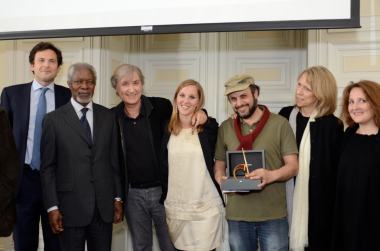
3 May 2014 Cartooning for Peace award, Geneva (c) THF
In case you noticed, my post of yesterday about the Cartooning for Peace Award came a day late; sorry. The award ceremony took place on Saturday 3 May, International Day for Press Freedom. To make up for the error here are the winners (Palestinian-Syrian Hani Abbasi, and Egyptian Doaa Eladl), in company of inter alia Kofi Annan and municipal councillor Guillaume Barazzone. The exhibit remains to be visited along the Quai Wilson in Geneva until 3 July 2014. Also present were the well-known cartoonists Chappatte, Plantu et Liza Donnelly. More information and links in my post of yesterday:
Cartooning for Peace: international award and exhibit in Geneva as from today
May 4, 2014
Today, 3 May 2014, the Foundation Cartooning for Peace in Geneva hands out the 2nd International Prize for the best press cartoon (le Prix international du dessin de presse à Genève), followed by the exhibit “La guerre dans tous ses états”
This recent bi-annual award, given by Foundation in cooperation with the City of Geneva, will handed over by Kofi Annan, Honorary President of Cartooning for Peace. It rewards the creator for his or her courage, talent and engagement in favour of peace and human rights.
The work of the laureates form part of an exhibit of some hundred cartoons which are displayed in big format on the Quai Wilson for one month: from 3 May to 3 June.
via: Cartooning for Peace – Exposition « La Guerre dans tous ses états » Genève, Suisse.
the catalogue on line: Catalogue d’exposition en ligne
Ganji: Human rights in Iran improved, but still short of expectations
March 26, 2014
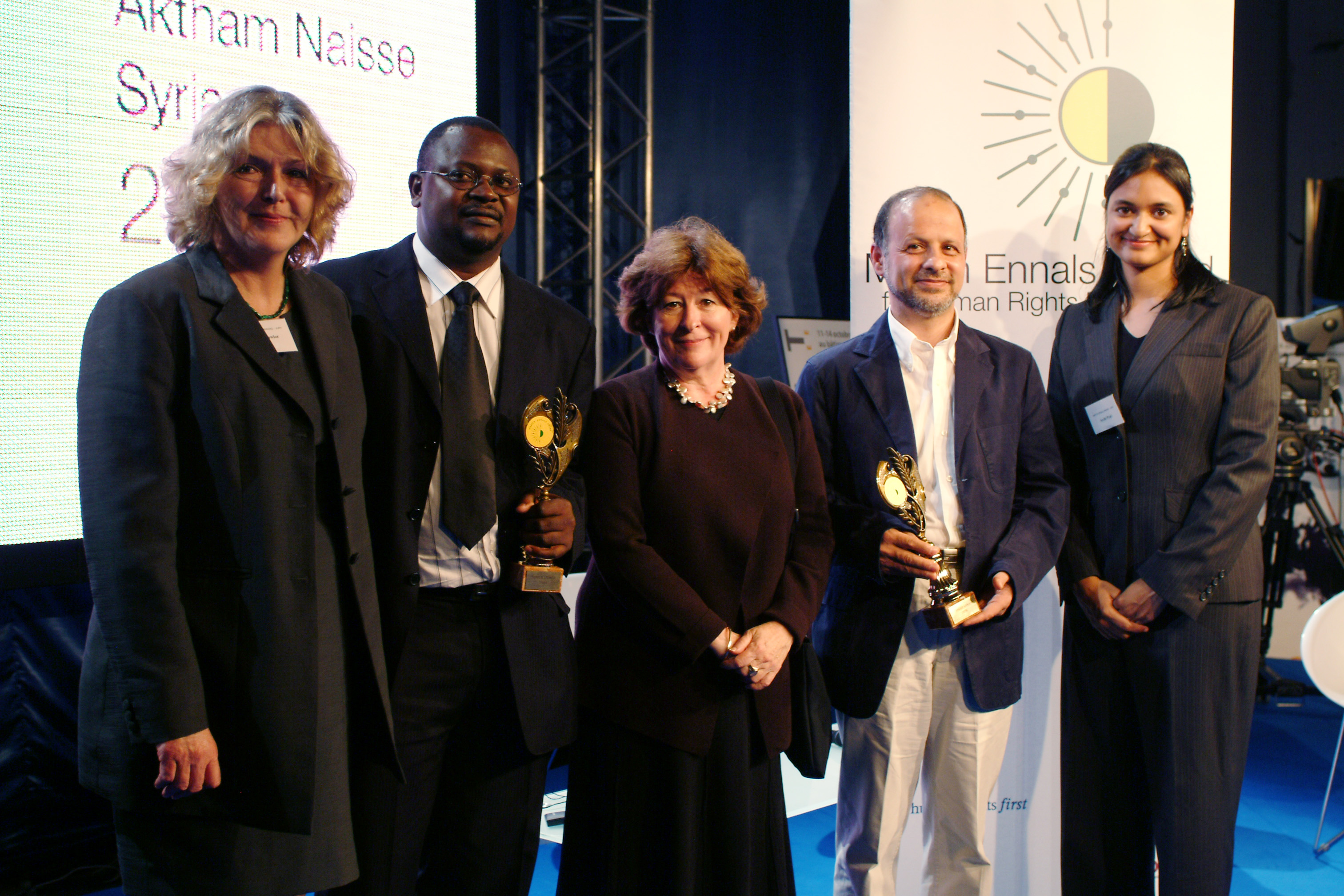
(Ganji – second from the right – at the MEA ceremony of 2006, where he received the award from UN High Commissioner Louise Arbour)
Al-Monitor of 25 March carries a lengthy interview with MEA Laureate Akbar Ganji in which Jahandad Memarian records many interesting insights, especially on the issue of sanctions and support to human rights defenders. The whole interview is certainly worth reading; here follow some long excerpts:
“It is not an exaggeration to say that Akbar Ganji is the most celebrated dissident within the ranks of Iranian journalists since the inception of the Islamic Republic of Iran in 1979. A former supporter of the revolution, Ganji became disenchanted and turned into one of its most vocal critics. He is best known for his work as a journalist covering the 1998 murders of Iranian dissidents in Reformist newspapers, a series which came to be known as “the chain murders” that implicated top governmental officials. For his work revealing the murders of dissidents and attending a conference in Berlin that was condemned by hard-liners who were reeling after a Reformist victory in parliament, Ganji was arrested and served time in Tehran’s Evin Prison from 2001 to 2006. During his final year in prison, he went on a hunger strike that doctors urged him to end for concerns he would suffer permanent brain damage.
Ganji has won several international awards, including the World Association of Newspapers’ Golden Pen of Freedom Award, the Canadian Journalists for Free Expression’s International Press Freedom Award, the Martin Ennals Award for Human Rights Defenders and the Cato Institute Milton Friedman Prize for Advancing Liberty. In an exclusive interview via email with Al-Monitor, Ganji, based in New York, shared his thoughts about human rights and democracy in the context of President Hassan Rouhani’s administration.
Al-Monitor: The UN secretary-general, Ban Ki-moon, has sharply criticized the Iranian president, Hassan Rouhani, saying, “He has not made any significant improvement” in ending human rights abuses since taking office. Nevertheless, Mahmoud Sadri — Iranian professor of sociology at the Federation of North Texas Area Universities — is optimistic about the new administration and has asked Iranian dissidents and intellectuals to take advantage of this historic opportunity. How do you evaluate the Rouhani administration?
Ganji: The situation has improved from various aspects compared with the [Mahmoud] Ahmadinejad administration. However, it falls short of the expectations of democracy advocates and human rights activists. The Rouhani administration truly seeks to improve the state of human rights, but it has faced obstacles in Iran’s power hierarchy, including organizations that [Supreme Leader] Ayatollah [Ali] Khamenei oversees, such as the judiciary, law enforcement, etc., in addition to the Majles [parliament] that is controlled by the conservatives and some radical reactionaries.
…….Since his administration came to power, Rouhani has spoken with the supreme leader about freeing the Green Movement’s leaders (former Prime Minister Mir-Hossein Mousavi and former Majles speaker Mehdi Karoubi) and political prisoners, guaranteeing that nothing would happen, if they were freed.
Al-Monitor: In January, you wrote a Huffington Post article titled “The Iran Nuclear Accord Is Good for Human Rights.” It seems to me whenever international pressure on the Iranian government increased, Iran improved its record. For example, Tehran released political prisoners ahead of Hassan Rouhani’s UN speech, including prominent human rights lawyer Nasrin Sotoudeh. Don’t you think such actions stem from international pressure? In the absence of this leverage — i.e., international pressure — Iran would continue human rights violations.
Ganji: With regard to “external pressure on an undemocratic regime and improvement of human rights or increased oppression,” there is no law/rule that would address the cause-reaction relationships. At most, one can speak of “correlation.”[…] we need to know the following:
First, economic sanctions represent the collective punishment of a country’s people and do not necessarily lead to dictatorships’ downfall.
Second, long-term sanctions destroy the internal infrastructure of societies. ..Consequently, trust that is the basis of social capital is destroyed. Because of the sanctions, the oppressive regime’s increasing level of oppression, the internal destruction of society, is not visible. It is only in the aftermath of the dictatorship’s downfall that we will witness the visible spread of a wave of hatred, revenge and violence.
Third, in a life and death situation, the state of human rights, democracy and freedom completely falls by the wayside.
Fourth, consider Iraq’s example again. Before, the invasion al-Qaeda forces did not exist in Iraq, but they were born and bred as a result of the US sanctions and the US attack on Iraq. This story has been repeated in Libya and Syria. …..Iranian, US and European officials have professed that economic sanctions against Iran have affected Iran’s economy negatively. Last year, the economic growth rate fell to -5.8%. The inflation rate rose to 40%. The corruption rate climbed, and other negative outcomes followed. We should ask ourselves, what is the impact of recession on ordinary people’s lives?
The middle class, as a vehicle of democracy, has been transformed to the impoverished class, and its democratic movement may lose its agents. Democracy is the product of the balance of power between the government and civil society.
The transformation of the nuclear agreement from temporary to permanent, improvement of Iran’s relationship with Western governments, rekindling of ties between Iran and the United States, lifting of all the economic sanctions and alleviation of foreign threats can help empower the people through their mobilization and expansion of civil society. In that sense, the regime’s focus and its supporters will not be on discovering conspiracies of foreign governments and military attacks to destroy the regime. Let’s not forget that democracy and human rights have a direct relationship with economic development.
Al-Monitor: You have opposed US aid to Iranian dissidents and human rights activists. What are your key criticisms against such aid? What actions should foreign countries.. take or avoid ?
Ganji: The opposition that I have spoken about consists of groups and people that advocate regime change in Iran, so they can come to power. It is not possible for the leaders of a country to be indebted to other foreign governments, including the United States, Israel, Saudi Arabia, Russia and China. In that case, they will become the greater powers’ pawns. Look at the groups that have received financial aid from foreign governments in the past 35 years. What have they done? Do their terrorist and espionage activities constitute human rights activism, or are such activities considered criminal in all countries, including the United States and Israel, and are they strongly punished?
However, I support educational financial aid, including student scholarships and research fellowships for scholars. Just think about what would have happened if the $1.5 trillion that was spent on the wars in Afghanistan and Iraq would have been used toward education and development of the Middle East, and how that would have changed the region. Why do Western governments, the United States included, not grant scholarships to tens of thousands of talented and smart Iranian youth as students in social sciences?
Western governments should protest all human rights violations; they should give ethical and spiritual support to pro-democracy and human rights activists; they should file complaints at the UN Human Rights Council and ease the process of bringing perpetrators to justice. Moreover, Western powers should stop selling weapons of torture and oppression to dictatorial regimes. Ultimately, they should allocate financial resources to form independent labor unions and improve the state of human rights.
Read more:
Multiple Exposure: Front Line’s video programme for Human Rights Defenders
March 22, 2014

This blog wants keep you informed of what happens to human rights defenders and on what they do to protect the rights of others. I have also a special interest in the power of images in this area. So, I draw your attention to “Multiple Exposure” a monthly video magazine broadcast by Front Line Defenders, now in its 5th episode. Segments in the series will offer a behind-the-scenes peek at the difficulty of carrying out human rights work in different countries; more information about trends and political developments that directly impact human rights; and profiles of individual human rights defenders at risk.
Episode 5 covers the finalists of the 2014 Front Line Defenders Award for Human Rights Defenders
 |
Pakistan: SAWERA – Recipient of the 2014 Front Line Defenders Award for Human Rights Defenders at Risk SAWERA was selected from a total of 110 nominees from 51 countries on the basis of the NGO’s exceptional courage in defending the rights of women and girls in a region where groups working on these issues face extreme risks. |
 |
Bangladesh: Adilur Rahman Khan- Finalist of the 2014 Front Line Defenders Award Adilur Rahman Khan is the Secretary of Odhikar, a human rights organisation founded in 1994 to raise awareness of human rights abuses and to create a vibrant democratic system through election monitoring. |
 Kenya: Lydia Mukami – Finalist of the 2014 Front Line Defenders Award
Lydia Mukami is the chair of the Mwea Foundation, a grass-roots organisation of rice farmers in the Mwea constituency of Kirinyaga county, in the Central Province of Kenya.
 Belarus: Ales Bialiatski – Finalist of the 2014 Front Line Defenders Award
In a country where almost all independent critical voices have been silenced, Ales Bialiatski is one of the few people prepared to champion civil liberties, human rights and the rule of law.
 Honduras: Berta Caceres – Finalist of the 2014 Front Line Defenders Award
Berta Caceres is a Lenca indigenous woman who has been on the front lines defending the territory and the rights of the indigenous Lenca people for the last 20 years.
 United Arab Emirates: Dr Mohamed Al Roken – Finalist of the 2014 Front Line Defenders Award
Dr Mohamed Al Roken is a leading lawyer and human rights defender in the United Arab Emirates. Despite official hostility and restrictive laws designed to curtail human rights activities, Mohamed has remained a champion of the rule of law and respect for universal human rights.
Sean Penn uses star power for good in Dublin
March 7, 2014 Sean Penn is in Dublin today, 7 March, to hand out a human rights award. The winner of the 2014 Front Line Defenders Award was chosen from 110 nominations from 51 countries. Members of the Irish and European Parliaments, representatives of Front Line Defenders and Al Jazeera Media Network made up the judging panel. Jim Loughran, of Front Line Defenders said: “Sean Penn’s support is hugely important in terms of driving publicity…As one human rights defender said to us recently, if you are visible, you have rights. If you are invisible, you are a victim.” He presented the award to a Pakistani woman rights defender, Noorzia Afridi, who founded the Society for Appraisal and Women Empowerment in Rural Areas (SAWERA) along with her sister Fareeda “Kokikhel”, who was shot dead on her way to work in 2012.
Penn in Dublin to give human rights award | Irish Examiner.
It shows that star power can be used for good and I should have listed Penn in: https://thoolen.wordpress.com/2014/02/10/star-power-and-human-rights-a-difficult-but-doable-mix/
Chechen President Kadyrov tries to intimidate Joint Mobile Group
March 6, 2014Igor Kalyapin – as President of the Joint Mobile Group [JMG] – is recipient of the 2013 Martin Ennals Award for Human Rights Defenders [http://www.martinennalsaward.org which contains an excellent short film on his work] as well as the 2011 Front Line Defenders 
 Award [http://www.frontlinedefenders.org/node/16876]. In spite of this, he is continually subjected to a defamation campaign, the most recent incident taking place on 25 February 2014, at a meeting of the Civil Chamber of the Chechen Republic, where the Head of the Republic of Chechnya, Ramzan Kadyrov, accused Igor Kalyapin of being a “traitor of the nation” and a man who defends “bandits and drug addicts” and “promotes his personal interests”.
On 25 February 2014, Ramzan Kadyrov further accused the human rights defender of using human rights work to make a career. Kadyrov stated that there are ‘real’ human rights defenders in Chechnya and that the Republic does not need ‘Kalyapins’. This statement was broadcast by the state TV channel Vainakh. Kadyrov went on to list cases which are being investigated by Igor Kalyapin and the JMG (such as Islam Umarpashaev and Ruslan Kutaev – more information on these cases on: http://www.frontlinedefenders.org/.)
Somali Human Rights Defender Abdiaziz Abdinur Ibrahim receives Oxfam Novib/PEN Award For Freedom Of Expression
February 24, 2014Abdiaziz Abdinur Ibrahim, a participant in the Protective Fellowship Scheme for Human Rights Defenders At Risk at the Centre for Applied Human Rights at York University, was jailed in his native Somalia in 2013 after he interviewed a woman who claimed she was raped by government security forces. On 21 February 2014 he was honored as the recipient of the Oxfam Novib/PEN Award For Freedom Of Expression which recognises writers who have been persecuted for their work and continue to write
via Persecuted journalist in spotlight at University of York From York Press.
http://www.pen-international.org/oxfam-novibpen-award-for-freedom-of-expression/
Nominations deadline for 25th Annual Roger Baldwin Medal on 15 March
February 14, 2014New York based Human Rights First is now accepting nominations for the 2014 Roger N. Baldwin Medal of Liberty which recognizes an individual or organization who demonstrates exceptional commitment to advancing human rights. Named in honor of the principal founder of the American Civil Liberties Union and the International League for Human Rights, the Roger N. Baldwin Medal of Liberty Award was established in 1989. This year marks the 25th anniversary of the award and it will focus areas such as human trafficking, religious freedom, LGBT rights, refugee protection, and defense of civil society. The winner will be selected by a jury and will receive a $25,000 prize. The award will be presented at a ceremony during Human Rights First’s annual Human Rights Summit in Washington, D.C. in December 2014. Nominations are due on March 15, 2014.
More information on this award and past awardees can be found at: <http://www.humanrightsfirst.org/our-work/human-rights-defenders/baldwin-award> .
For more on other human rights awards see THF’s Digest of international human rights awards: http://www.trueheroesfilms.org/thedigest/
Call for nominations for the 2014 Frontline Award until 14 January
January 8, 2014The annual Front Line Defenders Award was established in 2005 to honour the work of a human rights defender who, through non-violent work, is making an outstanding contribution to the promotion and protection of the human rights of others, often at personal risk to themselves. A cash prize of €15,000 is awarded to the laureate and his/her organisation. Deadline: 24 January 2014
Further information and the online nomination form: http://www.frontlinedefenders.org/front-line-award-human-rights-defenders-risk
 Hans Thoolen on Human Rights Defenders and their awards