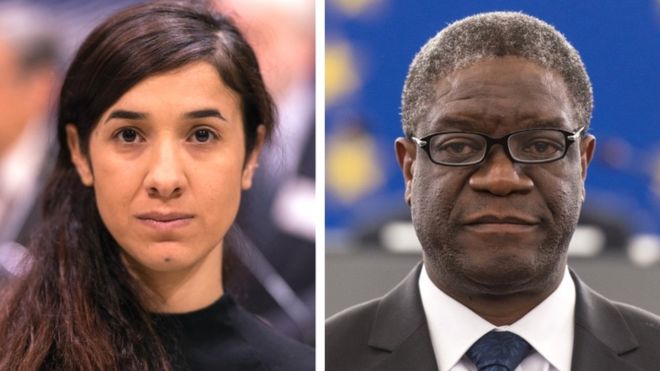
Nobel Peace Prize for anti-rape activists Nadia Murad and Denis Mukwege – Image copyright EPA
You do not have it hear it through me as most mainstream media carry the news (here the BBC with elaborate information) that the 2018 Nobel Peace Prize has gone to campaigners against rape in warfare, Nadia Murad and Denis Mukwege. After the controversy created around some of the recent laureates, these two are safe bets as both have been recognized widely:
Ms Murad is an Iraqi Yazidi who was tortured and raped by Islamic State militants and later became the face of a campaign to free the Yazidi people. She found recognition from at least two earlier awards:
Dr Mukwege is a Congolese gynaecologist who, along with his colleagues, has treated tens of thousands of victims. He received wide recognition with 8 international human rights awards:
2008 United Nations Prizes in the Field of Human Rights
2009 Olof Palme Prize
2010 Wallenberg Medal (University of Michigan)
2011 King Baudouin International Development Prize
Ms Murad, 25, dedicated the award to her mother, who was killed by the Islamic State (IS) militants who overran their home in 2014. Ms Murad described her escape in a BBC interview in 2016, detailing how the women who were held captive were treated by IS.
Dr Mukwege was operating at his hospital when he heard he had won the prize. He dedicated his award to all women affected by sexual violence. He lives under the permanent protection of UN peacekeepers at his hospital and has also previously called for a tougher line on rape as a weapon of war.
The South Sudanese doctor, Evan Atar Adaha, was chosen for his 20-year commitment to providing medical services to people forced to flee conflict and persecution in Sudan and South Sudan, as well as to the communities that welcome them. Dr. Atar runs the only functional hospital in Upper Nile State, an area larger than Ireland. Located in the town of Bunj, in Maban County, it serves more than 200,000 people, including 144,000 refugees from Sudan.
Presenting the Nansen award in Geneva’s Bâtiment des Forces Motrices, Filippo Grandi, UN High Commissioner for Refugees, said that most of the doctor’s patients were refugees and he had lived through displacement himself, after fighting forced him to close his first hospital in Kurmuk, Sudan. In addition, he embodied “not only solidarity, but courageous solidarity” with his refugee patients, “two commodities that are very scarce in today’s world.”
Originally from Torit, a town in southern South Sudan, Dr. Atar studied medicine in Khartoum, Sudan, and afterwards practised in Egypt. In 1997, as war ravaged Sudan’s Blue Nile State, Dr. Atar volunteered to work there. In 2011, increasing violence forced him to pack up his hospital and flee with his staff and as much equipment as he could transport, a journey that took a month. In his acceptance speech, Dr. Atar said “However, this award is not for me as an individual. The award is for my team back in Maban.”
The keynote speaker at the event, actor Cate Blanchett, who is a UNHCR Goodwill Ambassador, earlier told the audience: “It is a formalised way of saying ‘thank you’ to one person specifically, but more importantly, it carries with it the inexpressible thanks to all who work in the humanitarian fields – often at great personal cost.” Blanchett concluded: “People like Dr. Atar inspire us to build a better future for everybody.”
The event was hosted by South African actress and advocate for UNHCR’s LuQuLuQu campaign Nomzamo Mbatha. She introduced the evening’s performers including Indian sitar player Anoushka Shankar, Syrian dancer and choreographer Ahmad Joudeh and Norwegian singer Sigrid.
British radio and television presenter Anita Rani hosted a Facebook Live stream of the ceremony on the UNHCR Facebook page.
Polish lawyer Adam Bodnar – Defender of minority rights and judicial independence in Poland (Photo credit: Kluczek/RPO.GOV.PL )
The Rafto Prize 2018 is awarded to the Polish lawyer Adam Bodnar and the institution he leads, the Office of the Commissioner for Human Rights, for the important stance taken in the face of current political developments in Poland. A key function of the Ombudsman, or the Commissioner for Human Rights, is to ensure that the public authorities secure and respect the human rights of all members of Polish society. As lawyer and Ombudsman, Adam Bodnar (41) has highlighted the crucial role played by independent Ombudsman institutions in safeguarding human rights in Poland – and other countries – where such actors and institutions increasingly have come under attack.
Since Law and Justice (PiS) won the Polish election in October 2015, the party has used its majority in the National Parliament to adopt legislation that reduces the independence of the courts and centralizes state powers. New laws grant the government control of state media and place severe limits on freedom of information and political lobbying. The rights of vulnerable groups have been repeatedly ignored. “The award is not just an award to my work and the institution, but mostly a support from your community given to the Polish civil society, academia, judges and lawyers fighting for rule of law, juridical independence, pluralism and protection of minorities in Poland,” said Adam Bodnar.
The Rafto Prize for 2018 to Adam Bodnar and the Ombudsman for Human Rights highlights the rolling back of democracy and human rights protections in Poland. The conflict over the Polish Constitutional Tribunal and the Supreme Court are important internationally because they are symbolic of an alarming tendency where the independence of courts increasingly is under political pressure. It is crucial that the international community, the EU, Norway and other European countries take a clear stance against human rights violations and attacks on the rule of law and minority rights that take place in our own region. Adam Bodnar, being the civil servant, cannot accept the prize money awarded along with the Rafto Prize. The Rafto Foundation will identify and donate the prize money to civil society working for human rights in Poland.
“The Laureates’ trailblazing work for accountability, democracy and the regeneration of degraded land gives tremendous hope and deserves the world’s highest attention. At a time of alarming environmental decline and failing political leadership, they show the way forward into a very different future,” comments Ole von Uexkull, Executive Director of the Right Livelihood Award Foundation. For more on the award see: http://trueheroesfilms.org/thedigest/awards/right-livelihood-award
The Award presentation will take place on 23 November at the Vasa Museum in Stockholm, followed by public events and high-level meetings in Geneva, Zurich and Berlin.
The Laureates of this year’s Right Livelihood Award, widely known as the ‘Alternative Nobel Prize’, will be announced on Monday, 24 September. The announcement will take place in Stockholm at 09:00 (CEST) at the International Press Centre at the Ministry for Foreign Affairs, Fredsgatan 6, and streamed live via rightlivelihoodaward.org.
Over 200 organisations from all over the world have signed on to an open letter endorsing the idea of giving the Nobel Peace Prize 2018 to the global community of Human Rights Defenders.
12 September 2018
Dear Members of the Norwegian Nobel Committee,
9 December 2018 will mark the 20th anniversary of the UN’s Declaration on Human Rights Defenders (HRDs). It is an ideal and opportune moment to recognise and celebrate the efforts of these extraordinary individuals who despite threats of violence and unlawful imprisonment, harassment, intimidation, torture and assassination, continue to peacefully challenge injustice and call for the implementation and strengthening of the rule of law. Since 1998, over 3000 human rights defenders have been killed for defending the fundamental values enshrined in the Universal Declaration of Human Rights adopted by the UN.
In recognising the increasingly hostile environments globally, in which human rights defenders must work, the late Former Secretary-General to the United Nations, Kofi Annan, recently said:
“To stand up for human rights requires courage, perseverance, vigilance and a strong foundation of knowledge and evidence. We need to be vigilant in the protection of human rights defenders, for when the defenders’ rights are violated, all our rights are injured.”
In the same vein and emphasising the critical role that human rights defenders play in promoting and fostering stable democracies and sustainable peace, Permanent Representative of Norway to the Organisation for Security and Cooperation in Europe, Ambassador Steffen Kongstad said: “Threats and attacks against human rights defenders may hamper the realisation of economic, social and cultural rights, undermining social cohesion, and ultimately stability and development.”
Despite this recognition and respect at the highest levels of the international community, human rights defenders are killed every day. HRDs who suffer disproportionately are those activists working at grassroots and community levels, in isolated regions and from marginalised populations, who lack networks and resources to command international attention. Human rights defenders can be community leaders, lawyers, journalists, environmental activists, victims of abuse, trade unionists and teachers.
It is for these urgent reasons that Peace Brigades International with the support of the UK All-Party Parliamentary Human Rights Group has nominated the global community of HRDs for the 2018 Nobel Peace Prize. It is the highest humanitarian achievement through which to recognise HRDs and celebrate their commitment to advocating for and building societies that are peaceful, safe, inclusive, tolerant, just and sustainable for all. The nomination is currently supported by the UN Special Rapporteur on the situation of HRDs and some governments, diplomats and parliamentarians around the world.
We believe that awarding the Nobel Peace Prize to the global community of HRDs will mark a milestone in legitimising the crucial work they undertake to protect humanity and bring the trends of persecution they suffer to the public eye.
Furthermore, this collective award would mark a world first. By nominating a community rather than individuals or organisations, we emphasise that the trends making the defence of human rights ever more risky and ever more admirable, are global. We seek to highlight that the community itself is integral to the defence of human rights and it is the idea of community that motivates people to take enormous risks defending the rights of others and advancing peace.
Khoi is an independent artist who is shaping public discourse in Vietnam. She reached stardom in 2010, when she won the highest award for songwriting in Vietnam. As a celebrity, Mai advocated for women’s rights, LGBT rights, and to end violence against women. More recently, she became the focal point of public discourse after nominating herself to run in the 2016 parliamentary elections. Her pro-democracy campaign sparked a nationwide debate about political participation and ultimately led to a meeting with then-U.S. President Barack Obama. Since running for parliament, Mai has had her concerts raided, has been evicted from her house twice, and is effectively banned from singing in Vietnam. In March 2018, she was detained at Hanoi airport on suspicion of “terrorism” after returning from a European tour.
Despite this harassment, Mai continues to find creative ways to spark conversation on art, human rights, and democracy. In February 2018, she released a new album, “Mai Khoi Chem Gio – Dissent.” In a review of the album, The Economist commented, “If music alone could break chains, this would be the music to do it.” Mai’s work aims to counter the authoritarian ways of thinking that justify social control. She is currently the subject of a feature-length documentary that is scheduled to air on Netflix in 2019.
“Mai Khoi is outstanding in her commitment to human rights,” said Havel Prize Committee Chairman Thor Halvorssen. “Through her music and her campaigns, she has put civil liberties and democracy on the forefront of public conversation in Vietnam.”
The Havel Prize ceremony will be broadcast live at oslofreedomforum.com at 3:00 p.m. Oslo time (GMT+2) on Wednesday, May 30.
The Swedish-based Anna Lindh Memorial Fundhas named pro-Kurdish human rights lawyer from Turkey Eren Keskin as the recipient of the 2018 Anna Lindh Prize. “She has worked tirelessly to help … girls and women as well as LGTBQ people and [displaced] Syrians in Turkey,” said Lena Hjelm-Wallén, chairman of the memorial fund’s board. “Even when her work led to imprisonment, she still stood up for human rights without regard to political or religious background. Keskin’s brave voice is needed today more than ever and is a work entirely in Anna Lindh’s spirit.
The prize will be awarded at a ceremony in Stockholm on June 19.
The prize is awarded in memory of slain Swedish politician Anna Lindh since 2004 and aims “to encourage primarily women and youth who, in Anna Lindh’s spirit, show the courage to work against indifference, prejudice, oppression and injustice in order to stimulate a society where human rights are respected.” See also: https://humanrightsdefenders.blog/2014/10/27/the-anna-lindh-lecture-2014-focused-on-human-rights-defenders/
Peter Sewakiryanga (left) and Margret Arach Orech after receiving their awards at a function in Bugolobi. Photo by Ashraf Kasirye
The 2018 Human Rights Defenders Award went to Margaret Arach Orech, the founder of Uganda Landmine Survivors’ Association and Peter Sewakiryanga, the founder of Kyampisi Childcare Ministries, an organisation that supports child victims of sacrifice.
Arach, who lost her leg to a landmine during an attack by the Lord’s Resistance Army (LRA) rebels in 1998, uses her organisation to solicit for support for fellow survivors and persons with disabilities.
Sewakiryanga, a pastor now takes care of 80 child survivors of trafficking and human sacrifice has built an extensive network linking communities and security to track suspected cases. In 2017, Sewakiryanga travelled to Oman to rescue six victims of child trafficking. He is credited for championing research and spearheading an awareness campaign in communities to stop the crime.
“The defenders we’re honouring today work in some of the most dangerous areas of the world, sacrificing their own security to peacefully demand justice and human rights for their communities,” said Andrew Anderson, Executive Director of Front Line Defenders, as he announced the winners in Dublin.
—-
Nurcan Baysal, Turkey – Regional Winner for Europe & Central Asia & Global Laureate
Nurcan is a Kurdish journalist and human rights defender based in Diyarbakir. When the government launched a military offensive in the south-east in 2016, Nurcan spent months visiting Kurdish villages under bombardment, documenting human rights violations, and stopping to help families who’d lost everything in the conflict. Her writings are known for their critical focus on voice women living under the bombardment. When the authorities launched a military operation in Afrin, Nurcan took to social media to demand peace and condemn the violent assault. She was detained for speaking against the violence, and although later released she now faces up to 3 years in jail in a separate case related to her writing. Nurcan, according to authorities’ absurd claims, had “spread propaganda for armed terrorist organizations … and a call for provocative actions.” In addition to her reporting, Nurcan has also co-founded several NGOs, set up a camp to help Yazidi women fleeing the Islamic State, and been a key voice in countless reconciliation programs in the region. [see also: http://bianet.org/english/human-rights/197288-kurdish-journalist-baysal-wins-frontline-defenders-human-rights-prize]
Soni Sori, India – Regional Winner for Asia
Soni Sori is an indigenous and women’s rights defender in the militarised Bastar region of Chattisghar, India, where state-backed paramilitary forces are waging a violent campaign against local Adivasi tribes in the name of combating an armed Maoist insurgency. Soni documents and advocates against violence perpetrated by the paramilitary and police forces, which includes razing villages, burning homes, raping local women, and torturing and sexually assaulting tribes people detained without cause. Soni has also defended a number of educational centres from destruction by Maoist groups. In retaliation for her work, security forces detained and tortured Soni, pushing stones inside of her body and assaulting her for hours. Years later, men attacked her with acid and threatened to do the same to her daughter if she did not cease her advocacy on behalf of tribeswomen raped by the security forces. She has refused to stop her work, and continues to travel into the Maoist regions to speak with survivors of the ongoing conflict. [see also: https://feminisminindia.com/2018/05/18/soni-sori-wins-front-line-defenders-award/] and https://humanrightsdefenders.blog/2016/02/23/human-rights-defenders-in-india-democracy-is-not-enough/
Peaceful Resistance of the Micro-Region of Ixquisis, Guatemala – Regional Winner for the Americas
La Resistencia Pacífica de la Microregión de Ixquisis formed in response to grave rights violations committed in the name of economic advancement in Guatemala. The government has authorised destructive mining and hydroelectric mega-projects in the region despite the widespread opposite from the 59 villages and 7 communities in the municipality. HRDs in the Peaceful Resistance risk their lives to defend the territory. In 2016 alone, there were more than 75 reported attacks against HRDs in the Peaceful Resistance including killings, shootings, harassment, and defamation campaigns.
LUCHA, DRC – Regional Winner for Africa
LUCHA is a non-partisan youth movement formed in eastern Democratic Republic of Congo that struggles against chronic corruption and impunity in the DRC. Initially focused on
local issues like access to drinking water, electricity, and youth unemployment, in just 6 years the movement has developed into an extensive national-level network of powerful social organisers. Peaceful protests and demonstrations led by LUCHA are routinely attacked by authorities. In October 2017, 5 young protests were killed during a LUCHA-organised demonstration, and many of their members and leaders having been arrested and detained during peaceful assemblies. The Congolese national intelligence agency has detained several members, who have endured physical and psychological abuse in detention.
Hassan Bouras – Regional Winner for the Middle East & North Africa
Hassan Bouras is a journalist, blogger, leading member of the Algerian League of Human Rights, and founding member of the Rejection Front, a coalition against fracking to extract shale gas in Algeria. His reporting on both corruption and torture in Algeria spans more than two decades and because of this work he has been repeatedly targeted by Algerian authorities. He has continued his writing and advocacy despite years of judicial harassment, arbitrary detentions, violent raids on his home, and imprisonment.


 Hans Thoolen on Human Rights Defenders and their awards