Posts Tagged ‘Guardian’

Buscarita Roa: one of the last of the Abuelas

August 10, 2025

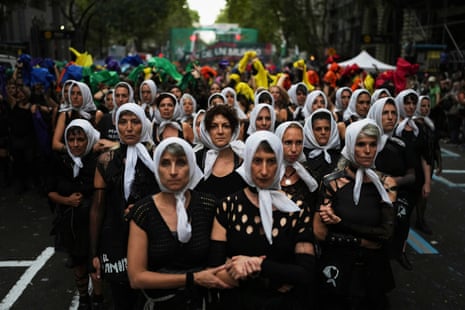
A group of women dressed in black and wearing white headscarves

Women dressed as the mothers and grandmothers of the Plaza de Mayo gather in Buenos Aires, Argentina, in March. Photograph: Rodrigo Abd/AP

On Wednesday 6 August 2025 the Guardian carried an interview with Buscarita Roa, one of the last of the Abuelas.” ..

Argentina’s 1976-83 military dictatorship tortured, killed and “disappeared” an estimated 30,000 people – political opponents, students, artists, union leaders: anyone it deemed a threat. Hundreds of babies were also taken, either imprisoned with their parents, or given to military families. The Abuelas de Plaza de Mayo have fought for almost 50 years to find these grandchildren. Buscarita Roa is one of two surviving active members.

On 28 November 1978, my 22-year-old son, José, his wife, Marta, and their baby daughter, Claudia, joined the list of those “disappeared”. A squad of Argentina’s military police stormed their home and I couldn’t find out any more. I went everywhere to look for them – police stations, courthouses, army camps, churches. I was desperate. But nobody would answer me. Every door was closed. It was a suffocating, hermetic time.

Then one day, not long after they were taken, I watched as a group of women walked in circles around the Plaza de Mayo in Buenos Aires. These mothers and grandmothers had started to gather, demanding answers about their missing relatives. I recognised one of the women. She said come with us, and I did.

We – who would become known as the Abuelas – didn’t know each other before. But we would meet every week and walk round and round the square, identifying each other with our white headscarves.

At first some of the husbands came, but we knew they risked being “disappeared” too, so then the men stayed at home and we went alone. It was still dangerous, a terrifying time, and some of the first mothers were taken themselves.

When the police ordered us to leave, and we didn’t, they charged at us on horseback. But we were younger then, so we could run.

Together we started going to the police stations and the courts, searching for answers. We cried in front of them, and they told us to go away, they didn’t want to see us. We knew the dictatorship was watching us from afar.skip past newsletter promotion

My granddaughter’s disappearance haunted my life. She was only eight months old when she was taken, and whenever I would see a little girl who looked like her, I would follow her, unable to stop until I saw her face. If there were people at my front door I would think, oh she must have come home. Other times, people would tell us they had seen a neighbour with a new baby. So we would go to their houses, trying to glimpse the child, to see if they looked like one of ours. We were doing crazy, desperate things, but it was all we had.

Many years passed before we started to receive any information. Most people didn’t believe us, and those that did thought our sons were terrorists. Still, we continued to go to Plaza de Mayo to pray for the return of our children. And when the country’s economic situation improved, we started travelling abroad to share our story too.

In 2000, I found my granddaughter, and was able to hug her again for the first time in two decades. People had come forward with their suspicions, and a judge agreed to investigate. We learned that Claudia had been taken to the clandestine detention centre “El Olimpo” with her mother, where she was kept for three days before being illegally adopted by a military family. They created a fake birth certificate, signed by a military doctor. My son and daughter-in-law were tortured and killed.

Claudia was in my heart every day that she was missing. I can’t explain what I felt when I found her. It was a pure, overwhelming joy. But I was also afraid, fearful that she would reject me. By then she was 21, and had been raised by a military family. I couldn’t invade my granddaughter’s life just like that, she needed to figure out the terrible truth and start trusting us. Slowly, over long afternoons of mate [a traditional herbal drink], we got to know each other and have built a beautiful relationship.

Belonging to the Abuelas helped me to heal. We laughed, we cried and we became friends. We were relentless too – we women have not rested once in half a century. But while some of us found our grandchildren, others only found bodies, and most of us found nothing at all. And then there is the battle of time; it is cruel and many of the Abuelas have died. There were once many of us, and now there are fewer than 10.

Estela de Carlotto, the president of the Abuelas, and I are the two last active members. But we are growing old too, and I don’t know how much further life will take us. We have found 140 of the grandchildren, with the last reunited last month, but we estimate that nearly 300 are still missing.

The ones we have found have now taken up the mantle. This is the legacy de Carlotto and I leave behind: a generation of grandchildren still looking for the others.

My lifelong work has consisted of searching for my son and daughter-in-law. I am 87 years old now, but I will never give up.

As told to Harriet Barber

https://www.theguardian.com/global-development/2025/aug/06/grandmothers-argentina-disappeared-legacy-reunited

Why we need human rights now more than ever [debate in the UK)

May 15, 2024

Shami Chakrabarti

On 6 May 2024 the Guardian gave the floor to Shami Chakrabarti, a lawyer and Labour member of the House of Lords; the author of Human Rights: The Case for the Defence, who makes a cogent and strong statement in the current debate on the UK leaving the European convention on human rights. [see also: https://www.economist.com/britain/2024/04/25/why-britains-membership-of-the-echr-has-become-a-political-issue].

In the three decades since I became a lawyer, human rights – once understood as an uncomplicated good, a tool for securing dignity for the vulnerable against abuses by the powerful – have increasingly come under assault. Perhaps never more so than in the current moment: we are constantly talking about human rights, but often in a highly sceptical way. When Liz Truss loudly proclaims “We’ve got to leave the ECHR, abolish the supreme court and abolish the Human Rights Act,” she’s not the fringe voice she might have been in the 1990s. She represents a dangerous current of opinion, as prevalent on parts of the radical left as on the populist right of politics. It seems to be gaining momentum.

As an idealistic youngster, I would have been shocked to know that in 2024 it would be necessary to return to the back-to-basics case, to justify the need for fundamental rights and freedoms. But in a world where facts are made fluid, what were once thought of as core values have become hard to distil and defend. In an atmosphere of intense polarisation, human rights are trashed along all parts of the political spectrum – either as a framework to protect markets, or as a form of undercover socialism. What stands out for me is that the most trenchant critics share a profound nationalism. Nationalists believe that universal human rights – the clue’s in the name – undermine the ability of states to agitate for their narrower interests.

Given that so many of our problems can only be tackled with an international approach, a robust rights framework is more important than ever

It’s no coincidence that the governments keenest on turning inwards – Viktor Orbán’s in Hungary, that of former president Bolsonaro in Brazil – have been least keen on common standards that protect minorities in their own territories and hold them to high standards in the international arena. At a time of insecurity, these leaders leverage fear to maximise their appeal. The prospect of a second Trump administration in the US demonstrates that this trend shows no sign of abating. In that context, it’s vital to make the case for human rights anew.

It boils down to this: given that so many of our problems – in an age of climate change, global disorder and artificial intelligence – can only be tackled with an international approach, a robust rights framework is more important than ever. There are parallels with the postwar period in which human rights were most fully articulated, a time when it was obvious to everybody that cooperation and global standards were the best way to shore up our common humanity after a period of catastrophic conflict and genocide.

Of course everyone believes in some rights – normally their own and those of friends, family and people they identify with. It is “other people’s” freedoms that are more problematic. The greater the divisions between us, the greater this controversy. And yet, it is precisely these extreme disparities in health, wealth, power and opinion that make rights, rather than temporary privileges given and taken away by governments, so essential. They provide a framework for negotiating disputes and providing redress for abuses without recourse to violence.

New technologies, and AI in particular, require more not less international regulation. As people spend more time online, they become vulnerable to degrading treatment, unfairness and discrimination, breaches of privacy, censorship and other threats. The so-called “black boxes” behind the technology we use make ever more crucial decisions about our daily lives, from banking to education, employment, policing and border control. Anyone who flirts with the notion of computer infallibility should never forget the postmasters and other such abuses, perpetrated and then concealed.

Our shrinking, burning planet is the ultimate reason why nationalism does not work in the interests of humankind

Perhaps most important of all is the growing contribution of human rights litigation to the struggle against climate catastrophe. A whole generation of lawyers and environmentalists is taking notes from earlier struggles, just as suffragists once learned from slavery abolitionists. This is despite the machinations of fossil fuel corporations versed in a thousand lobbying, jurisdictional and other delaying tactics.

Our shrinking, burning planet is the ultimate reason why nationalism does not work in the interests of humankind. Today’s global empires, sailing under logos rather than flags, need to be more directly accountable under human rights treaties. Our existing mechanisms, whether local and national governments, domestic and international courts, or some of the more notoriously tortuous UN institutions, may be imperfect and in need of reform. Yet, like all structures of civilisation, they are easier to casually denigrate than to invest in and adapt to be more effective.

While I have been writing this, I have been voting in the House of Lords on amendments to the so-called safety of Rwanda bill. It is the most regressive anti-human rights measure of recent times, and intended to be that way. It will not stop the boats of desperate people fleeing persecution, but is designed to stop the courts. British judges will be prevented from ensuring refugees’ fair treatment before they are rendered human freight and transported to a place about whose “safety” our supreme court was not satisfied. Rishi Sunak will be able to use this situation as excuse for an election pledge to repudiate the European convention on human rights.

If he gets his way, rights will be removed not just from those arriving by boat, but from every man, woman and child in the UK. By contrast, the golden thread of human rights is equal treatment: protecting others as we would wish to be protected ourselves, if that unhappy day ever came. It’s a thread we must never let go of.

https://www.theguardian.com/books/2024/may/06/the-big-idea-why-we-need-human-rights-now-more-than-ever

see also: https://eachother.org.uk/dont-make-human-rights-a-dirty-word-the-national-campaign-sweeping-the-highstreet/

India – not satisfied with its ranking – planning to develop own democracy index

April 2, 2024

The New Indian Express of 22 March 2024 reports (based on Al Jazeera) that Prime Minister Narendra Modi government has approached a major Indian think tank to develop its own democracy ratings index that could help it counter recent downgrades in rankings issued by international groups that New Delhi fears could affect the country’s credit rating. The Observer Research Foundation (ORF), which works closely with the Indian government on multiple initiatives, is preparing the ratings framework,

On June 2023, The Guardian reported that the Indian government has been secretly working to keep its reputation as the “world’s largest democracy” alive after being called out by researchers for serious democratic backsliding under the nationalist rule of the Narendra Modi government, according to internal reports seen by The Guardian.

Despite publicly dismissing several global rankings that suggest the country is on a dangerous downward trajectory, officials from government ministries have been quietly assigned to monitor India’s performance, minutes from meetings show, The Guardian said. Al Jazeera revealed that the Observer Research Foundation (ORF), which works closely with the Indian government on multiple initiatives, is preparing the ratings framework. The new rankings system could be released soon, an official was quoted as saying.

Global human rights NGO Amnesty International has continued to highlight the erosion of civil rights and religious freedom under the Narendra Modi regime.

Amnesty in its India 2022 report noted that arbitrary arrests, prolonged detentions, unlawful attacks and killings, internet shutdowns and intimidation using digital technologies, including unlawful surveillance as major concerns faced by minority groups, human rights defenders, dissenters and critics of the Union government. [see also: https://www.amnesty.org/en/latest/news/2024/03/india-crackdown-on-opposition-reaches-a-crisis-point-ahead-of-national-elections/]

Similarly, Human Rights Watch has also continued to highlight the crackdown on civil society and media under the Modi government citing persecution of activists, journalists, protesters and critics on fabricated counterterrorism and hate speech laws. The vilification of Muslims and other minorities by some BJP leaders and police inaction against government supporters who commit violence are also among HRW’s concerns in India.

Notably, the ‘Democracy Index’, prepared by The Economist Group’s Economist Intelligence Unit, had downgraded India to a “flawed democracy” in its 2022 report due to the serious backsliding of democratic freedom under the Modi government.

Similarly, the US-based non-profit organization Freedom House had lowered India’s standing from a free democracy to a “partly free” democracy in its global freedom and internet freedom ratings, while V-Dem Institute, a Sweden-based independent research institute, had classified India as an “electoral autocracy”, as part of its 2022 Democracy report. for more on ranking, see: https://humanrightsdefenders.blog/tag/ranking/

https://www.newindianexpress.com/nation/2024/Mar/22/centre-planning-its-own-democracy-index-amid-global-rankings-downgrade

Steven Kabuye, Ugandan LGBTQ activist, stabbed after death threats

January 5, 2024

On 3 January 2023 it was reported that a prominent Ugandan LGBTQ+ activist Steven Kabuye was stabbed by unknown assailants on a motorbike after receiving death threats. Steven Kabuye, 25, suffered knife wounds and was left for dead on the outskirts of the capital Kampala.

Human rights defenders have been warning about the risk of attacks on members of the LGBTQ+ community after Uganda last year adopted what is considered one of the harshest anti-gay laws in the world.

Kabuye told detectives investigating the incident that he had been receiving death threats, according to a statement issued by police spokesperson Patrick Onyango.

Richard Lusimbo, head of the community action group Uganda Key Populations Consortium, said: “All our efforts at the moment [are to ensure] that he gets the medical attention he deserves and also the perpetrators of this heinous act are held responsible.”

Ugandan gay rights activist Hans Senfuma said in post on X that the attackers wanted to kill Kabuye. “Steven claims that these two guys’ intentions were to kill him, not robbing, and also claims that it seems they have been following him for several days,” Senfuma wrote.

Kabuye, who works with the Coloured Voices Media Foundation, which campaigns on behalf of LGBTQ+ youth, told investigators who visited his bedside that he had been receiving death threats since March 2023. He had returned to Uganda in December for Christmas after travelling abroad in June.

In May last year, Uganda adopted anti-gay legislation containing provisions making “aggravated homosexuality” a potentially capital offence and setting out penalties for consensual same-sex relations of up to life in prison.

https://www.theguardian.com/world/2024/jan/03/ugandan-lgbtq-activist-in-critical-condition-after-brutal-knife-attack

https://www.barrons.com/news/prominent-uganda-lgbtq-activist-injured-in-knife-attack-0796fbdf

Climate Human Rights Defenders increasingly seen as eco-terrorists

October 15, 2023

Damien Gayle, Matthew Taylor and Ajit Niranjan in the Guardian of 12 October 2023 published the result of their research in Europe into using repressive measures to silence climate activists[see: https://humanrightsdefenders.blog/2023/10/04/human-rights-platform-at-the-gulbenkian-foundation-hears-michel-forst-worries-about-treatment-of-climate-defenders/]

In Germany, France, Italy, Sweden, the Netherlands and the UK, authorities have responded to climate protests with mass arrests, the passing of draconian new laws, the imposing of severe sentences for non-violent protests and the labelling of activists as hooligans, saboteurs or eco-terrorists. The crackdowns have come in spite of calls by senior human rights advocates and environmental campaigners to allow civic space for the right to non-violent protest, after a summer of record-breaking heat in southern Europe that is attributed to the effects of climate breakdown.

The UK has led the way in the crackdown, experts say, with judges recently refusing an appeal against multi-year sentences for climate activists who blocked a motorway bridge in east London. The three-year jail terms for Marcus Decker and Morgan Trowland earlier this year are thought to be the longest handed out by a British judge for non-violent protest.

Michel Forst, the UN rapporteur on environmental defenders since June last year [not really, for his correct title is the “Special Rapporteur on Environmental Defenders under the Aarhus Convention, Mr. Michel Forst” [see: https://humanrightsdefenders.blog/2022/07/22/aarhus-convention-on-environmental-information-gets-especially-experienced-rapporteur/], described the situation in the UK as “terrifying”. He added that other countries were “looking at the UK examples with a view to passing similar laws in their own countries, which will have a devastating effect for Europe”.

“Since my appointment I have been travelling to many countries in Europe and there is a clear trend,” Forst told the Guardian. “We can see an increasing number of cases by which these climate activists are brought to court more and more often and more and more severe laws being passed to facilitate these attacks on defenders.”

He added: “I’m sure that there is European cooperation among the police forces against these kinds of activities. My concern is that when [governments] are calling these people eco-terrorists, or are using new forms of vilifications and defamation … it has a huge impact on how the population may perceive them and the cause for which these people are fighting. It is a huge concern for me.”

Amnesty International said it was investigating a continent-wide crackdown on protest. Catrinel Motoc, the organisation’s senior campaigner on civil space and right to protest in Europe, said: “People all around the world are bravely raising their voices to call for urgent actions on the climate crisis but many face dire consequences for their peaceful activism.

“Peaceful protesters are left with no choice but to stage public protests and non-violent direct actions because European countries are not doing enough to tackle the climate crisis.

“There’s alarming evidence of criminalisation, harassment, stigmatisation and negative rhetoric towards environmental defenders.”

In June, Dunja Mijatović, the Council of Europe’s commissioner for human rights, also called for an end to crackdowns on environmental activists. Last December, Volker Türk, the UN’s high commissioner for human rights, appealed to governments to protect the “civic space” for young environmental activists, and “not crack down in a way that we have seen in many parts of the world”.

There was widespread outrage this summer when France’s interior minister, Gérald Darmanin, used one of the state’s most-powerful tools to order the banning of one of the country’s leading environmental protest groups. Les Soulévements de la Terre, a collective of local environmental campaigns, had staged a series of protests, with tactics including sabotage, that ended with violent confrontations with police, and Darmanin denouncing the activists as “far left” and “ecoterrorists”.

In the Netherlands, one of a series of roadblock protests on the A12 highway in The Hague in May was dispersed by police using water cannon, with more than 1,500 arrested. Seven climate activists were convicted of sedition – a charge that had never before been levelled against climate protesters – in relation to online posts calling for people to join an earlier demonstration.

In Sweden, about two dozen members of the Återställ Våtmarker [Restore Wetlands] group were convicted of sabotage for blocking highways in the capital, Stockholm. Others were held on remand for up to four weeks for taking part in protests.

In Germany in May, police staged nationwide raids against the Letzte Generation (Last Generation) group, whose supporters had glued themselves to roads on a near-weekly basis for months, as well as targeting art galleries and other cultural spaces. On a police directive, the homepage of the group was shut down and possessions belonging to members were seized.

At the most recent count, supplied by the activists, police had made more than 4,000 arrests of supporters of Last Generation taking part in road blocks in Berlin alone.

Authorities in Italy have used anti-organised crime laws to crack down on protests, where the Ultima Generazione (also Last Generation) group has staged road blocks since last year. The Digos police unit, which specialises in counter-terrorism, in April justified the use of anti-Mafia laws to target the group by saying its civil disobedience actions had not taken place spontaneously, but were organised, discussed and weighed up by an internal hierarchy. This came along with new, stiffer penalties for protests, with activists facing fines of up to €40,000 for actions targeting artworks and other cultural heritage.

Richard Pearshouse, director of the environment division at Human Rights Watch, said: “These restrictions on environmental protest across Europe and the UK are incredibly short-sighted. These governments haven’t grasped that we all have a huge interest in more people taking to the streets to demand better environmental protection and more climate action.

“Governments need to respect the rights to assembly and expression, and ramp up their own environmental protections and climate ambitions. That’s the only way we have a chance to get out of this climate crisis with our democratic institutions intact.”

A spokesperson for the UK Home Office said: “The right to protest is a fundamental part of our democracy but we must also protect the law-abiding majority’s right to go about their daily lives.

“The Public Order Act brings in new criminal offences and proper penalties for selfish, guerrilla protest tactics.”

The French interior ministry said local officials had the right to ban demonstrations with a serious risk of disturbing public order. “These one-off bans, of which there are very few in absolute terms, are not imposed because of the reason for the demonstration.”

The Italian interior ministry referred to a statement from the culture minister Gennaro Sangiuliano in April, who said attacks on monuments cause economic damage to the community that is is expensive to clean up. “Those who cause damage must pay personally.”

The German interior ministry declined to comment. The Bavarian interior ministry referred the Guardian to the public prosecutor’s office in Munich, which provided a statement from June in which it confirmed it had authorised the tapping of phones for six of seven Last Generation members under criminal investigation.

The Swedish interior ministry declined to comment. The Dutch ministry of justice did not respond to requests for comment.

https://www.theguardian.com/environment/2023/oct/12/human-rights-experts-warn-against-european-crackdown-on-climate-protesters

and later followed by:

https://globeecho.com/politics/climate-protesters-in-europe-face-a-massive-crackdown/

https://www.ohchr.org/en/statements-and-speeches/2023/10/environmental-rights-are-key-all-human-rights-turk-says

Human Rights Watch goes to Hollywood

May 4, 2023

Julian Borger in the Guardian of 4 May 2023 tells how an NGO teams up with Hollywood to sharpen human rights focus.

Human Rights Watch (HRW) has decided to take on Hollywood to improve the visibility and awareness of humanitarian issues in popular culture. As part of the move, the advocacy group has signed up with a talent agent firm, Activist Artists Management (AAM), to provide “scripted and unscripted content in film and television”, an HRW statement said…

The group has set up a department of three staff and additional consultants, to deal with Hollywood full-time – advising writers and directors on incorporating realistic treatment of human rights issues into their work.

We’re excited to work with Hollywood to spread that message and equip committed activists, advocates and artists standing up for justice through the stories they tell,” said Tirana Hassan, HRW’s new executive director.

Amanda Alampi, the organisation’s director of campaigns and public engagement, argued it was a logical step towards deepening the impact of HRW’s investigative work. “We have consistently done human rights investigations and told real-life stories to try to put a human face on it. But increasingly, we think that scripted storytelling is going to be really important in this area,” Alampi said. “So what we’re trying to do is think about – how do we insert a positive human rights message into popular culture? And Hollywood seems like a great place to start.

She said one way HRW would try to wield influence is to work with producers and writers “to encourage them to think about human rights to choose to tell stories more responsibly” in movie projects already in the pipeline.

“Then a second area is really about whether we can pitch story ideas that would actually tell effective human rights stories,” Alampi added. “We already use our meticulous fact-finding to sway policymakers and put perpetrators in the dock. This is about reaching a broader public with stories that illustrate human rights issues – especially through unexpected storytellers and platforms, like space or superheroes.”..

Alampi argued that allowing Hollywood to script and fictionalise true stories would not impinge on HRW’s reputation for factual accuracy, because the group would not be central to creating the fiction, but would simply pass on ideas that could be a starting point for movies with a human rights message.

“This is not about getting attention for HRW or getting us into a story, it’s about seeding human rights through effective storytelling, so I don’t think that’s a concern,” Alampi said. “Often our work in entertainment advocacy is focused on being a connector between our partners, impacted people and storytellers who could help share those stories with wider audiences.

Bernie Cahill, an AAM founding partner, said: “Activist is honored to partner with Human Rights Watch to amplify the important stories of its decades-long fight for justice, dignity, compassion and equality for people everywhere.

https://www.theguardian.com/us-news/2023/may/04/human-rights-watch-hollywood-film-tv

Daughter of Danish-Bahraini rights activist offers to take his place in prison

April 4, 2023

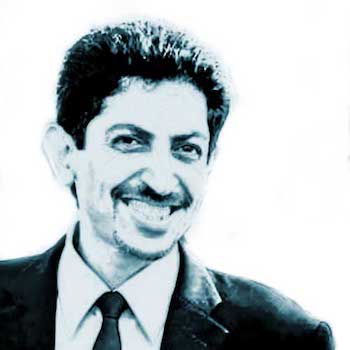
Ruth Michaelson in the Guardian of Friday 24 March 2023 reports that human rights activist Abdulhadi al-Khawaja’s health has suffered so much inside a Bahraini prison that his daughter Maryam has offered to trade places with him. She fears that without urgent action, her father will slowly die behind bars without being able to see his family.

I don’t know how much longer my dad has. I spend every day dreading each time the phone rings, as it might be someone calling me to let me know my dad is no longer around,” said Maryam. “I know he has serious health issues and the authorities are using [lack of] access to proper treatment as a method of punishment. I don’t want to wait around for my dad to be released to us in a coffin. I can’t do that.” She added: “The central issue is that my father shouldn’t be in prison to begin with.” [see: https://humanrightsdefenders.blog/2022/11/29/mea-laureate-abdulhadi-al-khawaja-facing-new-charges-for-protesting-injustice-in-jau-prison/]

Khawaja is one of Bahrain’s most prominent human rights campaigners. He has a decades-long history of activism, and was arrested in the dead of night at his family home in April 2011 for his involvement in pro-democracy protests that swept the kingdom. Two months later, he was sentenced to life imprisonment. Twelve years into his sentence, his family say the Danish-Bahraini dual national is being denied crucial medical treatment as punishment for his status as a human rights defender, raising the risk that Khawaja could die behind bars without urgent intervention from the Danish authorities. See: https://www.trueheroesfilms.org/thedigest/laureates/4d45e316-c636-4d02-852d-7bfc2b08b78d

He was convicted of terrorism and attempting to overthrow the government, charges that were condemned as politicised by rights groups. The United Nations Working Group on Arbitrary detention declared that the sentence was directly linked to Khawaja’s desire to freely express his political beliefs and participate in protests, despite the Bahraini authorities’ ruling that anti-government protests were illegal. A spokesperson for the Bahraini government, when asked about Khawaja’s case, said that “freedom of expression and opinion is a constitutional right and no one is detained because of their political views or activism.”

https://www.theguardian.com/global-development/2023/mar/24/denmark-bahrain-rights-activist-maryam-al-khawaja-abdulhadi-prison

Good news: Iran temporarily frees human rights defender Nasrin Sotoudeh

November 9, 2020

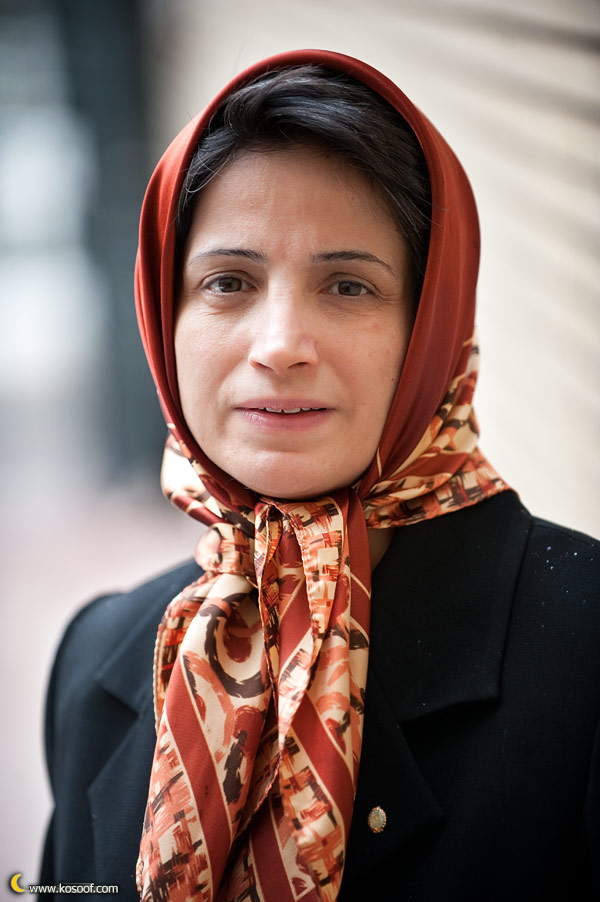
Many media outlets (here the Guardian) reported on Saturday 7 November 2020 that Iran has temporarily released Nasrin Sotoudeh, a prominent human rights lawyer who was jailed two years ago on spying and propaganda charges. Sotoudeh’s release followed warnings last month by human rights groups that her health had severely deteriorated after she staged a six-week hunger strike to demand the release of political prisoners and rights activists.

{see: https://humanrightsdefenders.blog/2020/10/07/un-rights-chief-urges-iran-to-release-jailed-sotoudeh-and-other-human-rights-defenders-citing-covid-19-risk/ as well as:https://humanrightsdefenders.blog/2019/06/13/1-million-people-demand-that-iranian-government-release-nasrin-sotoudeh/ ]

“Nasrin Sotoudeh … went on furlough with the agreement of the assistant superintendent of the women’s prison,” the judiciary’s Mizan news agency said, without giving further details.

Sotoudeh, 57, who has represented opposition activists including women prosecuted for removing their headscarf, was arrested in 2018 and charged with spying, spreading propaganda and insulting Iran’s supreme leader.

Sotoudeh has been recognised widely with seven major human rights awards.

https://humanrightsdefenders.blog/2020/04/24/martin-ennals-award-laureates-rally-to-demand-freedom-for-their-imprisoned-fellow-award-winners/

See also: https://www.lawgazette.co.uk/news/sotoudeh-thanks-global-colleagues-as-she-is-freed-for-now/5106333.article

https://www.theguardian.com/world/2020/nov/07/iran-temporarily-frees-human-rights-lawyer-nasrin-sotoudeh

Mugabe wins Chinese peace prize – this time for real

October 23, 2015

When I wrote my 1 April 2013 post about President Robert Mugabe getting the revamped Gaddafi award [https://thoolen.wordpress.com/2013/03/31/gaddafi-human-rights-award-resurrected-mugabe-rumored-to-be-laureate/], I could not know that one day he would actually get an award. But according to the Guardian and other newspapers this what happened when he was given the “Confucius award“, which was set up in 2010 as a Chinese alternative to the Nobel peace prize after the Norwegian Nobel committee infuriated Beijing by handing its annual peace prize to the jailed dissident writer Liu XiaoboRead the rest of this entry »

Tony Blair’s Children’s Award in contrast with his PR work for a dictator

November 27, 2014

This blog has always had keen interest in awards and in celebrities abusing their reputation. The current row over Tony Blair receiving an award from Save the Children USA as described by Katie Nguyen of Reuters on 26 November 2014 is exactly at the crossroads of these two interest.

Quartet Representative to the Middle East and former British Prime Minister Tony Blair attends the International donors conference on financing the reconstruction of the Gaza Strip in Cairo October 12, 2014.  REUTERS/Mohamed Abd El Ghany/Files
(former British Prime Minister Tony Blair at International donors conference on October 12, 2014. 
CREDIT: REUTERS/MOHAMED ABD EL GHANY/FILES)
Save the Children’s U.S.A chapter gave its annual Global Legacy Award to former British prime minister Tony Blair last week. It stated that it was to recognise Blair’s role in persuading the G8 to agree to debt relief of $40 billion for the poorest nations. Staff working for the charity were furious about the award, the Guardian newspaper reported and more than 100,000 people have signed a petition demanding that Save the Children revoke the award.

Read the rest of this entry »