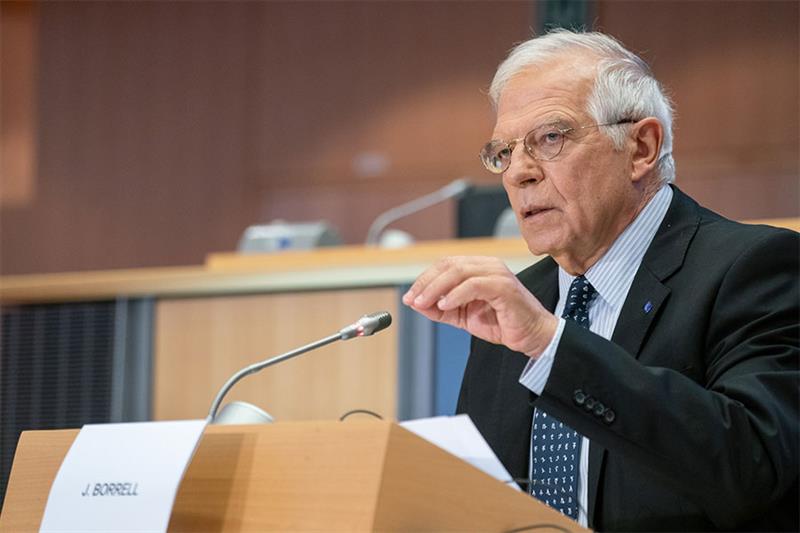
The European Union (EU) provided roughly €10 billion to support non-government organisations (NGOs) in its partner countries over the past seven years (2014-2021) EU High Representative and Vice-President Josep Borrell said in a statement in celebration of World NGO day, 26 February.
File Photo: EU s High Representative and Vice-President Josep Borrell. Photo courtesy of European parliament website.
“On World NGO Day, we honour all civil society actors who, every day, are at the forefront of the fight for human rights, the respect of democratic values and the rule of law. The EU commends their role in supporting and giving a voice to the most vulnerable as well as their essential contribution to building peaceful, just, and inclusive societies.”
“Today, with the unprovoked and unjustified military aggression against Ukraine by the Russian Federation, international peace and the rule of law are under attack. The EU stands firmly by the Ukrainian and Russian people along with their civil society and youths, whose future and voices are threatened by President Putin’s disregard of democracy, human rights, and international rules,” Borrell stated.
Borrell added that countries that curtail NGOs’ activity through legal and administrative measures hamper universal human rights and fundamental freedoms. See e.g.: https://humanrightsdefenders.blog/tag/foreign-agents/
The global human rights organizations market is expected to grow from $16.60 billion in 2021 to $17.47 billion in 2022 at a compound annual growth rate (CAGR) of 5.3%. The growth is mainly due to the companies rearranging their operations and recovering from the COVID-19 impact, which had earlier led to restrictive containment measures involving social distancing, remote working, and the closure of commercial activities that resulted in operational challenges.
The market is expected to reach $20.53 billion in 2026 at a CAGR of 4.1%.
The human rights organizations market consists of revenue generated through human rights services by entities that are engaged in promoting causes associated with human rights either for a broad or a specific constituency.
Establishments in this industry address issues such as protecting and promoting broad constitutional rights and civil liberties of individuals and those suffering from neglect, abuse, or exploitation, promoting the interests of specific groups such as children, women, senior citizens, or persons with disabilities, improving relations between racial, ethnic, and cultural groups, and promoting voter education and registration.
The main types of human rights organizations are nongovernmental organizations, intergovernmental organizations, governmental organizations and international organizations. Governmental human rights organizations are run by government bodies and are involved in the protection of human rights and the reduction of human rights violations.
The different modes of donation include online, offline. The organization locations can be domestic, international and have various applications in areas such as all humans, children, women, disabled, LGBTQ, others.
Asia Pacific was the largest region in the human rights organizations market in 2021. North America was the second largest region in the human rights organizations market. The regions covered in this report are Asia-Pacific, Western Europe, Eastern Europe, North America, South America, Middle East and Africa.
The rise in hate crimes is expected to drive the human rights organizations market. Hate crime is a form of criminal violence upon a person or property, caused in whole or in part by an offender’s bias against a race, religion, disability, sexual orientation, ethnicity, gender, or gender identity.
As per the annual report of FBI published in 2019, physical attacks against individuals have risen, accounting for 61% of the 7,120 cases reported by law enforcement authorities nationally as hate crimes in the USA. Government and non-governmental organizations aim to curb the abuses that challenge people’s human rights, which further aids in the growth of the human rights organizations market. Increasing attacks against human rights defenders are anticipated to hinder the human rights organization market. Attacks against human rights organizations that strive to safeguard human rights are rising at an alarming rate.
The Scholars at Risk Media Review of January 2022, carries an in-depth article about a university funding row which has raised fears of Chinese influence, written by Yojana Sharma on 26 January 2022:
The Free University of Amsterdam (Vrije Universiteit Amsterdam or VU Amsterdam) in the Netherlands has said it will return Chinese funding for its Cross Cultural Human Rights Centre (CCHRC) after an embarrassing row over Chinese influence on academia when it emerged that several of the centre’s academics publicly denied China oppresses Uyghur peoples. See also: https://chinachange.org/2020/04/30/one-chinese-gongos-war-against-global-human-rights/
But the row in the Netherlands amid other recent controversies over Chinese funding of university centres and Confucius Institutes in Germany and the United Kingdom has also made university disclosure of foreign funding more urgent, academics said. In 2018, 2019 and 2020, the CCHRC at VU Amsterdam received a subsidy of between €250,000 (US$282,000) and €300,000 (US$339,000) from the Southwest University of Political Science and Law in Chongqing, China.
According to documents obtained by Dutch broadcaster NOS, the Chinese university was the sole financial contributor to the CCHRC during those years, which has raised eyebrows.
VU Amsterdam has said it would return the money it had already received from China for this year, NOS revealed last week. But the university only backed down after the damaging revelations prompted a public outcry and strong statements by the Dutch education minister and others condemning the activities of the centre.
On Wednesday NOS said the activities of the Centre were being suspended, with all its lectures for students cancelled, ascribing the decision to the executive board and deans of the university. The Centre’s activities were already in doubt after the return of funds, making it dependent on the university or other donors for its continued survival.
The row blew up just as the Dutch education ministry is due to present its National Guidelines on Knowledge Security on 31 January and to announce its ‘Government-wide knowledge security front-office’, which is expected to have an advisory role and support universities in identifying risks.
It also followed the publication last week of the European Commission ‘toolkit’ for universities on how to deal with foreign interference.
Dutch Education Minister Robbert Dijkgraaf responded swiftly and unequivocally to the report, saying he was “very shocked” that the funding arrangement signalled possible academic dependence.
“It is urgent and sensible that the Free University now takes action quickly. Scientific core values such as academic freedom, integrity and independence must always be guaranteed,” he said in a statement.
The minister added: “It is important that Dutch knowledge institutions are and remain alert to possible risks of undesired influence by other countries and that they take adequate measures to safeguard academic core values, especially when it comes to universal values like human rights.”
The centre runs an academic journal and organises conferences. Its mission, laid down in the financing agreement with the Chinese university, is to draw attention to a “global view of human rights”, and specifically to the way in which non-Western countries such as China view human rights.
University’s lukewarm initial response
After a lukewarm initial response when the university merely underlined that “as befits the Free University, the research of the CCHRC is independent, interdisciplinary, dialogical and socially relevant”, it added to its statement just hours later, saying “even the appearance of dependence is unacceptable” and announced that it was “taking appropriate measures”, including halting the funding from China.
The university said it has not yet decided whether it will also refund subsidies from previous years, but it said it would first conduct an investigation to determine “whether the independence of the institute’s research has been safeguarded on all fronts”.
The CCHRC website noted in October 2020 that a delegation of people affiliated to the centre ‘recently’ visited the western Chinese region of Xinjiang… the CCHRC website noted: “The situation we encountered in the four cities in this trip did not reflect the grim situation as depicted in the Western reports. There is definitely no discrimination of Uyghurs or other minorities in the region.”
CCHRC Director Tom Zwart, professor at Utrecht University, who is also a frequent guest at Chinese state events and on Chinese state television, told NOS any similarities between the centre’s positions online and those of the Communist Party were “coincidental” and were not steered by any direct influence. Zwart described the CCHRC website as a place for “uncensored free thought”, ascribing the comments on its webpages to individuals “who do not represent the organisation as a whole”.
On 26 January CCHRC released a new statement on its website saying the website would be “temporarily taken offline” in order “to check whether a sufficiently clear distinction is made between statements made on behalf of the Centre and opinions and observations made in a personal capacity.”
It added: “[The] Centre explicitly endorses the conclusions of the United Nations regarding the systematic violation of the Uyghur human rights. In this vein, the Centre’s director, in the presence of members of the Chinese State Council and the Politburo, called on 8 April 2021 to respect and protect the rights of Uyghurs and stop repressive anti-terrorism policies.”
Ingrid d’Hooghe, an expert on China-Europe relations and senior research fellow at the Leiden Asia Centre, Leiden University in the Netherlands, said: “The director of the Centre said in an interview which was also on TV that they were fully independent, there was nothing that made them say what they were saying. But apparently it did not cross their mind that even if they are independent, it doesn’t look like it.”
Dutch academic Lokman Tsui, a researcher on digital freedoms and a former assistant professor at the Chinese University of Hong Kong, said via Twitter: “Important to note: until this year, they [the university in Chongqing] were the only funder. Problematic, because it’s hard to be independent if your research centre relies on one single funder. Problematic also, because public universities in China are closely affiliated with the Chinese Communist Party.”
Tsui added: “But whether the research centre is independent or not is also beside the question. The more important question is: Why is the university allowing its integrity and its reputation to be compromised by accepting money meant to validate China’s atrocious human rights record?”
Need for disclosure legislation
“We need legislation that universities have to make funding public,” Fulda said, pointing to Section 117 of the United States Higher Education Act which requires universities that receive foreign gifts of US$250,000 or more within a calendar year to file a disclosure report to the government.
Other draft foreign influence bills, including the Senate Bill S.1169 in the US, are currently attempting to tighten those rules, including reducing the amount that has to be declared by institutions and individuals if the funding comes from certain countries such as China, after a number of universities failed to report substantial foreign gifts under Section 117.
An amendment to the UK Higher Education Bill tabled on 12 January in the House of Commons would require disclosures of foreign funds of £50,000 (US$68,000) going back 10 years.
“The question is, if the Dutch government or other governments in Europe issued new regulations where universities were forced to make these contracts public, whether it would change things, and I think it would,” said Fulda.
Leiden Asia Centre’s d’Hooghe said: “There is no regulation that forces people to register somewhere what kind of collaboration they have. With new regulations in Australia and, to a certain extent, in the US and Canada, you have to become public with that kind of information. Not so in the Netherlands.”
“It’s not necessarily that people want to keep it a secret, it’s just not something that is done routinely. So at top levels in the university, but often even at the faculty level, the departments don’t have a good overview of exactly what kind of research is being done with whom, and how this is financed,” she said
The Association of Universities in the Netherlands (VSNU) published a “Framework for Knowledge Security” in July 2021 that outlined risks and the need for monitoring research collaboration, as well as recommending that universities set up their own internal ‘knowledge security advisory team’ to include experts such as cybersecurity specialists.
The focus is on building risk awareness but does not go as far as requiring disclosure of foreign funding. Some universities have pointed out that they cannot ‘police’ research or researchers on behalf of the government.
Who will investigate?
The Netherlands Inspectorate of Education has not indicated that it will carry out a broader investigation into China influence at universities in the country, saying in a statement following the VU Amsterdam row: “No other signals about Chinese influence are known to the inspectorate.”
Sophie Richardson, China director at Human Rights Watch, said in a statement that the Inspectorate of Education “would be wise to do more homework in this area”.
“In a decade of documenting Chinese government threats to academic freedom around the world, Human Rights Watch has found threats at universities from Australia to the United States, and proposed a code of conduct to help mitigate these risks.
“One key step: universities should publicly disclose all direct and indirect Chinese government funding and a list of projects and exchanges with Chinese government counterparts on an annual basis,” she said.
“In showing its permeability to Chinese government influence, the Free University shouldn’t limit its response simply to returning the funding. It should urgently assess whether students and scholars of and from China on its campus are subjected to harassment or surveillance,” which she noted had been well documented elsewhere, notably in Australia, Canada, the UK and the US.
“University leadership and scholars should assess whether censorship and self-censorship have eroded the curriculum or classroom debate,” Richardson added.
“The Free University should also join forces with counterparts across Europe – from Berlin to Cambridge to Budapest – who have faced similar problems, and agree to share information and adopt common standards with the goal of collectively resisting Beijing’s efforts to curtail academic freedom. The list of potential participants – supposedly ‘free’ universities – is disturbingly long.”
EU toolkit for universities: will it make a difference?
The EU issued a toolkit for universities on 18 January. Although it is comprehensive, d’Hooghe noted that “these rules are not binding because the EU has no competence in the area of education”. Universities are outside Brussels’ remit.
She saw it more as a “service to EU member states who still don’t have national rules, who find it very difficult to develop them or don’t have the capacity to develop them”.
While many ongoing collaboration projects with Chinese universities continue, despite academics and researchers being unable to travel due to pandemic restrictions, d’Hooghe said she knew of many who “are staying away” from starting new projects with China, in part due to risks, including reputational risks.
But she noted that legislation on a national level regarding foreign influence could be tricky. “University autonomy is regarded as an important value and very important for science to advance, so universities are very reluctant to be limited by binding regulations.”
On the eve of Human Rights Day (10 December 2021) and coinciding with the Summit for Democracy, the European Union launched the Global Europe Human Rights and Democracy programme. This programme, worth €1.5 billion, steps up EU support in promoting and protecting human rights and fundamental freedoms, democracy, and the rule of law and the work of civil society organisations and human rights defenders around the world during the period 2021–2027. The programme will promote and protect the universality of human rights, strengthen the rule of law and accountability for human rights violations and abuses, and defend the full and effective exercise of fundamental freedoms, including the freedom of expression, supporting independent journalism and media, while seizing opportunities and countering risks associated with digital and new technologies.
High Representative/Vice President Josep Borrell said: “Courageous people from all backgrounds are fighting on a daily basis for their civil liberties, for independent media and to safeguard democratic institutions, often at great personal risk. The European Union stands with them. The Global Europe Human Rights and Democracy programme will allow us to strengthen our support to and protection of universal human rights and democratic principles worldwide: for everyone, at any time and everywhere. Together with civil society organisations, human rights defenders, the UN Human Rights Office and the International Criminal Court, we will leave no one behind.”
International Partnerships Commissioner Jutta Urpilainen, said: “Human rights and democracy are a cornerstone of sustainable and inclusive development, and essential to addressing global challenges and ensure citizens reach their full potential and realise their aspirations. In whichever way you measure it – in stability, equality, economic growth, health or longevity – democracies always outperform other forms of government in the long run. I am proud to think of the countless human rights defenders, young people, women, girls and civil society organisations that the €1.5 billion Global Europe Human Rights and Democracy programme will empower to build a better tomorrow for all of us.”
It has five overarching priorities:
Protecting and empowering individuals – €704 million
Uphold all human rights, including by working towards the universal abolition of the death penalty, the eradication of torture and cruel and inhumane treatment, the fulfilment of basic needs, decent working conditions, the eradication of child labour, and a safe, clean, healthy and sustainable environment. The programme will promote equality, inclusion and respect for diversity, support human rights defenders and counter shrinking space for civil society, and strengthen the rule of law, ensure a fair and effective administration of justice, and close the accountability gap.
Building resilient, inclusive and democratic societies – €463 million
The programme will support functioning pluralist, participatory and representative democracies, and protect the integrity of electoral processes. It will, for instance, engage civil society observers in election observation and support pro-democracy organisations, networks and alliances.
Promoting a global system for human rights and democracy – €144 million
Enhance strategic partnerships with key actors, such as the Office of the UN High Commissioner for Human Rights (OHCHR), the International Criminal Court (ICC), regional human rights systems, national human rights institutions, the private sector, and the Global Campus of Human Rights.
Safeguarding fundamental freedoms, including harnessing the opportunities and addressing the challenges of digital and new technologies – €195 million
Create and maintain an environment conducive to the full exercise of all fundamental freedoms both offline and online. For example, it will help strengthen the capacity of independent, pluralistic and quality media, including investigative journalists, bloggers and fact-checkers, to provide the public with reliable information through responsible and professional reporting. It will support civil society in fostering online media literacy and digital skills and in promoting an open, global, free and secure internet equally accessible to all.
Delivering by working together – €6.6 million
The earmarked funds can support the civil society in engaging with national authorities within the framework of the human rights dialogues that the EU conducts with partner countries, or finance training, studies, or exchanges of best practice. It underpins all of the activities.
In the first year of implementation, the EU will focus on promoting a global system for human rights and democracy. For example, in 2022–2024, the EU will support the Office of the United Nations High Commissioner for Human Rights with €16 million, the Global Campus of Human Rights with €10 million, and the International Criminal Court with €3 million. The EU will also support in 2022 the launch of a Team Europe Democracy initiative to reinforce the impact of EU and Member States’ global support to democracy. The 2021 action plan complements a number of urgent individual measures under the programme adopted earlier.
Background
The Global Europe Human Rights and Democracy programme is flexible as regards procedures, and supports civil society actions independently of the consent of partner countries’ governments and other public authorities. A substantial part of the programme will be implemented at country level. Subsequent calls for proposals covering the different activities, open to civil society organisations across the world, will be published in the coming months. See also: https://humanrightsdefenders.blog/2018/02/27/10611/
Funded under the thematic pillar of the new Neighbourhood, Development and International Cooperation Instrument (NDICI) – Global Europe, the Global Europe Human Rights and Democracy programme is the successor of the European Instrument for Democracy and Human Rights (EIDHR), which was established in 2006 to support civil society-led actions in the area of human rights and democracy in countries outside the EU. Under the previous financial period 2014–2020, the European Instrument for Democracy and Human Rights was allocated €1.33 billion.
Movies that matter has extended the Deadline for itsCall for Proposals.
Are you organising a human rights film event, festival or mobile cinema project and still looking for funding? Apply for the next round of its grant programme to give your project the necessary boost. For this second selection round of 2021, organisations in Southeast Asia are especially invited to apply (Cambodia, East Timor, Indonesia, Laos, Malaysia, Myanmar, Philippines, Thailand and Vietnam).
See if your project meets the basic criteria for funding and make sure to apply before Wednesday 15 September 2021.
After successfully completing his mission to space, Bezos announced a new initiative titled the Courage and Civility Award to honour “leaders who aim high, pursue solutions with courage, and always do so with civility.”
“We live in a world where sometimes instead of disagreeing with someone’s ideas, we question their character or their motives,” Bezos said. “What we should always be doing is questioning ideas, not the person. We need unifiers and not vilifiers.”
The Courage and Civility Award is a $100 million award for a person to give to charities and non-profit organizations of their choice or keep it for their organization. “It’s easy to be courageous but also mean. Try being courageous and civil. Try being courageous and a unifier. That’s harder and way better and makes the world better,” said Bezos.
Jones was present at the event in Van Horn, Texas to accept the award. He thanked Bezos, and stated: “Sometimes dreams come true and the headline around the world should be anything is possible if you believe,”.
Jones, the founder of Dream Corps, spoke about the importance of dismantling oppressive systems and giving everyone access to opportunities like the one Bezos experienced in space.
Dream Corps is an organization that strives to close prisons and open doors of opportunity by bringing people together across racial, social and partisan lines. Its programs focusing on criminal justice reform, building a green economy and creating equity in the technology industry.
“If this small group of people can make miracles happen in outer space, a bigger group of people can make miracles happen down here, and we’re gonna do it,” Jones said.
Christy Price on 30 June 2021 sets out the way the Urgent Action Funds works:The Urgent Action Fund for Women’s Human Rights works on behalf of women and LGBT+ human rights defenders at critical moments to get them the funding, protection, and strength they need to effect change quickly and without the bureaucracy.
People often speculate on where activists get the money to organize, educate and execute direct actions. Many times, they blame some “nefarious”, rich philanthropist for paying a group of people to protest in actions that lean their way politically. The truth is, at least for Women’s Human Rights Activists, much more nuanced.
The Urgent Action Fund for Women’s Human Rights works on behalf of women and LGBT+ human rights defenders at critical moments to get them the funding, protection, and strength they need to effect change quickly and without the bureaucracy.
The Urgent Action Fund For Women’s Human Rights is part of a larger project called the Global Philanthropy Project which is made up of 21 member organizations. The Urgent Action Fund is one of those member organizations.
The Urgent Action Fund quickly funds women’s human rights defenders (WHRD) who are poised to make great gains and face serious threats to their work. Once a WHRD applies for a grant they receive a decision within 72 hours, with money on the ground being used to defend women and LGBT people within one to seven days. Activists can apply 24/7 and in any language.
The Urgent Action Fund is led by activists rooted in feminism and strengthened through solidarity. Besides providing rapid response grantmaking, they help grassroots activists by advocacy and alliance building, as well as research and publications. They join a global consortium of Urgent Action Funds in Latin America and Africa.
The Urgent Action Fund provides funding for direct action, political education, movement resilience, collective care, new grassroots frameworks and leadership building focused on women, transgender, gender diverse, youth and/or the historically marginalized. Collectively Urgent Action Fund support’s women’s rights and LGBT+ rights movements in more than 110 countries worldwide.
If you are looking for funding for your organization or group, you can visit https://urgentactionfund.org/who-we-are/mission-history/ to learn more about this organization and to apply for a grant. You can also visit their Facebook and Twitter pages to see how you can get involved. The staff are all working remotely due to the COVID-19 pandemic but can be reached at 415-523-0360.
The NHRF is opening a specialised and limited call for concept notes for projects contributing to building resilience, adaptability and increased safety and security for human rights defenders and human rights movements. Projects focusing on digital security and new technological threats used against human rights defenders and projects that seek to give psychosocial and multifaceted support to human rights defenders will be prioritized. The applicant should explain how the initiative will lead to a positive change for human rights defenders in their local communities.
Geographical location: India, Indonesia, Pakistan, Sri Lanka, Thailand and Myanmar. Regional initiatives that include human rights defenders from one or more of the listed countries are also welcome to apply.
Thematic area and target groups: Protection of human rights defenders at risk, the right to defend rights, digital security, psychosocial support, pressure on and repression of civil society. Initiatives with a strong gender focus will be prioritized.
Amount: 15-25,000 USD. Please note that the proposed project budget must be proportionate to the applicant’s current annual budget and must not exceed an amount that is more than double the current annual budget.
Project timeline: One year (12 months)
Project start date: End of 2021/beginning of 2022*.
Deadline for registration and concept note: 18 April 2021
(NB: This call is part of the NHRF’s resource mobilisation, and grantmaking is dependent upon positive response from the NHRF’s network.)
Priority will be given to:
Organisations that are led by the target group or that have a strong link to the community and have special competence in the thematic area of focus
Organisations that adapt an inclusive approach, for example for gender, minorities and persons with disabilities
Organisations that work with women human rights defenders, LGBTIQ- defenders, environmental defenders and trade union activists
Organisations that have proven experience from working in networks, both nationally and regionally
Organisations focusing on digital security and psychosocial support
How to apply
Organisations working within the thematic area are invited to complete the eligibility quiz and concept note form in the NHRF application portal. You will also be asked to upload an overview of a one-year budget of the proposed project. Applicants must adhere to the word limits within the submission form.
The NHRF will review submissions and then make a shortlist of applicants that will be invited to submit a full application. This process could take time – up to 6 months – so we ask applicants to please be patient with our processes.
On 17 March 202 Ben McInerny of the international Observatory for Human Rights drew attention to the distressing news that “the British government plans to continue slashing overseas aid, with spending on the newly formed Open Societies and Human Rights directorate set to fall by as much as 80%.”.
Speaking in the House of Commons yesterday, the leader of the SNP Iain Blackford MP condemned the proposals, calling for greater bipartisan oversight of the reduction in aid spending: “Only this morning, it has emerged that the UK Government also plan to cut their human rights support and anti-corruption measures by a staggering 80%. If the Prime Minister is prepared to stand up for such callous cuts, is he also prepared to guarantee that he will allow for a straight vote on them in the House of Commons?”
One of the projects reportedly threatened by these cutbacks is a £16m initiative aimed at advancing press freedom across the Middle East and North Africa – a region which has seen a “decline in freedom of expression, media freedom and civic space”, according to participants of the 2020 Global Conference for Media Freedom.
The UK took a global role with the launch of the media freedom initiative by the Foreign, Commonwealth and Development Office (FCDO) under the previous Foreign Secretary, Jeremy Hunt. The UK also co-hosted the 2019 Global Conference for Media Freedom in London. However, though Dominic Raab has been supportive, he has had no direct involvement and this may be reflected in the budget cuts.
Despite the UK government’s attempts to depict post-Brexit Britain as a global “force for good”, these cutbacks come as part of a precipitous contraction of overseas aid spending.
Earlier this month, leaked Foreign Office internal documents revealed proposed aid cutbacks of more than 50%, with Syria and Libya seeing a reduction in funding of 67% and 63% respectively..
David Miliband, president of the International Rescue Committee, said the changes would undermine Britain’s “global reputation”, stating that:
“The phrase ‘global Britain’ rings hollow. As the UK prepares to host the G7, the reduction of assistance to Yemen is a stark warning of what is to come as the government delivers on widespread cuts across the entire UK aid portfolio”
Andrew Mitchell, Former Shadow Secretary of State for International Development, said reducing the aid budget to less than 0.7% of gross domestic income (GDI) remains unlawful without a change to legislation, adding that:
“To grow the budget to 0.7% from 0.5% took four years, but the equivalent cut is being undertaken in a matter of weeks”
Boris Johnson has said the decision to cut aid budgets is justified by the current Covid-19 crisis, stating that “current straitened circumstances” make reductions necessary, although no other G7 country is cutting its aid programme to the same extent.
It is imperative that funding, crucial to the provision of humanitarian assistance to some of the world’s most vulnerable groups, be at least 0.7% of GDI. The Covid-19 crisis should not be an excuse to reduce aid spending, but rather a reason to increase it.
According to Reuters on 17 March 2021 Facebook said it was launching a corporate human rights policy and a fund aimed at supporting human rights defenders facing online threats.
“This new policy sets out the human rights standards we will strive to respect as defined in international law including the United Nations Guiding Principles on Business and Human Rights (UNGPs),” says Facebook’s director of human rights, Miranda Sissons, in a blog post.
“And it sets out how we will apply these standards to our apps and products, policies, programming, and overall approach to our business.”
The most critical human rights issues, such as risks to freedom of expression, will be reported to the company’s board of directors. Meanwhile, Facebook will release an annual public report on how it’s addressing human rights concerns stemming from its products, policies or business practices.
And a new fund – the amount’s undisclosed – will give offline support to those defending human rights under threat, starting in Asia later this year. This is expected to involve offering security to activists and journalists.
“We’ll also build on our existing work to protect defenders’ accounts — efforts that include combating malicious actors who are targeting them, protecting them from incorrect content removals using Cross Check, offering advanced security options, taking steps to thwart unauthorized access to the accounts of defenders who are arrested or detained, and partnering with human rights organizations on outreach and training,” says Sissons.


 w
w 

 Hans Thoolen on Human Rights Defenders and their awards