A good example of the interaction of the work of international [human rights] organisations and local media is this piece from El Universal in Venezuela under the title: “Front Line Defenders reject intimidation of human right advocates”. It mentions:
Front Line Defenders called for prompt and unbiased investigation into the arbitrary detention and assault of human rights activist Inti Rodríguez and defamation of Humberto Prado, a representative of non-governmental organization Venezuelan Prison Watch .
The UN requests inquiry into involvement of armed gangs in violent events.
The European Union calls for peaceful dialogue in Venezuela
USA asks Maduro’s government to respect freedom of expression.
expressed its concern that the whereabouts of human rights defender and lawyer Roshdy El Sheikh Rasheed remain unknown ten days after his disappearance from the city of Tadmor on 31 January 2014. Mr Roshdy El Sheikh Rasheed is the vice-president of the Arab Organization for Human Rights (AOHR) in Syria, an international organisation with UN consultative status whose objective is to promote adherence to human rights principles in Arab states. The human rights defender was taken from his home to an unknown location by plain-clothes individuals on 31 January 2014. As Tadmor is under control of government forces, it is considered very likely that state actors are involved in the disappearance. Roshdy El Sheikh Rasheed fled from Homs to Tadmur in 2013 in order to seek medical attention for an injury he sustained whilst documenting human rights violations during armed battles in Homs. [The human rights defender had been previously detained twice by authorities in Homs.]
The Syrian conflict has been marked by the targeting and abductions of other human rights defenders, to mention just: Razan Zaitouna, Wael Hamada, Nazem Hamaadi and Samira Khalil, Khalil Matouk (or Matouq).
The family of Uyghur professor Ilham Tohti has had no news of his whereabouts since he was arrested at his home in Beijing on January 15, 2014. Tohti is a leading academic and one of the most prominent commentators on basic rights issues affecting the Uyghur people. The Uyghurs are a predominantly Muslim ethnic minority—in a country that is 91.6% Han Chinese—that live primarily in the Xinjiang region of China and have been repressed by the government. The Chinese authorities raided Tohti’s home on January 15, arresting him and confiscating his computer. The public security bureau in the capital of Xinjiang released a statement accusing Tohti of inciting separatism, but refused to inform his family where he is being held.
(Martha Díaz at the 2013 FLD Platform for Human Rights Defenders)
Death threats abound again in Colombia:
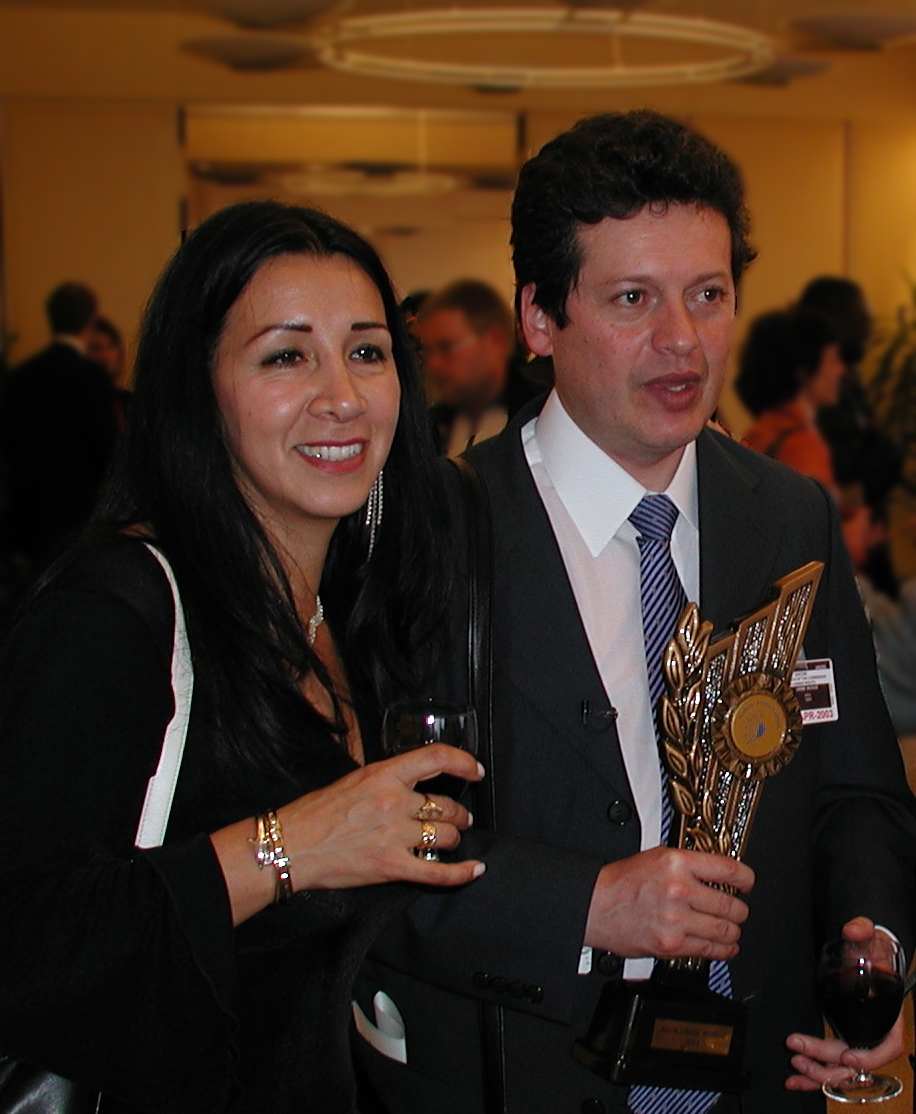
Front Line Defenders report that on 9 February 2014, human rights defender Martha Díaz received the fifth text message to declare her a military target and threaten her with death within three days. All five threats have come from the same phone number. Martha Díaz is the director and legal representative of the Asociación de Familiares Unidas por un Solo Dolor (Association of Relatives United by a Single Sorrow – AFUSODO), an organisation for family members of victims of extrajudicial killings, particularly false positives. She is also the technical secretary of the Atlantic chapter of MOVICE (National Movement of Victims of the State).On Wednesday 12 February, the President of Parliamentarians for Global Action Ross Robertson has expressed his concern and condemnation of the death threats against a well-known Colombian parliamentarian, Ivan Cepeda is a well-respected Colombian MP and human rights defender as well as against Bogota Mayor Gustavo Petro and human rights defender Alirio Uribe Muñoz (the latter is the 2003 Laureate of the Martin Ennals Award for Human Rights Defenders, portrayed here with his wife in 2003).
Human rights of womenin Afghanistan were at the forefront of the international agenda after the fall of the Taliban in 2001. Thirteen years later, nine Afghan women human rights defenders working at the front line reflect on the progress that has been made over the last years, as well as on the risks they have faced because of their work. Today, new challenges arise, as the lack of commitment at national and international level endangers past achievements and the continuation of progress in the near future. Dublin-based Frontline Defenders published the following video in 2 parts:
Front Line Defenders launched an online and social media campaign to focus attention on the plight of 12 human rights defenders (HRDs) from Eastern Europe and Central Asia coinciding with the launch of the Winter Olympics in Sochi, Russia. The ‘Rights. Risks. Change!’ campaign (www.sportshrd.org) calls on the public to take solidarity action to support these 12 defenders and to pressure local officials to respect the work of HRDs.
All 12 of the HRDs highlighted in the campaign have displayed great courage and integrity in their work on a range of human rights issues. Read the rest of this entry »
reports that on 25 January 2014 the office of LGBTI rights organisation Alternative in Côte d’Ivoire was attacked for the fourth time, and a security guard was hospitalised. The attack is the fourth such attack in one week, and follows previous threats. During the attack on the offices, laptops and desktop PCs were stolen and everything else in the office destroyed, including the electricity supply lines and emergency food supplies for people living with AIDS. It is reported that although members of the organisation called on the nearby police to help, the police did not come.
[On 20 January 2013, a mob attacked the home of human rights defender Mr Claver Touré, executive director of Alternative. For more information http://www.frontlinedefenders.org/node/24748]
On 21 January 2014, the indigenous Lenca leader and human rights defender, Mr Justo Sorto, was found dead in Jesús de Otoro, Western Honduras. Justo Sorto was an active member for twenty years of the Consejo Cívico de Organizaciones Indígenas Populares – COPINH (Civic Council of Popular Indigenous Organisations). The human rights defender was killed by several gunshots from a high-calibre weapon. [ COPINH is an organisation that works for the defence of the land and the environment, and for improving the living conditions of communities and indigenous peoples in Honduras.] The indigenous Lenca community works for the defence of its forests and against the execution of mining projects in the region. Read the rest of this entry »
On 21 January 2014, a group of unidentified armed men attempted to break in to the house of human rights defender Ms Amina Mohamed. She was recently warned that a gang, hired by a young man involved in a lawsuit she is working on, was planning to “punish” her and her family for her activism on gender-based violence. Amina Mohamed is a community activist, and member of Bunge la Wamama Mashinani(The Women’s Parliament at the Grassroots), the women’s branch of the Bunge la Mwananchi movement (The People’s Parliament). Amina Mohamed has particularly been vocal on issues of gender-based violence in Kenya. Read the rest of this entry »
For those who think that large international human rights meetings tend to take place in the ‘western’, you should check out the programme and website of the WORLD HUMAN RIGHTS FORUM which was held in Brasilia from 10 – 13 December 2013: http://www.fmdh.sdh.gov.br/index.php/en/program [representatives from 74 countries, more than 500 different activities and over 9.000 participants].
One such activity was the seminar “Comparative experiences for the protection of human rights defenders at the international level” chaired by Luciana García, director of the Department of Defence of Human Rights, from the Brazilian Human Rights Secretariat. Luis Enrique Eguren, President of Protection International, shared the table (picture above) with experts from other organisations, such as: Andrea Rocca of Front Line Defenders, Laura Tresca of Article 19, and Michelle Morais de sa Silva, General Coordinator for Accompaniment in Projects of International Cooperation.
The WFHR is an initiative of the Human Rights Secretariat of the Presidency of the Brazilian Republic, whose main objective is to promote a space for the public debate on Human Rights in which the progress and challenges are addressed with respect for the differences and social participation, with the aims of reducing inequalities and fighting against human rights violations…The Minister Maria do Rosário, from the Human Rights Secretariat of the Presidency of the Republic of Brazil: “We organise this forum in Brazil because we think governments must always be opened to dialogue with civil society, precisely because this strengthens democracy …..We learn with Mandela that it is ourselves who must be the actors for the promotion of peace”.
At the closing ceremony of the World Human Rights Forum it was announced which countries will host the next events: Morocco in 2014 and Argentina in 2015.




 Hans Thoolen on Human Rights Defenders and their awards