Posts Tagged ‘freedom to demonstrate’

Germany Prosecutes Environmental Defenders says HRW

May 30, 2024

Nina Alizadeh Marandi of HRW on 28 May 2024 said that German environmental activists are facing increasingly harsh rhetoric and legal action from authorities as they mobilize to confront the climate crisis.

Last week, on 21 May, Germany’s efforts to curb environmental activism took a disturbing turn when authorities used an offence typically reserved for prosecutorial pursuit of serious organized crime to indict Letzte Generation (Last Generation), a climate activist group known for disruptive protests such as roadblocks and other acts of civil disobedience, as a criminal organization. A conviction under federal law would pave the way for prosecuting anyone who participates in or supports Letzte Generation, including administratively or financially.

This heavy-handed approach reflects a troubling trend in Europe of stifling civil society and climate activism. Such actions chill public participation in protests against state policies or state inaction on a range of urgent issues. [see also:https://humanrightsdefenders.blog/2024/03/04/state-repression-of-environmental-defenders-a-major-threat-to-human-rights/]

The investigation into Letzte Generation as a criminal organization has involved armed police conducting predawn raids, storming private apartments while the activists were still asleep, and granting warrants for police to surveil the group’s communications, including calls made with media.

Last year the group’s website was temporarily seized during a fundraising campaign, with a notice from the police falsely labeling Letzte Generation a criminal organization and stating any donation constitutes illegal support for crime. This move by the police, despite no judicial assessment of the charges having taken place, exposes a deeply worrying bias against the group and raises questions about whether authorities are respecting due process.

International law protects the right to public participation in environmental matters and recognizes peaceful, nonviolent civil disobedience as a legitimate form of assembly. Disruptions like traffic blockades, while inconvenient, generally do not constitute violence under international standards, although damage to or destruction of private or public property may.

While civil disobedience often involves breaking national laws, authorities are required to respond proportionately, giving due weight to the right to protest and the importance to the public interest of the issues at stake.

The government’s extreme response to Letzte Generation’s activism appears disproportionate, threatens the very right to protest, and smears climate activists when their cause has never been more urgent. Instead of intimidating environmental defenders, Germany should live up to its commitment to ambitious climate action and investigate the concerns that groups like Letzte Generation raise.

https://www.hrw.org/news/2024/05/28/germany-prosecutes-environmental-defenders

But it can also be undone: see: https://www.hrw.org/news/2024/05/29/uk-court-rules-anti-protest-measures-unlawful

UN Human Rights Office alarmed over repression of student protests in USA

May 2, 2024

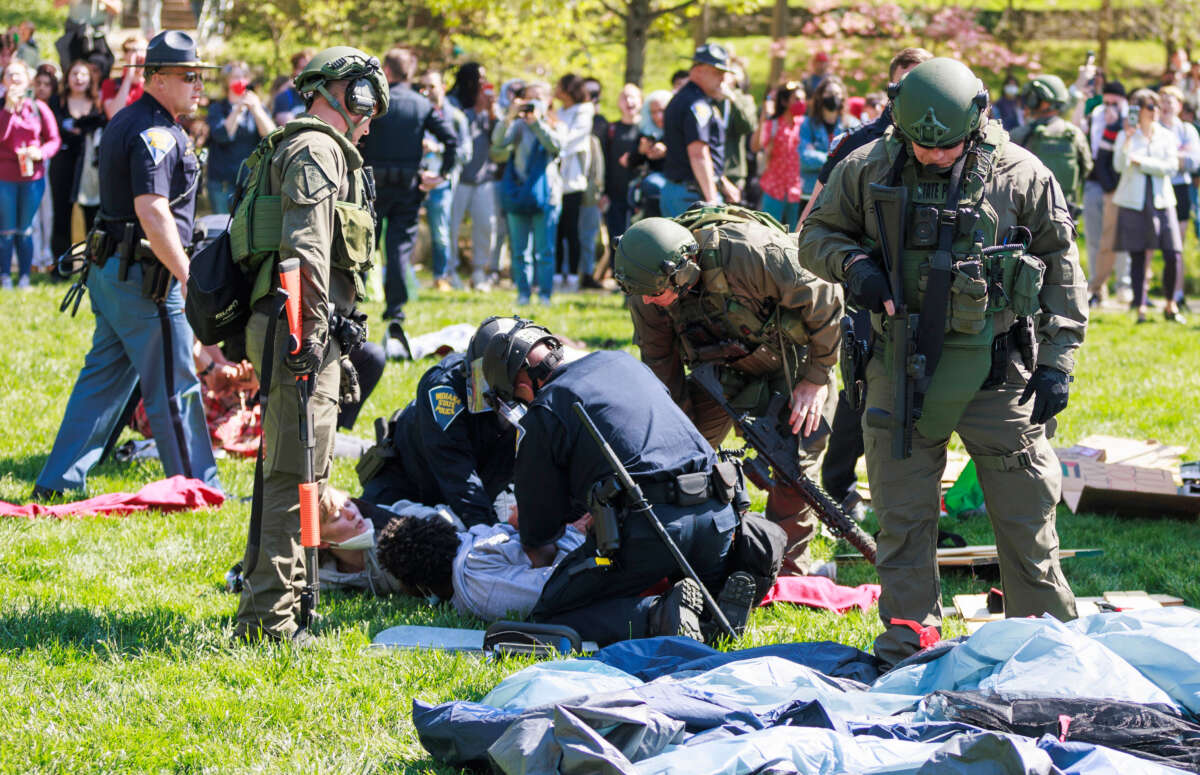
Dozens of people are arrested by the Indiana State Police riot squad during a pro-Palestinian protest on campus in Bloomington, Indiana, on April 25, 2024.

UN human rights officials are expressing alarm over the recent wave of violent repression by university administrators against the student protests for Palestinian liberation that have swept the U.S., raising concerns that protesters’ rights to free speech and assembly are being violated.

A statement on Tuesday said that UN High Commissioner for Human Rights Volker Türk, the UN’s top human rights officer, is “troubled” over a “series of heavy-handed steps taken to disperse and dismantle protests” across U.S. college campuses.

Freedom of expression and the right to peaceful assembly are fundamental to society — particularly when there is sharp disagreement on major issues, as there are in relation to the conflict in the Occupied Palestinian Territory and Israel,” said Türk. “I am concerned that some of the law enforcement actions across a series of universities appear disproportionate in their impacts.

Over the last two weeks, over 1,200 protesters have been arrested across dozens of campuses after university administrators enlisted police to crack down on encampments and other demonstrations set up by students calling for their schools to divest from Israel and supporting corporations, among other demands. At some universities, administrators even allowed law enforcement officers to aim sniper rifles at their students for their peaceful acts of protest.

UN Special Rapporteur on Human Rights Defenders Mary Lawlor said that universities’ crackdowns are an obvious violation of students’ rights.

https://www.ohchr.org/en/statements/2024/02/israelopt-enabling-human-rights-defenders-and-peaceful-protests-vital-achieving

https://www.ohchr.org/en/press-releases/2024/04/united-states-america-un-human-rights-chief-troubled-law-enforcement-actions

see also: the Economist of 30 April: Escalating protests expose three fault lines on American campuses

Report of a UN consultation on law enforcement’s role in peaceful protests

February 21, 2024

On 16 February, 2024 Sandra Epal Ratjen & Nicolas Agostini in Global Rights reported on a UN consultation on law enforcement’s role in peaceful protests which brought together practitioners and human rights defenders.

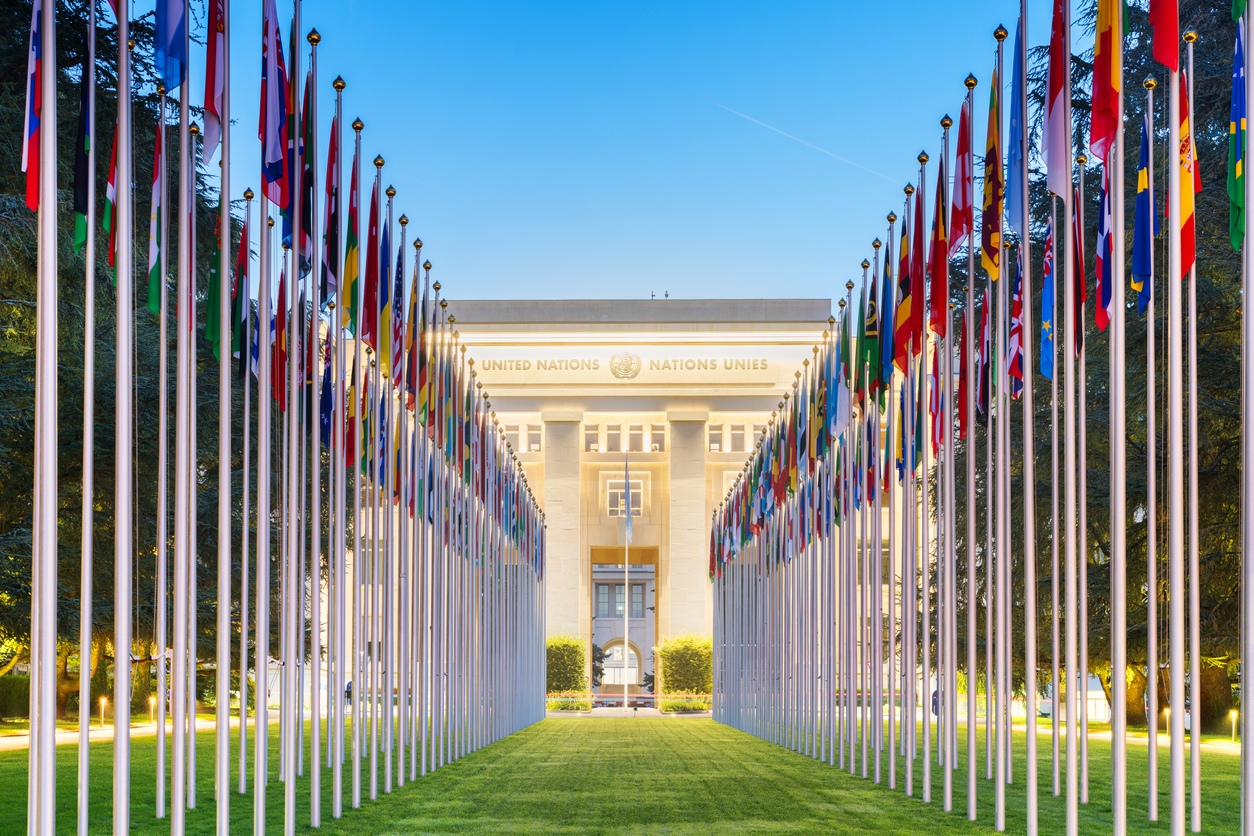
Over two days in Geneva, the UN special rapporteur on freedoms of peaceful assembly and association, Clément Voule, the UN Human Rights Office (OHCHR), and the UN Office on Drugs and Crime (UNODC) convened a consultation on the facilitation of peaceful protests by law enforcement. The event followed several regional workshops, organized in accordance with Human Rights Council resolution 50/21, which requested that the special rapporteur develop “technical and practical tools . . . to assist law enforcement officials in promoting and protecting human rights in the context of peaceful protests.” There was nothing unusual in this format—or in the event’s title. But despite its attractive feel (at least for human rights geeks), it ran the risk of turning into yet another academic discussion replete with theorizing but offering little in the way of practical solutions. 

It turned out to be one of the most refreshing, engaging, and action-oriented human rights dialogues we’ve attended.

It’s about the makeup

What made the event rather unusual was its makeup. In addition to civil society members (public assembly, law enforcement, torture, and rule of law specialists attended), the consultation brought together practitioners from all over the world. By “practitioners,” we mean not just police watchdogs (oversight bodies and disciplinary authorities) but police officers and commanders, all on active duty. 

While some activists would draw back with a wince, those human rights defenders and organizations who were present engaged with an open mind, as did law enforcement personnel. Participants weren’t going to talk amongst themselves or only preach to the converted. They were going to try to bring about an actionable outcome. After all, their aim was to devise how law enforcement can facilitate peaceful assemblies and protect rights in such contexts.

Peer pressure was minimal. On all sides, there was nothing to “prove”: no need to adopt an intransigent position, no need to show you’re smart, no need to cajole anyone—there were only incentives to share expertise and experience. 

Sure, there were precedents. Recent workshops brought together practitioners and outlined best practices. For instance, the “Istanbul Process” meeting on promoting religious tolerance held in Singapore was practitioner-centric. Since then, however, the Istanbul Process has collapsed as the Organization of Islamic Cooperation (OIC) revived the “defamation of religions” agenda.

Without naïveté but considering the “real-world” nature of the outputs of this process, we’re confident that the work done under the auspices of Clément Voule, OHCHR, and UNODC will, to some extent, enhance human rights compliance in police practice and benefit both peaceful protesters and law enforcement officials. Notably, the outcome documents are less technical than most human rights documents. 

It’s also about the substance

The consultation was also innovative because of its hands-on approach. In addition to the main working document, a “Model Protocol” for the law enforcement facilitation of peaceful protests, the project led by Clément Voule and his team, OHCHR, and UNODC will produce a “Handbook” and a “Checklist” for law enforcement professionals. The latter two will be practical documents guiding police practice. 

The magnitude and diversity of experiences in the room meant that discussions were light-years away from sterile sloganeering or divisive debates—the kind we see on social media. On civil society’s side, no one advocated “defunding the police.” On the police side, no one advocated for qualified immunity. All participants created a fertile ground for dialogue on how to ensure human rights-compliant, competent, and respected law enforcement that is able to facilitate, not hinder, public assemblies. 

Civil society participants recognized the need for well-funded, well-trained police. We kept in mind (and were reminded of) the realities of the job—what the average law enforcement officer faces daily. The challenges include understaffing, lack of adequate training, and, quite simply, fear (facing a crowd, even peaceful, will never feel like sitting on your sofa sipping a Whiskey Sour). Law enforcement participants, for their part, recognized the need for accountable police behavior and to confront discrimination and abuses of power. They kept in mind (and were reminded) that to be respectful is a sine qua non to be respected.

Also reviewed were “prior to protest,” “during protest,” and “after protest” issues, plus the situation of specific groups and accountability for violations. One section addressed police well-being, which is essential to human rights compliance, as strained police officers are much more likely to engage in misconduct. We didn’t shy away from addressing sensitive issues—police brutality, accountability, or budgeting. 

It wasn’t an echo chamber, but participants agreed on key points. Among others: the role of police vs. the role of prosecution; the need for effective communication between protesters and police, de-escalation, and adequate training for police officers; or the fact that a clear distinction must always be made between peaceful and non-peaceful elements of an assembly. 

It was a far cry from the way these conversations unfold online, and once again, one can see the toxicity of social media. Instead of fostering healthy discussions (differences aren’t that wide between most people), social media algorithms artificially promote simplistic views, entrench positions, and elevate the most divisive topics. This process distracts those seeking solutions from problem-solving. No one benefits from this situation—certainly not rights-holders. 

Don’t forget political will 

Assuredly, the outcomes of this consultation will go unheeded in many countries, where protests are rare or police have total impunity. Elsewhere, not much will happen without political will. 

But the beauty of this consultation is that political will to facilitate assemblies won’t need to come from the highest level. Once publicly available, the outcome documents—particularly the Handbook and Checklist, with their guidelines on communication, de-escalation, and risk assessment regarding protests—will be available for law enforcement agencies and officers at all levels to use. The ideal scenario, of course, will be governments publicly committing to using the outcome documents.

The final documents will stem from a dialogue that brought together people with hands-on experience who tried to build bridges and maximize their chances of having an impact on the ground. This model should inform future human rights dialogues.

The Protocol, Handbook, and Checklist will be presented at the next session of the UN Human Rights Council, February 26–April 5, 2024. Clément Voule will make his last appearance as special rapporteur. For his successor—and for all people of goodwill who want to see peaceful protests proceed without hindrance, as well as rights-compliant law enforcement, joint work will be needed to popularize, operationalize, and implement the documents. 

https://www.openglobalrights.org/sandra-Epal-Ratjen/Human-rights-dialogue-we-need
Verdict against labour rights defenders, another blow to Cambodia’s civic space

May 30, 2023

On 26 May 2023 The Asian Forum for Human Rights and Development (FORUM-ASIA) called for quashing the convictions of NagaWorld union leader Chhim Sithar alongside eight members of the Labor Rights Supported Union of Khmer Employees of NagaWorld (LRSU).

FORUM-ASIA strongly condemns the verdict given on 25 May 2023 by a Phnom Penh municipal court. The trade unionists were convicted of ‘incitement to commit a felony or disturb social security’ under Criminal Code Articles 494 and 495.

Sithar was sentenced to two years in prison. Meanwhile, the other union members were sentenced to one to one and a half years in prison and received suspended sentences or judicial supervision.

We urge the court to overturn the verdict as Cambodian authorities are abusing the criminal justice system by targeting union leaders and other labour rights advocates. We call on the Cambodian Government to immediately release Sithar. This is the umpteenth unfair decision that exemplifies the government’s contempt for democratic principles as well as Hun Sen’s attempts to silence critical voices months before the national elections,’ said Mary Aileen D. Bacalso, Executive Director of FORUM-ASIA.

Alongside other union members, Sithar was first arrested in January 2022 and held in pre-trial detention for two months after being charged with incitement to commit a crime for leading a peaceful strike demanding higher wages for workers and the reinstatement of hundreds of union members who believe they were unjustly fired in December 2021. After being released on bail, Sithar was once again detained in November 2022 for allegedly violating her bail by travelling abroad to join a trade union conference without court approval.

The trial against Sithar and her eight co-defendants–Chhim Sokhorn, Hay Sopheap, Kleang Soben, Ry Sovandy, Sok Kongkea, Sok Narith, Sun Sreypich, and Touch Sereymeas–began in January 2023. During the trial, Sithar stated that the LRSU has followed all legal protocols for their protest against mass layoffs and alleged union-busting, only launching the strike after all viable mediation efforts were exhausted. Meanwhile, prosecutors claimed that Sithar and LRSU members are guilty of leading a strike for more than a year even after authorities have declared the strike to be illegal.

Nevertheless, in February 2023, Sithar won the prestigious Human Rights Defenders Award– from the US Department of State–for her exceptional courage and leadership in advocating for the promotion and protection of universally recognised human rights and fundamental freedoms.

www.forum-asia.org

Delhi High Court re-establishes that criticism is not sedition

June 16, 2021

Lawyers have welcomed the decision by Delhi High Court stating that protesters have the right to criticise the government. They also hailed the Court’s verdict defining the lines between criticism of the government and activities that destabilize the country.

Aneesha Mathur in India Today of 16 June 2021 reports that -with the Delhi High Court rapping the government and Delhi Police over imposing UAPA on activists in connection with the clashes, following the anti-CAA protest – lawyers and jurists have said the verdict was significant since it has tried to define the line between criticism of the government, which is a Constitutional right, and activities that destabilize the country.

Former Supreme court justice Madan B Lokur welcomed the High court verdict.: “The judgment is welcome. It’s about time the courts told the State that draconian laws like the UAPA, NSA, sedition and so on may be used, if at all, very rarely and only if there is clinching evidence. Draconian laws cannot and must not be abused otherwise our braveheart judges will strike down arbitrary actions. The Delhi High Court has opened the door for interference and other High Courts should follow quickly while recognising that human rights are for humans and not the faceless State,”.

See also; https://humanrightsdefenders.blog/2018/10/07/india-attacks-on-human-rights-defenders-abound-under-unlawful-activities-prevention-act/

Senior advocate Dushyant Dave told India Today TV that the court had “not said anything new but laid down the law on the facts of the case.” Dave also called for “proactive and expeditious” movement from the judiciary on similar cases, and said that the activists “had lost one year of their life,” for no reason.advertisement

We are the world’s largest democracy. We will not be able to call ourselves a democracy if such laws are used to suppress dissent.” Speaking to India Today TV, Dave said despite “rule of law”, India had “become a police state.”

“Not only is BJP government abusing UAPA, but the Congress government also abused POTA and thousands were put in jail,” said Dave.

Lawyer Vrinda Grover also said the HC verdict was “significant” since there has been indiscriminate use of the law in recent years.

“Over the last few years, we see the police frequently using UAPA and sedition to silence critical citizens’ voices by placing them behind bars under stringent anti-terror law. The High Court has pierced through the indiscriminate use of UAPA by the police and unwarranted labelling of activities as terrorism. The Court has reiterated that non-violent contestation of government policies and laws is a constitutionally protected right to protest. Finally, the court has also reminded that if the speedy trial is not possible they must be granted bail,” said Grover.

He added: “In this context, we must raise the issue of incarceration of 16 human rights defenders in the Bhima Koregaon case under UAPA for almost three years and the trial is yet to commence. The judiciary must intervene and not allow the criminal legal machinery to be used by the State to suppress fundamental freedoms of citizens, otherwise democracy is in peril.”

“Anti-terror laws are made very strict because they are meant to handle terrorism cases. The government must balance the right of the citizens to protest and criticise with the need of the state. But governments tend to treat criticism as sedition and anti-national, which is wrong. The two judges have shown courage in calling this out,” said Senior advocate Geeta Luthra.

Former Law Commission chairman, Justice BS Chauhan said that while the potential for misuse “cannot mean repeal of an act”, there is a “need to define the contours of the law, as the UAPA is a wide provision” as it was meant to combat serious threats.advertisement

“Courts need to define contours of sedition and UAPA otherwise they can cover freedom of speech and expression,” said Chauhan.

https://www.indiatoday.in/law/story/wrong-to-treat-criticism-as-sedition-lawyers-welcome-delhi-hc-verdict-quashing-uapa-case-against-activists-1815309-2021-06-16

Palestinian human rights defender Amro Issa convicted for speaking out

January 7, 2021

On Wednesday morning 6 January 2021 an Israeli military court convicted Palestinian Human Rights Defender Issa Amro for peacefully protesting and civil disobedience. The Israeli military judge announced the verdict in a hearing attended by representatives of British, European, EU and Canadian consulates. Amnesty International issued a statement calling to drop all the “politically motivated” charges.

Today Israel announced that Palestinians are not allowed to peacefully protest the Israeli occupation without a permit from the occupier,” Amro stated. “This conviction is the military system against the Palestinian nonviolent resistance. It aims to suppress my voice and end all activism against the Israeli occupation.” Amro’s Israeli lawyer Gaby Lasky added that “The military court is just an organ of occupation. The [indictment for nonviolent protest] is an example of how the courts are used in order to deter the important voices of human rights defenders.”

Amro is a founder of the Youth Against Settlements group in Hebron, which organises non-violent activism against the illegal Israeli settlements in Hebron and the discriminatory restrictions placed on Palestinians by the Israeli authorities in the city. Amro first appeared in an Israeli military court in 2016 on 18 charges, ranging from “insulting a soldier” to “participating in a march without a permit”. Some of the charges dated back to 2010.

The indictment, first presented in 2016, included 18 charges related to Amro’s community organizing deemed “baseless,” “politically motivated” or “physically impossible” by Amnesty. The military judge convicted Amro on six counts: three counts of “participating in a rally without a permit,” two counts of “obstructing a soldier,” and one count of “assault.” These surround Amro’s participation in the peaceful “Open Shuhada Street” demonstration in 2016; Amro’s participation in the nonviolent “I Have a Dream” demonstration from 2013 in which participants wore masks of Obama and Martin Luther King; one count of obstruction relates to a nonviolent sit-in protest in 2012 calling to re-open the old Hebron municipality building; one count of “assault” by “shoving someone” related to a previously-closed case from 2010, an incident for which the indictment had included an obstruction charge (acquitted) for Amro yelling “I am being assaulted” in the Israeli police station prior to Amro being carried out to an ambulance on a stretcher.

In 2019, UN Special Rapporteurs called for Amro’s protection and expressed “concern” over the charges. In 2017[see: https://humanrightsdefenders.blog/2019/04/11/un-rapporteurs-intervene-again-for-palestinian-human-rights-defender-issa-amro/]; thirty-five U.S. House Representatives and four Senators including Bernie Sanders sent letters highlighting that some charges were not internationally recognizable offenses and that Amnesty would consider Amro a “prisoner of conscience” if convicted. Issa Amro is the co-founder and former coordinator of the Hebron-based Youth Against Settlements initiative. In 2010, he was declared “Human Rights Defender of the year in Palestine” by the UN OHCHR and he is formally recognized by the European Union. He won the One World Media Award in 2009 for his involvement in B’Tselem’s camera distribution project. He was a guest of the U.S. State Department in 2011 and has spoken at the UN Human Rights Council on numerous occasions. The sentencing is scheduled for 8 February.

See also: https://humanrightsdefenders.blog/2016/12/21/palestinian-human-rights-defenders-continue-to-be-persecuted/

Saleh Higazi, Amnesty International’s Middle East and North Africa Deputy Director, said: “The Israeli authorities must end their campaign of persecution against Palestinian activist Issa Amro, who is a prominent voice against Israel’s regime of discrimination and systematic human rights violations against Palestinians in the Occupied Palestinian Territories, particularly in Hebron.”

https://www.scoop.co.nz/stories/WO2101/S00025/israeli-military-court-convicts-un-recognized-palestinian-human-rights-defender-for-protesting-without-a-permit.htm

http://www.ekklesia.co.uk/node/30290

https://www.amnesty.org.uk/

https://mailchi.mp/3fff66fe2a8b/military-court-convicts-human-rights-defender-issa-amro?e=51113b9c0e

New Year, New Charges against Thai Protesters – the Lese-majesty law in Thailand

January 4, 2021

Thai authorities on 1 January 2021 made their 38th arrest of a pro-democracy activist in recent weeks under the country’s tough lèse majesté law as authorities crack down on the country’s unprecedented protest movement. That law, Section 112 of the Thai criminal code, forbids defamation of the king and provides for three to 15 years’ imprisonment for violations.The law had been dormant since King Maha Vajiralongkorn succeeded his father, King  Bhumibol Adulyadej, who died in 2016. The Thai government, though, is now using it to try to stamp out continuing protests calling for the government to resign, a new constitution and reform of the monarchy

Thailand’s authorities must stop targeting pro-democracy protesters with draconian legal action and instead enter into dialogue, according to the UN’s special rapporteur for freedom of assembly, who warned the country risks sliding into violence. Clément Voule said he had written to the Thai government to express alarm at the use of the fierce lese-majesty law against dozens of protesters, including students as young as 16.

It is legitimate for people to start discussing where their country is going and what kind of future they want,” Voule said of the protests. “Stopping people from raising their legitimate concerns is not acceptable.

So far, 37 people face charges of insulting the monarchy for alleged offences ranging from wearing traditional dress deemed to be a parody of the royals to giving speeches arguing that the power and wealth of the king should be curbed.

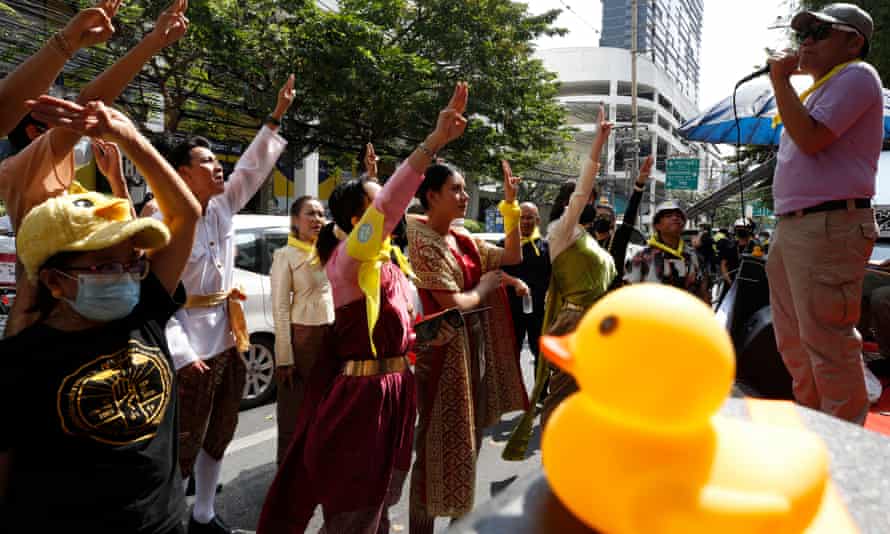
Anti-government protesters flash a three-finger salute – a gesture used adopted by protesters from the Hunger Games films – as they gather in support of people detained under the lese-majesty law at a police station in Bangkok.
Anti-government protesters flash a three-finger salute – a gesture used adopted by protesters from the Hunger Games films – as they gather in support of people detained under the lese-majesty law at a police station in Bangkok. Photograph: Narong Sangnak/EPA

Prominent protest leaders face an unusually high number of charges. This includes the student activists Parit Chiwarak, also known as Penguin, (12 charges) and Panusaya Sithijirawattanakul (six charges) and the human rights lawyer Anon Nampa (eight charges), who have given speeches calling for the power of the royals to be curbed.

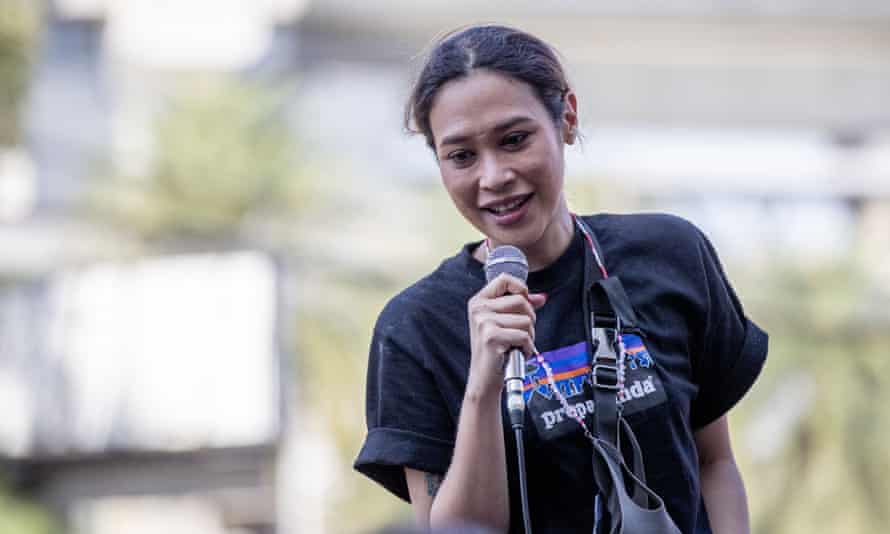
The pro-democracy protest fundraiser Inthira Charoenpura
The pro-democracy protest fundraiser Inthira Charoenpura speaks from a stage outside Bang Khen police station in Bangkok. Photograph: Gemunu Amarasinghe/AP

Protesters – who have faced various other charges over recent months, including sedition – declined to participate in a government reconciliation panel in November, rejecting it as an attempt to buy time. The recent cases come after months of demonstrations in which protesters have made unusually frank and public calls for reform to the monarchy.

Benja Apan, 21, one of 13 people facing charges over a demonstration outside the German embassy in Bangkok, said legal action was unlikely to deter protesters from coming out in the new year. “I actually think it will bring more people out, because it is not fair,” she said.

The human rights group Amnesty International has launched a campaign calling on PM Prayut Chan-o-cha to drop charges pressed on a number of activists for their role in the pro-democracy movement and to repeal, or at least amend, Thailand’s draconian lèse majesté law. According to the campaign, at least 220 people, including minors, face criminal charges for relating to their actions in the pro-democracy movement. Activists are calling on government and monarchy reform, raising issues considered taboo and unprecedented in Thai society. Thailand must amend or repeal the repressive laws it is using to suppress peaceful assembly and the expression of critical and dissenting opinions.

Amnesty International is calling on people to take action and send a letter to the prime minister, calling on the Thai government to change their approach when handing the ongoing protests to protect human rights. Sample letter by AI’s campaign calls on Prayut to:

  • Immediately and unconditionally drop all criminal proceedings against protesters and others charged solely for exercising their rights to freedom of peaceful assembly and expression
  • Cease all other measures, including harassment, aimed at dissuading public participation in peaceful gatherings or silencing voices critical of the government and social issues
  • Amend or repeal legislation in order to ensure it conforms with Thailand’s international human rights obligations on freedom of peaceful assembly and expression, and to train state officials to carry out their duties confirming to Thailand’s obligation to respect, protect and fulfil the peaceful exercise of the rights to freedom of peaceful assembly and expression.

On Saturday 19 December 2020 Maya Taylor in The Thaiger had already reported that the United Nations High Commission for Human Rights has expressed shock and dismay at Thailand’s use of its strict lèse majesté law against a 16 year old pro-democracy activist. The UN High Commissioner for Human Rights’ spokesperson Ravina Shamdasani has called on Thailand to refrain from using the law against those exercising their right to freedom of speech, as she expressed alarm that a minor was being charged under the law. “It is extremely disappointing that after a period of 2 years without any cases, we are suddenly witnessing a large number of cases, and – shockingly – now also against a minor. We also remain concerned that other serious criminal charges are being filed against protesters engaged in peaceful protests in recent months, including charges of sedition and offences under the Computer Crime Act. Again, such charges have been filed against a minor, among others.

The UN Human Rights Committee has found that detention of individuals solely for exercising the right to freedom of expression or other human rights constitutes arbitrary arrest or detention. We also urge the government to amend the lèse majesté law and bring it into line with Article 19 of the ICCPR on the right to freedom of expression.”

Thailand’s Foreign Ministry spokesman has played down the UN High Commissioner for Human Rights’ criticisms over the kingdom’s enforcement of the Lese Majeste law.

See also in 2019: https://humanrightsdefenders.blog/2019/12/23/thailand-amnesty-and-un-rapporteur-agree-on-misuse-of-lese-majeste/

https://thethaiger.com/news/national/pro-democracy-movement-making-little-headway-monarchys-powers-remain-untouched

https://www.theguardian.com/world/2020/dec/27/un-thailand-protesters-royal-insult-law-lese-majesty

https://www.voanews.com/east-asia-pacific/new-year-new-charges-thai-protesters-slapped-royal-defamation-charges

USA and 3 other countries in the Americas downgraded by human rights researchers

December 17, 2020

On Wednesday, 16 December 2020 Débora Leão and Suraj K. Sazawal published an opinion piece in IPS entitled: “USA Downgraded as Civil Liberties Deteriorate Across the Americas” (Débora Leão is a Civic Space Researcher at CIVICUS, the global civil society alliance. She has a Master of Public Policy degree. Prior to joining CIVICUS, Débora worked on advocacy and research related to civic participation, urban development and climate justice. Suraj K. Sazawal serves on the board to Defending Rights & Dissent and is co-author of ‘Civil Society Under Strain’, the first book to explore how the War on Terror impacted civil society and hurt humanitarian aid.

Protests in New York City against racism and police violence, following the death of George Floyd. Credit: UN Photo/Evan Schneider

Few images better illustrate the recent decline in civil liberties in the United States than that of peaceful protesters near the White House being violently dispersed so Donald Trump could stage a photo-op. Moments before the president emerged from his bunker on June 1 to hold a bible outside a boarded-up church, federal officers indiscriminately fired tear gas at people who had gathered in Lafayette Park to protest about the police killing of George Floyd. This was far from an isolated incident: nationwide protests against systemic racism and police brutality have been met with widespread police violence.

Since May, the CIVICUS Monitor, an online platform that tracks fundamental freedoms across 196 countries, documented dozens of incidents where law enforcement officers, dressed in riot gear and armed with military grade-equipment, responded to Black Lives Matter protests with excessive force. These include officers driving vehicles at crowds of protesters and firing tear gas canisters and other projectiles at unarmed people, leaving at least 20 people partially blinded.

Throughout the year, journalists and health workers, clearly marked as such while covering the protests, have been harassed and assaulted. In one incident caught on live TV, a news reporter and camera operator from Louisville, Kentucky were shot by police with pepper balls while covering protests over the police killing of Breona Taylor.

This sustained repression of protests and an increased crackdown on fundamental freedoms led to the USA’s civic space rating being downgraded from ‘narrowed’ to ‘obstructed’ in CIVICUS new report, People Power Under Attack 2020.

This disproportionate response by law enforcement officers to protesters goes beyond what is acceptable practice when policing protests, even during an emergency. Under international law, people have a right to assemble freely. Any restrictions to this right must be proportionate and necessary to address an emergency or reestablish public order.

While recent brutality against protests for racial justice is concerning, the decline in basic freedoms in the USA began before this crackdown. The repression seen in 2020 was preceded by a wave of legislation limiting people’s rights to protest.

In recent years, several states enacted restrictive laws which, for example, criminalise protests near so-called critical infrastructure like oil pipelines, or limit demonstrations on school and university campuses. Increased penalties for trespassing and property damage are designed to intimidate and punish climate justice activists and organisations that speak out against fossil fuels.

In the wake of Black Lives Matter protests, some of the ‘anti-protest’ bills introduced this year seem particularly cruel, for instance, by proposing to make people convicted of minor federal offences during protests ineligible for pandemic-related unemployment benefits.

Growing disregard for protest rights underscores wider intolerance for dissent. In parallel with restrictions on the freedom of peaceful assembly, the USA also saw an increase in attacks against the media, even before Black Lives Matter demonstrations erupted. Over the past three years, the CIVICUS Monitor has documented the frequent harassment of journalists by the authorities and civilians while covering political rallies or when conducting interviews.

Correspondents critical of the Trump administration or reporting on the humanitarian crisis in the USA/Mexico border region sometimes faced retaliation; documents obtained by ‘NBC 7 Investigates’ in 2019 showed the US government created a database of journalists who covered the migrant caravan and activists who were part of it, in some cases placing alerts on their passports.

In January 2020 a journalist was barred from accompanying Secretary of State Mike Pompeo in an official trip to Europe after Pompeo objected to the questions by another reporter from the same outlet.

The harsh treatment of people wanting to express themselves and the decline of civil liberties is part of a broader global decline in fundamental freedoms. Our new report shows less than four percent of the world’s population live in countries that respect the freedoms of association, peaceful assembly and expression.

Each country’s civic space is rated in one of five categories: ‘open, ‘narrowed, ‘obstructed,’ ‘restricted,’ or ‘closed’. The USA was one of 11 countries downgraded from its previous rating.

Another recent example may be that on 15 December 2020 five independent UN human rights experts expressed serious concern over the arrest and charges brought against an indigenous leader (Nicholas Tilsen, human rights defender of the Oglala-Lakȟóta Sioux Nation), for peacefully protesting a political rally held last July at Mount Rushmore National Memorial, located on treaty lands of the Great Sioux Nation.

In the Americas, three other countries showed significant declines: Chile and Ecuador were downgraded to ‘obstructed’ and Costa Rica’s rating changed to ‘narrowed’.[see also: https://humanrightsdefenders.blog/2020/07/01/even-costa-rica-has-serious-problem-with-protection-of-indigenous-defenders/] In the first two countries, as with the USA, rating changes reflected unnecessary and disproportionate crackdowns on mass protest movements.

Violations of protest rights were common across the region, with detention of protesters and excessive use of force among the top five violations of civic freedoms recorded this year. In addition, the Americas continue to be a dangerous place for those who dare to stand up for fundamental rights: across the world, 60 percent of human rights defenders killed in 2020 came from this region.

The authorities must engage with civil society and human rights defenders to create an environment where they are able to fulfil their vital roles and hold officials accountable.

https://news.un.org/en/story/2020/12/1080122

Thailand: joint statement by International NGOs on Pro-Democracy Protests

November 29, 2020

A group of 13 important human rights NGOs – in a joint statement – condemn the Thai police’s unnecessary and excessive use of force against peaceful protesters marching to the national parliament in Bangkok on November 17, 2020. They are concerned that authorities could employ similar measures when facing protesters who have declared they will march to the Siam Commercial Bank headquarters on November 25.

On November 17, police set out barriers and barbed wire to prevent a peaceful march organized by pro-democracy movements from reaching the parliament. Protesters planned to protest outside the parliament as members of parliament and senators debated seven different proposals for constitutional amendments, including an amendment proposed by the lawyers’ non-governmental organization iLAW (Internet Law Reform Dialogue), which was supported by the People’s Movement and its allies. Police refused to let protesters through the barriers, and when the demonstrators acted to breach those barriers, police crowd control units used water cannons laced with purple dye and an apparent teargas chemical, as well as teargas grenades and pepper spray grenades, to forcibly disperse thousands of demonstrators, including students, some of whom are children. Water cannons were first used at approximately 2:25 pm and police continued their efforts to disperse protesters, with constant use of water cannons, teargas and pepper spray into the evening.

Police also failed to prevent violence between pro-democracy protesters and royalist “yellow shirts” near the Kiak Kai intersection, near the parliament. Initially, riot police separated the two groups. However, video posted on social media later showed police officers informing the royalist protesters that they would withdraw and seconds later they vacated their position between the two groups. During the ensuing skirmishes, both sides were filmed throwing rocks and wielding clubs. Live broadcasts included sounds that appeared to be gunfire.

The Erawan Medical Centre reported that there were at least 55 protesters injured, mostly from inhaling teargas. It also reported that there were six protesters who suffered gunshot wounds. The injured included children: a kindergartener and elementary school students….

On November 18, the spokesperson for United Nations Secretary-General António Guterres “expressed concern about the [human rights] situation in Thailand … it’s disturbing to see the repeated use of less lethal weapons against peaceful protesters, including water cannons … it’s very important that the government of Thailand refrain from the use of force and ensures the full protection of all people in Thailand who are exercising a fundamental peaceful right to protest.”

We call on the Thai government to respect, protect and fulfill the right of demonstrators to peacefully protest, in line with Thailand’s international obligations under the ICCPR and customary international law. Specifically, Thailand should:

1.     Permit the People’s Movement march to proceed on November 25 and allow for non-violent protesters, including those who are children, to peacefully protest in front of the Siam Commercial Bank headquarters.

2.     Protect the rights of protesters, including those who are children, in accordance with the Human Rights Committee’s General Comment No. 37 on the Right of Peaceful Assembly.

3.     Facilitate the exercise of the right to peacefully assemble and refrain from dispersing assemblies by using weapons, including less-lethal weapons, against protesters in line with the United Nations Basic Principles on the Use of Force and Firearms by Law Enforcement Officials and UN and other guidance on less-lethal weapons.

4.     Protect protesters, including those who are children, from violence and interference by non-State actors, while also protecting the rights of counter-demonstrators.

5.     Take steps to ensure accountability for rights violations associated with the government’s crackdown on the protest movement and to ensure that those whose rights have been violated enjoy the right to an effective remedy, as guaranteed under ICCPR article 2(3).

Signed by:

Amnesty International

Article 19

ASEAN Parliamentarians for Human Rights

Asia Democracy Network

Asian Forum for Human Rights and Development (FORUM-ASIA)

Asian Network for Free Elections (ANFREL)

CIVICUS: World Alliance for Citizen Participation

Civil Rights Defenders

FIDH – International Federation for Human Rights

Fortify Rights 

Human Rights Watch

International Commission of Jurists

Manushya Foundation

———–

https://www.hrw.org/news/2020/11/25/statement-international-ngos-pro-democracy-protests-november-17-and-25-2020

Women human rights defenders in Poland under severe pressure

November 2, 2020

On 2 November 2020 ILGA Europe, Front Line Defenders, Amnesty International, Human Rights Watch, Freemuse and KPH Campaign Against Homophobia issued on joint statement demanding that Poland drop unfounded charges against women rights defenders for peaceful activism

Image: Elżbieta Podleśna / Image from Amnesty International UK website

Unfounded charges of “offending religious beliefs” are being brought against three women human rights defenders in Poland for simply exercising their right to freedom of expression, a coalition of six nongovernmental groups said. The first hearing in their case is scheduled for November 4, 2020, in the town of Plock. 

The Prosecutor General should drop the charges – and ensure that the three women can carry out their human rights work without harassment and reprisals by the authorities. The Polish authorities should amend their legislation in line with international and regional human rights standards and abstain from using it against activists to unduly curtail their right to freedom of expression.  

The three human rights defenders, Elżbieta, Anna and Joanna – whose surnames are not being used to protect their privacy – are facing trial for “offending religious beliefs” under Article 196 of the Criminal Code (C.C.) in relation to the use of posters depicting the Virgin Mary with a rainbow halo symbolic of the LGBTI flag around her head and shoulders. The authorities are alleging that the three activists pasted the posters on 29 April 2019 in public places such as on portable toilets, dustbins, transformers, road signs, building walls in public areas in the city of Plock and have “publicly insulted an object of religious worship in the form of this image which offended the religious feelings of others”. They now face up to two years in prison if found guilty for their peaceful activism. 

The authorities arrested and detained Elżbieta in 2019 after she took a trip abroad with Amnesty International. The authorities opened an initial investigation against her in May 2019 and in July 2020, they officially charged the three activists. 

Having, creating or distributing posters such as the ones depicting the Virgin Mary with a rainbow halo should not be a criminal offence and is protected under the right to freedom of expression.  

In its current formulation, Article 196 of the Criminal Code imposes undue restrictions on the right to freedom of expression by providing overly broad discretion to the authorities to prosecute and criminalise individuals for expression that must be protected. This is incompatible with Poland’s international and regional human rights obligations.  

Poland is bound by the International Covenant on Civil and Political Rights (ICCPR), the European Convention on Human Rights as well as the Charter of Fundamental Rights of the EU to respect, protect and fulfil the right to freedom of expression.  

Furthermore, in 2013, the Special Rapporteur in the field of cultural rights noted that “Restrictions on artistic freedoms based on insulting religious feelings… are incompatible with [ICCPR]”. In 2019, this was again highlighted by the Special Rapporteur on freedom of opinion and expression who stressed that criminalising expression that insults religious feeling limits “debate over religious ideas and… such laws [enable] governments to show preference for the ideas of one religion over those of other religions, beliefs or non-belief systems”. Freemuse is particularly concerned about the policing of artistic and creative content by the authorities in Poland and regard it as an unlawful attack on freedom of artistic expression. 

Amnesty International has previously called on the Polish authorities to repeal or amend legal provisions, such as Article 196 of the Criminal Code, that criminalises statements protected by the right to freedom of expression, for example in the report ‘Targeted by hate, Forgotten by Law: Lack of a coherent response to hate crimes in Poland’. Many other national and international human rights organisations have criticised provisions of the Polish Criminal Code, including Article 196, as problematic because they constitute restrictions on the right to freedom of expression not permissible under international human rights law. 

International human rights law permits states to impose certain restrictions on the exercise of the right to freedom of expression only if such restrictions are provided by law and are demonstrably necessary and proportionate for the protection of certain specified public interests (national security, public order, protection of health or morals) or for the protection of the rights of others (including the right to protection against discrimination). When restricting the right to freedom of expression to protect public order or morals, the Human Rights Committee, which interprets the ICCPR, observed that states must not base their restrictions on principles deriving “exclusively from a single tradition” e.g. Christianity. States may impose certain restrictions on certain forms of expression if they can demonstrate that such restrictions are necessary and proportionate to the specified purpose (that is, the measure is designed to be effective in achieving its goal, lesser measures do not suffice and without putting in jeopardy the right itself). The current formulation of Article 196 of the C.C. does not appear to pass the test of proportionality and necessity. ..

The organisations recall that everyone has a right to express themselves safely and without fear of reprisals, and that the right to freedom of expression is protected, even if  some people might find the expression to be deeply offensive (Human Rights Committee, General Comment 34 on Freedom of Expression, para. 11). In the words of the European Court of Human Rights the right to freedom of expression “is applicable not only to information or ideas that are favourably received or regarded as inoffensive or as a matter of indifference but also to those that offend, shock or disturb the state or any sector of the population”.

Elżbieta, Anna and Joanna now face up to two years in prison if found guilty under the unfounded charges brought against them. The case against them is not unique but an example of the repeated harassment activists and human rights defenders face simply for carrying out peaceful activism in Poland, which Polish and international human rights organisations have documented and denounced at length in the last several years.  

Elżbieta, Anna and Joanna stood against hate and discrimination and for years they have been fighting for a just and equal Poland. They deserve to be praised and not taken to court for their activism.  

To date, around 140,000 people have joined an international campaign urging the Prosecutor General to drop the unfounded charges against the three women human rights defenders. The campaign is available at https://www.amnesty.org/en/get-involved/take-action/poland-activist-elzbieta-podlesna/.    

Elżbieta is one of the courageous 14 women human rights defenders who were beaten and targeted for standing up to hate in Poland during the Independence March in 2018. [see: https://humanrightsdefenders.blog/2019/10/30/after-two-years-justice-for-14-woman-human-rights-defenders-in-poland/]

At the time of her arrest in May 2019, she had just returned from a trip to Belgium and the Netherlands with Amnesty International, where she participated in several events and advocacy meetings with activists and supporters to raise awareness about the situations of peaceful protesters and the crackdown they are facing in Poland.  

https://undocs.org/A/HRC/23/34

Amnesty International, report ‘Targeted by hate, Forgotten by Law: Lack of a coherent response to hate crimes in Poland’, available at https://www.amnesty.org/en/documents/eur37/2147/2015/en/.

See their story at https://www.amnesty.org/en/latest/campaigns/2019/04/14-women-blog/.  

——

https://freemuse.org/news/poland-drop-charges-against-women-rights-defenders-ngos-call-to-drop-unfounded-charges-for-peaceful-activism/