Posts Tagged ‘freedom of expression’
March 29, 2013
Further to my post of 27 March, it now turns out that on 21 March Sultan Qaboos of Oman pardoned 50 people, including several human rights defenders, who had been targeted in a recent crackdown. The 50 had been arrested on charges including insulting the ruler, various cyber-crimes, and taking part in unauthorised protests.
via Oman: Activists and Human Rights Defenders Receive Pardon | Front Line.
Posted in Front Line, human rights, Human Rights Defenders | Leave a Comment »
Tags: freedom of expression, Front Line Defenders, Human right, human rights, Human Rights and Liberties, Human Rights Defenders, Middle East, Oman, Qaboos bin Said al Said, sultan qaboos
March 29, 2013
The second criminal case against journalist Andrzej Poczobut has been closed, and the charges of “libelling the President of Belarus” have been dropped, reports AI through Protection on Line. He had been targeted for his work as a journalist and for the legitimate exercise of his right to freedom of expression. On 15 March, criminal charges against Andrzej Poczobut were dropped by the Investigative Committee of the Hrodna region, Belarus, due to lack of evidence. The Investigative Committee reached the conclusion that there is no evidence of a crime by Andrzej Poczobut, as the experts fail to agree that he had libelled the President in his articles. Andrzej Poczobut was arrested on 21 June 2012 and released on 30 June under bail conditions. His bail conditions have now been lifted and he can now travel within Belarus. Andrzej Poczobut is a correspondent of the Polish daily newspaper Gazeta Wyborcza and a prominent activist for the Polish minority in Belarus. Andrzej Poczobut continues to serve a three-year suspended prison sentence – imposed on 5 July 2011 – on similar charges for other newspaper articles. Under this sentence he cannot leave Belarus and has to register with the police.
via Belarus: Criminal charges dropped against journalist: Andrzej Poczobut Amnesty International | | ProtectionlineProtectionline.
Posted in human rights, Human Rights Defenders | Leave a Comment »
Tags: Amnesty International, Andrzej Poczobut, Belarus, freedom of expression, Gazeta Wyborcza, Hrodna, Human rights defender, Journalist, judicial harassment, polish minority, Protection on Line
March 27, 2013
On 22 February I reported on a large trial in Oman against several human rights defenders, Front Line now report in an update that some of them were released on bail but others continue in detention.

(Said Al-Hashimi, a HRD amongst those released on bail)
On 17 March 2013, several human rights defenders were granted bail by the Appeals Court during a retrial ordered by the Supreme Court. Amongst the human rights defenders released are writer Said Al Hashimi, lawyer Basma Al Kiyumi, Basima Al Rajihi, Khalid Al Nawfali and Mohammed Al Fazari. The next hearing was adjourned until 24 March 2013. Basma Al Kiyumi, Basima Al Rajihi, Khalid Al Nawfali and Mohammed Al Fazari had been convicted for allegedly publishing insulting and defamatory material on a social media site, while Said Al Hashimi was convicted for alleged participation in an illegal gathering.
While Front Line Defenders welcomes the release of the human rights defenders, it reiterates that the ongoing campaign of judicial harassment and intimidation should be ceased and that all their convictions should be quashed.
Oman: Update – Release of several human rights defenders on bail | Front Line.
Posted in Front Line, human rights, Human Rights Defenders | 1 Comment »
Tags: al hashimi, Appellate court, Basma Al Kiyumi, freedom of expression, Front Line Defenders, Human right, Human rights defender, Human Rights Defenders, judicial harasment, Middle East, Oman, religion, Said Al Hashimi
March 15, 2013

(@SAIDYOUSIF)
The Cairo Institute for Human Rights Studies (CIHRS) presented an oral intervention before the Human Rights Council on 12 March, 2013, in which it expressed its concerns over the continued deterioration in the situation of human rights in Egypt since President Mohamed Morsi took power. The oral intervention was based on the assessment of members of the Egyptian NGO Forum, a collective of 23 independent human rights organizations in Egypt, on the situation of human rights in Egypt during the first 8 months of Morsi’s presidency. It asserted that three major rights-related crises have been seen over this period: undermining of the independence of the judiciary, violations to the right to free expression and media freedoms, and violations to the right to assembly and peaceful protest. http://www.cihrs.org/?p=6159&lang=en
In addition, CIHRS organized a side event at the HRC, on 11 March, featuring representatives of the Egyptian NGO Forum, including Mohammed Zaree, director of the Egypt Roadmap Program at CIHRS, Masa Amir, researcher at Nazra for Feminist Studies, and Nihad Abboud, from the Association for Freedom of Thought and Expression. The event was chaired by Ziad Abdel Tawab, deputy director of the Cairo Institute for Human Rights Studies. He expressed concern for an independent civil society in Egypt, referring to recent attempts by the current government to put in place unprecedented restrictions on the funding and activities of non-governmental organizations.
Next, Nihad Abboud drew attention to the violations which have been committed against journalists and photographers as examples of the threats to freedom of expression and of opinion in Egypt. Ms. Abboud further pointed out that the right to freedom of expression is particularly targeted in the context of the right to protest. She spoke about draft legislation to regulate demonstrations, stating that the draft law contains many restrictions on the right to free assembly by allowing the authorities broad powers to ban or restrict demonstrations. ..Perhaps most worrying is that the new constitution includes provisions which restrict on the right to free assembly for the first time in Egypt. Masa Amir turned to the precarious situation of women human rights defenders in Egypt, reminding the audience of the specific targeting of women through virginity tests and other violations by the Supreme Council of the Armed Forces. The side event was concluded with the call that the international community should reassess its engagement with Egypt, in order to avoid replicating the mistakes of the past, including support for dictatorships which blatantly violate human rights.
As if to demonstrate the precarious situation of HRDs in Egypt Front Line Defenders reports that the Egyptian Human rights defender Hassan Mustafa sentenced to two years imprisonment on 12 March by the Mansheya Misdemeanour Court in Alexandria on charges of allegedly assaulting a member of Alexandria Prosecution Office. Numerous supporters of the human rights defender gathered in front of the Courthouse at the time of the hearing to protest against his trial and demand his release. Hassan Mustafa is a well-known human rights defender in Alexandria who has defended the rights of detainees and campaigned on issues such as police brutality and economic rights. According to Hassan Mustafa’s lawyer, the Court heard only two out of fifteen testimonies, of witnesses who denied that he assaulted the Prosecution Office member.
http://www.frontlinedefenders.org/node/22008
Posted in human rights | 1 Comment »
Tags: Alexandria, Cairo Institute for Human Rights Studies, CIHRS, Democracy, Egypt, freedom of expression, Front Line Defenders, Hassan Mustafa, Human right, human rights, Human rights defender, Human Rights Defenders, human rights organizations, Middle East, Mohamed Morsi, side event, Supreme Council of the Armed Forces, UN Human Rights Council
March 12, 2013

Last Saturday, two distinguished human rights defenders in Saudi Arabia were sentenced to jail in Riyadh for establishing an unlicensed human rights organization. Mohammed Al-Qahtani and Abdullah Al-Hamad (or Hamid) established the Saudi Civil and Political Rights Association (ACPRA) in 2009. The organization’s mission is to promote human rights awareness within the Kingdom. ACPRA called for political representation of Saudi citizens and creation of laws to protect minorities. The organization also worked on documenting human rights abuses within the Kingdom. Despite multiple efforts to license ACPRA, the organization’s petitions were rejected and the group was eventually banned by Saudi authorities. The two men were sentenced to 10 and 11 years in prison on accusations including the rather illiberal sounding “breaking allegiance to the King”, “disseminating false information through foreign entities” and “forming an unlicensed organization“. This trial and the ensuing heavy sentence are clearly linked to them exercising their rights to freedom of opinion and association.
Posted in human rights, Human Rights Defenders | Leave a Comment »
Tags: Abdullah Al-Hamad, Abdullah Al-Hamid, ACPRA, Alkarama, Civil society, freedom of association, freedom of expression, Freedom of speech, Human right, human rights, Human Rights Defenders, human rights organization, illegal detention, independence of the judiciary, jail, Middle East, Mohammed Al-Qahtani, Muftah, political prisoners, prison, Riyadh, Saudi, Saudi Arabia, Saudi Civil and Political Rights Association, Sentence (law)
March 11, 2013
Front Line report s that on 4 March 2013, human rights defender and prominent radio and television journalist Mr Julio Ernesto Alvarado announced his resignation from presenting the week night news commentary programme Medianoche on national radio station Radio Globo, due to serious fears for his life. Julio Ernesto Alvarado, who is also Director of Mi Nación, an hourly news programme transmitted nightly by television station Globo TV, has been subjected to continuous threats and surveillance since he began presenting the radio programme in 2011, the most recent incidents of which occurred on 1 and 2 March 2013. 
On 1 March 2013, a vehicle prevented him from entering the tunnel which gives access to the car park of the premises of Radio Globo and Globo TV. The journalist was subsequently forced to park elsewhere. Upon entering the building, Julio Ernesto Alvarado was informed by security guards that an unknown man had entered the premises of Radio Globo. When the journalist went to investigate, he was unable to locate the individual. It is believed that the man had entered the building in order to inspect Julio Ernesto Alvarado’s work environment and system of security.
Read the rest of this entry »
Posted in human rights | Leave a Comment »
Tags: death threats, Director General of Police, freedom of expression, freedom of information, Front Line, globo tv, Honduras, Human Rights Defenders, Journalist, Julio Ernesto Alvarado, Manuel Zelaya, Medianoche, national radio station, radio, Radio Globo, radio journalist, Rede Globo, Ricardo Ramírez, Tegucigalpa
March 11, 2013
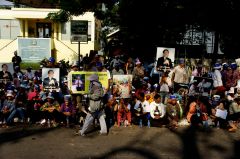
(800 people gathered in front of the Phnom Penh Court of Appeal to support Mam Sonando (c) Clothilde Le Coz)
Arrested on July 15th 2012, Beehive Radio journalist and director, Mam Sonando, was sentenced in the first instance to twenty years in prison in October 2012. He was charged with instigating villagers and peasants to protest against lands expropriation, in Kratie province. He was convicted and sentenced for “aggravating circumstances rebellion, unlawful interference in the performance of public functions, insurrection, inciting people to take arms against the state authority”. After spending already eight months in prison, his appeal started on 5 March 2013.
Read the rest of this entry »
Posted in human rights, Human Rights Defenders | 4 Comments »
Tags: AI, Amnesty International, Beehive Radio, Cambodia, France, freedom of expression, human rights, Journalist, Kratie, land rights, Lawyers without Borders, Luon Savath, Luon Sovath, Mam Sonando, MEA 2012, Phnom Penh, Protection on Line, radio, Radio broadcasting, radio journalist, trial observation
March 7, 2013

( Ane Tusvik Bonde of HRHF and Intigam Aliyev with the Homo Homini Award received on 4 March 2013)
In its intervention on 5 March 2013 at the Human Rights Council, the Human Rights House Foundation (HRHF) welcomed the reports of the Special Rapporteur on the situation of human rights defenders, including the one to the General Assembly on legislation affecting human rights defenders. HRHF stated that they are concerned, as is the Special Rapporteur, by the fact that more and more countries misuse or design legislation in order to impede or even criminalise the work of human rights defenders, or to label them as “foreign agents” such as in the Russian Federation.
HRHF especially welcomed the communications re Azerbaijan, as published in the addendum to the Rapporteur’s report, including the communication about the closure of the Azerbaijan Human Rights House on 16 March 2011 and the warnings against two NGOs threatened to be closed for their online publications on 5 March 2012. This communication has still not been answered. HRHF also regretted that Azerbaijan has not to date replied to the communication of the Special Rapporteur in relation to the arrest of photographer and blogger Mehman Huseynov, a case it already brought to the attention of the Council in July 2012.
Azerbaijan continues to use detention of human rights defenders as a tool to silence them. Most recently, on Saturday 26 January 2013, Intigam Aliyev was amongst 47 other demonstrators arrested for peacefully protesting in Baku. He was awarded the Homo Homini Award in Prague on 4 March, for his exceptional and courageous work in favour of human rights. Intigam Aliyev’s remains disbarred and his NGO blocked. In relation to this protest of 26 January, Emin Milli was sentenced to administrative detention for 15 days for promoting the protest on Facebook in violation of article 298.1 and 298.2 of the code of the Republic of Azerbaijan. Emin Milli was previously detained for 16 months along with Adnan Hajizade for publishing a critical video on Youtube. http://humanrightshouse.org/Articles/19109.html
Posted in human rights, Human Rights Defenders | 3 Comments »
Tags: Adnan Hajizade, Azerbaijan, Azerbaijan Human Rights House, disbarment, Emin Milli, facebook, freedom of expression, Homo Homini Award, HRHF, Human right, Human Rights Council, Human rights defender, Human Rights Defenders, Human Rights House Foundation, Intigam Aliyev, lawyer, Mehman Huseynov, Prague, Special Rapporteur, UN, video, You Tube
March 6, 2013
Just an example of how politics and elections interact with the role of human rights defenders, always a touchy subject:
After the Zambian Police arrested and charged Zambia’s opposition leader, Hakainde Hichilema, on 27 January 2013, seven 7 Civil Society Organisations in Zambia have called upon the Zambia’s Human Rights Commission, Southern African Development Community (SADC), the African Union, the Commonwealth and “other human rights defenders” to review Zambia’s human rights record and denounce the violations by the Zambian Government. The organisations have also called upon the Electoral Commission of Zambia to cancel by-elections in Livingstone and Mpongwe in accordance with Section 28 of the Electoral Act No. 12 of 2002. Reading the statement during the Press Briefing at FODEP House in Lusaka on behalf of the 7 organisations the Young African Leaders Initiative President Andrew Ntewewe, called on the Deputy Inspector General of Police to immediately resign for violating fundamental political rights which are guaranteed by the Constitution of Zambia when he banned political rallies in the Livingstone. With a strong sense of exaggeration the organisations have advised the Zambian Police Command to resist the temptation of “turning the Police Service into a unit similar to NAZIs Gestapo under Hitler in Germany”. The 7 organisations have lambasted the Zambia Police for their continued unprofessionalism in handling matters that border on freedom of expression, assembly, movement and association. The organisations that appended their signatures to the statement included; Foundation for Democratic Process (FODEP), Operation Young Vote (OYV), Anti-Voter Apathy Project (AVAP), Southern Centre for Construction Resolutions of Disputes (SACCORD), Young African Leaders Initiative (YALI), the Zambia Centre for Inter-party Dialogue (ZCID) and the Zambia National Womens Lobby Group (ZNWLG).
via allAfrica.com: Zambia: Civil Society Groups Request Review of Human Rights.
Posted in human rights, Human Rights Defenders | Leave a Comment »
Tags: African Union, allafrica com, civil society organisations, CSOs, Deputy Inspector General of Police, elections, electoral commission of zambia, freedom of assembly, freedom of demonstration, freedom of expression, Hakainde Hichilema, Human right, Human Rights Defenders, Lusaka, Mpongwe, police brutality, politics, Southern African Development Community, Zambia
February 20, 2013
On 17 February 2013 I wrote about the case of Eynulla Fatullayev, editor of the website Haqqin.az, a former AI prisoner of conscience and winner of press freedom awards (see also quote at the end of this post) who seems to have taken a more apologetic stand with regard to violations in his home country Azerbaijan. Just a few days before – 11 February – the NGO Civil Rights Defenders had published a piece under the title: ‘New crackdown on human rights activities in Azerbaijan’. There seems to be no stand taken by Fatullayev (at least not in English).

Avaz Zeynalli, chief editor of Khural newspaper, charged for tax evasion and corruption.
The Azeri government is putting new pressure on the country’s already repressed civil society. NGOs that receive even minor funds can be severely punished, according to a new draft law. The draft follows a series of repressions of media workers and civil activists. According to the proposed amendments NGOs receiving donation over the equivalent of 190 euro without a proper agreement, face up to 3500 euro and confiscation of property. This increases the authorities’ control over NGOs. The violations have grown in the beginning of 2013. Media workers that have been covering demonstrations and riots have been arrested, questions and in some cases beaten. At the same time the homes of journalists and civil activists have been searched, detained, subjected to gas attacks, put under surveillance and in other ways obstructed in their work. Read the rest of this entry »
Posted in human rights | Leave a Comment »
Tags: Azerbaijan, Civil Rights Defenders, Civil society, detention, Eynulla Fatullayev, Fatullayev, Freedom (Azerbaijan), freedom of expression, freedom of the press, International Press Institute, IPI, journalists, judicial harassment, NGOs, Unesco



 Hans Thoolen on Human Rights Defenders and their awards