Posts Tagged ‘film’
March 1, 2013
Protection International – based in Brussels – announces the launch of its new documentary, The Law of the Strongest, an in-depth account of the work of Honduran human rights defenders and the many challenges they face. You can watch it now at http://vimeo.com/58640439 (Spanish version with English subtitles). On 6 March 2013, The Law of the Strongest will be screened in Geneva.
“In this country, everything is being sold : water, earth and even oxygen” says Salvador Zúñiga, leader of the Civic Council of Popular and Indigenous Organizations of Honduras (COPINH) standing on a muddy road. Behind him, a no-trespassing sign bars the way to a dam construction project. “This project will not benefit the local population, but only the private interests”.
Like other members of his organization, Salvador Zuñiga denounces judicial harassment, threats and attempted corruption aimed at putting an end to their peaceful resistance to these mega projects.
Pascale Boosten and Eric Juzen, directors at the PI video team, met with COPINH representatives and other human rights defenders in order to produce the documentary, The Law of the Strongest.
Contact : Pascale Boosten, pboosten@protectioninternational.org
Posted in human rights, Protection International | Leave a Comment »
Tags: Brussels, corruption, dam, documentary, environment, environmental issues, film, Geneva, Honduran, Honduras, Human right, Human Rights and Liberties, Human rights defender, Pascale Boosten, Protection International, Salvador Zuñiga, The Law of the Strongest, video, Vimeo
January 16, 2013
Yvette Alberdingk Thijm, executive director of the US-based NGO Witness, wrote a post in the Huffington Post of 15 January about this fascinating topic on the occasion of Witness’ 20th anniversary. Here are some quotes before making a more critical comment:
“Twenty years ago, WITNESS was created because a world with many cameras — a world “where the eyes of the world are opened to human rights” — did not yet exist, a big bold vision at the time. Today, building on two decades of experience in creating tangible human rights change by exposing the truth through video, we are envisioning the next frontier: a world where video is not only ubiquitous, but has given millions the power to hold human rights abusers accountable, to deliver justice and to transform the human rights landscape.”….”So in 2013 and beyond, we are committed to building “video-for-change” communities, supporting networks of human rights defenders, from communities fighting forced evictions in Brazil to youth in the U.S. campaigning to protect the environment.”
In 2012, Witness launched the Human Rights Channel in partnership with YouTube and Storyful to ensure that important human rights stories are seen and contextualized. “We are committing in 2013 and beyond to take on the systems. The technology companies that run the platforms must create more human rights friendly spaces for all of us. And we decided to focus on the international legal systems to improve the understanding of how to authenticate citizen media to hold perpetrators of abuse accountable. We are working to achieve this vision by partnering and sharing in order to meet the challenge in front of us. We’ll join forces with technology mavens and mobile developers, with courageous human rights defenders worldwide, with brave bloggers, with witnessing citizens, with peer networks and effective organizations.”
—
Witness has indeed greatly advanced the use of images in the struggle for human rights and its future plans are daunting. What is missing – understandably in a piece that celebrates the achievement of a group’s anniversary – is the wider picture of what the human rights movement is doing with images. From the visualization of human rights defenders (the Martin Ennals Award, Front Line Defenders, Rights Livelihood Awards, Tulip Award, Civil Rights Defenders, HRF to mention just some who regularly make film portraits and/or stream their proceedings), the production of films on HRDs (e.g. True Heroes foundation), the systematization of access to images (e.g. by HURIDOCS) and the showing of films by a myriad of human rights film festivals (HRW, AI, Movies that Matter, and some 30 others). This modest blog alone has made some 60 references to the use of film images for human rights, many by Witness and the organizations mentioned above.
I mentioning this not because of ‘fairness’ in the sense that others need to be mentioned also, but because the full scope of the challenges ahead needs to be seen and addressed. Human rights images face the same problems as documentation: (1) information overload; (2) finding the most relevant information (even more daunting for images as searching directly on images is still far away); (3) authenticity and veracity; (4) ensuring quantity and quality of dissemination (what goes ‘viral’ is not necessarily what serves human rights) and (5) protecting of sources and participants (have the persons in the film given informed consent?). And I am sure there are quite a few other important issues.
So when the executive director of Witness states that it excites her “that we, together with so many allies, are taking the challenge for the future head on“, one must hope that it includes all those who can contribute to her vision of a world ” where many, many more citizens and human rights defenders have access to knowledge, skills and tools enabling them to create compelling, trustable videos and to make sure that their video is acted upon and human rights change happens.”
http://www.huffingtonpost.com/witness/human-rights-2013_b_2475221.html
Follow Witness on Twitter: www.twitter.com/witnessorg see its annual report: annual report
Posted in human rights | 2 Comments »
Tags: 2012, Amnesty International, Civil Rights Defenders, film, film festival, Front Line, human rights, Human Rights Defenders, Human Rights First, Human Rights Watch, HURIDOCS, Martin Ennals Award for Human Rights Defenders, MEA, Movies that Matter, Non-governmental organization, True Heroes Foundation, Tulip award, video, Witness (human rights group), YouTube
January 2, 2013
“The Cause of Progress” tells the story of the lives of three Cambodians caught up in the country’s chaotic and often violent economic progress, set against the backdrop of the shifting political, religious and familial landscapes of modern-day Cambodia. Shot over the course of three years, the film is a unique and intimate portrait of modern Cambodia. At times poignant and emotional, at others violent and chaotic, the film explores the impact of progress on modern society – from the corruption of the national religion, to the disintegration of the family, to the abusive power and kleptocracy of the ruling political elite.
What is happening in Cambodia is happening all over the developing world, from South America to Africa to Eastern Europe – land is being colonised by the developed world and the local elites, while the rightful owners are being displaced. This film addresses one of the most pressing issues of our time.
Each of the three personal narratives focuses on a different aspect of the story but forced evictions and land grabbing recur across all three. The Venerable Loun Sovath is a Human Rights Defender who uses video as part of his activist campaigning, all the while fighting against the corruption within his religious order. He is the 2012 Laureate of the MEA. Sopheap, facing eviction and waiting for a new home, is struggling to start a new business while she tries to cope with her slowly disintegrating family. And Srey Pov – at the front lines of a high profile forced eviction – comes face to face with a corrupt political elite and the sometimes difficult relationship between global institutions and the developing world.
This film will offer a unique insight into a country at a pivotal time in its development, finally shaking off the legacy of the past and the atrocities of the Khmer Rouge, Cambodia’s future direction is uncertain.
Those who want to keep up to date on future developments of this project should sign up to the film’s blog, join its facebook group, and mailing list and follow on twitter @chriskellyfilm
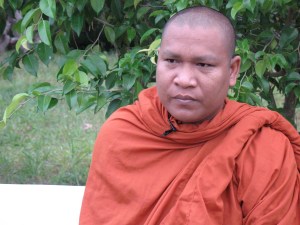
Luon Sovath by Dovona

Filmmaker Chris Kelly filming at Boeung Kak lake. Image © Nicolas Axelrod 2010.
Posted in films, human rights, Human Rights Defenders | Leave a Comment »
Tags: Africa, Cambodia, Chris Kelly, documentary, Eviction, film, Human rights defender, Human Rights Defenders, Khmer Rouge, land disputes, Loun Sovath, MEA, The Cause of Progress
December 12, 2012

(Photo credit: Wikipedia)
The photojournalist Fernando Moreles has been awarded the second Tim Hetherington Grant, an annual visual journalism award focusing on human rights, Human Rights Watch and World Press Photo announced 0n 11 December 2012. Human Rights Watch and World Press Photo established the grant to honor the legacy of Hetherington, a photojournalist and filmmaker who was killed during fighting in Libya in April 2011. The €20,000 grant was given to Moleres for his project “Waiting for an Opportunity,” in which he is documenting the harsh realities of juvenile justice in Sierra Leone. For more than two decades Moleres, who was born and lives in Spain, has been committed to documenting the plight of the most vulnerable populations and covering issues relating to children and labor, juvenile justice, and refugees. “Fernando Moleres’ moral and emotional commitment to his photographic subjects is clear,” said Carroll Bogert, deputy executive director at Human Rights Watch. “Tim Hetherington would have loved this work and Human Rights Watch is thrilled to support it.”
Related articles:
Fernando Moleres Wins Tim Hetherington Grant (hrw.org)
Tim Hetherington, 1970-2011 (edendale.typepad.com)
Posted in films, HRW, human rights | Leave a Comment »
Tags: Carroll Bogert, Fernando Moleres, film, Freetown, human rights, Human Rights Watch, Libya, photo journalism, Sierra Leone, Tim Hetherington, Tim Hetherington Grant, visual journalism, World Press Photo
October 16, 2012
An “Insignificant State” called “Ubeki-beki-beki-beki-stan-stan” or a highly repressive regime torturing human rights defenders?
Last October(2011), the International Federation for Human Rights (FIDH) launched a new web application to bring attention to human rights defenders still incarcerated in horrific conditions in Uzbek prisons.
US Republican presidential candidate Herman Cain stated on 8 October 2011 “When they ask me who’s the president of Ubeki-beki-beki-beki-stan-stan, I’m going to say, ’You know, I don’t know. Do you know?” Cain added that it was not a priority to know “the head of one of those small, insignificant states around the world”.
FIDH does want people to know. And to care.
At least 10 Uzbek human rights defenders remain in detention under appalling conditions ; several of them are members of FIDH member organisation, the Human Rights Society of Uzbekistan (HRSU).
Nevertheless, Uzbekistan has long been a key US partner, hosting US military bases servicing the Afghan military campaign. Moreover, in 2009 the EU dropped all 2005 sanctions imposed following the Andijan tragedy, despite there being no serious change in Uzbekistan’s human rights record.
On the rare occasions that the international community has sent strong messages on human rights issues these calls have been heard: on the eve of Secretary of State, Hillary Clinton’s last visit to Uzbekistan in December 2010, one human rights defender, Farhad Mukhtarov was released. Again, on 14 October 2011, the member of the HRSU Norboy Kholjigitov was released on parole, after 6 years and 4 months in detention, in advance of Hillary Clinton’s visit to Tashkent on 23 October 2011. I should add that in 2008 the MEA laureate Mutabar Tadjibaeva was released after concerted pressure by EU, US and a large number of NGOs!
Must we wait another 10 years to release all the imprisoned human rights defenders?
Therefore I am repeating the FIDH’s application (in English and Russian) and spread the word about this situation by linking it to my blog. Do the same and go to http://www.fidh.org/2011_UZ
The application details the history of human rights defenders, their wrongful detention, and the general political background influencing their situation.
Uzbekistan : New web application on detained human rights … – FIDH.
Posted in films, Human Rights Defenders | 1 Comment »
Tags: FIDH, film, human rights, Human Rights Defenders, International Federation for Human Rights, MEA, Mutabar Tadjibayeva, Non-governmental organization, political prisoners, Uzbekistan, web application
May 11, 2012
This recent film is not directly about Human Rights Defenders (although they are certainly victims of it) nor about the treatment of ethnic minorities. Rather is demonstrates. through a large variety of interviews with victims, lawyers – including Basil Fernando of the Asian Human Rights Commission – and experts, how a lack of investigative skills and high-level condoning have led the Sri Lankan policy to use torture routinely. Most shockingly a former police officers confirms that this is what is expected from the police by the system. It has become a mindset at all levels, including most of the judiciary. It is a long film but worth it. The Danish film maker, Josefina Bergsten, manages to demonstrate the disconnect between international procedures (which are based on functioning institutions that have to address a few bad apples) and the reality on the ground in Sri Lanka where the good apples are the exception. See it and forward it: https://vimeo.com/41898677
Posted in AHRC, films, human rights | 8 Comments »
Tags: Asian Human Rights Commission, Basil Fernando, film, Human rights defender, ill treatment, law enforcement, Sri Lanka, torture, UN procedures, video, Vimeo
March 16, 2012
The Kony 2012 campaign is not focused on Human Rights Defenders, but this blog has always taken a fierce interest in the link between videos and human rights and that is now the real issue at hand. There have been many views expressed by experts or those who think they are experts, but the reflections by Riona McCormack in her post “Lessons learned from the KONY 2012 campaign” REPSSI website, I find the most complete and forward-looking until now. I will quote her literally:
Never has a video – and certainly not one created by an NGO – generated such heated and conflicting responses, or achieved such global reach. Fast approaching the 100-million-viewer mark, in the week since the campaign’s launch, coverage of “KONY 2012” has infiltrated every major news outlet and online forum, and ignited a storm of commentary among Facebookers and Tweeters of all ages. However, there is a side to this public debate that has been relatively under-explored: and that is the lessons for media and communications professionals, and specifically those of us working in the development sector.
Here are five important lessons that we can draw from this campaign:
1) Emotion sells: Empathy, sorrow, joy, anger – these are the things that make us human, and motivate us to act, learn, or care. The KONY2012 campaign provides emotional resonance in abundance, and the success of this approach is evident. If we are honest, many of us probably felt at least a niggling worm of jealousy watching that YouTube counter climb into the millions. How many excellent, worthy causes have we been pushing for years, wishing for a response just like this? We can learn from this, in terms of how we present our work. At the same time, these tactics, familiar from the film industry, have the dangerous potential to become a form of emotional pornography. We must be careful in how we employ this approach, so that we do not compromise our mission, or our ethics, in order to provoke a reaction. An example of a feel-good video that doesn’t ignore the agency of the people involved is Mama Hope’s glorious celebration of connectivity, their “Stop the Pity. Unlock the Potential” Campaign.
2) Urgency equals action: Another key to the success of the campaign was the inherent sense of urgency woven into it. The video emphasises the “window of opportunity” that will soon close, the terrible suffering of children which must not continue. For the same reason, efforts to fundraise for earthquake relief funds and other sudden disasters or famines are radically more successful than for ongoing issues of malnutrition. How can we use this in our own campaigns? How can we make long-standing issues with no easy answer into a cause of immediate concern? The Girl Effect is one very slick example of how to introduce a sense of urgency into a long-term problem – education for girls.
3) People want to act (1): Once people care about something, they usually ask “so what can I do?” If there is no answer to this question, your audience may be left more cynical and apathetic than before. The KONY2012 campaign’s infectiously viral success is due to the clear, simple action it provided for ordinary people to take. Whilst the simplistic nature of this action (especially in the context of a highly complex, distant conflict) has been the subject of much of the criticism facing the campaign, there are many cases in which liking, tweeting or forwarding on a message would be a perfectly appropriate action to encourage. There have also been great examples of creative actions that go beyond simply clicking a button – such as the inspired Movember moustache drive. Bear this in mind the next time you create your own campaign: don’t just inform, ask. Let’s transform viewers into activists. We might be surprised by the response.
4) People want to act (2): … because it’s worth repeating. We need to recognise that however dubious the message or methodology of the campaign, the millions of people who watched the video, forwarded it on, and bought “action packs” from Invisible Children were motivated by a genuine desire to make a difference. Yet how many of us have at one time or another bemoaned the apathy and ignorance of the vast, amorphous “general public”? Is this is an opportunity for all of us as development communicators to recognise that if we are failing to engage the public, perhaps we need to look at ourselves and how we are communicating?
5) We need debate, not derision: Many supporters of the KONY2012 campaign have said “at least it has started people talking.” And this is certainly true; some truly excellent pieces of investigation, analysis, satireand reflection have been published, including a gratifyingly large number of responses from Ugandans. However, much of the debate taking place last week was bitter, simplistic, and divisive – the detractors classifying supporters as ignorant and uninformed, the supporters calling the detractors pompous and cynical. Both ‘sides” in this debate were to blame for the lack of a balanced discussion. If you disagree with aspects of the KONY2012 campaign, alienating those who support it will not change their viewpoint, nor will it encourage them to read more, learn more and engage more critically with complex issues. How can we find a way to transform the desire to be of service, so evident in the KONY2012 campaign, into sustainable, well-thought out actions?
I share her conclusion that we should not do as if there is only one choice: hate or love the campaign: “Rather, we can take from it what is useful – and discard the rest.”
You can contribute to this debate via The Drum Beat Network: http://www.comminit.com/policy-blogs/content/lessons-learned-kony-2012-campaign-0
Related articles
Posted in films, human rights | 2 Comments »
Tags: film, human rights, ICC, Invisible Children, josephkony, Kony 2012, lords resistance army, Non-governmental organization, Uganda, Ugandan, video, YouTube
October 16, 2011
Last Thursday, 13 October, the ceremony for Kasha, the Ugandan 2011 laureate of the Martin Ennals Award for Human Rights Defenders, took place in Geneva, again in the beautiful Victoria Hall. There was a large audience of 600 people. Moreover, the 2010 MEA laureate, Muhannad al-Hassani from Syria, also made a surprise appearance. The True Heroes Foundation made a 8-minute summary of highlights of the ceremony and this overview gives an excellent impression of the whole evening. Please go to our newly designed website: http://www.martinennalsaward.org.
Posted in Al-Hassani, films, human rights, Human Rights Defenders, THF | 2 Comments »
Tags: ceremony, film, Kasha, LGBT, Martin Ennals Award, Martin Ennals Award for Human Rights Defenders, MEA, Syria, THF, Uganda
April 13, 2011
This blog has a special interest in HRDs and films. Therefore the following is highlighted:
The jury at the Movies that Matter Festival, which was held in The Hague from March 24 to 31, awarded Suciwati Munir, Angkhana Neelaphaijit and Padma Perera, a Special Jury Award for Josefina Bergsten’s film “UNJUST”. The film documents the struggles of the three wives, mothers and activists to challenge impunity and get justice for their husbands, all of who lost their lives in 2004 due to the murderous intentions of state agents. “Through this film, three women who have seen the worst aspects of their countries’ justice systems have helped the world to understand what it means to be living in these sorts of conditions,” said Basil Fernando, of the Asian Human Rights Commission. His Hong Kong-based regional rights group had already in July 2010 given the film its Asian Human Rights Award for Creative Media.
Suciwati’s husband, Indonesian human rights lawyer Munir, was poisoned on a Garuda Airlines flight in 2004 while travelling from Indonesia to study abroad. A former pilot and former head of the airline were implicated in the murder, and the pilot given a 20-year jail sentence. However, the trail of connections to his killing has led back to the Indonesian secret services, and the masterminds have never been identified. A five-minute video profile of Suciwati is available on the website: http://www.moviesthatmatterfestival.nl/english_index/nieuws_en/news/169
Thai police abducted Angkhana’s husband, Somchai, from his car on a street in Bangkok. Although five police went on trial, only one was convicted of a minor offence. He has himself disappeared, and an appeal court recently overturned his conviction. All the police are still serving. Angkhana has since set up an organization to work for the victims of enforced disappearances in Thailand, and is now among the country’s best known human rights defenders. In 2006 she was a joint recipient of the Gwangju Prize for Human Rights.
Padma’s husband Gerard was a victim of police torture in Sri Lanka who became an outspoken and fearless advocate of human rights. Gunmen connected to the police shot him as he travelled on a public bus, shortly before he was going to depose in court against the officers who were accused of torturing him. The Human Rights Commission of Sri Lanka has honoured Padma with an award for the struggle that she has undertaken since to get justice for her husband and to promote human rights in her country.
Persons wishing to obtain copies of “UNJUST” may contact the filmmaker, Josefina Bergsten, at josefina.bergsten@gmail.com.
0.000000
0.000000
Posted in films, human rights, Human Rights Defenders, Movies that Matter | 2 Comments »
Tags: award, film, Indonesia, Sri Lanka, Thailand
April 8, 2011
The film I mentioned last wednesday – to be shown tonight in Brussels – is not so much on the life of Ernst as on the current work of Human RIghts Defenders in Burundi, in particular one of his colleagues, Pacifique Nininahazwe, one of the nominees of the Martin Ennals Award this year. Of course there is attention paid
to the impunity for Ernest assassination.
Posted in human rights, Human Rights Defenders, MEA, Protection International | 1 Comment »
Tags: Burundi, film

 Hans Thoolen on Human Rights Defenders and their awards