Posts Tagged ‘environment’

Colombia and Brazil – the world’s deadliest countries for environmental activists

February 17, 2025

Cândida Schaedler on 12 February 2025 asks whether anything can be done to protect them.

In 2023, 196 land and environmental defenders were murdered around the world – the vast majority of them in Latin America. In fact, just four countries – Brazil, Colombia, Honduras and Mexico – accounted for over 70 percent of those killings. Colombia was by far the deadliest country, with 79 murders, followed by Brazil, with 25.

We spoke with some of these brave activists to learn more about the threats they face, how they stay safe and how Colombia and Brazil are working to keep them alive.

Quilombolas
Quilombolas in the Jequitinhonha Valley in Minas Gerais, Brazil. Photo: Mídia NINJA, Flickr

“When we recognized ourselves and declared ourselves a quilombo, our peace was over”, recalls Elza,* a Brazilian Quilombola leader in her late 50s.

In December 2008, she was shot and injured in an attack that killed her brother and sister. Since then, she hasn’t left her home alone – not even for a walk in her own territory, one of the 11 urban quilombos in Porto Alegre, the capital of Rio Grande do Sul in southern Brazil.

Quilombos are Afro-Brazilian communities that were originally founded by escaped slaves in colonial times.

Today, they are officially defined as “ethno-racial groups that, by self-definition, have their own historical trajectory, maintain specific territorial relations and are presumed to have Black ancestry related to resistance against historical oppression.” Brazil has recognized quilombos in its constitution since 1988, but the process of gaining legal recognition is time-consuming and often fraught with obstacles. Elza’s community was officially designated a quilombo in 2005, but only after its residents agreed to give up half their territory. Ever since, they’ve been battling gangs and real estate speculators who want control of the same 58 hectares of land they call home.

In 2022, they once again came under attack. Armed men showed up at their door in an attempt to take over a housing project under construction in the quilombo, which had been put on hold due to a dispute with the bank financing it….

Elza and her daughter, Carolina,* live under the protection of the Brazilian government, which has a program to safeguard human rights defenders, environmentalists and communicators.

Jesus Pinilla
Jesus Pinilla leads a workshop for the Network of Young Guardians of the Atrato. Photo courtesy of Jesus Pinilla

Jesus Pinilla is a 26-year-old Afro-Colombian activist from a small community in the Chocó Department in western Colombia. He is a member of the Network of Young Guardians of the Atrato, a group composed of 36 young people defending the Atrato River – considered the mightiest river in Colombia.

Back in 2016, the Atrato was the first Colombian river to be given legal rights. Enforcing those rights are a group of 10 guardians, along with the Young Guardians, who are embroiled in a constant battle against mining companies exploiting the river’s waters.

Pinilla works as an environmental educator. He first became an environmental activist at the age of 14, but he fears that the risks often drive young people away from climate and environmental movements in Colombia.

“My community is located by the river, so we are constantly dealing with it on a daily basis,” he says. “We depend on it for our basic needs.”

Brazil military police officer
Policing is not enough to tackle the threats facing land and environmental defenders in Latin America. Photo: Agência Brasília, Flickr

“When combined with the interests of communities, the internal armed conflict becomes even more dangerous,” says Leonardo González Perafán, director of the Institute for Development and Peace Studies (Indepaz) in the capital, Bogotá.

“That’s when actions against environmental defenders and communities come into play,” he explains, adding that environmental conflicts often occur in countries with abundant mineral resources.

In most cases, communities are forced to self-organize to ensure their own safety due to the absence of the state.

“They provide self-protection through Indigenous or campesino [farmer] guards,” he explains. 

The communities have also developed communication strategies to share information with each other, as well as with the authorities and other organizations.

But as long as the armed conflict persists, it will be very difficult for the government to tackle systemic threats against environmental defenders, especially in areas where it has little authority, says Franklin Castañeda, director of human rights at Colombia’s Ministry of the Interior.

Castañeda explains that more than 15,000 people are currently protected under the National Protection Unit (UNP), which aims to ensure the safety of members of Congress, mayors, journalists, human rights defenders, community leaders and other individuals facing threats due to their work.

The majority – around 9,000 – of these people are social leaders, including environmental defenders. The UNP provides them with security measures such as bulletproof vests, private escorts, armored vehicles or other measures as deemed necessary on a case-by-case basis.

Still, Castañeda emphasizes that individual measures are a last resort. The government has also invested in prevention, such as ensuring that the military and police are not involved in illegal activities.

Despite these efforts, Castañeda concedes that there is still plenty of work to be done to address the structural drivers of conflict, such as high levels of socioeconomic inequality.

“Most of the territories where social conflicts arise are the least developed ones that the government still cannot reach.”

He says these areas will need internet access, highways and other infrastructure to improve the government’s ability to ensure safety and the rule of law.

Quilombo in southern Brazil
A quilombo in southern Brazil. Photo: Cândida Schaedler

In Brazil, the main drivers of conflict are deforestation, illegal mining, real estate speculation and the expansion of agriculture.

In response, the government is supporting 1,304 people through the Program for the Protection of Human Rights Defenders, Communicators and Environmentalists (PPDDH), linked to the Ministry of Human Rights and Citizenship. 

The program’s coordinator, Igo Martini, emphasizes the importance of listening to the communities to respond quickly to their protection needs.  Last year, it carried out 54 public consultations to devise a National Plan to address threats to these communities. But Martini also points out the need to address the root causes rather than merely deploying the police.

“If we don’t solve the underlying causes, the program will continue for another 20 or 40 years just responding to emergencies,” he warns. “A movement from the states is also necessary, not just from the federal government.”

“We need to strengthen agencies, monitoring systems and prevention systems, like the Brazilian Institute of the Environment and Renewable Natural Resources (Ibama), for example.”

The PPDDH operates in three areas: state protection, justice protection and collective protection.

While state and justice protection are offered by the police and courts respectively, collective protection involves strengthening communities and providing them with the tools to communicate with each other and report threats to the authorities to safeguard their territory.

https://thinklandscape.globallandscapesforum.org/71968/deadliest-countries-for-environmental-activists/

10 December 2024: Human Rights Day

December 10, 2024

Here a few highlights for this year from UN and NGOs sources:

While commemorating the 76th anniversary of the Universal Declaration of Human Rights, the United Nations Secretary-General Antonio Guterres said that “human rights are under assault”. “Whether economic, social, civic, cultural or political, when one right is undermined, all rights are undermined,” Guterres said in a post on X. “Let’s protect, defend and uphold all human rights for all people,” he added. In a video message, The UN secretary-general said “we must stand up for all rights — always.”

Achim Steiner UNDP Administrator added his voice:

..As we mark Human Rights Day 2024, we are reminded that human rights are not abstract ideals. They are vital tools for addressing these pressing challenges and advancing dignity and justice for all. 

… the United Nations Development Programme (UNDP) works to support human rights solutions that strengthen accountability, protect communities and foster peace, recovery, and stability. This includes partnering with National Human Rights Institutions, which often represent the frontline defenders of human rights. … Local initiatives also remain key. That includes women in Somalia who are being supported to lead peace efforts including assisting those facing violence, discrimination, and injustice. “I have resolved numerous local disputes…I feel motivated when I see I have been able to change people’s lives positively,” says Fatuma who led a local Peace Working Group.

As the accelerating climate emergency threatens the ability of current and future generations to enjoy their right to a clean, healthy, and sustainable environment, UNDP is focusing on access to justice, working with the United Nations Environment Programme (UNEP) and OHCHR to help communities claim their rights. …The private sector also has a pivotal role to play. UNDP supports the implementation of the UN Guiding Principles on Business and Human Rights including to advance sustainable practices that protect the environment. Indeed, technology offers both risks and opportunities to advance human rights. The Global Digital Compact aims to create an inclusive, open, safe, and secure digital space that respects, protects and promotes human rights. Tech-enabled UNDP tools like iVerify and eMonitor+ deployed in over 25 countries to monitor and address false narratives and hate speech show the potential. It is now crucial to adopt a rights-based approach to technologies like A.I., addressing ethical challenges, protecting data, and tackling biases to mitigate risks today and unlock immense benefits for the generations to come. [https://humanrightsdefenders.blog/2024/09/27/united-nations-adopts-ground-breaking-pact-for-the-future-to-transform-global-governance/]

——

The NGO Index on Censorship spotlights four people standing up for human rights around the world:

Despite the declaration, all around the world human rights are being challenged, degraded and attacked. That is why this year, on Human Rights Day, we pay tribute to five human rights defenders who have worked tirelessly to defend people’s rights and have been persecuted as a result. 

Jemimah Steinfeld, CEO at Index on Censorship said:  “In this increasingly polarised and authoritarian world these people stand out as beacons of hope and light. It’s depressing to think that over 75 years since the Declaration, we still need a day like this but that should not detract from the bravery and fortitude of these people. May their example show us all how we can all better fight injustice.” 

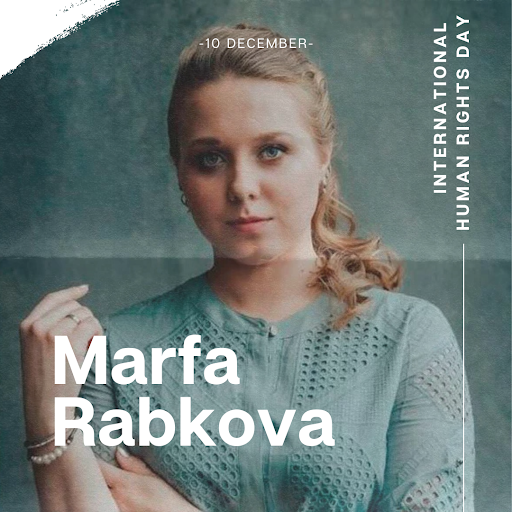
Marfa Rabkova (Belarus) Marfa Rabkova is a human rights defender who has been behind bars since 17 September 2020. She has long been targeted by the Belarusian authorities as a result of her civic activism. Marfa became head of the volunteer service at the Human Rights Centre Viasna in 2019. During the 2020 presidential election, she joined the “Human Rights Defenders for Free Elections” campaign, which registered over 1,500 election observers. When peaceful protests began to take place after the election, she helped document evidence of torture and violence against demonstrators.  Marfa was indicted on a long list of charges, including inciting social hostility to the government and leading a criminal organisation. She was sentenced to 14 years and 9 months in prison in September 2022, after nearly two years of pre-trial detention. Index on Censorship calls for her immediate and unconditional release.  See also:
https://humanrightsdefenders.blog/2021/03/22/belarus-end-reprisals-against-human-rights-defenders/

https://www.indexoncensorship.org/2024/12/human-rights-day-2024-a-tribute-to-human-rights-defenders/

https://www.undp.org/speeches/administrators-statement-human-rights-day-10-december-2024

https://www.coe.int/sl/web/commissioner/-/on-human-rights-day-the-commissioner-calls-for-action-to-realise-the-universal-declaration-s-vision

https://www.ohchr.org/en/stories/2024/12/celebrating-human-rights-day-around-world

Indigenous human rights defender Victoria Maladaeva from Russia

November 6, 2024

‘Indigenous communities must have better political representations to ensure our rights are protected both constitutionally and in practice,‘ says Victoria Maladaeva, and Indigenous peoples’ rights defender from Russia. Victoria was also a participant in ISHR’s Women Rights Advocacy Week this year. She spoke to ISHR about her work and goals.

Hello Victoria, thanks for accepting to tell us your story. Can you briefly introduce yourself and your work?

Sure! I’m a Buryat anti-war decolonial activist, co-founder of the Indigenous of Russia Foundation.

What inspired you to become involved in the defence of human rights?

Since the full-scale Russian invasion of Ukraine, Indigenous peoples, particularly Buryat, have been hit the hardest. I wanted to help my people, fight the Russian propaganda and raise awareness about systemic colonial oppression and discrimination faced by Indigenous people and ethnic minorities in the Russian Federation.

What would Russia and your community look like in the future if you achieved your goals, if the future you are fighting for became a reality?

The country needs a large-scale transformation— political, economic, and cultural. Indigenous communities must have better political representations to ensure our rights are protected both constitutionally and in practice. Genuine democratic reforms involve fundamental rights for self-determination and autonomy where Indigenous peoples gain control of their land and resources. Putin’s constitution’s amendments to national Republics must be reversed, our languages must be mandatory in all schools, universities, and institutions where Indigenous communities live. 

How do you think your work is helping make that future come true?

I’m advocating for the rights of Indigenous peoples with international stakeholders and institutions to raise awareness about issues faced by our communities and spreading awareness, producing documentaries, and mobilising diasporas. 

Have you been the target of threats or attempts at reprisals because of your work?

Unfortunately, yes. There have been threats because of my anti-war activism and for shedding light on the disproportionate mobilisation in the Republic of Buryatia. For some reason, my colleagues and I were denied participation in the UN Permanent Forum on Indigenous Issues. I would like to believe this was a mistake and that there was no influence from the Russian delegation at the UN.

Do you have a message for the UN and the international community?

Russia needs decolonisation and de-imperialisation. Without revising the past and acknowledging colonial wars (not only in Ukraine) and discrimination, there can be no bright future for Russia—free and democratic. The international and anti-imperialist community should acknowledge that the Russian government is not for any anti-colonial movement. Stand in solidarity with independent Indigenous activists!

https://ishr.ch/defender-stories/human-rights-defenders-story-victoria-maladaeva-from-russia

Open Global Rights on creating pathways for environmental defenders in the trickiest places

October 26, 2024

Grassroots environmental defenders are building a variety of strategic, community-based approaches to environmental justice. Global actors can do more to support their work write Rebecca Iwerks & Ye Yinth & Otto Saki on 14 October 2024 in Open Global Rights.

Fighting for land, environmental, and climate justice is risky. Global Witness annually reminds us of the staggering number of people who are killed for defending their land—over 2,100 since 2012. And lethality is only the tip of the iceberg, one of a multitude of violent tactics that people face when they speak up for their community. [see also: https://humanrightsdefenders.blog/2024/09/18/global-witness-2023-2024-annual-report-violent-erasure-of-land-and-environmental-defenders/]

The last few years have seen encouraging steps to respond through global and regional policy. National governments have started to make specific commitments to protect environmental rights defenders, deeming it necessary to address the climate crisis. The Escazu agreement in Latin America has explicit requirements for the state protection of environmental rights defenders. [NOTE: On 16 October 2024 civil society in the Americas has issued an urgent call to accelerate the implementation of the Plan of Action on Human Rights Defenders, of the Escazú Agreement, adopted five months ago].Just this month, the UNFCCC Supervisory Body for Article 6.4 and the UN Secretary General’s Panel on Critical Energy Transition Minerals showed how global bodies can incorporate the protection of environmental rights defenders directly into climate policy. More broadly, hundreds of organizations have pooled their efforts to end retaliation against environmental defenders through the ALLIED network.

What do we do while we wait for momentum to build and for policy to translate into practice? We can draw hope from thoughtful, strategic examples of grassroots legal empowerment. Throughout the world, legal empowerment advocates—people helping individuals and groups know, use, and shape the law with the support of community paralegals—are assisting communities in registering their land, stopping corporate pollution of their water, and negotiating fair land use deals even in the most difficult places. 

Last year, we examined the experiences of environmental defenders who were able to continue their work in repressed environments, using tenets of legal empowerment to find pathways to justice in ways that reduce their risk. Here’s what we saw:

  1. Building community power.…
  2. Changing paths to remedy. …
  3. Building relationships with allies. …..
  4. Knowing, using, and shaping the law to respond to security concerns. …

How do we super-charge support for this subtle, effective protection alternative? 

While grassroots justice advocates are continuing to seek remedies in tricky places, global actors can do more to support them. The primary shift that can support this type of innovative risk response is to provide flexible, unrestricted funding directly to grassroots justice advocates, whether through philanthropy or from pooled private sector funds that facilitate independent legal and technical support. Flexible funding allows the practitioners to shift their plans as pathways become riskier; it also allows them to invest in security equipment that may not clearly fit into a project-driven budget. Openness to different types of reporting can allow grassroots justice advocates to make decisions about what information is safest for them to reveal without concerns about financial security.

Secondly, those who influence global frameworks, such as the UN Sustainable Development Goals and the United Nations Framework Convention on Climate Change (UNFCCC), can do more to incorporate the security of environmental rights defenders into these frameworks. For example, the security of environmental rights defenders is integral to the access to justice encompassed by Sustainable Development Goal 16, and progress on that issue should be included in all SDG 16 reporting. Within the UNFCCC, the language protecting defenders from Article 6.4 Supervisory Body and the Secretary General’s Panel on Critical Energy Transition Minerals should be mirrored throughout climate policy frameworks and resourced during their implementation. 

While the actions against environmental defenders are shocking, there are significant steps the rights community can take now to support grassroots actors moving forward.

https://www.openglobalrights.org/creating-pathways-to-land-and-environmental-justice-in-the-trickiest-places/

Volker Türk: Environmental human rights defenders are champions for our future

September 30, 2024

Volker Türk, United Nations High Commissioner for Human Rights

Global CITIZENS FESTIVAL 2024

New York

Friends, New Yorkers, global citizens.

Human rights defenders are champions for our future – shining a light on repression, on injustice and on solutions to humanity’s greatest challenges.

In return, they are often smeared, intimidated, imprisoned, and worse.

According to data gathered by my Office, last year, 320 human rights defenders, journalists and trade unionists in 40 countries were killed. Many of them while protecting nature and the environment.

Across the globe, environmental human rights defenders are leading efforts to tackle a climate crisis that is growing ever more ferocious, more terrifying, and more present.

They are standing up for the marginalized, for the natural world, and for the planet.

For the human right to a clean, healthy and sustainable environment.

They deserve our gratitude and our protection.

My office is proud to support the Leaders Network for Environmental Activists and Defenders (LEAD), a new initiative focused on meaningful and safe participation of defenders in climate and environmental discussions.

But they need your support too. So I urge you to join my office.

Take action to protect civic space and help us to build a more sustainable and more equal future. 

https://www.ohchr.org/en/statements-and-speeches/2024/09/environmental-human-rights-defenders-are-champions-our-future-turk

CAFOD calls for justice as another environmental defender is killed in Honduras

September 26, 2024

Juan Lopes - Screenshot

Juan Lopes

Catholic aid agency CAFOD has called for justice, after the murder of a prominent environmentalist that CAFOD supported.

Following the news of the murder of Juan Lopez – anti-mining, environmentalist, community leader and Municipal Councillor of Tocoa, northern Honduras – who was shot dead by several men as he headed home in his car from church, Paz Redondo, CAFOD’s Country Representative for Central America said: “The assassination of Juan Lopez clearly shows once again the complicity between the authorities, international companies, and organised crime in Tocoa, and the inability of the government to protect environmental and human rights defenders in the emblematic case of the Guapinol river – despite the fact that precautionary measures had been ordered by the Interamerican Court of Human Rights – IACHR.“

Juan Lopez denounced the corruption within local and central governments in Honduras during a public press conference just before he was killed.

Paz Redondo continues: “Justice needs to be more than words for the state of Honduras, a state that shows once again its fragility and inability to combat corruption within its ranks, as it continues to serve the interests of extractives and organised crime. Juan publicly denounced this corruption within local and central governments and was killed days after his and his fellow activists’ latest public press conference.”

For over a decade, the communities of Guapinol, San Pedro and other areas in the vicinity of Tocoa have been denouncing the illegal granting of mining concessions in the “Carlos Escaleras National Park” in Honduras. Their advocacy efforts were fruitful in February, when the Honduran government approved Decree 18-2024 to protect the core zone of the national park, a key achievement to safeguard the environment against mining and energy projects in the area.

The murder of Juan Lopez is not the first killing in the Guapinol case. Over 160 community members in Tocoa have been killed protecting their land and natural resources since 2010 (Amnesty, 2024). In 2023, three community leaders were killed in what the community saw as retaliation, following the release of defenders who had been criminalised. Later in the year, in October 2023, 30 members of the Municipal Committee for the Defense of Common and Public Goods of Tocoa and of the Bufete Justicia para los Pueblos, were granted precautionary measures by the Human Rights Interamerican Court (IACHR).

Juan Lopez was killed despite precautionary measures which were ordered by the IACHR last October. The community of Tocoa believes his death could have been prevented if the Honduran authorities had implemented the precautionary measures granted to Juan Lopez. CAFOD, alongside ERIC has accompanied the Guapinol community in their fight to protect the land and natural resources essential for their survival, and we will continue supporting them as they defend their environmental rights.

https://www.frontlinedefenders.org/en/case/killing-human-rights-and-environmental-defender-juan-lopez

Global Witness 2023-2024 Annual Report: Violent Erasure of Land and Environmental Defenders

September 18, 2024

According to a new report by Global Witness released on 10 September, more than 2,100 land and environmental defenders were killed globally between 2012 and 2023.

  • An estimated 196 land and environmental defenders were killed in 2023 around the world, according to a new Global Witness report published today
  • The new figures take the total number of defenders killed between 2012 to 2023 to 2,106
  • For the second year running, Colombia had the highest number of killings worldwide – with a record 79 defenders killed last year, followed by Brazil (25), Mexico (18) and Honduras (18)
  • Once again, Latin America had the highest number of recorded killings worldwide, with 166 killings overall – 54 killings across Mexico and Central America and 112 in South America
  • Environmental defenders are also being increasingly subject to range of tactics for silencing those who speak out for the planet across Asia, the UK, EU and US

The new figures bring the total number of defender killings to 2,106 between 2012 and 2023.

Overall, Colombia was found to be the deadliest country in the world, with 79 deaths in total last year – compared to 60 in 2022, and 33 in 2021. This is the most defenders killed in one country in a single year Global Witness has ever recorded. With 461 killings from 2012 to 2023, Colombia has the highest number of reported environmental defender killings globally on record.

See:https://humanrightsdefenders.blog/2023/09/25/global-witness-annual-report-2022-a-land-rights-defender-killed-every-other-day/

Other deadly countries in Latin America include Brazil, with 25 killings last year, and Mexico and Honduras, which both had 18 killings.

Central America has emerged as one of the most dangerous places in the world for defenders. With 18 defenders killed in Honduras, the country had the highest number of killings per capita in 2023. A total of 10 defenders were also killed in Nicaragua last year, while four were killed in Guatemala, and four in Panama.

Worldwide, Indigenous Peoples and Afrodescendents continue to be disproportionately targeted, accounting for 49% of total murders.

Laura Furones, Lead Author and Senior Advisor to the Land and Environmental Defenders Campaign at Global Witness, said:

“As the climate crisis accelerates, those who use their voice to courageously defend our planet are met with violence, intimidation, and murder. Our data shows that the number of killings remains alarmingly high, a situation that is simply unacceptable.

While establishing a direct relationship between the murder of a defender and specific corporate interests remains difficult, Global Witness identified mining as the biggest industry driverby far, with 25 defenders killed after opposing mining operations in 2023. Other industries include fishing (5), logging (5), agribusiness (4), roads and infrastructure (4) and hydropower (2).

In total, 23 of the 25 mining-related killings globally last year happened in Latin America. But more than 40% of all mining-related killings between 2012 and 2023 occurred in Asia – home to significant natural reserves of key critical minerals vital for clean energy technologies.

As well as highlighting the number of killings worldwide, the report unearths wider trends in non-lethal attacks and their harmful impacts on communities globally. It highlights cases of enforced disappearances and abductions, pointed tactics used in both the Philippines and Mexico in particular, as well as the wider use of criminalisation as a tactic to silence activists across the world.

The report also explores the crackdown on environmental activists across the UK, Europe and the US, where laws are increasingly being weaponised against defenders, and harsh sentences are more frequently imposed on those who have played a role in climate protests. The findings form part of a concerning trend of criminalisation cases emerging worldwide.

https://www.euronews.com/green/2024/09/11/european-governments-are-using-harsh-overly-broad-laws-to-silence-climate-protesters

Despite the escalating climate crisis – and governments pledging to achieve the Paris Agreement target of 1.5C – land and environmental defenders are being increasingly subject to a wide range of attacks to stop their efforts to protect the planet. At least 1,500 defenders have been killed since the adoption of the Paris Agreement on 12 December 2015.

Nonhle Mbuthuma, author of the report’s foreword and Goldman Environmental Prize Winner 2024, said:

“Across every corner of the globe, those who dare to expose the devastating impact of extractive industries — deforestation, pollution, and land grabbing — are met with violence and intimidation. This is especially true for Indigenous Peoples, who are essential in the fight against climate change, yet are disproportionately targeted year after year.

Download Report (PDF | 2.76 MB | Full Report)

Human rights defenders in Brazil disappointed by Lula and Mary Lawlor agrees with them

April 24, 2024

On 19 April 2024 – Indigenous Peoples Day in Brazil – tribal leaders and activists used the occasion to criticize government of Brazilian President Luiz Inácio Lula da Silva for falling short on promises to safeguard native land rights.

This is revolting for us Indigenous peoples to have had so much faith in the government’s commitments to our rights and the demarcation of our territories,” Alessandra Korap Munduruku, a member of the Munduruku people and a 2023 winner of the prestigious Goldman Environmental Prize, told Amazon Watch in a statement published Friday.

“We hear all of these discussions about environmental and climate protection, but without support for Indigenous peoples on the front lines, suffering serious attacks and threats. Lula cannot speak about fighting climate change without fulfilling his duty to demarcate our lands,” she added.

On the same day United Nations Special Rapporteur on the situation of human rights defenders, Mary Lawlor said that Brazil needs to prioritise the demarcation and titling of land – the root cause of most attacks against human rights defenders in the country.

“Human rights defenders are under extreme threat in Brazil. The Federal Government knows this but has so far failed to put the structures in place to provide them with better protection and tackle the root causes of the risks they face,” said Mary Lawlor, in a statement following an official visit to the country.

Brazil’s Federal Government recognises human rights defenders and their work, and understands the risks they face, the expert noted. However, when human rights defenders challenge structures of power that impose and reinforce injustice, they are violently attacked and face an extremely high level of risks, she said. “Again and again during my visit I heard from defenders who had survived assassination attempts, who had been shot at, had their houses surrounded, had death threats delivered to their door. I heard from defenders whose work had been criminalised,” Lawlor said.

“The defenders most at risk in Brazil are indigenous and quilombola people and members of other traditional communities. In many cases, perpetrators of the attacks are known. Yet, there is rampant impunity for these crimes,” the expert said.

The UN expert said business and markets play a key role as drivers of conflicts, putting human rights defenders at risk. “The demarcation and titling of indigenous, quilombola and other traditional peoples’ land, as well as the revision of the legality of all existing concessions given to companies must be prioritised,” she said.

Lawlor said that in urban areas, human rights defenders were also being attacked, defamed and heavily criminalised, specifically black women human rights defenders, journalists, popular communicators and lawyers, and social and cultural workers.

“The conflation of human rights defenders with criminals by local authorities – in particular defenders who are part of social movements and supporting the most vulnerable in society – is a clear problem and must end,” the expert said.

A protection programme to address situations of risk for human rights defenders has been in place in Brazil for some time. However, Lawlor said it was currently unfit for purpose and needs radical reform and expansion. Lawlor applauded the Federal Government for re-opening the door to human rights defenders and civil society in the design of policy that affects them and encouraged authorities to not abandon these efforts.

“The Federal Government needs to match the courage of human rights defenders in the country – and it must do so now,” Lawlor said.

On 22 April 2024 Maria Laura Canineu HRW’s Deputy Director, Environment and Human Rights, said she wanted to use this quilombolaas an opportunity to celebrate the work of the courageous people who put themselves at risk fighting for a world in which people and the planet can thrive. “I personally would like to honor Osvalinda Marcelino Alves Pereira. Sadly, she passed away from a long-standing illness just over a week ago.”

https://reliefweb.int/report/brazil/united-nations-special-rapporteur-situation-human-rights-defenders-mary-lawlor-brasilia-19-april-2024-enpt

Download Report (PDF | 213.1 KB | Statement – English version)

https://www.commondreams.org/news/lula-indigenous-rights

https://www.hrw.org/news/2024/04/22/earth-day-homage-beloved-forest-defender

UNEP defines environmental defenders

April 23, 2024

The UN defines environmental human rights defenders as “individuals and groups who, in their personal or professional capacity and in a peaceful manner, strive to protect and promote human rights relating to the environment, including water, air, land, flora and fauna”. 

Environmental defenders remain highly vulnerable and under attack across the globe. Worldwide, environmental defenders face growing assaults and murders – in conjunction with increasing intimidation, harassment, stigmatization and criminalization. At least three people a week are killed protecting our environmental rights – while many more are harassed, intimidated, criminalized and forced from their lands.

“For their tireless work in empowering communities and protecting ecosystems, environmental defenders are killed in startling numbers. Murder is not the only way environmental defenders are persecuted; for every 1 killed, there are 20 to 100 others harassed, unlawfully and lawfully arrested, and sued for defamation, amongst other intimidations” – John Knox, former UN Special Rapporteur on Human Rights and the Environment.

The United Nations has recognized the threats to environmental defenders and called for their protection. The UN Environment Programme (UNEP) builds on this work to support environmental defenders through its Defenders Policy, through which we:

  • Denounce the attacks, torture, intimidation and murders of environmental defenders;
  • Advocate with states and non-state actors, including business, for better protection of environmental rights and the people standing up for these rights;
  • Support the responsible management of natural resources;
  • Request government and companies’ accountability for the different events where environmental defenders have been affected / murdered.

And that problems exist – even in the developed world – is demonstrated again by the 19 April 2024 piece: https://theconversation.com/three-reasons-to-support-environmental-defenders-227742

Forst, in his report, puts it like this: “states must address the root causes of mobilisation” not the mobilisation itself. Indeed, tackling protesters and not oil producers is the democratic equivalent of rearranging deckchairs on the Titanic.

https://www.unep.org/topics/environmental-law-and-governance/who-are-environmental-defenders

Inter-American Court on the Escazú Agreement’s protection for environmental defenders

March 8, 2024

On 7 March 2024, the ISHR report that the Inter-American Court of Human Rights examined the Escazú Agreement’s role in safeguarding environmental defenders, a landmark move for climate justice and human rights

The Advisory Opinion, which has already garnered a record number of interventions – over 250, a record in the history of the court – will mark a rare instance in which the Court will analyse a treaty that is not part of the Inter-American System, but of the Economic Commission for Latin America and the Caribbean: the ‘Regional Agreement on Access to Information, Public Participation and Justice in Environmental Matters in Latin America and the Caribbean’, also known as the ‘Escazú Agreement‘. For more on this, see: https://humanrightsdefenders.blog/tag/escazu-agreement/

In order to support the protection of environmental defenders, ISHR filed an intervention on environmental defenders, in collaboration with CIEL, FARN, and other international, regional and national organisations and human rights experts. 

The obligation to effectively protect EHRDs

The Inter-American Court of Human Rights has already recognised that States are obliged to protect human rights defenders, arising from the general obligations to protect the rights to life and integrity of the person, among others. However, the Court has yet to expressly establish whether protecting environmental defenders is an obligation that also derives from environmental commitments made by States, as these stakeholders are an indispensable partner in the fight against climate change. 

This is an opportunity for the Court to recognise that, in order to guarantee the right to a clean, healthy and sustainable environment, States must protect environmental defenders, as violating their rights also violates the rights they are defending.

The Court is also called to elaborate upon the specific protection needs of Indigenous, women and youth defenders. These groups face particular forms of attacks which must be addressed with cultural and gender perspectives, taking into account not only the particularities of the attacks they suffer, but also of their needs and desires. 

In the case of Indigenous groups, the existing jurisprudence of the Court on recognising collective rights, along with the language used in article 9 of the Escazú Agreement – which establishes that ‘persons, groups and organisations’ can defend human rights – provides an opportunity to firmly establish the existence of a collective right to defend human rights, as well as the State’s obligation to set up and adapt their protection measures and mechanisms to ensure that collective protection is available when needed.

Environmental defenders and ‘access rights’

While the express mention of environmental defenders in the Escazú Agreement is extremely important, it is not its main focus. The treaty contains several obligations for States to guarantee access to information, to decision-making spaces and to justice in environmental matters. 

These ‘access rights’ are applicable to all persons, but the Inter-American Court must reaffirm and elaborate upon its own jurisprudence related to their applicability for environmental defenders, which states that: ‘defenders cannot properly defend environmental rights if they cannot exercise their own rights of access to information, freedom of expression, assembly and peaceful association, guarantees of non-discrimination and participation in decision-making‘.

This is also an opportunity for the Court to clearly assert that private actors are also under the obligation to respect these rights, which includes conducting meaningful consultations and ensuring the free, prior and informed consent of communities affected by their projects.

The extent of the Advisory Opinion

Latin America is the region with the most and the oldest laws and protection mechanisms regarding human rights defenders, so it was only logical that it would be the first region to adopt the first treaty that expressly protects them.

The Inter-American Court has also been a pioneer in this regard. It was the first regional human rights court to deal with human rights defenders’ cases and order structural reforms to better protect them.

These successes must be celebrated, but there is still work to be done. The coming years will see an increase in three areas, all linked with one another: climate crisis, the amount of environmental defenders, and the risks faced by defenders. 

The Court must seize this opportunity and set an example for countries in the region and beyond on how to properly defend the rights of those that defend our rights.

See the intervention here: Amicus 1 IACrtHR AO on CC and EHRDs

https://ishr.ch/latest-updates/environmental-defenders-and-the-inter-american-court-advisory-opinion-on-climate-change