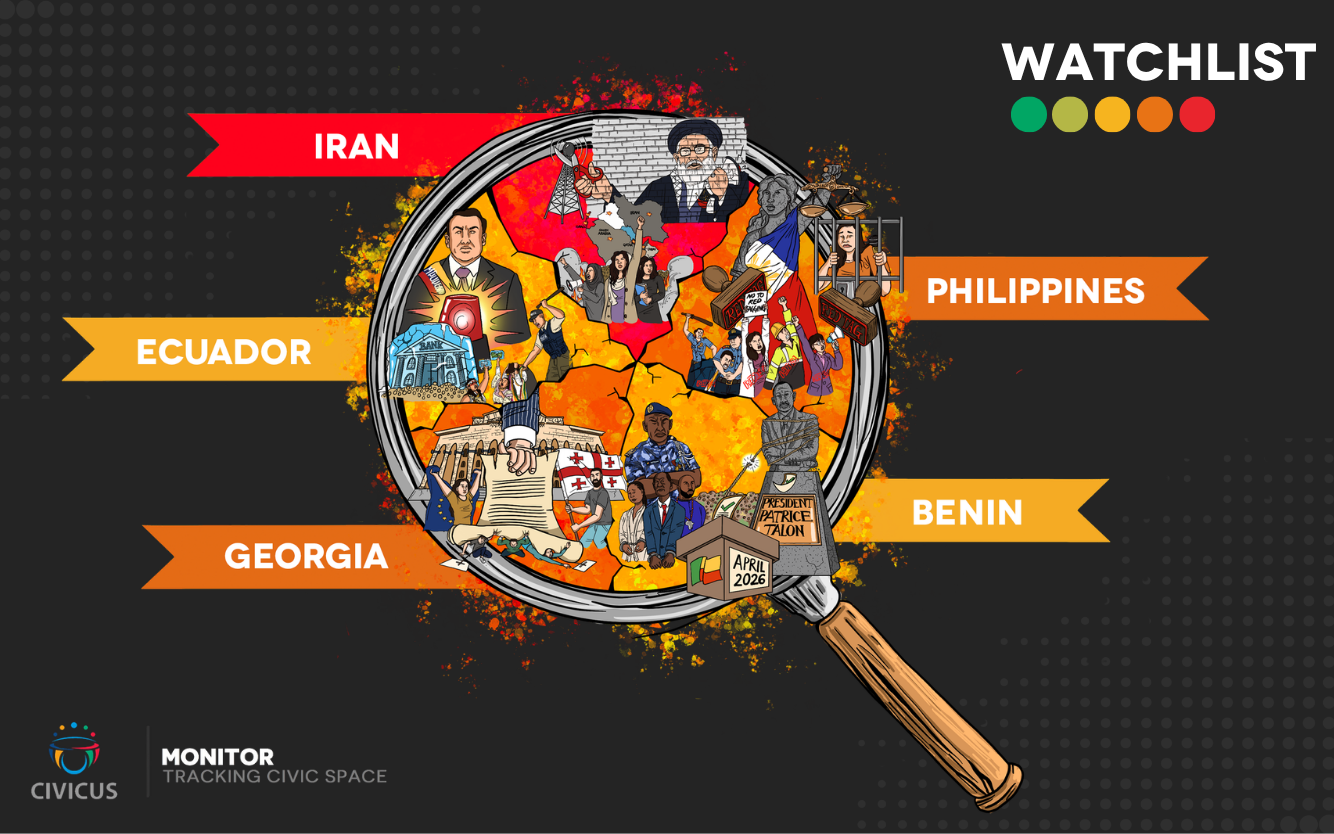
The March 2026 Watchlist from the CIVICUS Monitor highlights five countries where civic freedoms are deteriorating at an alarming pace: Ecuador, Georgia, Iran, the Philippines and Benin. Each faces escalating restrictions on fundamental rights, including freedoms of expression, association and peaceful assembly. The Watchlist draws on research findings, partner input and testimony from activists on the ground, and signals where urgent international attention is needed.
CIVICUS MONITOR CIVIC SPACE RATINGS:
OPEN
NARROWED
OBSTRUCTED
REPRESSED
CLOSED
Ecuador Civic space rating:Obstructed Ecuador’s government has increasingly relied on militarised security measures, invoking an “internal armed conflict” to justify exceptional powers. Indigenous-led protests in 2025 were met with lethal force, arbitrary detentions and internet disruptions. Environmental and Indigenous leaders face criminalisation, with more than 200 social leaders investigated or prosecuted. A 2025 law has expanded state control over civil society organisations, enabling account freezes and burdensome reporting. Journalists face killings, attacks and suspensions of media outlets, all unfolding amid a broader erosion of judicial independence.
Georgia Civic space rating:Repressed Georgia has seen a dramatic decline in civic space, marked by mass protests since late 2024 and heavy-handed police responses. Hundreds have been detained, tortured or investigated. New laws restrict protests, impose “foreign agent” requirements on civil society and media, and threaten criminal penalties for receiving foreign funding. Opposition parties and leaders face politically motivated charges, and new rules bar many civil society actors from political participation for years.
Iran Civic space rating: Closed Iran’s civic space, already severely restricted, has worsened following mass protests over economic and political grievances. Security forces killed thousands of protesters in January 2026 during a nationwide internet blackout, and tens of thousands were arrested. After regional airstrikes in February 2026, authorities imposed another shutdown and intensified censorship. Journalists and activists face extreme risk, and some detainees now face the death penalty. Despite repression, demonstrations continue following the death of the Supreme Leader.
The Philippines Civic space rating:Repressed Civic space in the Philippines remains under pressure, with police violence and mass arrests during anti-corruption protests in 2025. Dozens of protesters face sedition charges under cybercrime laws. Human rights defenders are frequently targeted, including through fabricated terrorism-financing cases. Red-tagging—accusing critics of communist links—remains widespread. Journalists also face prosecution, including the conviction of reporter Frenchie Mae Cumpio after years of pre-trial detention.
Benin Civic space rating:Obstructed Benin approaches its April 2026 presidential election with shrinking democratic space. Strict electoral rules have limited the field to two approved candidates, and the January 2026 legislative elections produced a parliament without opposition representation. Authorities increasingly use the Digital Code to prosecute journalists and critics, while media outlets face suspensions and mandatory government messaging. Protests are routinely banned or dispersed, and fear of reprisals has led to widespread self-censorship.
Nathalia Bonilla is an environmental human rights defender from Ecuador who works in the protection of the rights of Nature. She told ISHR about her country’s sharp policy turn in favour of extractive activities and spoke about the ‘utopia’ she and her peers would like to see in its place. ‘A revolution where you can’t dance is not my revolution,’ Nathalia said, in arguing for an ‘environmentalism for the people’.
Nathalia Bonilla is an environmental human rights defender from Ecuador who works in the protection of the rights of Nature. She told ISHR about her country’s sharp policy turn in favour of extractive activities and spoke about the ‘utopia’ she and her peers would like to see in its place. ‘A revolution where you can’t dance is not my revolution,’ Nathalia said, in arguing for an ‘environmentalism for the people’.
On 16 October 2025 Amazon Watch reported that more than 130 civil society and human rights organizations from across Latin America and around the world have issued an urgent appeal for an immediate end to repression, militarization, and human rights violations by the Ecuadorian government. The statement follows weeks of violent crackdowns against Indigenous-led protests that began on September 21, when social movements mobilized to defend democracy, rights, and the environment amid controversial government reforms.
According to Ecuadorian human rights groups, the government’s response has been brutal and disproportionate: at least three people have been killed, including Indigenous leader Efraín Fuerez; over 282 people injured; 172 detained; and 15 temporarily disappeared. Reports also confirm attacks on journalists, raids without warrants, internet blackouts, and summary deportations, while military operations continue across several provinces.
The joint declaration denounces the criminalization of Indigenous and human rights defenders, who face fabricated charges of terrorism, sabotage, and illicit enrichment, along with the freezing of organizational bank accounts. The signatories condemn President Daniel Noboa’s use of racist and stigmatizing rhetoric to justify state violence and to discredit legitimate social protest.
“Defending life, land, human rights, and freedom of expression cannot be criminalized. Peace cannot be imposed by force; it is built on truth, justice, and dialogue,” the statement affirms.
The organizations also point to international alarm: on October 8, seven United Nations Special Rapporteurs expressed concern about the repression and institutional rollbacks that weaken environmental protections and Indigenous rights. Two days later, members of the European Parliament called for a public EU statement, a monitoring mission, and a review of the E.U.–Ecuador Trade Agreement under its human rights clauses.
In response to the escalating crisis, Amazon Watch has launched an international action urging President Noboa to cease all violence immediately, end the criminalization of Indigenous movements, and ensure full respect for human rights and the rule of law.
Download the statement in PDF format to view a complete list of signatories.
On 20 October 2023 Front Line Defenders wrote that between 2 October 2023 and 16 October 2023, human rights defender Javier Medardo Feijoo Villa received several death threats via phone calls and voice messages towards both him and his family. The unidentified perpetrators claimed that they were keeping the human rights defender under surveillance, and maintained that they had access to his data and aware of all his moves within the community.l
Javier Medardo Feijoo Villa is the president of the Estero Piedras community, located in the coastal area of the Molleturo on Azuay province. This community is also part of the San Felipe de Molleturo Commune, an ancestral territory that has been of great importance to the region, given that it has fought to defend against attempts by transnational mining companies to dispossess the people in the region of their land and water sources. He is also president of the North Zone Road Committee, which represents 15 communities in the region. As a community leader, the human rights defender has sought support from the competent authorities to stop criminal acts and illicit activities, mainly assaults and robberies caused by criminal groups that threaten the area. Javier has played an important role in the defence of water, nature and the territories belonging to the communities who he represents.
Since 2 October 2023, human rights defender Javier Medardo Feijoo Villa has been the target of several death threats. Over the course of two weeks, he has received calls and voice messages threatening to kill him and his family. The callers claimed to be keeping the human rights defender under surveillance, and maintained that they had access to his data, as well as all his moves. The level of violence articulated in these threats increased over the weeks, causing the human rights defender to stop responding to messages or calls altogether, and provoking him to block the numbers of those who called him. The threats continued up until 16 October 2023. The human rights defender has been filing relevant complaints with the Prosecutor’s Office about the recent threats and has requested that the Police Commander of Zone 6 take the necessary measures protect him and his family.
Violence against human rights defenders working on indigenous, land and environmental rights has been on the rise in Ecuador; human rights defenders Andrés Durazno and Alba Bermeo were murdered in 2021 and 2022 respectively. Still to this day no one has been charged with their murder.
Front Line Defenders announced the five winners of its 2023 Award for Human Rights Defenders at Risk, at a special ceremony in Dublin on 26 May 2023. Laureates from each of the major global regions travelled to Ireland to accept the Award, including:
“This year’s laureates are a courageous and inspiring group of people who reflect the determination, dynamism and diversity of human rights defenders (HRDs) who are on the front lines of fighting for a more just world,” said Olive Moore, Interim Director of Front Line Defenders. “Their vital work in defence of human rights in DRC, Ecuador, Jordan, Philippines and Ukraine impacts countless people in their communities and beyond. By shining an international spotlight on their struggles and empowering them to continue their work, we at Front Line Defenders hope this Award will touch the lives of many more people on whose behalf they act.”
Olivier Bahemuke Ndoole (Democratic Republic of the Congo) is a leader among environmental and land defenders in DRC and one of the most trusted advocates on behalf of communities impacted by land grabs, trafficking, and illegal resource extraction activities. He is also the only advocate who organises judicial training and capacity-building sessions for DRC citizens on topics related to environment and community rights in Goma, eastern DRC.
AMERICAS
Segundo Ordóñez (Ecuador), an Afro-descendant human rights defender, is one of the most visible faces and the community representative in the two legal proceedings brought against the Japanese-owned company Furukawa Plantaciones C. A. and the State of Ecuador. The cases have focused on how workers on abacá (Manila hemp) plantations suffer labour exploitation as they farm the raw materials in slavery-like conditions.
ASIA AND THE PACIFIC
Jeany ‘Rose’ Hayahay (Philippines) is a woman human rights defender based in Mindanao, the Philippines. Since 2019, she has been the spokesperson of the Save Our Schools Network (SOS Network), a coalition of child-focused NGOs, church-based groups and other stakeholders advocating for children’s right to education in Mindanao.
EUROPE AND CENTRAL ASIA
Digital Security Lab Ukraine (Ukraine) is a team of specialists in the field of digital security and internet freedom. They help Ukrainian journalists, human rights defenders and public activists solve problems with digital security, as well as promote the realisation of human rights on the internet by influencing government policy in the field of digital rights.
MIDDLE EAST AND NORTH AFRICA
Hala Ahed (Jordan) is a Jordanian human rights lawyer who has worked with a number of human rights and feminist organisations to defend women’s rights, workers’ rights, and the freedoms of opinion, expression and peaceful assembly in Jordan.
In preparation for what may be the final days of the trial of Ola Bini, an open source and free software developer arrested shortly after Julian Assange’s ejection from Ecuador’s London Embassy, civil society organizations observing the case have issued a report citing due process violations, technical weaknesses, political pressures, and risks that this criminal prosecution entails for the protection of digital rights. Bini was initially detained three years ago and previous stages of his prosecution had significant delays that were criticized by the Office of the Inter-American Commission on Human Rights (IACHR) Special Rapporteur for Freedom of Expression. An online press conference is scheduled for May 11th, with EFF and other organizations set to speak on the violations in Bini’s prosecution and the danger this case represents. The trial hearing is set for May 16-20, and will most likely conclude next week. If convicted, Bini’s defense can still appeal the decision.
What’s Happened So Far
The first part of the trial against Ola Bini took place in January. In this first stage of testimony and expert evidence, the court repeatedly called attention to various irregularities and violations to due process by the prosecutor in charge. Human rights groups observing the hearing emphasized the flimsy evidence provided against Bini and serious flaws in how the seizure of his devices took place. Bini’s defense stressed that the raid happened without him present, and that seized encrypted devices were examined without following procedural rules and safeguards.
These are not the only problems with the case. Over two years ago, EFF visited Ecuador on a fact-finding mission after Bini’s initial arrest and detention. What we found was a case deeply intertwined with the political effects of its outcome, fraught with due process violations. EFF’s conclusions from our Ecuador mission were that political actors, including the prosecution, have recklessly tied their reputations to a case with controversial or no real evidence.
Ola Bini is known globally as someone who builds secure tools and contributes to free software projects. Bini’s team at ThoughtWorks contributed to Certbot, the EFF-managed tool that has provided strong encryption for millions of websites around the world, and most recently, Bini co-founded a non-profit organization devoted to creating user-friendly security tools.
What Bini is not known for, however, is conducting the kind of security research that could be mistaken for an “assault on the integrity of computer systems,” the crime for which he was initially investigated, or “unauthorized access to a computer system,” the crime for which he is being accused now (after prosecutors changed the charges). In 2019, Bini’s lawyers counted 65 violations of due process, and journalists told us at the time that no one was able to provide them with concrete descriptions of what he had done. Bini’s initial imprisonment was ended after a decision considered his detention illegal, but the investigation continued. The judge was later “separated” from the case in a ruling that admitted the wrongdoing of successive pre-trial suspensions and the violation of due process.
A so-called piece of evidence against Bini was a photo of a screenshot, supposedly taken by Bini himself and sent to a colleague, showing the telnet login screen of a router. The image is consistent with someone who connects to an open telnet service, receives a warning not to log on without authorization, and does not proceed—respecting the warning. As for the portion of a message exchange attributed to Bini and a colleague, leaked with the photo, it shows their concern with the router being insecurely open to telnet access on the wider Internet, with no firewall.
Between the trial hearing in January and its resumption in May, Ecuador’s Prosecutor’s Office revived an investigation against Fabián Hurtado, the technical expert called by Ola Bini’s defense to refute the image of the telnet session and who is expected to testify at the trial hearing.
On January 10, 2022, the Prosecutor’s Office filed charges for procedural fraud against Hurtado. There was a conspicuous gap between this charge and the last investigative proceeding by prosecutors in the case against Hurtado, when police raided his home almost 20 months before, claiming that he had “incorporated misleading information in his résumé”. This raid was violent and irregular, and considered by Amnesty International as an attempt to intimidate Ola Bini’s defense. One of the pieces of evidence against Hurtado is the document by which Bini’s lawyer, Dr. Carlos Soria, included Hurtado’s technical report in Bini’s case file.
Hurtado’s indictment hearing was held on February 9, 2022. The judge opened a 90-day period of investigation which is about to end. As part of this investigation, the prosecutor’s office and the police raided the offices of Ola Bini’s non-profit organization in a new episode of due process violations, according to media reports.
Civil Society Report and Recommendations
Today’s report, by organizations gathered in the Observation Mission of Bini’s case, is critical for all participating and to others concerned about digital rights around the world. There is still time for the court to recognize and correct the irregularities and technical weaknesses in the case. It points out key points that should be taken into consideration by the judicial authorities in charge of examining the case.
In particular, the report notes, the accusations have failed to demonstrate a consistent case against Ola Bini. Irregularities in court procedures and police action have affected both the speed of the procedure and due process of law in general. In addition, accusations against Bini show little technical knowledge, and could lead to the criminalization of people carrying out legitimate activities protected by international human rights standards. This case may lead to the further persecution of the so-called “infosec community” in Latin America, which is made up primarily of security activists who find vulnerabilities in computer systems, carrying out work that has a positive impact on society in general. The attempt to criminalize Ola Bini already shows a hostile scenario for these activists and, consequently, for the safeguard of our rights in the digital environment.
Moreover, these activists must be guaranteed the right to use the tools necessary for their work—for example, the importance of online anonymity must be respected as a premise for the exercise of several human rights, such as privacy and freedom of expression. This right is protected by international Human Rights standards, which recognize the use of encryption (including tools such as Tor) as fundamental for the exercise of these rights.
These researchers and activists protect the computer systems on which we all depend, and protect the people who have incorporated electronic devices into their daily lives, such as human rights defenders, journalists and activists, among many other key actors for democratic vitality. Ola Bini, and others who work in the field, must be protected—not persecuted.
On 30 March 2022 CIVICUS reported on a very interesting case: On 11th March 2022, the National Assembly of Ecuador approved a bill granting amnesty to 268 people who faced prosecution for their defence of land, indigenous and environmental rights, and for their involvement in 2019 protests. The bill was approved by the plenary of the National Assembly with 99 favourable votes out of the 125 parliamentarians in attendance.
Among those benefitted by the amnesty, 153 are land defenders, 43 are environmental activists, 12 are Indigenous leaders criminalised for administering Indigenous justice and 60 others were more generally facing charges related to their involvement in the October 2019 demonstrations. Several defenders, such as Gabriela Fraga, Nancy Simba, Ángel Punina, Javier Ramírez and Jovita Curipoma, were cleared of charges related to resistance against extractive industries. Civil society groups also highlighted the case of Víctor Guaillas, a water defender who had been detained on charges of ‘sabotage’ in 2019, for whom amnesty came too late. Guaillas was one of the 62 people murdered in November 2021 amid a riot in a Guayaquil prison.
Ecuador’s Human Rights Alliance (DDHH) called the move a “historical precedent against the criminalisation and prosecution of rights defenders.” In a statement, the coalition said that this amnesty “means vindicating the right to truth and justice for those who exercise the right to defend human rights” in a context of recurrent criminalisation of these actors.
In a separate but related development, in December 2021 President Guillermo Lasso had made stigmatising statements about social movements and Leonidas Iza, the president of the Indigenous confederation Confederación de Nacionalidades Indígenas (CONAIE). Iza and former CONAIE president Jaime Vargas were among those facing prosecution related to October 2019 protests, and were both granted amnesty in March 2022.
On 21st December 2021, during a weekly broadcast programme in which he discusses government initiatives, Lasso called Iza “an anarchist” and “a violent man,” and claimed that the Indigenous leader “hates democracy.” The President accused the CONAIE leader of incentivising violence during the October 2019 protests. Lasso also said his government would use all the power of the state to jail “those who want to anarchise this country, disrupt public services, and deepen an economic crisis that has already been affected by the pandemic.”
On 22nd December 2021, the DDHH issued a statement expressing solidarity with the Indigenous movement and Leonidas Iza. The coalition said that Guillermo Lasso’s “violent and contemptuous discourse stigmatises the work carried out by social and political leaders, social and Indigenous movements, and makes unfounded and reckless attacks against Leonidas Iza.”
Lasso repeated his statements in a programme aired on 4th January 2022, calling Iza “an enemy of Ecuadorean democracy.”
On 27th January 2022, Ecuador’s Constitutional Court confirmed the violation “of the rights to prior consultation, to nature, water, a healthy environment, culture and territory, as well as comprehensive reparation measures”, regarding the A’i Cofán Indigenous people of the Sinangoe community in relation to mining concessions that affected their ancestral territory without their free, prior and informed consent. In their ruling, the country’s highest court reaffirmed the state’s obligations in consultation processes on plans and projects that affect Indigenous peoples’ rights and interests.
Indigenous communities and organisations have led the international campaign “Who Should Decide?”. Just days before this court ruling, they delivered more than 365,000 signatures to the Constitutional Court asking the Court to protect the right of Indigenous peoples to decide on the future of their ancestral territories.
International group Amazon Frontlines said that the Constitutional Court ruling recognises “for the first time, the right of Indigenous communities to have the final decision over oil, mining and other extractive projects that affect their lands.” The organisation also evaluated that Ecuador “now has one of the most powerful legal precedents in the world on the internationally recognised right of Indigenous peoples to Free, Prior and Informed Consent.”
In a letter to President Biden, the organizations state: “More than four months since a discerning opinion by the UN Working Group on Arbitrary Detention that found Steven Donziger’s detention to be arbitrary, U.S. judicial authorities have thus far failed to take any action to remedy the situation and implement the Working Group’s call to ensure Mr. Donziger’s immediate release.” See also: https://humanrightsdefenders.blog/2020/08/17/steven-donziger-speaks-out-himself-about-being-targetted-by-chevron
In a statement in October 2021, President Biden promised the U.S. would “stand in solidarity with, and continue to work tirelessly in support of, the activists, human rights defenders, and peaceful protestors on the front lines of the struggle between freedom and tyranny.”All the while, the administration has failed to side with the brave human rights defenders within the United States and respond to the demand of the U.N. Working Group on Arbitrary Detention, Congress, and the international community to free Steven Donziger.
“Steven Donziger is a human rights defender that bravely stood up against one of the most powerful corporations in the world,” said Daniel Joloy of Amnesty International. “In response, he has endured years of harassment, intimidation, smear campaigns and more than two years in arbitrary detention. President Biden must now listen to the over 100 human rights and environmental organizations calling to pardon Steven Donziger and ensure he is released immediately and unconditionally. Allowing this ordeal to continue only sends a chilling message that corporations around the world can continue attacking human rights defenders without consequences.”
Paul Paz y Miño of Amazon Watch said “Instead of supporting the people of Ecuador who were poisoned by Chevron’s admitted deliberate dumping of billions of gallons of toxic waste, Biden has turned a blind eye to the persecution of a key lawyer who worked to win a historic judgment against Chevron. The U.S. government’s responsibility should be to make Chevron clean up its waste and support efforts to hold the fossil fuel company accountable, not allow the appointment of a private prosecutor with ties to the very same oil company to imprison human rights lawyer Steven Donziger. This travesty has gone on for over two years, and Biden has ignored members of the E.U. parliament, members of the House and Senate, and even the United Nations High Commissioner for Human Rights. Well over 100 organizations are now demanding action, and Biden’s lack of action continues to be a dark stain on his alleged claims to respect human rights. Oil companies do not prosecute and imprison people in the U.S. This must end now.”
Chevron’s legal attack on Donziger is not the first, nor will it be the last case of its kind. Right now, the right to dissent is being repressed by both our government and corporations
Annie Leonard, co-Executive Director Greenpeace USA
Simon Taylor, Co-Founder & Director, Global Witness said “I have spent much of the past 25 years seeking accountability of the fossil fuel industry for its gross human rights abuses and other crimes. Amongst the judicial authorities we have liaised with during this time, the Southern District of New York has stood as a beacon in this fight against criminality. Shockingly, just as Biden gears up this struggle, New York’s judicial authorities seem instead intent on destroying their reputation, thanks to their apparent complicity in the unprecedented corporate prosecution and judicial harassment of Steven Donziger. These acts, in my experience, are more what I would expect from one of the ‘Banana Republics’ we have investigated around the world. These are shameful acts. If Biden is serious about tackling the climate crisis, he cannot allow the fossil fuel industry to weaponise the US judicial system to go after its detractors – Biden must act now and release Steven Donziger.”
On Wednesday, 16 December 2020 Débora Leão and Suraj K. Sazawal published an opinion piece in IPS entitled: “USA Downgraded as Civil Liberties Deteriorate Across the Americas” (Débora Leão is a Civic Space Researcher at CIVICUS, the global civil society alliance. She has a Master of Public Policy degree. Prior to joining CIVICUS, Débora worked on advocacy and research related to civic participation, urban development and climate justice. Suraj K. Sazawal serves on the board to Defending Rights & Dissent and is co-author of ‘Civil Society Under Strain’, the first book to explore how the War on Terror impacted civil society and hurt humanitarian aid.
Protests in New York City against racism and police violence, following the death of George Floyd. Credit: UN Photo/Evan Schneider
Few images better illustrate the recent decline in civil liberties in the United States than that of peaceful protesters near the White House being violently dispersed so Donald Trump could stage a photo-op. Moments before the president emerged from his bunker on June 1 to hold a bible outside a boarded-up church, federal officers indiscriminately fired tear gas at people who had gathered in Lafayette Park to protest about the police killing of George Floyd. This was far from an isolated incident: nationwide protests against systemic racism and police brutality have been met with widespread police violence.
Since May, the CIVICUS Monitor, an online platform that tracks fundamental freedoms across 196 countries, documented dozens of incidents where law enforcement officers, dressed in riot gear and armed with military grade-equipment, responded to Black Lives Matter protests with excessive force. These include officers driving vehicles at crowds of protesters and firing tear gas canisters and other projectiles at unarmed people, leaving at least 20 people partially blinded.
Throughout the year, journalists and health workers, clearly marked as such while covering the protests, have been harassed and assaulted. In one incident caught on live TV, a news reporter and camera operator from Louisville, Kentucky were shot by police with pepper balls while covering protests over the police killing of Breona Taylor.
This sustained repression of protests and an increased crackdown on fundamental freedoms led to the USA’s civic space rating being downgraded from ‘narrowed’ to ‘obstructed’ in CIVICUS new report, People Power Under Attack 2020.
This disproportionate response by law enforcement officers to protesters goes beyond what is acceptable practice when policing protests, even during an emergency. Under international law, people have a right to assemble freely. Any restrictions to this right must be proportionate and necessary to address an emergency or reestablish public order.
While recent brutality against protests for racial justice is concerning, the decline in basic freedoms in the USA began before this crackdown. The repression seen in 2020 was preceded by a wave of legislation limiting people’s rights to protest.
In recent years, several states enacted restrictive laws which, for example, criminalise protests near so-called critical infrastructure like oil pipelines, or limit demonstrations on school and university campuses. Increased penalties for trespassing and property damage are designed to intimidate and punish climate justice activists and organisations that speak out against fossil fuels.
In the wake of Black Lives Matter protests, some of the ‘anti-protest’ bills introduced this year seem particularly cruel, for instance, by proposing to make people convicted of minor federal offences during protests ineligible for pandemic-related unemployment benefits.
Growing disregard for protest rights underscores wider intolerance for dissent. In parallel with restrictions on the freedom of peaceful assembly, the USA also saw an increase in attacks against the media, even before Black Lives Matter demonstrations erupted. Over the past three years, the CIVICUS Monitor has documented the frequent harassment of journalists by the authorities and civilians while covering political rallies or when conducting interviews.
Correspondents critical of the Trump administration or reporting on the humanitarian crisis in the USA/Mexico border region sometimes faced retaliation; documents obtained by ‘NBC 7 Investigates’ in 2019 showed the US government created a database of journalists who covered the migrant caravan and activists who were part of it, in some cases placing alerts on their passports.
In January 2020 a journalist was barred from accompanying Secretary of State Mike Pompeo in an official trip to Europe after Pompeo objected to the questions by another reporter from the same outlet.
The harsh treatment of people wanting to express themselves and the decline of civil liberties is part of a broader global decline in fundamental freedoms. Our new report shows less than four percent of the world’s population live in countries that respect the freedoms of association, peaceful assembly and expression.
Each country’s civic space is rated in one of five categories: ‘open, ‘narrowed, ‘obstructed,’ ‘restricted,’ or ‘closed’. The USA was one of 11 countries downgraded from its previous rating.
Another recent example may be that on 15 December 2020 five independent UN human rights experts expressed serious concern over the arrest and charges brought against an indigenous leader (Nicholas Tilsen, human rights defender of the Oglala-Lakȟóta Sioux Nation), for peacefully protesting a political rally held last July at Mount Rushmore National Memorial, located on treaty lands of the Great Sioux Nation.
Violations of protest rights were common across the region, with detention of protesters and excessive use of force among the top five violations of civic freedoms recorded this year. In addition, the Americas continue to be a dangerous place for those who dare to stand up for fundamental rights: across the world, 60 percent of human rights defenders killed in 2020 came from this region.
The authorities must engage with civil society and human rights defenders to create an environment where they are able to fulfil their vital roles and hold officials accountable.



 Hans Thoolen on Human Rights Defenders and their awards