The Carmignac Photojournalism Award is an annual prize given to investigative photojournalists covering human rights violations [see: http://www.trueheroesfilms.org/thedigest/awards/carmignac-photojournalism-award]. Each year, a team of environmental and political leaders selects a region to focus on and then selects a recipient, who uses the foundation’s $55,000 prize money to shoot the project they proposed. The annual award, now in its 10th year, focuses on a different region and associated human rights topic each year. For 2019 the jury chose to call for project proposals around deforestation and the Amazon. Evan Nicole Brown writing in Fact Company of 12 September 2019 notes that “in an ironic twist, the recipient of the prize money was announced as the rain forest was being obscured by plumes of smoke from the unprecedented fires.”
The winner, Tommaso Protti, is an Italian-born photographer who has lived in Brazil for the past five years. ..the prize money supported the production of his photojournalism work, which began in January of this year and wrapped up in July. His reportage, developed in tandem with British journalist Sam Cowie, was revealed at the Visa pour l’Image festival in France on September 4.
……
“There’s a big problem with impunity inside the region because of the state—it leads directly to killing the environment and indigenous leaders,” Protti says. “The people there don’t have the protection [like most of us] experiencing climate collapse. The majority of the people I’ve met try to make a living with what the forest offers them.”
Poor environmental health in the Amazon is, in part, responsible for poverty and violence in surrounding favelas too. Rural agricultural workers, who depend on the forest for a living, have been forced to leave the Amazon now that it is less dense and farming has been modernized. The only place left for them to go are Brazil’s cities, resulting in a crowding of favelas and the tension that results from a government pushing disparate communities into close proximity.
One of Protti’s selected photographs depicts members of the Guajajara forest guard beating an indigenous man accused of collaborating with illegal loggers. Over the course of his time photographing the rain forest and its native people, Protti was able to observe how seasonal changes affect the Amazon’s health, during the dry season (July through October) and the rainy season too. The joint work between Protti and Cowie explores the humanitarian crises plaguing the region—from Venezuelan refugee groups to agrarian and religious conflicts—and the ongoing deforestation too. “It’s a really complex award from my point of view. [The Amazon] is a national treasure,” Protti says about his win. “It’s nothing new, fires happen every year . . . but at the same time, the fires are consequences of the social [situation].”
Protti’s photographs and the accompanying reportage will be presented in London and at the Maison Européenne de la Photographie (MEP) in Paris starting December 4. They will also be included, concurrently, in a monograph copublished with Reliefs Éditions.
The decision as to the Prize winner will be made by the Selection Panel on 29 September 2019, and its name will be announced in the Chamber of the Parliamentary Assembly of the Council of Europe in Strasbourg, on 30 September 2019 at 12:30pm. The award ceremony for the Prize will subsequently take place in the presence of all three shortlisted candidates. Two other candidates, who have also been shortlisted are Mr Buzurgmehr Yorov (Tajikistan) and the Youth Initiative for Human Rights.
The UNPO is currently campaigning for Mr. Tohti to also be awarded the Sakharov Prize saying that such prizes are an excellent way in which the international community can continue to show support for the Uyghur people in the face of hostile oppression.
China’s predictable reaction came quickly: “Beijing slammed on Thursday the nomination of a jailed academic from China’s Uighur minority for one of Europe’s top human rights awards, saying it equated to “supporting terrorism”.
Saudi human rights lawyer Waleed Abu al-Khair, who was convicted on anti-terrorism charges and sentenced to 15 years in prison, is the winner of the 2019 ABA International Human Rights Award. For more on this and other awards for human rights lawyers see: http://www.trueheroesfilms.org/thedigest/awards/aba-international-human-rights-award
The ABA Journal states that Abu al-Khair founded Monitor for Human Rights, one of the only human rights organizations in Saudi Arabia, in 2008. He dedicated his legal career to defending human rights and the right to freedom of expression, and pushed for an elected parliament, independent judiciary, constitutional monarchy and other reforms in his country. Abu al-Khair’s 2014 arrest and conviction largely stemmed from comments he made to the media and on social media that criticized Saudi Arabia’s human rights record, discussions of human rights in his home and his defense of activists who were punished for criticizing the government, according to Human Rights Watch and Amnesty International. The human rights organizations say the specific charges against him included disobeying the ruler and seeking to remove his legitimacy; insulting the judiciary and questioning the integrity of judges; setting up an unlicensed organization; harming the reputation of the state by communicating with international organizations; and preparing, storing and sending information that harms public order.
His full 15-year sentence was upheld by a Saudi appeals court in 2015 after he refused to apologize for the alleged offenses. He is currently in the Dhahban Central Prison in Jeddah, Saudi Arabia. The United Nations Human Rights Council’s Working Group on Arbitrary Detention has twice reviewed the legitimacy of Abu al-Khair’s detention, and in 2018, declared that Saudi Arabia lacked legal basis and grounds for restricting his freedoms of expression and opinion, the ABA press release says.
The Ramon Magsaysay Award, one of Asia’s best known prizes, celebrates transformative leadership. In the past five decades, the award has been bestowed on over three hundred men, women and organizations whose selfless service has offered their societies, Asia, and the world successful solutions to some of the most intractable problems of human development. For more on this regional award, see: http://www.trueheroesfilms.org/thedigest/awards/ramon-magsaysay-award-for-community-leadership] The trustees of the Ramon Magsaysay Award Foundation annually select the awardees. The Award is presented to them in formal ceremonies in Manila, Philippines on August 31st, the birth anniversary of the much-esteemed Philippine President whose ideals inspired the Award’s creation in 1957.
The winners for 2019 are:
Kim, Jong-ki, South Korea
In 1995, Kim Jong-ki was a highly successful businessman handling market operations in China for a giant Korean electronics company. Married, with a son and daughter, he was at the height of his career when tragedy struck.
In the year his son died, Jong-ki established the Foundation for Preventing Youth Violence (FPYV), the first organized effort in South Korea to address school violence as a systemic social problem affecting students, families, schools, and the community-at-large.
The impact of Jong-ki and FPYV on Korean society has been profound, establishing a nationwide presence and creating collective action on a social problem hitherto neglected.
In electing Kim Jong-ki to receive the 2019 Ramon Magsaysay Award, the board of trustees recognizes his quiet courage in transforming private grief into a mission to protect Korea’s youth from the scourge of bullying and violence, his unstinting dedication to the goal of instilling among the young the values of self-esteem, tolerance, and mutual respect, and his effectively mobilising all sectors of the country in a nationwide drive that has transformed both policy and behaviours towards building a gentler, non-violent society.
Kumar, Ravish, India
In 1996, he joined New Delhi Television Network (NDTV), one of India’s leading TV networks and worked his way up from being a field reporter. After NDTV launched its 24-hour Hindi-language news channel — NDTV India — targeting the country’s 422 million native speakers of Hindi, he was given his own daily show, “Prime Time.”
As an anchor, Ravish is sober, incisive, and well-informed. He does not dominate his guests but affords them the chance to express themselves. He does not balk, however, at calling the highest officials to account or criticizing media and the state of public discourse in the country; for this reason, he has been harassed and threatened by rabid partisans of one kind or another.
Ravish has been most vocal on insisting that the professional values of sober, balanced, fact-based reporting be upheld in practice.
In electing Ravish Kumar to receive the 2019 Ramon Magsaysay Award, the board of trustees recognizes his unfaltering commitment to a professional, ethical journalism of the highest standards; his moral courage in standing up for truth, integrity, and independence; and his principled belief that it is in giving full and respectful voice to the voiceless, in speaking truth bravely yet soberly to power, that journalism fulfills its noblest aims to advance democracy.
Neelapaijit, Angkhana, Thailand
In 2006, with the help of non-government organizations and her own family, Angkhana founded Justice for Peace Foundation (JPF), a network of human rights and peace advocates that has done important work in documenting the human rights situation in southern Thailand, thus raising public awareness and putting pressure on government to act on human rights cases, providing legal assistance to victims; and training women on human rights and the peace process.
In 2015, Angkhana was named commissioner of the National Human Rights Commission of Thailand, the only Commission member with grassroots human rights experience.
In her soft-spoken and measured tone she asserts: “Most women experience conflict and violence in a different way than men.
In electing Angkhana Neelapaijit to receive the 2019 Ramon Magsaysay Award, the board of trustees recognizes her unwavering courage in seeking justice for her husband and many other victims of violence and conflict in southern Thailand; her systematic, unflagging work to reform a flawed and unfair legal system, and the shining proof she is that the humblest ordinary person can achieve national impact in deterring human rights abuses.
Such a journalist is 41-year-old Ko Swe Win. Born to a poor family in Yangon, he grew up in politically turbulent times and fell victim to state repression early on.
In 2017, he criticized a powerful, ultranationalist Buddhist monk, Ashin Wirathu, for purveying “hate speech” and publicly commending the killer of a Muslim human rights activist. Wirathu, Swe Win wrote, had desecrated Buddhism and should be punished for endorsing assassination and fomenting hate.
Swe Win and Myanmar Now draw strength from the fact that they are making a difference. With a current readership of 350,000, the news service is highly regarded for the quality, balance, and depth of its reporting on high-impact issues, including land grabbing, child labor, and abuse of domestic workers.
In electing Ko Swe Win to receive the 2019 Ramon Magsaysay Award for Emergent Leadership, the board of trustees recognizes his undaunted commitment to practice independent, ethical, and socially engaged journalism in Myanmar; his incorruptible sense of justice and unflinching pursuit of the truth in crucial but under-reported issues; and his resolute insistence that it is in the quality and force of media’s truth-telling that we can convincingly protect human rights in the world. [see also: https://humanrightsdefenders.blog/2017/09/03/myanmar-time-for-aung-san-suu-kyi-to-return-at-least-some-of-her-many-human-rights-awards/]
The fifth award winner is Mr Cayabyab, 65, who was recognised for “his compositions and performances that have defined and inspired Filipino popular music across generations”.
The Committee to Protect Journalists’ (CPJ) 2019 Gwen Ifill Press Freedom Award recognizing extraordinary and sustained achievement in the cause of press freedom will be presented to Zaffar Abbas, editor of Pakistan’s daily newspaper Dawn. Abbas, who has decades of experience as a reporter in Pakistan, has led Dawn since 2010. Under his leadership, Dawn and its reporters frequently have come under government pressure. This is the second Ifill award which replaces the Burton Benjamin Memorial Award. For more on this and other awards for journalists: http://www.trueheroesfilms.org/thedigest/awards/gwen-ifill-press-freedom-award
“Zaffar Abbas is the embodiment of journalistic courage, which is why the board is so pleased to honor him with the Gwen Ifill Press Freedom Award,” said Kathleen Carroll, chair of the CPJ board. “Every day he fights to deliver facts to Dawn’s readers in the face of pressure, obstacles, and blockades from the institutions in Pakistan that would much prefer to go about their business without scrutiny from the press or the public.”
On 16 July 2019, the Committee to Protect Journalists announced that journalists from Brazil, India, Nicaragua, and Tanzania will receive the 2019 International Press Freedom Awards amid the erosion of press freedom in democracies around the globe. The journalists have faced online harassment, legal and physical threats, and imprisonment in their pursuit of the news
CPJ’s 2019 awardees are:
Patrícia Campos Mello, a reporter and columnist at Brazil’s daily Folha de S. Paulo. During the Brazilian presidential election campaign in 2018, Campos Mello was attacked online and doxxed in response to her coverage of supporters of then presidential-candidate Jair Bolsonaro allegedly sponsoring bulk messaging in WhatsApp.
Neha Dixit, a freelance investigative journalist in India who covers human rights. She has faced legal and physical threats, as well as online harassment, after reporting on alleged wrongdoing by right-wing nationalist groups and police.
Lucía Pineda Ubau, news director, and Miguel Mora, founder and editor, of Nicaraguan broadcaster 100% Noticias. The pair was imprisoned in December 2018 in relation to their coverage of political unrest. They were freed on June 11 after six months behind bars, under surveillance and in isolation most of the time.
Maxence Melo Mubyazi, champion of online freedom of expression in Tanzania, who co-founded and is the managing director of Jamii Forums, an online discussion site and source of breaking news. Melo has been charged under the country’s restrictive CyberCrimes Act and, in 2017, appeared in court 81 times.
All of the winners will be honored at CPJ’s annual awards and benefit dinner, which will be chaired by Laurene Powell Jobs and Peter Lattman of the Emerson Collective. The event will be held at the Grand Hyatt New York in New York City on November 21, 2019.
Kenyan social justice activist Naomi Barasa and Colombian human rights lawyer Daniel Prado have won the first annual Henry Brooke Awards for Human Rights Defenders, created in 2018 by PBI UK and pro bono legal network the Alliance for Lawyers at Risk.
These awards are in honour of the life and legacy of Sir Henry Brooke – barrister at Fountain Court Chambers, founder of the Alliance for Lawyers at Risk and patron of PBI UK – who passed away in January 2018. They are presented annually to defenders who encapsulate the qualities Sir Henry most admired and reflected in his own life: selflessness, courage, and commitment to seeking justice for the oppressed and the marginalised. The award winners were selected by a panel of leading figures from the UK legal and human rights communities. For more on this award, see: http://www.trueheroesfilms.org/thedigest/awards/henry-brooke-awards-for-human-rights-defenders
Naomi Barasa was selected for the award in recognition of her remarkable determination and commitment to grassroots human rights work in the most disadvantaged social circumstances. Born in an informal settlement on the outskirts of Nairobi, Naomi was a close witness to street violence, police brutality, impunity and the overwhelming inequality of the slums. Her journey as a human rights defender has embedded her in the struggle to improve living conditions for Nairobi’s 2.5 million slum dwellers. Naomi was instrumental in the campaign that led to the passage of the Sexual Offences Act in 2006, and has acted as Campaigns Manager for the Right to Adequate Housing with Amnesty International since 2009. She has contributed to the adoption of legislation such as the Housing Bill 2011, the Evictions and Resettlement Bill and the Slum Upgrading & Prevention Policy. What motivates her work, she says, is “the resilience of the suffering people and the desire to see a different world. A world that has a mathematics of justice, not of inequality.”
Daniel Prado was selected as an example of a lawyer who has defied huge personal risk in order to pursue justice for the victims of human rights violations, oppose impunity and defend the rights of marginalised communities against powerful interests. He began his career by providing legal support to the family members of victims of enforced disappearance in the early 1990s and currently works with the Colombian NGO the Inter-Church Justice and Peace Commission (CIJP). Among other emblematic cases, Daniel represents victims of paramilitarism in the case of Los Doce Apóstoles (The Twelve Apostles), in which Santiago Uribe, brother of former President and Senator Alvaro Uribe Velez, stands accused of creating paramilitary groups responsible for more than 500 murders. Daniel’s involvement in this and other high-profile cases has seen him exposed to death threats, harassment and a public campaign of defamation and slander. Speaking of his work, he has said: “The risks in Colombia are unstoppable. I have taken many cases that have had consequences for a lot of people… we live in a constant state of anxiety about what can happen to us.”
PBI provides security and advocacy support to both Naomi Barasa and Daniel Prado, to help mitigate the risks they face as a result of their human rights work.
On 14 June 2019, AfricanDefenders (Pan-African Human Rights Defenders Network) awarded distinguished five human rights defenders on the African continent [for more on this and other regional awards, see: http://www.trueheroesfilms.org/thedigest/awards/african-human-rights-defenders-shield-awards]The winners are Beatrice Mtetwa, Felix Agbor Aniyor, Donald Deya, Fatou Jagne Senghor, and the Sudan Women Protest. The Shield Awards highlight the positive impact of their outstanding human rights work and their unwelding motivation.
The Shield Awards comprise five sub-regional awards and an overall Africa Shield Award. For this third edition, a jury composed of Hon. Commissioner Soyata Maiga, Chairperson of the African Commission on Human and Peoples’ Rights (ACHPR); Hon. Commissioner Rémy Ngoy, Special Rapporteur on Human Rights Defenders in Africa; Margaret Sekaggya, former UN Special Rapporteur on Human Rights Defenders; and Hassan Shire, Chairperson of AfricanDefenders, acknowledged that Sudan Women Protest should be granted the overall Africa Shield Award – also the winner of the North African Regional Award. Sudan Women Protest is a community of Sudanese women activists at the frontline of the Sudanese revolution since December 2018 – bringing to the fore women voices and rights. “This is for all the women, mothers, daughters who stood up to mobilise the people and to ensure that their rights are not forgotten – we all stand in solidarity with them,” said Walaa Salah, a Sudanese activist living in Kenya, who received the award on behalf of the community, as the women activists on the ground are immobilised due to the ongoing violence. “I hope I will be able to travel to Sudan, and bring this shield as a testimony to your solidarity.”Beatrice Mtetwa, Shield Award winner for Southern Africa, is a Zimbabwean human rights lawyer Mtetwa has protected and promoted human rights for years, with a focus on HRDs and journalists, by representing on pro-bono hundreds of HRDs facing harassment and abusive detention in Zimbabwe. As a founding member and board member of Zimbabwe Lawyers for Human Rights (ZLHR), she continues to nurture leaders on the continent who carry her visionary mission of establishing a blue chip human rights lawyer’s organisation in Zimbabwe that has made access to justice for HRDs facing judicial persecution a reality in her home country. “This means a lot, particularly because it comes from my fellow African HRDs,” she said while receiving the award from Sekaggya. [see also: https://humanrightsdefenders.blog/2014/11/06/human-rights-documentary-beatrice-mtetwa-the-rule-of-law-on-television-and-internet/].The Central African Shield Award was presented to Felix Agbor Anyior Nkongho, a Cameroonian lawyer and the founder of the Centre for Human Rights and Democracy in Africa. He has provided pro bono legal services to hundreds of victims. While seeking social justice and equality in the Anglophone region of Cameroon, he was arrested, charged, and tried at a ilitary tribunal for terrorism, rebellion to incite civil war, revolution, contempt against the State, and secession, which carries the death penalty. He was thrown into a cell with 12 alleged members of the Boko Haram terrorist group, later transferred to solitary confinement for 45 days, and was not allowed to attend his father’s funeral. Today, he is documenting and reporting systematic human rights violations committed by both government security forces and the armed separatist groups in the Anglophone region of Cameroon. “We, HRDs, defend the rights of others, so I thank you for protecting us,” he said.Fatou Jagne Senghor, Executive Director of Article 19 West Africa, received the Shield Award for West Africa for her engagement on freedom of expression and media freedom. The award recognises Senghor’s longstanding human rights work in West Africa in general, and in The Gambia in particular. She plays an important role in regards to ensuring accountability on human rights violations, building the capacity of civil society, and strengthening the reforms in The Gambia. “Freedom of expression is increasingly under attack, and we need defenders like Fatou to protect us,” emphasised George Morara, Commissioner of the Kenya National Commission on Human Rights, while handing Senghor her shield.Donald Deya received the Shield Award for the East and Horn of Africa sub-region. Deya is an international human rights lawyer who represent and support victims of human rights abuses on the African continent. He represented numerous victims before the ACHPR, , the African Court on Human and Peoples’ Rights, the East African Court of Justice, and several national High courts. Deya is also the head of the Secretariat of the Pan African Lawyers Union (PALU), chair of the Boards of the Centre for Citizens’ Participation on the African Union (CCPAU) and the International Coalition for the Responsibility to Protect (ICRtoP). He dedicated the award to all African HRDs who suffer from persecution.
Through their human rights work, the awardees have faced harassment, intimidation, arbitrary detention, and even the threat of death – but they have never abandoned their tenacious commitment to human rights protection and promotion. Expressing her appreciation to their efforts, Hon. Maiga said: “I congratulate all the winners for their courage, and acknowledge the risks they take, and their strength that enables them to stand up for the rights of others.”
On a special note, Hassan Shire presented the Shield of Africa award to Hon. Commissioner Maiga Soyata. This special award is presented by AfricanDefenders to valuable dignitaries who have demonstrated longstanding contributions to protecting and promoting the rights of African citizens. Hon. Maiga dedicated 12 years of her life to protecting the rights of Africans across the continent, notably promoting the rights of women in Africa through the Maputo Protocol. “This is a coronation for her outstanding role in the protection of the rights of African citizens,’’ said Hassan Shire.
Last week the New York Times announced that it would no longer carry [https://www.nytimes.com/2019/06/10/business/international-new-york-times-political-cartoons.html] political cartoons in its international edition. The outcry was loud but also accompanied by other voices such as on 16 June 2019 “The point is that globalisation and information technology have changed the business of cartooning. Cartoonists wedded to the old-school, in-house ways of the 20th century can throw tantrums about free speech as much as they like. If they do not recognise the way the world has changed – and is changing – then they will be left behind as their profession moves forward. History is not on their side. Just as 18th-century copperplate engravings were replaced by lithograph prints, and standalone caricatures were replaced by cartoons in 19th-century humour magazines, and they in turn by 20th-century newspaper cartoons, the web cartoon has well and truly arrived in the 21st century.“[http://theconversation.com/the-new-york-times-ends-daily-political-cartoons-but-its-not-the-death-of-the-art-form-118754]
In the meantime, Cartoonists Rights NetworkInternational seeks nominations for its twenty-fourth Courage in Editorial Cartooning Award. Read the rest of this entry »
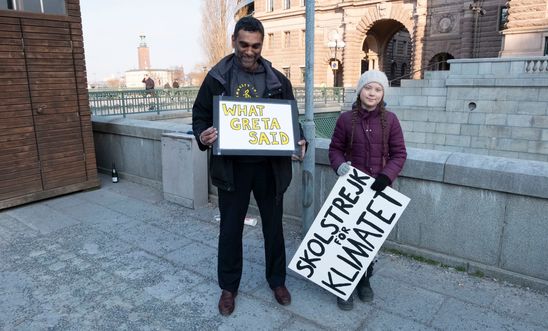
The Fridays for Future movement was started by Greta Thunberg, a teenager from Sweden who last August began protesting outside the Swedish parliament – skipping school every Friday demanding the Swedish government take more serious action to tackle the climate crisis. Her efforts have inspired a global movement, with the most recent Fridays for Future schools strikes seeing more than one million young people from all over the world take part, with demonstrations in more than 100 countries.
Greta Thunberg, said: “It is a huge honour to receive Amnesty International’s Ambassador of Conscience award on behalf of Fridays for Future. This is not my award, this is everyone’s award. It is amazing to see the recognition we are getting and know that we are fighting for something that is having an impact. To act on your conscience means that you fight for what you think is right. I think all those who are part of this movement are doing that, because we have a duty to try and improve the world. The blatant injustice we all need to fight against is that people in the global south are the ones who are and will be most affected by climate change while they are the least responsible for causing it.”
Kumi Naidoo, Amnesty International’s Secretary General, said: “The Ambassador of Conscience award celebrates people who have shown unique leadership and courage in standing up for human rights. I can think of no better recipients this year than Greta Thunberg and the Fridays for Future climate strike movement.
Greta Thunberg, said: “Human rights and the climate crisis go hand in hand. We can’t solve one without solving the other. Climate change means people won’t be able to grow food, their homes will come under threat and their health will be compromised. Governments have a duty to protect us, so why are they doing nothing to stop climate change from devastating our lives?”
Kananura Irene, a Fridays for Future activist from Kampala, Uganda, said: “Sometimes I feel really sad because some of the people I try to talk to won’t listen. Some people insult us, others think we are politicians, and others ignore us entirely, they tell us maybe we won’t finish what we’ve started. But I can assure everyone that we are really determined to finish what we have started, because our futures are on the line.”
[Around the world, attacks against ordinary people who stand up for freedom, justice and equality are surging. Authorities around the world are misusing their power to crack down on human rights defenders – imprisoning, torturing and even killing them for speaking up. In 2018, 321 defenders in 27 countries were targeted and killed for their work – the highest number ever on record. Amnesty is calling on the UK Government to show the world that protecting human rights defenders is a priority.]
 Grajaú, Brazil—A deforested area in the southern Maranhão state seen from a helicopter belonging to IBAMA, Brazil’s national environmental agency [Photo: © Tommaso Protti for Fondation Carmignac]
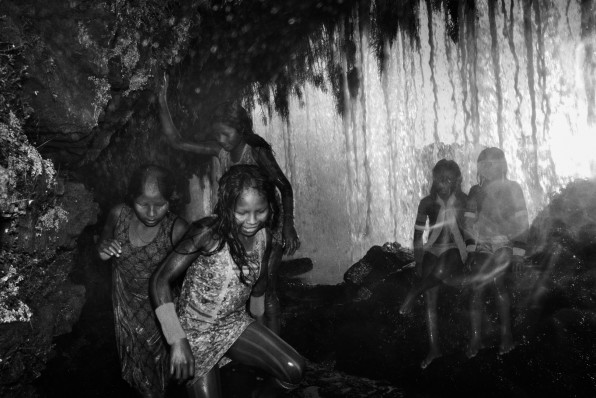 Kayapó Indigenous Land—Kayapo children play behind a waterfall in the Kubenkrãnken indigenous village, in southern Pará state. The Kayapo have only been in contact with nonindigenous society since the 1960s. Their land serves as a crucial barrier to deforestation advancing from the south. [Photo: © Tommaso Protti for Fondation Carmignac]

 The Ramon Magsaysay Award, one of Asia’s best known prizes, celebrates transformative leadership. In the past five decades, the award has been bestowed on over three hundred men, women and organizations whose selfless service has offered their societies, Asia, and the world successful solutions to some of the most intractable problems of human development. For more on this regional award,



 Hans Thoolen on Human Rights Defenders and their awards