Posts Tagged ‘corporate accountability’

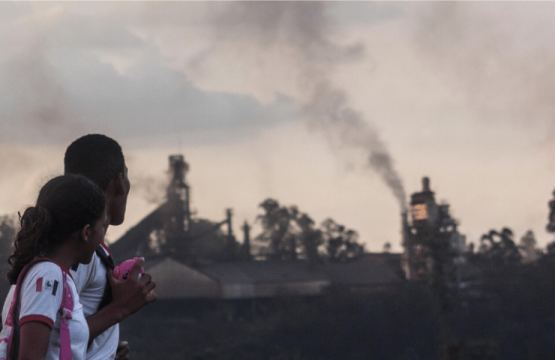
Only 9% of companies assessed by Forrest 500 committed to not tolerate attacks on defenders

September 15, 2025

On 8 September 2025, a report “Defending forests shouldn’t cost lives: Forest 500 assesses corporate zero tolerance policies,” links world’s top banks to social & environmental harms from mining

… Global Canopy’s annual Forest 500 assessment looks at six human rights criteria closely associated with preventing deforestation. Three indicators are interconnected with deforestation as violations of these rights frequently happen around the point of forest loss. They are: Free, Prior and Informed Consent (FPIC); zero tolerance for threats and violence against forest, land and human rights defenders; and customary rights to land, resources and territory.

Among them, zero tolerance is least likely to be addressed by companies: only 9% of the 500 companies assessed have a public commitment in place for at least one forest risk commodity. By comparison, 37% of companies have committed to FPIC, and 24% have commitments to respect the customary rights of IPLCs to land, resources and territory.

… Only 47 Forest 500 companies have commitments for zero tolerance. Companies in the palm oil (18%) and cocoa (14%) supply chains are more likely to have commitments. Commitments are scarce in the beef (10%), soy (11%) and timber (6%) sectors, although these industries are linked to abuses in Latin America. According to BHRRC, 40% of attacks against human rights defenders over the last decade took place in Latin America, with Brazil recording the highest number of killings worldwide.

… Only six of the Forest 500 companies publish evidence of due diligence and progress reporting on eradicating violence and threats f

The report focuses on financing for companies mining critical minerals used in the global energy transition, including lithium, nickel, graphite and cobalt. Nearly 70% of these transition mineral mines overlap with Indigenous lands and roughly an equal amount is in regions of high biodiversity.

“Our findings shed light on the central role that financial institutions play in enabling this new wave of destruction as companies rush to expand mining operations as rapidly as possible,” Steph Dowlen, forests and finance campaigner for the Rainforest Action Network, told Mongabay by email. “While this extraction for raw minerals falls under a ‘green’, ‘clean’ or ‘renewable’ banner, it’s still extraction and the mining sector remains high-risk, dominated by companies with egregious track records on rights, the environment and corporate accountability.”

The report assessed environmental, social and governance policy scores of 30 major financial institutions and found an average score of only 22%. Vanguard and CITIC scored the lowest, each with just 3%. The assessment found that many financial institutions lacked policies to prevent financing issues, including pollution, Indigenous rights abuses or deforestation.

Of all institutions assessed, 80% lacked policies on human rights defenders and none had safeguards for Indigenous peoples living in voluntary isolation. Many institutions (60%) lacked grievance mechanisms, which allow communities that have been negatively impacted by mining activities to seek justice. Also, 60% of institutions had no policies on tax transparency, which is key to preventing companies from shifting profits abroad and ensuring that mining revenues remain in the resource-rich countries.

“Due to the significant overlap with transition minerals and Indigenous Territories, and high-biodiversity areas, there is an immediate need for governments, financial institutions and mining companies to stop and listen,” Dowlen said. “Indigenous Peoples and local communities have been raising the alarm for a long time but continue to face disproportionate harm as well as violence and intimidation for defending their rights and their lands.”

BlackRock and JPMorgan Chase declined to comment on the report. None of the other institutions mentioned in this piece responded to Mongabay’s emails.

https://www.business-humanrights.org/en/latest-news/forest-500-report-finds-only-9-of-companies-assessed-have-a-public-commitment-to-not-tolerate-attacks-on-defenders/

New report: a retrospective on the Business frameworks and actions to support defenders

August 10, 2025

ISHR launched a new report  that summarises and assesses progress and challenges over the past decade in relation to initiatives to protect human rights defenders in the context of business frameworks, guidance, initiatives and tools that have emerged at local, national and regional levels. The protection of human rights defenders in relation to business activities is vital.

Defenders play a crucial role in safeguarding human rights and environmental standards against adverse impacts of business operations globally. Despite their essential work, defenders frequently face severe risks, including threats, surveillance, legal and judicial harassment, and violence.  

According to the Business and Human Rights Resource Centre (BHRRC), more than 6,400 attacks on defenders linked to business activities have been documented over the past decade, emphasising the urgency of addressing these challenges.  While this situation is not new, and civil society organisations have constantly pushed for accountability for and prevention of these attacks, public awareness of the issue increased with early efforts to raise the visibility of defenders at the Human Rights Council and the adoption of key thematic resolutions, as well as raising defenders’ voices at other foras like the UN Forum on Business and Human Rights. 

The report ‘Business Frameworks and Actions to Support Human Rights Defenders: a Retrospective and Recommendations’ takes stock of the frameworks, tools, and advocacy developed over the last decade to protect and support human rights defenders in the context of business activities and operations.

The report examines how various standards have been operationalised through company policies, investor guidance, multi-stakeholder initiatives, legal reforms, and sector-specific commitments. At the same time, it highlights how despite these advancements, the actual implementation by businesses remains inadequate. Effective corporate action remains insufficient, highlighting a critical gap that must be urgently addressed to ensure defenders can safely carry out their vital work protecting human rights and environmental justice. In order to address this, drawing on case studies, civil society tracking tools, and policy analysis, the report identifies key barriers to effective protection and proposes targeted recommendations
Download the report

Indicators on how to track businesses’ respect for human rights defenders

March 11, 2024

According to the Business and Human Rights Resource Center (BHRRC), since January 2015, there have been nearly 5,000 attacks on human rights defenders working on business and human rights issues. Defenders and UN experts have long worked to hold businesses accountable for meeting their responsibilities to defend civic freedoms and protect human rights defenders. Part of this work has included articulating what these responsibilities are and practical steps to meet them.

Inspired by and building from the United Nations Guiding Principles on Business and Human Rights, the BHRRC and ISHR 2018 report, ‘Shared Space Under Pressure: Business Support for Civic Freedoms and Human Rights Defenders, Guidance for Companies,’ lays out the normative framework that clarifies the corporate responsibility to act and to do no harm against HRDs. The UN Working Group on Business and Human Rights reaffirmed this in their 2021 Guidance on ensuring respect for human rights defenders. This guidance develops the implications of the Guiding Principles for engaging with and safeguarding the rights of human rights defenders– providing both States and businesses with a set of recommendations to follow.

Over the last few years, there has been an increasing articulation of the responsibility of businesses to respect and promote civic freedoms and the rights of Human Rights Defenders.  Some recent examples of these efforts include the 2023 Unilever human rights policy and implementation guide and the BHRRC Human Rights Defender Policy Tracker.

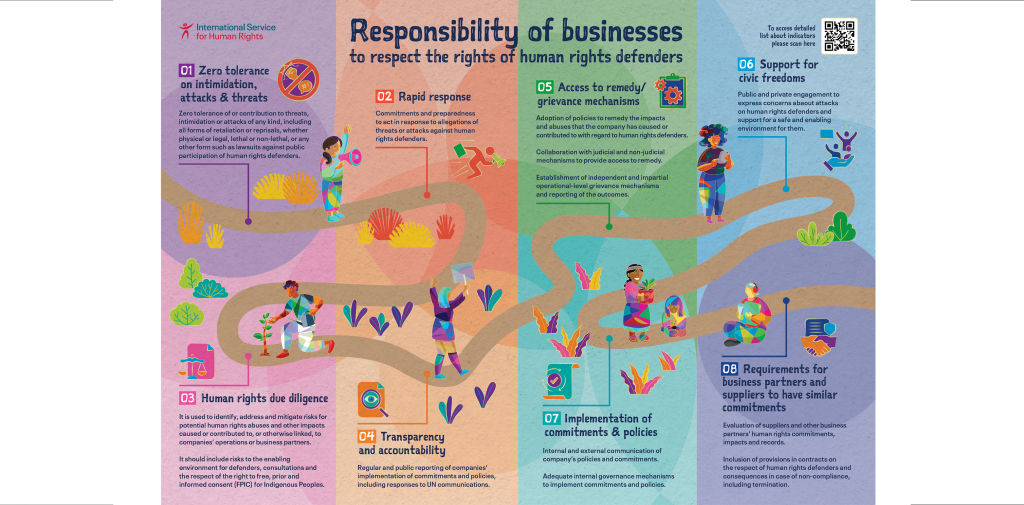
In this same spirit, ISHR is launching a set of Indicators on Business and Human Rights that cover the following areas:

  • Zero tolerance on intimidation, attacks and threats against HRDs
  • Human rights due diligence
  • Transparency and accountability
  • Access to remedy/grievance mechanisms
  • Support for civic freedoms
  • Requirements for business partners and suppliers to have similar commitments

The indicators come in list and poster form. ISHR has also produced a ‘snapshot’ of the UN Working Group’s Guidance on ensuring respect for human rights defenders, in the form of an explainer, available in multiple languages. 

We created a wonderful “Responsibility of businesses” roadmap poster for you. It shows the important steps to take on the journey to a responsible business, respecting the rights of human rights defenders amongst all people. You can download it in poster size print quality in the download section and print it yourself to go on your office wall, to remind everyone about the little steps and big responsibility to take everyday.

https://ishr.ch/defenders-toolbox/resources/business-and-human-rights-indicators

UN High Commissioner for Human Rights Volker Türk urges EU to approve key business and human rights legislation

February 24, 2024

On 13 February 2024, UN High Commissioner for Human Rights Volker Türk urged EU leaders to approve a ground-breaking agreement on business and human rights, amid reports that support for the measure may now be in question in the European Council.

The adoption of the Corporate Sustainability Due Diligence Directive would show historic leadership by the EU at a time when global leadership in support of human rights is needed more than ever,” said Türk.

For the past four years, work on the Directive has seen unprecedented involvement by many stakeholders, including business and my Office, as well as political commitment from EU institutions and Member States to push it forward. This process has truly raised hopes of ensuring more effective management of human rights risks by large companies.

For the Directive to fail now would be a massive blow,” he said.

The EU-wide Directive would require certain large EU and non-EU companies to take reasonable steps to identify and address adverse human rights risks.

“Human rights due diligence is feasible and supports sustainable business processes that deliver long-term value to society at large. And for those reasons it also makes eminent business sense,” said Türk.

Many of the companies that would fall within the Directive’s scope have backed its adoption. It would create a level playing field by harmonizing disparate rules across jurisdictions.

“The agreement on the Directive is reported to be substantially aligned with the UN Guiding Principles on Business and Human Rights and other relevant international human rights standards. I am convinced the Directive can make a positive contribution to respect for human rights, and its adoption would send an important message of solidarity to those at risk from business activities,” the UN Human Rights Chief said.

A vote on the Directive is possibly due later this week.

See also:

Statements Statement of the Working Group on the issue of human rights and transnational corporations and other business enterprises to the 26th Session of the Human Rights Council

Statements Working Group on Business and Human Rights introductory remarks at HRC26 side event on “the role of human rights defenders in promoting corporate responsibility.”

Statements Working Group introductory remarks at HRC26 side event on “how to effectively integrate a gender perspective in implementing the Guiding Principles on Business and Human Rights”

https://www.ohchr.org/en/press-releases/2024/02/un-human-rights-chief-urges-eu-leaders-approve-key-business-and-human-rights

Human Rights Defenders and the EU’s mandatory due diligence initiative

February 21, 2022

Since Mary Lawlor took up her mandate of Special Rapporteur on the situation of Human Rights Defenders, she has been paying close attention to the EU’s legislative initiative on sustainable corporate governance, and in particular to the proposed creation of binding obligations for companies to carry out due diligence to identify and address human rights and environmental risks linked to their activities. See also: https://humanrightsdefenders.blog/2021/09/07/un-experts-urge-eu-to-take-the-lead-on-protecting-human-rights-defenders-in-context-of-business/

The reason is that defenders who draw attention to the human rights and environmental risks associated with business projects, including of EU companies, and who seek accountability where violations and harms actually occur, are often at high risk of retaliation for their actions, in particular where they themselves are from the communities directly affected.

With this in mind, in September 2021, she issued the public statement referred to above calling on the EU Commission to seize the moment and craft a powerful, progressive proposal which would include safeguards for Human Rights Defenders highlighting corporate harms. She followed this up in November with a series of meetings with key EU Commissioners and their teams in Brussels, during which she outlined what she believes to be the key provisions to include in their proposal on due diligence for it to empower human rights defenders. This position has now become public through the paper below:

FIDH launches “SEE YOU IN COURT” campaign

September 29, 2021

The disastrous impact that multinationals have on the environment can no longer be denied. The human right to live in a healthy environment concerns us all, therefore, FIDH and its member organisations are launching coordinated legal actions across the world. The companies implicated and States which allow it to happen must be held accountable.

The first legal actions

It is time to recognize the right to a healthy environment as a fundamental human right and to hold companies accountable for their actions.

  • Environmental impact = human impact Because human rights and the environment are interdependent, it is crucial that States recognise the right to a healthy environment as a fundamental human right. Hundreds of organisations are fighting for a UN resolution to achieve international recognition of this.
  • Restoring a healthy environment to affected communities In the face of environmental disasters and human rights violations, the balance is still too often tipped in favour of the companies involved. Ensuring access to justice for those most affected and passing laws which hold multinationals accountable are also means to protect the planet.

https://seeyouincourt.fidh.org/?lang=en#

Facebook launches a human rights policy and fund for human rights defenders

March 17, 2021

According to Reuters on 17 March 2021 Facebook said it was launching a corporate human rights policy and a fund aimed at supporting human rights defenders facing online threats.

Facebook has – belatedly, according to some – released a global corporate human rights policy, along with a fund supporting those defending human rights. Rather than introducing any new rules on content, the new policy essentially codifies and regulates the company’s existing practices and introduces more transparency. [see also: https://humanrightsdefenders.blog/2020/06/03/more-on-facebook-and-twitter-and-content-moderation/]

This new policy sets out the human rights standards we will strive to respect as defined in international law including the United Nations Guiding Principles on Business and Human Rights (UNGPs),” says Facebook’s director of human rights, Miranda Sissons, in a blog post.

“And it sets out how we will apply these standards to our apps and products, policies, programming, and overall approach to our business.”

The most critical human rights issues, such as risks to freedom of expression, will be reported to the company’s board of directors. Meanwhile, Facebook will release an annual public report on how it’s addressing human rights concerns stemming from its products, policies or business practices.

And a new fund – the amount’s undisclosed – will give offline support to those defending human rights under threat, starting in Asia later this year. This is expected to involve offering security to activists and journalists.

“We’ll also build on our existing work to protect defenders’ accounts — efforts that include combating malicious actors who are targeting them, protecting them from incorrect content removals using Cross Check, offering advanced security options, taking steps to thwart unauthorized access to the accounts of defenders who are arrested or detained, and partnering with human rights organizations on outreach and training,” says Sissons.

https://www.forbes.com/sites/emmawoollacott/2021/03/17/facebook-promises-more-support-for-human-rights/?sh=fad8f837353a

https://www.reuters.com/article/us-facebook-human-rights/facebook-launches-fund-for-human-rights-defenders-facing-threat-idUSKBN2B8305?il=0

EU law on corporate due diligence and SLAPPs: crucial and urgent matters

November 19, 2020

European Parliament is deciding its position on what an EU law on corporate due diligence should look like. Richard Gardiner (a Senior Campaigner for Corporate Accountability at Global Witness) on 2 September  2020 explains more and more recently (11 November 2020) a group of 87 organisations and media freedom groups call on the EU to to protect journalists against gag lawsuits (SLAPPs)

As the European Parliament begins developing proposals for a new – and momentous – law to hold business to account for its impact on people and planet, Richard Gardiner sets out how this process came about and what needs to happen now to ensure this really delivers results.

Where are we now?

Following the publication of the European Commission study on due diligence requirements through the supply chain earlier this year, in April, European Commissioner for Justice Didier Reynders announced to the European Parliament Responsible Business Conduct Working Group that he will introduce EU rules on corporate accountability and corporate due diligence in early 2021.

In response to this announcement, Members of the European Parliament are now starting work to develop a European Parliament position on what an EU law on corporate due diligence could look like. This work will take place within the European Parliament Legal Affairs Committee and will be led by MEP Lara Wolters.

The goal of this work is to influence the final Commission legislative proposal and ensure that the Commissioner follows through on his commitment to present an ambitious framework for this law.

Potential to be a real game changer?

Global Witness has long advocated for mandatory corporate accountability rules to tackle corporate abuse against people and planet.

Our recently published report ‘Defending Tomorrow’ shows that while land and environmental defenders continue to act as the first line of defence against climate breakdown, far too many businesses, financiers and governments either fail to protect them or – in the worst examples – can be complicit in the violence they face.

These brave people play a vital role challenging companies operating recklessly, rampaging unhampered through virgin forests, protected wetlands, indigenous territories and biodiversity hotspots. They are on the frontline of our global, collective fight against climate change. However, despite their importance to the preservation of our planet, our report shows that 212 land and environmental defenders were murdered in 2019 – the bloodiest on record, with the deadliest sectors for this violence being mining, agribusiness and logging.

Our findings show that an average of four land and environmental defenders are killed every week since the Paris Agreement was signed in 2016. These are reinforced by our previous investigations on continued deforestation, minerals that fuel and fund conflict, and grand-scale corruption.

There is clearly a legislative gap when governments and citizens have no legal means to hold corporations accountable for their human rights and environmental abuses. As the world’s largest trading bloc, the EU is now looking to lead the global debate on corporate accountability and this new law will shape not only corporate behaviour within the EU but also globally.

What needs to be in this new law?

Civil society united in their calls for the EU to introduce legislation on corporate due diligence. We have consistently pointed to the fact that voluntary measures have proved to be vastly insufficient and new legislation is urgently needed to establish clear, robust and enforceable cross-sectoral requirements on all business enterprises, including financial institutions, to respect human rights and the environment.

As the European Parliament begins to discuss the details of corporate accountability legislation, Global Witness is part of a coalition of NGOs that has published its call to action for the key elements needed to hold businesses to account:

  • The new law must apply to all businesses, including finance, of all sizes and sectors acting in the EU.
  • Business must have a duty to address all the adverse human rights, environmental and governance impacts in their global supply chains.
  • Businesses must conduct Responsible Business Conduct (RBC) Due Diligence to identify, cease, prevent, mitigate, monitor and account for their adverse risks.
  • Businesses must engage and consult with all relevant stakeholders, including human rights defenders and indigenous peoples, as part of their RBC due diligence.
  • Businesses must be made liable for the human rights, environmental and governance adverse impacts in their global value chains.

You can read the full paper here.

So what happens next?

The months between now and the end of the year promise to be extremely interesting on the topic of corporate accountability across all the EU institutions. Firstly, the European Parliament will aim to finalise its advice to the Commission by end 2020 in order to ensure that it can be taken into account in the Commission proposal. Secondly, the Commission has draft plans to release a public consultation on the new due diligence legislation in Autumn 2020 to get public input on how to draft their proposal.

And finally, the German Presidency of the European Council have indicated that due diligence is a key political priority for their Presidency and they will aim to have Council conclusions on this topic by the end of the year. At Global Witness, we will continue to engage with all the European institutions to ensure that EU policy makers live up to their commitments to introduce a meaningful and impactful new law.

SLAPPs: More and more journalists and civil society organisations are being sued by powerful businessmen and politicians. The International Press Institute (IPI) has joined a group of 87 organisations and media freedom groups calling on the EU to ensure those with a watchdog role are protected from gag lawsuits.

‘SLAPP’ stands for Strategic Lawsuit against Public Participation. It’s a form of legal harassment designed to intimidate critical voices into silence. Expensive and unscrupulous law firms market this attack-dog service to powerful and wealthy individuals who can afford to drag on abusive proceedings for years just to shield themselves from unwanted public scrutiny. [see also: https://humanrightsdefenders.blog/2020/01/28/ngos-demand-that-rules-against-strategic-lawsuits-against-public-participation-slapp-are-upgraded/]

This scrutiny is the lifeblood of healthy democratic societies. The European Court of Human Rights and other national and regional courts have consistently and explicitly recognised in their judgments the important role a free press, and more broadly civil society, plays in holding the powerful to account. Their judgments reaffirm the obligation states have to create an environment that is conducive to free speech. Because without this, democracy weakens and dies.

The holes in our laws that allow powerful people to hammer their critics into submission are a hole in European democracy. Cases of abuse pepper the continent. Poland’s second-biggest daily newspaper, Gazeta Wyborcza, has received over 55 legal threats and lawsuits by a number of actors, including from Poland’s ruling party, since 2015.

French businessman Vincent Bolloré and companies affiliated with the Bollore Group have blanketed journalists and NGOs in libel suits to stop them covering his business interests in Africa. In Spain, meat producer Coren is demanding €1 million in damages from an environmental activist for criticising its waste management practices, having previously threatened activists and scientists who were researching nitrate levels in its local waters.

The people we depend on for information about what is happening around us are being distracted, impeded, or entirely blocked from pursuing their work by these costly and resource-intensive legal attacks. The situation is becoming skewed beyond recognition. When it comes to certain people, governments, companies and topics, it’s not writers, film makers or journalists who decide what we read, watch and talk about.

It’s not even the courts, for SLAPPs rarely make it to a hearing, let alone a court judgment. Rather, it’s the oligarchs and their associates in politics, through the lawyers they pay, who are shaping the narrative and preventing the truth from emerging.

We’ve seen a worrying pattern emerge in Europe of government officials or beneficiaries of large public contracts adopting the tactics of celebrities and oligarchs to shield themselves from the heightened level of scrutiny that their positions or financial links to government warrant. The fact that the threats are often cross-border ratchets up the costs for journalists and activists, who find themselves summoned to court far from home in Europe’s most expensive legal jurisdictions.

Awareness of this problem is growing. European Commission Vice-President Věra Jourová has promised to ‘look into all possible options’ to counter the threat SLAPPs pose to European democracy. One promising solution lies in the institutions of the European Union, and it could help realter the balance between pursuers of SLAPPs and the public’s right to be informed of matters in the public interest.

EU-wide legislation should be adopted to protect people across the European Union from SLAPPs. This has to be a priority. As in other parts of the world, rules should be in place across the EU to allow SLAPP suits to be dismissed at an early stage of proceedings, to sanction SLAPP litigants for abusing the law and the courts, and to provide measures to allow victims to defend themselves.

When we consider the importance of public watchdogs such as investigative journalists, activists, and whistleblowers to the rule of law and the fight against corruption, the absence of safeguards is a threat not only to press freedom but to the proper functioning of Europe’s internal market and, increasingly, to Europe’s democratic life.

The reality is that for every journalist or activist threatened with violence in Europe, a hundred more are silenced discreetly by letters sent by law firms, perverting laws meant to protect the reputations of the innocent from attacks by the powerful.

SLAPPs are a far less barbaric means of silencing someone than a car bomb or a bullet to the head, but their silencing effect is often just as destructive.

Signatories

COVID and Human Rights: Shifting Priorities also for Companies

April 29, 2020

Foley Hoag LLP - Corporate Social Responsibility

Isa Mirza for Foley Hoag LLP wrote an interesting overview piece with focus on how Corporate Social Responsibility fits in:

The COVID-19 pandemic is one of the most significant global public health crises since the Influenza Pandemic of 1918-20. The spread of the Coronavirus through every continent and major metropolis has led to unprecedented policy responses from governments both large and small. As a result, the human rights community is more closely scrutinizing the impact of these responses, while many company operations are more likely to overlap with the pandemic and evolving government policy in some way. The corollary of this dynamic could be considerable, not just in the near term, but for how rights are to be protected and respected in the future.

Governments Around the World Threaten Rights under Cover of COVID-19

………

Corporate Responses to COVID-19

Companies have also made changes to their operations and policies in response to the pandemic. Many businesses have waived fees and made it easier to obtain a refund, instituted emergency relief and exemptions for borrowers, revised their rules to make them more transparent and flexible, made multi-million dollar donations to support public health efforts, and redirected or repurposed some of their products to help boost the supply of medical equipment.

NGOs and watchdog groups, however, are increasingly concerned about possible situations where companies could be knowingly or inadvertently violating rights as they attempt to sharply attune their operations to COVID-19 and attendant government policies.

Some companies that provide teleconferencing services – a lifeline for families and business during the crisis – have been accused of instituting weak privacy protections and misleading users regarding the quality of their encryption technologies. Concern has also been raised that some social media platforms have been slow in removing hate speech and discriminatory content against groups stereotyped as vectors of the Coronavirus. Under certain conditions, the latter could lead to physical violence against members of populations most vulnerable during the crisis, such as ethnic and religious minorities, healthcare workers in close contact with COVID-19 patients, and individuals under quarantine order.

Corporate Responsibility and How Companies Can Respect Rights During COVID-19

Although companies cannot directly change government policies or be expected to contravene national laws, the current crisis does compel businesses to consider if their operations may be contributing to harmful impacts caused by states and how then they could be meaningfully addressed.

There are well-established international instruments, principles, and best practices that companies can follow when considering how best to respect human rights in the context of COVID-19.

The United Nations Guiding Principles on Business and Human Rights (“UNGPs”) set global human rights expectations for companies in the 21st Century. The UNGPs are designed to encompass the full ecosystem in which business enterprises conduct commercial transactions and maintain supply chains. The UNGPs are premised upon three pillars. The first pillar is that governments have a duty to protect human rights. The second pillar is that companies have a responsibility to respect human rights. The third pillar is that both governments and companies must provide a remedy when human rights are violated.

The corporate responsibility to respect human rights is primarily a responsibility to do no harm. This responsibility can be met in two ways. First, a company should avoid causing or contributing to adverse human rights impacts through its own commercial activities, and should address such impacts when they occur. Second, a company should seek to prevent or mitigate adverse human rights impacts to which it is directly linked. A business is deemed to be directly linked to a human rights impact when it has ties through its value chain to an entity that has caused an adverse human rights impact.

Companies can largely meet their responsibility to do no harm by reviewing their operations and supply chains to identify human rights risks; conducting human rights due diligence to prevent adverse human rights impacts arising from commercial activities; and mitigating, remedying, or otherwise addressing adverse human rights impacts that nonetheless occur.

Social media platforms, internet providers, teleconference service companies, and other ICT-based enterprises should also consider the standards set forth in the Principles on Freedom of Expression and Privacy of the Global Network Initiative (“GNI Principles”). Premised on international human rights norms, the GNI Principles provide member companies with non-binding standards and guidance for implementing them. Importantly, the GNI Principles state that member companies bear an express responsibility to respect and promote the freedom of expression and privacy rights of their users. In addition, GNI member companies should be able to demonstrate their efforts in this regard. ICT companies that are not GNI members would be best served by seeking to emulate these standards.

Companies can further fulfill their human rights responsibilities by publicly disclosing the steps they are taking to address challenges identified in their due diligence.

In addition to being integral aspects of the UNGPs, due diligence and public disclosure are salient precepts in other human rights standards. For example, The Voluntary Principles on Security and Human Rights – the only set of standards providing detailed guidance to natural resource companies regarding how to respect human rights in the provision of security at their operations – call on extractives companies to carry out regular due diligence on the potential human rights risks associated with the protection of natural resource assets. In addition, companies that implement the Voluntary Principles are encouraged, where possible, to publically disclose their efforts to address human rights issues that have been found through the due diligence process. Many governments are now also expecting companies to conduct some form of due diligence and commit to public transparency in order to enter into government contracts and partnerships.

In countries and regions where pandemic prevention policies have contributed to credible reports of human rights abuses, companies should be circumspect to ensure their local operations and supply chains are not contributing to those harms. When operational risks related to COVID-19 are determined to be likely, a company should be prepared to conduct targeted due diligence and a review of relevant policies. This could be complemented by public reporting on specific actions the company has taken to acknowledge and remediate COVID-related human rights challenges.

In addition, companies should consider taking the further step of discussing their due diligence efforts and findings with governments, human rights organizations, representatives of workers and vulnerable groups, and – where beneficial to public health planning – with the medical community.

The Coronavirus pandemic has stretched the resources of every institution across the globe. Governments bear primary responsibility for protecting human rights during the crisis, but their responses have also led to abuses. Although it may seem daunting for companies to factor their potential role in such abuses into their existing operations and policies, doing so will place them at the cutting-edge of best practice. It will also strengthen their capacity to adapt and respect rights in the face of future global crises.

See also: https://humanrightsdefenders.blog/2020/04/09/policy-response-from-human-rights-ngos-to-covid-19-the-business-and-human-rights-resource-centre/

https://www.jdsupra.com/legalnews/covid-19-and-global-human-rights-93783/

Honduran defender Iris Argentina Álvarez killed by private security guards

April 22, 2020

With all eyes on the pandemic it is easy to forget that “violence as usual” continues against human rights defenders. Here one case:

Human Rights Defender, Iris Argentina Álvarez, was killed on 2 April 2020, by private security agents from the company CRAE´S, employed by the La Grecia Sugar Mill. Her murder took place during a violent, illegal eviction in the Los Chanchos section of Marcovia, Choluteca in the South of HondurasCommunity witnesses report that National Police officers were in the area when the aggressors opened fire against several families with many children. They affirm that the police did absolutely nothing to stop the violence that ended the life of the defender and left two other people wounded, including an underage child.

The Business and Human Rights Resource Centre attempted to contact La Grecia sugar mill but was not succesful and CRAE´S private security company did not respond.

See also: https://humanrightsdefenders.blog/2019/07/25/four-honduran-woman-human-rights-defenders-say-why-funders-need-to-prioritize-social-movmements/

https://im-defensoras.org/2020/04/whrdalert-honduras-defender-killed-by-security-agents-in-violent-illegal-eviction/


https://www.business-humanrights.org/en/honduras-defender-iris-argentina-álvarez-killed-by-private-security-guards-from-the-company-crae´s-employed-by-the-la-grecia-sugar-mill-the-companies-did-not-respond?mc_cid=4f7a17b150&mc_eid=81043e761b