The Human Rights Cities Networkpromotes the development of human rights in Europe and beyond. This online platform creates an interactive community of human rights cities practitioners. It is a team of like-minded people committed to acknowledge the vital role cities play in protecting, promoting and fulfilling human rights. Guest member cities and associate members are key actors, sharing new ideas and taking current concepts to their own cities.
Its mission is to create an information hub and support people to connect and scale up the successful expansion of human rights cities.
Its vision is to help make human rights a reality for every citizen, in every city; and in doing so to foster participatory democracy and social justice.
About the network
The Human Rights Cities Network is an info hub, where you will find information on what constitutes a human rights city and how existing cities can be developed further. The primary objective is to develop a network of like-minded people who can expand their knowledge and share their experiences, to significantly grow the number of Human Rights Cities around Europe. The Human Rights Cities Network acknowledges the vital role cities play in protecting, promoting and fulfilling human rights.
The network helps implement the full spectrum of human rights for people living in urban settings, by supporting cities and political decision-makers. It also connects them with Human Rights Cities practitioners, who can contribute to the development of concepts, guiding practices and operational strategies, to enhance human rights. Professionalism, inclusive governance and a clear human rights perspective are essential principles. Ultimately, the network promotes a model where human rights are used to redefine the city as a more livable space.
Ana Zbona, Project Manager of Civic Freedoms and Human Rights Defenders at the Business & Human Rights Resource Centre writes about a primeur in her area: for the first time major companies have said that that human rights defenders and civic freedoms essential for profitable business,
The statement is the first of its kind, with supporters including Unilever,Adidas, Primark, ABN AMRO, Anglo American, Leber Jeweler, Domini and the Investors Alliance on Human Rights. It stresses that when human rights defenders are under attack, so is sustainable and profitable business….Human rights defenders, civil society organizations, international organizations and progressive governments have been insisting for years that if civic freedoms which allow citizens to propose solutions to social problems, and to push governments to respect and protect human rights, are eroded, so are any prospects for sustainable development and just and inclusive economic growth. Now, these voices have been joined by a group of well-known brands and investors who are vocal about how they, too, depend on the rule of law, accountable governance, stable investment environments and respect for human rights. Read the statement here.
Although not a human rights award in the strict sense, I think that the current state of civil society in large parts of Europe does need a boost [see e.g. https://humanrightsdefenders.blog/2017/04/04/europe-also-sees-shrinking-space-for-human-rights-defenders/]. So the EESC Civil Society Prize 2018 on identities, European values and cultural heritage in Europe is most welcome and human rights groups and defenders should apply.
The European Economic and Social Committee (EESC) this year is promoting initiatives to do with European values, identities and cultural heritage. The deadline is 7 September 2018. The Civil Society Prize, now in its tenth edition, was launched by the EESC to reward and encourage by civil society organisations and/or individuals that have made a significant contribution to promoting the common values that bolster European cohesion and integration.
Prize money totals EUR 50 000 and will be awarded to a maximum of five winners and it will reward innovative initiatives which have made a significant contribution to:
raising awareness of the multiple layers and richness of European identities;
exploiting the full potential of Europe’s cultural wealth;
facilitating access to European cultural heritage; and
promoting European values such as respect for human dignity and human rights, freedom, democracy, equality and the rule of law.
The full list of requirements and the online application form are available on webpage – EESC Civil Society Prize 2018.
The EESC Civil Society Prize is open to all civil society organisations officially registered within the European Union and acting at local, national, regional or European level. It is also open to individuals.
The award ceremony will take place on 13 December 2018 in Brussels.
On 6 July 2018 Stephanie Nebehay reported for Reuters that China, Russia and Pakistan lost their bid on Friday to weaken a U.N. resolution upholding the crucial rule of human rights defenders. The United Nations Human Rights Council adopted a resolution calling on all states to protect civil society groups from threats and intimidation, and prosecute reprisals against them. Chile presented the resolution text on behalf of more than 50 countries on the final day of a three-week session. Amendments proposed by China, Pakistan and Russia – declaring that civil society groups must respect “the sovereignty and territorial integrity of states” and that their funding must be “legal and transparent” – were soundly defeated. So, in spite of increasing retaliation against human right defenders and pressure on civil society in many countries [see recently: https://humanrightsdefenders.blog/2018/06/08/ishr-new-report-on-reprisals-and-restrictions-against-ngo-participation-in-the-un/ ], the UN is still able to resist some of the more blatant attempt to silence critics.
“China and Russia are often the least tolerant of civil society at home. They are now seeking to introduce similar restrictions at the international level,”John Fisher of Human Rights Watch told Reuters. Their attempts to place national sovereignty above international human rights law “would turn guarantees of peaceful assembly and association on their heads”.
“These amendments were a swing and a miss for China and its allies on the Council,” Sarah Brooks of the International Service for Human Rights told Reuters, using an American baseball term. “Their efforts to limit civil society’s independence and shut down civil society voices were rebuffed by a strong message – from member states across the globe – about the importance of keeping defenders’ voices at the table”.
[At the current session, China tried unsuccessfully to block the accreditation of Uighur activist Dolkun Isa, U.N. sources said. China’s delegation publicly challenged activists speaking on behalf of Uighur and Tibetan ethnic minorities. Council president Vojislav Suc, Slovenia’s ambassador, said allegations of intimidation and reprisals had emerged during the session and urged “all necessary measures” to prevent such acts.]
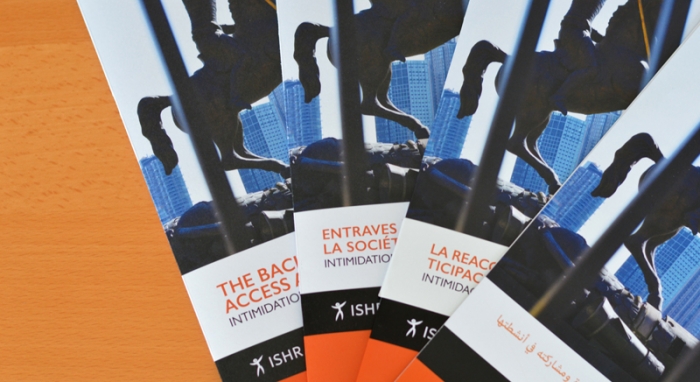
In a new report entitled “The Backlash Against Civil Society Access and Participation at the United Nations” the ISHR outlines the many different ways States employ to keep critical voices out of multilateral spaces. ISHR’s new report provides a road map for States and UN representatives to prevent and counter restrictions on civil society participation in UN processes.
Civil society has the right to ‘unhindered access to and communication with international bodies. However, that right is not being respected. ISHR’s new report documents a broad range of obstacles faced by human rights defenders, from opaque bureaucracies and procedures to reprisals, physical threats and attacks. ‘States decide who gets through the door,’ said ISHR’s Eleanor Openshaw. ‘States that fear calls for accountability and justice do what they can to prevent civil society access to and participation in UN spaces’.
Click on the video below to get an insight into the report:
Opaque practices and procedures provide covers for States seeking to block NGO entry. An NGO seeking to participate in a UN high-level event can be a victim of the ‘no-objection’ procedure. This is the means by which any State can veto their participation without being named or providing any justification. ‘The no-objection procedure is poorly defined, and provides no formal criteria for objections to NGO participation,’ said ISHR’s John Indergaard. ‘It’s carte blanche to exclude legitimate NGOs for illegitimate reasons.’
Even when civil society representatives make it into an actual UN building, they have been thrown out without explanation or asked to leave while events were ongoing. At some high-level events and committee meetings, NGO representatives have been barred from giving statements or bringing in documents related to their work. Physical attacks and intimidation against those seeking to cooperate with the UN are well documented. ‘These restrictions and reprisals are all aimed at dissuading civil society participation,’ said Openshaw. ‘They need to be challenged in each and every case.’
“How to Respond to Challenges Facing Civil Society Organisations Working on Human Rights?” is the topic of a side event on Monday, 25 June 2018(12:30 – 14:00) at the Palais des Nations, Room XXIII.
Challenges to the work of civil society organisations exist in every part of the world and take a variety of forms. Based on recent reports on civil society space of the OHCHR and the EU Fundamental Rights Agency, this event gathers various stakeholders, including NGOs, governments, UN agencies and other intergovernmental organizations, to reinforce the importance of civil society engagement, and address the many challenges which hinder its effective functioning. This surely will include the question of reprisals against HRDs cooperating with the UN. Questions to be addressed include: What are the major challenges facing civil society organisations? What are some examples of emerging good practices? How can we ensure that the needs of underrepresented parts of civil society are taken into account? What is the role of the Human Rights Council in ensuring a safe and enabling environment? Can we identify ways forward and concrete next steps?
SPEAKERS
Ambassador Michael Gaffey, Permanent Representative of Ireland to the UN in Geneva
Michael O’Flaherty, Director of the European Union Agency for Fundamental Rights (FRA)
Lopa Banerjee, Director of UN Women’s Civil Society Division
Peggy Hicks, Director of the Research and Right to Development Division of the Office of the High Commissioner for Human Rights (OHCHR)
Phil Lynch, Director of International Service for Human Rights (ISHR)
There are many different approaches States employ to keep critical voices out of multilateral spaces. ISHR’s new report of 30 May 2018 [The Backlash Against Civil Society Access and Participation at the United Nations] outlines what these are and provides a road map for States and UN representatives to prevent and counter reprisals and restrictions on civil society participation in UN processes.
Civil society has the right to ‘unhindered access to and communication with international bodies’. However, that right is not being respected. ISHR’s new report, ‘The Backlash Against Civil Society Access and Participation at the United Nations‘ documents a broad range of obstacles faced by human rights defenders, from opaque bureaucracies and procedures to physical threats and attacks.
‘States decide who gets through the door,’ said ISHR’s Eleanor Openshaw. ‘States that fear calls for accountability and justice do what they can to prevent civil society access to and participation in UN spaces’. Opaque practices and procedures provide covers for States seeking to block NGO entry. An NGO seeking to participate in a UN high-level event can be a victim of the ‘no-objection’ procedure. This is the means by which any State can veto their participation without being named or providing any justification. ‘The no-objection procedure is poorly defined, and provides no formal criteria for objections to NGO participation,’ said ISHR’s John Indergaard. ‘It’s carte blanche to exclude legitimate NGOs for illegitimate reasons.’
Even when civil society representatives make it into an actual UN building, they have been thrown out without explanation or asked to leave while events were ongoing. At some high-level events and committee meetings, NGO representatives have been barred from giving statements or bringing in documents related to their work. Physical attacks and intimidation against those seeking to coöperate with the UN are well documented.
‘These restrictions and reprisals are all aimed at dissuading civil society participation,’ said Openshaw. ‘They need to be challenged in each and every case.’
On 9 May 2018, Hungary’s (remaining) civil society issued the Professors Solidarity Call below, signed by 77 professor until now and asking for more signatories. It concerns the so-called “Stop Soros” bill, to be voted by the Hungarian parliament very soon, which will have a devastating impact on both Hungarian civil society and the asylum seekers and refugees that are already in a dire state. That Victor Orban is behind an ‘anti-Soros bill’ is the more remarkable as he himself was the beneficiary of a Soros scholarship [in 1988 a dissident Hungarian university graduate wrote a letter to George Soros, a billionaire philanthropist, asking for help obtaining a scholarship to Oxford University. In the letter, which has recently resurfaced, the young Viktor Orban said he wanted to study the “rebirth of civil society”. He got the scholarship.– the Economist 7 April 2018].
PROFESSORS’ SOLIDARITY DECLARATION AND CALL FOR ACTION IN DEFENCE OF THE HUNGARIAN HELSINKI COMMITTEE AND THE HUNGARIAN CIVIL SOCIETY
We, 77 university professors and academics from 28 countries around the world, express our solidarity with the Hungarian Helsinki Committee and the independent Hungarian civil society, which currently faces an imminent existential threat.
The so-called “Stop Soros” bill, to be voted by the Hungarian Parliament in mid-May 2018, will have a devastating impact on both Hungarian civil society and those vulnerable human beings that cannot count on anyone else’s support. The new legislation will allow the government to simply ban the activities of organizations assisting refugees and migrants in a fast and arbitrary process. Activities such as legal aid to asylum-seekers, reporting to the UN or the EU, holding university lectures about refugee law or recruiting volunteers will be rendered illegal, if these are performed by civil society actors who dare to criticise government practices. Practices, which are equally condemned by the EU and the international community.
The Hungarian Helsinki Committee (HHC) is an outstanding human rights organization, well-known and respected for its professionalism around the world, not only by civil society, but by academia, state authorities and the judiciary as well. The HHC has massively contributed to the promotion of refugee law education and legal clinics on various continents. We all personally know and highly respect their work. States should be proud of such NGOs, instead of aiming to silence them.
Strong and independent civil society organisations are as indispensable for democracy and the rule of law as strong and independent universities. If NGOs such as the Hungarian Helsinki Committee are threatened, democracy is threatened. If a prestigious organization, winner of various international human rights awards, can simply be banned from providing legal aid to refugees, if a globally reputed voice of human rights can be silenced with an administrative measure in an EU member state, then further dramatic anti-democracy measures are likely to follow. There is a real risk that the Hungarian example will be increasingly copied elsewhere, and soon it may be too late to stop the domino effect.
We call on our governments to express, without delay, their vivid discontent with Hungary’s legislation aiming at annihilating independent civil society. We call on universities around the world to do the same and actively demonstrate their solidarity with the Hungarian Helsinki Committee and the entire threatened Hungarian civil sector. We call on the European Union to prove to the world its credibility as a guardian and global promoter of fundamental rights, and immediately take action to prevent this flagrant human rights violation from happening on its own territory.
Signatures (in alphabetical order) at the end of the document: https://www.helsinki.hu/wp-content/uploads/Professors-solidarity-call-HHC-HU-NGOs-2018.pdf
The Geneva Academy’s new publication Optimizing the UN Treaty Body System outlines a series of recommendations related to the functioning of United Nations Treaty Bodies (UN TBs) to prepare for the upcoming review of UN TBs by the UN General Assembly in 2020. ‘While the last words will remain with states and TBs members, this report can provide a basis for negotiations and the blueprint for future changes’ underlines Felix Kirchmeier, co-coordinator of the Academic Platform on Treaty Body Review 2020.
This work is the outcome of a three-year consultative process to collect academic inputs and ideas via the creation of an academic network of independent researchers, a call for papers, a series of regional consultations, annual and expert conferences, as well as ongoing interactions with key stakeholders: states, treaty bodies, national human rights institutions, civil society organizations and the Office of the UN High Commissioner for Human Rights and other parts of the UN. ‘The issue of TBs’ reform is almost as old as the system itself: many proposals that are on the table today were already formulated before. Our academic contribution takes these proposals out of their political context by analysing them, their relevance, their likelihood to be implemented and the possible need for updates’ adds Felix Kirchmeier.
The final objective of the publication and of the entire process is to make the TB system ‘fit for purpose’ by outlining measures to optimize its functioning, effectiveness and efficiency while safeguarding its key protection role and maintaining the existing legal framework.
‘While the publication provides several detailed recommendations, it notably call for a consolidated state report and a single review, or a semi-consolidated state report and two clustered reviews; the implementation of incremental changes in the TBs working methods; and a consolidation of TBs’ structure in terms of membership, as well as financial and substantial support’ underlines Kamelia Kemileva, Executive Manager at the Geneva Academy and co-coordinator of the Academic Platform on Treaty Body Review 2020.
The 45-page study contains many interesting ideas and I copy here only one of particular interest which is to improve the system’s accessibility and visibility:
To meet its purpose, TB output must be accessible and visible. Many contributors expressed concern on this account. Modern technology offers easy solutions, some of which have been implemented but could be taken further.
Contributors unanimously welcomed the webcasting of country examinations and consider it an important improvement. However, they recommended that webcasts should be broadcast and archived in all working languages, as well as the language in which the review is held – the only one that is available at the moment. They also suggested that webcasts should be easier to access via links on the OHCHR home page in each country and via each committee’s session web page.
Many contributors also called for a readily accessible, up-to-date, comprehensive database of TB jurisprudence. It was noted that information on TB findings is currently hard to find (when available), that the database is incomplete, and that decisions are not always available in all UN official languages. Accessing and understanding TB jurisprudence remains a challenge for all stakeholders – whether they are victims of human rights violations, TB members, states, national and regional human rights mechanisms, civil society organizations, or scholars.
Contributors recommended that more user-friendly fact sheets and jurisprudence summaries should be prepared to disseminate TB findings and other important developments.
To increase visibility, contributors proposed maintaining dedicated pages on social media platforms. This would bring TBs’ work to the attention of larger audiences, assist Committees to update information on their activities, and create followers. More generally, the system’s achievements and impact on rights-holders should be better documented and publicized.
The last year or so there has been a lot soul-searching within the broader human rights movement, questioning its relevance or even survival at a time of resurgent ‘anti-human rights’ attitudes in the superpowers (regression in China, USA, and Russia, with the EU vacillating between careful diplomacy and trade interest). A number of smaller countries have also taken enthusiastically to human rights bashing (just to mention Turkey, Philippines, Hungary, Venezuela and Burundi). In all these cases the leadership seems to imply that human rights are niceties that no longer have the support of the majority of their population, which could well be true due to the extent that their control over the media and relentless whipping up of populist feelings make this self-fulling.This blog has tried to monitor – at least illustrate – this phenomenon on many occasions [too many to list]. Now comes along an interesting piece written by professor Samuel Moyn of Yale university under the provocative title “How the Human Rights Movement Failed” (published on 23 April 2018 in the New York Times). The piece is a must read (in full) and I give the text below in green. Even if I disagree with some important parts, it remains a coherent and thought-provoking article (once you get over feeling offended by the idea that you are a plutocrat).
The key notion is expressed in the following quotes:
“.those who care about human rights need to take seriously the forces that lead so many people to vote in majoritarian strongmen in the first place.”
and
“The truth is that the growth of international human rights politics has accompanied the very economic phenomena that have led to the rise of radical populism and nationalism today. In short, human rights activism made itself at home in a plutocratic world.”
Where I most disagree with the author is that there is lot more going on in the human rights movement than the defense of civil and political rights or playing along with elites. Either he does not know it or ignores it on purpose. The thousands of human rights defenders working in their own countries are fully aware of the realities on the ground and are often prioritizing social, economic, cultural and community rights [just a cursory sample of blog posts on environmental activists will show this: https://humanrightsdefenders.blog/tag/environmental-activists/]. International and regional NGOs mostly help and protect them! Also, the author seems to underestimate the potential attraction of the human rights cause in civil society (especially victims and young people), whose mobilization is still patchy. If the human rights movement can overcome its fragmentation and use media better this potential could turn tides. Say I!.
Here the piece in full/ judge for yourselves:
The human rights movement, like the world it monitors, is in crisis: After decades of gains, nearly every country seems to be backsliding. Viktor Orban in Hungary, Rodrigo Duterte in the Philippines and other populist leaders routinely express contempt for human rights and their defenders. But from the biggest watchdogs to monitors at the United Nations, the human rights movement, like the rest of the global elite, seems to be drawing the wrong lessons from its difficulties.
Advocates have doubled down on old strategies without reckoning that their attempts to name and shame can do more to stoke anger than to change behavior. Above all, they have ignored how the grievances of newly mobilized majorities have to be addressed if there is to be an opening for better treatment of vulnerable minorities.
“The central lesson of the past year is that despite considerable headwinds, a vigorous defense of human rights can succeed,” Kenneth Roth, the longtime head of Human Rights Watch, contended recently, adding that many still “can be convinced to reject the scapegoating of unpopular minorities and leaders’ efforts to undermine basic democratic checks and balances.”
That seems unlikely. Of course, activism can awaken people to the problems with supporting abusive governments. But if lectures about moral obligations made an enormous difference, the world would already look much better. Instead, those who care about human rights need to take seriously the forces that lead so many people to vote in majoritarian strongmen in the first place.
The truth is that the growth of international human rights politics has accompanied the very economic phenomena that have led to the rise of radical populism and nationalism today. In short, human rights activism made itself at home in a plutocratic world.
It didn’t have to be this way. The Universal Declaration of Human Rights, which was promulgated in 1948 amid the consolidation of welfare states in Europe and North America and which formed the basis of the human rights agenda, was supposed to enshrine social protections. But in the 1970s, when activists in the United States and Western Europe began to take up the cause of “human rights” for the victims of brutal regimes, they forgot about that social citizenship. The signature group of that era, Amnesty International, focused narrowly on imprisonment and torture; similarly, Human Rights Watch rejected advocating economic and social rights.
This approach began to change after the Cold War, especially when it came to nongovernmental advocacy in post-colonial countries. But even then, human rights advocacy did not reassert the goal of economic fairness. Even as more activists have come to understand that political and civil freedom will struggle to survive in an unfair economic system, the focus has often been on subsistence.
In the 1990s, after the Cold War ended, both human rights and pro-market policies reached the apogee of their prestige. In Eastern Europe, human rights activists concentrated on ousting old elites and supporting basic liberal principles even as state assets were sold off to oligarchs and inequality exploded. In Latin America, the movement focused on putting former despots behind bars. But a neoliberal program that had arisen under the Chilean dictator Augusto Pinochet swept the continent along with democracy, while the human rights movement did not learn enough of a new interest in distributional fairness to keep inequality from spiking.
Now the world is reaping what the period of swelling inequality that began in the 1970s through the 1990s sowed.
There have been recent signs of reorientation. The Ford Foundation, which in the 1970s provided much of the funding that made global human rights activism possible, announced in 2015 that it would start focusing on economic fairness. George Soros, a generous funder of human rights causes, has recently observed that inequality matters, too.
Some have insisted that the movement can simply take on, without much alteration of its traditional idealism and tactics, the challenge of inequality that it ignored for so long. This is doubtful.
At the most, activists distance themselves from free-market fundamentalism only by making clear how much inequality undermines human rights themselves. Minimum entitlements, like decent housing and health care, require someone to pay. Without insisting on more than donations from the rich, the traditional companionship of human rights movements with neoliberal policies will give rise to the allegation that the two are in cahoots. No one wants the human rights movement to be remembered as a casualty of a justifiable revolt against the rich.
If the movement itself should not squander the chance to reconsider how it is going to survive, the same is even truer of its audience — policymakers, politicians and the rest of the elite. They must keep human rights in perspective: Human rights depend on majority support if they are to be taken seriously. A failure to back a broader politics of fairness is doubly risky. It leaves rights groups standing for principles they cannot see through. And it leaves majorities open to persuasion by troubling forces.
It has been tempting for four decades to believe that human rights are the primary bulwark against barbarism. But an even more ambitious agenda is to provide the necessary alternative to the rising evils of our time.
—–
Samuel Moyn is the author of “Not Enough: Human Rights in an Unequal World.”


 Hans Thoolen on Human Rights Defenders and their awards