Posts Tagged ‘China’

Li Wenzu – wife of Wang Quanzhang – wins 2018 Edelstam award

December 5, 2018
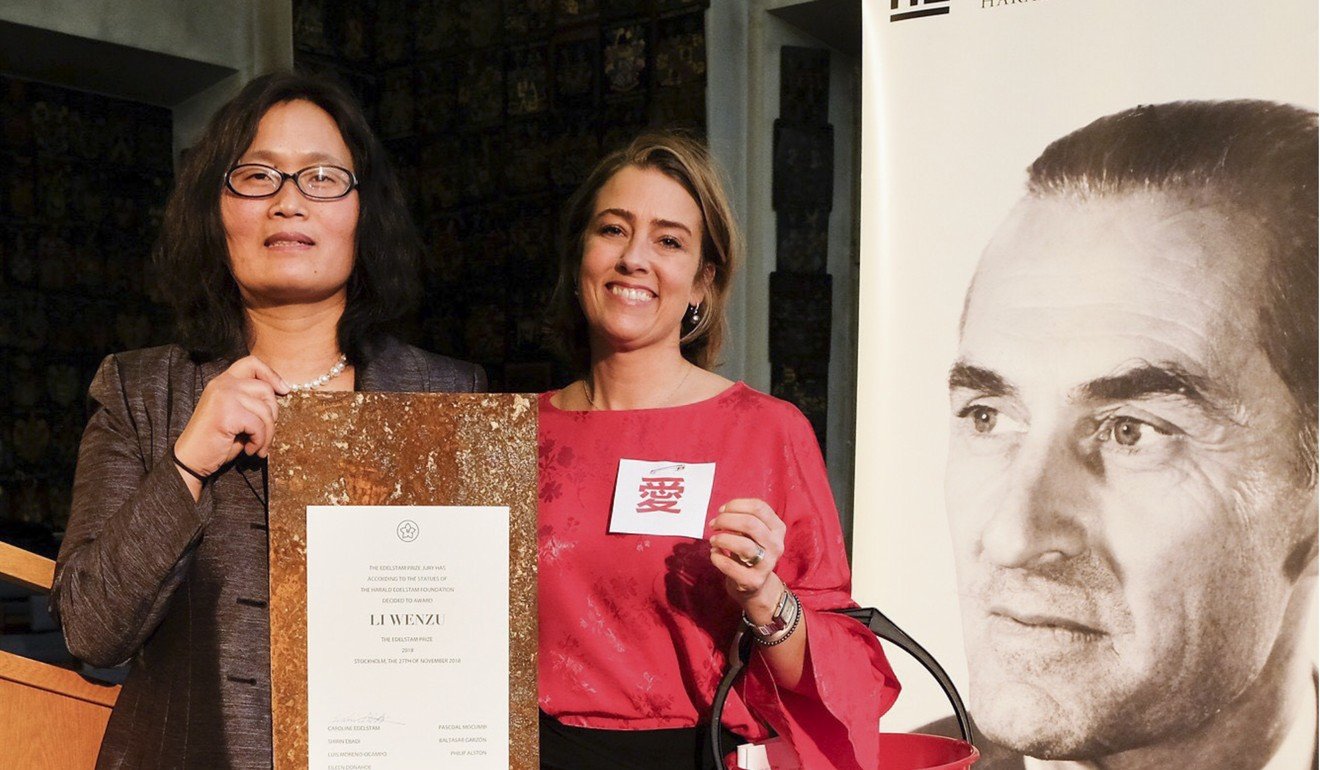
On 27 November, 2018 Li Wenzu, Chinese ‘709’ campaigner won the Edelstam human rights award [see: http://trueheroesfilms.org/thedigest/awards/edelstam-prize]

Li is barred from leaving the country, so at Tuesday night’s ceremony, the organisers could only air a recorded video message from Li and present the award on Li’s behalf to Yuan Weijing, wife of the exiled and blind Chinese legal campaigner Chen Guangcheng. It was the first time the Edelstam Prize, named after Swedish diplomat Harald Edelstam, was awarded to a Chinese person.
Li Wenzu is the wife of detained human rights lawyer Wang Quanzhang. She was barred from  leaving China after her high-profile 170km march from Beijing to Tianjin in April, when she petitioned to visit the husband she has not seen since his arrest in the summer of 2015. Wang, now 42, was among the 300 lawyers and legal activists taken by the Chinese government during a crackdown that began on July 9, 2015. Critics said the campaign was an effort to silence China’s human rights defenders. In the aftermath of what became known as the “709” crackdown, Li and other spouses of detainees formed a support group and began campaigning for their release. [see https://humanrightsdefenders.blog/2015/07/29/the-remarkable-crackdown-on-lawyers-in-china-in-july-2015/]

When I heard the news of the award, I was nervous because I felt that in China there were so many people who worked hard for the 709 case, and their achievements were far greater than mine. Everything that I’ve done is just what I should do. I don’t deserve this award. So thanks to everyone for the encouragement and recognition,” Li said on Wednesday. “Every 709 family is now facing problems,” she said. “For example, the lawyers who have been released are still strictly controlled by the authorities. They are almost unable to work normally. Without income, family life is a big problem.

Second, the released lawyers need a long time to recover because of the torture, the physical and mental damage [they have suffered]. In the process, I think it was very important for lawyers to be reunited with their family members. Therefore, the 709 families and wives did not return to an easy life when their husbands came home,” she said.

Most of the 709 detainees were released, but several were jailed. Only Wang, who was charged with subverting state power in February 2017, remains behind bars in Tianjin awaiting trial. In her video message for the Edelstam ceremony, Li voiced her fears for her husband: “Only Wang Quanzhang remains in extended detention. I am really worried and afraid that he might never leave jail in his lifetime”. [see also: https://humanrightsdefenders.blog/2017/12/30/rsdl-chinas-legalization-of-disappearances/]

Caroline Edelstam, the founder and president of the Edelstam Foundation, said Li “has continued advocating, beyond her personal interest, for the principles of rule of law and democracy in China, and campaigned not only for her husband’s release but also for the freedom of all the victims of violations of human rights in China”.

Olympic Committee tries its hands on human rights, ..cautiously

December 3, 2018

The IOC has set up an advisory committee on human rights chaired by Zeid Ra’ad al-Hussein, the former U.N. high commissioner for human rights. One can only hope that he will fare better than his UN predecessor’s short tenure in FIFA’s Governance Committee and that the IOC’s human right panel will do a better job than its FIFA counterpart [see my post of today: https://humanrightsdefenders.blog/2018/12/03/fifas-second-report-on-human-rights-misses-sustainable-approach/]. The IOC advisory committee was in the pipeline since March 2017 [https://humanrightsdefenders.blog/2017/03/14/olympic-games-in-future-bound-by-human-rights-standards/].

IOC President Thomas Bach said Saturday 2 December 2018 at meetings in Tokyo that “human rights standards” will be included in Olympic host-city contracts, beginning with the 2024 Games in Paris. “Promoting humanistic values in sport has been a core feature of the IOC since its beginning” and “Our mission, to put sport at the service of humanity, goes hand in hand with human rights, which is part of our DNA” But his answers re the Bejing Winter Olympics in 2022 fell short of this lofty language: Bach was asked if the committee would look at human rights in China, where hundreds of thousands of Muslims in western China are being held in interment camps. He said the IOC would not question China because it “has not the mandate nor the authority to solve the human rights problems” that are clearly “political issues. Bach suggested the committee would focus on issues like the rights of transgender athletes. “We should concentrate on what we can really achieve and what we can really do” .

https://humanrightsdefenders.blog/2018/06/27/new-global-center-for-sport-and-human-rights-created-to-address-abuses/

14 major NGOs call for immediate release of Chinese human rights defender Huang Qi

November 6, 2018

Chinese authorities must immediately and unconditionally release citizen journalist and human rights defender Huang Qi, a group of 14 NGOs (and not the least, see below) said on November 5, 2018. Huang Qi (黄琦), the founder and director of 64 Tianwang Human Rights Center, is not receiving adequate medical care in detention and his health has seriously deteriorated, according to his lawyer who visited him on October 23. Huang’s condition is so serious that there is an immediate threat to his life. [see also: https://humanrightsdefenders.blog/2016/12/01/rsfs-press-freedom-prize-2016-goes-to-the-64-tianwang-website-in-china/]

The Chinese government must immediately and unconditionally release Huang, who has been detained solely for the peaceful exercise of his right to freedom of expression, and end its policy of denying prompt medical treatment to prisoners of conscience. Several human rights defenders and ethnic and religious minorities have died in detention in recent years due to a lack of prompt medical treatment, including Liu Xiaobo, Cao Shunli [see: https://humanrightsdefenders.blog/2015/03/27/china-or-the-un-must-ensure-independent-investigation-into-death-of-cao-shunli/], Yang Tongyan, and Tenzin Delek Rinpoche, intensifying fears that Huang Qi might suffer the same fate without urgent intervention.

Authorities have repeatedly rejected applications for release on medical bail despite Huang’s heath condition continuing to deteriorate. He faces charges of “illegally providing state secrets to foreign entities” and “leaking state secrets” due to his work with 64 Tianwang Human Rights Center, which documents and publishes reports on enforced disappearances, trafficking, human rights violations and complaints against government officials. Huang faces the possibility of life imprisonment. His 85-year-old mother has been campaigning for his release, fearing he may die in prison. Last month two of his associates received suspended prison sentences and were released, but authorities have continued to hold Huang. The UN Working Group on Arbitrary Detention issued an opinion in April 2018 that declared Huang’s detention arbitrary, but the Chinese government continues to ignore the Working Group’s recommendation that Huang be released and compensated.

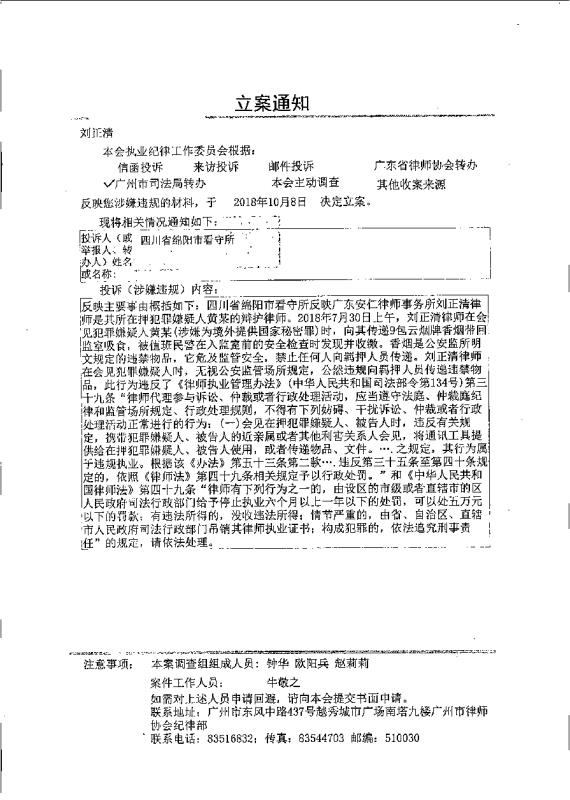
Lawyers representing Huang Qi have also faced retaliation. One of his lawyers, Sui Muqing, was disbarred in February 2018 for defending human rights defenders, such as Huang. [https://www.frontlinedefenders.org/en/case/human-rights-lawyer-sui-muqing-disbarred] Huang’s current lawyer, Liu Zhengqing, received a notice in October that he is under investigation for giving Huang cigarettes during a meeting in July. Liu faces suspension of his law license or a large fine.

http://rsdlmonitor.com/immediately-unconditionally-release-huang-qi/

In this context also relevant is: https://mailchi.mp/ishr/alert-to-the-human-rights-councils-35th-session-31901?e=d1945ebb90

No naming and shaming on reprisals at 39th Human Right Council session

October 5, 2018

On my ‘favorite’ topic of reprisals [see e.g.: https://humanrightsdefenders.blog/tag/reprisals/ ] the ISHR reported that for the first time, the Human Rights Council had a chance to have a dialogue on the Secretary-General’s annual report on reprisals on 20 September 2018. Civil society had hoped States would seize this opportunity to denounce States carrying out reprisals against defenders engaging with the UN. Regrettably only one State, Germany, made explicit reference to a case of reprisal in the report. ‘We welcome in particular Germany’s intervention in the dialogue, citing the case of Egyptian lawyer Ibrahim Metwally, detained since October 2017 by the Egyptian authorities’, said Salma El Hosseiny, ISHR Human Rights Council Advocate. ‘This is precisely what we need more of—States having the courage and conviction to stand up for defenders and call out countries that attack and intimidate them. What we see now is defenders dissuaded from engaging because the cost is too high. What we need is for States to turn away from repression and attacks, because the cost to them is too high’.

The senior official on reprisals, Andrew Gilmour [https://humanrightsdefenders.blog/tag/andrew-gilmour/], presented the Secretary-General’s annual report on reprisals during the first ever interactive dialogue with the Human Rights Council. The report catalogues 45 new cases of reprisals, ranging from travel bans and smear campaigns to arbitrary arrests and detention, inhuman treatment, torture, and killing. The ASG made it clear in his presentation that reported cases are just the ‘tip of the iceberg’ and spoke of three significant trends:

(1) the systematic denigration of human rights defenders and civil society organizations as “terrorists”;

(2) reprisals often being disguised as legal, political and administrative measures; and

(3) the use of accreditation and security procedures to hinder people from speaking out at UN headquarters and elsewhere.

ISHR delivered a statement during the session citing cases of reprisals against Chinese defenders not included in the report—Wang Qiaoling, Li Wenzu, Cao Shunli, and Uyghur activist Dolkun Isa—and calling for systematic follow-up by the Council on cases in the report.

We are especially concerned, once again, about the high number of Council Members or candidates for Council membership cited in the report, including: Bahrain, Burundi, Cameroon, China, Cuba, Democratic Republic of Congo, Egypt, Hungary, India, Iraq, Japan, Kyrgyzstan, Mexico, Pakistan, Philippines, Rwanda, Saudi Arabia, United Arab Emirates, and Venezuela,’ said El Hosseiny.

Half of the States cited in the report intervened during the dialogue to deny the allegations against them. While a significant number of States engaging in the dialogue supported the mandate to varying degrees and asked the ASG what could be taken to strengthen it, another group questioned the ASG’s methodology. Still others firmly opposed the work of the ASG on reprisals, including China and Cuba. China said it ‘regrets and objects’ to the report and the mechanism, and its use of ‘unproven information’, which it deems an interference with its sovereignty.

A side event organised by ISHR following the dialogue highlighted the urgent need to improve both the physical and digital security of defenders at risk of reprisals, and for States and the OHCHR to take a stronger position on this issue at a time when powerful States are threatening the UN system and its core values. ISHR in particular noted its disappointment with the low number of States in the dialogue that took due note of the allegations in the report, as opposed to attacking the methodology of the report and the reliability of the information.

Watch the statement here: 

Read ISHR’s full statement to the Council here.

https://www.ishr.ch/news/hrc39-l-states-largely-decline-cite-specific-cases-during-councils-first-discussion-reprisals

BRICS leaders should have addressed human rights at their recent summit

July 30, 2018

Russian President Vladimir Putin (L) Indian Prime Minister Narendra Modi (C) and Turkish President Recep Erdogan (R) interact during a family photo during the BRICS summit meeting in Johannesburg, South Africa, 27 July 2018. EPA-EFE/GIANLUIGI GUERCIA / POO

As they met in Johannesburg last week, BRICS leaders focused on the economy, development, peacekeeping, health and industrialisation issues within the bloc (accounting for 40% of the world’s population). However, equally important issues such as the protection and realisation of human rights in the respective countries remained off the agenda. Jennifer Wells, an intern with AI South Africa, on 30 July 2018, gave a useful reminder of what could and should have been also addressed:

Brazil

Brazil has one of the highest murder rates in the world, with around 60,000 people murdered each year…Brazil’s failure to protect black Brazilians from police violence remains critical as this year marks the 25th anniversary of the Candelaria killings. The tragedy, in which eight young black boys were killed by off-duty police officers in Rio de Janeiro in 1993, represents the endemic racism within the Brazilian security forces. The situation was aggravated by the murder of Rio de Janeiro human rights defender and councilwoman Marielle Franco on 14 March 2018. [https://humanrightsdefenders.blog/2018/03/16/marielle-franco-38-year-old-human-rights-defender-and-city-councilor-of-rio-assassinated/]

Russia

human rights defenders and civil society activists continued to face harassment, intimidation and arbitrary arrests across the country. The trial of human rights defender Oyub Titiev started in Chechnya. He, like several other human rights defenders, is being prosecuted on trumped-up criminal charges. Law enforcement agencies continue to launch cases on fabricated “extremism” and “terrorism” charges. [https://humanrightsdefenders.blog/2018/01/15/chechen-human-rights-defender-oyub-titiev-arrested-on-trumped-up-charges/] The Ukrainian film director Oleg Sentsov, serving 20 years on “terrorism” charges, is on day 75 of a hunger strike demanding the release of “64 political prisoners from Ukraine”. The right to freedom of peaceful assembly has been increasingly restricted in Russia since 2012 and remains under severe clampdown. …. The rights of LGBTI people are trampled upon daily and the authorities continue to refuse to investigate the horrific gay purge in Chechnya. The World Cup has come and gone, but the suppression of freedoms and shrinking of civil liberties continues unabated.

India

It’s a similar story in India where human rights defenders are consistently under threat, attacked and threatened, often from security forces. India has witnessed horrific instances of alleged extrajudicial executions by security forces for years as police and federal forces have effective immunity from prosecution. In the North-Eastern state of Manipur, human rights defenders who have lost their loved ones in alleged extrajudicial executions and are now campaigning for justice, face unprecedented attacks. Salima Memcha, a widow who lost her husband to an alleged extrajudicial execution, was verbally threatened by security personnel. Her house was also vandalised by them. Three other human rights defenders in Manipur have faced similar reprisals for campaigning for justice for their loved ones.

China

In China, the government continues to enact repressive laws under the guise of “national security” that present serious threats to human rights. Nobel Peace Prize laureate Liu Xiaobodied in custody whilst other human rights defenders are detained, prosecuted and sentenced on vague charges such as “subverting state power”, “separatism” and “picking quarrels and provoking trouble”. Controls on the internet have been strengthened and freedom of expression and freedom of association are under attack.[see also:https://humanrightsdefenders.blog/2018/04/12/how-china-extracts-televised-confessions-from-human-rights-defenders/]

South Africa

In the host nation, nearly a quarter of century after adopting arguably one of the most progressive constitutions in the world, the country is bedevilled by profound inequalities, which persistently undermine economic, social and cultural rights. Failures in the criminal justice system continue to present barriers to justice for victims of human rights abuses and violations, including the state’s failure to hold perpetrators accountable for the killing of 34 striking mineworkers in Marikana in 2012 by the South African Police Service. Access to sexual and reproductive health services remain a human rights issue as does the provision of quality education.

https://www.dailymaverick.co.za/article/2018-07-30-what-brics-leaders-should-have-talked-about/

China, Russia and Pakistan in UN fail at attempt to muzzle human rights defenders (for now)

July 7, 2018

On 6 July 2018 Stephanie Nebehay reported for Reuters that China, Russia and Pakistan lost their bid on Friday to weaken a U.N. resolution upholding the crucial rule of human rights defenders. The United Nations Human Rights Council adopted a resolution calling on all states to protect civil society groups from threats and intimidation, and prosecute reprisals against them. Chile presented the resolution text on behalf of more than 50 countries on the final day of a three-week session. Amendments proposed by China, Pakistan and Russia – declaring that civil society groups must respect “the sovereignty and territorial integrity of states” and that their funding must be “legal and transparent” – were soundly defeated. So, in spite of increasing retaliation against human right defenders and pressure on civil society in many countries [see recently: https://humanrightsdefenders.blog/2018/06/08/ishr-new-report-on-reprisals-and-restrictions-against-ngo-participation-in-the-un/ ], the UN is still able to resist some of the more blatant attempt to silence critics.

China and Russia are often the least tolerant of civil society at home. They are now seeking to introduce similar restrictions at the international level,” John Fisher of Human Rights Watch told Reuters. Their attempts to place national sovereignty above international human rights law “would turn guarantees of peaceful assembly and association on their heads”.

“These amendments were a swing and a miss for China and its allies on the Council,” Sarah Brooks of the International Service for Human Rights told Reuters, using an American baseball term. “Their efforts to limit civil society’s independence and shut down civil society voices were rebuffed by a strong message – from member states across the globe – about the importance of keeping defenders’ voices at the table”.

[At the current session, China tried unsuccessfully to block the accreditation of Uighur activist Dolkun Isa, U.N. sources said. China’s delegation publicly challenged activists speaking on behalf of Uighur and Tibetan ethnic minorities. Council president Vojislav Suc, Slovenia’s ambassador, said allegations of intimidation and reprisals had emerged during the session and urged “all necessary measures” to prevent such acts.]

https://www.reuters.com/article/us-un-rights/china-russia-fail-to-curb-activists-role-at-u-n-rights-forum-campaigners-idUSKBN1JW2EM

Guide to HRD issues at the 38th session of the UN Human Rights Council

June 15, 2018

The UN Human Rights Council will hold its 38th regular session at Palais des Nations in Geneva from 18 June to 6 July 2018. The International Service for Human Rights (ISHR) has – as usual – published an excellent alert full of substantive issues (see link at the bottom of this post). Here I just highlight some of the session’s features that are of special interest to human rights defenders;

Sexual orientation and gender identity. The first interactive dialogue with the new Independent Expert on protection against violence and discrimination based on sexual orientation and gender identity will be held between 9:00 and 12:00 on Monday 18 June. The Council will consider the new report of the mandate holder as well as the report of the country visit to Argentina.
In a joint written submission to the Independent Expert submitted in the lead-up to the presentation of his report to the Council, a group of 12 NGOs detail State obligations that if  implemented, would work towards ensuring that LGBTI defenders’ rights are protected (based in existing international human rights law and articulated in the Yogyakarta Principles (YP) and Yogyakarta Principles plus 10, (YP +10). ISHR and ILGA will organise a side-event that will build on this submission and discuss in more detail State obligations set out in the YP +10. The event will take place on 21 June 2018 from 15:00 to 16:30 in Room XXIII.

Reprisals. Reports of cases of intimidation and reprisal against those seeking to cooperate with the UN not only continue, but grow.  Item 5 of the Human Rights Council’s agenda provides a key opportunity for States to raise concerns about reprisals, and for governments involved in existing cases to provide an update to the Council on any investigation or action taken toward accountability to be carried out. [see recent: https://humanrightsdefenders.blog/2018/06/08/ishr-new-report-on-reprisals-and-restrictions-against-ngo-participation-in-the-un/]

Women human rights defenders and women’s rights. The Annual Full Day Discussion on the human rights of women will take place on Thursday 21 June from 16:00 to 18:00. It will focus on the specific impact of online violence on the work of women human rights defenders. It is crucial that the Council’s discussions and resolutions recognise the critical role of women human rights defenders (WHRDs) and organisations led by women and girls as rights holders and agents of change. The Council will hold an interactive dialogue with the Special Rapporteur on violence against women, its causes and consequences on 20 June between 09:00 and 12:00 and will consider her report including the report of her visit to Australia. The Council will also hold an interactive dialogue with the Working Group on the issue of discrimination against women in law and in practice and will consider their reports including a report on the country visit to Samoa and Chad.

Business and human rights. The Council consider the report of the Working Group on the issue of human rights and business. It examines the duty of States to protect against human rights abuses by business enterprises to whom they provide support for trade and investment promotion. It will also consider the Working Group’s report on its mission to CanadaPeru, and on the sixth session of the Forum on Business and Human Rights. Both country reports contain specific sections analysing the situation of human rights defenders, with the report on Peru raising serious concerns about the high level of threats, attacks and violence against local leaders and human rights defenders. The interactive dialogue will be an opportunity for States to follow-up to recommendations made in the UPR in that regard. The core group on the resolution on business and human rights (Argentina, Norway, Ghana and Russia) have announced that they will present a resolution at this Council session to request the OHCHR to continue with the accountability and remedy report with a focus on non-State based remedy mechanisms. The first informal consultation on the draft resolution will be held on 18 June at 16:30 in Room XXIV.

Other thematic reports

The Council will also hold an interactive dialogue and consider the report of the new Special Rapporteur on the rights to freedom of peaceful assembly and of association. Switzerland with Costa Rica also announced that they will be running the resolution on the protection and promotion of human rights in the context of peaceful protests. The first informal consultations will be held on 19 June from 11:30 to 12:30 in Room V.

The Council will also hold an interactive dialogue and consider the report of the Special Rapporteur on the promotion and protection of the right to freedom of opinion and expression, which examines regulation of user-generated content online. The Council will consider the report of the High Commissioner on procedures and practices in respect of civil society engagement with international and regional organisations. The core group on the civil society space resolution (Chile, Ireland, Japan, Sierra Leone and Tunisia) announced that they will present a resolution this session.

The Council will also consider the reports of and hold interactive dialogues with the Special Rapporteur on the independence of judges and lawyers, including the report of his mission to Poland, and with the Special Rapporteur on extrajudicial, summary or arbitrary executions, including reports of her missions to Iraq and El Salvador.

Country specific developments

Burundi During its 36th session, the Council passed two resolutions on Burundi. One resolution was led by the European Union and extended the mandate of the Commission of Inquiry. The second resolution was led by the African Group and requested OHCHR to urgently dispatch a team of three experts to engage with the Burundian authorities and all other stakeholders to “collect and preserve information, to determine the facts and circumstances in accordance with international standards and to forward to the judicial authorities of Burundi such information”. The aim was to establish the truth and ensure that the perpetrators are held accountable. Read here ISHR’s analysis of the two resolutions. At the 38th session, the Council will hear the oral briefing by the High Commissioner on the mission of OHCHR on 4 July between 15:00 and 18:00. The Council will also hear an oral briefing by the Commission of Inquiry on 27 June between 09:00 and 12:00. For more information on the situation of human rights defenders in Burundi, check ISHR Briefing Paper for the UPR here. [see also: https://humanrightsdefenders.blog/2016/10/26/enough-is-enough-ngos-call-for-burundi-suspension-from-un-human-rights-council/]

China. By any measure, the Chinese government is not living up to the commitments to protect and promote human rights inherent in its Human Rights Council membership. Since the twelve-country joint statement on the human rights situation in China in March 2016, there has been no concerted effort to use the Council space creatively to call for accountability and transparency related to violations in China. This, despite the fact that in July 2017, Chinese security authorities presided over the death in custody of Liu Xiaobo, the first Nobel Peace Prize winner to die in detention since Carl von Ossietzky died in Nazi Germany in 1938… In this context NGOs , incl. the iSHR, continue to call for the release of individuals arbitrarily detained and/or held incommunicado, including Wang Quanzhang, Gui Minhai, Tashi Wangchuk, Lee Ming-che, and Yu Wensheng. [see also: https://humanrightsdefenders.blog/2018/03/07/china-and-the-un-human-rights-council-really-win-win/]

Eritrea. The Council will hold an interactive dialogue with and consider the report of the Special Rapporteur on the situation of human rights in Eritrea on 25 June. A cross-re­gional group of non-governmental organisations urged the Council to support and co-sponsor at the 38th session a streamlined resolution that accurately reflects the gravity of the situation on the ground, renews the mandate of the Special Rapporteur under the Council’s agenda item 4, and sets out a framework for needed reforms to improve the human rights situation in the country and advance accountability.

Other country situations include: 

  • An interactive dialogue on the oral update by the High Commissioner on the situation of human rights of the minority Rohingya Muslim population and other minorities in Rakhine State of Myanmar, and the oral report of the Special Rapporteur on the situation of human rights in Myanmar
  • An enhanced interactive dialogue on the report of the High Commissioner on the findings of the team of international experts on the situation in the Kasai regions of the Democratic Republic of the Congo (DRC) and on the oral update by OHCHR on the situation of human rights in the DRC
  • An oral update by the High Commissioner on the situation of human rights in Ukraine
  • An oral update by the Independent Expert on the situation of human rights in the Central African Republic
  • An interactive dialogue with the Commission of Inquiry on Syria (oral update) and consideration of the summary report of OHCHR on the high-level panel discussion on violations of the human rights of children in Syria
  • An interactive dialogue with the Special Rapporteur on the situation of human rights in Belarus on his report
  • During this session, the Council will adopt the UPR working group reports as part of the 29th session of the UPR. These reports list recommendations the following States under review are expected to implement: France, Tonga, Romania, Mali, Botswana, the Bahamas, Burundi, Luxembourg, Barbados, Montenegro, the United Arab Emirates, Israel, Liechtenstein, and Serbia.

This session of the Council will provide an opportunity for BurundiMali and the United Arab Emirates to to accept recommendations made in relation to human rights defenders, as proposed in ISHR’s briefing papers on those countries.

The Council appointed new Bureau members due to the departure of the Ambassadors of Chile and Germany. The members of the Bureau for 2018 now comprises of the following Ambassadors:

  • Vojislav ŠUC (Slovenia), President of the Human Rights Council
  • Evan P. GARCIA (Philippines), Vice President
  • Cristobal Gonzalez-Aller Jurado (Spain), Vice President
  • Juan Eduardo EGUIGUREN (Chile), Vice President and Rapporteur
  • François Xavier NGARAMBÉ (Rwanda), Vice President

Panel discussions

During each Council session, panel discussions are held to provide member States and NGOs with opportunities to hear from subject-matter experts and raise questions. All panel discussions will be broadcast live and archived on http://webtv.un.org. Four panel discussions are scheduled for this upcoming session:

  • The Annual Full Day Discussion on the human rights of women will be held in two sessions. First, on 21 June from 16:00 to 18:00, the panel will focus on the impact of violence against women human rights defenders and women’s organisations in digital spaces. The concept note of the panel is available here.
  • The second panel will be held on 22 June from 10:00 to 12:00 and will focus on advancing women’s rights through access and participation in information and communication technologies (ICTs). The concept note of the panel is available here.
  • A panel discussion will be held on 26 June from 16:00 to 18:00 on the human rights of internally displaced persons in commemoration of the twentieth anniversary of the Guiding Principles on Internal Displacement. The concept note of the panel is available here.
  • The Annual Thematic Panel Discussion on technical cooperation in the promotion and protection of human rights will be held on 4 July from 10:00 to 12:00. The topic will be “Human rights and the Sustainable Development Goals: enhancing human rights technical cooperation and capacity-building to contribute to the effective and inclusive implementation of the 2030 Agenda for Sustainable Development”. The concept note of the panel is available here.

The ISHR and other NGOs will again organize quite a few side events on which I will report separately.

https://www.ishr.ch/news/hrc38-key-issues-agenda-june-2018-session
Death of international human rights regime declared premature by professor Nye

May 24, 2018
Joseph S. Nye, a professor at Harvard, in a piece of 10 May 2018 entitled “Human rights and the fate of the liberal order“, takes issue with those who despair of the current slide of the human rights system as we know it. The piece is certainly worth reading in total:
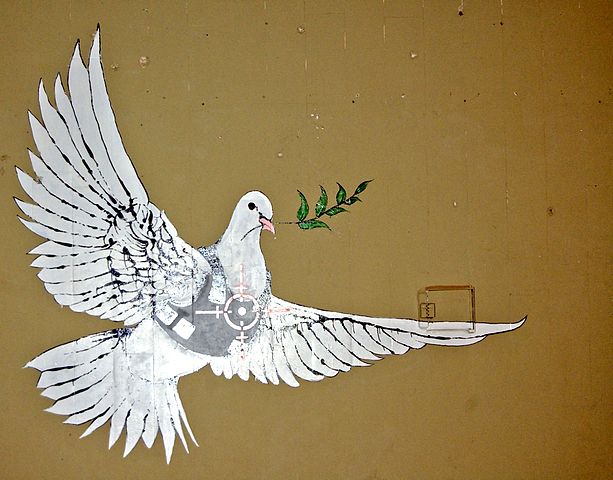
Image courtesy Pawel Ryszawa via Wikimedia Commons.

Many experts have proclaimed the death of the post‑1945 liberal international order, including the human-rights regime set forth in the 1948 Universal Declaration of Human Rights. The cover of Foreign Policy recently displayed the white dove of human rights pierced by the bloody arrows of authoritarian reaction.

According to ‘realist’ international relations theorists, one cannot sustain a liberal world order when two of the three great powers—Russia and China—are anti-liberal. Writing in Foreign Affairs, Yascha Mounk and Roberto Stefan Foa argue that the era when Western liberal democracies were the world’s top cultural and economic powers may be drawing to a close. Within the next five years, ‘the share of global income held by countries considered “not free”—such as China, Russia, and Saudi Arabia—will surpass the share held by Western liberal democracies’.

There are several problems with this argument. For starters, it relies on a measure called purchasing power parity, which is good for some purposes, but not for comparing international influence. At current exchange rates, China’s annual GDP is $12 trillion, and Russia’s is $2.5 trillion, compared to the United States’ $20 trillion economy. But the more serious flaw is lumping countries as disparate as China and Russia together as an authoritarian axis. There is nothing today like the infamous Axis of Nazi Germany and its allies in the 1930s.

While Russia and China are both authoritarian and find it useful to caucus against the US in international bodies like the United Nations Security Council, they have very different interests. China is a rising power that is highly intertwined with the international economy, including the US. In contrast, Russia is a declining country with serious demographic and public health problems, with energy rather than finished goods accounting for two-thirds of its exports.

Declining countries are often more dangerous than rising ones. Vladimir Putin has been a clever tactician, seeking to ‘make Russia great again’ through military intervention in neighbouring countries and Syria, and by using cyber-based information warfare to disrupt—with only partial success—Western democracies. A study of Russian broadcasting in Ukraine found that it was effective only with the minority that was already Russia-oriented, though it was able to produce polarising and disruptive effects in the political system. And the revival of Cold War–style information warfare has done little to create soft power for Russia. The London-based Soft Power 30 index ranks Russia 26th. Russia has had some success cultivating allies in Eastern Europe, but it is not part of a powerful authoritarian axis such as existed in the 1930s.

China is different. It has announced its willingness to spend billions to increase its soft power. At meetings in Davos in 2017 and Hainan in 2018, Xi Jinping presented China as a defender of the existing international order, but one with Chinese rather than liberal characteristics. China does not want to overturn the current international order, but rather to reshape it to increase its gains.

It has the economic tools to do so. It rations access to its huge market for political purposes. Norway was punished after the dissident Liu Xiaobo was awarded the Nobel Peace Prize. Eastern Europeans were rewarded after they watered down European Union resolutions on human rights. And Singaporean and Korean companies suffered after their governments took positions that displeased China. The Chinese government’s massive Belt and Road Initiative to build trade infrastructure throughout Eurasia provides ample opportunities to use business contracts to wield political influence. And China has increasingly restricted human rights at home. As Chinese power increases, the global human-rights regime’s problems will increase.

But no one should be tempted by exaggerated projections of Chinese power. If the US maintains its alliances with democratic Japan and Australia, and continues to develop good relations with India, it will hold the high cards in Asia. In the global military balance, China lags far behind, and in terms of demography, technology, the monetary system and energy dependence, the US is better placed than China in the coming decade. In the Soft Power 30 index, China ranks 25th, while the US is third.

Moreover, no one knows what the future will bring for China. Xi has torn up Deng Xiaoping’s institutional framework for leadership succession, but how long will Xi’s authority last? In the meantime, on issues such as climate change, pandemics, terrorism and financial stability, both an authoritarian China and the US will benefit from cooperation. The good news is that some aspects of the current international order will persist; the bad news is that it may not include the liberal element of human rights.

The human-rights regime may face a tougher environment, but that is not the same as a collapse. A future US administration can work more closely with the EU and other like-minded states to build a human-rights caucus. A G10, comprising the world’s major democracies, could coordinate on values alongside the existing G20 (which includes non-democracies such as China, Russia and Saudi Arabia), with its focus on economic issues.

Others can help. As Kathryn Sikkink points out in her new book, Evidence for hope, while US support has been important to human rights, the US was not always very liberal during the Cold War, and the origins of the regime in the 1940s owed much to Latin Americans and others. Moreover, transnational rights organisations have developed domestic support in numerous countries.

In short, we should be concerned about the multiple challenges to liberal democracy during the current setback to what Samuel P. Huntington called the ‘third wave’ of democratisation. But that is no reason to give up on human rights.

World Press Freedom Day: a good time for honoring journalists

May 4, 2018

Yesterday, 3 May 2018, was World Press Freedom Day and many noteworthy activities took place. The Economist and many other newspapers of course paid attention with grisly statistics from the Committee to Protect Journalists and other sources. It was also a time to award courageous journalists and cartoonist; just to mention a few:

Musa Kart was announced as the 2018 laureate of the International Press Cartoon Prize by Cartooning for Peace.

The 2018 International Press Cartoon (or Drawing) Prize, presented biannually in Geneva, was awarded to the Turkish cartoonist who was recently sentenced to almost four years in prison for “aiding terrorism”. He is a 64-year-old artist working with the Turkish daily newspaper Cumhuriyet and was described as a “free spirit and a remarkable artist” by Swiss cartoonist Chappatte, a member of the jury.

It was also the day of the presentation of the first Ari Rath Prize for Critical Journalism (established to honour journalists who have rendered outstanding services to critical reporting on immigration, expulsion and asylum, committed to respect for human rights, in the spirit of the former editor-in-chief of the Jerusalem Post, who died in January 2017). Austrian journalist Alexandra Föderl-Schmid was the laureate.

Alexandra Föderl-Schmid who helped shape the daily newspaper “Der Standard” for almost three decades. / Picture: © Wikimedia Commons / Franz Johann Morgenbesser.

For more on the many human rights awards for the media and journalists see: http://trueheroesfilms.org/thedigest/

The Stockholm Center for Freedom (SCF) partnered with the London-based International Observatory of Human Rights (IOHR) to commemorate World Press Freedom Day in Stockholm with an event focused on Turkey, which leads the world in the highest number of journalists in jail. According to SCF data, 258 journalists and media workers were in jail as of today, with 59 of them already convicted on dubious charges of terrorism, defamation and coup plotting. In addition, 142 Turkish journalists who were forced to go into exile or still remain at large in Turkey are wanted for arrest by authorities.


Nine NGOs wrote on World Press Freedom Day a joint letter expressing deep concern over the continued arbitrary detention of Tashi Wangchuk, a Tibetan language advocate arrested in 2016 after giving an interview to the New York Times. Tashi Wangchuk has since been tried for “inciting separatism,” a politically motivated charge that violates his rights to freedom of expression and association. [Tashi Wangchuk began raising public concern for the lack of rightful Tibetan-language education …In late 2015, he spoke with the New York Times in an interview about his attempts to promote the teaching of Tibetan; he insisted the interview be on the record. A journalist from the New York Times also accompanied him to Beijing, where Tashi Wangchuk attempted to file a lawsuit to ensure local authorities guarantee the provision of Tibetan language education. The result was an article and video documentary featured in the New York Times in November 2015.

In his article, Tashi Wangchuk insisted that his language advocacy was peaceful and non-political. His attempts to persuade the Chinese government to guarantee Tibetan language instruction were conducted through official channels and he made it clear that he was not advocating Tibetan independence. Instead, his main focus was ending the destruction of Tibetan language and culture. Despite taking these precautions, Tashi Wangchuk was arrested on 27 January 2016, held in an unknown location and later stood trial in a closed session. See also:

https://humanrightsdefenders.blog/2018/03/07/china-and-the-un-human-rights-council-really-win-win/

 Tashi Wangchuk press freedom day ngos


And then there were many smaller events all around the globe that also deserves attention, such as Amnesty International Nepal voicing support to journalists as human rights defenders (such as Charan Kumar Prasai and Subodh Pyakurel and Rajan Prasad Kuikel).

———
https://www.economist.com/blogs/graphicdetail/2018/05/daily-chart-0 
http://www.myrepublica.com/news/41038/?categoryId=81
http://www.cartooningforpeace.org/en/
https://www.swissinfo.ch/eng/business/world-press-freedom-day_imprisoned-turkish-caricaturist-awarded-geneva-cartoon-prize/44092346


https://stockholmcf.org/scf-iohr-partner-to-celebrate-world-press-freedom-day-with-a-focus-on-turkey/
https://www.vindobona.org/article/presentation-of-the-first-ari-rath-prize-for-critical-journalism
https://www.hongkongfp.com/2018/05/03/world-press-freedom-day-xi-jinping-release-tibetan-tashi-wangchuk-charged-nytimes-report/

How China extracts televised “confessions” from human rights defenders

April 12, 2018

Safeguard Defenders says these confessions violate both domestic and international law as they are often filmed before detainees have been allowed their right to a fair trial. In some cases, the confessions were extracted before formal arrest. “They deprive the suspect of due process; infringing on the right to a fair trial, the presumption of innocence, the right to remain silent, the right not to self-incriminate and the right to be protected against giving a forced confession and torture.

Many foreign nationals have been included in these confessions, which are aired on Chinese state television and, in some cases, by Hong Kong media. The monitoring group believes they are regularly used as “tools of propaganda” for both domestic audiences and as part of China’s foreign policy.

The report found that 60 percent of the confessions are from detainees who either worked in media – such as journalists, bloggers and publishers – or were human rights defenders, such as lawyers, NGO workers and activists. They are people whom the Chinese Communist Party (CCP) typically perceives as its enemies or critics and are usually charged with national security crimes or social order violations. The study also found that Chinese police regularly took charge of the so-called confessions. Routinely dictating and directing what the detainee should say and do, right down to the outfit they were to wear.

The interviewees described how the police took charge of the confession from dressing them in ‘costume;’ writing the confession ‘script’ and forcing the detainee to memorise it; giving directions on how to ‘deliver’ their lines – including in one case, being told to weep; to ordering retake after retake when not satisfied with the result,” the report said.

As a result of their research, Safeguard Defenders has called on the Chinese authorities to immediately stop the use of televised confessions and ensure all detainees receive the legal protections enshrined in domestic and international law. The group also called on foreign governments to stress to Beijing that there will be “consequences for ongoing violations of fundamental rights and freedoms.”

State news channel CCTV was identified as the primary broadcaster for televised confessions. Sanctions, including travel bans and asset freezes, should be imposed on key executives of the media network, the group recommends. The network, along with others responsible for airing such confessions, should also be registered as foreign agents in other countries. According to the report, “media organizations that film, collaborate with police in the staged and scripted process, and broadcast these confessions… are as culpable as the Chinese state in committing this deceptive, illegal and human rights violating practice.”

https://qz.com/1249842/swedish-human-rights-activist-peter-dahlins-first-hand-account-of-how-china-extracts-confessions-for-tv/

https://www.standardrepublic.com/world/world-news-chinese-language-state-tv-which-operates-in-uk-and-us-produces-chilling-compelled-confession-movies-for-brutal-regime/

https://asiancorrespondent.com/2018/04/threats-torture-fear-rights-group-calls-for-end-to-chinas-televised-confessions/#crKm6uQdL4vf7sJS.97