Posts Tagged ‘China’

41st UN Human Rights Council: what the NGOs see as its result

July 16, 2019

On 12 july 2019, ISHR published what key civil society organisations thought of the just finished 41st session of the UN Human Rights Council.

Civil society organisations welcomed significant outcomes of the Human Rights Council’s 41st session, including the extension of the SOGI mandate, adopting the first resolution on the Philippines and extending its scrutiny over Eritrea, the Democratic Republic of Congo, Belarus and Ukraine. This session witnessed heightened scrutiny of Council members by shedding light on the situations in Saudi Arabia and China. It missed an opportunity, however, to ensure that human rights are not sidelined in Sudan.

16 leading human rights organisations (see below) expressed regrets that Council members seek to use their seats to shield themselves and others from scrutiny. They called on States to stand with victims of human rights violations. They welcomed the renewal of the mandate of the Special Rapporteur on freedom of peaceful assembly association, that the Council stood up to the global backlash against the rights of women and girls, and that it continued to address the threat posed by climate change to human rights. They also welcomed the reports on Venezuela, called on the High Commissioner to immediately release the UN database of businesses engaged with Israeli settlements, and on all States to pursue accountability for victims of intimidation and reprisals.

Full statement below:

By renewing the mandate of the Independent Expert on sexual orientation and gender identity (SOGI), the Council has sent a clear message that violence and discrimination against people of diverse sexual orientations and gender identities cannot be tolerated. It reaffirmed that specific, sustained and systematic attention is needed to address these human rights violations and ensure that LGBT people can live a life of dignity. We welcome the Core Group’s commitment to engage in dialogue with all States, resulting in over 50 original co-sponsors across all regions. However, we regret that some States have again attempted to prevent the Council from addressing discrimination and violence on the basis of SOGI.

This Council session also sent a clear message that Council membership comes with scrutiny by addressing the situations of Eritrea, the Philippines, China, Saudi Arabia and the Democratic Republic of Congo. This shows the potential the Council has to leverage its membership to become more effective and responsive to rights holders and victims.

The Council did the right thing by extending its monitoring of the situation in Eritrea. The onus is on the Eritrean Government to cooperate with Council mechanisms, including the Special Rapporteur, in line with its membership obligations.

We welcome the first Council resolution on the Philippines as an important first step towards justice and accountability. We urge the Council to closely follow this situation and be ready to follow up with additional action, if the situation does not improve or deteriorates further. We deeply regret that such a resolution was necessary, due to the continuation of serious violations and repeated refusal of the Philippines – despite its membership of the Council– to cooperate with existing mechanisms.

We deplore that the Philippines and Eritrea sought to use their seats in this Council to seek to shield themselves from scrutiny, and those States [1] who stood with the authorities and perpetrators who continue to commit grave violations with impunity, rather than with the victims.

We welcome the written statement by 22 States on China expressing collective concern over widespread surveillance, restrictions to freedoms of religion and movement, and large-scale arbitrary detention of Uyghurs and other minorities in Xinjiang. We consider it as a first step towards sustained Council attention and in the absence of progress look to those governments that have signed this letter to follow up at the September session with a resolution calling for China to allow access to the region to independent human rights experts and to end country-wide the arbitrary detention of individuals based on their religious beliefs or political opinions.

We welcome the progress made in resolutions on the rights of women and girls: violence against women and girls in the world of work, on discrimination against women and girls and on the consequences of child, early and forced marriage. We particularly welcome the renewal of the mandate of the Working Group on Discrimination Against Women and Girls under its new name and mandate to focus on the intersections of gender and age and their impact on girls. The Council showed that it was willing to stand up to the global backlash against the rights of women and girls by ensuring that these resolutions reflect the current international legal framework and resisted cultural relativism, despite several amendments put forward to try and weaken the strong content of these resolutions.

However, in the text on the contribution of development to the enjoyment of all human rights, long standing consensus language from the Vienna Declaration for Programme of Action (VDPA) recognising that, at the same time, “the lack of development may not be invoked to justify the abridgment of internationally recognized human rights” has again been deliberately excluded, disturbing the careful balance established and maintained for several decades on this issue.

We welcome the continuous engagement of the Council in addressing the threat posed by climate change to human rights, through its annual resolution and the panel discussion on women’s rights and climate change at this session. We call on the Council to continue to strengthen its work on this issue, given its increasing urgency for the protection of all human rights.

The Council has missed an opportunity on Sudan where it could have supported regional efforts and ensured that human rights are not sidelined in the process. We now look to African leadership to ensure that human rights are upheld in the transition. The Council should stand ready to act, including through setting up a full-fledged inquiry into all instances of violence against peaceful protesters and civilians across the country.

During the interactive dialogue with the Special Rapporteur on extrajudicial and summary executions, States heard loud and clear that the time to hold Saudi Arabia accountable is now  for the extrajudicial killing of journalist Jamal Khashoggi. We recall that women human rights defenders continue to be arbitrarily detained despite the calls by 36 States at the March session. We urge States to adopt a resolution at the September session to establish a monitoring mechanism over the human rights situation in the country.

We welcome the landmark report of the High Commissioner on the situation for human rights in Venezuela; in response to the grave findings in the report and the absence of any fundamental improvement of the situation in the meantime, we urge the Council to adopt a Commission of Inquiry or similar mechanism in September, to reinforce the ongoing efforts of the High Commissioner and other actors to address the situation.

We welcome the renewal of the mandate on freedom of peaceful assembly and association. This mandate is at the core of our work as civil society and we trust that the mandate will continue to protect and promote these fundamental freedoms towards a more open civic space.

We welcome the renewal of the mandate of the Special Rapporteur on Belarus. We acknowledge some positive signs of re-engagement in dialogue by Belarus, and an attempted negotiation process with the EU on a potential Item 10 resolution. However, in the absence of systemic human rights reforms in Belarus, the mandate and resolution process remains an essential tool for Belarusian civil society. In addition, there are fears of a spike in violations around upcoming elections and we are pleased that the resolution highlights the need for Belarus to provide safeguards against such an increase.

We welcome the renewal of the quarterly reporting process on the human rights situation in Ukraine. However, we also urge States to think creatively about how best to use this regular mechanism on Ukraine to make better progress on the human rights situation.

The continued delay in the release of the UN database of businesses engaged with Israeli settlements established pursuant to Council resolution 31/36 in March 2016 is of deep concern.  We join others including Tunisia speaking on behalf of 65 states and Peru speaking on behalf of 26 States in calling on the High Commissioner to urgently and fully fulfill this mandate as a matter of urgency and on all States to  cooperate with all Council mandates, including this one, and without political interference.

Numerous States and stakeholders highlighted the importance of the OHCHR report on Kashmir; while its release only a few days ago meant it did not receive substantive consideration at the present session, we look forward to discussing it in depth at the September session.

Finally, we welcome the principled leadership shown by Belgium, Luxembourg and the Netherlands, in pursuing accountability for individual victims of acts of intimidation and reprisals under General Debate Item 5, contrasting with other States which tend to make only general statements of concern. We call on States to raise all individual cases at the interactive dialogue on reprisals and intimidation in the September session.

[1]States who voted against the resolution on the Eritrea: Bahrain, Burkina Faso, Cameroon, China, Cuba, Egypt, Eritrea, Iraq, India, Saudi Arabia, Somalia, the Philippines and Pakistan.
States who voted against the resolution on the Philippines: Angola, Bahrain, Cameroon, China, Cuba, Egypt, Eritrea, Hungary, Iraq, India, Qatar, Saudi Arabia, Somalia, and the Philippines.

*Statement delivered by the International Service for Human Rights (ISHR) on behalf of: DefendDefenders (the East and Horn of Africa Human Rights Defenders Project); Global Initiative for Economic, Social and Cultural Rights; Asian Forum for Human Rights and Development (FORUM-ASIA); International Federation for Human Rights (FIDH); International Commission of Jurists (ICJ); Center for Reproductive Rights; ARTICLE 19; Cairo Institute for Human Rights Studies; Human Rights House Foundation; CIVICUS: World Alliance for Citizen Participation; Franciscans International; Association for Progressive Communications (APC); Amnesty International; Human Rights Watch; International Lesbian and Gay Association (ILGA).

For the preview of the the 41st session, see: https://humanrightsdefenders.blog/2019/06/14/guide-to-human-rights-defenders-issues-at-the-41st-human-rights-council-starting-on-24-june/

http://www.ishr.ch/news/hrc41-civil-society-presents-key-takeaways-human-rights-council

In memoriam Chinese human rights defender Ji Sizun

July 15, 2019

Undated photo of award-winning Chinese human rights activist Ji Sizun, who died of cancer at 71, weeks after the end of his prison term, July 10, 2019.

Undated photo of award-winning Chinese human rights activist Ji Sizun, who died of cancer at 71, weeks after the end of his prison term, July 10, 2019. Courtesy of an RFA listener.

Award-winning Chinese human rights activist Ji Sizun has died of cancer, pn 10 July 2019 weeks after the end of his prison term. He was 71. Ji, a self-taught legal activist from the southeastern province of Fujian, died of colorectal cancer on Wednesday afternoon at the Zhangzhou Xiangcheng Hospital in Zhangzhou city, his family said.

He had just finished serving a four-and-a-half year jail term for publicly supporting the 2014 pro-democracy movement in Hong Kong, and had been held incommunicado and under close surveillance by the authorities since his “release” in April. His family members were denied permission to visit or speak with him until he was unconscious (!), and Ji’s body was sent directly for cremation after his death by the authorities. His sister said her brother had dedicated his life to human rights work, which was why he had never married. “He would say that his work was too dangerous, so he didn’t want to have a wife and child to care about him.”

Ji’s cancer was diagnosed while he was in prison, and he was offered treatment in a local hospital, according to Ji Zhongjiu, a lawyer who had tried to visit him there.

A source close to the case said Ji’s remains had been handed over to his local neighborhood committee, rather than to his family, sparking suspicions that Ji’s death may not have been entirely due to natural causes. “There are huge question marks over this whole thing … as for the family’s letter entrusting them with this task, the family are very confused about that,” the source said. “The letter was signed on June 12, and Ji suddenly died less than a month after they signed it, so clearly there are suspicions that the authorities have been playing god.” He said the family never wanted Ji to be cremated.

Earlier this year, Ji was awarded the fifth Cao Shunli Memorial Award for Human Rights Defenders, for his contribution in promoting legal rights and education at the grassroots level in China. Cao died in March 2014 after she was denied medical treatment for months while in detention. See: https://humanrightsdefenders.blog/2019/03/16/human-rights-defender-ji-sizun-in-jail-awarded-5th-cao-shunli-memorial-award-for-human-rights-defenders/

The Chinese authorities should investigate the circumstances and causes of human rights activist Ji Sizun’s death, Human Rights Watch said.

Reported by Gao Feng for RFA’s Mandarin Service, and by Wong Lok-to for the Cantonese Service. Translated and edited by Luisetta Mudie.

https://www.rfa.org/english/news/china/activist-death-07102019113636.html

https://www.hrw.org/news/2019/07/10/china-account-activists-death

Joint letter by 22 States to Human Rights Council re China’s Uighurs

July 12, 2019
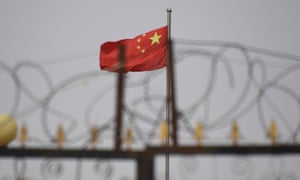
A Chinese flag behind razor wire at a housing compound in Yangisar, south of Kashgar, in China’s western Xinjiang region
China is reportedly holding one million people, mostly ethnic Uighurs, in internment camps in Xinjiang Photograph: Greg Baker/AFP/Getty Images

UN ambassadors  – including Australia, Britain, Canada, France, Germany and Japan – co-signed the letter released Wednesday and sent to the Human Rights Council president, Coly Seck, and the High Commissioner for Human Rights, Michelle Bachelet.

Rights groups and former inmates describe them as “concentration camps” where mainly Muslim Uighurs and other minorities are being forcefully assimilated into China’s majority ethnic Han society. The letter expresses concern “about credible reports of arbitrary detention… as well as widespread surveillance and restrictions, particularly targeting Uighurs and other minorities in Xinjiang.” It calls on China to stop arbitrary detention and allow “freedom of movement of Uighurs and other Muslim and minority communities in Xinjiang.” The authors, who include ambassadors from across the EU as well as Switzerland, requested that the letter become an official document of the Human Rights Council, which ends its 41st session in Geneva on Friday. Chinese officials describe the camps as voluntary “vocational education centres” where Turkic-speaking Uighurs receive job training.

The letter may have been the only available option with China having enough support in the UN Council to vote down a formal resolution. See also: ttps://www.reuters.com/article/us-china-xinjiang-rights-idUSKCN1U721X?utm_campaign=trueAnthem:+Trending+Content&utm_content=5d28c3e00ca7240001cb2eef&utm_medium=trueAnthem&utm_source=twitter

On the same day Human Rights Watch commented: Most importantly, the joint letter sends a strong message that we are moving beyond the era of selectivity, and that no country, large or small, is exempt from the scrutiny of this Council. We understand that the joint letter remains open for additional signatures, and we encourage those delegations that have not yet signed to do so. We are particularly disappointed that OIC member states have not yet engaged meaningfully or credibly with the human rights situation affecting Muslims in Xinjiang, while they have spoken out on other situations. This risks fueling perceptions of double standards and politicization; supporting the constructive joint statement would be a useful step towards addressing such perceptions.

We also welcome China’s acceptance of a UPR recommendation to respond positively to a country visit request by the UN Special Rapporteur on freedom of religion or belief.

We would suggest that China could benefit from technical assistance by drawing on the expertise of other UN Special Rapporteurs, such as the Special Rapporteur on the promotion of human rights while countering terrorism. Given that China has advanced the need to counter terrorism as its rationale for mass programs directed at Uyghurs and others in Xinjiang, the Special Rapporteur could offer useful guidance on whether there are more rights-respecting ways to counter terrorism than mass surveillance, detaining over a million Muslims, and stripping an entire population of its rights to freedom of religion, privacy, culture and expression.

See also: https://humanrightsdefenders.blog/2016/10/11/hot-news-ilham-tohti-chinas-mandela-wins-2016-martin-ennals-awad/

https://www.theguardian.com/world/2019/jul/11/more-than-20-ambassadors-condemn-chinas-treatment-of-uighurs-in-xinjiang

https://www.hrw.org/news/2019/07/11/independent-reporting-xinjiang-abuses-requires-unfettered-access-not-stage-managed

Lawyers key to the rule of law – even China agrees but only lip service

June 26, 2019

Lawyers have an essential role in upholding the Constitution and realising the rule of law – at the Human Rights Council 41st session this week, even China agreed. So why does the Chinese government continue to harass, intimidate and persecute lawyers who defend human rights ask 4 NGOs on 25 June 2019: Lawyers for Lawyers, International Bar Association, International Service for Human Rights and Lawyer’s Rights Watch Canada. In a joint statement the NGOs call on the UN expert on independence of judges and lawyers, and the Council and its members, to press for accountability.

‘The Chinese delegation recognised the need for balance in regulation between lawyers’ and judges’ rights, on the one hand, and their professional responsibilities, on the other hand’, says Sarah M Brooks, Asia Advocate at ISHR. ‘But it is hard to take this claim seriously, as Chinese authorities continue to adopt  abusive laws and measures, using them as a “sledgehammer” to restrict fundamental freedoms’.

This includes in particular lawyer Jiang Tianyong, who – since his nominal release from prison on 28 February 2019 – has been subject to invasive surveillance, restrictions on his freedom of movement, and refusal of independent medical exams. Worse, he is unnecessarily and inhumanely kept from joining his family in the U.S. [see also: https://humanrightsdefenders.blog/2017/11/21/jiang-tianyong-chinese-defender-of-defenders-sentenced-to-2-years-jail/]

The statement draws on research conducted by Chinese Human Rights Defenders and other partners into two ‘administrative measures’ that have had far-reaching consequences for lawyers on the ground.  The Measures on the Administration of Law Firms and Administrative Measures for the Practice of Law by Lawyers of Law Firms call on lawyers, law firms and regional bar associations not only to take measures to ensure that lawyers’ freedom of speech, both online and off, in professional and personal capacities, is not critical of the government. Furthermore, language added to one of the measures in 2018 specifically states that  ‘Law firms shall adhere to guidance of Xi Jinping Thought on Socialism with Chinese Characteristics for a New Era, adhere to and strengthen the comprehensive leadership of the Party over the work of lawyers, persist in preserving the authority and uniform leadership of the Party with Comrade Xi Jinping as its core, make support for the Party’s leadership and support for socialist rule of law basic requirements for the profession, and increase the conscientiousness and resoluteness with which lawyers as a group walk the path of socialist rule of law with Chinese characteristics’.

As a result of making comments that were deemed critical of the Chinese Communist Party, from January 2017 to January 2019, groups have documented cases of at least 26 lawyers and three law firms that have been punished for their opinion or expression, or by association with lawyers. This includes well-known rights lawyers such as Yu Wensheng, Wang Yu, Xie Yanyi and, just last week, Liu Xiaoyuan. 

[for the massive crackdown in 2015, see: https://humanrightsdefenders.blog/2015/07/29/the-remarkable-crackdown-on-lawyers-in-china-in-july-2015/]


—-

Full statement

Joint statement under Item 3: Interactive Dialogue with Special Rapporteur on Independence of Judges and Lawyers and the Independent Expert on SOGI

24 June 2019

Mr. Vice President,

We thank the Special Rapporteur for his report. We wish to highlight that many of the trends of restriction he notes also apply to lawyers. For example, across China, repression of human rights lawyers and legal activists continues. They are disappeared, detained, and denied basic rule of law guarantees.

Lawyer Jiang Tianyong is one example. Although he served his sentence for ‘inciting subversion of the State’, he now lives under constant police surveillance and with a serious medical condition.

What was his so-called ‘crime’? Representing fellow lawyers in court, investigating black jails, speaking out for victims of human rights violations and meeting with UN officials.

Mr Special Rapporteur, we are concerned about Chinese government actions to imprison and disbar lawyers who do not adhere to official ideology. The Chinese delegation raised earlier the need to uphold the Constitution – we couldn’t agree more. But problematic regulations passed in 2016 allow authorities to, inter alia, shut down law firms if they refuse to dismiss lawyers who express critical views, or who advocate for clients or causes unpopular with the Communist Party of China.

China’s claims to ‘faithfully uphold the rule of law’ are true only in relation to national laws created to authorize such government action. Chairman Xi has stressed the Communist Party’s control over the legal system, and has used the law to repress and punish those mandated to uphold and protect rights.

Yu Wensheng, Sui Muqing, Zhou Shifeng, Xie Yanyi, Li Heping, Wang Yu, Liu Zhengqing and Liu Xiaoyuan are only 8 out of at least 27 documented cases of human rights lawyers whose licenses have been invalidated or revoked since 2016, simply for fulfilling their professional duties.

In her UPR follow-up letter to the government, the High Commissioner identified key areas for improvement, including ‘guaranteeing an independent judiciary, fair trials, and access to legal counsel, releasing all human rights defenders, including lawyers’.

We call on you, Mr Special Rapporteur, and on this Council, to insist that China immediately stop all forms of harassment and persecution of human rights lawyers, including through administrative means, and unconditionally release those arbitrarily deprived of their liberty.

Thank you.

Speech by Commissioner Dunja Mijatović at RightsCon 2019, Tunis, about digital security

June 17, 2019

Council of Europe Commissioner for human rights, Dunja Mijatović, gave a speech at the world’s leading summit on human rights in the digital age, RightsCon 2019, in Tunis, on 11 June 2019:

…A recent article of the New York Times from the city of Kashgar showed the extent to which the Chinese authorities are using facial recognition and snooping technologies to keep a tight control of the Muslim community.  If you think that this does not concern you because it is happening far away, you would be terribly wrong. The Chinese experiment bears a great significance for all of us. It shows to what extent the cozy relations between technology companies and state security agencies can harm us. This has become particularly acute as part of states response to terrorist threats and attacks. States around the world have increased their surveillance arsenal, not always to the benefit of our safety. On the contrary, in several occasions they used it to silence criticism, restrict free assembly, snoop into our private life, or control individuals or minorities.

An illustration of this comes from human rights defenders. If in the past human rights defenders have been ahead of states in using technological progress to expose human rights abuses, now they are facing a backlash. As we speak, states and non-state actors are intercepting their communications, intrude their personal data, trace their digital footprint. States are using technologies to learn about human rights defenders’ plans or upcoming campaigns; to find or fabricate information that can help intimidate, incriminate or destroy their reputation; or to learn about their networks and sources.

This concerns us all. At stake here is the society we want to live in and bequeath to the next generations. Technology should maximise our freedoms and rights – and keep those in power accountable.

To get there we need to strengthen the connections among us and crowdsource human rights protection, promotion and engagement. An important step in that direction would be to provide more support, funding and digital literacy training to human rights defenders. It is also crucial that the private sector and state authorities uphold human rights standards in the designing and implementation of all technological tools.

Living in an increasingly digital world does not mean living artificial lives with artificial liberties. Our rights must be real, all the time.

We all must resist the current backlash and persist in demanding more human rights protection, more transparency and more accountability in the digital world.

https://www.coe.int/en/web/commissioner/-/2019-speech-by-dunja-mijatovic-council-of-europe-commissioner-for-human-rights-at-the-world-s-leading-summit-on-human-rights-in-the-digital-age-rights

Guide to Human Rights Defenders issues at the 41st Human Rights Council starting on 24 June

June 14, 2019

Thanks to the – as always very complete and timely – “Alert to the Human Rights Council’s 41st session” (from 24 June to 12 July 2019) issued by the International Service for Human Rights. I am able to give a short guide to the main items that relate to human rights defenders. To Read the full Alert to the session online click here and stay up-to-date with @ISHRglobal and #HRC41 on Twitter.

Thematic areas of interest:

Sexual orientation and gender identity: The interactive dialogue with the Independent Expert on protection against violence and discrimination on the basis of sexual orientation and gender identity (SOGI) will be held on Monday 24 June at 11:00. The Council will consider the new thematic report of the mandate holder as well as the report of the country visits he made to Georgia and Mozambique. The Council will also consider the renewal of the mandate.

Business and human rights: The Council will hold an interactive dialogue with and consider several reports of the Working Group on the issue of human rights and transnational corporations and other business enterprises on 26 June. The Working Group will present a report on the gender dimensions of the Guiding Principles on Business and Human Rights and the reports of country visits to Thailand and Kenya. The Working Group’s report on the gender dimensions of the Guiding Principles integrates clear recognition that women human rights defenders play a vital role in challenging business-related human rights abuses as well as in promoting and protecting human rights in relation to business activity, including the right to an effective remedy. As a result of this work, women human rights defenders often face gender-specific risks including sexual violence, misogynist public shaming and online harassment. Among its recommendations, the Working Group calls on business enterprises to ensure the meaningful participation of women’s organisations, women human rights defenders and gender experts in all stages of human rights due diligence.

Women human rights defenders and women’s rights: The annual full day discussion on the human rights of women will take place on 27 and  28 June. The discussions will focus this year on violence against women in the world of work, the rights of older women and their economic empowerment. A panel focused on women’s rights and climate change will also be organised, focusing on climate action, best practices and lessons learned. States should place due consideration on the role of women human rights defenders and social movements in this regard, in line with the Human Rights Council resolution focused on environmental human rights defenders adopted in March 2019…
The Council will also hold an interactive dialogue with the Working Group on the issue of discrimination against women in law and in practice which focuses on women deprived of liberty (including women human rights defenders in detention, facing travel bans, among other situations), and will consider their reports including a report on the country visits to Honduras and Poland. The Council will hold an interactive dialogue with the Special Rapporteur on violence against women, its causes and consequences on 27 June and will consider her report including the report of her visits to Canada and Nepal.

Reprisals:  In spite of a number of measures, reprisals not only continue, but grow. Item 5 of the Human Rights Council’s agenda provides a key opportunity for States to raise concerns about reprisals, including specific cases, and for relevant governments to provide updates on cases to the Council on any investigation or action taken toward accountability. During the organisational meeting held on 7 June, the President of the Council stressed the importance of ensuring the safety of those participating in the Council’s work, and the obligation of States to prevent intimidation or reprisals. In line with previous calls, ISHR expects the President of the Human Rights Council to publicly identify and denounce specific instances of reprisals by issuing formal statements, conducting press-briefings, corresponding directly with the State concerned, publicly releasing such correspondence, and insisting on undertakings from the State concerned to investigate, hold the perpetrators accountable and report back to the Council on action taken. [see also: https://humanrightsdefenders.blog/2019/05/13/ishr-on-reprisals-un-and-states-must-do-more-to-address-reprisals/]

Other key thematic reports: The Council will hold dedicated debates and consider reports of several mandates relating to civil, political, economic, social and cultural rights, and the role of human rights defenders in that work area, in some instances involving the renewal of the mandate:

  • The Special Rapporteur on independence of judges and lawyers and on the right to health (including country visits report to Canada and Kyrgyzstan) on 24 June
  • The Special Rapporteur on the rights to freedom of peaceful assembly and association (mandate renewal, reports include country visits to Tunisia and Armenia) on 25 June
  • The Special Rapporteur on extrajudicial, summary or arbitrary executions and right to education on 26 June
  • The Special Rapporteur on freedom of opinion and expression (including thematic report on surveillance companies and country visit report to Ecuador) on 25 June
  • The Special Rapporteur on extreme poverty and human rights (including country visits reports to the UK and Laos) on 28 June

In addition, the Council will hold dedicated debates on rights of specific groups including with:

  • The Special Rapporteur on the human rights of migrants (and country visit report to Niger) on 24 June
  • The Special Rapporteur on the human rights of internally displaced persons on 28 June (mandate renewal)
  • The Special Rapporteur on trafficking in persons (and country visit to Nigeria) on 27 June
  • The Special Rapporteur on the elimination of discrimination against persons affected by leprosy and their family members on 24 June

Country-specific developments:

China: For more than a year, the international community has had access to credible reports and first-hand testimony of the harassment, surveillance, and mass detention of more than one million Uyghurs and other Turkic Muslims in Xinjiang. Despite the consistent work of the UN human rights mechanisms to review China, ask questions, and make recommendations, there has been no serious or effective response. The Council should take urgent action to seek access, monitoring and reporting of the situation to inform future actions. ..ISHR urges States to act collectively to advance a resolution calling for China to allow access to the region to independent human rights experts and to end country-wide the arbitrary detention of individuals based on their religious beliefs or political opinions.

Sudan: In response to the gross and systematic human rights violations occurring in Sudan, ISHR andother NGOs have urged Council Member States to urgently hold a Special Session on the human rights situation in Sudan. The Council should urgently establish an international fact-finding mission to document violations, identify perpetrators and push for accountability, in line with calls made by a group of Special Procedures including the Independent Expert on Sudan. Since 3 June, Rapid Security Forces, riot police and national security officers violently dispersed peaceful protesters in Khartoum as well as in different cities across Sudan. The MENA Women Human Rights Defenders’ Coalition reported that at least 113 people have died including women human rights defenders. Civil society documented cases of rape, attacks on hospitals, with hundreds injured and missing.  The Transitional Military Council is enforcing a ban on communication causing an internet black out. The High Commissioner has deplored the killings and proposed ‘the rapid deployment of a UN human rights monitoring team’ to Sudan.

Saudi Arabia: The June session provides an important opportunity for the Council to follow up on the joint statement delivered on behalf of 36 States [see: https://humanrightsdefenders.blog/2019/03/08/saudi-arabia-for-first-time-openly-criticized-in-un-human-rights-council/] .. Seven women’s rights activists have been provisionally released, but they are still facing trial, and other women human rights defenders are still in detention, with the human rights situation on the ground deteriorating markedly on other fronts, including through increased use of the death penalty and the authorities’ continuing crackdown on freedom of expression.  [see also: https://humanrightsdefenders.blog/2019/03/28/3-saudi-women-human-rights-defenders-released-but-for-how-long-and-what-about-the-others/]
The Special Rapporteur on extrajudicial, summary or arbitrary executions will present her findings of the investigation into the killing of Khashoggi. [see: https://humanrightsdefenders.blog/2019/01/26/other-members-of-the-uns-khashoggi-investigation-team-named/%5D…..ISHR calls on States to advance a Human Rights Council resolution establishing a monitoring mechanism over the human rights violations in the country and calling explicitly for the immediate and unconditional release of all human rights defenders including the detained women human rights defenders and to drop all charges against them, including those provisionally released. ISHR considers the March joint statement as a first step towards more sustained and dedicated review by the Council in its efforts to hold its members accountable.

The Philippines: The Philippines is one of the most dangerous countries for human rights defenders. Several NGOs callied on the Council to advance accountability for human rights violations by adopting a resolution establishing an independent international investigation into extrajudicial killings and this call was strongly endorsed by a group of independent UN experts who condemned a ‘sharp deterioration in the situation of human rights across the country, including sustained attacks on people and institutions defending human rights.’ [see also: https://humanrightsdefenders.blog/2019/06/07/philippines-labour-rights-defender-dennis-sequena-shot-dead-while-meeting-with-workers/]

Egypt: Despite the Egyptian government’s assurances to the African Commission civil society faced restrictions, reprisals and intimidation for engaging or seeking to engage with the Commission. These restrictions and reprisals happened in a context where the Government of Egypt crushes dissent, discourages public participation in public affairs and punishes people who dare to claim basic human rights. Individuals and communities who engaged with the Special Rapporteur on the right to housing during her visit in September 2018 faced systematic reprisals. All other scheduled visits by the Special Procedures have been postponed as a result. [see: https://humanrightsdefenders.blog/2018/12/07/egypt-denounced-for-reprisals-against-human-rights-defenders-who-talked-to-visiting-un-delegation/ and https://humanrightsdefenders.blog/2019/05/12/reprisal-against-egyptian-human-rights-defender-mohamed-soltan/]. ISHR calls on States to condemn the acts of intimidation and reprisals for civil society engaging with the African Commission and with the Special Procedures, and recall Egypt’s obligations to prevent acts of intimidation and reprisals, investigate the allegations and provide victims with effective remedy.

Burundi: The Commission of Inquiry on Burundi will present its oral briefing on 2 July. The closing of the office of the High Commissioner for Human Rights is regrettable and worrying. In addition, ISHR remains seriously concerned over the breaches to due process observed in all of human rights defender Germain Rukuki’s legal proceedings since his arrest without warrant on 13 July 2017. [See: https://humanrightsdefenders.blog/2019/03/29/ngo-statement-condemns-new-irregularities-in-the-case-of-germain-rukuki-burundi/]. For more information on the situation of human rights defenders in Burundi, check ISHR Briefing Paper for the UPR here.

Other country situations: The High Commissioner will present her oral update to the Council on 24 June. The Council will hear reports on and is expected to consider resolutions addressing a range of country situations, in some instances involving the renewal of the relevant expert mandates. These include:

  • Interactive dialogue with the Special Rapporteur on the human rights situation in Belarus (mandate renewal) on 1 July
  • Interactive dialogue with the Special Rapporteur on the human rights situation in Eritrea (mandate renewal) on 2 July
  • Interactive dialogue with the Commission of Inquiry on Syria, the Commission of Inquiry on Burundi and the Special Rapporteur on Myanmar on 2 July
  • Enhanced interactive dialogue with the government of Sudan and OHCHR on 9 July
  • Enhanced interactive dialogue on the situation in the Democratic Republic of Congo and interactive dialogue with the team of experts on the situation in the Kasai region on 9 July
  • Interactive dialogue with the High Commissioner on the situation in Ukraine on 10 July
  • Interactive dialogue with the Independent Expert on the Central African Republic on 10 July
  • Enhanced interactive dialogue on the report of the High Commissioner on Venezuela on 10 July
  • Interactive dialogue with the High Commissioner on the situation of Rohingya Muslims and other minorities in Myanmar on 10 July
  • First oral update and enhanced interactive dialogue on the report of the High Commissioner on Nicaragua on 11 July
  • Oral update by the High Commissioner on cooperation with Georgia on 11 July

Adoption of Universal Periodic Review (UPR) reports: During this session, the Council will adopt the UPR working group reports on New Zealand, Afghanistan, Chile, Viet Nam, Uruguay, Yemen, Vanuatu, North Macedonia, Comoros, Slovakia, Eritrea, Cyprus, Dominican Republic and Cambodia.

Resolutions to be presented to the Council’s 41st session: At the organisational meeting resolutions were announced (States sponsoring the resolution in brackets); it is possible that more resolutions could be presented at this session. These include:

  • The human rights situation in Belarus (European Union)
  • Human rights of internally displaced persons (Austria, Honduras, Uganda)
  • Human rights and climate change (Bangladesh, Philippines, Viet Nam)
  • Human rights, sexual orientation and gender identity (Argentina, Brazil, Chile, Colombia, Costa Rica, Mexico, Uruguay).
  • Elimination of discrimination against women and girls (Colombia, Mexico)
  • Rights to freedom of peaceful assembly and of association (Czech Republic, Indonesia, Lithuania, Maldives, Mexico)
  • New and emerging and digital technologies and human rights (Republic of Korea, Austria, Brazil, Denmark, Morocco, Singapore)
  • Accelerating efforts to eliminate all forms of violence against women(Canada)
  • The human rights situation in Syria (France, Germany, Italy, Jordan, Kuwait, Morocco, Netherlands, Qatar, Turkey, United Kingdom of Great Britain and Northern Ireland)

There wil be again many side events at the Council, on which I will report separately.

Read here the three year programme of work of the Council with supplementary information.
Read here ISHR’s recommendations on the the key issues that are or should be on the agenda of the UN Human Rights Council in 2019.

Today: Tiananmen Square 30 years ago was ‘correct’ but singing about it still not allowed

June 4, 2019

As many news outlets report today it is 30 years ago that China cracked down on Tiananmen Square. China tries mostly to forget about it and make others forget it about it too. Still, it recenty came out to defend it as the “correct policy”. “That incident was a political turbulence and the central government took measures to stop the turbulence which is a correct policy” Defence minister Wi Fenghe Wei told a regional security forum in Singapore. “The 30 years have proven that China has undergone major changes,” he said, adding that because of the government’s action at that time “China has enjoyed stability and development“. On the other hand Wu Qian, a spokesman for the defence ministry, decried the use of the word “suppression” to describe the crackdown.

But it does cover Chinese rock musician Li Zhi, who has been outspoken and sung songs about social issues including the Tiananmen Square crackdown, and has not been seen for three months. The South China Morning Post of 2 June has a detailed piece on what happened to this singer: His upcoming tour has been cancelled and his social media accounts taken down. Then his music was removed from all of China’s major streaming sites – as if his career had never existed at all. “Now this square is my grave,” Li sang. “Everything is just a dream.”

The disappearance of Li, the musician, has left fans searching for answers. On February 20, the official Weibo social media account for the 40-year-old’s concert tour posted a photograph of its team in front of a truck about to embark on scheduled performances in Sichuan province in China’s southwest. Just two days later, however, the account posted an image of a hand wearing what appeared to be a hospital wrist band and the words: “Very sorry.” The next post, published the same day, announced without explanation that the tour was cancelled and that ticket purchasers would shortly receive a refund. Fans flooded the comment section with wishes for a speedy recovery.

But the suggestion that a health issue was behind the cancellations was later thrown into doubt. A statement published in April by Sichuan’s culture department said it had “urgently halted” concert plans for a “well-known singer with improper conduct” who was previously slated for 23 performances – the same number of concerts which Li had scheduled in the province. It said 18,000 tickets were fully refunded.

..Li’s presence on the Chinese internet was completely erased. An April 21 central government directive ordered all websites to delete any audio or video content relating to five of Li’s songs, according to China Digital Times, an organisation that publishes leaked censorship instructions. The authenticity of the directive could not be independently verified.

“There’s pretty much a consensus” among those working in the industry that Li’s disappearance from public view is due to the sensitive anniversary, said a music industry professional who spoke on condition of anonymity because of fear of government retribution. “He did a number of songs that were considered politically risky, making references to June 4, 1989, and so he’s been out of the picture,” the industry professional said.

Li’s current whereabouts could not be confirmed. His company and record label did not respond to repeated interview requests. Li’s songs alluding to the Tiananmen Square protests – The Square, The Spring of 1990 and The Goddess, in honour of the Goddess of Democracy that students erected – were part of his earlier works. In recent years, the bespectacled singer has avoided making public political statements, focusing more on promoting his performances. In 2015, state-run China Daily newspaper published a profile of Li, describing him as a performer who easily sells out concerts. After years of working as an independent artist, he signed last autumn with Taihe Music Group, a major Chinese record label. Fans who knew Li as a largely apolitical entertainer expressed bewilderment online about his disappearance. Others made veiled references to China’s internet censorship. On Zhihu, a question-and-answer website similar to Quora, one user wrote that people posed questions every day about what might have happened to Li, but these posts always disappeared the next morning “as if nothing had happened at all”.

Another user said: “I don’t dare to say it, nor do I dare to ask.” A fan who has been sharing Li’s music on his personal account spoke on condition of anonymity because he feared his employers would punish him for discussing the subject. “Everyone knows the reason for Li Zhi’s disappearance,” the fan said. “But I’m sorry, I can’t tell you, because I follow China’s laws and also hope that Li Zhi can return.” Quoting one of Li’s lyrics, the fan added: “The world will be all right.” Fans continue to circulate videos of Li’s performances online. His complete discography has been uploaded onto file-sharing websites, with back-up links in case the original ones are shuttered. Some users shared tribute art, including a black T-shirt with the words “improper conduct”. A few years ago, in a performance in Taiwan, Li bounced around on stage, strumming his guitar and repeating a chorus in apparent tribute to the spirit of Chinese propaganda.

Foreign companies are not immune. Apple Music has removed from its Chinese streaming service a song by Hong Kong singer Jacky Cheung Hok-yau that references the Tiananmen crackdown. Tat Ming Pair, a Hong Kong duo, have been deleted entirely from the app. They released a song this month called Remembering is a Crime in memory of the protests.

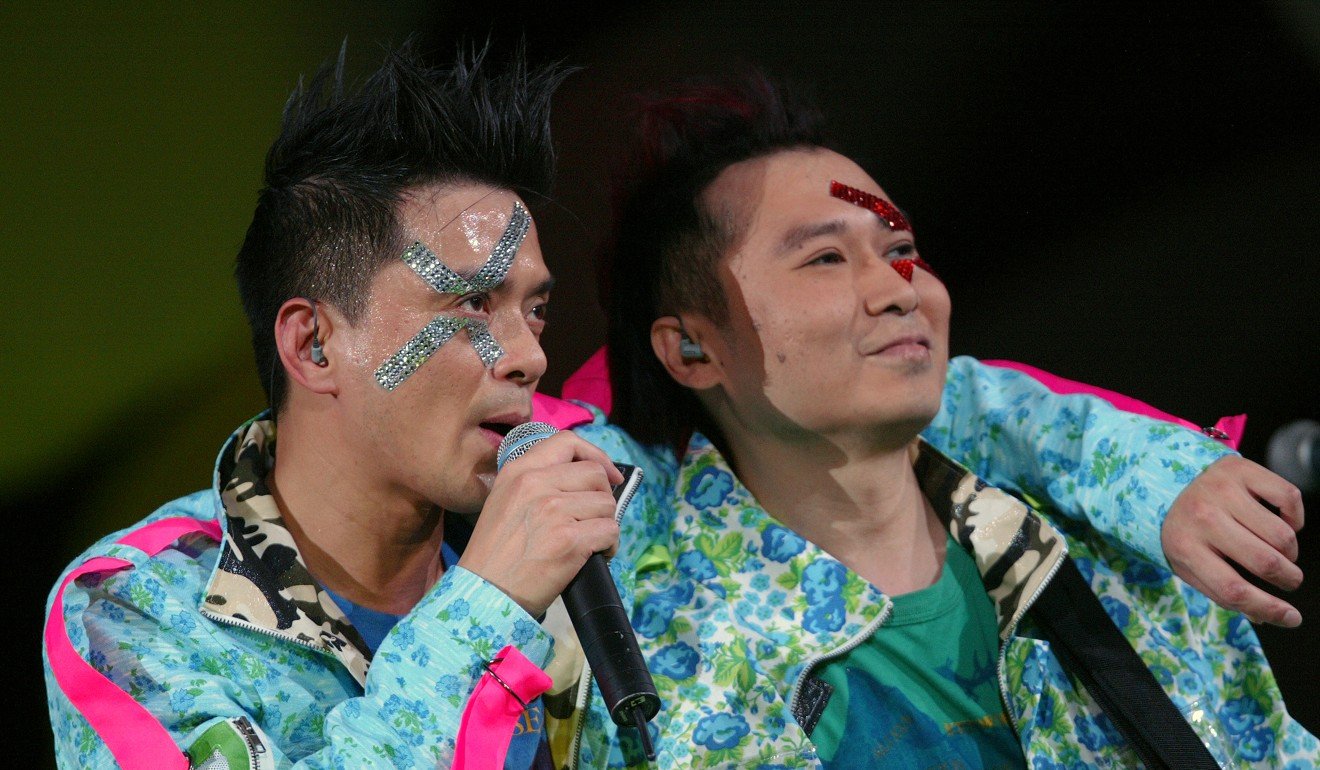
Music by Tat Ming Pair – Anthony Wong Yiu-ming (left) and Tats Lau Yi-tat – has been deleted from the Apple Music app. Photo: K.Y. Cheng

Wikipedia also announced this month that the online encyclopaedia is no longer accessible in China. While the Chinese-language version has been blocked since 2015, most other languages could previously be viewed, Wikipedia said.

The Human Rights Foundation publised this video about China’s Million Person Muslim Prison Camps:

For the 25th anniversary see: https://humanrightsdefenders.blog/2014/06/13/25-years-tiananmen-celebrated-with-over-100-detentions/

See also: https://humanrightsdefenders.blog/2019/05/31/on-4-june-streets-around-chinese-embassy-to-be-renamed-tiananmen-square/

https://uk.news.yahoo.com/china-says-tiananmen-square-crackdown-1989-correct-policy-093500064.html

https://www.scmp.com/news/china/politics/article/3012782/outspoken-folk-rock-singer-li-zhi-disappears-china-tightens

On 4 June streets around Chinese embassy to be ‘renamed’ Tiananmen Square

May 31, 2019

Dr Shao Jiang

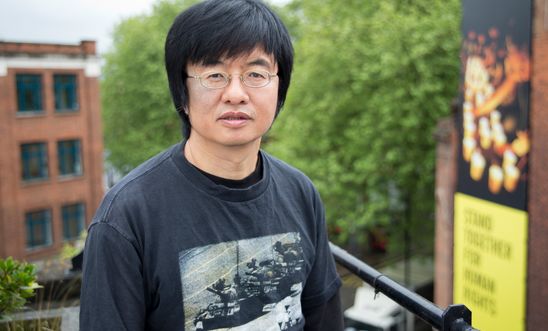
I have always liked the symbolic act of renaming streets after human rights defenders [see e.g. https://humanrightsdefenders.blog/2018/06/07/ahmed-mansoor-ten-years-jail-for-tweeting-and-a-street-named-after-you/]. Amnesty International activists will ‘rename’ the streets surrounding the Chinese Embassy in London next week to mark the 30th anniversary of the notorious Tiananmen Square crackdown. On Tuesday 4 June (10h00 am), a total of 30 authentic-looking ‘Tiananmen Square’ street signs will be displayed in the streets around the embassy in central London to mark the anniversary. Amnesty UK Director Kate Allen and Shao Jiang – one of the original student protest leaders who was in Tiananmen Square on the night of 4 June – will place a ‘Tiananmen Square’ sign immediately outside the Chinese Embassy building.

https://www.amnesty.org.uk/press-releases/london-streets-around-chinese-embassy-be-renamed-tiananmen-square-anniversary

Profile of Chinese human rights Defender Teng Biao

May 20, 2019
China Digitial Times (CDT) is expanding its wiki to include short biographies of , cartoonists, , and other people pushing for change in China. The wiki is a work in progress. Here the case of Teng Biao, of whom I wrote earlier in 2015: https://humanrightsdefenders.blog/2015/03/17/stop-dancing-with-dictators-says-chinese-human-rights-defender-teng-biao/.

. (Source: Wikipedia)

Teng Biao, born on August 2, 1973 in Jilin Province, is a human rights lawyer, activist, and former professor who is dedicated to exposing China’s human rights abuses and fighting against its use of the death penalty. After being repeatedly detained for his work, Teng moved to the U.S. in 2014, where he has continued his life’s work as a visiting scholar at institutions such as Princeton, Harvard, and New York University.

Teng obtained his Doctor of Law from Beijing University in 2002 before joining the faculty of the China University of Political Science and Law as a lecturer. He later served as a visiting scholar at the Chinese University of Hong Kong and Yale University. He swiftly entered the fore of high-profile legal cases, including but certainly not limited to the Sun Zhigang incident in 2003, serving as counsel for activists Chen Guangcheng and Hu Jia, and death penalty cases such as the Leping case in Jiangxi Province.

Prior to moving to the U.S. in 2014, Teng was subject to multiple instances of police harassment. In 2008, he was detained for two days before being released following widespread calls from both domestic and foreign advocates; in 2010, he was detained for visiting a human rights lawyer under house arrest; in 2011, as those in China began to call for their own Jasmine Revolution, he was detained for ten weeks; in 2013, he was detained for attending Hu Jia’s birthday dinner.

In 2014, Teng relocated to the U.S., where he has continued observing and criticizing Chinese government practices. These include presenting a sobering view on the true nature of Xi Jinping’s corruption crackdown, expressing concern for detained fellow rights lawyer Jiang Tianyong, and calling for President Obama to pressure China on human rights at his last G20 summit appearance.

Teng again roused attention in 2016 when the American Bar Association abruptly cancelled publication of his book “Darkness Before Dawn,” a detailing of his 11-year career as a rights defender in China. The cancellation has been one of many cases of foreign entities who have either bowed to Chinese pressure for fear of upsetting the Chinese government or proactively curried favor for the sake of economic gain.

Over the course of his career, Teng has spearheaded multiple initiatives. He has co-founded two NGOs: Beijing’s China Against the Death Penalty, and the Open Constitution Initiative (Gongmeng), an organization composed of lawyers and academics that advocates for the rule of law in China. From the U.S., Teng co-founded the China Human Rights Accountability Center alongside rights defenders such as Zhou Fengsuo and Chen Guangcheng following the passage of the Global Magnitsky Human Rights Accountability Act under the Obama Administration. The act authorized the president to sanction foreign individuals who commit human rights violations or are engaged in significant levels of corruption. The Center aims to help the U.S. to enforce the Act and introduce similar legislation in other democratic countries.

Teng has been awarded the Human Rights Prize of the French Republic (2007), the NED Democracy Award (2008), Human Rights Watch Hellman/Hammett Grant (2010), Prize for Outstanding Democracy Activist (China Democracy Education Foundation, 2011), and the Religious Freedom and Rule of Law Defender Award (2012).

Entry written by Lisbeth.

Person of the Week: Teng Biao

Human Rights Council: Reprisals instead of responses is the answer by many States

March 21, 2019
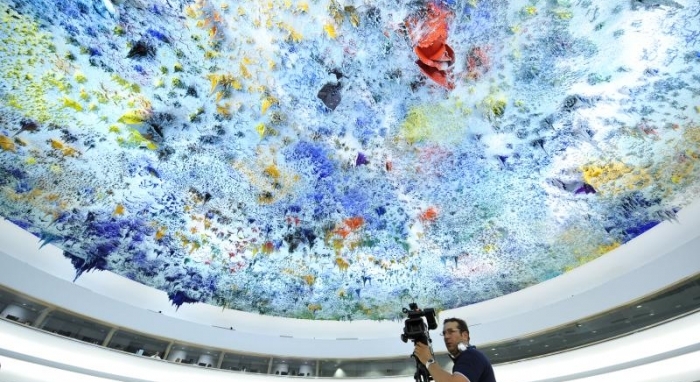
Room XX of the Human Rights Council

In two statements delivered to the 40th Session of the Human Rights Council, ISHR and Amnesty International reacted to the latest Joint Communications Report of the UN Special Procedures – independent human rights experts, appointed to monitor and report on human rights violations and to advise and assist in promoting and protecting rights. The report cites nine cases of reprisals against human rights defenders cooperating with the UN, and reveals that 95 states have not responded to letters from the UN experts concerning human rights violations.

There are two, related issues at stake here: (1) non-response to letters from the UN, and even worse (2) reprisals against human rights defenders who cooperate with the UN.

When I started my blog in 2010 (and one of the motivations) a main concern was the lack of response and enforcement [see https://humanrightsdefenders.blog/2011/03/20/taking-on-non-response-this-bloggers-lone-response/ and : https://www.linkedin.com/pulse/20140603192912-22083774–crime-should-not-pay-in-the-area-of-international-human-rights ].

As Helen Nolan of ISHR explains, 35 States have recently failed to respond to two or more of these letters. 13 of these nations are members of the Council. ‘Repeat offenders are a particular concern,’ says Nolan. India has failed to reply to a staggering 8 communications, Mexico 6, Italy 5, and Bangladesh and Nepal 4 each.’ Nolan emphasises that a failure to reply is a failure to cooperate, and welcomes the fact that the recently published report of the Annual Meeting of Special Procedures focuses on non-cooperation, including ‘more subtle forms’, such as selective cooperation with particular mandates. ‘To encourage cooperation, the Council must make non-cooperation more costly,’ says Nolan. ‘We urge the President of the Council to work closely with the Coordinating Committee of the Special Procedures to find ways to do this,‘ adds Nolan.

ISHR and Amnesty International’s second statement noted that under GA Resolution 60/251, Council members must ‘fully cooperate with the Council.’ Yet, the report cites nine cases of reprisals involving these members:

  • China sought to revoke the Society for Threatened Peoples’ ECOSOC status after vexatiously alleging that a person accredited by them, Dolkun Isa, participated in incitement and funding of separatism and terrorism, in retaliation for cooperation with the UN;
  • Egypt carried out forced evictions, and violations of the rights to physical integrity, liberty and security against individuals who cooperated with the Special Rapporteur on the right to adequate housing during her recent visit;
  • Iraq carried out unlawful arrest, enforced disappearance and torture against Imad Al Tamimi and intimidated and threatened Israa Al Dujaili for cooperating with the UN;
  • Libya arrested an individual in retaliation for taking steps to clarify the fate and whereabouts of his father, including with UN mechanisms;
  • The Philippines labeled defenders “terrorists” in reprisal for their engagement with the UN;
  • Russia surveilled, intimidated and harassed Yana Tannagasheva and her husband, for speaking out about impacts of coal mining on indigenous people in Siberia and in possible reprisal for their communication with UN mechanisms;
  • Turkmenistan carried out reprisals against a defender and her husband for her cooperation with the UN; and
  • In Yemen, forces loyal to President Hadi and the Saudi-led coalition detained human rights defenders Radhya Al-Mutawakel and Abdulrasheed Al-Faqih for cooperating with the UN.

‘We call on the President of the Council to request updates on the cases from Iraq, Libya, Russia, Turkmenistan and Yemen, as there has been no response from the States concerned,’ said Nolan. For an older post on reprisals, see: https://humanrightsdefenders.blog/2014/03/13/zero-tolerance-for-states-that-take-reprisals-against-hrds-lets-up-the-ante/

Full text of the first statement (on failure to reply) available here.

Full text of the second statement (on cases of reprisals) available here.

You can also watch the videos of the statements via the link below: