Posts Tagged ‘Cartooning for Peace’

African Cartoonists work under pressure

March 30, 2026
Cartoonists under pressure

Laurent Soucaille wrote on 2 March 2026 for the New African Magazine that “African press cartoonists are making greater use of social media. While this allows them to escape certain forms of censorship, they are still subject to threats.

These are difficult times for cartoonists and press caricaturists concludes a report published on 2 March 2026 under the authority of UNESCO and compiled by various press freedom organisations, including Cartooning for Peace and Reporters Without Borders. The report highlights violations of the right to caricature, even in countries that were previously considered ‘free’, foremost among them the United States. Of course, the most serious violations are found in the Middle East, Russia and China, not to mention the specific cases of Gaza and Ukraine. The situation has deteriorated particularly badly in Turkey and India, the authors lament.

In Africa, the situation is more mixed: a multitude of online media outlets have emerged in recent years, opening up new space for cartoonists, while opportunities are becoming scarcer in the traditional press. ‘In addition, many cartoonists have been able to use social media as a means of dissemination, notably by creating memes,’ notes Kenyan journalist Patrick Gathara, himself a cartoonist.

However, he acknowledges that over the past two years, the situation for African cartoonists has become tense, particularly in East and Southern Africa. In Kenya, in December 2024, the mysterious disappearance of Kibet Bull, who was released a month later, ‘marked a dangerous escalation in the state’s response to online reaction’. The case of the cartoonist, who was admittedly not very complimentary towards President William Ruto, ‘fits into a broader context of abductions targeting online influencers during a period of heightened political tension’.

Other cases are symptomatic, such as that of Jimmy Spire, known as ‘Ssentongo’, in Uganda. The cartoonist echoed a campaign denouncing the deterioration of public services in Kampala, attracting both the hostility of the authorities and the support of human rights defenders in his country and in the West. The cartoonist became both an influential civil society actor and a journalist vulnerable to pressure and threats.

The report also mentions Congolese cartoonist Kayene, who died in Rwanda in 2024. ‘His case highlights the precarious situation of cartoonists working across borders in a region where protection frameworks for artists at risk remain weak, informal and unreliable,’ comments Patrick Gathara.

In South Africa, legal and institutional pressures are the main threat. In a country where freedom of expression is protected, cartoonists are less exposed to violence but remain vulnerable to defamation lawsuits, political intimidation, editorial caution or ‘fabricated public outrage’.

This phenomenon affects many countries around the world, where the intended effect of cartoons aimed at a select readership is exaggerated and distorted on social media. ‘It takes a lot of determination to be a satirical cartoonist today. It’s no longer enough to have talent and ideas, you also need the energy to defend them and endure being insulted and vilified by thousands of internet users,’ says Riss, editor-in-chief of Charlie Hebdo, the French satirical weekly magazine.

With regard to North Africa, it is not surprising that the report expresses concern about threats to press freedom, and therefore to cartoonists, in Egypt. ‘Pre-trial detention is becoming a new weapon for the regime to silence those who inform and debate, through the abuse of anti-terrorism laws,’ the report states indignantly.

Across the continent, the document – which does not claim to be exhaustive – summarises three major trends that characterise a ‘rapidly changing’ landscape. First, cartoonists are increasingly seen as political actors. From Kenya to Nigeria to Zimbabwe, ‘the majority of political elites view visual satire as a form of mobilisation rather than commentary’.

As online youth movements organise, cartoons often become ‘symbols of rallying, making cartoonists early and visible targets of repression,’ the report summarises.

Secondly, it notes that ‘soft censorship’ is developing more rapidly than open violence; while kidnappings and threats persist, governments and institutions are increasingly turning to bureaucratic or reputation-damaging tools. These threats relate to accreditations, take the form of investigations by professional bodies, bans and suspensions of newspapers, defamation lawsuits and online smear campaigns. Not to mention very broad interpretations of laws relating to ‘insults’ or ‘cybercrime’. As a result, “these more discreet control mechanisms create a climate of fear and self-censorship while avoiding the scrutiny of the rest of the world, which is more sensitive to physical repression.

Thirdly, the report points out, digital platforms have both increased the reach and the risks. Most African cartoonists now publish mainly on social media. While this allows them to bypass traditional editorial filters, it also exposes them to direct state surveillance, harassment by bots and political control. In this context, ‘virality promotes influence, but also vulnerability’ for press cartoonists.

By publishing mainly on social media, African cartoonists bypass traditional editorial filters, but are nonetheless exposed to direct state surveillance, harassment by bots and political control.

For earlier posts re cartoonists see: https://humanrightsdefenders.blog/tag/cartoons/

Cartoons and human rights come together in Geneva

February 23, 2021

Kyra Dupont in Geneva Solutions of 23 February 2021 goes into the history that links Geneva and cartoons: “Drawings for peace, the role of Geneva” Geneva is said to be the cradle of comics thanks to Rodolphe Töpffer who was the first to put words on an illustrative sequence in the 1830s. Geneva has remained a vivid breeding ground for cartoons since then. (Credit: Patrick Chappatte) “Töpffer pioneered the genre, his work was a laboratory,” confirmed Zep at the opening of the exhibition, The comic strip, a Geneva invention? last November. The comic artist and creator of the bestselling Titeuf series discovered him at the age of 20 and admits that it is difficult to escape his influence for a cartoonist living in Geneva.

Since then, Switzerland remains the country with the most important press organizations’ ratio in the world compared to its population.

…..there is indeed a Geneva breeding ground for comic strips and press cartoons, two universes which cohabit in “a kinship never totally assumed, a bit like cousins from first-generation families with their own associations, their own interests, but both take part in this great wealth of talent and artists in a very small area with a very small population,” explains Patrick Chappatte, press cartoonist for Le Temps or the Boston Globe, among others. Indeed, political cartoonists are doing more than well in French-speaking Switzerland between Mix and Remix or Burki, which have now disappeared, but also Barrigues, Herman, Benedict, the new artists of the satirical newspaper Vigousse or the recent application La Torche 2.0 which develops press cartoons on smartphones.

Chappatte recalls that the press cartoons developed hand in hand with press freedom and democracy. Today we cannot imagine the front page of our newspapers without them.

“As luck would have it, today we are in a period where press cartoons are heckled and democracy is being questioned everywhere. We are living in a paradoxical era where we can say absolutely everything and send each other the worst things on social networks, and at the same time we bear a cautious attitude in the traditional media, companies under economic pressure, and exercise great caution in crisis management. On the one hand a precautionary principle is applied to humour and opinion, and on the other hand the real reactionaries are completely unleashed on social networks.”

The filtering of the media, the real professional entities, is what is most damaging to democracy and freedom of expression, according to the cartoonist who had to stop drawing for The New York Times when it decided to no longer publish daily political cartoons in its international edition in June 2019. “They took the easiest path in order to not have problems with political cartoons in the future… Did we just invent preventive censorship ? This, in the end, is about democracy,”  reacted Chappatte in his Ted talk, “A free world needs satire”.

Chappatte is the president of the Freedom Cartoonists Foundation. Renamed last October, the Geneva-based Cartooning for Peace Foundation was created in 2010 at the initiative of Kofi Annan See https://www.trueheroesfilms.org/thedigest/awards/EBEE0ECF-565B-6614-9B67-A6938EB46155. Every two years, with the support of the city of Geneva, the Freedom Cartoonists Foundation rewards a cartoonist for his courage and his role in promoting freedom of expression and human rights in particularly difficult circumstances. Note there is also the US-based Robert Russell Courage in Editorial Cartooning Award [https://www.trueheroesfilms.org/thedigest/awards/089b7a90-6c76-11e7-9ec2-2b88daf768c2]

This year, Chappatte was also awarded the Fondation pour Genève prize for his outstanding contribution to the influence of Geneva and his commitment to freedom of press and expression. “It’s quite a strong message at a time when press cartoons are being called into question,” says Chappatte, who regrets that the sanitary crisis has delayed the Freedom Cartoonists Foundation’s price to May 2021.

The extremists, the autocrats, the dictators and all the ideologues of the world cannot stand humour…We need political cartoons more than ever and we need humour.

For some earlier posts on cartoons see: https://humanrightsdefenders.blog/tag/cartoons/

Cartoonist Ramón Esono Ebalé freed in Equatorial Guinea

March 8, 2018
Good news is rare but deserves attention, especially when it seems to be the result of an international campaign: the global #FreeNseRamon coalition:
An Equatorial Guinean court on 7 March, 2018 released an artist imprisoned on dubious charges for nearly six months, 18 human rights groups including PEN America said today. The prosecution dropped all charges against Ramón Esono Ebalé, a cartoonist whose work is often critical of the government, after the police officer who had accused him of counterfeiting $1,800 of local currency admitted making the accusation based on orders from his superiors.  [Esono Ebalé, who lives outside of his native Equatorial Guinea, was arrested on 16 September, 2017, while visiting the country to request a new passport. Police interrogated him about drawings critical of the government, said two Spanish friends who were arrested and interrogated alongside him and were later released. But a news report broadcast on a government-owned television channel a few days after the arrest claimed that police had found 1 million Central African francs in the car Esono Ebalé was driving. On 7 December, he was formally accused of counterfeiting. The charge sheet alleged that a police officer, acting on a tip, had asked him to exchange large bills and received counterfeit notes in return.]“It is a huge relief that the prosecution dropped its charges against Ramon, but they should never have been pressed in the first place,” said Salil Tripathi, chair of PEN International’s Writers-in-Prison Committee. “We urge the authorities to guarantee his safe return to his family, allow him to continue creating his hard-hitting cartoons, and ensure that Equatorial Guinea respects the right to freedom of expression.”

Ramon’s release from prison is a testament of the power of collective work of hundreds of artists, concerned citizens, and NGOs,” said Tutu Alicante, director of EG Justice, which promotes human rights in Equatorial Guinea. “But we must not forget that dozens of government opponents who are not as fortunate fill Equatorial Guinea’s jails; thus, the fight against human rights violations and impunity must continue.”

(The human rights groups are Amnesty International, Arterial Network, Association of American Editorial Cartoonists, Asociación Profesional de Ilustradores de Madrid, Cartoonists Rights Network International, Cartooning for Peace, Committee to Protect Journalists, Caoilfhionn Gallagher QC, Jonathan Price and Paul Mason, Doughty Street Chambers, UK, EG Justice, FIDH, within the framework of the Observatory for the Protection of Human Rights Defenders, Freemuse, Human Rights Watch, Index on Censorship, PEN America, PEN International, Reporters without Borders, Swiss Foundation Cartooning for Peace, World Organisation Against Torture (OMCT), within the framework of the Observatory for the Protection of Human Rights Defenders.)

(see also: https://humanrightsdefenders.blog/tag/cartooning-for-peace-award/)

https://pen.org/press-release/equatorial-guinea-artist-freed-prison/

https://freedomnewspaper.com/2018/03/07/press-release-amnesty-international-equatorial-guinea-artist-freed-from-prison/


FIDH looks back at 2016 in comic strip

March 28, 2017

 looks back at 2016 in its traditional comic strip, done in cooperation with Cartooning for Peace.

To see it in a readable format go to: FIDH looks back at 2016 in our traditional comic strip


For last year’s cartoon: https://humanrightsdefenders.blog/2016/04/04/fidh-looks-back-at-2015-with-cartoons/

Cartoonists Gado (Kenya) and Zunar (Malaysia) get 2016 Cartooning for Peace Prize

May 4, 2016

evenement-prix-international-presse-0

Today – in order to celebrate the World Press Freedom Day on the 3rd of May – it was announced that the 2016 International Editorial Cartoons Prize is awarded to the Kenyan caricaturist, Gado, and the Malaysian cartoonist, Lunar. Some of their cartoons are shown below:

Gado and Zunar remind us how fragile this liberty remains in Africa and in Asia as well as in other regions of the world. Through their commitment towards open and transparent societies, Gado and Zunar, who have received threats in their countries of origin and can no longer practice their profession, confront us with our responsibility to preserve freedom of expression and act in order to support the combat of those who cannot express themselves through their art”, declared Mr Kofi Annan, he Honorary President of the Swiss Foundation.

The cartoonist Patrick Chappatte, jury member, added: “For having had the courage to draw the king naked, Gado and Zunar are faced with a power machine that seeks to silence them. What this Prize seeks to do is just the opposite: to amplify their voices, which are those of democracy and justice.

This prize, awarded every two years in Geneva, rewards a cartoonist for his/her courage, talent and commitment to the values of peace, tolerance as well as for his/her fight for freedom of expression. The event goes with an exhibition presented along the quai Wilson in Geneva until June 4th, 2016. For more information, click here!

For 2014 event see: https://thoolen.wordpress.com/2014/05/05/cartooning-for-peace-award-handed-over-by-kofi-annan-in-geneva/

For the biographies: Gado and Zunar.


  • Gado (Kenya)
     Gado (Kenya)
  • Gado (Kenya)
    Gado (Kenya)
  • Gado (Kenya)
    Gado (Kenya)
  • Gado (Kenya)
     Gado (Kenya)
  • Zunar (Malaysia)
     Zunar (Malaysia)
  • Zunar (Malaysia)
    Zunar (Malaysia)
  • Zunar (Malaysia)
     Zunar (Malaysia)
  • Zunar (Malaysia)
     Zunar (Malaysia)


Source: Cartoonists Gado (Kenya) and Zunar (Malaysia), recipients of the 2016 Cartooning for Peace Prize – Cartooning for Peace

FIDH looks back at 2015 with cartoons

April 4, 2016

For the second consecutive year, the FIDH has put some of its key actions and impacts in a comic strip. These cartoons have been created in partnership with the association Cartooning for Peace, founded by Plantu. [for more posts on Cartooning for Peace see: https://thoolen.wordpress.com/tag/cartooning-for-peace/]logo FIDH_seul

Source: FIDH looks back at 2015 in our traditional comic strip

see also: https://thoolen.wordpress.com/2014/02/10/fidh-tells-its-2013-story-in-cartoons-and-there-is-also-cartooning-for-peace/

Charlie Hebdo attack: intolerance extreme

January 8, 2015

What a way to start the human rights year: yesterday’s attack on Charlie Hebdo. One of the victims is Bernard VerlhacTignous” who was a member of the Cartooning for Peace Foundation. A good moment to recall the posts on the power of (political) cartoons: https://thoolen.wordpress.com/tag/cartooning-for-peace/, that their work may continue to inspire.

Cartooning for Peace award in Euronews video clip

May 23, 2014

This clip was produced by True Heroes Films (THF) for Euronews which covered the event of the 2nd international Cartooning for Peace award. [for more on the award see http://www.trueheroesfilms.org/thedigest/award/cartooning-peace-press-award].

The foundation “Cartooning for Peace” went to Syria-Palestinian Hani Abbas and Egyptian Doaa Eladl for their work. Former Secretary General Kofi Annan handed them the international award for press cartoonists in Geneva, as part of World Press Day. French cartoonist Plantu gave Euronews his views on the significance of using cartoons as a form of expression: “We’re trying to show the level of resistance that exists today, from the perspective of the very people that allow us to understand the word “resistance”, the cartoonists that ultimately become the foot soldiers of democracy. In other words, they’re railing against different powers, not just the power of their editors but also against political and religious power.” 

From Lake Geneva, euronews correspondent Wolfgang Spindler said: “Political cartoons can be subversive, provocative and amusing – they make us smile, they give us pause for thought. But we very often forget that the cartoonists behind them sometimes have to risk their lives daily for the sake of their work.”  via: http://www.euronews.com/2014/05/05/drawing-for-peace

The cartoon exhibition on the banks of Lake Geneva runs until the beginning of July and then moves to Sarajevo.

previous post: https://thoolen.wordpress.com/2014/05/04/cartooning-for-peace-international-award-and-exhibit-in-geneva-as-from-today/


Cartooning for Peace Award handed over by Kofi Annan in Geneva

May 5, 2014

3 May 2014 Cartooning for Peace award, Geneva (c) THF

3 May 2014 Cartooning for Peace award, Geneva (c) THF

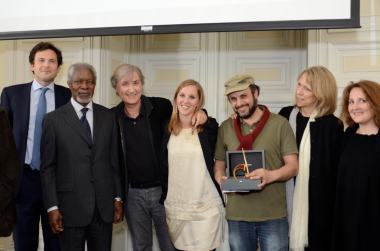
In case you noticed, my post of yesterday about the Cartooning for Peace Award came a day late; sorry. The award ceremony took place on Saturday 3 May, International Day for Press Freedom. To make up for the error here are the winners (Palestinian-Syrian Hani Abbasi, and Egyptian Doaa Eladl), in company of inter alia Kofi Annan and municipal councillor Guillaume Barazzone. The exhibit remains to be visited along the Quai Wilson in Geneva until 3 July 2014. Also present were the well-known cartoonists Chappatte, Plantu et Liza Donnelly. More information and links in my post of yesterday:

https://thoolen.wordpress.com/2014/05/04/cartooning-for-peace-international-award-and-exhibit-in-geneva-as-from-today/

Cartooning for Peace: international award and exhibit in Geneva as from today

May 4, 2014

affiche-geneve

Today, 3 May 2014, the Foundation Cartooning for Peace in Geneva hands out the 2nd International Prize for the best press cartoon (le Prix international du dessin de presse à Genève), followed by the exhibit  “La guerre dans tous ses états

This recent bi-annual award, given by Foundation in cooperation with the City of Geneva, will handed over by Kofi Annan, Honorary President of Cartooning for Peace. It rewards the creator for his or her courage, talent and engagement in favour of peace and human rights.

The work of the laureates form part of an exhibit of some hundred cartoons which are displayed in big format on the Quai Wilson for one month: from 3 May to 3 June.

Logo-Cartooning-for-Peace

via: Cartooning for Peace – Exposition « La Guerre dans tous ses états » Genève, Suisse.

the catalogue on line: Catalogue d’exposition en ligne