Posts Tagged ‘Business and human rights’

Davos’ annual meeting starts on 22 May under human rights cloud

May 22, 2022
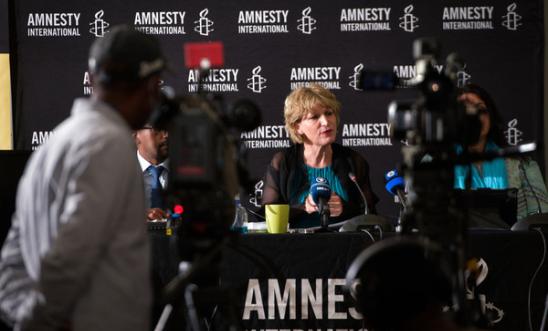
Agnès Callamard at a press conference

Agnès Callamard at a press conference © Amnesty International

Ahead of the World Economic Forum’s annual meeting in Davos that starts today, Sunday 22 May 2022, Agnès Callamard, Amnesty International’s Secretary General, said: 

This year’s Davos conference takes place amid a gathering storm of human rights crises. Russia’s mounting war crimes in Ukraine, the terrifying rollback on abortion rights in the US, the still-neglected climate emergency, the ongoing failure to secure universal vaccine access – these are just a few examples of what happens when human rights are sacrificed for power and profit.  

“Many of the political and business leaders attending Davos are directly responsible for these catastrophes, whether through their explicit pursuit of anti-human rights agendas or through their contemptible inaction and failure to implement solutions.  

“The Davos guestlist includes some of the richest and most powerful people in the world, and they have a moral obligation to put respect for human rights at the top of the agenda. They must use their vast wealth and influence to change the status quo and end the rampant inequality which has been the root cause of so much recent suffering.

The World Economic Forum’s annual meeting will take place in Davos, Switzerland, between 22 and 26 May.

https://www.amnesty.org.uk/press-releases/global-rich-and-powerful-meet-davos-amid-gathering-storm-human-rights-crises

SHIFT’s new Chair is former High Commissioner Zeid Ra’ad Al Hussein

May 20, 2022

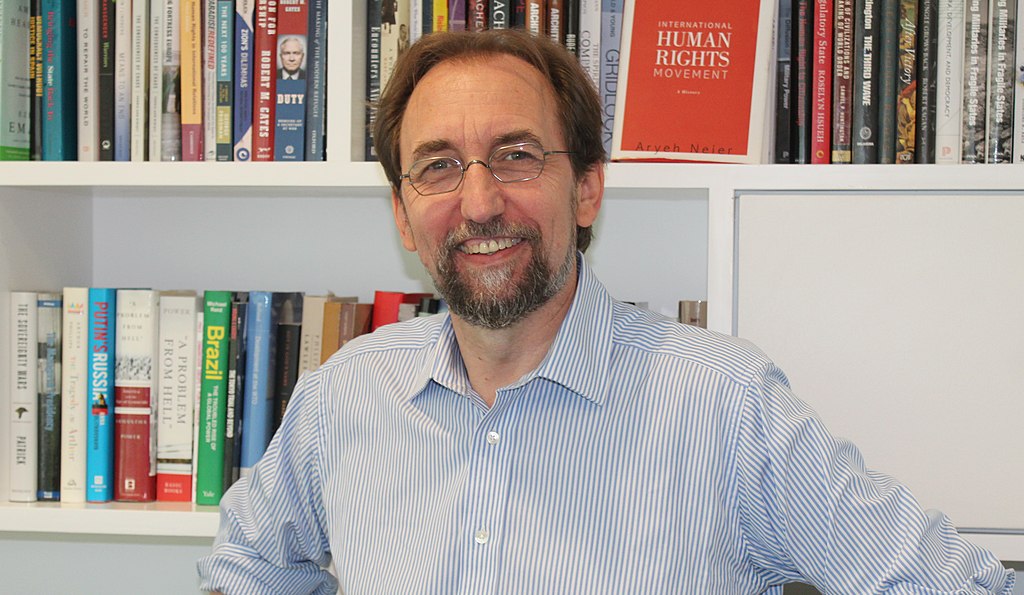
Shift, the centre of expertise on the UN Guiding Principles on Business and Human Rights, announced the appointment of HRH Prince Zeid Ra’ad Al Hussein as the new Chair of its Board of Trustees. He served as the United Nations High Commissioner for Human Rights from 2014-2018, as well as Jordan’s Permanent Representative to the UN, and as the first president of the International Criminal Court (ICC), among other leadership roles.

He is currently the CEO and President of the International Peace Institute and the Perry World House Professor of Practice of Law and Human Rights at the University of Pennsylvania Carey Law School. He is also a member of The Elders, an independent group of global leaders working together for peace, justice and human rights, first established by Nelson Mandela in 2007. He has been recognized globally and received 5 human rights awards, see: https://www.trueheroesfilms.org/thedigest/laureates/8ec8e85a-66ba-404c-b82e-720ebf044549]  

Prince Zeid succeeds Shift’s late founding Chair, Professor John Ruggie, author of the UN Guiding Principles on Business and Human Rights. [See also: https://humanrightsdefenders.blog/2021/09/28/in-memoriam-john-ruggie-father-of-business-and-human-rights/]

On taking up the role of Shift’s Chair, Prince Zeid said:  

The unanimous endorsement of the Guiding Principles in 2011 represented a watershed moment in changing the understanding of companies’ responsibility for the negative impacts that business activities can have on people. For a decade now, Shift has worked relentlessly to embed the ethos of the UNGPs in the way business gets done, with the focus where it must always be – on delivering better outcomes for the most vulnerable workers and communities. I am delighted to take up the role of Chair of Shift’s Trustees at a time when we see so much growth in the appetite and need for the organization’s work and leadership, not least as regulators, legislators, investors and financiers become more attuned to their own roles in incentivizing rights-respecting business practices, including as an essential component of a Just Transition to carbon neutral economies. I look forward to working with the Board and the management team to seize these growing opportunities to deliver on the promise of the UN Guiding Principles.”

For the past three years, Shift has worked closely with Prince Zeid in strategic partnerships to advise global sports bodies––including the International Olympic Committee and the Féderation Internationale de l’Automobile ––on their responsibility to respect human rights under the UN Guiding Principles.

Better “business and human rights” starts with better understanding

May 17, 2022

Andrés Zaragoza in Open Global Rights of 16 May 2022 hits the nail by arguing that “If we want to constructively engage companies, business associations or investors on human rights issues, we must recognize who our interlocutor is.

..Building trust and a common narrative to engage in a constructive conversation is extremely difficult. Some would argue that a trusting relationship between civil society and private companies is not only impossible but also not desirable; that good faith is nowhere to be found in business sectors where human rights abuses can and do take place.

It has already been 10 years since the adoption of the UN Guiding Principles on Business and Human Rights…..The enactment of legislation at the regional and national levels requiring companies to carry out human rights due diligence, such as the newly proposed EU Directive on Corporate Sustainability Due Diligence, as well as negotiations on a binding international treaty on business and human rights, creates a window of opportunity for NGOs to be creative, ambitious, and innovative in testing new advocacy strategies to change corporate conduct and advance human rights.

Despite an understandably dogged legacy of mistrust between civil society and corporations, there is a momentum for human rights organizations to engage productively with businesses, responsible investors, and other private actors that hold increasing market power, leverage, and are subject to new human rights legislation. As we write, global corporations are becoming increasingly relevant actors in international conflicts. In other words, businesses could become powerful allies in advancing human rights’ agendas with governments or in regards to public opinion.  

It’s no mystery that businesses and civil society speak different languages and engage from radically distinct perspectives when referring to human rights issues.

It is true that corporate activism is on the rise, with some companies supporting important causes and campaigns such as LGBTQ+ rights, anti-racism, equality, and non-discrimination. However, companies are not founded for promoting and protecting human rights, even if we may wish it otherwise. Instead, corporations see human rights issues through the lens of their productive and business models. This does not mean that workers or companies do not care about human rights. They do care, especially in certain sectors and business cultures. 

As civil society, we need to identify and understand how to best engage our strategic targets and audiences. If we want to constructively engage companies, business associations or investors on human rights issues, we must recognize who our interlocutor is. Businesses’ core activity is the starting point to analyse any human rights issue: their business, people, customers, and supply chain

Businesses tend to focus on risk identification and mitigation. There is growing recognition that human rights defenders can play a vital role in sounding the alarm on problems within an organization’s operations or supply chain. Generally, ‘UN speak’ does not work with businesses. Civil society should avoid jargon when engaging with business circles. Business representatives seek examples and clarity on which human rights issues are of concern and how they are relevant to their operations. See also: https://humanrightsdefenders.blog/2019/01/21/davos-businesses-need-strong-human-rights-defenders/

Civil society should not automatically feel good about the fact that a company has a person with “human rights” written in their title. Unfortunately, this often means that a position was created for compliance or reputational management purposes, to deal discreetly with human rights issues, or engage (read: manage) civil society relations. By contrast, companies that take human rights seriously embed the topic across functions and departments, working towards including human rights within the company’s ethos. 

To achieve change, civil society should make every effort to better understand the complexity of a particular company, its economic sector, activity, internal governance, corporate values, and culture. Each company has its own systems and structure, progressing through their human rights journey differently. 

On a micro level, the individual background, connections, and motivations of the human rights personnel within the company have great bearing on how issues are pushed through a company. At the systemic level, NGOs must understand the functioning of international business, economics, investment and trade.  

Lessons learnt and scars taken 

..Civil society should understand and use the market. As companies need to comply with human rights and sustainability regulations, NGOs and defenders can become key in risk assessment or due diligence processes, influencing directly the behavior of companies. We need to know the “enemy” and know ourselves. As civil society, we should build our technical capacity to understand and leverage international business, economics, investment and trade. We will not change business dynamics if we do not understand them.

See also: https://humanrightsdefenders.blog/2022/02/18/business-network-on-civic-freedoms-and-human-rights-defenders-launches-new-website/

https://www.openglobalrights.org/what-it-takes-to-bridge-the-divide-between-the-business-sector-and-human-rights/

Green economy and human rights defenders: Provide data, denounce attacks

April 21, 2022

On 21 April 2022 Christen Dobson, Ana Zbona and Andrea Pelliconi of the Business & Human Rights Resource Centre wrote a piece entitled: “Safe, legitimate engagement between firms, human rights defenders key to a just transition

..Human rights defenders are vital leaders of a just transition to green economies. They are on the front lines of the climate crisis – and they hold essential information on the risks and harms associated with business actions, which can be used by companies and investors to conduct effective environmental and human rights due diligence to create long-term value.

Yet, these defenders are under sustained attack. In 2021, there were at least 615 attacks against people raising concerns about business-related harms, with nearly 70 per cent of attacks against climate, land and environmental rights defenders. Since January 2015, we have documented more than 3,870 attacks globally, including killings, death threats, arbitrary detention and strategic lawsuits against public participation.

Indigenous peoples, who are at the forefront of protecting biodiversity and our shared planet, experience a disproportionately high level of attacks. Although they comprise approximately 5 per cent of the world’s population, they faced 18 per cent of attacks globally in 2021. [see also: https://humanrightsdefenders.blog/2021/09/13/global-witness-2020-the-worst-year-on-record-for-environmental-human-rights-defenders/]

One of the main drivers of this violence is the failure of companies and investors to engage in safe and legitimate consultation with rights-holders and defenders. This failure stands to derail the fast transition to a zero-carbon economy that we urgently need.

If companies and investors do not listen to people highlighting risks related to their operations, investments, supply chains, and business relationships, or if it is not safe to raise these concerns, they will lose out on critical information needed to mitigate harm and achieving a fast and fair energy transition, essential for averting the climate crisis. [see also: https://humanrightsdefenders.blog/2021/09/07/un-experts-urge-eu-to-take-the-lead-on-protecting-human-rights-defenders-in-context-of-business/]

Renewable energy firms guilty too

While companies and investors are increasingly making welcome and necessary commitments to climate action, including promises to achieve net zero by mid-century, many do not have policies expressing zero-tolerance against reprisals, nor do they assess risks to defenders or engage in consultation with them. See: https://humanrightsdefenders.blog/2022/04/07/clean-energy-will-not-automatically-be-good-for-indigenous-land-defenders/

That’s the case even in the sector most crucial to the transition: our 2021 Renewable Energy Benchmark, we found that of the 15 of the largest global renewable energy companies evaluated, all scored zero on their commitment to respect the rights of human rights and environmental defenders.

The urgently needed global transition to green economies will only be successful if it is sustainable and just. This means respecting the rights of the people at the forefront of protecting our earth and raising the alarm about harmful business practices.

We have seen this failure to secure consent from affected communities prior to starting development projects lead to horrific outcomes. On 30 December 2021, police officers in the Philippines raided an Indigenous village, killing nine leaders. Local groups said that those killed were targeted and red-tagged because of their opposition to the Jalaur Mega Dam construction. Indigenous groups had challenged the project for years saying it would destroy their ancestral domain.

Meanwhile, in Mexico, an Indigenous Zapotec community has been raising concerns about wind farm construction not respecting their rights to self-determination and free, prior, and informed consent. Leaders have faced stigmatisation and harassment. In October 2018, a federal court in Mexico delivered a historic ruling in favour of the community, ordering the Mexican authorities to carry out a consultation at a wind farm operated by a state-owned company based in Europe. In October 2020, the community filed a civil lawsuit in Paris against the company.

Engaging with rights-holders and defenders early on is one of the most effective ways of identifying actual and potential human rights and environmental impacts, while also reducing business risks. It is also their responsibility under the United Nations Guiding Principles on Business and Human Rights.

For human rights due diligence processes to be effective, companies and investors can start by making clear they will not tolerate any attacks to defenders related to their operations, value chains or investments, communicating this publicly and to their suppliers and business partners. Companies should also conduct due diligence across their entire value chains, as the biggest risks and harms to people and planet occur in the lower tiers…

Throughout the entire due diligence process, companies should engage in ongoing consultation with rights-holders and defenders, including prior to and at every stage of business activity, and integrate their input into decision-making.

Effective due diligence also involves conducting human rights and environmental impact assessments. The assessments should map potentially affected rights-holders and land and resource conflicts and by informed by rights-holders and defenders’ expertise

This is not just nice to do. Conducting safe and legitimate human rights and environmental due diligence benefits everyone and will ensure companies are more effectively achieving their climate commitments. As the UN Working Group on Business and Human Rights says, defenders need to be seen as key partners who can help businesses identify their human rights impacts, rather than being seen as obstacles to be disposed of.

The urgently needed global transition to green economies will only be successful if it is sustainable and just. This means respecting the rights of the people at the forefront of protecting our earth and raising the alarm about harmful business practices.

https://www.eco-business.com/opinion/safe-legitimate-engagement-between-firms-human-rights-defenders-key-to-a-just-transition/

Business Network on Civic Freedoms and Human Rights Defenders launches new website

February 18, 2022

The Network is now launching its official website, where details about activities, priorities and participants can be found and engagement is encouraged. 

The work of human rights defenders  (HRDs) and civil society is vital to peace, justice, fairness and sustainable development. It is also essential to promote transparency and combat corruption. Nonetheless, around the world, there is a concerted attack on the essential freedoms and the rule of law on which business and civil society depend. Both defenders and organisations who expose the risk of abuse by companies in their operations and supply chains are under particular attack.

Responsible businesses and investors need to both step up and lead by example as well as to speak and act decisively to protect open societies and the “shared civic space” in which both companies and civil society develop. Sustainable development cannot thrive in closed societies where cronyism and corruption prosper, and basic human rights are not respected.

But why, when and how should business engage on this urgent agenda? There is no easy answer and progress will only be achieved by motion and action. Created in 2016 with this goal in mind, the Business Network on Civic Freedoms and Human Rights Defenders is formed by a group of companies committed to identifying ways that businesses and society can benefit from increased support from the private sector for the protection of civic freedoms and human rights defenders. See also: https://humanrightsdefenders.blog/2019/01/21/davos-businesses-need-strong-human-rights-defenders/

The Network is now launching its official website, where details about activities, priorities and participants can be found and engagement is encouraged. 

The participating NGOs and defenders have been providing guidance for companies, which was compiled in the Shared Space Under Pressure Report on Business Support for Civic Freedoms and Human Rights Defenders, published by BHRRC and ISHR in 2018. Since then, at least 30 companies make references to human rights defenders in their internal policies. A good trend, but not enough in terms of numbers, implementation, and impact. Additionally, some of the members signalled their early commitment to this agenda through this public statement in support of civic freedoms, human rights defenders and the rule of law.

The Business Network on Civic Freedoms and Human Rights Defenders is coordinated by the Business & Human Rights Resource Centre, the International Service for Human Rights, and The B Team. Approximately 40 major multinationals currently participate in the Business Network. The Network works across sectors, which include businesses, civil society (NGOs, community representatives, union leaders and other front line human rights defenders), investors, international institutions and academia.

https://ishr.ch/latest-updates/business-human-rights-the-business-network-on-civic-freedoms-and-human-rights-defenders-launches-its-new-website/

2021 global data report from the CIVICUS Monitor

January 18, 2022

The new #PeoplePower2021 report shows where civil society conditions are improving and getting worse. A closer look at top violations & trends.

2021 global data report from the CIVICUS Monitor

  • 9 out of 10 people live in countries where civic freedoms are severely restricted 
  • Country downgrades include Poland, Singapore, Nicaragua, Jordan and South Africa
  • Detention of protesters is the top violation of civic freedoms in 2021
  • COVID-19 continues to be used as a pretext to restrict rights across the globe

The fundamental rights to freedom of expression, assembly and association continue to deteriorate year after year worldwide, according to a global report released by the CIVICUS Monitor, an online research platform that tracks fundamental freedoms in 197 countries and territories. The new report, People Power Under Attack 2021, shows that the number of people living in countries with significant restrictions on civic rights, including the freedoms of expression, association and peaceful assembly, amount to almost 89% of the population this year. See also: https://humanrightsdefenders.blog/2021/05/26/10th-edition-of-civicuss-state-of-civil-society-report-2021/

The CIVICUS Monitor data shows that year after year, there is significantly less space for people to exercise fundamental freedoms: only 3.1% of the world’s population lives in countries rated as ‘open’.

Nearly two billion people live in countries with the worst rating, ‘closed’, where the authorities are routinely allowed to imprison, injure and kill people for attempting to exercise their fundamental freedoms. China, Saudi Arabia, Turkmenistan and 21 other countries fall under this category – Nicaragua and Belarus joined their ranks this year. 

It is nearly two years since the start of the COVID-19 pandemic and the virus is having a dire impact on civic freedoms globally, one that will have lasting impact if remedial action is not taken. Our research shows the detention of protesters and the use of restrictive laws to muzzle dissent are becoming more prevalent, as governments use the pandemic to introduce or implement additional restrictions on civic freedoms. 

“Governments across the world are setting a very dangerous precedent by using the health emergency as a smokescreen to crack down on protests and enact or amend legislation that will further limit peoples’ rights. Specifically, disinformation legislation is being enacted and used to criminalise speech, a concerning practice that could become the new norm to crush dissent,” said Marianna Belalba Barreto, Civic Space Cluster Lead. 

This year, 13 countries have been downgraded and only one improved their rating.  The CIVICUS Monitor is particularly concerned about civic space restrictions in Europe, where four countries dropped a rating: Belarus, Belgium, Czech Republic, and Poland. Europe has the greatest number of ‘open’ countries, but year after year we continue to see signs of serious deterioration.

Also alarming is the deterioration of civic space conditions in Africa, where South Africa, Botswana, Mali and Mozambique all dropped ratings. In the Americas, Nicaragua joined Cuba in our worst category, ‘closed’. The Middle East and North Africa retained its status as the region with the worst civic rights record, with Jordan being downgraded to ‘repressed’. In Asia, Singapore also fell into the ‘repressed’ category, as a persistent clamp down on dissent and opposition voices continues. 

https://monitor.civicus.org/widgets/world

“What we are seeing is not a proportional reaction to a health emergency, where restrictions are meant to be extraordinary measures to deal with a crisis that is temporary. On the contrary, governments are using the pandemic as a pretext to further accelerate the crackdown on human rights that we have been documenting over the past years.” 

Although only one country – Mongolia – improved its rating in 2021, it is important to highlight the resilience of civil society. Governments have not been successful in silencing alternative voices or limiting their activism. Despite increasing restrictions, civil society has found ways to continue to speak up and claim their rights.  

Over twenty organisations collaborate on the CIVICUS Monitor, providing evidence and research that help us target countries where civic freedoms are at risk. The Monitor has posted more than 550 civic space updates in the last year, which are analysed in People Power Under Attack 2021. 

Civic freedoms in 197 countries and territories are categorised as either closed, repressed, obstructed, narrowed or open, based on a methodology that combines several data sources on the freedoms of association, peaceful assembly and expression.

As the climate crisis intensifies and the effects of the COVID-19 pandemic exacerbate social and economic inequalities, the efforts of civil society are fundamental to achieve tangible results and systematic change. However, a new report by CIVICUS shows how activists, human rights and environmental defenders face profound barriers: not only are governments and businesses failing to take urgent steps to mitigate the climate crisis; they are also actively trying to silence activists, disrupt and prevent climate actions and repress environmental, land and Indigenous rights defenders. In addition, companies play a crucial role in limiting human rights activism.

CIVICUS’ report highlights the role of companies across the world in perpetrating, contributing to, or allegedly benefiting from attacks on human rights defenders and rights groups, including: Feronia PHCFormosa Plastics GroupSOCFINNewmont Mining CompanyXiang Lin SI LtdGreat Season LtdChevron EnergySomkhele and Tendele Coal Mining, PanAust, Oxec, OCP Ecuador and Petroecuador, SG Interests, Celtejo, Mineral Commodities (Ltd) (MRC) and Mineral Sands Resources, PetroTal, Enbridge, Lydian Armenia, andthe RWE Group. The report also highlights positive developments from Chevron and the Mizuho Financial Group.

The Business and Human Rights Resource Centre (BHRRC) had already asked most of these companies to respond to the allegations included in the report, previously. Responses can be found in the companies’ dashboard. BHRRC asked RWE Group to respond to the allegations; RWE’s response is included below.

https://www.civicus.org/index.php/media-resources/reports-publications

https://www.business-humanrights.org/en/latest-news/civicus-report-highlights-role-of-companies-in-attacks-on-human-rights-defenders-amid-increasing-restrictions-on-civil-society/
AFREWATCH wins Business and Human Rights Award 2021

December 14, 2021

At the United Nations Forum on Business and Human Rights, the 2021 award recipient was announced: AFREWATCH — a small, courageous organization headquartered in Democratic Republic of Congo that focuses on the human rights and environmental impacts of extractive companies in Africa.

Here a 3-minute video announcing the award: https://www.humanrightsandbusinessaward.org/announcement-2021-recipient-of-the-human-rights-and-business-award/. The video features two Advisory Network members announcing the award (Abiodun Baiyewu and Seema Joshi), followed by the Executive Director of AFREWATCH (Emmanuel Umpula) accepting the award.

AFREWATCH researches and reports on abuses by mining and oil companies and by governments; engages with government officials to advocate for improvements in law and practice; presses for extractive companies to pay their fair share of taxes, and helps grassroots community organizations build their capacity.  

For more on this award and its laureates, see: https://www.trueheroesfilms.org/thedigest/awards/fd511ca0-10f0-11ea-8f61-d1d879c27588

https://www.humanrightsandbusinessaward.org/award-recipient/afrewatch/

Norway’s Telenor in Myanmar should do more than pull out – it should not hand sensitive data to the regime

October 26, 2021

The Norwegian firm took a principled stance to Myanmar’s coup. The same can’t be said for its exit from the country, writes Aung Myo Min, Minister of Human Rights in Myanmar’s National Unity Government., on 25 October 2021.

Praising Norway as a global leader when it comes to protecting human rights defenders and Telenor for acting in principled ways following the attempted coup by pushing back against the military junta’s illegal directives, the author is perplexed that in July, “after considering all possible alternatives and events,” Norway’s largely state-owned telecoms provider agreed to sell its Myanmar operations to the Lebanese firm M1 Group. According to the Centre for Research on Multinational Corporations (SOMO), M1 is “infamous for its business activities in countries with violent totalitarian and extremist regimes.” In 2012, telco MTN Syria, a subsidiary of MTN in which M1 is the major shareholder, undermined protest leaders by blocking text messages at the behest of the Bashir al-Assad regime. In 2013, MTN installed “lawful surveillance equipment” for its mobile network in South Sudan during a crackdown on government critics by state security forces.

It is to be feared that M1 group will hand over user details of some 18.2 million Telenor users to the military junta, placing human rights defenders even more clearly in the crosshairs.

Telenor has operated in Myanmar since 2014, a decision that back then, according to the Group, was informed by “a thorough human rights impact assessment as part of the due diligence.” The Norwegian Government holds a 53 percent stake in Telenor.s.

The Centre for Research on Multinational Corporations, in coordination with 474 Myanmar civil society organizations, has lodged a complaint against the sale with the Norwegian National Contact Point (NCP) for the OECD Guidelines for Multinational Enterprises and, after an initial assessment, the watchdog found merit in the claim. Mediation may well follow. This offers Telenor and the Norwegian government an opportunity to salvage something significantly more valuable than telecoms assets and investments: their reputations.

Telenor says that its decision to sell “was not motivated by financial or strategic objectives,” but guided by its “commitment to its values and standards.” This commitment requires scrutiny. The potential sale of Telenor requires assessment of any adverse human rights impact and prevention or mitigation where they present.

https://thediplomat.com/2021/10/telenor-in-myanmar-norways-human-rights-reputation-is-on-the-line/

FIDH launches “SEE YOU IN COURT” campaign

September 29, 2021

The disastrous impact that multinationals have on the environment can no longer be denied. The human right to live in a healthy environment concerns us all, therefore, FIDH and its member organisations are launching coordinated legal actions across the world. The companies implicated and States which allow it to happen must be held accountable.

The first legal actions

It is time to recognize the right to a healthy environment as a fundamental human right and to hold companies accountable for their actions.

  • Environmental impact = human impact Because human rights and the environment are interdependent, it is crucial that States recognise the right to a healthy environment as a fundamental human right. Hundreds of organisations are fighting for a UN resolution to achieve international recognition of this.
  • Restoring a healthy environment to affected communities In the face of environmental disasters and human rights violations, the balance is still too often tipped in favour of the companies involved. Ensuring access to justice for those most affected and passing laws which hold multinationals accountable are also means to protect the planet.

https://seeyouincourt.fidh.org/?lang=en#

In memoriam John Ruggie, father of “Business and Human Rights”

September 28, 2021

On 22 September 2021, Harvard announced the death of Professor John Gerard Ruggie, last week.

A post by Gerald L. Neuman describes him as a major figure in international relations and human rights. Ruggie was the Berthold Beitz Professor in Human Rights and International Affairs at Harvard’s Kennedy School of Government.  In the human rights field he is most famous for establishing a viable foundation for addressing the human rights responsibilities of business corporations, the UN Guiding Principles on Business and Human Rights (2011).  A brilliant strategist, Ruggie engaged in extensive consultation, study, analysis and persuasion to rescue the business-and-human-rights project from the polarized confrontation that had brought it to an impasse.  His invaluable book Just Business:  Multinational Corporations and Human Rights (2013) provides a model for the multi-dimensional negotiations that enable such achievements. John’s unique blend of kindness, rigour, insight, and attentive listening will be sorely missed.

Photo of John G. Ruggie sitting in his office.
John G. Ruggie is the Berthold Beitz Professor in Human Rights and International Affairs. Rose Lincoln/Harvard Staff Photographer

see also: https://humanrightsdefenders.blog/2014/07/11/more-on-un-process-toward-contentious-treaty-on-business-and-human-rights/