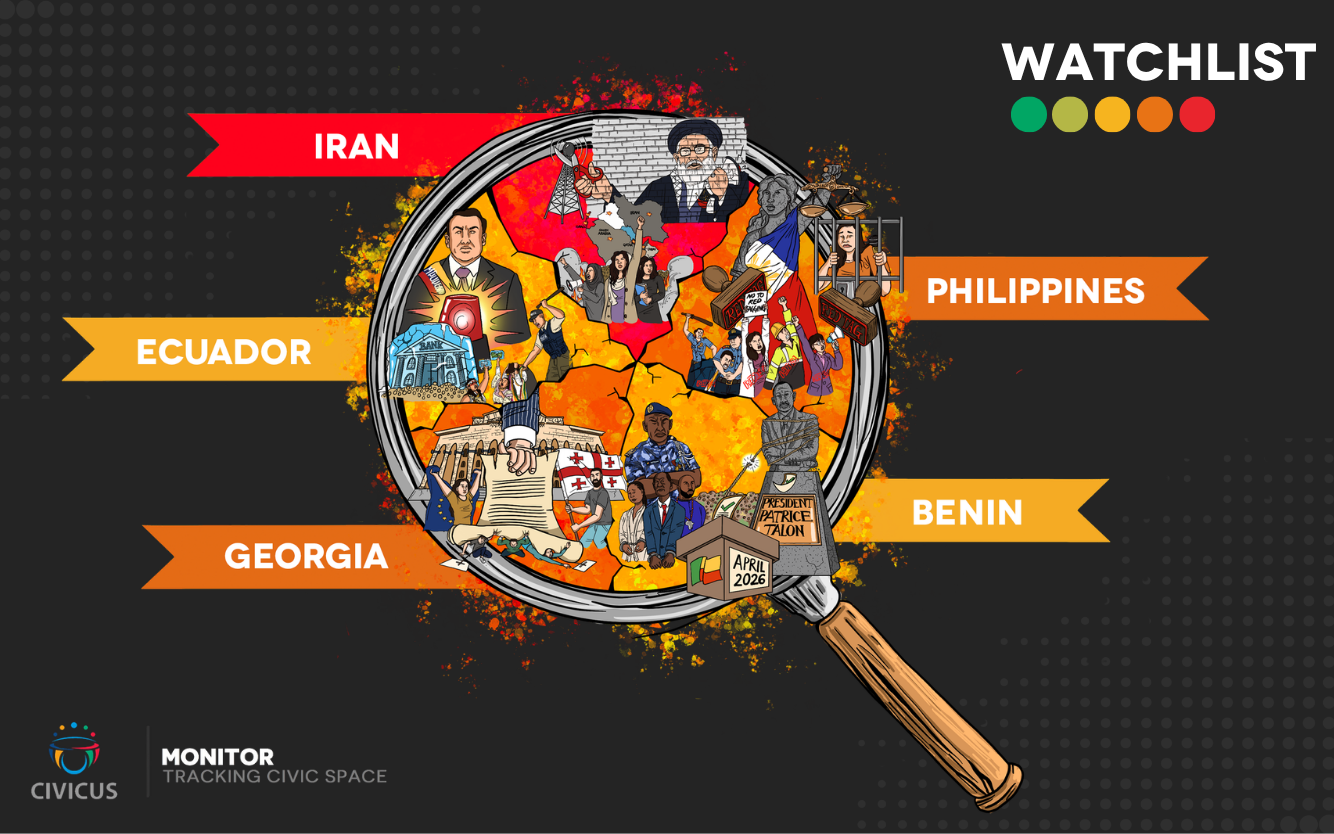
The March 2026 Watchlist from the CIVICUS Monitor highlights five countries where civic freedoms are deteriorating at an alarming pace: Ecuador, Georgia, Iran, the Philippines and Benin. Each faces escalating restrictions on fundamental rights, including freedoms of expression, association and peaceful assembly. The Watchlist draws on research findings, partner input and testimony from activists on the ground, and signals where urgent international attention is needed.
CIVICUS MONITOR CIVIC SPACE RATINGS:
OPEN
NARROWED
OBSTRUCTED
REPRESSED
CLOSED
Ecuador Civic space rating:Obstructed Ecuador’s government has increasingly relied on militarised security measures, invoking an “internal armed conflict” to justify exceptional powers. Indigenous-led protests in 2025 were met with lethal force, arbitrary detentions and internet disruptions. Environmental and Indigenous leaders face criminalisation, with more than 200 social leaders investigated or prosecuted. A 2025 law has expanded state control over civil society organisations, enabling account freezes and burdensome reporting. Journalists face killings, attacks and suspensions of media outlets, all unfolding amid a broader erosion of judicial independence.
Georgia Civic space rating:Repressed Georgia has seen a dramatic decline in civic space, marked by mass protests since late 2024 and heavy-handed police responses. Hundreds have been detained, tortured or investigated. New laws restrict protests, impose “foreign agent” requirements on civil society and media, and threaten criminal penalties for receiving foreign funding. Opposition parties and leaders face politically motivated charges, and new rules bar many civil society actors from political participation for years.
Iran Civic space rating: Closed Iran’s civic space, already severely restricted, has worsened following mass protests over economic and political grievances. Security forces killed thousands of protesters in January 2026 during a nationwide internet blackout, and tens of thousands were arrested. After regional airstrikes in February 2026, authorities imposed another shutdown and intensified censorship. Journalists and activists face extreme risk, and some detainees now face the death penalty. Despite repression, demonstrations continue following the death of the Supreme Leader.
The Philippines Civic space rating:Repressed Civic space in the Philippines remains under pressure, with police violence and mass arrests during anti-corruption protests in 2025. Dozens of protesters face sedition charges under cybercrime laws. Human rights defenders are frequently targeted, including through fabricated terrorism-financing cases. Red-tagging—accusing critics of communist links—remains widespread. Journalists also face prosecution, including the conviction of reporter Frenchie Mae Cumpio after years of pre-trial detention.
Benin Civic space rating:Obstructed Benin approaches its April 2026 presidential election with shrinking democratic space. Strict electoral rules have limited the field to two approved candidates, and the January 2026 legislative elections produced a parliament without opposition representation. Authorities increasingly use the Digital Code to prosecute journalists and critics, while media outlets face suspensions and mandatory government messaging. Protests are routinely banned or dispersed, and fear of reprisals has led to widespread self-censorship.
Laureates from each of the major global regions (or their representatives) traveled to Ireland to accept the Award, including:
Africa: Luc Agblakou of Hirondelle Club International (Benin)
Americas: The Movement for Human Rights, Peace and Global Justice (MONDHA) (Dominican Republic / Haiti)
Asia and the Pacific: Arnon Nampa of Thai Lawyers for Human Rights (Thailand)
Europe and Central Asia: Sharifa Madrakhimova (Uzbekistan)
Middle East and North Africa: Mhamed Hali (Western Sahara)
“In a world that has become harsher for human rights defenders, these five courageous individuals and organisations face tremendous risks while carrying out their peaceful work to uphold the rights of their communities,” said Alan Glasgow, Executive Director of Front Line Defenders.
“These laureates are rays of light in some very dark situations of repression, discrimination and detention. Their steadfast commitment to human rights provides the solutions we need to brink humanity back from the brink, and to create a better, more just world. Governments must begin to see human rights defenders, not as a threat to their grasp on power, but as positive changemakers who can improve societies and defend the human rights of their citizens.”
This year’s laureates were selected from among hundreds of candidates put forward in a secure, public nomination process carried out between November 2024 and January 2025. In addition to a cash prize aimed at bolstering their protection, the winners receive support from Front Line Defenders on digital and physical security, advocacy, visibility, wellbeing and more.
The 2025 Front Line Defenders Award winners are:
Africa
Luc Agblakou is a human rights educator and defender for LGBTIQ+ rights in Benin. He is the Founding President of Hirondelle Club International, the first LGBTIQ+ organisation promoting integration in the country. His work has led to the inclusion of LGBTIQ+ people in the strategic plan to combat HIV/AIDS in Benin as well as court rulings promoting the protection of the LGBTIQ+ community.
Americas
The Movement for Human Rights, Peace and Global Justice (MONDHA), representing the Dominican Republic and Haiti, is a non-governmental organisation (NGO) founded in 2005 with the aim of improving the living conditions of vulnerable communities, with a particular focus on women and young people in these communities. MONDHA’s work is particularly strong in support of people of Haitian descent. To achieve this goal, they implement human development programmes related to community health, legal aid, human rights and education for communities and people of Haitian descent.
Asia and the Pacific
Arnon Nampa is a human rights lawyer who volunteers with Thai Lawyers for Human Rights. TLHR was established in 2014 to provide legal assistance to alleged violators of lèse-majesté (insulting the monarchy) and HRDs targeted by the authorities following the military coup of 22 May 2014. Arnon Nampa has defended numerous individuals accused of lèse-majesté under Article 112 of the Criminal Code, including the cases of several jailed HRDs.
Mhamed Hali from Western Sahara is a dedicated human rights defender and a member of the Sahrawi Association of Victims of Grave Human Rights Violations committed by the Moroccan State (ASVDH). He holds a doctorate in international humanitarian law, and currently serves as the Secretary General of the Association for the Protection of Sahrawi Prisoners in Moroccan Prisons (LPPS).
Germany and France honoured this year 15 people who have made outstanding contributions to the protection of human rights, campaigning for causes including women’s rights in Afghanistan, the freedom of the press in South Africa and children who are born as a result of rape in wartime.
On 10 December, international Human Rights Day, Foreign Minister Annalena Baerbock and French Foreign Minister Jean‑Yves Le Drian presented fifteen people with the Franco-German Prize for Human Rights. This award recognises the efforts of all those who work tirelessly every day to advance the causes of human rights and the rule of law. It is presented decentralised by the French and German missions in various locations around the world.
Jake Epelle who works to combat the ongoing stigmatisation and discrimination faced by people with albinism in Nigeria.
Noelah Godfrey Msuya who promotes the rights of children and women in Tanzania.
Monika Borgmann who is a German-Lebanese documentary-maker.
Jacques Letang who is a judge and lawyer in Haiti.
Cristina Palabay from the Philippines who leads the national association Karapatan.
Alexandrine Victoire Saizonou who is an advocate for women’s and children’s rights in Benin.
Ajna Jusic from Bosnia discovered at the age of 15 that she was born as a result of rape during wartime, and since then she has advocated for others in the same situation.
Erika Lorena Aifán Dávila is a judge who has been the target of constant attacks from the authorities of Guatemala.
Nebahat Akkoc is the Managing Director of the NGO Kamer in Turkey.
The Venezuelan Education-Action Program on Human Rights or PROVEA.
Narges Mohammadi who is spokesperson and vice chairman of the Iranian organisation Defenders of Human Rights Center.
May Sabai Phyu is a Kachin activist from Myanmar/Burma.
Shaharzad Akbar is an Afghan human rights defender who campaigns in particular for the rights of women in Afghanistan.
Tabelo Timse is an investigative journalist and a member of an independent non‑profit media centre in South Africa.
There is a list – updated monthly – by the One Free Press Coalition of nearly 40 news organizations, which identifies the 10 most urgent cases threatening press freedom around the world. Understanding the COVID-19 requires unbiased journalists, whose work requires protection. Not only does the act of informing the public carry risk to one’s own health but, in many countries, risk of retaliation. In China, freelance video journalist Chen Quishi disappeared on February 6 after informing family of plans to report on a temporary hospital in Wuhan, where the virus originated. Beijing has since expelled journalists from outlets including The Wall Street Journal, The New York Times and The Washington Post and demanded personnel information from Voice of America and TIME. Mohammad Mosaed, a reporter in Iran who criticized the government’s response to the pandemic, has been barred from practicing journalism and suspended from social media. Family members of imprisoned Egyptian journalist Alaa Abdelfattah were detained for protesting on behalf of prisoners who are vulnerable to the spread of the virus. An Azerbaijani journalist freed in mid-March described detention conditions allowing one shower per week, without soap, he told CPJ
Journalist, who warned about pandemic, banned from work and social media.
Freelance economic reporter Mohammad Mosaed awaits a court date, after intelligence agents of the Islamic Revolutionary Guard Corps (IRGC) arrested and interrogated him in February regarding social media accounts critical of government. The criticism included lack of preparedness to tackle the coronavirus outbreak. Until trial, authorities bar him from practicing journalism and suspended his social media accounts. Last year he endured 16 days in Evin prison for his tweets and was released on bail.
Editor facing potential detention, arrested again March 28.
Rappler editor Maria Ressa is scheduled for trial April 24, expecting a verdict on a cyber-libel charge brought by local businessman Wilfredo Keng regarding a May 2012 story. The relevant law took effect four months after the story in question was published. Depending how judges interpret the 2012 Cybercrime Prevention Act, Ressa could face six years in prison.
Family of jailed journalist protests prisons’ inaction to prevent COVID-19 threat.
While blogger Alaa Abdelfattah is held in Cairo’s Tora Prison, three of his family members face charges of unlawful protest, illegal assembly and obstructing traffic in their call to protect prisoners from the spread of coronavirus. They were released on bail exceeding $300 apiece. After reporting about politics and human rights violations, Abdelfattah has endured threats and been told he will never go free if he speaks of guards’ abuse.
Journalist covering coronavirus disappeared more than six weeks ago.
Freelance video journalist Chen Quishi has not been seen since February 6, when he informed family of plans to report on a temporary hospital. In late January, he had traveled from Beijing to the city of Wuhan in Hubei province and began filming and reporting on the coronavirus health crisis, according to his posts on YouTube. Friends running his Twitter account believe he is likely held in residential surveillance.
Journalist fears for her life, amid government-orchestrated threats.
After 19 years of persecution and legal censorship, award-winning journalist Claudia Julieta Duque told IWMF that she learned on February 29 about an ongoing criminal threat against her life. According to Duque, agents of the state institution in charge of protecting human rights defenders and at-risk journalists, called the National Protection Unit (UNP), were reportedly ordered to carry out intelligence activities to infiltrate Duque’s security scheme and threaten her welfare.
Imprisoned publisher undertook hunger strike while awaiting appeal.
No date has been set, following postponement of a March 12 appeal in the case of Martin Inoua Doulguet, publisher of Salam Info. He was found guilty on criminal charges of defamation and conspiracy in September, and sentenced to three years in prison. The privately owned quarterly newspaper reports on crime and politics in Chad, and Doulguet’s penalty includes a $1,675 fine and paying part of $33,514 in plaintiff damages.
Journalist serving life sentence prepares for final appeal.
On April 6, a Kyrgyz court is scheduled to hear the final appeal in the case of award-winning journalist Azimjon Askarov. The ethnic Uzbek, who reported on human rights, has spent more than nine years imprisoned on trumped-up charges that included incitement to ethnic hatred and complicity in the murder of a police officer. The decade-long case has drawn persistent international condemnation, and Kyrgyzstan’s only imprisoned journalist’s health deteriorates.
Cuban journalist Roberto Jesús Quiñones has spent more than six months behind bars, experiencing worsening treatment. Staff listen to all of his phone calls, have served him food containing worms, and upon learning of his secretly publishing from prison, suspended family visits and put him in solitary confinement. A municipal court in Guantánamo sentenced him to serve one year as a result of “resistance” and “disobedience” when police beat and detained him for covering a trial as a CubaNet contributor last April and his refusal to pay a fine imposed on him following this incident.
Reporter experiences repeated retaliation for his work.
On two different occasions last year, Benin courts delivered prison sentences to Ignace Sossou, a reporter for privately owned site Web TV. First was a one-month imprisonment and fine of $850 for publishing “false information” about local business dealings. Then an 18-month sentence and fine of $337 for defamation and disinformation in his reporting public statements made by Public Prosecutor Mario Mètonou.
Turkish and U.S. leaders continue pressuring for murdered journalist’s justice.
On March 25 Turkish officials indicted 20 Saudi nationals in the ongoing pursuit for answers surrounding Jamal Khashoggi’s brazen killing in Istanbul in 2018 and the Saudi crown prince’s role. That follows a March 3 news conference with U.S. Senator Ron Wyden, Representative Tom Malinowsk, and The Washington Post columnist’s fiancé, Hatice Cengiz, announcing that they are invoking procedures within the Senate Intelligence Committee to provide a congressional release of information from intelligence agencies.
Every year, the Amnesty International Ambassador of Conscience Award celebrates individuals and groups who speak out for justice. The 2016, award will be shared between world-renowned musician Angélique Kidjofrom Benin and three African youth activist groups: Y’en a marre from Senegal, Le Balai Citoyen from Burkina Faso and LUCHA from the Democratic Republic of Congo (DRC).
Angélique Kidjo. Credit: Pierre Marie Ziimmerman.
Grammy-winning artist Kidjo fled her homeland Benin in the 1980s after being pressured to perform for the country’s repressive regime. In a 40-year-career spawning 12 albums, she has been a prominent campaigner for freedom of expression and for the education of girls in Africa, as well as against female genital mutilation.
In the series “10 December, 10 Defenders” [https://thoolen.wordpress.com/2015/12/01/10-december-10-defenders-profiles-of-human-rights-defenders-against-torture/]the OMCT publishes today the case of “Benin: Meet Norbert: Better protecting children to break Benin’s cycle of violence“. “Violence is the first inheritance of a child born within a violent family,” says Norbert Fanou-Ako. As director of a non-governmental organization called Solidarity for Children in Africa and the World (ESAM) he is trying to break Benin’s vicious cycle of violence. The violence deeply engrained in this country starts at home and in school with commonplace whipping, caning, slapping and other uses of ill-treatment against children and then extends to regular beatings to force confessions out of suspected juvenile delinquents at police stations. Read the rest of this entry »
 Angélique Kidjo. Credit: Pierre Marie Ziimmerman.
 Hans Thoolen on Human Rights Defenders and their awards