Posts Tagged ‘Amnesty International’

Mary Robinson and the case of the Arab Princess

February 16, 2021

There’s a saying in show business that you can spend 20 years becoming an overnight star. In politics, the same is true in reverse, as the sad case of Mary Robinson and Princess Latifa of Dubai shows. Mary Robinson as former UN High Commissioner for Human Rights and a widely-honored human rights defender [with 9 awards to her name, see: https://www.trueheroesfilms.org/thedigest/laureates/4E44A265-DF1A-45E2-8C6A-3294577EA211] was a much admired personality. For that reason I was reluctant to highlight her role in the sad case back in December 2018, although many human rights NGOs (including AI and HRW) did criticise her.

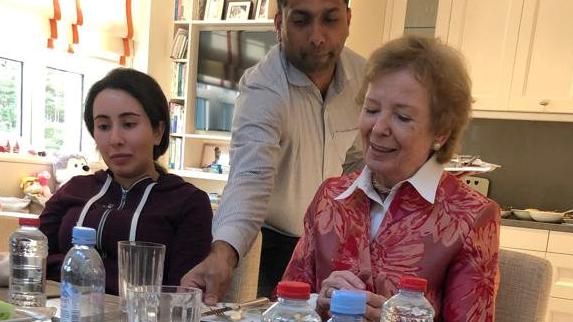
The former UN human rights Commissioner has been criticised for describing the daughter of Dubai’s ruler as “troubled” after she was reportedly forcibly returned to the kingdom after fleeing months earlier. Mary Robinson met with Sheikha Latifa on 15 December and photos released showed the two women smiling together in what appears to be a home. Ms Robinson, the former president of Ireland, told BBC’s Radio 4 the princess was a “vulnerable” woman with a “serious medical situation” for which she was receiving psychiatric care.

Immediately the highly publicised and bizarre meeting in December was panned by rights groups for being stage-managed by the Emirati ruling family (Ms Robinson is a personal friend of Sheikha Haya, a wife of the Dubai ruler.) Defending her comments, Ms Robinson released a statement saying: “I am dismayed at some of the media comments on my visit and I would like to say I undertook the visit and made an assessment, not a judgement, based on personal witness, in good faith and to the best of my ability.”

Toby Cadman, a barrister instructed by Detained in Dubai to act on behalf of the princess, told Review: “I am extremely disappointed that she would lend herself to what has been interpreted as a whitewash. We have requested an independent assessment of [Princess Latifa’s] state of mind and her physical well-being. It’s up to the United Nations to be satisfied that she is not being detained against her will.” Then in January 2019 Mrs Robinson stated that she contacted Michelle Bachelet, UN high commissioner for human rights. On 18/02/2019 Former Irish president Mary Robinson said she has no regrets over getting involved in the case of a Dubai princess who had tried to flee the UAE.

Exactly one year on from Latifa’s dramatic capture at sea, rights groups told The Independent they were deeply concerned about her welfare and still had no knowledge of what happened to her between her March 2018 capture and December when she reappeared in Dubai. Pleas to the UAE for an independent delegation to be granted access to the royal to assess her, have gone unanswered. “Human Rights Watch is still calling for her to be able to travel to a third country where we and other monitors can be assured she is able to speak freely and independently without fear of retaliation,” Hiba Zayadin of HRW told The Independent.Ms Robinson is not equipped to make an evaluation of Latifa, who was in the presence of people who allegedly forcibly disappeared her,” she added.

Amnesty International put out a similar call. “There has been no reply from the UAE, which has never responded to anything regarding domestic human-rights abuses that Amnesty International has attempted to raise with them,” said Amnesty’s Devin Kenney.

Now, 16 February 2021, after new footage was shared by BBC Panorama, in which the 35-year-old daughter of the ruler of Dubai has confirmed that commandos drugged her as she tried to flee by boat and flew her back to detention and accused her father, Sheikh Mohammed bin Rashid Al Maktoum, of holding her “hostage”, Mrs Robinson has stated that she feels “horribly tricked” by the family of Princess Latifa Al Maktoum, and has joined in calls for immediate international action in order to establish Princess Latifa’s current condition and whereabouts

Fortunately some of the worst rumours turn out not to be true e.g.that  Sheikha Latifa was killed during early 2019 through extreme physical torture by the female maids inside the palace.[https://www.weeklyblitz.net/news/fraud-racket-plays-new-trick-centering-a-murdered-princess/].

Robinson is rightly revered for her life’s work, and that work is not invalidated by her unacceptable interference in the case of Princess Latifa. But her reputation has been tarnished by this.

And on 25 February followed this https://www.theguardian.com/world/2021/feb/25/princess-latifa-letter-uk-police-investigate-sister-shamsa-cambridge-abduction

For those interested in the many articles about his case:
https://www.thetimes.co.uk/edition/ireland/dubai-paid-for-robinson-to-visit-runaway-princess-c3gnrv8cj
https://www.irishcentral.com/news/politics/former-irish-president-defends-decision-to-meet-princess-allegedly-detained-against-will
https://www.independent.ie/irish-news/the-mysterious-story-of-princess-latifa-her-reported-escape-from-dubai-and-her-meeting-with-mary-robinson-37679044.html
https://www.breakingnews.ie/ireland/mary-robinson-visit-to-dubai-a-private-family-matter-says-princess-haya-895790.html
https://www.thetimes.co.uk/article/robinson-writes-to-un-human-rights-chief-wp2z8vc9j
http://www.midwestradio.ie/index.php/news/28421-mary-robinson-s-address-to-ireland-s-diplomats-today-will-take-place-behind-closed-doors
https://www.wsj.com/articles/mrs-robinson-and-the-missing-princess-11547078838
https://www.independent.co.uk/voices/mary-robinson-dubai-princess-latifa-escape-uae-sheikh-mohammed-haya-a8717081.html
https://www.dailymail.co.uk/news/article-6586191/UAE-swaps-British-arms-consultant-centre-bribery-scandal-Dubai-princess.html was there a swap? https://scroll.in/latest/909621/christian-michels-family-to-move-un-after-claims-that-he-was-extradited-in-swap-for-dubai-princess
https://www.middleeasteye.net/news/mary-robinson-cancels-appearance-dubai-festival-over-jailed-uae-activist-840835552
https://www.hrw.org/news/2019/01/17/uae-injustice-intolerance-repression
https://www.breakingnews.ie/ireland/former-president-mary-robinson-has-no-regrets-over-dubai-princess-visit-905272.html
https://www.independent.ie/irish-news/letter-robinson-sent-to-un-about-princess-latifa-visit-is-not-for-public-distribution-37833996.html
https://www.dailymail.co.uk/news/article-6925547/Lisa-Bloom-calls-Dubai-rulers-HORSE-banned-Kentucky-derby-protest.html
https://www.middleeastmonitor.com/20190629-reports-dubai-princess-left-crown-prince-husband-fled-uae/
https://www.theguardian.com/commentisfree/2021/feb/18/uae-release-latifa-shamsa-women-rights

https://www.theguardian.com/commentisfree/2021/feb/28/the-tourists-who-flock-to-dubai-seem-happy-to-overlook-a-few-missing-princesses

Sri Lanka: damning UN report deserves follow up

January 28, 2021

The UN Human Rights Council (UNHRC) must take urgent steps to address the worsening human rights situation in Sri Lanka, said Amnesty International, on 27 January 2021 following the release of a damning UN report on the country’s efforts to ensure accountability for crimes committed during the civil conflict.

Almost twelve years on from the end of Sri Lanka’s civil war, the report, from the Office of the High Commissioner for Human Rights warns that the country’s persistent failure to address historic crimes is giving way to ‘clear early warning signs of a deteriorating human rights situation and a significantly heightened risk of future violations.’ [see also; https://humanrightsdefenders.blog/2020/07/30/sri-lanka-lawyers-human-rights-defenders-and-journalists-arrested-threatened-intimidated/]

In February 2020, the Sri Lankan government announced that it would no longer cooperate with the UNHRCs landmark resolution 30/1, which promotes reconciliation, accountability, and human rights in the country, and would instead pursue its own reconciliation and accountability process. This report lays bare Sri Lanka’s abject record on delivering justice and accountability and the decaying effect this has had on human rights in the country David Griffiths, Director of the Office of the Secretary General at Amnesty International

This report lays bare Sri Lanka’s abject record on delivering justice and accountability and the decaying effect this has had on human rights in the country. The seriousness of these findings highlights the urgent need for the UN Human Rights Council to step up its efforts in Sri Lanka,” said David Griffiths.

“For more than a decade, domestic processes have manifestly failed thousands of victims and their families. Given the government’s decision to walk away from resolution 30/1, and regression on the limited progress that had been made, the Human Rights Council must send a clear message that accountability will be pursued with or without the cooperation of the government.”

Amnesty International is calling on the UN Human Rights Council to implement the report’s key recommendations to put in place more stringent oversight on Sri Lanka, including more robust monitoring and reporting on the human rights situation, and the collection and preservation of evidence for future prosecutions. 

UN member states should learn from past experience, and this time heed the early warning indicators identified by the UN’s top human rights official.” said David Griffiths

The OHCHR report, published on 27 January 2021, is available to download here:.  The Human Rights Council will meet for its 46th session from 22 February to 23 March, during which Canada, Germany, Montenegro, North Macedonia and the UK – the current core group of states leading on Sri Lanka – are expected to present a resolution in follow-up to the OHCHR report.

Amnesty International published an assessment of the situation in Sri Lanka, setting out clear expectations for HRC action, earlier this month. The High Commissioner’s report supports the call for more robust monitoring and reporting on the situation, as well as the collection and preservation of evidence for future prosecutions.

https://www.amnesty.org/en/latest/news/2021/01/sri-lanka-damning-un-report-stresses-need-for-urgent-international-action-on-accountability/

Egypt decade after Arab spring: Amnesty and UN express concern over detention

January 27, 2021

The human rights organization Amnesty International published a scathing report on 25 January 2021 decrying the inhumane conditions in Egyptian prisons. The report comes a decade after the Arab Spring uprising.

The report detailed the experiences of 67 individuals in detention, 10 of whom died in custody and two who died shortly after being released. It was carried out primarily between February 2020 and November 2020 and focused on 16 prisons. It found that:

  • Prisoners were kept in squalid conditions and received unhealthy food;
  • There was no proper access to health care, which may have resulted in death;
  • Overcrowding, poor ventilation and limited access to water and toilets led inevitably to outbreaks of coronavirus.

The report also found that some prisoners were deliberately denied access to health care due to their political affiliations. Activists, politicians and human rights defenders were denied basic treatments available to other inmates. There was also evidence of prison authorities “targeting prisoners critical of the government and denying them adequate food or family visits,” Markus Beeko, Secretary General of Amnesty International in Germany, asserted. According to UN estimates, there are 114,000 people incarcerated in the north African country.

On 22 January 2021 Mary Lawlor also deplored the arrest and prolonged pre-trial detention of  human rights defenders and bloggers, and their  accusation of being members of a terrorist organisation, continuing Egypt’s practice to intimidate and criminalise human rights defenders, journalists and their families.

I am extremely concerned by the seemingly unrelenting efforts of the Egyptian authorities to silence dissent and shrink civic space in the country, despite repeated calls from UN mechanisms and the international community,” said Mary Lawlor, UN Special Rapporteur on the situation of human rights defenders.

The Special Rapporteur said she was disturbed by the detention since 2018 of human rights defender and blogger Mohamed Ibrahim Radwan, also known as ‘Mohamed Oxygen’, on charges of “membership of a terrorist organisation” and “misuse of social media” in retaliation for his posts and videos reporting on human rights issues. He was granted conditional release by the Cairo Criminal Court in November last year but was attached to a new case on charges of joining a terrorist organisation and kept in detention. He remains in pre-trial detention in Al-Aqrab Prison, south of Cairo.

Lawlor said that human rights defenders such as researcher and post-graduate student Patrick Zaki, who was arrested in February last year, have endured repeated renewals of detention without trial. “Pre-trial detention should only be used as the exception to the rule, rather than the default approach,” said Lawlor.

Not only are these human rights defenders, journalists and other civil society actors unduly targeted for their legitimate and peaceful defence of human rights and fundamental freedoms, they are wrongfully accused of belonging to terrorist organisations and portrayed as a national security threat under vague legal provisions,” the Special Rapporteur said. “This is an issue which I and a number of UN experts have previously communicated our concern about to the Egyptian authorities.

The Lawlor’s call has been endorsed by: Fionnuala Ní Aoláin, Special Rapporteur on the promotion and protection of human rights while countering terrorism and Irene Khan, Special Rapporteur on the promotion and protection of the right to freedom of opinion and expression.

In the meantime also a tiny sparkle of good news: Egypt’s Administrative Court overturned on Thursday a 2016 decision by Cairo governorate to close El-Nadeem Centre for the Rehabilitation of Victims of Violence and Torture. [see also: https://humanrightsdefenders.blog/2018/01/25/ai-germany-award-goes-to-egypts-nadeem-center-for-torture-victims/.

Ten years after the Tahrir square protests in Cairo, Egypt’s human rights record is disastrous. On the occasion of the anniversary of the 2011 revolution, several international campaigns are calling for the release of imprisoned activists writes Sofian Philip Naceur in Qantara.de Violent, authoritarian and extremely paranoid: since his bloody takeover in 2013, Egypt’s President Abdul Fattah al-Sisi has restored a regime whose brutality far outstrips even the reign of long-term ruler Hosni Mubarak. Hopes for real political and social change after the mass uprising that forced Mubarak out of office after 30 years in power have faded away, leaving a disillusionment that is omnipresent.

See also: https://humanrightsdefenders.blog/2020/12/18/arab-spring-information-technology-platforms-no-longer-support-human-rights-defenders-in-the-middle-east-and-north-africa/

Countless people who, before and after the 2011 revolt, campaigned in various ways for “bread, freedom and social justice” in Egypt, are today intimidated and politically inactive, or have fled the country to live in exile. Tens of thousands, however, remain imprisoned in Egypt for political reasons, paying a hefty price for their activism and courage.

Egyptian opposition figures are using the current media attention around the tenth anniversary of the “25 January Revolution” to highlight the fate of those currently in prison for their political engagement. Some have been sentenced to heavy jail terms, while others are subjected to pre-trial detention lasting years by the Egyptian security forces and the country’s judiciary. European opposition politicians are also participating in corresponding campaigns.

Eight politicians from Germany’s left-wing party – Die Linke – have signed a solidarity statement calling for the immediate release of all political detainees, which explicitly highlights the fate of six detained leftist activists, journalists and trade unionists. Although the campaign specifically highlights six individual cases, it expresses solidarity not only with Egyptian leftists, but with all those “who are resisting Sisi’s dictatorship”. In addition to journalist Hishem Fouad, who advocated for striking workers and independent trade unions long before 2011, the German politicians are also calling for the release of novelist Ayman Abdel Moati, lawyer and trade union activist Haitham Mohamadeen and trade unionist Khalil Rizk. All four are detained on flimsy, terrorism-related charges.

https://www.dw.com/en/egypt-amnesty-slams-inhumane-prison-conditions/a-56331626

https://en.qantara.de/content/human-rights-violations-in-egypt-demanding-president-sisi-free-his-political-prisoners

english.ahram.org.eg/NewsContentP/1/399358/Egypt/Egypt-court-overturns-closure-of-human-rights-NGO-.aspx

https://www.middleeasteye.net/news/egypt-amnesty-condemns-prison-conditions

https://www.aljazeera.com/opinions/2021/1/27/the-social-media-myth-about-the-arab-spring

https://www.yenisafak.com/en/news/academic-urges-new-era-for-political-prisoners-in-egypt-3559752

New low in Saudi sports washing: FIFA leader stars in Saudi PR video

January 11, 2021

By Rob Harris on actionnewsjax of 8 January 2021 reports on Amnesty International denouncing FIFA President Gianni Infantino’s for appearing in a promotional video for the Saudi Arabian government in which he claims the kingdom has made important changes. The slick 3½-minute PR campaign was posted on Twitter by the Saudi ministry of sport on Thursday, featuring Infantino participating in a ceremonial sword dance and sweeping shots of the palaces of Diriyah.

“It’s an amazing scenery, it’s an incredible history,” Infantino says in part. “This is something that the world should come and see. The video, which also features Infantino praising how “a lot has changed” in Saudi Arabia, was filmed while on a trip that saw him meet with the crown prince,

“It should be abundantly clear to everyone at FIFA that Saudi Arabia is attempting to use the glamour and prestige of sport as a PR tool to distract from its abysmal human rights record,” Amnesty International said in a statement to The Associated Press.

FIFA did not say if Infantino challenged Prince Mohammed on human rights issues in Saudi, given the governing body’s own code.

It’s worrying that Gianni Infantino has apparently endorsed a video where he hails the ‘greatness’ of Saudi Arabia but says nothing about its cruel crackdown on human rights defenders,” Amnesty said, “including people like Loujain al-Hathloul, who was given a jail sentence only days ago.”[see: https://humanrightsdefenders.blog/2020/12/29/loujain-al-hathloul-sentenced-to-over-5-years-prison-by-saudi-terror-court/]

We would urge Mr. Infantino to clarify the circumstances of his appearance in this video and to make a statement expressing support for jailed women’s human rights defenders like Loujain al-Hathloul,” Amnesty said. [https://humanrightsdefenders.blog/2020/11/06/loujain-al-hathloul-and-her-health-singled-out-by-cedaw/]

Scrutiny over Infantino’s links to Saudi Arabia in 2018 led to FIFA offering assurances that no nation would be allowed to fund its plans for new competitions. That followed a global uproar that saw Western businesses turn away from the crown prince and the sovereign wealth fund following outcry over Saudi writer Jamal Khashoggi’s slaying and dismemberment by government agents inside the kingdom’s consulate in Turkey.

FIFA said Infantino used his meetings to discuss how football can be a “vector of core social values, such as inclusion, solidarity and tolerance.” Amnesty did welcome Infantino’s support for women’s football in Saudi Arabia.

https://www.actionnewsjax.com/sports/amnesty-critical/X3PX62NHAFLLYABC7GA3BHZF7Q/

Palestinian human rights defender Amro Issa convicted for speaking out

January 7, 2021

On Wednesday morning 6 January 2021 an Israeli military court convicted Palestinian Human Rights Defender Issa Amro for peacefully protesting and civil disobedience. The Israeli military judge announced the verdict in a hearing attended by representatives of British, European, EU and Canadian consulates. Amnesty International issued a statement calling to drop all the “politically motivated” charges.

Today Israel announced that Palestinians are not allowed to peacefully protest the Israeli occupation without a permit from the occupier,” Amro stated. “This conviction is the military system against the Palestinian nonviolent resistance. It aims to suppress my voice and end all activism against the Israeli occupation.” Amro’s Israeli lawyer Gaby Lasky added that “The military court is just an organ of occupation. The [indictment for nonviolent protest] is an example of how the courts are used in order to deter the important voices of human rights defenders.”

Amro is a founder of the Youth Against Settlements group in Hebron, which organises non-violent activism against the illegal Israeli settlements in Hebron and the discriminatory restrictions placed on Palestinians by the Israeli authorities in the city. Amro first appeared in an Israeli military court in 2016 on 18 charges, ranging from “insulting a soldier” to “participating in a march without a permit”. Some of the charges dated back to 2010.

The indictment, first presented in 2016, included 18 charges related to Amro’s community organizing deemed “baseless,” “politically motivated” or “physically impossible” by Amnesty. The military judge convicted Amro on six counts: three counts of “participating in a rally without a permit,” two counts of “obstructing a soldier,” and one count of “assault.” These surround Amro’s participation in the peaceful “Open Shuhada Street” demonstration in 2016; Amro’s participation in the nonviolent “I Have a Dream” demonstration from 2013 in which participants wore masks of Obama and Martin Luther King; one count of obstruction relates to a nonviolent sit-in protest in 2012 calling to re-open the old Hebron municipality building; one count of “assault” by “shoving someone” related to a previously-closed case from 2010, an incident for which the indictment had included an obstruction charge (acquitted) for Amro yelling “I am being assaulted” in the Israeli police station prior to Amro being carried out to an ambulance on a stretcher.

In 2019, UN Special Rapporteurs called for Amro’s protection and expressed “concern” over the charges. In 2017[see: https://humanrightsdefenders.blog/2019/04/11/un-rapporteurs-intervene-again-for-palestinian-human-rights-defender-issa-amro/]; thirty-five U.S. House Representatives and four Senators including Bernie Sanders sent letters highlighting that some charges were not internationally recognizable offenses and that Amnesty would consider Amro a “prisoner of conscience” if convicted. Issa Amro is the co-founder and former coordinator of the Hebron-based Youth Against Settlements initiative. In 2010, he was declared “Human Rights Defender of the year in Palestine” by the UN OHCHR and he is formally recognized by the European Union. He won the One World Media Award in 2009 for his involvement in B’Tselem’s camera distribution project. He was a guest of the U.S. State Department in 2011 and has spoken at the UN Human Rights Council on numerous occasions. The sentencing is scheduled for 8 February.

See also: https://humanrightsdefenders.blog/2016/12/21/palestinian-human-rights-defenders-continue-to-be-persecuted/

Saleh Higazi, Amnesty International’s Middle East and North Africa Deputy Director, said: “The Israeli authorities must end their campaign of persecution against Palestinian activist Issa Amro, who is a prominent voice against Israel’s regime of discrimination and systematic human rights violations against Palestinians in the Occupied Palestinian Territories, particularly in Hebron.”

https://www.scoop.co.nz/stories/WO2101/S00025/israeli-military-court-convicts-un-recognized-palestinian-human-rights-defender-for-protesting-without-a-permit.htm

http://www.ekklesia.co.uk/node/30290

https://www.amnesty.org.uk/

https://mailchi.mp/3fff66fe2a8b/military-court-convicts-human-rights-defender-issa-amro?e=51113b9c0e

New Year, New Charges against Thai Protesters – the Lese-majesty law in Thailand

January 4, 2021

Thai authorities on 1 January 2021 made their 38th arrest of a pro-democracy activist in recent weeks under the country’s tough lèse majesté law as authorities crack down on the country’s unprecedented protest movement. That law, Section 112 of the Thai criminal code, forbids defamation of the king and provides for three to 15 years’ imprisonment for violations.The law had been dormant since King Maha Vajiralongkorn succeeded his father, King  Bhumibol Adulyadej, who died in 2016. The Thai government, though, is now using it to try to stamp out continuing protests calling for the government to resign, a new constitution and reform of the monarchy

Thailand’s authorities must stop targeting pro-democracy protesters with draconian legal action and instead enter into dialogue, according to the UN’s special rapporteur for freedom of assembly, who warned the country risks sliding into violence. Clément Voule said he had written to the Thai government to express alarm at the use of the fierce lese-majesty law against dozens of protesters, including students as young as 16.

It is legitimate for people to start discussing where their country is going and what kind of future they want,” Voule said of the protests. “Stopping people from raising their legitimate concerns is not acceptable.

So far, 37 people face charges of insulting the monarchy for alleged offences ranging from wearing traditional dress deemed to be a parody of the royals to giving speeches arguing that the power and wealth of the king should be curbed.

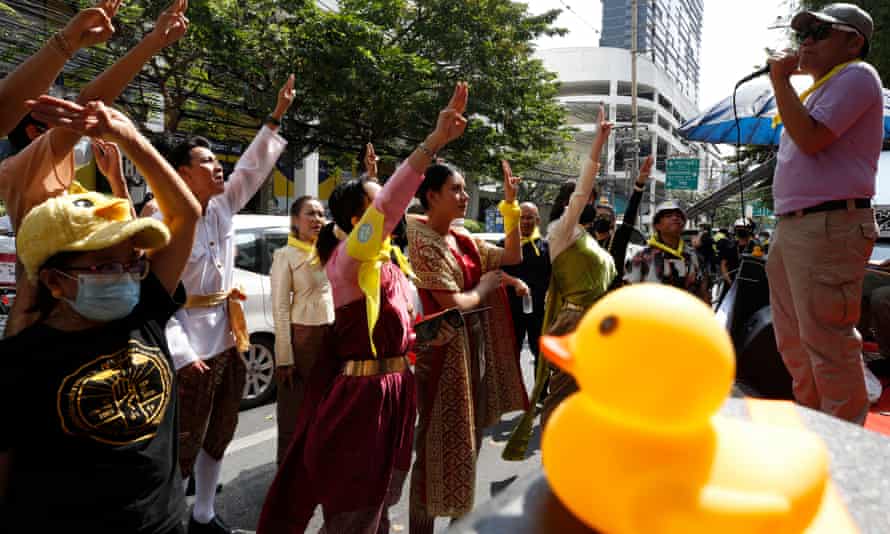
Anti-government protesters flash a three-finger salute – a gesture used adopted by protesters from the Hunger Games films – as they gather in support of people detained under the lese-majesty law at a police station in Bangkok.
Anti-government protesters flash a three-finger salute – a gesture used adopted by protesters from the Hunger Games films – as they gather in support of people detained under the lese-majesty law at a police station in Bangkok. Photograph: Narong Sangnak/EPA

Prominent protest leaders face an unusually high number of charges. This includes the student activists Parit Chiwarak, also known as Penguin, (12 charges) and Panusaya Sithijirawattanakul (six charges) and the human rights lawyer Anon Nampa (eight charges), who have given speeches calling for the power of the royals to be curbed.

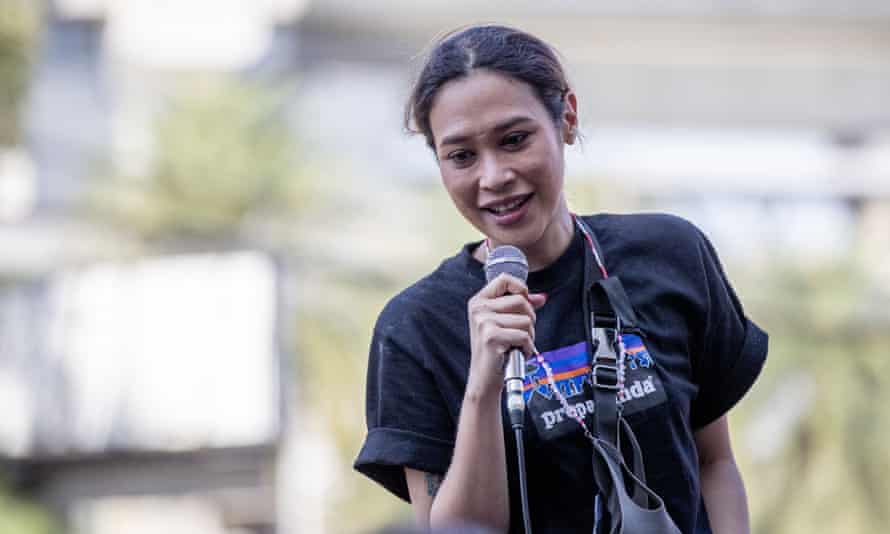
The pro-democracy protest fundraiser Inthira Charoenpura
The pro-democracy protest fundraiser Inthira Charoenpura speaks from a stage outside Bang Khen police station in Bangkok. Photograph: Gemunu Amarasinghe/AP

Protesters – who have faced various other charges over recent months, including sedition – declined to participate in a government reconciliation panel in November, rejecting it as an attempt to buy time. The recent cases come after months of demonstrations in which protesters have made unusually frank and public calls for reform to the monarchy.

Benja Apan, 21, one of 13 people facing charges over a demonstration outside the German embassy in Bangkok, said legal action was unlikely to deter protesters from coming out in the new year. “I actually think it will bring more people out, because it is not fair,” she said.

The human rights group Amnesty International has launched a campaign calling on PM Prayut Chan-o-cha to drop charges pressed on a number of activists for their role in the pro-democracy movement and to repeal, or at least amend, Thailand’s draconian lèse majesté law. According to the campaign, at least 220 people, including minors, face criminal charges for relating to their actions in the pro-democracy movement. Activists are calling on government and monarchy reform, raising issues considered taboo and unprecedented in Thai society. Thailand must amend or repeal the repressive laws it is using to suppress peaceful assembly and the expression of critical and dissenting opinions.

Amnesty International is calling on people to take action and send a letter to the prime minister, calling on the Thai government to change their approach when handing the ongoing protests to protect human rights. Sample letter by AI’s campaign calls on Prayut to:

  • Immediately and unconditionally drop all criminal proceedings against protesters and others charged solely for exercising their rights to freedom of peaceful assembly and expression
  • Cease all other measures, including harassment, aimed at dissuading public participation in peaceful gatherings or silencing voices critical of the government and social issues
  • Amend or repeal legislation in order to ensure it conforms with Thailand’s international human rights obligations on freedom of peaceful assembly and expression, and to train state officials to carry out their duties confirming to Thailand’s obligation to respect, protect and fulfil the peaceful exercise of the rights to freedom of peaceful assembly and expression.

On Saturday 19 December 2020 Maya Taylor in The Thaiger had already reported that the United Nations High Commission for Human Rights has expressed shock and dismay at Thailand’s use of its strict lèse majesté law against a 16 year old pro-democracy activist. The UN High Commissioner for Human Rights’ spokesperson Ravina Shamdasani has called on Thailand to refrain from using the law against those exercising their right to freedom of speech, as she expressed alarm that a minor was being charged under the law. “It is extremely disappointing that after a period of 2 years without any cases, we are suddenly witnessing a large number of cases, and – shockingly – now also against a minor. We also remain concerned that other serious criminal charges are being filed against protesters engaged in peaceful protests in recent months, including charges of sedition and offences under the Computer Crime Act. Again, such charges have been filed against a minor, among others.

The UN Human Rights Committee has found that detention of individuals solely for exercising the right to freedom of expression or other human rights constitutes arbitrary arrest or detention. We also urge the government to amend the lèse majesté law and bring it into line with Article 19 of the ICCPR on the right to freedom of expression.”

Thailand’s Foreign Ministry spokesman has played down the UN High Commissioner for Human Rights’ criticisms over the kingdom’s enforcement of the Lese Majeste law.

See also in 2019: https://humanrightsdefenders.blog/2019/12/23/thailand-amnesty-and-un-rapporteur-agree-on-misuse-of-lese-majeste/

https://thethaiger.com/news/national/pro-democracy-movement-making-little-headway-monarchys-powers-remain-untouched

https://www.theguardian.com/world/2020/dec/27/un-thailand-protesters-royal-insult-law-lese-majesty

https://www.voanews.com/east-asia-pacific/new-year-new-charges-thai-protesters-slapped-royal-defamation-charges

Saudi Arabia’s abominable human rights record..

November 30, 2020

Nothing new in this strongly-worded piece except the source…on 30 November 2020 the Tehran Times published the piece below written by Stephen Lendman an American columnist, and Research Associate of the Centre for Research on Globalization (CRG):

Like the U.S., Israel, and other rogue states, the Saudis operate by their own rules in flagrant violation of international laws, norms, and standards. It’s the world’s head-chopping/public whippings capital. Anyone can be targeted for exercising free expression, human rights activism, or other forms of dissent against despotic rule.

They’re also vulnerable for not praying at designated times, improper dress code, non-observance of gender segregation, and other nonconformity with Wahhabi extremism.

Its documented high crimes include state-sponsored murder, torture, arbitrary arrests, and detentions, supporting ISIS and other terrorist groups, partnering in U.S. regional wars, banning free elections, denying due process and judicial fairness, prohibiting religious freedom, human trafficking, kidnappings, committing crimes of war and against humanity, along with virtually every other rule of law breach imaginable.

In mid-November, the London Daily Mail reported the following: “Saudi interrogators forced jailed women’s rights activists to perform sex acts, hung them from ceilings and ‘tortured’ them with electric shocks,” citing a report, titled: “A Stain on World Leaders and the G20 Summit in Saudi Arabia: The shameful detention and torture of Saudi women.

The report explained that in May 2018, “10 human rights defenders who had successfully campaigned” to end the prohibition against women driving were arrested and detained. 

Weeks later, nine more arrests and detentions followed. Targeted individuals were activists for women’s rights in the kingdom. A few are males who support gender equality were also arrested. Most individuals targeted remain detained. It was learned that they were “subjected to torture, inhuman and degrading conditions of detention, solitary confinement, and unfair trial processes.”

In the report, human rights lawyer Baroness Helena Kennedy called on G20 nations to boycott the virtual November 21-22 Riyadh summit until wrongfully detained women are free. Other charges included forcing them to watch pornography, along with performing other sexual acts on interrogators. [see also: https://humanrightsdefenders.blog/tag/helena-kennedy/]

Commenting on her report, Baroness Kennedy said horrendous abuses endured by detained women in the kingdom wouldn’t be tolerated in “decent nation(s),” adding: “Being expected to deliver for interrogators, what that has done to the soul of a woman is so terrible.

Saudi abuses against nonviolent activist women are typical of how their ruling authorities always operate — showing contempt for the rights of ordinary people, tolerating no dissent.

Crown prince Mohammad bin Salman (MBS) is the kingdom’s torturer assassin-in-chief. He personally signed off on the October 2018 brutal murder and dismemberment of Jamal Khashoggi in the kingdom’s Istanbul consulate. In 2017, he arrested and detained hundreds of royal family members and Saudi businessmen. Held under house arrest at Riyadh’s Ritz-Carlton hotel, they were forced to pay tens or hundreds of billions of dollars in cash and assets to the regime for release — MBS grand theft on the phony pretext of rooting out corruption. 

He consolidated power by eliminating rivals and terrorizing potential ones. Royal family members, Saudi businessmen, and others in the kingdom not willing to affirm loyalty to his rule risk arrest, detention, torture, and elimination.

Since appointed crown prince in June 2017 — gaining power because his of father’s mental and physical deterioration — he’s ruthlessly gone all-out to solidify it unchallenged. He likely OK’s sexual and other torture of detained women activists.

UN secretary-general Guterres is largely silent about Western, Israeli and Saudi high crimes, serving their interests instead of condemning them. As long as Saudi Arabia is oil-rich, its wealth used to invest in Western countries and buy their weapons, as well as partnering in their regional wars, their ruling authorities will turn a blind eye to the worst of kingdom high crimes.
————

Also interesting to note that in “Related News” one finds links such as:

but you will search in vain for information on human rights defenders in Iran, of course.

https://www.tehrantimes.com/news/455241/Saudi-Arabia-s-abominable-human-rights-record

Loujain al-Hathloul’s trial: Judge transfers her case to even worse court

November 26, 2020

Following up on my post from yesterday [https://humanrightsdefenders.blog/2020/11/25/loujain-al-hathloul-to-stand-trial-in-saudi-arabia-today/] Amnesty International reported on 25 November 2020 that a Saudi Arabian judge has decided to transfer human rights defender Loujain al-Hathloul’s case to Saudi Arabia’s Specialized Criminal Court (SCC), an institution used to silence dissent and notorious for issuing lengthy prison sentences following seriously flawed trials

https://www.amnesty.org/en/latest/news/2020/11/saudi-arabia-loujain-alhathlouls-trial-exposes-hypocrisy-on-womens-empowerment/

Loujain al-Hathloul to stand trial in Saudi Arabia today

November 25, 2020

As I have been following the case of Loujain al-Hathloul regularly [see https://humanrightsdefenders.blog/tag/loujain-al-hathloul/] I think it is important to report that she will appear in a Saudi court today Wednesday 25 November 2020, more than two years after she was first detained in a crackdown on human rights defenders.

al-monitor Lina al-Hathloul, whose sister Loujain is being held by Saudi authorities, speaks at the 10th Anniversary Women In The World Summit at David H. Koch Theater at Lincoln Center on April 10, 2019, in New York City. Photo by Photo by Mike Coppola/Getty Images.
We were just announced that @LoujainHathloul has a trial tomorrow,” her sister, Lina al-Hathloul, tweeted Tuesday.

The conservative Gulf kingdom insists that Hathloul and the others are detained over national security concerns. Saudi Minister of State for Foreign Affairs Adel Jubeir told CNN last week that Hathloul’s fate “was up to the courts.” 

The idea that she and her friends were detained because they advocated women’s driving is preposterous,” said Jubeir. 

Hathloul’s court date was scheduled for March but was postponed indefinitely amid what Saudi officials said were coronavirus concerns. On Oct. 26, she began a hunger strike to protest her treatment in prison and lack of regular contact with her parents. 

Amnesty International urged Riyadh to allow diplomats and journalists to attend the trial. The rights group also called for Hathloul to be given access to her parents, and to a lawyer so she can prepare an adequate defense. 

In light of the women rights activists reporting having been tortured or otherwise ill-treated in detention, we also have concerns about the admissibility of any ‘evidence’ that might be submitted in court tomorrow,” Lynn Maalouf, Amnesty’s deputy Middle East and North Africa director, said in a statement. 

The only just outcome for this trial would be the immediate and unconditional release of Loujain al-Hathloul,” Maalouf said.  

On Tuesday, a group of 29 organizations issued a letter to the president of Saudi Arabia’s Human Rights Commission, Awwad Al-Awwad, expressing their concern over the “continued arbitrary detention of women’s rights defenders.” 

Hathloul’s expected court appearance comes days after Saudi Arabia wrapped up its hosting duties for this year’s Group of 20 summit, of which women’s empowerment was a theme. Ahead of the virtual gathering, a coalition of human rights organizations sought to draw attention to what they say is an increase in repression under Crown Prince Mohammed bin Salman. 

https://www.al-monitor.com/pulse/originals/2020/11/loujain-al-hathloul-saudi-arabia-trial-jailed-women-activist.html

What limits for NGOs in the decentralisation of human rights infrastructure?

November 11, 2020

Ravindran Daniel, in Open Global Rights of 10 November 2020 published a piece that should interest anybody who wrestles with the issue of how to ‘decentralise’ the international human rights movement. In “What are the implications of International Human Rights NGOs moving to the South?” Daniel – who is a human rights lawyer from India, served as director of the Human Rights Division with the UN peacekeeping missions in East Timor, Libya and the Sudan and established the Asian Forum for Human Rights and Development – takes the recent closure of AI India as the starting point for a wider discussion of the structural problems that come up in trying to realise the ‘democratization of the global human rights movement”. [see also: https://humanrightsdefenders.blog/2020/09/29/amnesty-feels-forced-to-shut-sown-its-india-office-amidst-govenment-pressure/]


..The closure of Amnesty International’s India office raises questions about AI’s global strategy and the democratization of the global human rights movement. AI’s India office was part of the AI’s 2010 Global Transition Program (GTP) which aimed at restructuring the organization by reducing its London office operations and transferring them to regional hubs in various parts of the world. New forms of national offices were set up in India, Brazil, South Africa, Kenya, Nigeria, and Indonesia. The aim was also to make AI a truly global movement and raise funds from the Global South and not depend entirely on funds from the Global North. Donors such as the Ford Foundation and the Open Society Foundation funded AI’s move to the South which was seen as strengthening mobilization from local to international levels and increased contact with human rights defenders and civil society actors.

However, it also raised some questions for both AI and the global human rights movement.

When opening its office in India in 2012, AI may not have foreseen the assumption of power by an illiberal government in 2014; although it must have known the risks involved in other countries. When AI rolled out its GTP program in 2010, was it unrealistically optimistic, particularly when the global support for human rights  in the West was rapidly declining? The optimism about emerging powers such as India, Brazil, and South Africa had waned and several illiberal governments had become powerful in the global system. It could not have waited for an opportune time since governments of various hues always challenge human rights organizations to function freely. The fact remains that human rights offices, national or international, face reprisals by governments and AI should have foreseen it when it established its India office under the GTP program. The question remains: was the cost including the consequences for those associated with AI India worth the risk?

However, the question is: given its tradition of safeguarding its members from bias and reprisals, what steps did it take to prevent reprisals for its members and supporters of national offices? Since 2001, AI abandoned its “own country rule” under which AI members were barred from working on cases in their own countries. It was a self-imposed limitation to safeguard members against potential problems from their own governments but also to stress the importance of solidarity in human rights work.

The closure of the Indian office raises the value of “own country rule” which would have possibly prevented the Indian government from taking the extraordinary step of closing the AI’s office. The Indian Government is alleging money laundering, which would entail conducting investigations against all those who contributed to AI India putting a large number of its supporters at risk.

Was the cost including the consequences for those associated with AI India worth the risk?

Moreover, the aim of the “own country rule” was to prevent AI’s local chapters from becoming just another local human rights organization with international links. In the case of the AI India office, its links to its parent organization seemed to have impeded its functioning. For example, in November 2019, Indian police raided the AI India office after the parent organization testified before the US Congress on the situation in Jammu and Kashmir.

The closure of the AI’s India office has implications for the global human rights movement as well. An evaluation of the Ford Foundation’s Strengthening Human Rights Worldwide Global Initiative (SHRW), under which the foundation funded AI to move to the South, raised the following issues: how to differentiate between the roles played by national and international NGOs; if these roles could be construed as the imperial expansion of Northern-based groups?; if such moves help or reduce the voice of local groups and communities;and if international NGOs have an advantage over national NGOs in garnering a larger share of resources due to a concentration of “cultural capital” (“knowledge and access to global governance institutions”) among NGOs based in the North?

The ecology of the human rights movement began changing in the 80s and the SHRW review captures it. In this changed context, AI’s efforts to be closer to the ground happened at an ill-advised time when strong NGOs had emerged in the South and were increasingly challenging the traditional human rights ecology. While based in the North, AI was functioning as a global movement with some of the corresponding limitations, such as authoritarian governments accusing it of being a Western organization. AI, instead of building from its strength, seemed to have pursued a naïve goal of expanding in the field at a wrong time for the wrong reasons.

Nevertheless, the global human rights movement must condemn the Indian government’s actions against the AI India office. It must campaign for withdrawing all the cases and restoring the office. It should also examine the lessons learned from democratizing the movement in the last two decades, including strengthening the role and voices of NGOs in the South. AI on its part should re-examine its GTP’s assumptions considering the developments of the last two decades. A 2017 evaluation of the GTP commissioned by AI recommended the need for a “new narrative” that “…goes beyond moving closer to the ground, beyond the distribution of Amnesty International Secretariat (IS) and to the distribution of Amnesty as a movement… (making all) regions vibrant communities for public campaigning”.


https://www.openglobalrights.org/what-are-the-implications-of-international-human-rights-ngos-moving-to-the-south/