Posts Tagged ‘AI’

2018: Latin America still the graveyard for environmental human rights defenders

April 28, 2018

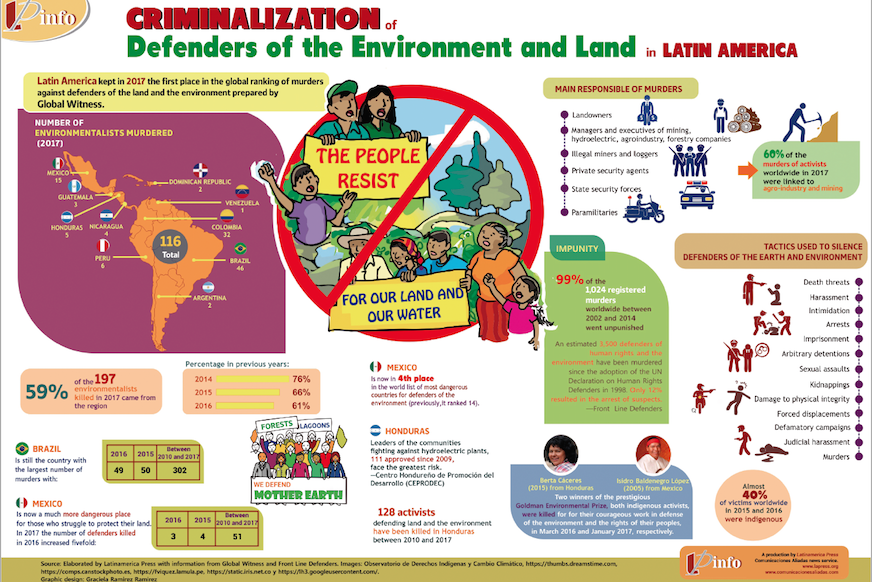
This blog has on several occasions drawn attention to reports that show that Latin America is among the deadliest places to be a human rights defender [e.g. https://humanrightsdefenders.blog/2016/01/06/latin-america-philippines-most-dangerous-places-for-human-rights-defenders/]. An infographic – published on 27 March 2018 by Latin America Press – summarises criminalization of land & environmental rights defenders in Latin America.

 
http://www.lapress.org/objetos/informe/48PI_criminalization-defenders-of-the-land.pdf
In 2016/17 an Amnesty International team took two trips to Peru and one to Paraguay and spoke with representatives of 10 human rights groups in Peru and 14 in Paraguay. AI concludes that environmental leaders are under constant threat. Authorities in Paraguay and Peru are unjustly criminalizing activists who speak out to protect their environment and land, an Amnesty International report released Thursday revealed. [see also: https://humanrightsdefenders.blog/2016/02/27/alarming-criminalisation-of-human-rights-defenders-in-latin-america/]

The report, A Recipe for Criminalization: Defenders of the Environment, Territory and Land in Peru and Paraguay, outlined the three “ingredients” both countries use to undermine the efforts of human rights defenders. First, they delegitimize activists through smear campaigns. Second, they apply laws and regulations that allow for forced evictions. And, third, they misuse the criminal justice system to prosecute activists for unfounded reasons.

Those who bravely stand up to defend their land and the environment are frequently targeted because of their work. These attacks have a devastating impact on their physical, mental and emotional wellbeing, as well as that of their families and communities,” Amnesty International Americas director Erika Guevara-Rosas said in a press release.

The report included examples of how these ingredients combine on the ground. For example, Amnesty International highlighted the case of community activists working to protect their home in Peru’s Cajamarca region from the gold and copper Conga mining project. On 26 April 2013, police arrested 16 protesters on trumped up charges of abduction and coercion. The state prosecutor sought 30-year prison sentences. But the evidence presented was secondhand and so spotty and contradictory that a court dismissed the case in 2017.

In Paraguay, the Tekoha Sauce community of the Avá Guaraní People was evicted from their ancestral lands by a court order following a dispute with local businessman German Hultz. The community was forced onto a nature reserve where they struggle to survive because hunting and fishing is not allowed. During the court proceedings leading up to the eviction, their opponents stigmatized the indigenous community by referring to them as a “gang of criminals.”

On 24 April 2018, Front Line reported that on 19 April 2018, Olivia Arévalo Lomas, a woman human rights defender and spiritual leader of the Shipibo-Konibo indigenous peoples, was killed by unknown assailants just a few feet from her home in the community of ‘Victoria Gracia’, in Peru. The defender was shot in the chest and died instantly. Her body was left on the street in full view of her local community (https://www.frontlinedefenders.org/en/profile/olivia-arevalo).  The killing of Olivia Arévalo Lomas comes after a spike in violence, threats and intimidation against members of FECONAU communities in Ucayalí, such as Santa Clara de Uchunya. In the past six months, several members of FECONAU have been subjects of attacks. A representative of FECONAU, Edinson Mahua, was shot at close range and narrowly escaped serious injury, while community leaders in Ucayalí have received anonymous death threats. 

In the meantime Colombia has seen a spike in assassinations of human rights defenders in 2018, according to study by Colombian NGO Somos DefensoresA total of 46 human rights leaders have been killed so far this year, up from 26 in the same period last year; paramilitary groups were responsible for three of the killings, four were murdered by guerrilla groups and another four were killed at the hands of security forces. The investigative body also recognized a total of 132 acts of aggression against public defenders so far this year. Of the registered acts, there were 12 attacks, 66 death threats and one case of forced disappearance. The provinces in which the aggression occurred were predominately in areas at the heart of the country’s conflict, with Cauca, Antioquia and Norte de Santander figuring heavily in the statistics.

The UN has said it is “extremely concerned” about the increase in violence surrounding social leaders while Inspector General Fernando Carrillo has “urged” authorities to “assume their commitments to defend the lives of social leaders.” While the government has attempted to reel in the varying armed criminal groups responsible for a lot of these acts — as seen with the 2016 peace deal with the FARC guerrilla organisation, and ongoing peace negotiations with the ELN rebel group — it has clearly failed to provide basic security, and protect human rights defenders, rural community leaders and other social activists.

—-

https://www.ecowatch.com/environmental-activists-amnesty-international-2563882266.html

https://reliefweb.int/report/peru/recipe-criminalization-defenders-environment-territory-and-land-peru-and-paraguay

https://colombiareports.com/killing-of-human-rights-leaders-in-colombia-more-than-doubles-study/

https://www.business-humanrights.org/en/latin-america-infographic-summarises-criminalization-of-land-environmental-rights-defenders-in-the-region

UN Human Rights Council should strengthen impact on the ground, say NGOs

April 24, 2018

The assault on human rights in the UN is starting to hurt

April 1, 2018

Success in passing the “win-win resolution” in the UN Human Rights Council [https://humanrightsdefenders.blog/2018/03/26/chinas-win-win-resolution-gets-the-votes-in-the-un-council/], is just the visible part of a larger and more ominous assault on the human rights system as it has been built up (however incomplete and painstaking) over the last decades. Julian Borger in the Guardian of 27 March 2018 (“China and Russia accused of waging ‘war on human rights’ at UN”) describes how the two countries lobbied to cut funding for human rights monitors and for a senior post dedicated to human rights work. This all seems to fit very well with the trend started in 2016 and which I tried to describe in early 2017 in a series of posts, of which the last one was: https://humanrightsdefenders.blog/2017/02/24/2017-10-need-to-reset-for-human-rights-movement/.

The funding of the office of the high commissioner for human rights in Geneva has also been cut. The current high commissioner, Zeid Ra’ad Hussein, has announced that he will be stepping down this year and not seeking another term in the post, explaining to his staff that the lack of global support for protecting human rights made his job untenable. [https://humanrightsdefenders.blog/2017/12/22/bound-to-happen-but-still-high-commissioner-zeid-announces-he-will-not-seek-second-term/]

Last week, Zeid was due to address the UN security council on plight of civilians in Syria but before he began, Russia called a procedural vote to stop him speaking on the grounds that the council was not the proper forum for discussing human rights. “The fifth committee has become a battleground for human rights,” Louis Charbonneau, the UN director for Human Rights Watch, was quoted in the Guardian. “Russia and China and others have launched a war on things that have human rights in their name.”

China has real political momentum at the UN now,” Richard Gowan, a UN expert at the European Council for Foreign Relations, said. “It is now the second biggest contributor the UN budget after the US, and is increasingly confident in its efforts to roll back UN human rights activities. It is also pushing its own agenda – with an emphasis on ‘harmony’ rather than individual rights in UN forums. And a lot of countries like what they hear.”

A western diplomat at the UN conceded that human rights were losing ground at the UN, in part because China had become a more assertive voice, prepared to lead lobbying campaigns, and because Beijing is increasingly leveraging its vast and growing investments in the developing world to win votes for its agenda at the UN.

https://www.theguardian.com/world/2018/mar/27/china-and-russia-accused-of-waging-war-on-human-rights-at-un

https://www.amnesty.org/en/latest/news/2018/03/a-new-low-for-the-un-security-council-as-russia-takes-syrian-human-rights-off-the-table/

Anniversary sparks high-level arrest in investigation of Berta Caceres murder

March 3, 2018

[On 2 March 2016, Berta Cáceres, a courageous defender of the environment and Indigenous rights, was shot dead by gunmen in her home in Intibucá, Honduras.  She campaigned against the Agua Zarca hydroelectric dam project and the impact it would have on the territory of the Indigenous Lenca People. see also: https://humanrightsdefenders.blog/2016/03/07/exceptional-response-from-ngo-world-on-killing-of-berta-caceres/]

A recent report from an independent team of international lawyers hired by the family of Berta Cáceres had exposed serious flaws in the official investigation. The report includes evidence that would implicate high-level business executives and state agents in the crime.  The Honduran Attorney General’s office has arrested eight people in connection to Berta’s murder, including some individuals linked to Desarrollos Energéticos S.A. (DESA), the company building the Agua Zarca dam, and others with ties to the military, but COPINH (the NGO Berta worked for) is concerned that no high-ranking officials in the government or the company have been investigated for having allegedly ordered her murder. Ahead of the trial which is scheduled to begin in June, the lawyers of Berta’s family and COPINH have called on the prosecutor office and the judicial authorities to ensure that those responsible for ordering the killing of Berta are also investigated and brought to justice.

Then on the same day as the anniversary of her killing the Honduran authorities (AP reports) arrested Roberto David Castillo Mejia, who at the time of the slaying was executive president of DESA, calling him an intellectual author of the crime. It became the ninth arrest in the killing of Caceres. Two others have been arrested for allegedly impeding the investigation.

The Public Ministry alleges Castillo was “the person in charge of providing logistics and other resources to one of the material authors already being prosecuted for the crime.” In a statement, DESA defended Castillo and its employees as innocent, saying they were “totally unconnected” to the crime and calling the “unjust detention” the result of “international pressure and campaigns by diverse NGOs to discredit the company.”

DESA questioned the coincidence that the arrest came on the second anniversary of Caceres’ killing as her supporters held a protest in Honduran capital of Tegucigalpa. Caceres’ relatives said they were certain of Castillo’s guilt.

https://www.amnestyusa.org/press-releases/honduras-failure-to-identify-those-behind-berta-caceres-murder-puts-other-activists-at-risk/

https://www.stamfordadvocate.com/news/crime/article/Honduras-New-arrest-in-2015-killing-of-activist-12724134.php

http://www.peoplesworld.org/article/continuing-the-battle-berta-caceres-daughter-to-return-to-honduras/

Ibrahim Halawa – after 4 years in detention in Egypt – is able to speak out

February 27, 2018

Amnesty International published on 26 February 2018 an insightful interview with an Egyptian youth arrested in the august 2013 protests.
Weeks after his release Ibrahim Halawa spoke to AIu about his time in an Egyptian prison. Now walking the streets of Dublin his freedom has changed his life forever. Ibrahim Halawa was arrested aged just 17 along with hundreds of others during protests on 16 and 17 August 2013 around al-Fath Mosque in downtown Cairo. The protests descended into violence which the security forces responded to by using excessive lethal force that left at least 97 people killed, but according to Amnesty International’s research there is no evidence to indicate he was involved in any of the violence. The organization believes he was jailed for peacefully protesting. He was eventually acquitted on 18 September 2017, but 442 others were sentenced after a deeply unfair mass trial. Amnesty International is calling for all others who have been sentenced for peacefully exercising their rights to be immediately released.


Amnesty’s Annual report 2017 is out: depressing but rays of hope

February 22, 2018

Amnesty International´s annual report, The State of the World’s Human Rights 2017, assesses the human rights situation in 159 countries and delivers a most comprehensive analysis of the state of human rights in the world today. Here follow some summaries form the media:

AI itself highlights in the launch on 22 February 2018, the deepening human rights crisis in the Americas.  “People across the Americas faced a deepening human rights crisis fuelled by growing government intolerance of dissent and increasing demonization in political rhetoric that cemented its status as one of the most violent and unequal regions in the world“, Amnesty International warned. Nevertheless, the organization found that a growing resistance movement of both first-time and seasoned activists provides real hope of reversing the slide towards oppression and fear.

The report highlights alarming trends for the state of human rights in the Americas, including:

  • High levels of violence that continued to ravage the region, with waves of unlawful killings, enforced disappearances and arbitrary detentions. In Mexico, more than 34,000 people remained missing, and extrajudicial executions were rife. A year on from Colombia’s historic peace agreement, violence was still a daily part of life, and an estimated 60,000 people were forcibly displaced due to armed conflict in 2017 alone, according to official numbers.
  • Venezuela continues to face a serious human rights crisis, fuelled by the escalation of government-sponsored violence to respond to the increasing social discontent created by rising inflation and a humanitarian crisis. Thousands of people were arbitrarily detained and there were many reports of torture and other ill-treatment.
  • Latin America and the Caribbean remained as the most violent regions in the world for women and girls, despite strict laws aimed at addressing the crisis. The region has the world’s highest rate of non-intimate partner violence against women, and the second highest rate of intimate partner violence.
  • Ongoing intimidation and attacks against community leaders, journalists and activists who stood up for human rights. Environmental defenders were among the most at risk. Of the 188 environmental defenders killed in 2017, 110 took place in the Americas, according to the NGO Front Line Defenders.
  • Deepening discrimination and neglect of the rights of rural communities and Indigenous Peoples, including their rights to their ancestral territory and to free, prior and informed consent on projects affecting them. From Peru to Nicaragua, national and transnational corporations sought to take control of land away from Indigenous Peoples and peasant farmers, affecting their livelihoods and contaminating their basic resources.
  • A rapidly out of control yet largely invisible refugee crisis as hundreds of thousands of people from some of the world’s most violent countries, including El Salvador and Honduras, were denied urgent asylum.

Yet these injustices have also inspired many more people to join long-standing struggles, and the report details many important achievements that human rights activists helped to secure. These include lifting the total ban on abortion in Chile and the approval of a law to help victims of enforced disappearances in Mexico find their missing loved ones. [see also my: https://humanrightsdefenders.blog/2017/12/31/2017-a-year-to-forget-for-human-rights-defenders-but-dont-forget-the-human-rights-defenders/]

Last year proved that however disenfranchised people were, they refused to resign themselves to a future without human rights. Emerging social discontent inspired people to take to the streets, stand up for their rights and demand an end to repression, marginalization and injustice,” said Erika Guevara Rosas, Americas Director at Amnesty International The Americas was at the hub of this new wave of activism. The “Ni Una Menos” (“Not one woman less”) movement denounced violence against women and girls across the region, while survivors of gender-based and sexual violence in Argentina, Mexico, Jamaica, Peru, and many other countries took to the streets to protest against impunity for such crimes.

Protesters and refugees bear the brunt of ‘normalized’ violence: Hundreds of activists were killed last year as authorities sought to repress civil society and muzzle the media, the report says. Human rights defenders faced threats, harassment and attacks in most countries in the region, while states failed to protect them and acknowledge the importance of their work.

The injustice of President Trump’s cruel pledge to build a wall along the USA-Mexico border was emphasized by Central America’s ongoing refugee crisis. More than 50,000 people from Honduras, Guatemala and El Salvador sought asylum in other countries, thousands of whom were then apprehended at the US border. Mexico received a record number of asylum applications but repeatedly failed to provide protection to those who needed it – instead pushing people back to highly dangerous situations.

The numbers of people fleeing Venezuela rocketed as it faced one of the worst human rights crises in its recent history, fuelled by an escalation of government-sponsored violence. When the country’s crippling shortage of food and medical supplies sparked protests, the security forces’ heavy-handed response lead to more than 120 deaths.

Instead of trying to suppress people when they speak out, governments should address their concerns, said Amnesty International.

We are witnessing history in the making as people rise up and demand justice in greater numbers. If leaders fail to discern what is driving their people to protest, then this ultimately will be their own undoing. People have made it abundantly clear that they want human rights: the onus now is on governments to show that they are listening,” said Salil Shetty, Secretary General of Amnesty International.

[for last year see: https://humanrightsdefenders.blog/2017/02/24/2017-10-need-to-reset-for-human-rights-movement/]

Interesting to note the different emphasis placed on the report such as in the Al-Jazeera article: “World leaders abandoning human rights: Amnesty

World leaders are undermining human rights for millions of people with regressive policies and hate-filled rhetoric, but their actions have ignited global protest movements in response, a rights group said. US President Donald Trump, Russian leader Vladimir Putin, and China’s President Xi Jinping were among a number of politicians who rolled out regressive policies in 2017, according to Amnesty International’s annual human rights report published on Thursday. The human rights body also mentioned the leaders of Egypt, the Philippines and Venezuela. “The spectres of hatred and fear now loom large in world affairs, and we have few governments standing up for human rights in these disturbing times,” Salil Shetty, Amnesty’s secretary-general, said. “Instead, leaders such as el-Sisi, Duterte, Maduro, Putin, Trump and Xi are callously undermining the rights of millions.”  [see also my https://humanrightsdefenders.blog/2018/01/19/ai-welcomes-resistance-to-trumps-human-rights-policies/]

Radio Free Europe/Radio Liberty also focuses on the US angle: Amnesty International has taken aim at U.S. President Donald Trump and other world leaders the global watchdog says are abandoning human rights, accusing them of setting a “dangerous precedent” for other governments to follow. And then gives a useful summaries of countries in its region:

Central Asia

Afghanistan

Armenia

Azerbaijan

Belarus

Bosnia-Herzegovina

Georgia

Moldova

Russia

Ukraine

Adding  Iran and Pakistan.


Euronews obviously also focus on Europe:  Between eastern Europe’s “hostile discourse to human rights” and the rights of freedom of association and assembly put at risk in the entire continent, this year’s Amnesty International World Report warned that “space for civil society continued to shrink in Europe” and gives then a thematic overview of the key takeaways for Europe from the report.

https://www.amnesty.org/en/latest/news/2018/02/deepening-human-rights-crisis-spurs-new-era-of-activism-in-the-americas/
http://www.aljazeera.com/news/2018/02/world-leaders-abandoning-human-rights-amnesty-180221174518140.html
https://www.rferl.org/a/amnesty-international-trump-other-leaders-setting-dangerous-precedent-abandoning-human-rights/29055935.html
http://www.euronews.com/2018/02/21/-space-for-civil-society-continued-to-shrink-across-europe-report-says

Update on Turkey: Taner Kılıç released but what about all the others?

January 31, 2018

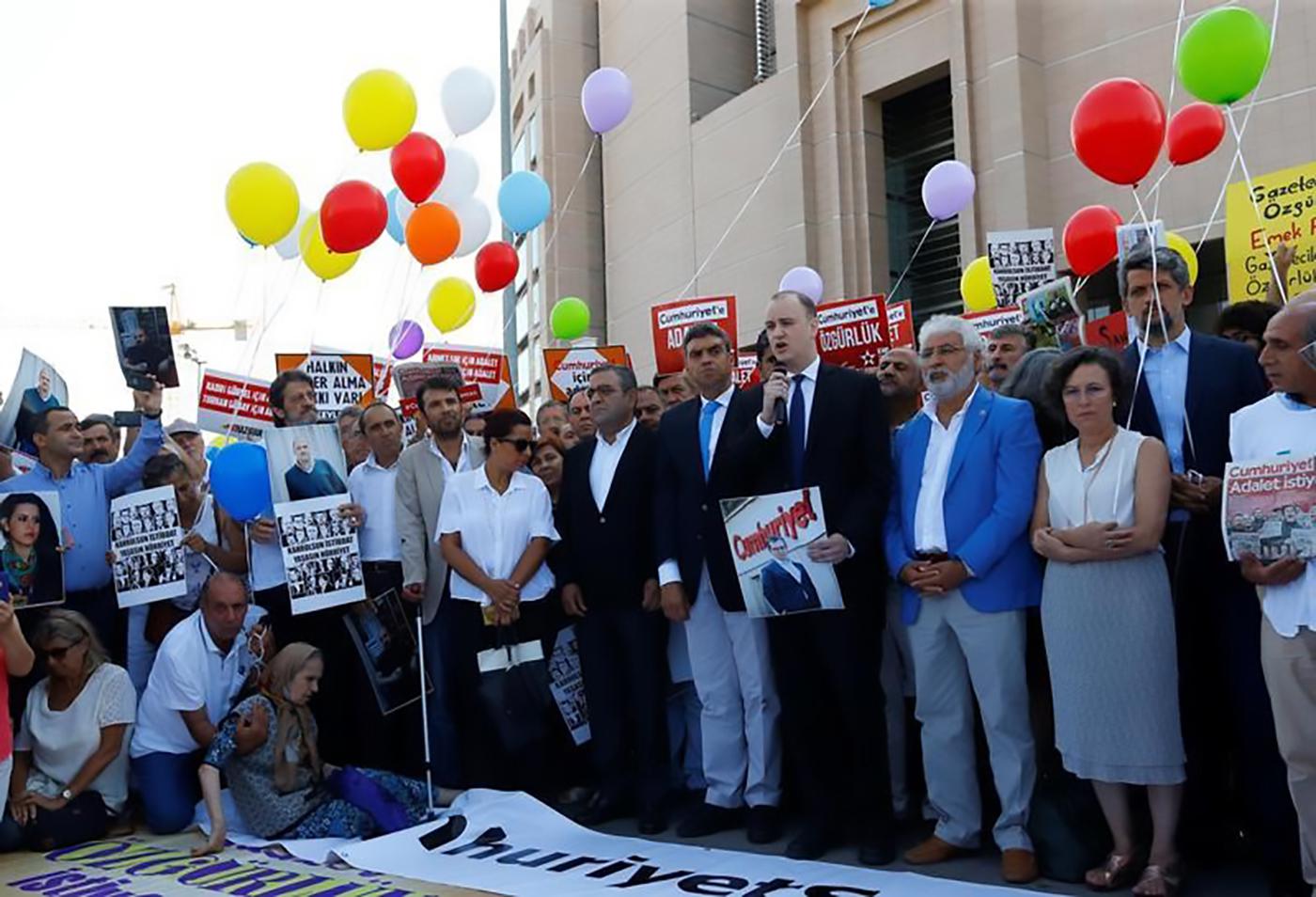
Following a decision by a court in Istanbul to conditionally release the Chair of Amnesty International Turkey, Taner Kılıç, after nearly eight months in detention, Gauri van Gulik, AI’s Europe Director said: “It is an enormous relief that Taner will soon be back with his wife and daughters, sleeping in his own bed for the first time in almost eight months. But we cannot forget that many other innocent people remain behind bars without a shred of evidence in Turkey.” “Today we take a brief moment to celebrate, but tomorrow we will continue our struggle to have all charges dropped against Taner, the Istanbul 10, and all other innocent victims wrongfully caught up in this vicious crackdown.”

NOTE:  1 February update in http://gkmen.com/2018/02/01/turkey-court-reverses-release-of-amnesty-head-taner-kilic/: “Andrew Gardner, a senior Amnesty researcher on Turkey, tweeted that Kılıç was transferred from prison custody to gendarmerie custody late Wednesday. While the Istanbul court rejected the appeal, it nonetheless sent the application to another court for a decision on Kilik’s detention. “This is devastating for Taner’s family and a disgrace to justice”, he added. The group said the next hearing in his trial has been set for June 21.

While Kılıç has now been released, the trial against him, director of Amnesty International Turkey İdil Eser, and the other nine human rights defenders on trumped-up terrorism related charges continues. [Kılıç was detained on June 6, 2017 and sent to jail three days later, where he has been ever since. Ten other activists “the Istanbul 10”, including Eser, were detained a month later. Eight of them were held for almost four months before being released on bail at their first hearing in October. The Istanbul 10 were accused of “membership of a terrorist organization,” a baseless allegation for which the prosecution has yet to provide any concrete evidence that would stand up to scrutiny. – https://humanrightsdefenders.blog/2017/11/22/celebrities-come-out-to-support-taner-kilic-amnesty-turkeys-chair-on-trial-today/ ]

Over 570 lawyers arrested in Turkey in last 18 months

Turkish police wrestle a lawyer to the ground outside of a courthouse in Turkey. (Photo: Social Media)
 Ari Khalidi (Kurdistan24.net) reported on 30 January 2018 that an opposition lawmaker in Turkey revealed on Tuesday that authorities had arrested 572 lawyers during the one and a half year-long state of emergency in place since a failed military coup to topple the administration of President Recep Tayyip Erdogan. Republican People’s Party (CHP) lawmaker Senal Sarihan told a press conference at the Turkish Parliament that of the lawyers arrested, 488 faced maltreatment in police custody, as 79 of them were given prison sentences.

..Last week, the International Bar Association’s Human Rights Institute (IBAHRI) urged the Turkish government to stop persecuting lawyers.

This situation demonstrates a flagrant disregard for the rule of law and is a deliberate attack on human rights defenders and legal professionals. We call on the Turkish government to bring an end to this deplorable situation and to adhere to international instruments,” IBAHRI’s Co-Chair Hans Corell said. According to IBAHRI, 1,488 lawyers were prosecuted, and 34 bar associations were shut down in Turkey.

http://www.kurdistan24.net/en/news/dc830090-68a9-4f8f-a766-d4725d5f9e6a

https://www.amnestyusa.org/press-releases/turkish-court-releases-amnesty-chair-after-nearly-8-months-in-jail/

https://www.hrw.org/news/2018/01/18/turkey-media-activists-political-opposition-targeted

https://www.ft.com/content/797ff3d2-f228-11e7-b220-857e26d1aca4

AI welcomes resistance to Trump’s human rights policies

January 19, 2018

Having just posted about HRW’s annual report [https://humanrightsdefenders.blog/2018/01/19/human-rights-watch-and-kenneth-roth-take-a-stand-against-trumps-dictator-friendly-policies/], I wanted to share also the assessment by AI USA on 19 January 2018: “USA: ‘resistance’ to Trump hailed after year of human rights violations”.

President Trump’s regressive policies have led to an upsurge in human rights activism © Amnesty International

Ahead of the one-year anniversary (20 January) of the inauguration of US President Donald Trump, Margaret Huang, executive director of Amnesty International USA, said:

“While the policies of the Trump administration presented daunting challenges over the past year, we also saw the rise of a fierce and determined movement of people across the country and around the world standing up to defend human rights.

“Starting with the throngs of people braving the January cold to fill the streets on the very first day of his presidency and continuing throughout the year, we have taken heart in the galvanising spirit of resistance that has swept the world. 

“We have marched alongside both seasoned activists standing up for women’s rights and we have welcomed those who have never actively protested before in denouncing Trump’s discriminatory Muslim ban. 

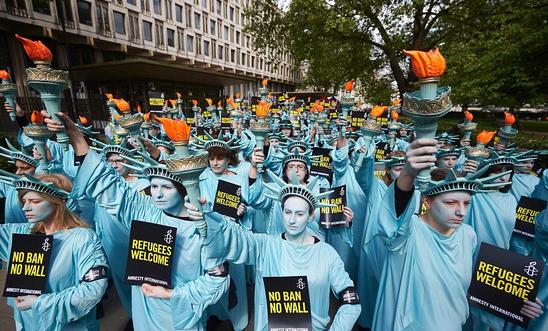
“We have placed welcome mats for refugees at the foot of Trump Tower, and filled London’s Grosvenor Square with 100 sombre Statues of Liberty standing in silent protest at the US Embassy.  

“From Sydney to Madrid, human rights defenders have made it known that the politics of hate and fear have no place in the world we wish to build for ourselves and our children.

A year of human rights violationsAmong other things in the past year, Amnesty has strongly criticised the Trump administration’s plan (reported earlier this week) to consider using nuclear weapons in response to a cyber-attack in the USA; the ending of “Temporary Protected Status” for over 250,000 people from El Salvador in the USA; the decision to recognise Jerusalem as the capital of Israel, its insistence on pushing ahead with a revised multi-country travel ban; an executive order affecting the Mexico-USA border which allows for the forcible return of people to life-threatening situations;  the withdrawal from the Paris Agreement on climate change; the reinstatement of the “global gag rule”affecting funding for international women’s health programmes; its continued sale of military equipment to countries with poor human rights records; and the decision to continue the construction of the Dakota pipeline despite environmental and cultural concerns. 

Gambia: Yahya Jammeh’s ex minister continues his detention in Switzerland

January 17, 2018
Yahya Jammeh campaign
Then-incumbent Gambian President Yahya Jammeh arrives escorted by his bodyguards for an electoral rally on November 24, 2016.  MARCO LONGARI/AFP/GETTY

Ousman Sonko, a former interior minister of Gambia suspected of human rights abuses who was arrested in January 2017, will have to remain in Swiss detention, the Swiss Federal Tribunal has ruled. Switzerland’s highest court has rejected an appeal by Sonko’s lawyers against a second prolongation of his detention. The Federal Tribunal said in a decision published in December that Sonko was still under urgent suspicion. As in a previous judgement on an appeal by Sonko, judges said they based their decision on independent reports by United Nations special observers on Gambia. These observers had not yet been questioned by the Office of the Attorney General (OAG) and the OAG also needed to go through files obtained from Gambia during the mutual assistance procedure, the latest judgement said. Trial International, an international justice organisation, accused Sonko of having personally taken part in what it described as torture between 2006 and 2016. Sonko served under ousted Gambian leader Yahya Jammeh. “As the head of detention centers, Sonko could not have ignored the large-scale torture that political opponents, journalists and human rights defenders suffered there,” said Benedict de Moerloose of TRIAL in a statement in 2017. 

Barrow, the new President, had stated that he plans to install a truth and reconciliation commissionin the country in order to take account of alleged abuses under Jammeh, before deciding whether to attempt to prosecute the former president. In May 2017 in the wake of the launch of its global ‘brave’ campaign”, the Regional Director for West and Central Africa of AI, Alioune Tine, had called for justice for United Democratic Party (UDP) activist Ebrima Solo Sandeng, and for all victims of the Jammeh regime. “There must be justice for Ebrima Solo Sandeng and for all victims,” Alioune Tine told Freedom Newspaper. Alioune Tine said that, during his meeting with President Adama Barrow, he received assurances from the Gambian leader that there would be ‘zero tolerance’ for human rights abuses.

See also: https://humanrightsdefenders.blog/2014/05/10/indian-star-celina-jaitly-shows-erykah-badu-the-way/

————–

https://www.swissinfo.ch/eng/ousman-sonko_gambian-ex-interior-minister-to-remain-in-custody/43758596

http://www.newsweek.com/adama-barrow-yahya-jammeh-exile-gambia-547615

http://www.newsweek.com/gambia-yahya-jammehs-ex-minister-detained-switzerland-crimes-against-humanity-549075

https://freedomnewspaper.com/2017/05/19/gambia-alioune-tine-calls-for-justice-for-solo-sandeng-as-amnesty-launches-new-gobal-campaign/

2017: a year to forget for human rights defenders – but don’t forget the human rights defenders

December 31, 2017

A bad year for human rights defenders comes to an end and it is fitting to so with drawing your attention (again) to Amnesty International‘s BRAVE campaign which has branded 2017 as a “bad year to be brave”. Since the adoption of the UN Declaration on Human Rights Defenders in December 1998, at least 3,500 activists have been killed – an average of 180 deaths a year – and the annual death toll shows no sign of diminishing. [e.g. in 2014, Front Line Defenders recorded 136 killings of human rights defenders; in 2016 that number had risen to 281 – and this year is set to be the deadliest year yet – see also my post: https://humanrightsdefenders.blog/2017/07/13/stop-the-killings-you-can-help-front-line/].

In the Brave campaign Amnesty highlighted a number of high profile deaths in 2017:

Amnesty warned of a wider “open season” on activists – which has seen alarming numbers of people imprisoned, threatened, beaten and abused in attempts to silence them. [ see also: https://humanrightsdefenders.blog/2017/12/06/amnesty-just-published-major-report-on-human-rights-defenders/]

Better forget this year and put our hope in 2018, but do not forget the human rights defenders themselves who are willing to pay the price as long as we pay attention…

have a good New Year…