On 18 November 2019 the ISHR launched its new guide to the UN Special Procedures, an essential tool for human rights defenders seeking to engage more strategically with these experts, for greater impact on the ground.
ISHR’s Practical Guide to the UN Special Procedures provides an overview of the system of independent human rights experts known as the Special Procedures, and the different ways human rights defenders can make use of it to further their human rights causes. Often their independence allows them to discuss issues deemed too politically ‘sensitive’ at the international level. It also enables them to act swiftly and react publicly against human rights violations. This handbook is intended to be a practical aid to working with the Special Procedures for non-governmental organisations (NGOs) and human rights defenders. O
You can find more tips and examples of how to engage with Special Procedures in the ISHR Academy, ISHR’s e-learning space for human rights defenders looking to strengthen their advocacy skills with the UN for greater impact on the ground. Helping human rights defenders strengthen their advocacy skills with the UN
Build your advocacy skills with these tools from ISHR and from around the web
Navigating the UN
An overview of the international human rights system and the importance of civil society engagement
A quick start guide to getting the most out of the learning modules developed by ISHR
UN Human Rights Council
Understand the structure, purpose and mandate of the Human Rights Council and the opportunities for effective engagement
Special Procedures
Explore the purpose and mandates of the Special Procedures and how you can work with them to strengthen your advocacy. For more see: https://academy.ishr.ch/
Cyndi Lauper will receive the inaugural High Note Global Prize from the Office of the High Commissioner for Human Rights and the High Note Global Initiative.
For her decades of activism with LGBTQ youth, Cyndi Lauper will be awarded the inaugural High Note Global Prize presented by the United Nations Human Rights and the High Note Global Initiative at her annual Home for the Holidays concert December 10, according to Rolling Stone. For more on this award: http://www.trueheroesfilms.org/thedigest/awards/high-note-global-prize
The High Note Global Initiative stated: “In 2008, Lauper co-founded True Colors United after learning that while 10% of American youth identify themselves as LGBTQ, up to 40% of American youth experiencing homelessness do so. The organization works to prevent and end youth homelessness, focusing on the unique experiences of LGBTQ youth. In 2008, Cyndi Lauper co-founded True Colors United, a nonprofit organization that implements innovative solutions to youth homelessness that focus on the unique experiences of LGBTQ young people, who make up to 40% of the youth homelessness population in America.”
The 2019 High Note Global Prize will be presented during the High Note Honors segment of Cyndi Lauper & Friends: Home for the Holidays at the Novo Theater at LA Live on December 10th. The award will be presented to Lauper by Kesha during the concert in Los Angeles. In 2008, Lauper cofounded True Colors United (named for her smash hit song about celebrating otherness), which “implements innovative solutions to youth homelessness that focus on the unique experiences of LGBTQ young people,” according to its website. In addition to Kesha, additional celebrities supporting Cyndi at the Novo Theater on UN Human Rights Day include, Billy Porter, Brandi Carlile, Belinda Carlisle, King Princess, Charlie Musselwhite, Henry Rollins, Perry Farrell with Etty Lau Farrell, Justin Tranter, K. Flay, Emily Estefan, Shawn Wasabi, comics Carol Leifer and Lily Tomlin, U.K. comedian Gina Yashere, Margaret Cho, and Carson Kressley. Taylor Swift, Billie Eilish, Mariah Carey, Dolly Parton, Lady Gaga, Kelly Clarkson, Dua Lipa, Kacey Musgraves, RuPaul, and Tegan and Sara are among the artists who have donated items and experiences for a charity auction with 100% proceeds supporting True Colors.
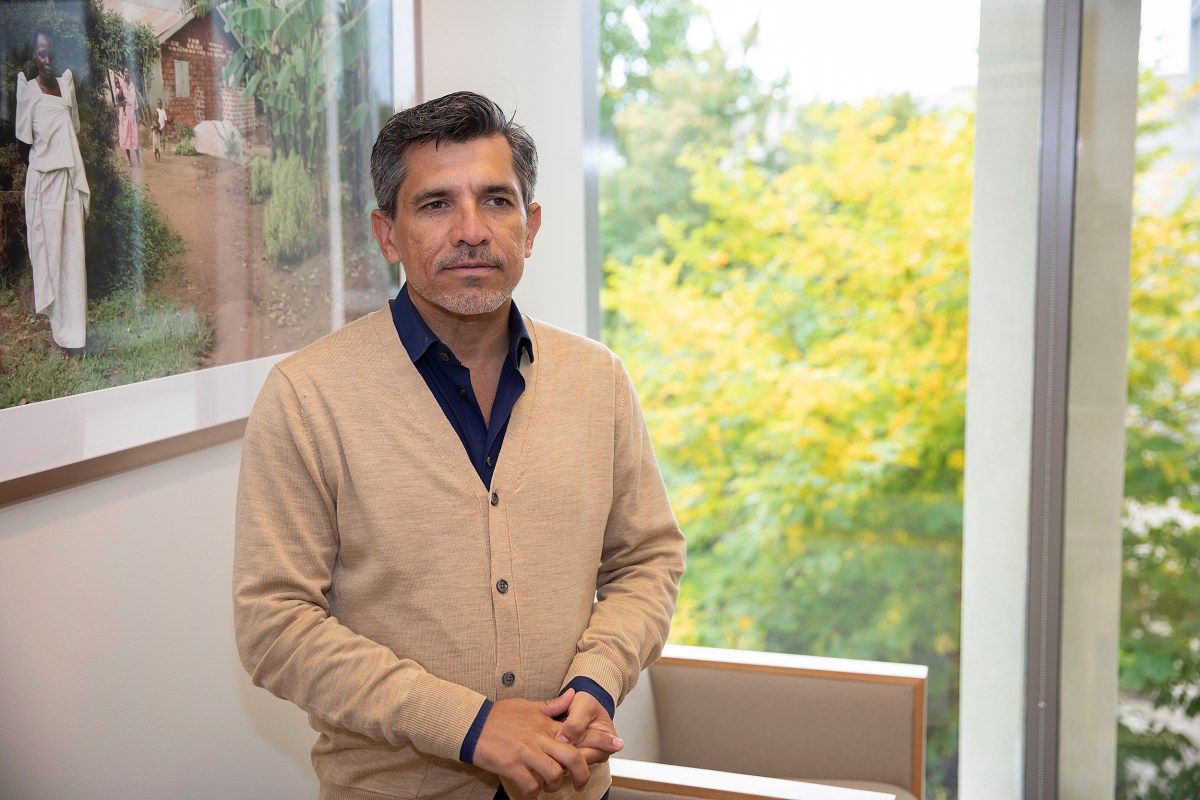
Victor Madrigal-Borloz, the U.N. independent expert, is now in residence at Harvard Law School. Kris Snibbe/Harvard Staff Photographer
Liz Mineo,Harvard Staff Writer, published on 22 October the following interview with Victor Madrigal-Borloz, the U.N. independent expert’ who examines root causes and highlights danger spots and progress
Costa Rican magistrate Victor Madrigal-Borloz has served for the past 21 months as the U.N. independent experton protection against violence and discrimination based on sexual orientation and gender identity. The Gazette interviewed Madrigal-Borloz, who is the Eleanor Roosevelt Senior Visiting Researcher with the Human Rights Program at Harvard Law School, to talk about his work and his hopes for the future:
GAZETTE: Why did you decide to take on this role?
MADRIGAL-BORLOZ: I have been working in the field of human rights for over 20 years and I saw the possibility to bring about substantial change. The topic bears a lot of significance to me, as a gay man myself. I have been working on these issues for over a decade, first at the Inter-American Commission [on Human Rights] and now at the global level. I have seen many people suffer as a result of stigma and discrimination, and this was a once-in-a-lifetime opportunity to do something about it and put my skills at the service of a cause.
GAZETTE: What did your report find in terms of the root causes of violence and discrimination against LGBT people?
MADRIGAL-BORLOZ:There are primary and secondary root cases. First, there is the notion that societies are structured around certain power relations, which have been designed in relation to a person’s sex. Your role in society is determined by your genital configuration. That’s a very basic construction, and all forms of violence and discrimination come from a defense of those power relations. The other factors come from mechanisms that aim to protect those power relations, such as the idea that gay, lesbian, or trans people don’t exist, and the stigma around them, which is enabled through the message that gay, trans, bisexual, and lesbian people are sick or mentally ill. The other aspect is criminalization. Same-sex relations are still criminalized in 69 countries, which means that, as of today, over 2 billion people live in countries where being gay or lesbian is illegal. Another factor is demonization expressed in the notion that somehow LGBT lives are sinful, immoral; that gays or lesbians cannot be good citizens. The idea is that at the end of the day, there’s something immoral about our existence, and that’s what all of us need to fight against.
GAZETTE: Of your findings, which ones struck you the most?
MADRIGAL-BORLOZ:What disturbs me is that in 2019 there are countries that are considering bringing back the death penalty for same-sex relations. There was a discussion in Uganda about it, and early this year Brunei Darussalam enacted legislation allowing the stoning of gay men. That, to me, is shocking. What I also find surprising is that there are environments that are actually extremely progressive when it comes to gender identity, but can be very restrictive when it comes to sexual orientation and vice versa. In Pakistan, for example, there is an extremely forward legislation on the recognition of gender identity, but sexual orientation is very much criminalized. Sexual orientation has always been a more challenging notion for societies, which in general have used the notion of a traditional binary, hetero-parental family as the nucleus of society, and this has been recognized in public discourse and in the law. But what we also know is that homosexuals, lesbians, and bisexuals have existed and sought happiness all throughout history.
GAZETTE: What policies or practices have been the most successful in the protection of LGBT rights?
MADRIGAL-BORLOZ: Anti-discrimination legislation with the words sexual orientation and gender identity is very important because it allows for all actors in the system to understand that a red line has been drawn and that shouldn’t be crossed. This creates the belief that lesbian, gay, trans, bisexual, or gender-diverse people are entitled to protection. Other good practices are policies aiming at promoting integration of LGBT people in society and campaigns to change hearts and minds.
Let me give you an example. About a year ago, the Inter-American Court of Human Rights issued an advisory opinion, OC-24, which determined that Costa Rica and other countries in the continent must implement same-sex marriage, and it gave a time frame for that. Despite the fact that this created great polarization in Costa Rica, the Costa Rican state has now put together a campaign called “Yes, I do,” or in Spanish, “Si, Acepto,” which focuses on the parents of gay and lesbian children and their reasons why they support gay marriage and why their children are entitled to happiness.
Another good measure is access to justice, and this means that judges have to actively seek to implement the principle of nondiscrimination when it comes to LGBT rights. That’s what the Supreme Court of India, the Supreme Court in Botswana, and the High Court in Trinidad and Tobago did when they voted to decriminalize gay sex in their respective countries.
GAZETTE:How do you explain the dramatic advances in the protection of LGBT rights in regions such as Latin America, where same-sex marriage is now legal in five countries?
MADRIGAL-BORLOZ:It’s the work of civil society and human-rights defenders and advocates who have fought relentlessly for their rights. I began working on these issues over a decade ago, and at that time the trans movement in South America was strong. An extraordinary trans activist in Argentina, Lohana Berkins, used to say that trans women must expose the audacity of their bodies to the society that fails to understand the fragility of their lives. The average life expectancy of a trans woman in Latin America is 35 years, and that’s what Berkins was talking about. It was her voice and those of other great fighters in the LGBT movement that forced people to see their humanity, and ensured that Argentina, Uruguay, and other countries in the continent have the most advanced legislation on legal recognition of gender identity.
GAZETTE:Which countries are the worst and best performers in terms of LGTB rights?
MADRIGAL-BORLOZ:I have a lot of resistance to ranking countries, because things change very fast. Most of these rights are not necessarily enshrined or written in stone; there are forces in societies that are quite keen on seeing them taken back. We live in times in which rising populism uses certain categories of people, such as LGBT communities, as pawns for their political objectives. But I can say that the most problems arise in the countries where gay sex is criminalized, and they are roughly distributed along the Caribbean, sub-Saharan Africa, some regions of Asia, and the Middle East. It’s not a small part of the world. Criminalization forces people to live underground, and often the situation of those whose existence is considered criminal is devastating. The killing of trans women, for example, has been invisible from public records because they are classified as men. And the levels of violence against lesbian women and gay men all over the world is worrisome.
GAZETTE: Why have there been more gains in protection of sexual orientation than gender identity, and what does it say about the possibility of social change?
MADRIGAL-BORLOZ:There is a certain concentration of power and influence within gay and lesbian, or cisgender, urban populations. They have been able to represent their valid agendas in the political debate. On issues of concern for the gay and lesbian urban upper and middle class, there has been more progress than on those concerning trans women or trans men coming from the countryside. But those gains show that social change is possible within one generation. Those of us who were born in the ’60s have seen the world change from a majority of countries criminalizing and pathologizing LGBT identities to a majority of countries embracing the richness that comes from diversity.
Social change is possible when the prime minister of Luxembourg speaks at the General Assembly last week, and declares “I was never hoping to be the gay prime minister. I just happen to be the gay prime minister.” When political leaders take part in a pride parade, they are changing the views that people have about LGBT people. I’ve had the honor of marching alongside Justin Trudeau in Vancouver, and the first lady of Costa Rica in pride parades. That makes me hopeful, but also the fact that the new generations have changed their paradigm of thinking; they embrace the notion that their existence is not determined by rigid notions of gender. That is a great source of inspiration.
But I worry that for some, the change will not come fast enough. Elderly LGBT people are suffering enormous health disparities, and after living their lives in inclusive environments, they are being forced to go back into the closet as they move to retirement communities that are not prepared to cater for their needs. They deserve happiness now.
GAZETTE: What would you like to see happening before your tenure as the U.N. independent expert ends in 2020?
MADRIGAL-BORLOZ:My dream is to see a world free of criminalization of same-sex relations by 2030. Given the fact that international human rights law considers criminalization of same-sex relations a violation of human rights, I see no reason why states would actually get away with continuing this practice past 2030. That’s what I like to dream about.
On 18 October 2019 the UN High Commissioner for Human Rights urged Egypt to immediately release scores of citizens who have been arrested in connection with recent anti-government demonstrations in several cities. Civil society groups report more than 2,000 people were detained before, during and after the protests on 20 September, which prompted the UN High Commissioner for Human Rights, Michelle Bachelet, to express concern about reports of lack of due process. On Friday her office reported that the arrests are continuing, with a number of well-known and respected civil society figures affected, some of whom have been accused of terrorism. “Once again, we remind the Egyptian Government that under international law people have a right to protest peacefully, and a right to express their opinions, including on social media. They should never be arrested, detained – let alone charged with serious offences such as terrorism – simply for exercising those rights”, spokesperson Ravina Shamdasani told journalists in Geneva.
The abduction, arbitrary detention and torture of human rights defender and journalist Esraa Abdelfattah is another indication that Egyptian authorities are stepping up brutality against human rights defenders in a bid to ‘terrorize’ critics and opponents, said Amnesty International today. Esraa Abdelfattah was assaulted and abducted by security forces in plainclothes on 12 October. The next day she described to the Supreme State Security Prosecution how she was tortured by officers who beat her, attempted to strangle her and forced her to stand for nearly eight hours. “Esraa Abdelfattah’s account of torture, coming just days after the prominent activist and blogger Alaa Abdel Fattah described a similar ordeal in custody, is an alarming indication that Egypt’s authorities are stepping up their use of brutal tactics to crack down on human rights defenders,” said Najia Bounaim, North Africa Campaigns Director at Amnesty International.
Prominent blogger Alaa Abdel Fattah as well as his lawyer, Mohammed El-Baqer are currently being held at the Tora Maximum Security Prison, south of Cairo. Both have been accused of belonging to a terrorist group, funding terrorism, spreading false news that undermines national security and “using social media to commit publishing offices”, the UN human rights office said. [see also: https://humanrightsdefenders.blog/2019/01/08/bloggers-and-technologists-who-were-forced-offline-in-2018/]
On 28 September the High Commissioner had already urged the “authorities to radically change their approach to any future protests’.
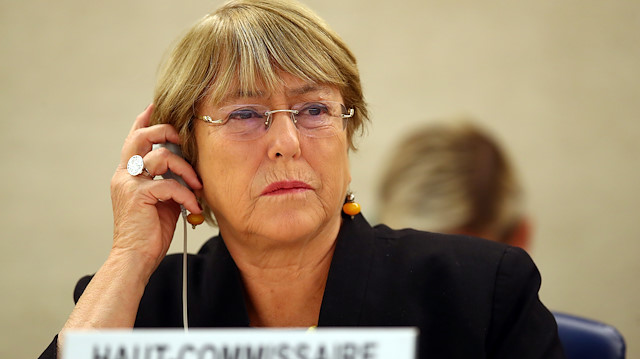
U.N. High Commissioner for Human Rights Michelle Bachelet Photograph: DENIS BALIBOUSE
More than 2,000 people were detained, including lawyers, human rights defenders, political activists, university professors and journalists on 20-21 September, she said. The Egyptian Foreign Ministry spokesperson stressed that there no citizen in Egypt is arrested or prosecuted for carrying out legitimate activities or criticizing the Egyptian government, but for violating the law. He added that the right to peaceful demonstration is guaranteed in accordance with the Constitution and the law. Hafez stressed that the OHCHR report was based on undocumented information, which only leads to falsehoods as the allegations contained in it are based on wrong ideas, and this hasty judgment reflects a lack of professionalism. He added that any actions taken against any person is done in accordance with the law and through sound legal procedures, all carried out with transparency and clarity.
In addition on 3 October 2019 it was reported in the New York Times that a series of sophisticated cyberattacks targeting Egyptian journalists, academics, lawyers, opposition politicians and human rights activists has been traced to Egyptian government offices, a cybersecurity firm has found. The attackers installed software on the targets’ phones that enabled them to read the victims’ files and emails, track their locations, identify who they contacted and when, according to a report to be published Thursday by Check Point Software Technologies, one of the biggest cybersecurity companies in the world, with headquarters just south of San Francisco and in Tel Aviv.
The cyberattack began in 2016, according to the Check Point report. The number of victims is unknown but Check Point identified 33 people, mostly well-known civil society and opposition figures, who had been targeted in one part of the operation. “We discovered a list of victims that included handpicked political and social activists, high-profile journalists and members of nonprofit organizations in Egypt,” said Aseel Kayal, a Check Point analyst.
Several activists targeted by the cyberattack were arrested as part of a crackdown on antigovernment protests. They include Hassan Nafaa, left, a political scientist at Cairo University, and Khaled Dawoud, a former journalist and leader of the secular Constitution Party. CreditAgence France-Presse — Getty Images
“We are witnessing an increase in xenophobia, hate speech, push-backs on women’s equality and the rights of minorities,” warned Michelle Bachelet, United Nations High Commissioner for Human Rights, also highlighting the ever-widening gaps in global wealth and access to resources. Moreover, underfunding has hampered the growing workload of the entire treaty body system, she said. Committees do not have adequate resources to carry out inquiries into grave or systematic violations. This results in a “credibility crisis” for all treaty bodies — and a denial of justice for the victims of human-rights violations.
Among the day’s three other briefers was Obiora Chinedu Okafor, Independent Expert on human rights and international solidarity, who focused on the issue of human-rights based solidarity in global refugee protection. The current refugee “crisis” was not caused by large numbers of refugees, but rather by States’ unwillingness to accept refugees into their countries — evading their responsibilities. Moreover, the rise of extremist political parties is complicating the issue, he said, as the “alternative right” and other racist civil society groups target any kind of solidarity with refugees. Echoing those words, the Russian Federation’s delegate noted that certain extremist political parties are impeding the entry of refugees into the European Union, and that the Independent Expert’s report lay the blame for this squarely at the feet of foreign interference in internal State affairs.
In his presentation, Michel Forst, Special Rapporteur on the situation of human-rights defenders, highlighted that 431 defenders were killed in 2017 and 2018. With that in mind, combating impunity is not only a legal obligation of States, but also a moral one. He further noted that “98 per cent of the killings of rights defenders remain unpunished” and that unless impunity is ended, the violence against them will continue. A zero-tolerance policy towards such attacks must be adopted, and the lack of political will — and of State recognition of rights defenders — addressed. Reacting to those comments, several delegates raised questions about digital attacks on human-rights defenders, with Germany’s representative underscoring that female defenders of human rights often face particular threats, such as the publication of private information. Mr. Forst responded that he has found research by the Special Rapporteur on freedom of association and the Special Rapporteur on freedom of expression helpful in this context, with a particular focus on advocating for social network businesses to provide better protections. To concerns raised by an observer for the State of Palestine and the representative of Georgia, he noted that his subsequent report will make specific proposals to assist defenders living in fragile States, as well as those living in conflict or post-conflict situations. On defenders who live in isolated areas, he said they are often not given sufficient attention by the international community. Ambassadors should leave their capitals and go into these far-flung areas to see where these defenders work, he said. Those who work on sexual and reproductive health and rights often bear the brunt of attacks, while those working on gender identity are harassed and threatened
The Special Rapporteur on the rights to freedom of peaceful assembly and of association, Clément Nyaletsossi Voulé, also presented his report.
The Opening statement by UN High Commissioner for Human Rights, Michelle Bachelet, at the 42nd Session of the UN human Rights Council in Geneva on 9 September 2019 was widely reported in the media as having an exceptionally strong focus on climate change and human rights.
The crucial paragraph on environmental human rights defenders is quoted below:
On the occasion of first International Day Commemorating the Victims of Acts of Violence Based on Religion or Belief – 22 August – a large group of UN independent experts (see names below) issued a statement saying that States have an important role to play in promoting religious tolerance and cultural diversity by promoting and protecting human rights, including freedom of religion or belief. The experts urged States to step up their efforts to combat intolerance, discrimination and violence against people based on religion or belief, including against members of religious minorities and people who are not religious.
Any distinction, exclusion, restriction or preference based on religion or belief which has the effect of nullifying or impairing the recognition, enjoyment or exercise of human rights and fundamental freedoms on an equal basis would amount to religious intolerance and discrimination. This was made clear in the 1981 General Assembly Declaration on the Elimination of All Forms of Intolerance and of Discrimination Based on Religion or Belief.
We have observed violence in the name of religion around the world perpetrated by States and non-state groups leading to discrimination, persecution, arbitrary arrests or detention, enforced disappearances, sexual violence and killings of many people based on their religion or belief. Victims have included religious minorities, individuals who are not religious, LGBTI persons, children and women who face many forms of discrimination and gender-based violence. Such violence threatens the hard-fought progress in securing women’s equality and the rights of LGBTI persons.
“We stress that religion or belief should never be used to justify discrimination. When faced with religious persecution or discrimination, victims are often also deprived of their right to participate fully in political, economic and cultural life, as well as their rights to education and to health. This can include the desecration and destruction of numerous cultural heritage sites of rich historic and religious value, such as places of worship and cemeteries.
As populism has become a trend in the political and social arena, it has fostered many forms of hatred against those who are viewed as foreign or simply different. Often, States and religious institutions resort to the instrumentalisation of religions or beliefs in order to retain their influence or control and achieve other political agendas. Fundamentalism is on the rise across the world’s major religious traditions, posing a threat to many human rights. Moreover, critical views of religions or beliefs are sometimes mischaracterised as ‘hate speech’ or labelled an offence to the religious feelings of others both by governments and non-state groups. Too often this is used as a pretext to silence those with critical voices and punish others for not believing.
The right to freedom of thought, conscience, and religion or belief is misunderstood as protecting religions and beliefs instead of the people with the beliefs and those without. It is incumbent on States to ensure that religions or beliefs are not used to violate human rights, and to combat religious extremism – which are a threat to many human rights, while adhering to international norms.
States have resorted to the securitisation of religion or belief, or viewing them through a lens of national security, in their fight against violent extremism. But an overly securitised approach has proven to be counterproductive and has led to xenophobia, increasing ‘religious profiling’ and discrimination, particularly towards religious minorities….
We urge States and all individuals and groups to work together to enhance the implementation of international human rights standards that protect individuals against discrimination and hate crimes, and to increase interreligious, interfaith and intercultural initiatives, and expand human rights education in an inclusive manner as a key catalyst for change.”
Speaking to Al Jazeera on Tuesday 20 August 2019, OHCHR spokesman Rupert Colville confirmed the body’s decision to postpone the Conference on Defining and Criminalising Torture in Legislation in the Arab Region. “We still plan to hold it in the Middle East/North Africa region, as for obvious reasons it is likely to have more impact within the region itself than if it is held in some more distant venue in Europe or elsewhere,” Colville said. He added that the UN “will consult widely with NGOs and national human rights institutions before deciding where and when it will now be held“.
Yousef Saba reported for Reuters on 15 August 2019 that human rights defenders criticized a United Nations decision to hold a conference in Cairo on torture (“Defining and Criminalizing Torture in Legislation in the Arab Region”) with an Egyptian state organization. “It’s illogical for a country where torture is systematic to host a conference on torture,” said Mohamed Zaree of the non-government Cairo Institute for Human Rights Studies. [see: https://humanrightsdefenders.blog/2017/10/10/breaking-news-egyptian-defender-mohammed-zaree-laureate-of-the-martin-ennals-award-2017/] “Egypt must be excluded as a place, or as the Egyptian regime, from hosting any forum or event related to human rights,” Zaree said.
The U.N. Office of the High Commissioner for Human Rights will co-host the regional conference with the government’s National Council for Human Rights (NCHR) on 4-5 September. Some 80 participants, both government and non-governmental, from 19 Arab countries are expected to attend. U.N. human rights spokesman Rupert Colville, who in February had said torture was endemic in Egypt, told Reuters: “It is a fairly standard type of event.”…
Gamal Eid, director of the Arab Network for Human Rights Information, said the idea of Egypt hosting such an event was a joke. “More ironic is that this is through the National Council (for Human Rights), the role of which is to always polish the government’s image and complicity in the human rights situation,” he said. NHCR president Mohamed Fayek will give a welcome address at the conference’s opening ceremony, according to an agenda seen by Reuters….In 2017, Egypt raided and shut down the Nadeem Center, which documented alleged human rights abuses and treated torture victims.
In the meantime on 19 August 2019 the NGO EuroMed Rights announced that it has declined the invitation and in an open letter addressed to UN High Commissioner, Ms Michelle Bachelet, EuroMed Rights expresses its deep reservations about the decision to hold this conference in Egypt, a country where torture is systematically practised by the security forces, and in collaboration with the Egyptian National Council for Human Rights, which acts under the auspices of the government. The letter recalls that detainees and prisoners in Egypt are frequently subjected to abuses which amount to torture, including electric shocks, beatings, suspension by limbs and rape. Read full letter here
In an environment where short-term and national interests are taking over, UN institutions are under attack….Michelle Bachelet, United Nations High Commissioner for Human Rights, and Coly Seck , President of the Human Rights Council, will discuss the importance and contribution of UN institutions to ensure that each country upholds and promotes human rights. WEDNESDAY 4 SEPTEMBER, 18h00 – 19h30 in Auditorium Ican Pictet, Maison de la Paix, Geneva, organised by the Graduate Institute of International and Development Studie.
Michelle Bachelet has been the United Nations High Commissioner for Human Rights since September 2018. She was the first female President of Chile and elected for two terms (2006–2010 and 2014–2018). She also served as the first Director of UN Women, Health Minister of Chile, and was Chile’s and Latin America’s first woman Defense Minister.
Coly Seck is President of the 13th Cycle of the Human Rights Council, serving a one-year term beginning 1 January 2019. He is the Permanent Representative of Senegal to the United Nations Office in Geneva since October 2016.
This discussion will be moderated by Vincent Chetail, Professor of International Law, Head of the International Law Department and Director of the Global Migration Centre at the Graduate Institute, and will then be followed by a Q&A with the public. This conference is organised in partnership with the Club Diplomatique de Genève.





 Hans Thoolen on Human Rights Defenders and their awards