On 29 May 2020 the UN Human Rights Council adopted a decision appealing to States to ensure human rights were at the front and centre of national responses to the pandemic and not side-lined while contending with the multiple ill effects of the virus on their societies.
“Today’s decision is a profound reminder of the far-reaching effects of this deadly virus on all aspects of our livelihoods and our rights which we cannot take for granted”, stated Council President Elisabeth Tichy-Fisslberger. “We are all in this together, and we must act together with a sense of purpose if we are going to achieve our common agenda to promote and protect human rights around the globe”, she added.
The President’s Statement, presented by Ambassador Tichy-Fisslberger, and adopted by the 47 member States of the human rights body by silence procedure, “calls upon States to ensure that all human rights are respected, protected and fulfilled while combatting the pandemic and that their responses to the COVID-19 pandemic are in full compliance with their human rights obligations and commitments”.
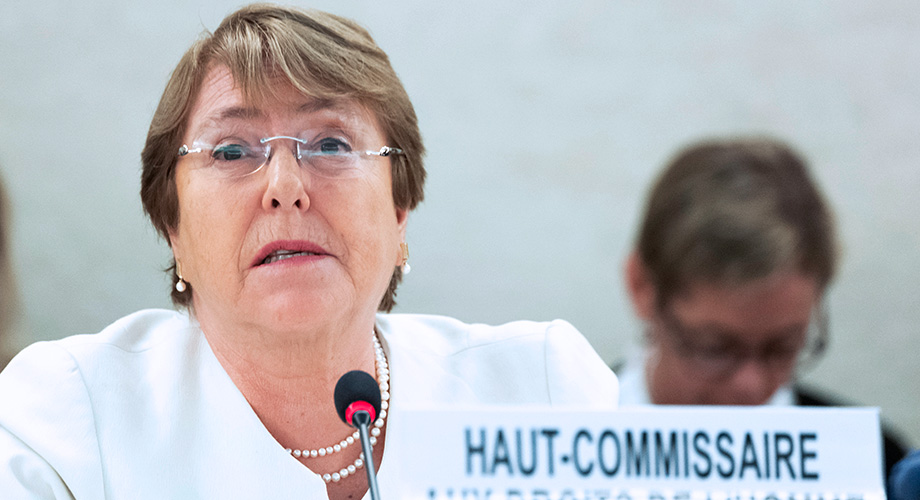
The adopted statement also calls on High Commissioner for Human Rights Michelle Bachelet to produce a report on the impact of the COVID-19 pandemic on the enjoyment of human rights around the world, including highlighting good practices and areas of concern, to be presented at the 46th session of the Human Rights Council scheduled to take place in February/March 2021. [One is to hope that it will include a hard look at the fragmentation of Covid-19 relate policy statements, see: https://humanrightsdefenders.blog/2020/05/27/proliferation-of-human-rights-bodies-guidance-on-covid-19/]
States also invited the High Commissioner to present an oral update on the human rights impact of COVID-19 at the 44th session of the Council which is still scheduled to start on 22 June, which is expected to set the tone for similar statements addressing the multiple human rights angles of the virus during the planned three-week meeting. Since suspending its 43rd session on 13 March due to coronavirus restrictions, the Human Rights Council has been conducting its business in a virtual manner holding regular Bureau meetings, with States and NGOs, and three “virtual informal conversations”, including with the High Commissioner and Special Procedures who have issued more than 90 press releases and statements addressing COVID-19.
Having just posted a report on the prolifiration of intergovernmental responses to the Corona virus pandemic [https://wp.me/pQKto-4ob], it perhaps good to point to the webinar that Business & human rights is organising on 4 June 2020 on Risks and Protection of Human Rights Defenders.
This webinar will have a focus on the risks and protection of HRDs, particularly labour rights and land/environmental defenders and ensuring their participation in the post-pandemic recovery.
It will have two parts: a closed and an open session. The closed session – happening on Jitsi – will be a safe space for civil society organisations, human rights defenders, including labour rights and land and environmental defenders, labour unions, and journalists to jointly define practical recommendations on what governments and companies can do to address human rights situation, particularly of labour, land, environmental defenders and civic freedoms, in the context of COVID-19. This part of the webinar is invite-only.
The second part – happening on Zoom – will be an open session, will be an opportunity for civil society, defenders, and journalists to interact with government and business representatives and discuss how companies, governments and civil society can work together to ensure all stakeholders are able to shape recovery efforts, and make sure they are human rights compliant. Anyone is free to join us in the public session by RSVP-ing below.
Event details
Event type
Webinar
Location
Online (Jitsi & Zoom)
Organisation
The Asian Forum for Human Rights and Development & Business & Human Rights Resource Centre
On 22 May 2020 Lisa Reinsberg in “Just Security” [see: https://www.justsecurity.org/about-us/) published a post ” Mapping the Proliferation of Human Rights Bodies’ Guidance on COVID-19 Mitigation“. It is in some ways rather critical of the response by intergovernmental bodies in the human rights area when it comes to the COVID-19 pandemic. It starts by pointing out that they have collectively put out more than 150 statements on respecting human rights during the pandemic since late February. ..To help those interested in keeping track of the many statements, the International Justice Resource Center (IJRC) has published a webpage – COVID-19 Guidance from Supranational Human Rights Bodies – listing and linking to all relevant press releases and other guidance. This article serves to provide an overview of – and initial response to – the nature, scope, and sources of human rights advice available to States in the context of the pandemic. Having myself contributed with my blog to the proliferation of policy repsonse by NGOs and IGOs, I feel that this piece deserves full citation:
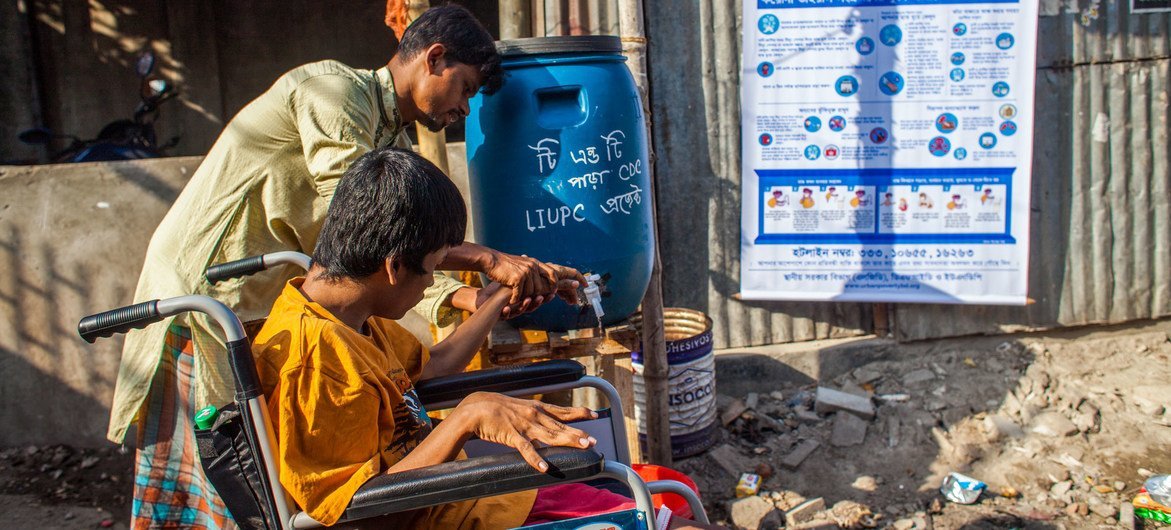
UNDP Bangladesh/Fahad Kaizer – In Bangladesh, the UN Development Programme and partners have rolled out emergency support to vulnerable communities.
New guidance issued on 30 April 2020 sets out key actions, to counter what the UN High Commissioner for Human Rights has called the “double risk” faced by persons with disabilities in the COVID-19 pandemic. As Michelle Bachelet explained, not only are people with disabilities at higher risk because of the crisis, they also are disproportionately affected by response measures such as lockdowns. “People with disabilities are in danger in their own homes, where access to day-to-day support and services may be limited due to lockdowns, and some may suffer greatly from being isolated or confined”, she said. “Persons with disabilities face even greater threats in institutions, as care facilities have recorded high fatality rates from COVID-19 and horrific reports have emerged of neglect during the pandemic.”
The UN rights chief added that making information about the virus available in accessible formats is vital. She also expressed concern over discrimination and stigma at this unprecedented time. “I have been deeply disturbed by reports that the lives of persons with disabilities may somehow be given different weight than others during this pandemic”, she said. “Medical decisions need to be based on individualized clinical assessments and medical need, and not on age or other characteristics such as disability.”
The guidance note published by the UN human rights office outlines steps governments and stakeholders can take during the pandemic. They range from discharging persons with disabilities from institutions, to increasing existing disability benefits, and removing barriers to COVID-19 treatment. Prioritizing testing and promoting preventive measures within institutions to reduce infection risk are other recommendations. Additionally, the guidance spotlights promising practices already in place in some countries. For example, in Switzerland and Spain, some persons with disabilities living in institutions were moved out to be at home with their families, while authorities in Canada have issued priority COVID-19 testing guidelines with specific measures for these settings.
UN High Commissioner for Human Rights, Michelle Bachelet, condemned the abuse of emergency powers to commit human rights violations in the name of preventing the spread of COVID-19. “[Emergency powers] need to be necessary, proportionate, and non-discriminatory,” says the statement. “They also need to be limited in duration and key safeguards against excesses must be put in place.”
During the ongoing pandemic, the exercise of emergency powers has been used as an excuse for unlawful detention, restriction of movement and suppression of press freedoms, according to Bachelet. The International Press Institute (IPI), a press freedoms watchdog, reports that many nations have silenced journalists under the pretext of stifling “fake news.” The IPI maintains a list of international media freedom violations occurring as a result of emergency powers abuses.
In Cambodia the application of emergency powers in response to the COVID-19 pandemic have resulted in the unlawful detention of those who disobey the emergency measures for up to 10 years in a move Amnesty International called “a naked power grab which seeks to manipulate the COVID-19 crisis in order to severely undercut human rights.” Further human rights abuses are reported from El Salvador, where grocery shoppers were unlawfully detained when President Nayib Bukele defied a Supreme Court order in their defense. In Central Asia, Amnesty International reports massive expansion of police powers through emergency powers granted during the pandemic.
“Given the exceptional nature of the crisis, it is clear States need additional powers to cope,” Bachelet’s statement concluded. “However, if the rule of law is not upheld, then the public health emergency risks becoming a human rights disaster, with negative effects that will long outlast the pandemic itself.”
police beats a man with his stick during a government-imposed lockdown in Siliguri, India. Photographer: Diptendu Dutta/AFP via Getty Images
In the context of policy response by Human Rights NGOs to COVID-19 this joint statement should not be missing: On 9 April 2020 Reliefweb published the Joint NGO statement on civil and political rights at First Virtual Informal Dialogue with the UN High Commissioner for Human Rights on COVID-19
This joint statement on the protection of civil and political rights in the context of the COVID-19 crisis was delivered on behalf of 33 non-governmental organizations (NGOs) during the first virtual informal briefing with the UN High Commissioner for Human Rights on 9 April 2020. It was delivered in conjunction with a separate joint statement on economic, social and cultural rights (IOR 40/2124/2020).
Chadema party MPs Halima Mdee, Ester Matiko and Ester Bulaya attend a press conference after being released from Segerea prison in Dar es Salaam, Tanzania, on March 12. PHOTO | AFP
According to BOB KARASHANI in the East African of 4 April 2020 Tanzania‘s Foreign Affairs ministry has hit out at the United Nations Human Rights Office for criticising the country’s human rights record as it heads to the October general election. According to the ministry’s Permanent Secretary Col Wilbert Ibuge, the statement issued by the Geneva-based UN agency on March 17, was biased, with unsubstantiated allegations, and an attempt to both malign Tanzania’s international reputation and intrude on its sovereignty. Col Ibuge said that before going public, the agency should have first raised its concerns with the government for clarification “which would have been duly and graciously provided.”
The UN recently called the sentencing of several opposition leaders on charges including sedition and unlawful assembly “further troubling evidence” of a crackdown on dissent and stifling of public freedoms in the country. It accused the government of using the country’s criminal justice system to target its critics, and called on Tanzania to “immediately lift” a four-year ban on political rallies ahead of the October election. “The democratic and civic space has shrunk to almost nothing in Tanzania,” the agency said.
Intentionally shutting down or restricting access to the internet violates multiple rights and can be deadly during a health crisis such as the COVID-19 pandemic, Human Rights Watch said on 31 March 2020. Governments that are currently imposing an internet shutdown, such as Bangladesh, Ethiopia (it just announced restoring service), India, and Myanmar, should lift them immediately to save lives. During a health crisis, access to timely and accurate information is crucial. People use the internet for updates on health measures, movement restrictions, and relevant news to protect themselves and others.
“Internet shutdowns block people from getting essential information and services,” said Deborah Brown, senior digital rights researcher and advocate. “During this global health crisis, shutdowns directly harm people’s health and lives, and undermine efforts to bring the pandemic under control.” For people around the world staying at home, either willingly or because of government restrictions, the internet is critical to communicate with doctors, family, and friends. For many children and others seeking an education, it is needed to continue learning as schools shutter around the world.
[Internet shutdowns have become increasingly common in recent years, usually during tense periods, such as elections, anti-government protests, or armed conflicts. Thirty-three countries enforced 213 internet shutdowns in 2019, according to Access Now. Government justifications ranged from a need to combat fake news to public safety and national security.[
The Wire (India) and other news outlets have written about the controversy ‘created’ around the UN High Commissioner for Human Rights’ intervention (Amicus Brief) in the Indian Supreme Court against the Citizenship Amendment Act(CAA). In response, the Indian government has claimed that no foreign party has “locus standi” on CAA as it pertains to Indian sovereignty.
In a statement on Tuesday, ministry of external affairs spokesperson Raveesh Kumar said that India’s permanent mission in Geneva was informed “yesterday evening by the UN High Commissioner for Human Rights that her Office had filed an Intervention Application in the Supreme Court of India in respect to the 2019 Citizenship Amendment Act (CAA)”. The CAA, passed by the Indian parliament in December 2019, seeks to grant fast-track citizenship to non-Muslim migrants from Pakistan, Bangladesh and Afghanistan who arrived in India on or before December 31, 2014. The CAA had led to widespread protests in India, starting with northeastern states. The UN human rights commissioner has highlighted several times that CAA would be discriminatory and violates India’s commitments made under international law. The UN stated that the High Commissioner has “has great respect for the Indian Supreme Court’s independence and importance, and in accordance with similar interventions in domestic jurisdictions by the High Commissioner and her predecessors, the amicus curiae will focus on providing an overview of relevant and applicable international human rights standards and norms to support the Court’s deliberations in the context of its review of the CAA”.
After India was informed about OHCHR’s intention, Kumar asserted CAA was an “internal matter of India and concerns the sovereign right of the Indian Parliament to make laws”. “We strongly believe that no foreign party has any locus standi on issues pertaining to India’s sovereignty,” he added.
That reaction seems rather overblown. The Supreme Court is hearing a total of 143 petitions seeking to examine the constitutional validity of the Citizenship Amendment Act. Foreign governments and nationals have been parties to several legal cases in the Indian court system. (The Supreme Court is currently hearing a petition filed in 2017 against the Indian government’s plan to deport all Rohingya Muslims, estimated to be around 40,000, back to Myanmar. On January 10, UN special rapporteur on contemporary forms of racism, racial discrimination, xenophobia and related intolerance E. Tendayi Achiume filed an application seeking to intervene in the ongoing case, which is being heard by a three-judge bench headed by Chief Justice S.A. Bobde. Earlier in the Italian marines case, the Italian ambassador had filed a petition challenging the jurisdiction of the Indian police after the arrests of the marines for the killing of Indian fishermen off the coast of India.)
In her draft application, Bachelet sought to intervene as an amicus curiae “by virtue of her mandate to inter aria protect and promote all human rights and to conduct necessary advocacy in that regard, established pursuant to the United Nations General Assembly resolution 48/141”. She noted that the office of the UN human right chief had filed amicus curiae briefs within proceedings before diverse jurisdictions, including International Criminal Court, US Supreme Court and final appeal courts in Asia and Latin America.
Lisa Schlein reported on 3 March 2020, for the VOA from Geneva, that the United Nations has canceled hundreds of human rights events because of coronavirus concerns in accord with the Swiss government’s decision to ban all public gatherings of more than 1,000 people. In announcing the decision, the president of the U.N. Human Rights Council, Elisabeth Tichy-Fisslberger, tells delegates she has received an urgent letter from the U.N. director-general in Geneva, spelling out measures that have to be taken in light of the coronavirus situation. “The director-general specified that that would entail canceling all side events and encouraging representatives to refrain from traveling to Geneva for the rest of the session,” said Tichy-Fisslberger. She also suggested that those special procedure mandate holders who are not already in Geneva could be encouraged to participate in the session via video conferencing.
Human Rights spokesman Rolando Gomez says 200 side events will be canceled until the end of this council session on March 20. He says that is an unfortunate, but responsible measure to take in order to prevent the coronavirus from spreading. He tells VOA the meetings generally attract on average 4,000 to 6,000 participants during the course of the session. He says those side events are very important.
“I should point out just as a technical note they are not official council side events,” said Gomez. “They take place in parallel and they are important as they inform the discussions in the formal proceedings. Of course, those lobbying efforts will continue unabated, which are important.” Side events are organized by non-governmental organizations and states. The Office of the U.N. High Commissioner for Human Rights also has spent a lot of time and effort in organizing several gatherings aimed at exploring particular aspects of human rights that demand a more comprehensive hearing and analysis. They will not be held.