Archive for the 'Human Rights Council' Category

UN rapporteurs decry Saudi Arabia’s use of anti-terror laws against human rights defenders

January 3, 2018

Independent Expert on Human Rights Michel Forst. Photo: Jean-Marc Ferré

On 2 January 2018 a group of four UN Special Rapporteurs (Michel ForstMr.  David Kaye, Ahmed Shaheed and Fionnuala D. Ní Aoláin) joined by José Antonio Guevara Bermúdez, Chair-Rapporteur of the Working Group on Arbitrary Detention) deplored Saudi Arabia’s continued use of counter-terrorism and security-related laws against human rights defenders and urged the release of all those detained for peacefully exercising their rights.

We are witnessing the persecution of human rights defenders for peacefully exercising their rights to freedom of expression, assembly, association and belief, as well as in retaliation for their work. The Government has ignored repeated calls by UN experts and others to halt these violations, rectify them, and prevent their recurrence.”

More than 60 prominent religious figures, writers, journalists, academics and civic activists are reported to have been detained in a wave of arrests since September, adding to a list of past cases which had already been raised by UN experts with the Government. “We have written to the Government requesting detailed information about these numerous arrests on terrorism, cyber-crime or any other state security-related charges during that period,” the experts said.

The experts noted that they are also seeking government clarification about how these measures are compatible with Saudi Arabia’s obligations under international human rights law, as well as with the voluntary pledges and commitments it made when seeking to join the UN Human Rights Council. “Despite being elected as member of the Human Rights Council at the end of 2016, Saudi Arabia has continued its practice of silencing, arbitrarily arresting, detaining and persecuting human rights defenders and critics,” they said.

In addition to previous cases and new arrests since September, the experts pointed to the country’s failure to implement two recent opinions of the UN Working Group on Arbitrary Detention, calling for “the release of all the human rights defenders concerned in these cases.”

See also: https://humanrightsdefenders.blog/2017/02/28/saudi-arabia-imprisoned-waleed-abu-al-khair-receives-another-human-rights-award/

http://www.ohchr.org/EN/NewsEvents/Pages/DisplayNews.aspx?NewsID=22570&LangID=E

Last straw?: U.N. Human Rights Rapporteur Barred By Myanmar

December 21, 2017

 Yanghee Lee, U.N. human rights special rapporteur to Myanmar, talks to journalists during a news briefing in Yangon, Myanmar, in July 2017.

Yanghee Lee, the U.N. special rapporteur on Myanmar, says she has been told that the Myanmar government will neither cooperate with her nor grant her access to the country for the remainder of her tenure. Lee was scheduled to visit Myanmar in January to assess human rights in the country, particularly in western Rakhine state, where the Rohingya are concentrated.

I am puzzled and disappointed by this decision by the Myanmar Government,she said in a statement.This declaration of non-cooperation with my mandate can only be viewed as a strong indication that there must be something terribly awful happening in Rakhine, as well as in the rest of the country.” “Only two weeks ago, Myanmar’s Permanent Representative informed the Human Rights Council of its continuing cooperation with the UN, referencing the relationship with my role as Special Rapporteur,” Lee said. Amnesty International called Myanmar’s decision to bar Ms Lee “outrageous”. James Gomez, the group’s director for Asia and the Pacific, said: “It is a further indication that authorities will do anything they can to avoid international scrutiny of their human rights record.”  [see also: https://humanrightsdefenders.blog/2017/02/01/murder-of-human-rights-defender-ko-ni-in-myanmar/]

The U.N. says more than 630,000 Rohingya have fled Myanmar since ongoing military attacks that began in August. Doctors Without Borders estimates that 6,700 Rohingya were killed in the first month of the crackdown. Refugees streaming into neighboring Bangladesh have brought with them tales of rape and murder at the hands of Myanmar’s soldiers.

U.N. High Commissioner for Human Rights Zeid Ra’ad Al Hussain told the BBC this week that Myanmar’s nominal leader, Aung San Suu Kyi, and the head of the country’s armed forces could potentially face charges of genocide for their role in the crackdown. “Given the scale of the military operation, clearly these would have to be decisions taken at a high enough level,” he told the BBC. “And then there’s the crime of omission. That if it came to your knowledge that this was being committed, and you did nothing to stop it, then you could be culpable as well for that.” [see also: https://humanrightsdefenders.blog/2017/09/03/myanmar-time-for-aung-san-suu-kyi-to-return-at-least-some-of-her-many-human-rights-awards/]

Myanmar’s refusal to cooperate with the U.N. comes as the country set up a joint working committee for the return of Rohingya refugees with Bangladesh — where hundreds of thousands are housed in squalid border camps. Under an agreement signed last month in Dhaka, a 30-member working group is to be set up for the voluntary repatriation of Rohingya.

The authorities last week arrested Wa Lone and Kyaw Soe Oo, Reuters journalists who have been covering the Rohingya crisis, and the men are being held incommunicado at an undisclosed location. They were arrested after being invited to dine with police officers on the outskirts of Yangon, the commercial capital.  After the arrests, the ministry of information released a picture of the men in handcuffs and alleged they had “illegally acquired information with the intention to share it with foreign media”.

https://www.npr.org/sections/thetwo-way/2017/12/20/572197324/u-n-human-rights-investigator-barred-by-myanmar

https://www.ft.com/content/6f0674ec-e57d-11e7-97e2-916d4fbac0da

Side event on human rights defenders working on Business and Human Rights issues

November 23, 2017

This side event will take place during the UN Forum on Business and Human Rights. The event will bring together multiple stakeholders to discuss how to remedy, redress and prevent attacks against human rights defenders working on business and human rights.

African human rights defenders were trained in Banjul on effective monitoring

November 10, 2017


Human rights defenders from across Africa were in The Gambia undergoing a three-day training to consolidate their knowledge and skills on relevant human rights instruments for effective monitoring at the continental and international levels. The training on international and regional human rights mechanisms, was held from 25 – 29 October 2017, was organised by the African Commission on Human and People’s Rights, CIVICUS, ISHR, ACHPR and the United Nations Human Rights Council. The training was held on the margins of the Forum on the Participation of NGOs in the 61st Ordinary Session of the African Commission on Human and Peoples’ Rights and 36th African Human Rights Book Fair.

The training was designed to sharpen the knowledge and skills on the procedures for the promotion and protection of human rights in Africa. It was divided into three main parts: the international and the regional systems and mechanisms for the two days, and freedom of association and assembly, the SDGs, and human rights monitoring. Hannah Forster of the African Centre for Democracy and Human Rights Studies (ACDHRS – http://www.acdhrs.org) said: “This, we believe, will enable us to better understand opportunities available as we engage governments in the fulfillment of their mandates to promote and protect human rights and it will equip us with the knowledge and skills to lobby our governments to domesticate and implement their commitments while assisting participants to frame a strategy as they seek redress for violations of human rights”.


Source: African human rights defenders train on effective monitoring – The Point Newspaper, Banjul, The Gambia

ISHR 2018 training for human rights defenders is now open for application

October 31, 2017
 If you are – or know – a human rights defender keen to increase interaction with the UN system, apply now for the 2018 edition of ISHR’s Human Rights Defenders Advocacy Programme !

The training will take place in Geneva between 11 and 22 June 2018 and provides defenders with opportunities to put their advocacy skills directly into action at the 38th session of the UN Human Rights Council. Get a taste of the programme here.

ISHR’s Human Rights Defender Advocacy Programme (HRDAP) equips defenders with the knowledge and skills to make strategic use of the international human rights system. It also provides an opportunity for participants to directly engage in lobbying and advocacy activities at the UN level to effect change on the ground back home.

As well as receiving training modules on all the UN human rights mechanisms from a range of experts, participants will also have the opportunity to build networks in Geneva and around the world, carry out lobbying of UN member States and UN staff, and learn from peers from a range of regions working on a range of human rights issues.

At the end of last year’s training, 100% of participants were either “very satisfied” or “satisfied” with the overall programme, and they all also felt that they would be able to apply what they learnt to their own day-to-day work. ISHR will look to build upon this success in 2018.

Participants will take part in:

  1. A short online learning component, prior to face-to-face training, to enable you to consolidate your existing knowledge and develop your advocacy objectives;
  2. Intensive training in Geneva during June, to coincide with the 38th session of the Human Rights Council. The training will focus on ways to effectively use international human rights mechanisms and to influence outcomes;
  3. Specific advocacy at Human Rights Council sessions and other relevant meetings, with regular feedback and peer education to learn from the experiences, including expert input from leading human rights advocates.

This programme is directed at experienced human rights defenders in non-governmental organisations, with existing advocacy experience at the national level and some prior knowledge of the international human rights system.

If you are interested in applying for ISHR’s training programme, please read the call for applications to check that you comply with the requirements, and apply before midnight Geneva time on 11 December 2018. The link to the online application form can be found in the call for applications. For more information, write to hrdap2018@ishr.ch.

for 2017 see: https://humanrightsdefenders.blog/2017/05/27/ishrs-human-rights-defenders-advocacy-programme-2017-starts-on-monday/

Source: HRDAP | ISHR 2018 training for human rights defenders: apply now! | ISHR

Documenting human rights: standards and practice – side event

September 27, 2017

This side event is announced too late, but still good to know and find out more from the organizing NGOs:


Philippines shows the weakness of the UPR system: spinning only on one side

September 23, 2017

On 23 September 2017 quite a number of observers and some media responded to the ill-deserved claim by the Philippines Government that it has scored a “big victory” in the UN’s UPR (Universal Periodic Review).  The problem remains that the UN itself does not have the outreach and ‘spinning’ capacity to counter the propaganda spread, especially at the national level in the Philippines.

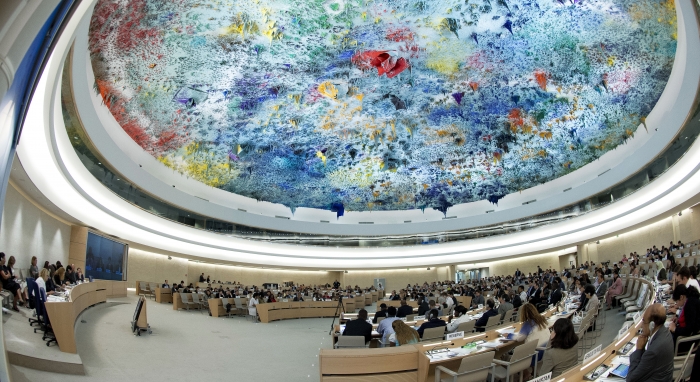
Seat of the United Nations Human Rights Council in Geneva. UN Brief photo

In reality it was ignoring important issues raised and rejected key recommendations made by other States. The Philippine delegation on Friday at the session in Geneva accepted only 103 out of 257 recommendations made by member-states. On Saturday, the Department of Foreign Affairs claimed the country “scored a big victory in Geneva” when the UN body “overwhelmingly adopted Manila’s human rights report card.” (Foreign Affairs Secretary Alan Peter Cayetano claimed the “adoption” of Manila’s report means that the country “has nothing to hide with its human rights record.“)  [see also: https://humanrightsdefenders.blog/2016/11/02/duterte-is-wrong-human-rights-defenders-are-beautiful/]

Adoption of the UPR outcome report, however, cover both the report by the Philippines’ and also the other states’ positions on its human rights record, which included calls to investigate killings (the final document “consists of the questions, comments and recommendations made by States to the country under review, as well as the responses by the reviewed State,” according to a UN human rights office’s brief on its website.)

While member-states welcomed the Philippines’ acceptance of some of the recommendations such as on poverty and education, many expressed concern over its decision not to take action on most of the points raised. Key recommendations merely “noted” by the Philippines—a move interpreted as a rejection by observers—include 44 related to extrajudicial killings in the Duterte government’s campaign against illegal drugs. The Philippines also snubbed recommendations relating to the protection of journalists and human rights defenders, as well as those urging it to lift conditions to allow access of the UN special rapporteur on extrajudicial killings.

A farce”. This was how human-rights group Karapatan described the Philippine government’s supposed “victory”. Karapatan secretary general Tinay Palabay said on Saturday the Philippine government delegation to Geneva “conveniently glosses over” the fact that it did not accept a number recommendation that aimed to resolve pressing issues on human rights. The Philippine delegation, however, practically denied before the UN body the existence of extrajudicial killings in the drug war despite the increasing number of deaths of suspects without trial.

International watchdog Human Rights Watch also reminded the Philippines to cooperate as a member of the council in all of its mechanisms, such as in allowing the special rapporteur without conditions to look into cases in the Philippines.

Sources: Ignoring issues raised, Philippines claims ‘victory’ in UN review | Headlines, News, The Philippine Star | philstar.com

http://www.interaksyon.com/dedma-blues-human-rights-watch-dismayed-at-ph-rejection-of-review-recommendations/

http://globalnation.inquirer.net/160441/karapatan-downplays-ph-delegates-victory-unhrc-united-nations-unhrc-dfa-cayetano-karapatan-human-rights-group#ixzz4tUkOfpcR

Important side event on Thursday 21 September 2017: Ending Reprisals

September 19, 2017

organizes on 21 September 2017 an important side event: “Ending Reprisals: Discussion with Human Rights Defenders and Experts”. The purpose of this discussion is to contribute to the critical debate on developing and strengthening procedures to prevent and address reprisals at the UN, ensuring that the voices of defenders are at the front and centre of the discussion.

This panel coincides with the presentation of the Secretary-General’s annual report on Cooperation with the United Nations, its representatives and mechanisms in the field of human rights (‘the reprisals report’) at the Council’s current session. [for some of my earlier posts on this crucial topic see: https://humanrightsdefenders.blog/tag/reprisals/]

Panelists: 

  • Michel Forst, UN Special Rapporteur on the situation of human rights defenders
  • Peggy Hicks, Director of Thematic Engagement, Special Procedures and Right to Development Division, OHCHR
  • Claudia Samayoa (UDEFEGUA), Human Rights Defender from Guatemala
  • Ellecer Carlos (iDEFEND & PAHRA), Human Rights Defender from the Philippines
  • Women human rights defender from Burundi, member of the MFFPS

Moderator:   Tess McEvoy, Legal Counsel, ISHR

(Attendance with UNOG pass only.)

Source: Invitation: Thursday 21 September, 3.00pm – Ending Reprisals: Discussion with Human Rights Defenders and Experts

HRC elections – How do the candidates for 2018 rate? 11 September events.

September 2, 2017

In advance of the Human Rights Council elections that will take place this October for the membership term 2018-2020, Amnesty International and the International Service for Human Rights will hold pledging events for candidate States in Geneva and New York on 11 September 2017. The events, which will be co-sponsored by a cross-regional group of Permanent Missions, are intended to give candidates an opportunity to present their vision for Council membership and to respond to questions from a range of stakeholders on how they would realise the pledges and commitments they may have made in seeking election.
If you can’t make it, you can follow the event live on ISHR YouTube channel: https://www.youtube.com/user/ISHRGlobal and submit questions to the candidates via Twitter using #HRCPledging.

Make sure to also check out the scorecards, for an ‘at-a-glance’ comparison of the candidates, focusing on their coöperation with the Council, their support for civil society, their engagement with UN treaty bodies and special procedures, whether they have spoken out in concern about reprisals, and whether they have established a national human rights institution:

please RSVP by 4 September using the following links:

  • New York event RSVP 
  • Geneva event RSVP 

Source: HRC elections | How do the candidates for 2018 rate? | ISHR

Even Maina Kiai cannot escape harassment in Kenya

August 22, 2017

There are certainly worse violations to which human rights defenders are submitted than a short detention at the airport, but this case concerns Maina Kiai, who is former UN Special Rapporteur on the rights to freedom of peaceful assembly. Kiai, also Kenya Human Rights Commission (KHRC) board member.  On 20 August 2017 he was stopped from catching his flight at Jomo Kenyatta International Airport to the US. This was after immigration officers demanded that he gets travel clearance before they could stamp his passport. He was held for about two hours before but was allowed to travel after Director of Immigration Major-General Gordon Kihalangwa (Rtd) intervened. Kihalangwa told the Star that Kiai was not detained but was taken through routine security checks that every traveler is subjected to. “Kiai was not restricted. It was a normal security check and not meant to demean him or anyone.”

That notoriety has protective value can be seen from what he added: “Kiai is a renown personality. He is even known to me. I spoke to him personally before he traveled“.  [for more on Maina Kiai: https://humanrightsdefenders.blog/tag/maina-kiai/]

Still, human rights defenders such as  Njonjo Mue termed the incident “disturbing and an attempt by the state to manage its citizens with a fist”“We are dealing with a regime determined to silence all independent voices, its dictatorship and we back to 1990s”Khelef Khalifa of Muslims for Human Rights (MUHURI) said it was not a coincidence but a deliberate attempt to silence all those voices that speak to power.

Last week, there were attempts by the state to shut down the NGOs KHRC and AfriCOG in what government termed as failure to comply with statutory obligations. The events climaxed by failed raid on AfriCOG offices. On 16 August 2017 this is what Front Line Defenders had to say about this:

Kenya Revenue Authority officials attempted to raid the African Centre for Open Governance’s offices.  On 14 and 15 August 2017, the Executive Director of the NGO Co-Ordination Board notified the Kenya Human Rights Commission- KHRC and the African Centre for Open Governance- AfriCOG that the Board would be cancelling their registration. The NGO Co-Ordination Board also called for the freezing of their accounts and the arrest of the Board of Directors and members of AfriCOG ……

On 16 August 2017, Kenya Revenue Authority officials attempted to raid the AfriCOG offices, however, the search was called off in order to investigate complaints by the organisation. On 15 August 2017, the Executive Director of the NGO Co-Ordination Board sent a letter to the Director of Criminal Investigations stating that AfriCOG will be shut down and calling for the arrests of its directors and members. The NGO Co-Ordination Board has alleged that AfriCOG is not a registered organisation under the NGO Co-Ordination Act 1990 as required by law. The letter, in which AfriCOG and the Central Bank of Kenya were copied, also called for the freezing of accounts in the name of  AfriCOG.

On 14 August 2017, the Kenya Human Rights Commission received a letter from the NGO Co-Ordination Board de-registering the NGO. In the letter, the Executive Director of the NGO Co-Ordination Board also asked the Central Bank of Kenya, who was copied in the correspondence, to freeze any accounts in the name of KHRC. The allegations by the Board include that the NGO has illegal bank accounts, that it illegally employs expatriates and that it is concealing illegal remuneration of board members. 

These allegations are similar to those made by the NGO Co-Ordination Board about the KHRC in 2015 when the Board issued a press statement announcing that it had initiated the de-registration process for a number of NGOs, including the KHRC. In Kenya Human Rights Commission v Non-Governmental Organisations Co-Ordination Board [2016] eKLR, Judge Onguto found that the NGO Co-Ordination Board had violated Article 37 of the Constitution by not giving the KHRC a hearing before deciding to cancel its registration certificate and freeze its bank accounts.

Source: Rights defenders condemn Maina Kiai detention, urges him to sue | The Star, Kenya

https://www.standardmedia.co.ke/article/2001251969/maina-kiai-briefly-stopped-at-jkia-as-officials-demand-clearance-to-travel

http://freeassembly.net/news/thank-you-from-kiai