Since the adoption of the Declaration on Human Rights Defenders (1998), UN bodies have developed approaches to promoting the work of defenders and ensuring their protection. However, this response has been insufficiently robust or coordinated, says the International Service for Human Rights (ISHR), one of the world’s foremost observers of the UN human rights system, in a piece published on 16 April 2018. Twenty years on, the situation for defenders in many countries around the world remains grave. [For earlier posts re the 20th anniversary of the HRD Declaration see: https://humanrightsdefenders.blog/tag/20th-anniversary-un-declaration-on-hrds/]
UN country missions and human rights mechanisms have developed some good practice in regard to the protection of human rights defenders (HRDs) but there is still much to be done to ensure a coherent, coordinated and courageous response. ISHR submitted findings on some aspects of the UN’s work on HRDs, to the Office of the UN High Commissioner on Human Rights (OHCHR) following its call for input. At country level, ISHR – along with partners Colombian Commission of Jurists and Ligue Tunisienne for Human Rights – found positive practice by OHCHR in encouraging the State to implement the Declaration.
‘In Colombia OHCHR has contributed to a collective understanding of who defenders are and what institutional changes may be needed to counter attacks against them,’ said ISHR’s Eleanor Openshaw. ‘While in Tunisia OHCHR has developed a database to systematise the process of follow up on UN recommendations.’ In other contexts, guidelines to steer bodies and representatives in country are often vague, with no mention of the Declaration as a key UN standard.
‘UN Resident Coordinators need to have an understanding of the Declaration on HRDs so they can ensure the protection of defenders is effectively integrated into their work,’ said Openshaw. ‘There is a gap between developments in key human rights mechanisms and country responses.’
Whilst there have been some positive developments connecting different parts of the UN system – for example the new UN Environment focus on environmental defenders, developed with the Special Rapporteur on HRDs – there is a lack of an informed or coordinated response in others. This points to the need for comprehensive UN-wide policies on the protection of defenders.
‘Ensuring coherence and effectiveness throughout the UN system in regard to the protection of defenders requires a strong steer from the very top – the UN Secretary General,’ said ISHR’s Tess McEvoy. ‘We hope Mr Guterres will commit this year – the 20th anniversary of the Declaration– to providing such leadership.’ The Special Rapporteur on Human Rights Defenders, Michel Forst has spoken of attacks against defenders ‘multiplying everywhere’.
Openshaw also stated: ‘The dangers for defenders are known. The UN system has good practice to build on – and it must – to fulfil its role in encouraging and demanding States realise their obligations to defenders.’
Success in passing the “win-win resolution” in the UN Human Rights Council [https://humanrightsdefenders.blog/2018/03/26/chinas-win-win-resolution-gets-the-votes-in-the-un-council/], is just the visible part of a larger and more ominous assault on the human rights system as it has been built up (however incomplete and painstaking) over the last decades. Julian Borger in the Guardian of 27 March 2018 (“China and Russia accused of waging ‘war on human rights’ at UN”) describes how the two countries lobbied to cut funding for human rights monitors and for a senior post dedicated to human rights work. This all seems to fit very well with the trend started in 2016 and which I tried to describe in early 2017 in a series of posts, of which the last one was: https://humanrightsdefenders.blog/2017/02/24/2017-10-need-to-reset-for-human-rights-movement/.
The Guardian piece makes states – inter alia- the following: According to diplomats and activists China and Russia have used the UN budget panel (5th committee) to cut funding for human rights monitors and for a senior post in the secretary general’s office in NY. The cut, first reported in Foreign Policy, means that the human rights work that was the responsibility of that official will be spread around other posts with other priorities.
Last week, Zeid was due to address the UN security council on plight of civilians in Syria but before he began, Russia called a procedural vote to stop him speaking on the grounds that the council was not the proper forum for discussing human rights. “The fifth committee has become a battleground for human rights,” Louis Charbonneau, the UN director for Human Rights Watch, was quoted in the Guardian. “Russia and China and others have launched a war on things that have human rights in their name.”
“China has real political momentum at the UN now,” Richard Gowan, a UN expert at the European Council for Foreign Relations, said. “It is now the second biggest contributor the UN budget after the US, and is increasingly confident in its efforts to roll back UN human rights activities. It is also pushing its own agenda – with an emphasis on ‘harmony’ rather than individual rights in UN forums. And a lot of countries like what they hear.”
A western diplomat at the UN conceded that human rights were losing ground at the UN, in part because China had become a more assertive voice, prepared to lead lobbying campaigns, and because Beijing is increasingly leveraging its vast and growing investments in the developing world to win votes for its agenda at the UN.
On 9 March 2018 the International Humanist and Ethical Union (IHEU) made a strongly-worded and totally correct statement “Actually, ‘freedom from religion’ is a human right”. Religious freedom is usually thought of in terms of (minority) religions being allowed to freely practice their religion but the limelight rarely shines on the situation of those who do not want to belong to a religion or express atheist views.
The IHEU) was responding to comments made by the Vatican delegation during a discussion (video) of the report of the UN Special Rapporteur on Freedom of Religion or Belief. The Vatican representative, Ivan Jurkovic, had disputed that ‘freedom from religion’ is covered by international law, saying that “Of the utmost concern, the use of the term freedom from religion, which is not contemplated in the international instruments, reveals a patronising idea of religion, going beyond the mandate of the special rapporteur.”
In response IHEU’s Director of Advocacy, Elizabeth O’Casey, corrected the Holy See listing the established rights which constitute freedom from religion, and highlighted why freedom from religion is so necessary for those professing no religious beliefs around the world: “freedom from coercion to adopt a religion is protected by law; freedom to have no religion is protected by law; freedom to leave a religion is protected by law; and freedom to criticise a religion is protected by law.”
She also noted that in his own comments to the Council, the UN Special Rapporteur on Freedom of Religion of Belief, Dr Ahmed Shaheed, also corrected the Holy See. Shaheed stated categorically that freedom from religion is protected by the right to freedom of religion or belief. Dr Shaheed mentioned specifically how humanist, atheist and secular bloggers are under attack, and that the right to freedom of religion or belief protects the individual, not the religion or belief itself.
In her statement, O’Casey went on to highlight just why statements such as those made by the Holy See are so objectionable and dangerous; especially in the context of state-based hate and a culture of impunity allowing for violence against those who have no religious beliefs. O’casey reminded the Council that 85 countries severely discriminate against non-religious individuals whilst seven countries were found to actively persecute the non-religious during last year. She also reminded the Council of the situation of those jailed in states such as Pakistan, Saudi Arabia and Iran for being atheist or humanist, and the brutal murder of so many secularists and rationalists with impunity in Bangladesh, India and the Maldives. O’Casey also mentioned Saudi Arabia, Egypt, Malaysia and Cyprus in their promoting state hatred against atheists and humanists.
In the light of this situation, O’Casey asked how many more humanists, atheists and secularists need to be killed, imprisoned, persecuted and disproportionately targeted for the international community to begin to understand the absolute importance of freedom of religion or belief for those with no religion? She concluded, “so long as the rest of the international community stay silent, the rights of the invisible minority of non-believers across the world will continue to be trampled upon, including by members of this Council.” The full text of O’Casey’s statement can be seen through the link below.
In this context it was interesting to see that in the UK a Burnley vicar, who has campaigned to expose sexual abuse and its cover-up in the Church of England, has been named Secularist of the Year!The Rev Graham Sawyer, who is the vicar of St James’ Church, was one of two joint winners presented with a £5,000 prize at a lunch hosted by the National Secular Society. Human rights campaigner Peter Tatchell, who won the award in 2012, presented the prize at the event in central London.
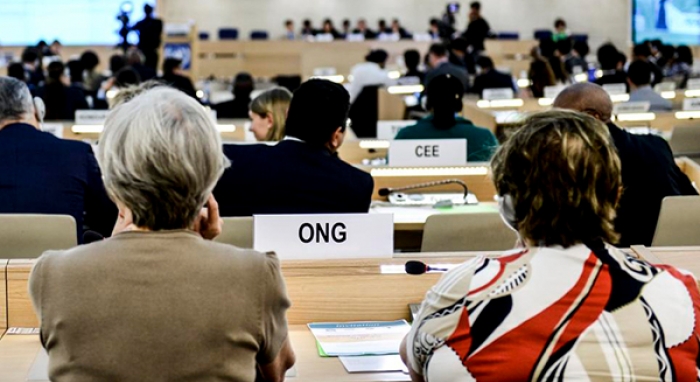
Diplomats gathered on Friday to vote on resolutions presented at the UN Human Rights Council in Geneva (swissinfo.ch)
The Chinese resolution calling for “mutually beneficial cooperation” on human rights issues was adopted at the United Nations Human Rights Council last week, but human rights defenders and several countries say it actually weakens human rights principles.
“The Chinese resolution is the first stage of a major step backwards,” Geneva-based human rights specialist Adrien Claude Zoller told swissinfo.ch, calling it “THE major event” of the Human Rights Council’s 37th sessionexternal link.
At first glance, Beijing’s resolution at the Human Rights Council – only its second-ever in nearly a dozen years ! – seems relatively innocent. The text, full of diplomatic language such as “universality” and “international constructive dialogue”, was adopted on Friday evening by 28 votes to one, with 17 abstentions.
But it nonetheless upset many diplomats and human rights campaigners in Geneva. Australia, Britain, Japan, and Switzerland were among those abstaining, though many envoys spoke out against the text. Ahead of Friday’s vote, Switzerland said the resolution contained “vague and ambiguous language that weakens fundamental human rights principles”. [see also in this context: https://humanrightsdefenders.blog/2018/03/22/unfortunately-europe-is-not-stepping-up-its-human-rights-policy-in-us-absence/]
While welcoming “constructive international cooperation as a means of promoting and protecting human rights”, Switzerland’s ambassador to the UN in Geneva, Valentin Zellweger, stressed that human rights-related mandates need to be able to act quickly and work efficiently to prevent crises. Civil society, he added, must be able to play a crucial role in protecting against and addressing violations.
Zoller said the resolution recalled certain language and concepts heard during the Cold War when the Soviet Union also invoked the idea of “mutually beneficial cooperation”. “The procedure put in place by the Chinese resolution involves putting an extra layer around the system of special procedures [such as independent investigations] and increasing pressure on them,” Zoller declared. It amounts, he said, to an attempt to “kill the messenger” and complicate the work of the special rapporteurs who carry it. “It attempts to do this by ignoring the monitoring bodies of human rights conventions [and returning] to the principle of non-interference.”
John Fisher, the Geneva-based director of Human Rights Watch, also criticised China’s strategy. His organisation last year issued a reportexternal link warning of Chinese interference in UN human rights mechanisms.
The United States cast the only “no” vote on the resolution, co-sponsored by states including Pakistan and Egypt. US diplomat Jason Mack said China was using its resolution to try to weaken the UN human rights system and norms. “The ‘feel-good’ language about mutually beneficial cooperation is intended to benefit autocratic states at the expense of people whose human rights and fundamental freedoms we are all obligated as states to respect,” he said.
He added that Chinese spokespeople had clearly been trying to “glorify their head of state by inserting his thoughts into the international human rights lexicon”.
On Monday, China accused the Americans of arrogance for rejecting the Chinese resolution. “I think the comments by this US official in Geneva…were extremely unreasonable, and also reflect the consistent ignorance and haughtiness of the US side,” Chinese Foreign Ministry spokeswoman Hua Chunying told a daily news briefing.
Many countries expressed at the meeting that the Chinese resolution reflected the common wishes of the international community and helped raise the ability of developing nations to speak for themselves on human rights issues, Hua added.
The Human Rights Council concluded on 22 March 2018 its general debate on the annual report of the United Nations High Commissioner for Human Rights and reports of the Office of the High Commissioner and the Secretary-General. The Council started the general debate on Wednesday, 21 March after hearing the presentation of reports on Burundi, Sri Lanka, Guatemala, Honduras, Colombia, Cyprus and Iran, and a summary can be seen here.
In the general discussion, delegations noted that some progress was being made to improve the human rights situations in those countries, but much remained to be done. Speakers stressed the relevance of protecting civil society actors and human rights defenders, including in the context of implementing peace agreements and pursuing reconciliation plans. States were commended for cooperating with the Office of the High Commissioner for Human Rights and other United Nations mechanisms, and were urged to prioritize efforts to combat impunity and to prosecute perpetrators of rights violations.
Speaking were the delegations of the United States; Australia; Georgia; Belgium; Israel; Norway; United Nations Children’s Fund; Canada; Denmark; Morocco; Greece; Algeria; Turkey; Ireland; and Netherlands as well as a large number of NGOs.
For those interested to know more of this General Debate on the Annual Report of the High Commissioner for Human Rights, I refer to Reliefweb which carries regularly summaries of what happens at the Council.
In the month of the International Women’s Day and in the year of the 20th Anniversary of the Declaration on Human Rights Defenders, this event will highlight the experience of women human rights defenders and the implementation of the Declaration.
It will also share findings and recommendations related to a recent joint researchon implementation carried out by the Colombian Commission of Jurists, the Tunisian League for Human Rights and ISHR.
Confirmed panellists include:
Ana Maria Rodriguez – Colombian Commission of Jurists
Djingarey Maiga – Femmes et Droits Humains Mali
Other panellists and co-sponsors will be announced soon.
20 March, 16h00 – 17h30 Room XXII, Palais des Nations, Geneva.
“The use of the judiciary in Bahrain to target human rights defenders and other activists” is a side eventorganised by CIVICUS and FIDH in co-operation with Americans for Human Rights & Democracy in Bahrain (ADHRB), the Gulf Centre for Human Rights (GCHR) and co-sponsored by ISHR.
It will take place on 13 March 2018 at 11:00 to 12:30 at Room XXIV. The event will address the politicisation of the judiciary to criminalise human rights defenders.
On 21 February human rights defender Nabeel Rajab, BCHR President and FIDH Deputy Secretary General, was sentenced to 5 years in prison under trumped-up charges in relation to tweets denouncing the torture against detainees at Jaw prison and exposing the killing of civilians in Yemen by the Saudi-led coalition. “This surrealistic verdict”, writes IFEX, “after a trial that was by itself a mockery of justice, illustrates once again the current crackdown on any dissenting voice in Bahrain, where scores of critics are currently jailed’.
Also the Observatory (FIDH-OMCT) and BCHR reiterate their call to the Bahraini authorities to immediately release him, as well as all detained human rights defenders.
Perhaps the most damning information comes from the Bahraini Government itself (8 March 2018) when it responded to the statement of the UN High Commissioner for Human Rights which had been ‘negative’ in his written review on the annual report on Bahrain. Dr. Yusuf Abdulkarim Bucheeri, Permanent Representative to the United Nations Office in Geneva, said in a statement that the review contained inaccurate information such as harassment of human rights defenders and other deleterious comments on the recent legal actions taken by Bahrain. ..They deliberately and unfairly side with malicious elements who have suspicious political agendas and sectarian tendencies and who want to inflict harm on the Kingdom of Bahrain and demean its achievements in the field of human rights, he said. “This is crystal clear from their support for the discourse of hatred and internal violence groups and for this reason, the Kingdom of Bahrain totally rejects the content of this statement with all the wrong and unacceptable descriptions it has given to the state.” Bucheeri said that Bahrain’s constitution stipulates the right to freedom of opinion and expression in an unquestionable manner and in a way that guarantees everyone’s right to express their opinion and disseminate it by word, writing or otherwise, but within the legal framework and without inciting division or sectarianism or undermining national security. …… He called on the Office of the High Commissioner for Human Rights to make concerted effort to understand the reality of human rights and the great challenges facing the Kingdom of Bahrain which faces terrorist acts aimed to destabilize its security and stability. The kingdom, he explained, confronts a phenomenon of violent extremism and it is the duty of the Office of the High Commissioner to do its best to double check the credibility of the information it obtained and to seek such information only from neutral, objective and non-politicized sources…
Most likely you have seen the reports about the UN High Commissioner of Human Right suggesting that Philippine President Rodrigo Duterte “needs to submit himself to some sort of psychiatric evaluation” over his “unacceptable” remarks about some Special Rapporteurs. Zeid Ra’ad al-Hussein demanded – rightly – that the Human Rights Council, of which the Philippines is a member, “must take a strong position” on the issue and that “these attacks cannot go unanswered.”
Speaking to reporters in Geneva, the rights chief referred to a court petition filed last month by Duterte’s government accusing the U.N. rapporteur on indigenous peoples, Victoria Tauli-Corpuz, and others of being members of a key communist rebel group. The Filipino President had repeatedly insulted the U.N. expert on extrajudicial killings, Agnes Callamard, lashing out at her for raising alarm over the thousands of suspects killed under his anti-drug crackdown. He has also taken aim at International Criminal Court prosecutor Fatou Bensouda, who announced last month that she was opening a preliminary examination into alleged extrajudicial drug killings. In a speech Wednesday, Duterte insulted the international court’s justices as “dumb” and “evil,” and said Callamard was “thin” and “undernourished.” Using an expletive, he warned, “Don’t (mess) with me, girls.”
Almost laughably “deaf’ to the language used his own President, the Philippine Foreign Secretary Alan Peter Cayetano blasted Zeid’s remarks as “irresponsible and disrespectful” and said the “unmeasured outburst” demeaned the Philippine president and should not be repeated.
Victoria Tauli-Corpuz, was listed as a member of the Maoist rebel group. She has denied the allegations. “The charges are entirely baseless and malicious,” Tauli-Corpuz told the Thomson Reuters Foundation in a telephone interview. “The government sees this as an opportunity to pursue people they don’t like. I am worried for my safety and the safety of others on the list, including several rights activists.” Local and international organizations have slammed the Philippine government’s action, with New York-based Human Rights Watch calling the petition “a virtual government hit list”. Two other U.N. special rapporteurs expressed “grave concern” about Tauli-Corpuz being on the list, and said she was being punished by Philippine President Rodrigo Duterte for speaking out against some of his policies.
It all sounds so nice: “universality,” “constructive dialogue,” “win-win cooperation.” China’s unexpected resolution on “Promoting the International Human Rights Cause through Win-Win Cooperation,” being presented this week at the United Nations Human Rights Council in Geneva, is chock full of such phrases. China’s government wants the world to believe it is a model citizen when it comes to human rights, but its draft resolution actually betrays the opposite intent, says John Fisher,Geneva Advocacy Director of Human Rights Watch on 5 March 2018.
Focusing only on intergovernmental dialogue and cooperation, rather than actual human rights violations or accountability for those, is obviously a “win” for China, but it’s not clear who the other winner is. Writes John Fisher. Certainly not victims. A true example of “win-win” might be releasing those wrongly detained, respecting the right of ethnic Uyghurs and Tibetans. Releasing Tibetan language rights advocate Tashi Wangchuk and Uyghur economist Ilham Tohti would be a true double-win.
…..China’s draft resolution fails to even acknowledge the Human Rights Council’s mandate to “address situations of violations of human rights, including gross and systematic violations,” and does not spell out any consequences when countries refuse to cooperate. As written, China’s resolution is a win only for itself, and, if adopted, a serious loss for any country serious about human rights inside China and around the world.
The UN High Commissioner for Human Rights stated on Wednesday 7 March that China’s actions on human rights did not match its words and the level of respect for basic liberties remained low in the country. Zeid Ra’ad Al Hussein did so in his annual report on human rights in the world to the UN Human Rights Council, “President Xi Jinping has called for ‘people-centred development for win-win outcomes as part of a community of shared future for mankind’, a commendable ambition. Sadly, China’s global ambitions on human rights are seemingly not mirrored by its record at home,” he said.
“My office continues to receive urgent appeals regarding arbitrary detentions, enforced disappearances, ill-treatment and discrimination, emanating from human rights defenders, lawyers, legislators, booksellers, and members of communities such as Tibetans and Uyghurs,” he added. Hussein said many of the cases involved people fighting against economic, social and cultural injustices such as corruption, illegal seizure of land and forced evictions or destruction of cultural sites.
Before the start of the current session of the UN Human Rights Council twenty NGOs had called on all member states to hold China accountable at the UN Human Rights Council, appears from a piece by the ISHR on 26 February 2018
In a private letter sent to select UN Member States, the NGOs called for clear and concrete actions to denounce China’s current rollback in respect for human rights at the UN Human Rights Council.
The organisations highlight five cases of human rights defenders that would benefit from further pressure being brought to bear on the Chinese government. They include:
Liu Xia, a poet kept under house arrest after the death of her husband, Nobel laureate Liu Xiaobo, in July 2017
Wang Quanzhang, a rights lawyer held incommunicado since 9 July 2015
Gui Minhai, a Swedish citizen arbitrarily detained in China since he vanished from Thailand in October 2015
….This year is particularly important, as human rights defenders inside and outside China prepare for the country’s next Universal Periodic Review, scheduled for November 2018. The letter to governments concludes: ‘For human rights defenders to have the courage to engage in this important process, with all the risks that it entails, it’s critical that they know that they are not alone’.
(Amnesty International, China Labour Bulletin, Christian Solidarity Worldwide, CIVICUS – World Alliance for Citizen Participation, Human Rights in China, Human Rights Watch, the International Campaign for Tibet, the International Commission of Jurists, the International Federation of Human Rights Leagues, the International Service for Human Rights, Lawyers for Lawyers, Lawyers’ Rights Watch Canada, PEN America, Swedish PEN, the Tibet Advocacy Coalition (comprised of the International Tibet Network Secretariat, Students for a Free Tibet, Tibet Initiative Deutschland, Tibet Justice Center, and Tibetan Youth Association in Europe), and the World Uyghur Congress.)
The ISHRon 28 February 2018 made the following statement which seem obvious to the readers of this blog but it cannot be stressed enough: Human rights defenders risk their freedom and sometimes their lives to advocate for the rights of fellow human beings. On the occasion of the Human Rights Council’s High-Level panel commemorating the 70th anniversary of the Universal Declaration on Human Rights (UDHR) and the 25th anniversary of the Vienna Declaration and Programme of Action, ISHR stressed that the realisation of the UDHR depends on the work of human rights defenders and that States who restrict the work of defenders are in turn violating their obligations under the UDHR.
2018 is not only the 70th anniversary of the Universal Declaration of Human Rights (UDHR) and the 25th anniversary of the Vienna Declaration and Programme of Action (VDPA), it also marks the 20th anniversary of the Declaration on human rights defenders which was adopted by consensus by the General Assembly in 1998.
The rights enshrined in the UDHR cannot be guaranteed without a safe and enabling environment for the people exercising and fighting to defend those rights. States who commit to guarantee the UDHR cannot restrict the work of defenders, nor fail to act upon their obligation to protect them.
20 years after the adoption of the Declaration, human rights defenders have perhaps never been more under threat. They are subjected to judicial harassment, arbitrary arrest and detention, torture, enforced disappearance, physical violence and even murder.
Defenders are also attacked when they bring their voices to the international community. Last year, a report by the Secretary-General found evidence of a strategy on the part of some States to prevent the activities of individuals cooperating with the UN. The report also highlights that the incidence of reprisals is becoming broader and that the means used are increasingly blunt…
“The realisation of the UDHR depends on the work of defenders, who risk their lives and their freedom to advocate for the rights of others,” said Salma El Hosseiny, ISHR’s Human Rights Council Advocate. “It is alarming that States are increasingly shrinking civil society space on one hand, and professing their commitment to guarantee the UDHR on the other hand“. These unprecedented attacks against civil society and defenders amount to violations of the same rights to which they are advocating for.
States must translate their commitment to the UDHR by taking immediate and effective measures to ensure that defenders are able to carry out their legitimate human rights activities without any hindrance, to ensure accountability for all perpetrators, and access to remedies for victims.
The Human Rights Council plays an important role in contributing to the realisation of the UDHR on the ground. Accordingly, any proposals to strengthen or enhance the efficiency of the Council should be measured through the lens of increasing its impact, rather than the relatively insignificant time or money it may save. Finally, it is imperative that any legitimate process to strengthen the Council include the meaningful participation of civil society in all stages.


 Hans Thoolen on Human Rights Defenders and their awards