Archive for the 'Human Rights Council' Category

Key issues affecting HRDs in 47th session of UN Human Rights Council (June 2021)

June 22, 2021

The 47th session of the UN Human Rights Council will take place from 21 June to 15 July 2021. The ISHR has again issued its very helpful overview of key issues and below is an extract of those affecting human rights defenders most directly. For a wrap-up of the previous session, see: https://humanrightsdefenders.blog/2021/03/29/wrap-up-46th-session-of-un-human-rights-council-with-key-resolutions-on-belarus-and-myanmar-and-more/

Modalities of participation in HRC47

According to the Bureau minutes of 2 and 4 June 2021, the extraordinary modalities for the 47th session should be similar to the modalities applied during the 46th session.

Thematic areas of interest:

Sexual orientation and gender identity

The Independent Expert on protection against violence and discrimination based on sexual orientation and gender identity will present his report, followed by an interactive dialogue on 24 June. The report seeks to document how particular narratives on gender are being used to fuel violence and discrimination based on sexual orientation and gender identity. In the report, the Expert examines how the incorporation of comprehensive gender theory enables more accurate and appropriate consideration of dynamics of negation and stigma, and the key role of law, public policy and access to justice in promoting either continuity of injustice or social change.

The report highlights the mandate’s position in relation to current narratives and constructions through which the application of gender frameworks, especially its promise for gender equality across diverse persons, is challenged; and build on gender concepts and feminist analysis to further substantiate the mandate’s understanding of root causes and dynamics of violence and discrimination based on sexual orientation and gender identity.

This report will be presented in the context of high levels of violence against trans and gender nonconforming people and those defending their rights. Beyond this, the COVID-19 pandemic has disproportionately impacted trans and gender nonconforming people and those defending their rights worldwide, especially those most marginalised.

Systemic racism, police brutality and violence against peaceful protests in the United States and globally

The High Commissioner will present the comprehensive report of Resolution 43/1 to the Council on 12 July followed by an interactive dialogue. ISHR previously joined 171 families of victims of police violence in the United States and over 270 civil society organisations from more than 40 countries in calling on the Council to establish an independent commission of inquiry into police killings of Black men and women, as well as violent law enforcement responses to protests in the United States….

The Council should ensure the establishment of robust international accountability mechanisms which would further support and complement, not undermine, efforts to dismantle systemic racism in the United States and globally, especially in the context of police violence against Black people.

Business and human rights

June 2021 marks the tenth anniversary of the unanimous endorsement by the Council of the United Nations Guiding Principles on Business and Human Rights (UNGPs). The Guiding Principles have become one of the key frameworks for private business to carry out their responsibility to respect human rights, for States to discharge their obligations under international law in relation to business activities, and for civil society and human rights defenders to utilise the UNGPs to demand structural changes in the way companies operate internationally. Human rights need to be an essential element of how businesses design their operations. After 10 years, we have the chance to look back and into the future with a critical eye. In that regard, a ‘Roadmap for the Next Decade’ will be presented by the UN Working Group on Business and Human Rights this month. ISHR continues to work with the UN, civil society and progressive companies to protect and promote the work of human rights defenders.

In tandem with its annual report, the UN Working Group will also present in June a long-awaited guidance document on business and human rights defenders based on the UNGPs. The ‘United Nations Guidance on the role of the Guiding Principles for engaging with, safeguarding and ensuring respect for the rights of human rights defenders’ was supported and informed by ISHR and partners, and builds on the experiences gathered through the Business Network on Civic Freedoms and Human Rights Defenders, an initiative ISHR co-founded with the Business and Human Rights Resource Centre. This document will become a key instrument for civil society, businesses and States in ensuring that human rights defenders are protected and recognised as essential actors in maintaining rule of law and a functioning shared civic space. 

The Working Group on the issue of human rights and transnational corporations and other business enterprises will present its reports, followed by an interactive dialogue, on 29 June. [see also: https://humanrightsdefenders.blog/2020/09/30/business-and-human-rights-updated-list-of-companies-supporting-hrds/]

Reprisals

On this topic see also: https://humanrightsdefenders.blog/2021/05/06/un-action-on-reprisals-towards-greater-impact/

During the 42nd session, the Council adopted a resolution which listed key trends such as the patterns of reprisals, increasing self-censorship, the use of national security arguments and counter-terrorism strategies by States as justification for blocking access to the UN. The resolution also acknowledged the specific risks to individuals in vulnerable situations or belonging to marginalised groups, and called on the UN to implement gender-responsive policies to end reprisals. The Council called on States to combat impunity and to report back to it on how they are preventing reprisals, both online and offline.

Item 5 of the Human Rights Council’s agenda provides a key opportunity for States to raise concerns about reprisals, and for governments involved in existing cases to provide an update to the Council on any investigation or action taken toward accountability to be carried out.

During the organisational meeting held on 7 June, the President of the Council stressed the importance of ensuring the safety of those participating in the Council’s work, and the obligation of States to prevent intimidation or reprisals.

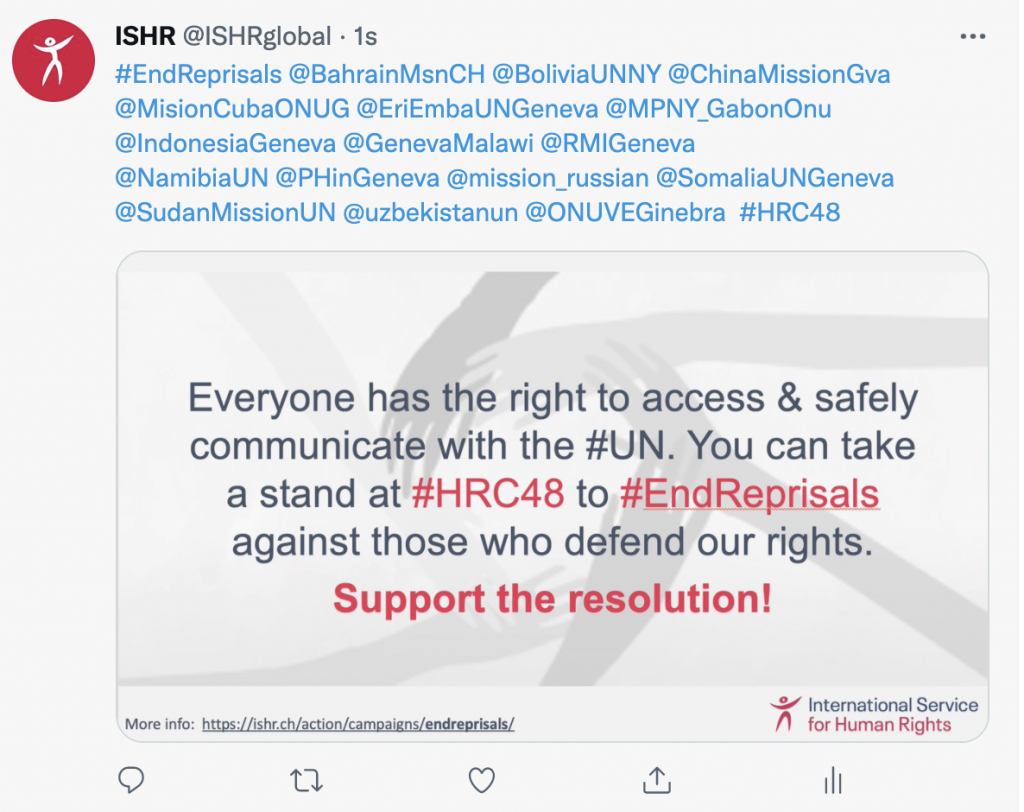
ISHR recently launched a study analysing 709 reprisals cases and situations documented by the UN Secretary-General between 2010 and 2020 and looked at trends and patterns in the kinds of cases documented by the UNSG, how these cases have been followed up on over time, and whether reprisal victims consider the UN’s response effective. Among other things, the study found that nearly half the countries serving on the Council have been cited for perpetrating reprisals. The study also found that the HRC Presidency appears to have been conspicuously inactive on intimidation and reprisals, despite the overall growing numbers of cases that are reported by the UNSG – including on individuals’ or groups’ engagement with the HRC – and despite the Presidency’s legal obligation to address such violations. The study found that the HRC Presidency took publicly reported action in only 6 percent of cases or situations where individuals or organisations had engaged with the HRC. Not only is this a particularly poor record in its own right, it also compares badly with other UN actors.

In line with previous calls, ISHR expects the President of the Human Rights Council to publicly identify and denounce specific instances of reprisals by issuing formal statements, conducting press-briefings, corresponding directly with the State concerned, publicly releasing such correspondence, and insisting on undertakings from the State concerned to investigate, hold the perpetrators accountable and report back to the Council on action taken.

Other thematic reports

At this 47th session, the Council will have dedicated debates with the mandate holders and the High Commissioner, including interactive dialogues with:

  • The High Commissioner on State response to pandemics 
  • The Special Rapporteur on the right to housing
  • The Special Rapporteur on the right of everyone to the enjoyment of the highest attainable standard of physical and mental health 
  • The Independent Expert on human rights and international solidarity
  • The Special Rapporteur on the right to education 
  • The Special Rapporteur on extreme poverty and human rights 
  • The Special Rapporteur on extrajudicial, summary or arbitrary executions 
  • The Special Rapporteur on the rights to freedom of peaceful assembly and of association 
  • The Special Rapporteur on the promotion and protection of the right to freedom of opinion and expression 
  • The Working Group on arbitrary detention on its study on drug policies
  • The Special Rapporteur on the right to privacy 

In addition, the Council will hold dedicated debates on the rights of specific groups including:

  • The Special Rapporteur on the human rights of migrants 
  • The Special Rapporteur on the human rights of internally displaced persons 
  • The Special Adviser on Prevention of Genocide 
  • The Working Group on discrimination against women and girls 
  • The Special Rapporteur on violence against women, its causes and consequences 
  • The Special Rapporteur on trafficking in persons, especially women and children
  • The Special Rapporteur on the independence of judges and lawyers 
  • The Special Rapporetur on the elimination of discrimination against persons affected by leprosy and their family members 

Country-specific developments

China 

One year after the UN Special Procedures issued a sweeping statement  calling for the international community to take ‘decisive action’ on the human rights situation in China, much more remains to be done. Calls are growing for more clear and timely reporting from the UN, including the High Commissioner for Human Rights and her Office, on the repressive policies and practices targeting Uyghurs and other Turkic Muslims. At the same time, worrying news continues about violations of cultural rights of Tibetans, while Hong Kong’s democratic institutions – and its people – have suffered a series of blows from legislative, policy and legal decision targeting pro-democracy leaders. For the first time since 1989, peaceful public demonstrations to commemorate the massacre on Tiananmen Square were prohibited. 

Against this context, ISHR urges States to speak out firmly against the lack of accountability for the Chinese government in light of substantial evidence of violations, including crimes against humanity. In so doing, it is essential to recognise the systemic and structural nature of these violations: to highlight the dire situation for Uyghurs, Tibetans and other minority groups; pro-democracy civil society leaders, lawyers and legislators in Hong Kong; and human rights defenders like lawyer and Martin Ennals Award winner Yu Wensheng [see: https://www.trueheroesfilms.org/thedigest/laureates/69fc7057-b583-40c3-b6fa-b8603531248e] and anti-discrimination activists like the Changsha 3. No matter its position or influence, China must be held to the same high standards as any other Council member. See also; https://humanrightsdefenders.blog/2020/12/18/chinas-continuing-crackdown-on-human-rights-lawyers-shocking-say-un-experts/

Egypt

At the 46th session of the Council, over 30 States led by Finland urged Egypt to end its repression of human rights defenders, LGBTI persons, journalists, politicians and lawyers under the guise of countering-terrorism. The joint State statement ended years of a lack of collective action at the Council on Egypt, despite the sharply deteriorating human rights situation in the country. Egypt must answers these calls, starting by releasing the thousands arbitrarily detained, protecting those in custody from torture and other ill-treatment, and ending the crackdown on peaceful activists. The UN Working Group on Arbitrary Detention has previously concluded that arbitrary detention is a systematic problem in Egypt and the Committee against Torture has concluded that torture is a systematic practice in Egypt. To date, Egypt has failed to address all the concerns expressed by States, the High Commissioner and Special Procedures, despite repeated calls on the government, including most recently by over 60 NGOs. ISHR joined over 100 NGOs from across the world in urging the Council to establish a monitoring and reporting mechanism on Egypt and will continue to do so until there is meaningful and sustained improvement in the country’s human rights situation.

Saudi Arabia

This session will mark two years since the Special Rapporteur on extrajudicial, summary or arbitrary executions presented to the Council the investigation into the unlawful death of Saudi journalist Jamal Khashoggi, and yet no meaningful steps towards accountability have been taken by the Saudi authorities. The Special Rapporteur called on Saudi Arabia to “demonstrate non-repetition by: releasing all individuals imprisoned for the peaceful expression of their opinion and belief; independently investigating all allegations of torture and lethal use of force in formal and informal places of detention; and independently investigating all allegations of enforced disappearances and making public the whereabouts of individuals disappeared”. To date, Saudi Arabia has refused to address these key concerns, which were also raised by over 40 States at the Council in March 2019, September 2019 and September 2020, further demonstrating its lack of political will to genuinely improve the human rights situation and to engage constructively with the Council. The sentencing and subsequent release of several women’s rights activists highlights the importance of the Council’s scrutiny which must be sustained in order to secure meaningful, concrete, and systematic gains. We recall that the Special Rapporteur also called on Member States to support resolutions that seek to ensure or strengthen accountability for the execution of Khashoggi. ISHR reiterates its call on the Council to establish a monitoring and reporting mechanism on the human rights situation in Saudi Arabia.

Colombia  

After more than a month of strikes and street protests in Colombia, which have seen protestors killed at the hands of law enforcement officers and civilians, and human rights defenders covering the events threatened and attacked, the Council session provides States with the opportunity to take action. States must call on Colombia to respect the human rights of its people – including the right to freedom of peaceful assembly – and address the underlying causes of the protests, including violations of economic, social and cultural rights, inequality and racial discrimination. This situation of violence and non-compliance with all standards of the use of force has had a particular impact on the Afro-descendant population. Specific calls from Colombian civil society include for OHCHR to investigate and report on the protests in the country including gather statistical data on the facts that threaten the human rights of Afro-Colombian people; for the High Commissioner to visit Colombia when possible; and for Colombia to open its doors to a range of Special Rapporteurs to allow for ongoing monitoring and reporting. The High Commissioner, who has made a statement on the situation in the country, will present her annual report at the start of the session and it is hoped and expected that Colombia will feature as a country of concern. [see also: https://humanrightsdefenders.blog/2020/01/20/colombia-21-january-2020-civil-society-begins-a-much-needed-patriotic-march/]

Nicaragua 

Last March, the Council renewed its resolution on the human rights situation in Nicaragua, which strengthened the High Commissioner’s office monitoring and reporting mandate, by including an interim oral update with recommendations in the context of upcoming national elections. Despite the resolution’s clear calls on the Government to repeal recently adopted laws that harshly restrict civic space, stop targeting human rights defenders and journalists, and urgently implement reforms to ensure free and credible elections, the Nicaraguan authorities have acted in the opposite direction. While UN experts ‘deplore spate of attacks and arrests of human rights defenders’, the OHCHR publicly expressed their deep concern that ‘Nicaragua’s chances of holding free and genuine elections on 7 November are diminishing as a result of measures taken by authorities against political parties, candidates and independent journalists, which further restrict the civic and democratic space’. As the High Commissioner will present her oral update on Nicaragua on 22 June, States should call on Nicaragua to urgently reverse course and implement the recommendations from resolution 46/2, in particular to guarantee the enjoyment of the rights to freedom of information, expression, association and assembly, and the right to take part in the conduct of public affairs; and to swiftly put an end to the harassment (including the judicial harassment) and detention of journalists and ex-members of the Violeta Chamorro Foundation and Confidencial media outlet. 

Venezuela

Venezuela will be back on the Council’s agenda with OHCHR providing an update on the situation of human rights in the country, including in regard to UN recommendations (5 July).  Recent positive developments in the country, including the nomination to the National Electoral Council of individuals supported by a broad swathe of civil society, are offset by continuing human rights and humanitarian crises. The UN’s recommendations to Venezuela are numerous, wide-ranging and largely ignored. States must use opportunities at the Council to press home the importance of those recommendations being heeded. ISHR looks forward to making a statement during the dialogue, focusing in on levels of implementation of recommendations. Given that reprisals against Venezuelan defenders have been common over recent years – with cases cited in eight of the Secretary General’s reports on cooperation with the UN since 2010 – it is essential that States speak out in support of civil society engagement and that the UN define a preventative strategy to ensure defenders’ protection. 

Burundi

On 30 June 2020, the Supreme Court of Burundi set aside the ruling by the Appeals Court to uphold the 32-year sentence in Rukuki’s case and ordered a second appeal hearing, citing violations to his right to a fair trial. This second appeal hearing took place 8 months later on 24 March 2021 in Ngozi prison, where he is currently detained. According to the Burundian Code of Criminal Procedure, following the hearing the Court has 30 days to return a verdict on the case, but this verdict is still pending nearly 60 days later. This delay clearly demonstrates a lack of due process in the case of the internationally recognised human rights defender and political prisoner. In an open letter, a group of civil society organisations denounced the dysfunctioning of judicial proceedings in the country. After confirming the 32 years sentence of defender Germain Rukuki, Burundi continues its crackdown against civil society. Germain Rukuki has now spent nearly 4 years in prison. He has already waited an additional 30 days for this final verdict to be announced without any legal reason; he should not have to wait any longer. In addition to ensuring the continued work of the Commission of Inquiry on Burundi, members of the Council need to call on Burundi to demonstrate their commitment to respect the independence of the judiciary and comply fully with the fair trial obligations of Burundi under international law and announce the verdict in this case without any further delay.  [see also: https://humanrightsdefenders.blog/2019/03/29/ngo-statement-condemns-new-irregularities-in-the-case-of-germain-rukuki-burundi/]

The Council will consider reports on and is expected to consider resolutions addressing a range of country situations, in some instances involving the renewal of the relevant expert mandates. These include:

  • Interactive Dialogue with the SR on the situation of human rights in Eritrea
  • Oral update by the High Commissioner on the situation of human rights in Nicaragua
  • Interactive Dialogue with the SR on the situation of human rights in Belarus 
  • Interactive Dialogue with the Commission of Inquiry on the Syrian Arab Republic 
  • Interactive Dialogue with the High Commissioner on the human rights situation of Rohingya Muslims and other minorities in Myanmar and Interactive Dialogue with the SR on the situation of human rights in Myanmar 
  • Interactive Dialogue with the SR on the situation of human rights in the Palestinian Territories occupied since 1967 
  • Interactive Dialogue with the High Commissioner on Ukraine  and interim report of the Secretary-General on human rights in Crimea 
  • Interactive Dialogue with the Independent Expert on the situation of human rights in the Central African Republic

Council programme, appointments and resolutions

During the organisational meeting for the 47th session held on 7 June the President of the Human Rights Council presented the programme of work. It includes seven panel discussions. States also announced at least 22 proposed resolutions. Read here the reports presented this session. 

The President of the Human Rights Council will propose seven candidates for the following sevent mandates: 

  1. The Independent Expert on the enjoyment of human rights by persons with albinism; 
  2. The Special Rapporteur on the right to privacy;
  3. The Special Rapporteur on violence against women, its causes and consequences; 
  4. Two members of the Working Group of Experts on People of African Descent (one from Asia-Pacific States and one from Eastern European States); 
  5. A member of the Working Group on Enforced or Involuntary Disappearances, from Western European and other States; 
  6. The Independent Expert on the effects of foreign debt and other related international financial obligations of States on the full enjoyment of all human rights, particularly economic, social and cultural rights 

As of 8 June, however, the recommended candidates list was only available for four of the above positions, due to challenges among the Consultative Group, the five individuals appointed from each UN region to interview and shortlist candidates. It is critical that the process overcome such delays, so as to avoid any protection gaps arising from a failure to appoint a new mandate holder.

Resolutions to be presented to the Council’s 47th session

The following resolutions were announced (States leading the resolution in brackets):

  1. Menstrual hygiene, human rights and gender equality (Africa Group)
  2. Elimination of harmful practices (Africa Group)
  3. Cooperation with and assistance to Ukraine in the field of human rights (Ukraine) 
  4. Situation of human rights of Rohingya Muslims and other minorities in Myanmar (OIC) 
  5. The protection of human rights in the context of human immunodeficiency virus (HIV) and acquired immunodeficiency syndrome (AIDS) (Brazil, Colombia, Mozambique, Portugal, Thailand)
  6. The human rights situation in the Syrian Arab Republic, on missing persons and enforced disappearances (France, Germany, Italy, Jordan, Kuwait, Netherlands, Qatar, Turkey, United Kingdom of Great Britain and Northern Ireland, United States of America)
  7. The human rights situation in Belarus, mandate renewal (EU)
  8. The human rights situation in Eritrea, mandate renewal (EU) 
  9. Negative impact of corruption on the enjoyment of human rights ( Austria, Argentina, Brazil, Ethiopia, Indonesia, Morocco, Poland, United Kingdom of Great Britain and Northern Ireland)
  10. Enhancement of international cooperation in the field of human rights (Azerbaijan on behalf of NAM)
  11. New and emerging digital technologies and human rights (Austria, Brazil, Denmark, Morocco, Republic of Korea, Singapore)
  12. Human rights of migrants (Mexico)
  13. Impact of arms transfers on human rights (Ecuador, Peru)
  14. Civil society space (Chile, Ireland, Japan, Sierra Leone, Tunisia)
  15. Realizing the equal enjoyment of the right to education by every girl (UAE, UK)
  16. Preventable maternal mortality and morbidity (Colombia, New Zealand, Estonia) 
  17. The promotion, protection and enjoyment of human rights on the Internet (Brazil, Nigeria, Sweden, Tunisia, United States of America)
  18. Accelerating efforts to eliminate all forms of violence against women (Canada)
  19. Right to education (Portugal)

Adoption of Universal Periodic Review (UPR) reports

During this session, the Council will adopt the UPR working group reports on Federated States of Micronesia, Lebanon, Mauritania, Saint Kitts and Nevis, Australia, Saint Lucia, Nepal, Oman, Austria, Myanmar, Rwanda, Georgia, Sao Tome and Principe and Nauru.

ISHR supports human rights defenders in their interaction with the UPR. We publish and submit briefing papers regarding the situation facing human rights defenders in some States under review and advocate for the UPR to be used as a mechanism to support and protect human rights defenders on the ground. 

Panel discussions

During each Council session, panel discussions are held to provide member States and NGOs with opportunities to hear from subject-matter experts and raise questions. Seven panel discussions are scheduled for this upcoming session:

  1. High-level panel discussion on the multisectoral prevention of and response to female genital mutilation
  2. Panel discussion on the tenth anniversary of the Guiding Principles on Business and Human Rights
  3. Panel discussion on the human rights of older persons in the context of climate change [accessible panel]
  4. Annual full-day discussion on the human rights of women, one on violence against women and girls with disabilities, and another on gender-equal socioeconomic recovery from the COVID-19 pandemic
  5. Quadrennial panel discussion on promoting human rights through sport and the Olympic ideal [accessible panel]. Theme: The potential of leveraging sport and the Olympic ideal for promoting human rights for young people
  6. ​Annual thematic panel discussion on technical cooperation and capacity-building. Theme: Technical cooperation to advance the right to education and ensure inclusive and equitable quality education and lifelong learning for all

Read here the three year programme of work of the Council with supplementary information.

Read here ISHR’s recommendations on the key issues that are or should be on the agenda of the UN Human Rights Council in 2021.

Stay up-to-date: Follow @ISHRglobal and #HRC47 on Twitter, and look out for the Human Rights Council Monitor.

During the session, follow the live-updated programme of work on Sched

https://www.ishr.ch/news/hrc47-key-issues-agenda-june-2021-session

https://genevasolutions.news/peace-humanitarian/myanmar-debate-dominates-human-rights-council-opening-session

https://observatoryihr.org/news/47th-session-of-the-human-rights-council-opens-on-the-longest-day/

Mary Lawlor calls AGAIN on UAE to release prominent human rights defenders

June 15, 2021

On 11 June 2021 Mary Lawlor, the UN Special Rapporteur on the situation of human rights defenders, called on the United Arab Emirates to immediately release five human rights campaigners detained since 2013.

Mohamed al-Mansoori [https://www.trueheroesfilms.org/thedigest/laureates/074ACCD4-A327-4A21-B056-440C4C378A1A], Hassan Mohammed Al-Hammad, Hadif Rashed Abdullah al-Owais, Ali Saeed Al-Kindi and Salim Hamdoon Al-Shahhi were among a group of 94 lawyers, rights advocates and academics accused of plotting to overthrow the Emirati government. 

In July 2013, 69 of the defendants in the “UAE-94” case were sentenced, eight of them in absentia, up to 15 years in prison.  The detentions came amid Abu Dhabi’s crackdown on an Islamist association called al-Islah and other activists calling for political reform in the aftermath of the Arab Spring. 

They should have never been detained in the first place for legitimately exercising the freedoms that all people are entitled to,” said Mary Lawlor.

Lawlor called the five activists’ sentences “excessively severe” and noted that the UN Working Group on Arbitrary Detention has declared their sentences arbitrary

She noted allegations that the rights defenders have been subjected to long periods in solitary confinement, which could amount to torture. Other allegations include prison guards shutting off the air conditioning amid scathing hot temperatures and covering windows to prevent the prisoners from getting sunlight. 

The prisoners have severely limited or no access to legal counsel, Lawlor said, potentially violating their right to a fair trial. 

I call on the Emirati authorities to release these human rights defenders from detention in order to continue their meaningful and necessary human rights work,” Lawlor said.

This follows an earlier plea of 22 February: https://humanrightsdefenders.blog/2021/02/22/lawlor-urges-uae-to-free-ahmed-mansoor-mohamed-al-roken-and-other-hrds/

https://www.al-monitor.com/originals/2021/06/un-expert-calls-uae-release-prominent-human-rights-defenders#ixzz6xesKipiF

Coming up: Voices of Uyghur camp survivors – a conversation with Gulbahar Jalilova

May 24, 2021

The Voices of Uyghur camp survivors : a conversation with Gulbahar Jalilova, is organised by the International Service for Human Rights and the World Uygur Congress. This event will be held in English, with Uyghur and French interpretation. Time 25 May 2021 11:00 AM in Zurich

Description Over a million Uyghurs and Turkic Muslims people are held in internment camps in the Uyghur region, exposed to harsh detention conditions, sexual violence, and the suppression of culture and
religious practice.

Gülbahar Jalilova was arbitrarily detained for sixteen months: now in exile, she’s decided to speak out on what she’s been through as a woman detainee despite the very high risks she faces.

Last February, ten UN independent experts wrote to the Chinese government about her case, raising grave concern about violations of international human rights and requesting explanations. What is the impact of this letter? What can the United Nations do to push for greater documentation, accountability, and justice for victims?

An event with Gülbahar Jalilova, Elizabeth Broderick (Chair of the UN Working Group on discrimination against women and girls), and Zumretay Arkin (Program and Advocacy Manager, World Uyghur Congress). Moderation by Raphael Viana David (ISHR).

https://us02web.zoom.us/webinar/register/WN_aTNzmcMfTVqxuhkLNoqTsw

Special Rapporteur Mary Lawlor starts new website

May 20, 2021

Mary Lawlor: Since taking up this role just over a year ago, Covid has meant that I have worked almost entirely online. This has been an opportunity to expand the ways we promote the work of Human Rights Defenders in online spaces.

So today, I am delighted to unveil my new website, which has been in the works for some time. At srdefenders.org, you’ll find the latest news and information about Human Rights Defenders and what my mandate is doing to protect them.

Start exploring now 👇
https://lnkd.in/gw_ZHEh

srdefenders.org,

https://nhrf.no/article/2021/special-rapporteur-launches-website-for-human-rights-defenders

Three environmental rights defenders in Cambodia sentenced, but Government remains unapologetic

May 13, 2021

On 7 May 2021 Mary Lawlor, the Special Rapporteur on the situation of human rights defenders, condemned a decision by a Cambodian court to sentence three environmental human rights defenders to jail terms of up to 20 months and urged the Government to release them immediately and unconditionally.

The convicted human rights defenders – Mr. Thun Ratha, Ms. Long Kunthea and Ms. Phuon Keoraksmey – are members of Mother Nature Cambodia (MNC), a non-governmental organization that advocates for the protection and preservation of Cambodia’s natural environment and supports local communities in defending those rights.

The three, who were sentenced by the Phnom Penh Municipal court on charges of incitement to create social chaos, had been in pre-trial detention for eight months before the conviction.

“The decision of the Cambodian court sentencing the three human rights defenders to prison terms is disgraceful and only reinforces the Government’s enduring policy to diminish civic space and dissenting voices,” said Mary Lawlor, the Special Rapporteur on the situation of human rights defenders.

“The verdict also shows how unable and unwilling the court is to uphold human rights and fundamental freedoms that the government has voluntarily accepted. I am concerned about the pattern of increasing prosecution of human rights defenders in Cambodia since July 2020,” Lawlor said. “The trial and conviction against the MNC human rights defenders clearly demonstrates a sustained intolerance and efforts to undermine the space for human rights defenders.”

“This decision is extremely worrying as States have the obligation to provide a safe and enabling environment in which environmental human rights defenders can operate free from threats, harassment, intimidation, criminalisation and violence,” emphasized the Special Rapporteur on human rights and the environment, Dr. David Boyd.

The three were arrested in September 2020 without warrants and were charged under articles 494 and 495 of Cambodia’s Penal Code. The charges carried a custodial sentence of between six months to two years and a fine of one to four million riels (approximately USD 250 to USD 1,000).

Lawlor expressed serious concerns about the lack of factual evidence underpinning the charges. The human rights defenders were convicted based on a number of Facebook posts on environmental matters and video clips which showed them raising human rights and environmental awareness in a factual and peaceful manner. No substantial evidence was cited that would prove how their actions had in fact or could potentially lead to “social chaos”.

“While the three human rights defenders may still file an appeal, I urge the Cambodian Government to immediately and unconditionally release them. No one should be criminalised for undertaking legitimate human rights work,” she said. “As highlighted in my last statement in November, I call on the United Nations system in Cambodia to support all human rights defenders who are exposed to risk.”

The expert’s call has been endorsed by Mr. David Boyd, Special Rapporteur on the issue of human rights obligations relating to the enjoyment of a safe, clean, healthy and sustainable environment; and Mr. Clément Nyaletsossi Voule, Special Rapporteur on the rights to peaceful assembly and of association.

—————

Not surprisingly the Cambodian government see it differently:

Cambodia’s permanent mission to the UN said Lawlor’s statement was false and misleading.

“Crime is crime and it cannot be justified because it is in pursuit of other aspirations,” the press release said.

The permanent mission’s statement said that Cambodia values all duly-registered NGOs that are operating within the boundaries of law and that, unfortunately, Professor Lawlor seems to be advocating the work of an unlawful organization that commits crimes in the name of environmentalism.

The mission said MNC had officially dissolved itself in 2017, but the organisation continued on illegally exploiting the environmental movement until today and that the self-proclaimed human rights defenders are not entitled to break the law with impunity.

It described Lawlor’s remarks as inappropriate and an interference in the national judicial system of a sovereign state, saying the demand for the government to arbitrarily release anyone is tantamount to an attack on the separation of powers and the independence of the judiciary that are guaranteed under the Constitution.

https://www.scoop.co.nz/stories/WO2105/S00111/cambodia-un-expert-condemns-conviction-of-three-environmental-rights-defenders-urges-their-release.htm

https://www.phnompenhpost.com/national-politics/kingdom-denounces-un-rapporteurs-statement-mother-nature-activists-trial

Mary Lawlor calls on Bahrain to release Abdulhadi al-Khawaja on 60th birthday

April 6, 2021
A placard reads "Abdulhadi al-Khawaja, will and determination, hunger strike" during an anti-government protest on 5 September 2014 (AFP/File photo)

A placard reads “Abdulhadi al-Khawaja, will and determination, hunger strike” during an anti-government protest on 5 September 2014 (AFP/File photo)

Mary Lawlor, UN special rapporteur on the situation of human rights defenders, made the case for the release of Abdulhadi al-Khawaja, former president of the Bahrain Centre for Human Rights, before his 60th birthday this week. in a video message posted to Twittery.

Khawaja, who previously served as president of the Bahrain Centre for Human Rights, has been in prison for 10 years, serving a life sentence for “organising and managing a terrorist organisation”, among other charges. “He’s serving a life sentence in prison for peacefully defending the rights of others,” Lawlor said.  

He’s been given an unfair trial and details of his torture have been corroborated by an independent commission of inquiry.”  Lawlor said she had known Khawaja “for many years” and “witnessed his committed work for human rights in the Middle East”

The UN expert also noted that Khawaja’s case had been taken up by the European Union, the United Nations and other international organisations.

I urge the Bahraini government to finally release Abdulhadi in time for his 60th birthday on the 5th of April. His family have been fragmented and dislocated and have suffered greatly over the past ten years; it would be an honourable and compassionate act to allow them to reunite,” Lawlor concluded. 

Khawaja’s was one of the first high-profile arrests following the beginning of pro-democracy protests in 2011 that sparked a widespread government crackdown in Bahrain. See also; https://humanrightsdefenders.blog/2014/09/12/bahrain-travails-of-a-family-of-human-rights-defenders/

https://www.middleeasteye.net/news/un-expert-calls-bahrain-release-human-rights-defender-abdulhadi-alkhawaja

https://www.civicus.org/index.php/media-resources/media-releases/5023-bahraini-human-rights-defender-abdul-hadi-al-khawaja-turns-60-on-his-10th-anniversary-in-prison

Wrap up 46th session of UN Human Rights Council with key resolutions on Belarus and Myanmar and more

March 29, 2021

UN Photo/Jean-Marc FerréA general view of the Geneva-based UN Human Rights Council in session. 24 March 2021

The UN’s top rights forum passed resolutions condemning abuses of fundamental freedoms in Belarus and Myanmar on Wednesday, in response to ongoing concerns over the human rights situation in both countries.

The ISHR and another 15 organisations (see below) produced as usual their reflections on the key outcomes of the 46th session of the UN Human Rights Council, as well as the missed opportunities to address key issues and situations including pushbacks and other human rights violations faced by migrants and refugees, and the human rights situations in Algeria, Cameroon, China, India, Kashmir and the Philippines.

They welcome some important procedural advances such as the possibility for NGOs to make video statements, which should be maintained and expanded after the pandemic for all discussions, including in general debates. …They are concerned by the renewal for another year of the ‘efficiency’ measures piloted in 2020, despite their negative impact on civil society participation in a year also impacted by the COVID-19 pandemic. We urge States to reinstate general debates in the June sessions, to preserve their open-ended nature, and maintain the option of video intervention also in general debates.

Environmental justice:

They welcome the joint statement calling for the recognition of the right of all to a safe, clean, healthy and sustainable environment that was delivered by the Maldives, on behalf of Costa Rica, Morocco, Slovenia and Switzerland and supported by 55 States. We call on all States to seize this historic opportunity to support the core-group as they continue to work towards UN recognition so that everyone in the world, wherever they live, and without discrimination, has the right to live in a safe, clean and sustainable environment.

We welcome the joint statement that was delivered by Bangladesh, on behalf of 55 States, calling the Council to create a new Special Rapporteur on human rights and climate change. We believe this new mandate would be essential to supporting a stronger human rights-based approach to climate change, engaging in country visits, normative work and capacity-building, and further addressing the human rights impacts of climate responses, in order to support the most vulnerable. This mandate should be established without further delay.

Racial Justice: Over 150 States jointly welcomed that the implementation of HRC Resolution 43/1 will center victims and their families. They urge the Council to respond to the High Commissioner’s call to address root causes of racism including the “legacies of enslavement, the transatlantic trade in enslaved Africans, and its context of colonialism”. The Council must answer to the demands of victims’ families and civil society’s, and establish – at its next session – an independent inquiry to investigate systemic racism in law enforcement in the United States and a thematic commission of inquiry to investigate systemic racism in law enforcement globally, especially where it is related to legacies of colonialism and transatlantic slavery.

Right to health: The resolution on ensuring equitable, affordable, timely, and universal access by all countries to vaccines in response to the COVID-19 pandemic is a welcome move in highlighting the need for States not to have export and other restrictions on access to safe diagnostics, therapeutics, medicines, and vaccines, and essential health technologies, and their components, as well as equipment  and encouraged States to use all flexibilities within TRIPs. However, a revised version of the resolution tabled was further weakened by the deletion of one paragraph on stockpiling of vaccines and the reference to ‘unequal allocation and  distribution among countries”. The specific deletion highlights the collusion between rich States and big pharmaceuticals, their investment in furthering monopolistic intellectual property regimes resulting in grave human rights violations. The reluctance of States, predominantly WEOG States who continue to defend intellectual property regimes and States’ refusal to hold business enterprises accountable to human rights standards is very concerning during this Global crisis.

Attempts to undermine HRC mandate: They regret that once again this Council has adopted a resolution, purportedly advancing ‘mutual beneficial cooperation’ which seeks to undermine and reinterpret both the principle of universality and its mandate. Technical assistance, dialogue and cooperation must be pursued with the goal of promoting and protecting human rights, not as an end in itself or as a means of facilitating inter-State relations. We reiterate our call on all States, and especially Council members, to consider country situations in an independent manner, based on objective human rights criteria supported by credible UN and civil society information. This is an essential part of the Council’s work; reliance on cooperation alone hobbles the Council’s ability to act to support the defenders and communities that look to it for justice.

Country-specific resolutions: They welcome the new mandate for the High Commissioner focused on the human rights situation in Belarus in the context of the 2020 Presidential election. It is now essential for States to support the High Commissioner’s office, ensuring the resources and expertise are made available so that the mandate can be operationalised as quickly as possible. Immediately afterwards, on 24 March, 2021 the Human Rights House Foundation published a call by 64 Belarusian and international human rights organisations, welcoming the resolution passed by the UN Human Rights Council mandating the High Commissioner to create a new robust monitoring and reporting mandate focused on accountability for human rights violations in Belarus that have taken place since 1 May 2020. In so doing, the Council demonstrated its determination to hold Belarusian authorities to account. This mandate needs immediate action. We urge the international community to support this critical next step. The mandate should provide a complementary and expert international mechanism to regional accountability processes already under way. Furthermore, it should assist in the identification of those responsible for the most serious violations for future prosecution. [https://humanrightshouse.org/statements/civil-society-organisations-call-for-the-immediate-operationalisation-of-hrcs-new-mandate-on-belarus/]

They welcome the renewal of the mandate of the Special Rapporteur on Iran, and urge Council to consider further action to hold Iranian authorities accountable, in view of the systematic impunity and lack of transparency surrounding violations of human rights in the country.

They welcome the call for additional resources for the Special Rapporteur on Myanmar, increased reporting by OHCHR as well as the work of the IIMM. Lack of international monitoring on, the imposition of martial law in Myanmar to prosecute civilians, including protesters, before military courts, the dangerous escalation of violence by the Tatmadaw and the widespread human rights violations amounting to crimes against humanity demand more efforts to ensure accountability.

They welcome the renewal and strengthening of the OHCHR’s monitoring and reporting mandate on Nicaragua, in a context of steady human rights deterioration marked by the Government’s refusal to cooperate constructively with the Office, over two years after its expulsion from the country. The adopted resolution lays out steps that Nicaragua should take to resume good faith cooperation and improve the situation ahead of this year’s national elections. It is also vital that this Council and its members continue to closely follow the situation in Nicaragua, and live up to the resolution’s commitments, by considering all available measures should the situation deteriorate by next year.

They welcome the increased monitoring and reporting on the situation of human rights in Sri Lanka. However, in light of the High Commissioner’s report on the rapidly deteriorating human rights situation and Sri Lanka’s incapacity and unwillingness to pursue accountability for crimes under international law, the Council should have urged States to seek other avenues to advance accountability, including through extraterritorial or universal jurisdiction.

While they welcome the extension of the mandate of the Commission on Human Rights in South Sudan (CHRSS), they regret the adoption of a competing resolution under the inadequate agenda item 10. This resolution sends a wrong signal as myriads of local-level conflicts and ongoing SGBV and other violations of fundamental rights continue to threaten the country’s stability. We urge South Sudan to continue cooperating with the CHRSS and to demonstrate concrete progress on key benchmarks and indicators.

They welcome the report by the Commission of Inquiry on Syria on arbitrary imprisonment and detention and reiterate the recommendation to establish an independent mechanism “to locate the missing or their remains”, and call on States to ensure the meaningful participation of victims and adopt a victim-centered approach, including by taking into consideration the Truth and Justice Charter of Syrian associations of survivors and families of disappeared when addressing arbitrary detention and enforced disappearance.

Country-specific State statements: They welcome States’ leadership and statements on human rights situations that merit the HRC’s attention.

They welcome the joint statement on the situation in Ethiopia’s Tigray region and urge all actors, including the Ethiopian Federal Government, to protect civilians and ensure unhindered humanitarian access. Those responsible for crimes under international law, including Ethiopian soldiers, members of armed militias and non-State groups, and Eritrean soldiers involved in Tigray, must be held criminally accountable. The HRC should mandate an independent investigation and reporting by the High Commissioner.

For the first time in seven years, States at the HRC have united to condemn the widespread human rights violations by Egypt and its misuse of counter-terrorism measures to imprison human rights defenders, LGBTI persons, journalists, politicians and lawyers and peaceful critics. They welcome the cross-regional joint statement by 32 States and we reiterate our call supported by over 100 NGOs from across the world on the HRC to establish a monitoring and reporting mechanism on the situation.

They welcome the joint statement by 45 States focused on the human rights situation in Russia, including the imprisonment of Alexi Navalny and the large number of arbitrary arrests of protestors across Russia. The statement rightly expresses concern for shrinking civil society space in Russia through recent legislative amendments and Russia using its “tools of State” to attack independent media and civil society.

In the context of mounting international recognition that Israel imposes an apartheid regime over the Palestinian people, they welcome Namibia’s call for the “restoration of the UN Special Committee on Apartheid in order to ensure the implementation of the Apartheid Convention to the Palestinian situation.” See also: https://humanrightsdefenders.blog/2021/01/18/israel-and-apartheid-israeli-human-rights-group-stirs-debate/]

For the future:

The next session will receive a report on pushbacks from the Special Rapporteur on human rights of migrants. The Council must respond to the severity and scale of pushbacks and other human rights violations faced by migrants and refugees in transit and at borders and the ongoing suppression of solidarity, including by answering the High Commissioner’s call for independent monitoring. The Council’s silence feeds impunity, it must build on the momentum of the joint statement of over 90 States reaffirming their commitment to protection of the human rights of all migrants regardless of status.

While the OHCHR expressed deep concern about the deteriorating human rights situation and the ongoing crackdown on civil society in Algeria, and called for the immediate and unconditional release of arbitrarily detained individuals, the Council has remained largely silent. As authorities are increasingly arbitrarily and violently arresting protesters – at least 1,500 since the resumption of the Hirak pro-democracy movement on 13 February, they call on the Council to address the criminalisation of public freedoms, to protect peaceful protesters, activists and the media.

Cameroon is one of the human rights crises the Council has failed to address for too long. They condemn the acts of intimidation and reprisal exercised by the Cameroonian government in response to NGOs raising concerns, including DefendDefenders. This is unacceptable behavior by a Council member. The Council should consider collective action to address the gross human rights violations and abuses occurring in the country.

They echo the calls of many governments for the Council to step up its meaningful action to ensure that concerns raised by civil society, the UN Special Procedures and the OHCHR about the human rights situation in China be properly addressed, including through an independent international investigation. We also regret that a number of States have taken an unprincipled approach of voicing support to actions, such as those by the Chinese government, including in Xinjiang and Hong Kong, through their national and other joint statements.

They call for the Council’s attention on the rapid deterioration of human rights in India. Violent crackdowns on recent farmers’ protests, internet shutdowns in protest areas, sedition and criminal charges against journalists reporting on these protests, and criminalisation of human rights defenders signal an ongoing dangerous trend in restrictions of fundamental freedoms in India. We call on India to ensure fundamental freedoms and allow journalists, HRDs and civil society to continue their legitimate work without intimidation and fear of reprisals. [see also: https://humanrightsdefenders.blog/2020/10/29/also-un-calls-on-india-to-protect-human-rights-defenders/]

We once again regret the lack of Council’s attention on the human rights crisis in Kashmir. Fundamental freedoms in the Indian-administered Kashmir remains severely curtailed since the revocation of the constitutional autonomy in August 2019. Raids in October and November 2020 on residences and offices of human rights defenders and civil society organisations by India’s anti-terrorism authorities in a clear attempt at intimidation have further exacerbated the ongoing crisis. We call on the OHCHR to continue to monitor and regularly report to the Council on the situation in both Indian and Pakistani administered  Kashmir, and on Indian and Pakistani authorities to give the OHCHR and independent observers unfettered access to the region. [See also; https://humanrightsdefenders.blog/2020/02/09/forgotten-kashmir-something-has-to-be-done/]

Nearly six months since its adoption, the Council Resolution 45/33 on technical assistance to the Philippines has proven utterly insufficient to address the widespread human rights violations and persistent impunity. Killings in the war on drugs continue, and attacks on human rights defenders and activists have escalated. The killing of nine unarmed activists on 7 March 2021 clearly demonstrates that no amount of technical assistance will end the killings as long as the President and senior officials continue to incite violence and killings as official State policy. It is imperative that the Council sets up an international accountability mechanism to end the cycle of violence and impunity in the Philippines. [see also: https://humanrightsdefenders.blog/2021/03/09/philippines-killings-continue-and-de-lima-stays-in-jail/]

Watch the statement: 

*The statement was also endorsed by: Franciscans International; Egyptian Initiative for Personal Rights (EIPR); International Commission of Jurists (ICJ);  International Movement Against All Forms of Discrimination and Racism (IMADR); Asian Forum for Human Rights and Development (FORUM-ASIA); African Centre For Democracy And Human Rights Studies; International Federation for Human Rights Leagues (FIDH); MENA Rights Group; International Lesbian and Gay Association; Impact Iran; Ensemble contre la Peine de Mort (ECPM); Siamak Pourzand Foundation; Cairo Institute for Human Rights Studies (CIHRS); ARTICLE 19; CIVICUS: World Alliance for Citizen Participation.

NOTE: The 47th regular session of the Human Rights Council is scheduled from 21 June 2021 to 9 July 2021.

https://www.ishr.ch/news/hrc46-civil-society-presents-key-takeaways-human-rights-council

Human Rights

UN Spotlight on Killing of South African Environmental Defender Mama Fikile

March 16, 2021

.On 15 March 2021 Katharina Rall, Senior Researcher, Environment and Human Rights at Human Rights Watch, wrote about Mama Fikile’s murder, It is almost five months since an environmental activist, Mama Fikile Ntshangase, was gunned down in her home in Somkhele in KwaZulu-Natal province, after raising concerns about a coal mine in the area. No arrests have been made. Mama Fikile had received threats to her life but carried on with what she perceived to be the only way to protect her community’s health and livelihood.

On March 3, the UN expert on human rights defenders used Mama Fikele’s story to begin a new report to the Human Rights Council in Geneva that highlights the risks many environmental defenders operate under, and the widespread attempts to silence their voices.

South African environmental justice groups have urged the government to carry out a prompt, thorough, and impartial investigation into Mama Fikile Ntshangase’s killing and ensure that those found responsible are held to account. But her family is still waiting for justice.

Beyond the individual tragedy and injustice, there is another reason the UN expert, Mary Lawlor, highlights the South African case in her global report. Killings of activists create an environment of fear and can have a chilling effect on the people around them. Or, as the UN expert frames it, “[t]here is no more direct attack on civil society space than the killing of human rights defenders.

As a community rights defender opposing coal mining in Fuleni, a small rural village not far from the place where Mama Fikile was killed, Billy Mnqondo once heard gunshots at the gate of his house and was warned by community members that he and his family will be in trouble if he continues to oppose mining. When, in 2018, Human Rights Watch visited Somkhele, Fuleni, and other communities affected by mining, some activists confirmed they were afraid to speak out about the impact of mining in their community, especially after Sikhosiphi “Bazooka” Rhadebe, another prominent environmental rights defender, was killed in Xolobeni in 2016.

Violence and intimidation against those who raise their voices to defend their right to a healthy environment is endemic in South Africa.  Human Rights Watch, in its 2019 report, published jointly with groundWork, the Centre for Environmental Rights, and Earthjustice,  documented how activists in mining-affected communities across the country have experienced threats, physical attacks, or property damage that they believe is retaliation for their activism. Most of these cases are not widely known and have not made headlines like the killings of Sikhosiphi “Bazooka” Rhadebe and Mama Fikile. Yet, investigations into these killings or other attacks are moving very slowly, if at all. 

Other, less brutal ways to silence the voices of environmental rights defenders are nuisance lawsuits, known as “strategic lawsuits against public participation” (SLAPPs) – baseless cases brought forward by companies to intimidate and burden activists with the onerous costs of mounting a legal defense.

South African courts are beginning to take a stance against these tactics. In February, the High Court in Cape Town issued a ruling that strengthens the constitutional right to freedom of expression. The court held that a defamation suit brought by an Australian mining company, Mineral Commodities Ltd (MRC), and its local subsidiary against three attorneys, two activists, and a social worker in relation to their statements about its operations is an abuse of legal process. The defamation trial may still proceed, but activists can now defend themselves by arguing that the Court should assess the SLAPP nature of the case.

Following this ruling it will be harder for corporations to use South Africa’s legal system against citizens and activists to silence and intimidate them when they raise human rights concerns or seek accountability for past abuses. The government should now do its part to follow the recommendations of the UN expert by bringing those responsible for killings of environmental defenders to justice. Unless there are prompt, effective, and impartial investigations into the killings—and those responsible are brought to justice— human rights defenders will continue to live in an environment of fear.

https://www.hrw.org/news/2021/03/15/un-spotlight-killing-south-african-environmental-defender

Mary Lawlor addresses Lawlessness in case of Berta Caceres and other HRDs

March 3, 2021

On 2 March 2021, Mary Lawlor – the UN’s Special Rapporteur on Human Rights Defenders – wrote for Amnesty International “Five years after Berta Cáceres was murdered, states are still failing to protect human rights defenders". With the presentation of Mary Lawlor's report to the UN Human Rights Council coming up this week, the piece is worth reading in full:

It’s five years today since environmental human rights defender Berta Cáceres was murdered in her home in Honduras. [see: https://www.trueheroesfilms.org/thedigest/laureates/2AD0CEE4-80CB-3234-04B4-F2ED7ACBE6C5]

She was one of hundreds of human rights defenders killed that year because of their peaceful work, and hundreds more defenders have been killed every year since. Those responsible are rarely brought to justice. Although some have been convicted of Berta Cáceres’ killing, others believed to have been involved have still not been brought to account. [see: https://humanrightsdefenders.blog/2020/06/10/nina-lakhanis-who-killed-berta-caceres-reviewed/]

It’s a familiar and continuing story, in Honduras and across the world, where those responsible for the murder of a human rights defender often enjoy impunity. This week I am presenting my latest report to the United National Human Rights Council in Geneva, and it is on the killings of human rights defenders and the threats that often precede them.

At least 281 human rights defenders were killed in 2019, with a similar number expected to be recorded for 2020. Unless radical, immediate action is taken we can expect hundreds more murders again this year.

Since 2015, at least 1,323 defenders have been killed. While Latin America is consistently the most affected region, and environmental human rights defenders like Berta Cáceres often the most targeted, it is a worldwide issue. At least 281 human rights defenders were killed in 2019, with a similar number expected to be recorded for 2020

Between 2015 to 2019, human rights defenders were killed in at least 64 countries, that’s a third of all U.N. member states. Those collecting the data agree that underreporting is a common problem. The number of defenders killed is likely significantly higher than the figures we have.

We know that on every continent, in cities and the countryside, in democracies and dictatorships, governments and other forces threatened and killed human rights defenders. Many, like Berta Cáceres, are killed in the context of large business projects.

Why do so many governments and others kill human rights defenders working peacefully for the rights of others? Partly because they can, safe in the knowledge that there is unlikely to be the political will to punish the perpetrators.

While some states, particularly those with high numbers of such killings, have established dedicated protection mechanisms to prevent and respond to risks and attacks against human rights defenders, defenders often complain that the mechanisms are under-resourced.

And in too many cases, businesses are also shirking their responsibilities to prevent attacks on defenders or are even responsible for the attacks.

These murders are not random acts of violence that come out of nowhere. Many of the killings are preceded by threats. As Amnesty International noted, Berta Cáceres’ murder “was a tragedy waiting to happen,” and she had “repeatedly denounced aggression and death threats against her. They had increased as she campaigned against the construction of a hydroelectric dam project called Agua Zarca and the impact it would have on the territory of the Lenca Indigenous people.”

And yet her government failed to protect her, as so many governments fail to protect their defenders. Since I took up this mandate in May last year I have spoken to hundreds of human rights defenders. Many have told me about their real fears of being murdered, and have shown me death threats made against them, often in public.

They tell me how some threats shouted in person, posted on social media, delivered in phone calls or text messages, or in written notes pushed under a door. Some are threatened by being included on published hit lists, receiving a message passed through an intermediary or having their houses graffitied. Others are sent pictures through the mail showing that they or their families have been under long-term surveillance, while others are told their family members will be killed. It’s not that complicated. It’s up to states to find the political will to prevent killings by responding better to threats against human rights defenders, and to hold murderers to account

I’ve been told by defenders about a coffin being delivered to the office of an NGO; a bullet being left on a dining room table in their home; edited pictures of them being posted on Twitter, showing them having been attacked with axes or knives; and an animal head being tied to the door of their organization’s office.

Those advocating for lesbian, gay, bisexual, transgender and intersex rights, and women and transgender human rights defenders, are often attacked with gendered threats, and targeted because of who they are as well as what they do. Women and LGBTI people demanding rights in a patriarchal, racist, or discriminatory contexts often suffer specific forms of attack, including sexual violence, smears and stigmatisation.

The murders of human rights defenders are not inevitable, many are signalled in advance, and yet governments fail, year after year, to provide enough resources to prevent them, and fail, year after year, to hold the murderers to account. In fact, states should not only end impunity but also publicly applaud the vital contribution that human rights make to societies.

This week I’ll again remind the U.N. that their members are failing in their moral and legal obligations to prevent the killings of human rights defenders. It’s no use for government officials to wring their hands and agree that the murder of Berta Cáceres and other defenders is a terrible problem and that someone should do something about it.

It’s not that complicated. It’s up to states to find the political will to prevent killings by responding better to threats against human rights defenders, and to hold murderers to account.

https://www.amnesty.org/en/latest/news/2021/03/asesinato-berta-caceres-estados-siguen-sin-proteger-defensores/

Lawlor urges UAE to free Ahmed Mansoor, Mohamed al-Roken and Nasser bin Ghaith

February 22, 2021

Having just written about a humanitarian award in the Emirates [https://humanrightsdefenders.blog/2021/02/22/zayed-award-for-human-fraternity-to-latifa-ibn-ziaten-and-uns-antonio-guterres/] it is appropriate to refer to UN Special rapporteur Mary Lawlor’s assessment that three human rights defenders imprisoned in the United Arab Emirates are being mistreated in conditions that may amount to torture.

Lawyer Mohamed al-Roken, jailed in 2012 in a crackdown on Islamists [https://www.trueheroesfilms.org/thedigest/laureates/7B69B1D9-E359-444A-B448-02E8B9C0750C], rights campaigner Ahmed Mansoor, imprisoned in 2018 for insulting the government [https://www.trueheroesfilms.org/thedigest/laureates/074ACCD4-A327-4A21-B056-440C4C378A1A], and pro-democracy blogger Nasser bin Ghaith, arrested in 2015, are all serving 10-year sentences. [https://humanrightsdefenders.blog/2017/03/31/uae-it-is-not-just-ahmed-mansoor-academic-nasser-bin-ghaith-gets-10-year-for-tweets/]

Reports … indicate that the conditions and treatment that these human rights defenders are subjected to, such as prolonged solitary confinement, are in violation of human rights standards and may constitute torture,” said Mary Lawlor,

The UAE government media office did not immediately respond to a request for comment. UAE authorities have previously dismissed such accusations as false and unsubstantiated.

Lawlor described the three rights defenders’ jail sentences as an attempt to silence them and “intimidate and deter others from engaging in this legitimate work“.

The statement said Mansoor went on hunger strike twice in 2019 to protest his conditions, including reportedly being held in a cell measuring four square metres with no mattress, and limited access to sunlight, a shower or portable water.

It said Bin Ghaith went on hunger strike in 2017 and 2018 to protest against being denied access to medication, as well as physical assault by prison authorities and periods in solitary confinement.

https://news.yahoo.com/u-n-rights-expert-urges-141938085.html