Archive for the 'organisations' Category

Human rights lawyer Semyon Simonov convicted under Russia’s foreign agents law

July 14, 2021

Nadia Murray-Ragg of Victoria U. Wellington Faculty of Law, in New Zealand reports on 12 July 2021 that human rights defender and lawyer Semyon Simonov was convicted under Russia’s foreign agents law in a controversial criminal trial on Sunday.

In December 2016, Russia designated the Southern Human Rights Center (SHRC) as a foreign agent, considering it to be engaging in political activity. The SHRC is an organization providing pro bono legal services on human rights issues in Russia. Given this status, Russian law required the SHRC to register as a foreign agent. According to Human Rights Watch (HRW), “foreign agent” connotes being a traitor or spy. [see: https://humanrightsdefenders.blog/2019/11/19/russias-foreign-agents-bill-goes-in-overdrive/]

In February of 2017, Russia fined the SHRC for its failure to register. A Russian court determined Simonov, the President of the SHRC, would be held liable to pay the fine in July of 2019 following the SHRC’s non-payment. Sunday’s ruling imposed a sentence of 250 hours of community service onto Simonov for failure to pay the fine.

Simonov has a long history of championing for human rights. He has documented the human rights violations endured by migrant workers preparing for the 2018 FIFA World Cup and the 2014 Winter Olympics.

Simonov’s criminal case has been heavily criticized by the human rights community. HRW’s Russia Researcher, Damelya Aitkhozhina, said “The criminal case against Semyon Simonov has been a sham from start to finish. It’s shocking and abhorrent that the authorities wasted so much time and resources on a case in which the accused did nothing but help people protect their rights.

Similarly, the country’s foreign agents law itself has faced calls for repeal. It has been criticized for quashing dissent and undermining the United Nations’ Declaration on Human Rights Defenders which provides in article one that everyone has the right “to promote and to strive for the protection and realization of human rights”.

The ‘foreign agents’ law is nothing more than a tool of repression,” said HRW. “[I]t should be immediately repealed.” See also: https://humanrightsdefenders.blog/2021/01/11/five-individuals-now-listed-as-foreign-agents-in-russia/

Radio Free Europe/Radio Liberty filed a lawsuit challenging the country’s foreign agents law, citing concerns about the controversial law’s “profound chilling effect”.

https://www.jurist.org/news/2021/07/russia-court-convicts-human-rights-lawyer-under-foreign-agents-law/


Remembering Suha Jarrar, young Palestinian Rights Defender

July 13, 2021

Omar Shakir wrote an obituary for Suha Jarrar, research and advocacy officer at Palestinian human rights organization al-Haq, who died at her home in Ramallah in the Israeli-occupied West Bank. Over her 31 years, Suha made an indelible impact on human rights advocacy in Palestine. He added that the Israeli Authorities should allow the detained mother, Parliamentarian Khalida Jarrar, to attend the funeral

A picture of Suha Jarrar and flowers prepared by the staff of the Palestinian human rights group al-Haq and displayed at a commemoration for Jarrar in Ramallah in the Israeli-occupied West Bank on July 12, 2021 
A picture of Suha Jarrar at a commemoration for Jarrar in Ramallah in the Israeli-occupied West Bank on July 12, 2021 © 2021 al-Haq

Suha conducted innovative research on the environmental impacts of the Israeli occupation, including a 2019 report arguing that discriminatory Israeli policies and practices impede the ability of Palestinians in the occupied West Bank to adapt to climate change. As point person on gender issues for al-Haq, she represented the organization when the United Nations Committee on the Elimination of Discrimination against Women deliberated on the situation of women in Palestine. She researched, advocated, and fearlessly pushed to mainstream within Palestinian civil society the full range of rights issues related to gender and sexuality, even where perilous and proscribed.

Suha died without her mother nearby, since Khalida Jarrar sits in an Israeli jail. For most of the last six years, Israeli authorities have detained Khalida, a 58-year-old elected member of the Palestine Legislative Council, over her political activism with the Popular Front for the Liberation of Palestine (PFLP). One of the more than 400 organizations that Israeli authorities have outlawed, the PFLP includes both a political party and an armed wing. The armed wing has attacked Israeli soldiers and civilians. Israeli authorities have never charged Khalida with involvement in armed activities.

Khalida spent long stretches, including between July 2017 and February 2019, in administrative detention without trial and charge. In March 2021, an Israeli military court sentenced her to two years in prison for “membership in an unlawful association,” based on a plea deal, with Israeli military authorities acknowledging that she “did not deal with the organizational or military aspects of the organization.” Detaining Khalida over her political activism violates her freedom of association, as Human Rights Watch has documented. The suspension of civil rights to the millions of Palestinians living in the Occupied Palestinian Territory is a central part of the Israeli government’s crimes against humanity of apartheid and persecution.

Suha’s infectious smile never faded, even though for much of her adult life, her mother was unjustly behind bars. Israeli authorities have reportedly denied a request for Khalida to attend Suha’s funeral. Having repeatedly detained Khalida in violation of her rights, Israeli authorities should at minimum allow her to say goodbye to her daughter.

https://www.hrw.org/news/2021/07/12/remembering-suha-jarrar-trailblazing-palestinian-rights-defender

The 3 human rights lawyers shortlisted for the L4L award

July 12, 2021

Lawyers from Myanmar and Belarus, and a lawyers’ collective from Algeria are shortlisted as finalists for the 2021 Lawyers for Lawyers Award. The 2021 Award will be presented to the laureate during a seminar hosted by Lawyers for Lawyers and the Amsterdam Bar Association in Amsterdam on 18 November 2021. The ceremony will also be live-streamed.

For more on the Lawyers for Lawyers Award and other awards for lawyers see: https://www.trueheroesfilms.org/thedigest/awards/B40861B3-0BE3-4CAF-A417-BC4F976E9CB0 .

The expert jury selected U Khing Maung Zaw from Myanmar, the Collective for the Defence of Hirak Detainees from Algeria and Maksim Znak and Liudmila Kazak from Belarus as finalists for the Award. The laureate of the Award will be announced later this year.

About the finalists

  • In Myanmar, U Khing Maung Zaw has courageously upheld the rule of law for more than five decades. He is currently representing leaders of the recently deposed Myanmar government and a number of other persons who have been arbitrarily detained on politically motivated criminal charges associated with the military coup in Myanmar beginning 1 February 2021. In this context of repression and danger, U Khin Maung Zaw remains committed to representing his clients.
  • Since February 2019, grassroots peaceful protests (the “Hirak”) have called for genuine democratic reform and rule of law in Algeria. In response, the government launched a campaign of arrests and judicial harassment against all those associated with this movement. The Collective for the Defence of Hirak Detainees, formed in July 2019 after the first wave of arrests, voluntarily and tirelessly defends those arbitrarily prosecuted, especially from marginalised backgrounds who cannot afford legal support.
  • In the aftermath of the 2020 presidential elections in Belarus, lawyers working on politically sensitive cases or cases of human rights violations were subjected to pressure, harassment and intimidation in connection to their professional activities. Maksim Znak and Liudmila Kazak represented human rights defenders and opposition leaders, and are paying a high price for their work. On 9 September 2020, Maksim Znak was taken into custody and is still being detained. On 19 February 2021, Liudmila Kazak was disbarred.

Israel and the international crime of Apartheid: a response by Human Rights Watch worth studying in full

July 9, 2021

EJIL Talk!, the Blog of the European Journal of International Law, last week had a symposium (see: https://www.ejiltalk.org/), which has addressed a number of legal issues arising from HRW’s report released in late April 2021 “A Threshold Crossed: Israeli Authorities and the Crimes of Apartheid and Persecution.” This report has received significant media attention.

See also: https://humanrightsdefenders.blog/2021/01/18/israel-and-apartheid-israeli-human-rights-group-stirs-debate/ and https://humanrightsdefenders.blog/2021/05/10/israeli-government-sponsored-app-goes-after-hrw-for-apartheid-categorisation/

On 9 july 2021 Clive Baldwin, Senior Legal Adviser of HRW, uses the opportunity to contribute to a substantive discussion focusing primarily on the implications of the report for the broader international legal discourse.

After detailed discussion of the international LEGAL aspects, he concludes:

The discussion demonstrates the importance of considering the term “apartheid” under international criminal law as a specific crime against humanity, together with the closely related crime against humanity of persecution. This requires a legal understanding of its definition and constitutive elements, as well as of ways to apply it. To even begin the process of criminal justice, prosecutors – and in particular those at the ICC – will first need to understand and investigate these crimes. Legal discussions like this symposium can, we hope, help advance this objective. These are crimes against humanity that have been neglected for too long.

https://www.hrw.org/news/2021/07/09/human-rights-watch-responds-reflections-apartheid-and-persecution-international-law

One of the Killers of Berta Caceras was just brought to justice

July 7, 2021

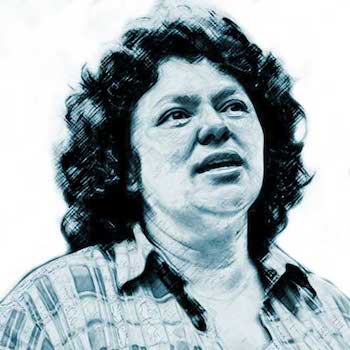
According to Common Dreams, human rights defenders on Monday 5 July 2021 welcomed the conviction of Roberto David Castillo Mejía, a Honduran businessman and former military intelligence officer, for the March 2016 assassination of Indigenous environmental activist Berta Cáceres, while calling on authorities in the Central American nation to bring everyone involved in planning the murder.

Memorial day: Environmental activist Berta Caceres was killed in her home in March 2016 Photo CC by Trocaire on Flickr.
(Photo CC by Trocaire on Flickr.)

The Guardian reports that the Tegucigalpa high court found Castillo—formerly head of the dam company Desarrollos Energéticos, or DESA—guilty of collaborating in Cáceres’ murder. The court ruled that Cáceres was killed for leading the campaign to stop construction of the $50 million Agua Zarca dam, a local grassroots effort which caused delays and monetary losses for DESA.

The environmentally destructive hydroelectric project is located on the Gualcarque River, which is sacred to the Indigenous Lenca people, and was approved despite its failure to comply with Honduran and international environmental requirements.

Cáceres, who was 44 years old when she was murdered, was co-founder and coordinator of the Council of Popular and Indigenous Organizations of Honduras (COPINH), a group dedicated to the defense of the environment in Intibucá and the protection of the Lenca. In 2015 she received the prestigious Goldman Environmental Prize for leading “a grassroots campaign that successfully pressured the world’s largest dam builder to pull out of the Agua Zarca Dam” project at Río Gualcarque. See also: https://humanrightsdefenders.blog/2020/06/10/nina-lakhanis-who-killed-berta-caceres-reviewed/

COPINH hailed Monday’s verdict as “a popular victory for the Honduran people” that “means the criminal power structures failed to corrupt the justice system.”

Erika Guevara-Rosas, Americas director at Amnesty International, said in a statement that “the long-awaited prosecution of David Castillo, convicted as co-author of the murder of Berta Cáceres, is an important step towards justice and the result of her family and COPINH’s tireless efforts to secure truth, justice, and reparation. However, justice for Berta will never be truly complete until everyone who took part in the crime, including those who planned it, is brought to justice.

We urge the prosecutors to keep uncovering the truth,” Guevara-Rosas continued. “Until all those responsible are held accountable, other human rights defenders in Honduras will continue to lose their lives, for raising their voices and defending the most vulnerable. The Honduran authorities must put an end to impunity.”

Noting that Honduras is “the most dangerous country for defenders of land, territory, and the environment,” Guevara-Rosas admonished the Honduran government, which she said “seems to look the other way when human rights defenders are attacked instead of fulfilling its obligation to protect them.”

“Authorities must take this seriously and do whatever is necessary to keep human rights defenders safe from harm, so that a crime like the murder of Berta Cáceres is never repeated,” she added.

A 2017 report (pdf) by international legal experts concluded Cáceres’ murder was not an “isolated incident” and alleged “willful negligence by financial institutions.” The report found that the targeting of Cáceres was part of a “strategy” by DESA employees, private security firms, and public officials “to violate the right to prior, free, and informed consultations of the Lenca.”

“The strategy was to control, neutralize, and eliminate any opposition,” the report said.

Berta received several awards: https://www.trueheroesfilms.org/thedigest/laureates/2AD0CEE4-80CB-3234-04B4-F2ED7ACBE6C5


http://redgreenandblue.org/2021/07/06/environmental-activist-berta-caceras-murdered-killer-just-brought-just

https://www.law.berkeley.edu/article/roxanna-altholz-human-rights-clinic-berta-caceres-investigation/

Profile of Barun Ghimire, human rights defender from Nepal

July 5, 2021

The rights of migrant workers is a global problem, and actors in different jurisdictions have to come together to make a difference in this particular area,” says Barun Ghimire, a human rights lawyer based in Kathmandu, Nepal. “And we need to create a collective narrative that is based on a rights-based approach of migrant workers”.

Barun Ghimire is a human rights lawyer and programme manager at the Law and Policy Forum for Social Justice. Barun works for the protection and defence of the rights of migrant workers in Kathmandu, Nepal. 

In this video, Barun explains his work in relation to the rights of migrants, as well as how Covid-19 has affected this group, which is facing even stronger vulnerability. He also calls the international community and other actors to come together and help improve the situation of migrants workers as well as their families.  To achieve this goal, it is necessary to create a new narrative and defend and promote the rights of migrant people in vulnerable situations, especially during and after Covid-19.

Barun was also a participant in ISHR’s Human Rights Defender Advocacy Programme (HRDAP) in 2020.

https://www.ishr.ch/news/human-rights-defenders-story-barun-ghimire-nepal

New investigation shows global reach of NSO Group’s spyware

July 5, 2021

On 3 July 2021, a new interactive online platform by Forensic Architecture, supported by Amnesty International and the Citizen Lab, maps for the first time the global spread of the notorious spyware Pegasus, made by cyber-surveillance company NSO Group.

‘Digital Violence: How the NSO Group Enables State Terror’ documents digital attacks against human rights defenders around the world, and shows the connections between the ‘digital violence’ of Pegasus spyware and the real-world harms lawyers, activists, and other civil society figures face.   NSO Group is the worst of the worst in selling digital burglary tools to players who they are fully aware actively and aggressively violate the human rights of dissidents, opposition figures, and journalists. Edward Snowden, President of Freedom of the Press Foundation.

NSO Group is a major player in the shadowy surveillance industry. The company’s Pegasus spyware has been used in some of the most insidious digital attacks on human rights defenders. When Pegasus is surreptitiously installed on a person’s phone, an attacker has complete access to a phone’s messages, emails, media, microphone, camera, calls and contacts. For my earlier posts on NSO see: https://humanrightsdefenders.blog/tag/nso-group/

“The investigation reveals the extent to which the digital domain we inhabit has become the new frontier of human rights violations, a site of state surveillance and intimidation that enables physical violations in real space,” said Shourideh C. Molavi, Forensic Architecture’s Researcher-in-Charge. 

Edward Snowden narrates an accompanying video series which tell the stories of human rights activists and journalists targeted by Pegasus. The interactive platform also includes sound design by composer Brian Eno. A film about the project by award-winning director Laura Poitras will premiere at the 2021 Cannes Film Festival later this month.

The online platform is one of the most comprehensive databases on NSO-related activities, with information about export licenses, alleged purchases, digital infections, and the physical targeting of activists after being targeted with spyware, including intimidation, harassment, and detention. The platform also sheds light on the complex corporate structure of NSO Group, based on new research by Amnesty International and partners.

For years, NSO Group has shrouded its operations in secrecy and profited from working in the shadows. This platform brings to light the important connections between the use of its spyware and the devastating human rights abuses inflicted upon activists and civil society,” said Danna Ingleton, Deputy Director of Amnesty Tech.

Amnesty International’s Security Lab and Citizen Lab have repeatedly exposed the use of NSO Group’s Pegasus spyware to target hundreds of human rights defenders across the globe. Amnesty International is calling on NSO Group to urgently take steps to ensure that it does not cause or contribute to human rights abuses, and to respond when they do occur. The cyber-surveillance must carry out adequate human rights due diligence and take steps to ensure that human rights defenders and journalists do not continue to become targets of unlawful surveillance.

In October 2019, Amnesty International revealed that Moroccan academic and activist, Maati Monjib’s phone had been infected with Pegasus spyware. He continues to face harassment by the Moroccan authorities for his human rights work. In December 2020, Maati Monjib was arbitrarily detained before being released on parole on 23 March 2021.

Maati Monjib, tells his story in one of the short films, and spoke of the personal toll following the surveillance, “The authorities knew everything I said. I was in danger. Surveillance is very harming for the psychological wellbeing of the victim. My life has changed a lot because of all these pressures.”

Amnesty International is calling for all charges against Maati to be dropped, and the harassment against him and his family by the Moroccan authorities to end.

To find out more visit digitalviolence.org

https://www.amnesty.org/en/latest/news/2021/07/investigation-maps-human-rights-harm-of-nso-group-spyware/

https://www.techradar.com/news/spyware-toolkit-used-by-governments-hackers-to-break-into-windows-machines

FIDH Launches Website Tracking Systematic Human Rights Violations in Belarus

June 28, 2021

SIARHEI LESKIEC / AFP

On 25 June 2021 the FIDH issued a press release announcing a new website on Belarus. Since May 2020, the administration of Aliaksandr Lukashenka, the de facto president of Belarus, has intensified repression, aiming to crush the country’s democratic movement. A new website launched by the International Federation for Human Rights (FIDH) tracks, compiles, and presents detailed information on the human rights situation in the country, including on political prisoners, violations against vulnerable groups, and efforts to advance accountability for the regime’s crimes.

FIDH and its member organisation in Belarus, Viasna Human Rights Center, have been closely monitoring and documenting the human rights situation in Belarus over the past year. The website launched today is intended as a comprehensive resource compiling up-to-date data and statistics, and offering analysis and insight into violations, including from our local partners such as Viasna. The website tracks and provides detailed information on political prisoners—particularly human rights activists, lawyers, journalists, and other human rights defenders, describes violations against vulnerable groups currently imprisoned by the regime—and details ongoing efforts to further accountability for the regime’s crimes.

The website has four main sections, updated daily, reflecting the most recent developments in four key areas: monitoring events and reactions, exposing crimes and furthering justice, defending human rights activists, and supporting vulnerable groups.

Monitoring events and reactions

On Monday, the EU approved new sanctions against 78 individuals and eight companies believed to support the crackdowns on the democratic movement and the forced landing of Ryanair flight with Raman Pratasevich on board late last month. The same day, the UK, Canada, and the US joined this initiative and introduced new sanctions. At the European Council yesterday, the EU also approved economic sanctions against parts of Belarus’ potash, oil, and tobacco exports, as well as telecommunication and banking sectors. We are monitoring this situation and will publish updates as soon as further information is available.

Exposing crimes and furthering justice

On 19 June, the law “On Amendments to the Laws on Ensuring the National Security of the Republic of Belarus” came into force. Among other provisions, it grants law enforcement the right to use military and special equipment to suppress riots and stipulates that officers not be liable for harm caused as a result of the use of force and weapons. This is one of a series of recent laws—including one that expands the definition of extremism—that threaten protesters’ lives and liberties, under the guise of ensuring public order and national security, and that violate the International Covenant on Civil and Political Rights. FIDH, which is on the Advisory Council of the International Accountability Platform for Belarus, regularly issues statements analysing such laws, as well as communications to the UN Special Procedures, in order to further justice in the country.

Defending human rights activists

Many human rights defenders (HRDs) in Belarus face persecution due to their professional activity. To date, at least 21 of them have been charged with supposed crimes in an attempt to thwart their human rights activities. Most recently, on 18 June, lawyer Andrei Machalau, who was a defense attorney in many criminal cases against protests activists and HRDs, including TUT.by journalist Katsiaryna Barysevich, was disbarred for alleged violation of professional ethics. Machalau is one of at least 17 lawyers whose licenses have been revoked since May 2020. We endeavour to defend each and every one of them and gather the available information in a dedicated section of our website.

Supporting vulnerable groups

The current regime demonstrates a blatant disregard for human rights of children, women, pensioners, persons with disabilities, and other vulnerable groups. Despite the overwhelmingly peaceful nature of the protest movement, hundreds of representatives of these groups have been detained, and sometimes beaten, for simply displaying the white-red-white flag: the main symbol of the democratic movement. On Monday, the Belarusian Ministry of Interior proposed that the KGB add the white-red-white flag and slogan Zhyve Belarus (Long live Belarus) to the list of banned Nazi symbols. Should this initiative be approved, public use of such symbols could lead to administrative or even criminal liability—potentially devastating news for many minors, women, and other Belarusians who have galvanised the protest movement using these symbols. We will be following the situation and supporting those who may suffer restrictions on freedom of speech due to this and other legislation.

https://www.fidh.org/en/region/europe-central-asia/belarus/mobilising-for-justice-in-belarus-fidh-launches-website-tracking

Palestinian human rights activist Nizar Banat dead after arrest and ill-treatment

June 26, 2021
Male relatives of Palestinian human rights activist Nizar Banat gather at the family home to mourn his death in Palestinian Authority custody
Male relatives of Palestinian human rights activist Nizar Banat gather at the family home to mourn his death in Palestinian Authority custody Mosab SHAWER AFP

On 24 June 2021, France24 reported that a Palestinian human rights activist Nizar Banat, 43, a PA critic from the city of Hebron, was arrested in a dawn raid Thursday by Palestinian security forces, Hebron governor Jibrin al-Bakri said. He died Thursday shortly after being arrested. His family reported that he was beaten to death.

Following… a summons from the public prosecution to arrest citizen Nizar Khalil Muhammad Banat, a force from the security services arrested him at dawn,” Bakri said in a statement carried by the official WAFA news agency.

No reason was given for his arrest.

Banat’s family accused security forces of “hitting him on the head with wooden sticks and bits of iron” and “deliberately murdering” him, they told the Palestinian news site Quds.

The governor only said that during Banat’s arrest, “his health deteriorated”.

Banat was known for his videos posted on Facebook, in which he denounced alleged corruption in the PA. He had registered as a candidate in the Palestinian parliamentary election which had been due to be held in May before president Mahmud Abbas postponed it indefinitely.

Bakri gave no indication of the cause of death, but both he and prime minister Mohammad Shtayyeh said an investigation had been launched.

The European Union delegation to the Palestinians said it was “shocked and saddened” by Banat’s death, adding that a “full, independent and transparent investigation should be conducted immediately”. The EU had voiced concern last November after Banat spent four days in custody in Jericho, and again expressed concern in May after Palestinian security forces raided Banat’s home.

On Tuesday, another Hebron-based Palestinian human rights activist, Issa Amro, said he was briefly detained after posting criticism of political detentions on Facebook.

https://www.france24.com/en/live-news/20210624-activist-dies-in-palestinian-authority-custody-governor

https://www.middleeastmonitor.com/20210724-pa-apologises-for-murder-of-activist-nizar-banat/

Martin Ennals Foundation reaches out: today

June 24, 2021

Martin Ennals Foundation, together with the Geneva Academy, IBAHRI, and ODAGE, is organizing a high-level panel discussion on how to effectively defend human rights lawyers in authoritarian times. Today 24 June at 13h30 Geneva time. With Belarussian human rights activist Tatsiana Khomich, sister of political prisoner Maria Kalasnikova; Xu Yan, wife of 2021 Martin Ennals Laureate Yu Wensheng of China; and Turkish human rights lawyer Ayşe Acinikli. You will also have the opportunity to hear Diego García-Sayán, UN Special Rapporteur on the Independence of Judges and Lawyers, Baroness Helena Kennedy QC and ISHR Director Phil Lynch.  

 Register for the event here >>

The MEA has also started an occasional newsletter with in this summer edition:

After a successful campaign, nominations for the 2022 Martin Ennals Award are now closed. We are excited by the high-quality nominations and thank those who contributed to our search for the next generation of human rights heroes.   Meanwhile, our support for human rights defenders continues through the Martin Ennals programs.

Director Isabel de Sola shares how education is paving the way for a more sustainable human rights movement. She informs about the Foundation’s education project – a program aimed at familiarizing students with the concept of human rights and the causes promoted by our Defenders.

Programme Officer Cristina Rendón writes “It takes a village to protect defenders”.  Because the three 2021 awardees were unable to communicate freely with the Martin Ennals Foundation, we had to reinvent our “Geneva Residency” programme by extending its activities to the support networks of our awardees. We learned about the importance of building a strong network of allies who can support defenders, in the good times and the bad

 https://www.martinennalsaward.org/upcoming-event-defending-human-rights-lawyers-in-authoritarian-times/