Archive for the 'organisations' Category

2021 ProtectDefenders.eu Annual Report

April 20, 2022

“The Human Rights Movement at a Crossroad”

On 14 April 2022, ProtectDefenders.eu published its 2021 annual report:

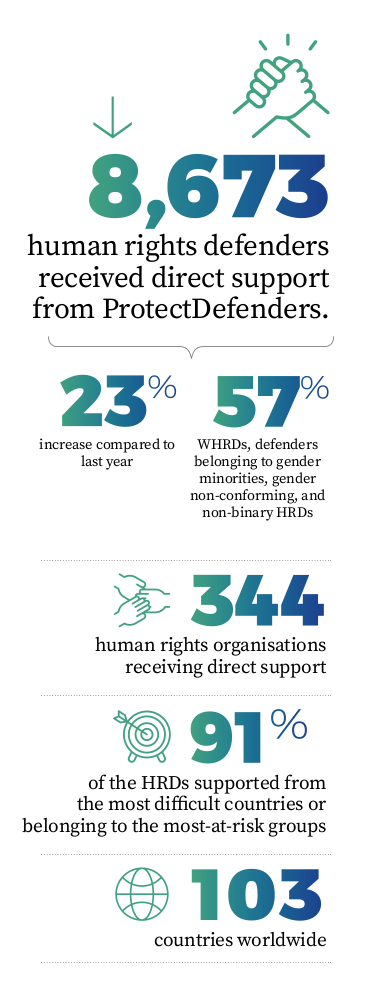
Throughout 2021, the EU human rights defenders mechanism, ProtectDefenders.eu, has delivered life-saving support and multi-faceted assistance to nearly 8,700 of the most at-risk human rights defenders and grassroots human rights organisations around the world – 23% more than in 2020. The EU HRD mechanism’s strategic, flexible, and efficient support has mitigated the ravages suffered by the human rights defence community last year, amid the pervasive impacts of the COVID-19 pandemic and the most critical global and geopolitical environment for human rights defence work reported since the creation of ProtectDefenders.eu in 2015.
Despite this extremely adverse situation, ProtectDefenders.eu has continued to mobilise protective support to individuals at risk, and to provide comprehensive assistance to organisations and movements confronting security threats. The support of ProtectDefenders.eu has helped human rights defenders and grassroots human rights groups to strengthen their resilience and protection globally, particularly in the most difficult contexts, making a significant contribution to their ability to continue their work.

Last year, the activities of the EU HRD mechanism have been impacted by an unprecedented increase in requests for urgent materially protective support from defenders and communities: ProtectDefenders.eu has had to respond to, among other severe crises, the dismantling and repression of civil society in Belarus, the consequences of the coup d’état in Myanmar on civil society and HRDs, and the collapse of Afghanistan as the Taliban took over its government. Thus, significant efforts were made to reach these most difficult countries and the most at-risk groups of defenders, who have absorbed an unprecedented level of the support delivered by the EU HRD mechanism. See also; https://humanrightsdefenders.blog/2019/05/28/the-eu-human-rights-defenders-mechanism-a-short-overview/

In a quickly evolving context, creative and flexible solutions and adaptations have been implemented, and this year the consolidation of the ProtectDefenders.eu consortium has given rise to new spaces to explore the privileged positioning of the EU HRD mechanism in the international community in support of defenders. This is illustrated by the launch of the first HRD resettlement stream by the government of Canada in partnership with ProtectDefenders.eu, the articulation of a comprehensive response in Afghanistan through new programmes in partnership with the EU, and the steps taken towards a more comprehensive and collective approach to advocacy on issues of common interest.

ProtectDefenders.eu has continued to provide a comprehensive, holistic and effective emergency protection for HRDs at the greatest risk, including 24/7 support, and to invest in the resilience and capacity of human rights organisations to continue their work in adverse environments – notably through lifeline and core-funding grant-making to local actors, including communities defending rights. ProtectDefenders.eu has also ensured that international temporary relocation capacities remain operational and accessible for HRDs and members of their families, and has taken a significant step in strengthening regional relocation structures through the Shelter Initiatives program. Furthermore, and despite the prevailing limitations created by the pandemic, capacity-building activities have continued to provide access to knowledge about reinforced protection strategies for the community of defenders. Similarly, ProtectDefenders.eu has strengthened its support to individual HRDs and NGOs through its reactive and protective advocacy work to HRDs at risk through urgent interventions, reports, and related proactive steps, mobilising the international community in an effort that has led to multiple success stories throughout the world.

This coordinated implementation, coupled with a holistic and complementary approach between partners, actions, strategies, and programmes, continues to step up the practical support available to HRDs at risk and local human rights NGOs in a timely and comprehensive manner; the vast majority of HRDs accessing ProtectDefenders.eu’s support have reported enhanced security and protection, and highly positive outcomes. Although the extreme situation in 2021 has pushed the mandate and resources of the EU HRD mechanism to the limit, ProtectDefenders.eu has managed to maintain and generate a consistently noticeable and positive impact on the HRD community at highest risk.

The 2021 ProtectDefenders.eu Annual Report is introduced by Victoria Fyodorova, a woman human rights defender from Belarus, Jamila Afghani, a WHRD from Afghanistan, Josep Borrell, Representative of the Union for Foreign Affairs and Security Policy/Vice-President of the European Commission, Jutta Urpilainen, Commissioner for International Partnerships, and Maria Arena, Chair of the European Parliament’s subcommittee on Human Rights.

Click to read and download the 2021 ProtectDefenders.eu Annual Report

EU’s Report on Human rights 2021

April 20, 2022

On 19 April 2022 the EU published its 2021 report on Human Rights and Democracy in the World.l

INTRODUCTION: In 2021, in a context characterised by a prevailing global pandemic and a sustained trend of rising authoritarianism, the EU stepped up its work to uphold human rights, democracy and the rule of law across the world and strengthened its tools.

On the eve of the Human Rights Day on 10 December 2021, the EU launched the Global Europe Human Rights and Democracy programme [see: https://humanrightsdefenders.blog/2021/12/17/eu-launches-a-e1-5-billion-6-year-plan-to-promote-human-rights-and-its-defenders/].

This annual report on human rights and democracy monitors the implementation of the EU Action Plan by presenting the progress achieved to date.

One landmark achievement is the EU Global Human Rights Sanctions Regime (EUGHRSR). In 2021, the EU adopted restrictive measures targeting persons and entities from China, the Democratic People’s Republic of Korea (DPRK), Libya, South Sudan, Eritrea and Russia, involved in serious human rights violations and abuses. The EU imposed sanctions in the case of Alexei Navalny’s arbitrary arrest and detention, as well as sanctions against the Wagner group and its members. In December, the Council adopted a decision prolonging for one year the existing sanctions.

Throughout the year, the EU took the lead in UN human rights fora on initiatives aimed at addressing human rights violations and abuses in Afghanistan, Belarus, Burundi, DPRK, Ethiopia, Eritrea and Myanmar. The first EU strategic dialogue with the Office of the UN High Commissioner for Human Rights (OHCHR) in October 2021 was an opportunity to share updates on global human rights issues, to discuss priorities and to build a stronger partnership for more effective multilateralism and rules-based international cooperation. As a staunch advocate of multilateralism, the EU also remains vigilant in the defence and advancement of universal human rights and the integrity and functionality of the global human rights system.

Pursuing its political priority towards achieving gender equality and women’s empowerment, the EU reinforced its ambition through the implementation of the EU Action Plan on Gender Equality and Women’s Empowerment in the EU External Action 2021-2025 (GAP III). The EU remained committed to preventing and combatting all forms of gender-based violence and engaged as an Action Coalition leader in the Generation Equality Forum, as well as in the Call to Action on Protection from Gender-Based Violence in Emergencies.

In 2021, the International Year for the Elimination of Child Labour, the EU Strategy on the Rights of the Child5 was also adopted. It was developed with contributions from over 10,000 children and proposed new actions to support children and contribute to the protection and promotion of their rights.

In 2021, the EU further expanded its concrete support to civil society organisations and human rights defenders, especially environmental, land and indigenous peoples’ rights defenders, women human rights defenders and labour rights defenders, who remained under severe pressure around the world. The 23rd EU-NGO Human Rights Forum organised on 7-8 December 2021 focused on ‘Rebuilding better: a human-rights based recovery from the pandemic’. The EU Human Rights Defenders Mechanism ProtectDefenders.eu (EUR 35 million for 2015-2022) has supported nearly 53,000 human rights defenders at risk and their families since its launch in 2015. [see: https://humanrightsdefenders.blog/2022/02/28/eu-by-far-biggest-funder-of-human-rights-defenders/]

In a global context of democratic backsliding, supporting democratic electoral processes remained a cornerstone of EU engagement worldwide. Despite the restrictions linked to the pandemic and political and security circumstances, in the second half of 2021 the EU successfully deployed Election Observation Missions to Zambia, Kosovo, Iraq, Venezuela, Honduras, and The Gambia.

Download document (PDF | 3.31 MB | Report of the EU High Representative for Foreign Affairs and Security Policy)Download document (PDF | 3 MB | Country Updates)

Save the date and come to the MEA ceremony 2022 or watch online

April 20, 2022

The Martin Ennals Award Laureates 2022 are leading architects of the human rights movement. Get inspired by their courage and unique contributions at the Award Ceremony on 2 June 2022

After a postponement due to the COVID-19 pandemic, registration for the Award Ceremony in person is now open. June 2nd, 18h00 at the Salle Communale de Plainpalais, Rue de Carouge 52, 1205 Geneva.

The Award Ceremony will also be live streamed on the MEA website and social media platforms: Instagram, Twitter, and Facebook. sign up

MEET THE LAUREATES of 2022

Dr. Daouda Diallo. Burkina Faso

A fearless activist, Dr. Daouda Diallo documents human rights abuses committed in the cross- fires of Burkina Faso’s violent conflict.

Pham Doan Trang. Vietnam

A leading journalist and champion of freedom of expression, Pham Doan Trang inspires others to speak up.

Abdul-Hadi Al-Khawaja, Bahrain

A champion of human rights and justice, Abdul-Hadi Al-Khawaja galvanized a new generation of activists in the Gulf region.

THE SPEAKERS include:

Catherine Sommer, Master of Ceremony, Journalist and Producer

Alfonso Gomez. Member of the executive – City of Geneva

Nada-Al Nashif

Haute-Commissaire adjointe des Nations Unies aux droits de l’homme

Fr. Xavier Soreng SJ

Watch the press conference below to get to know the three 2022 Laureates selected by the Jury.

Human Rights Defender Angkhana Neelapaijit in Thailand harassed

April 14, 2022
Photo captured on a security camera of the alleged assailant, a woman wearing a mask and a black t-shirt.
Photo captured on a security camera of the alleged assailant, a woman wearing a mask and a black t-shirt. © 2022 Private

The authorities in Thailand should urgently investigate an incident intended to intimidate a prominent human rights defender, Human Rights Watch said on 13 April, 2022.

On April 12, 2022, at about 6 a.m., an unidentified assailant threw a pair of 9-inch-long scissors at the house of Angkhana Neelapaijit in Bangkok, making a hole in her front door. Security camera footage showed what appeared to be a woman wearing a face mask and a dark t-shirt with the Thai numeral 9 standing in front of the house, throwing the scissors, and then running away. Angkhana, 66, is a former commissioner of the National Human Rights Commission of Thailand and a newly appointed member of the United Nations Working Group on Enforced or Involuntary Disappearances. See: https://www.trueheroesfilms.org/thedigest/laureates/0D5DED3E-F79F-4AB4-8261-F6A19486F062

Violent acts intended to intimidate a well-known figure like Angkhana not only pose a threat to her and her family, but send a spine-chilling message to the entire Thai human rights community,” said Elaine Pearson, acting Asia director at Human Rights Watch. “The Thai government should respond immediately by undertaking a serious investigation to ensure that everyone responsible for this incident is held accountable.”

Angkhana told Human Rights Watch that she and her family felt vulnerable after the Justice Ministry canceled her protection under the government’s witness protection program on April 1. The authorities claimed the service was no longer needed because Angkhana’s life would no longer be in danger after the Department of Special Investigation ended its investigation of the enforced disappearance of her husband, the prominent human rights lawyer Somchai Neelapaijit. [See also: https://humanrightsdefenders.blog/2021/03/17/where-is-somchai-a-brave-wifes-17-year-quest-for-the-truth/]

The Thai government should not ignore this disturbing incident, which appears to be a response to Angkhana’s effective human rights advocacy,” Pearson said. “Foreign governments and the United Nations should press the Thai government to urgently act to protect Angkhana and other human rights defenders in the country.”

https://www.hrw.org/news/2022/04/13/thailand-prominent-rights-defender-harassed

Human Rights Defender Vladimir Kara-Murza arrested in Russia

April 14, 2022

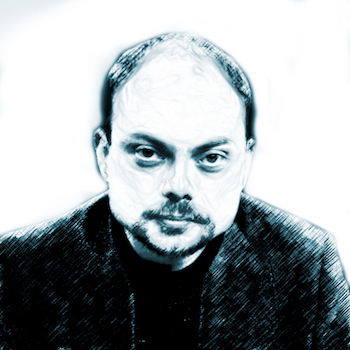
Vladimir Kara-Murza, the Russian democracy activist, historian, twice-poisoned critic of Vladimir Putin’s regime, and a senior advisor to Human Rights First, was reportedly arrested near his Moscow residence on 11 April 2022.  Kara-Murza’s arrest came just days after his return to Russia and shortly after CNN broadcasted an interview with him. He is the winner of 3 human rights awards, see: https://www.trueheroesfilms.org/thedigest/laureates/34e43b60-3236-11ea-b4d5-37ffeeddd006

We are deeply concerned for our friend Vladimir Kara-Murza’s personal safety, and we call on Russian authorities to release him immediately,” said Michael Breen, President and CEO of Human Rights First.  “Putin and his regime have shown themselves to be willing to break any law, domestic or international, to suppress political opposition at home and subjugate neighboring countries like Ukraine.  We call on all of democracy’s allies to oppose criminal behavior like this to protect human rights in Russia, Ukraine, and around the world.

Having been targeted for assassination twice before, Kara-Murza knew his return to Russia put him in danger.  In his recent CNN interview, Kara-Murza said, “The biggest gift we could give…to the Kremlin would be just to give up and run…that’s all they want from us.

https://www.humanrightsfirst.org/press-release/russian-human-rights-activist-vladimir-kara-murza-arrested-moscow

Major NGO offices in Russia now closed

April 9, 2022

On 8 April 2022, the Russian government closed the offices of Amnesty International and Human Rights Watch and several other NGOs such as Carnegie Endowment for International Peace, Friedrich Naumann Foundation for Freedom, Friedrich Ebert Foundation. This decision has been taken “in connection with the discovered violations of the Russian legislation.

On 11 March, Russia’s media regulator had already blocked access to Amnesty International’s Russian-language website.

Human Rights Watch had maintained an office in Russia for 30 years. The action was announced just days after an appeals court upheld the liquidation of Russia’s human rights giant, Memorial. [see also: https://humanrightsdefenders.blog/2021/11/12/it-had-to-happen-russian-authorities-move-to-shut-down-memorial/]

Human Rights Watch has been working on and in Russia since the Soviet era, and we will continue to do so,” said Kenneth Roth, executive director of Human Rights Watch. “This new iron curtain will not stop our ongoing efforts to defend the rights of all Russians and to protect civilians in Ukraine.”

Reacting to the news, Agnès Callamard, Secretary General of Amnesty International, said: “Amnesty’s closing down in Russia is only the latest in a long list of organizations that have been punished for defending human rights and speaking the truth to the Russian authorities. In a country where scores of activists and dissidents have been imprisoned, killed or exiled, where independent media has been smeared, blocked or forced to self-censor, and where civil society organizations have been outlawed or liquidated, you must be doing something right if the Kremlin tries to shut you up.

https://www.hrw.org/news/2022/04/08/russia-government-shuts-down-human-rights-watch-office

https://www.themoscowtimes.com/2022/04/08/moscow-shutting-down-amnesty-human-rights-watch-in-russia-a77290

No end to NSO’s Pegasus trouble

April 5, 2022

TechCrunch of 5 April 2022 reports that Investigators say they have found evidence that a Jordanian journalist and human rights defender’s iPhone was hacked with the Pegasus spyware just weeks after Apple sued the spyware’s maker NSO Group to stop it from targeting Apple’s customers.

Award-winning journalist Suhair Jaradat’s phone was hacked with the notorious spyware as recently as December 5, 2021, according to an analysis of her phone by Front Line Defenders and Citizen Lab that was shared with TechCrunch ahead of its publication. Jaradat was sent a WhatsApp message from someone impersonating a popular anti-government critic with links to the Pegasus spyware, compromising her phone. According to the forensic analysis, Jaradat’s iPhone was hacked several times in the preceding months and as far back as February 2021.

Apple had filed a lawsuit against Israeli spyware maker NSO Group in November 2021, seeking a court-issued injunction aimed at banning NSO from using Apple’s products and services to develop and deploy hacks against its customers. See also: https://humanrightsdefenders.blog/2021/07/21/nsos-pegasus-spyware-now-really-in-the-firing-line/…But so far the case has gotten off to a slow start after the first judge assigned to the case recused herself, with no decision on the case likely to be made any time before June.

Jaradat is one of several Jordanians, including human rights defenders, lawyers and fellow journalists whose phones were compromised likely by agencies of the Jordanian government, according to Front Line Defenders and Citizen Lab’s findings out Tuesday.

Among the others targeted include Malik Abu Orabi, a human rights lawyer whose work has included defending the teachers’ union, which in 2019 led the longest public sector strike in the country’s history. Abu Orabi’s phone was targeted as early as August 2019 until June 2021. Also, the phone of Ahmed Al-Neimat, a human rights defender and anti-corruption activist, was targeted by the ForcedEntry exploit in February 2021. The researchers said the hacking of Al-Neimat’s phone is believed to be the earliest suspected use of ForcedEntry.

Another Jordanian journalist and human rights defender’s phone was targeted, according to the researchers, but who asked for her identity not to be disclosed.

Meanwhile, on 5 April 2022, AFP reported that Palestinian lawyer Salah Hamouri, who is in Israeli detention, filed a complaint in France Tuesday against surveillance firm NSO Group for having “illegally infiltrated” his mobile phone with the spyware Pegasus.

Hamouri, who also holds French citizenship, is serving a four-month term of administrative detention ordered by an Israeli military court in March on the claim he is a “threat to security”.

He is one of several Palestinian activists whose phones were hacked using the Pegasus malware made by the Israeli company NSO, according to a report in November by human rights groups. See: https://humanrightsdefenders.blog/2021/11/10/palestinian-ngos-dubbed-terrorist-were-hacked-with-pegasus-spyware/

On Tuesday, the International Federation for Human Rights (FIDH), the Human Rights League (LDH) and Hamouri filed a complaint with the Paris prosecutor.  It accused NSO of “having illegally infiltrated the telephone of rights defender Salah Hamouri,” they said in a statement sent to the AFP bureau in Jerusalem. 

Obviously, this is an operation that is part of a largely political framework given the harassment Hamouri has been subjected to for years and the attacks on human rights defenders in Israel,” attorney Patrick Baudouin, honorary president of the FIDH, told AFP.

https://www.securityweek.com/palestinian-lawyer-sues-pegasus-spyware-maker-france

https://citizenlab.ca/2022/04/peace-through-pegasus-jordanian-human-rights-defenders-and-journalists-hacked-with-pegasus-spyware/

then

https://cybersecuritynews.com/whatsapp-wins-nso-pegasus-spyware-hacking-case/

Shocking case of refoulement from Spain

March 31, 2022

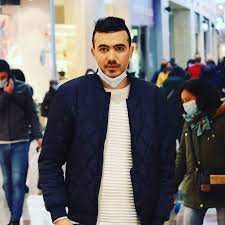
On 30 March 2022, Statewatch along with 13 other human rights organisations condemned the deportation from Spain to Algeria of Mohamed Benhalima, a human rights activist who faces a serious risk of torture and other ill-treatment in the North African state.

The organisations strongly condemn the deportation by Spain of Algerian activist Mohamed Benhalima, in the evening of 24 March 2022, despite the risks of torture and serious human rights violations he faces in Algeria, and therefore in blatant violation of Spain’s international obligations on non-refoulement. The authorities had been made aware, through civil society and legal appeals, that Mr Benhalima faces a high risk of torture, arbitrary detention and unfair trial in Algeria, where such violations are increasingly common against prisoners of opinion and peaceful activists.

Mohamed Benhalima is an Algerian citizen and a former Army corporal turned whistleblower, who exposed corruption among Algeria’s high-ranking military officials in 2019. He left Algeria after receiving information that his name was on a list of wanted military officials at risk of detention by the Algerian army for their participation in the Hirak, a mass pro-democracy protest movement.

He sought asylum in Spain on 18 February 2020 and again on 18 March 2022; Spain refused him asylum both times. On 14 March 2022, authorities opened an administrative file of expulsion for infringement of Art. 54.1.a. of Immigration Law 4/2000, alleging that Mr. Benhalima took part in “activities contrary to public security or which may be harmful for Spanish relationships with foreign states”.

Spanish authorities justified the opening of an expulsion file based on Mr. Benhalima’s alleged association with political opposition group Rachad, which was listed as a terrorist group by Algeria on 6 February 2022. Spanish authorities claimed that Rachad’s objective was to infiltrate radical youth into Algerian society to protest against the Algerian government, and concluded that the activist was a member of a terrorist group.

Authorities did not provide any proof of violent action or speech or any other action taken by the activist that would fall under a definition of terrorism in accordance with the definition proposed by the UN Special Rapporteur on the protection of human rights while countering terrorism. Authorities also do not appear to have considered a context in which Algerian authorities have been increasingly levelling bogus terrorism and state security charges against peaceful activists, human rights defenders and journalists since April 2021. On 27 December 2021, UN Special Procedures warned that the definition of terrorism in the Algerian Penal Code was too imprecise and undermined fundamental rights. They stated that the procedure for registration on the national terrorist list did not comply with international human rights standards and expressed concern that it could give rise to abuse.

On 24 March around 7pm, Mr. Benhalima’s lawyers were notified of the resolution of expulsion and promptly filed a request for an interim suspensive measure at the National Court of Spain, which was rejected; however, it was revealed later that the activist was already on his way to Algeria at the time.

On 21 March 2022, the UN High Commissioner for Refugees (UNHCR) submitted a non-public report to the Spanish government stating that Mr. Benhalima’s asylum request should be studied thoroughly in a regular procedure and not rejected expediently, arguing that the fear of torture was credible and that Algeria’s criminalisation of peaceful opposition was internationally recognised.

On 27 March, Benhalima appeared in a video broadcasted on Ennahar TV, in which he “confesses” to the crimes of conspiracy against the state, and states that he was not treated badly in custody. However, the undersigned organisations call into question the reliability of such statements which might be the result of duress. In addition, Benhalima had himself released a video from the retention centre in Valencia, before his deportation to Algeria, in which he warns that such videos would not be genuine and would show that he “was subjected to severe torture at the hands of intelligence services.”

In January and March 2021, in Algeria, Mohamed Benhalima was sentenced in absentia to a total of 20 years in prison for charges including “participation in a terrorist group” (Article 87bis 3 of the Penal Code) and “publishing fake news undermining national unity” (Art.196 bis) among other charges. The overly broad formulation of both articles has been used by Algeria repeatedly to criminalise fundamental freedoms. In one of the verdicts, issued on 9 March 2021, the judge sentenced Benhalima to 10 years in prison for his online publications, including videos exposing corruption in the army, a form of peaceful expression, which is protected under the right to freedom of expression.

Spanish authorities additionally motivated the expulsion based on Mr. Benhalima’s close relationship with Mohamed Abdellah, another Algerian whistleblower and former member of the military, who also sought refuge in Spain in April 2019 and was forcibly returned on 21 August 2021 using Art. 54.1.a. of Law 4/2000, in similar circumstances and for the same motives.

Mohamed Abdellah, currently detained in the military prison of Blida, stated in court on 2 January 2022 that he had been subjected to various forms of torture and ill-treatment upon his return to Algeria, including prolonged solitary confinement in a cell with no light and physical abuse, according to a witness who attended the hearing. He was also deprived of access to a lawyer.

Despite the strong similarities between both cases providing a compelling precedent about the actual risk of torture and ill treatment of activists and whistleblowers, notably former members of the military, in Algeria, the Spanish government showed its determination to forcibly return someone where their physical and psychological integrity was not guaranteed. In doing so, Spain flouted critical international law obligations under which nobody should be returned to a country where they would be in danger of suffering torture or other cruel, inhuman or degrading treatment.

Signatures

  • MENA Rights Group
  • Justitia Center for legal protection of human rights in Algeria
  • World Organisation Against Torture
  • Red Jurídica
  • CIHRS
  • Amnesty International
  • Irídia, Center for Human Rights
  • Collectif des familles de disparus en Algérie
  • Al Karama
  • Statewatch
  • Spanish Commission for Refugees – CEAR
  • Euromed Rights
  • Alianza
  • ActionAid

https://www.statewatch.org/news/2022/march/spain-forsakes-international-obligations-in-appalling-refoulement-of-algerian-whistleblower/

https://www.aljazeera.com/features/2022/4/6/rights-defenders-slam-spains-deportation-of-algerian-dissident

EU – China Summit on 1 April should not be a joke

March 30, 2022

European Union leaders should announce specific policy responses to the Chinese government’s atrocity crimes, Human Rights Watch said today, 30 March 2022. A virtual summit between the EU and China is scheduled for April 1, 2022.

The summit takes place at a time of heightened tensions between the EU and the Chinese government, which retaliated against Lithuania for its relations with Taiwan, baselessly sanctioned EU bodies and European research institutions, and has not condemned Russian war crimes in Ukraine. The Chinese government’s disregard for international human rights norms mirrors its domestic track record of grave abuses without accountability.

The EU’s foreign policy chief has pointed with alarm to the Chinese government’s ‘revisionist campaign’ against universal human rights and institutions,” said Sophie Richardson, China director at Human Rights Watch. “Brussels should revise its approach to match the magnitude of that threat.”

In a March 18 joint letter from 10 nongovernmental organizations to Ursula von der Leyen, president of the European Commission, and Charles Michel, president of the European Council, Human Rights Watch cited Chinese authorities’ deepening assault on human rights, including crimes against humanity targeting Uyghurs and other Turkic communities in Xinjiang, and heightened repression in Tibet and Hong Kong. Human rights defenders across the country – including the citizen journalist Zhang Zhan, the Uyghur intellectual and Sakharov Prize laureate Ilham Tohti, the Swedish publisher Gui Minhai, and many others – remain arbitrarily detained. {see https://www.trueheroesfilms.org/thedigest/laureates/37AE7DC4-16DB-51E9-4CF8-AB0828AEF491, and https://humanrightsdefenders.blog/2020/02/25/gui-minhai-10-years-jail-sentence-in-china/

While the EU has taken important steps in reaction to these developments, including some targeted sanctions and strong condemnations of Beijing’s abuses at the United Nations, these efforts lack the consequences to bring significant change. The rights groups urged Michel and von der Leyen to use their time with the Chinese leaders to announce further steps to counter Beijing’s abuses, and cautioned them against calling for yet another round of the bilateral human rights dialogue, which after 37 rounds has proven unable to secure concrete progress.

Stronger, better coordinated action is also supported by the European Parliament, which has remained a staunch critic of the Chinese government’s crackdown and has repeatedly denounced its abuses. Beijing responded by sanctioning several members of the European Parliament. In response, the European Parliament froze consideration of a bilateral trade deal and called for a new, and more assertive, EU strategy on China, including further targeted sanctions and closer coordination with like-minded partners. [see: https://humanrightsdefenders.blog/2021/05/21/china-eu-investment-deal-off-the-rail/]

Presidents Michel and von der Leyen should go beyond words of condemnation at the summit if they want to deter Chinese government violations now and in the future,” said Claudio Francavilla, EU advocate at Human Rights Watch. “Bolder steps are needed to counter Beijing’s crimes against humanity and anti-rights agenda, and EU leaders should announce their determination to pursue them.”

https://www.hrw.org/news/2022/03/18/joint-ngo-letter-ahead-eu-china-summit

https://www.hrw.org/news/2022/03/30/eu-no-business-usual-china-summit

Annual Report Amnesty 2021 is out

March 29, 2022

The human rights organisation looks back on 2021, “a year of dashed hopes“. According to Amnesty International, the digital sphere is increasingly becoming a space for activism — and repression.

Despite promises and pledges to the contrary, at almost every turn, leaders and corporations opted for a non-transformative path, choosing to entrench rather than overturn the systemic inequalities behind the pandemic. Yet, people the world over have made it abundantly clear that a more just world, grounded in human rights, is what they want

Agnès Callamard SG AI

Here is how Deutsche Welle summarized it:

Every year, Amnesty International looks at developments around the world and compiles an analysis of the most important global trends in human and civil rights. In its latest annual report, Amnesty Middle East and North Africa research and advocacy director Philip Luth says: “2021 was a year of really quite significant promises. … The reality was completely otherwise.”

There had been hope that the world might emerge from the pandemic equitably, Luther told DW, but richer countries in particular have prevented the widespread manufacture and distribution of vaccines. The annual report cites the facts: Fewer than 8% of the 1.2 billion people in Africa were fully vaccinated at the end of 2021 — the lowest rate in the world and far from the WHO’s 40% vaccination target…..The study also found that many governments have used the pandemic to suppress opposition and civil society. “It’s across regions and that’s one of the reasons we highlighted it in our global analysis,” Luther said. “Some governments very specifically used the smoke screen of the pandemic to restrict freedom of expression.” Examples of countries where protests have been broken up and human rights defenders are at risk include Cambodia, Russia, China and others.

According to Amnesty and other international organizations, the pandemic is also having an effect on civil society. “There are various strategies that are making it increasingly difficult for civil society to operate in different regions of the world,” Silke Pfeiffer, head of the department for human rights and peace at the Christian-affiliated aid organization Brot für die Welt (Bread for the World), told DW. “This is quite specifically directed at individual activists, who are discriminated against, threatened, persecuted and in some cases murdered.” In many countries, Pfeiffer said, governments cultivate a hostile environment. “It becomes increasingly difficult for civil society organizations to work,” she said. “That goes as far as the closure of NGOs; we see that again and again.” To cite just one example: In late March, Nicaraguan President Daniel Ortega had 25 nongovernmental organizations closed. One of them is the Nicaraguan partner organization to Brot für die Welt.

Governments and NGOs are increasingly doing their work online. Luther describes the development as a “double-edged sword.” Authorities clandestinely use technology in ways that have a negative impact on people’s human rights, he said: “Governments in many cases were also then trying to shut down and disrupt tools that enable civil society to better communicate with each other and spread information.”

Amnesty International’s annual report cites multiple examples of this: the internet shutdown from August 4, 2019, to February 5, 2021, in the India-controlled regions of Jammu and Kashmir; the use of facial recognition technology at protests in Moscow; and the use of Israel’s Pegasus spyware against journalists, opposition figures and human rights activists. Pfeiffer said the internet was an important way for civil society to organize and mobilize. But she added that, around the world, “governments and other actors have completely upgraded digitally and are now also taking very strong action against freedom on the internet — through censorship, by shutting down internet services, through mass surveillance.”

Across the world, Amnesty noted, people took to the streets to fight for their rights and the rights of others in 2021 — in Russia, India, Colombia, Sudan, Lebanon and at least 75 other countries. in the words of AI Secretary General: “The palpable and persistent resistance offered by people’s movements the world over is a beacon of hope. Uncowed and undaunted, theirs is a clarion call for a more equal world. If governments won’t build back better – if they seemingly are intent on building back broken – then we are left with little option. We must fight their every attempt to muzzle our voices and we must stand up to their every betrayal. It is why, in the coming weeks, we are launching a global campaign of solidarity with people’s movements, a campaign demanding respect for the right to protest. We must build and harness global solidarity, even if our leaders won’t.”

She also said:

Global trends to stifle independent and critical voices gathered steam in 2021 as governments deployed a widening gamut of tools and tactics. Human rights defenders, NGOs, media outlets and opposition leaders were the targets of unlawful detention, torture and enforced disappearance, many under the smokescreen of the pandemic.

At least 67 countries introduced new laws in 2021 to restrict freedom of expression, association or assembly. In the USA, at least 36 states introduced more than 80 pieces of draft legislation limiting freedom of assembly, whilst the UK government proposed the Police, Crime, Sentencing and Courts Bill, which would drastically curtail the right to freedom of peaceful assembly, including by expanding police powers.

Global trends to stifle independent and critical voices gathered steam in 2021 as governments deployed a widening gamut of tools and tactics. Human rights defenders, NGOs, media outlets and opposition leaders were the targets of unlawful detention, torture and enforced disappearance, many under the smokescreen of the pandemic.

At least 67 countries introduced new laws in 2021 to restrict freedom of expression, association or assembly. In the USA, at least 36 states introduced more than 80 pieces of draft legislation limiting freedom of assembly, whilst the UK government proposed the Police, Crime, Sentencing and Courts Bill, which would drastically curtail the right to freedom of peaceful assembly, including by expanding police powers.

https://www.dw.com/en/amnesty-international-2021-was-the-year-of-broken-promises/a-61285728