Vincent Ploton leads ISHR’s strategic engagement and litigation with the UN Treaty Bodies, and he drew attention to General Comment N° 26 of the Committee on Economic, Social and Cultural Rights, which spells out the obligations of States parties to the ICESCR in relation to land rights. This constitutes the first guidance wholly dedicated to land rights across the UN Treaty Body system. CESCR’s new resource provides a major opportunity for land rights defenders at a time when the global battle for natural resources is at a historical high, and those who stand to protect their land are on the frontline. In all world regions, people who resist the destruction and exploitation of their land are facing judicial harassment, threats and murders. Indigenous and peasant communities who defend their rights to cultivate and live on their ancestral lands are dispossessed and extorted by powerful actors. CESCR’s General Comment spells out the measures that States parties must take to uphold compliance with the obligations set out in the Covenant.
ISHR welcomes the dedicated section of the General Comment on land rights defenders, which echoes our inputs and calls on States parties to:
Publicly recognise … the importance and legitimacy of the work of human rights defenders and a commitment that no violence or threats against them will be tolerated
Repeal of any State legislation or any measures that are intended to penalise or obstruct the work of human rights defenders
Strengthen State institutions responsible for safeguarding the work of human rights defenders
Investigate and punish any form of violence or threat against human rights defenders
Adopt and implement programmes, in consultation with potential beneficiaries, that are well resourced and have inbuilt coordination mechanisms that ensure that adequate protection measures are provided to human rights defenders at risk whenever necessary
Speaking about this groundbreaking new guidance, the Committee’s Co-Rapporteur Rodrigo Uprimny said: “I hope that communities whose land rights are denied, including indigenous communities, can count on the force of international law, and the norms dictated by the International Covenant on Economic, Social and and Cultural Rights. The General Comment reaffirms and reinforces the concept of free, prior and informed consent and also recognizes the fundamental work of defenders of land rights.
‘If we work together to make sure that issues are more visible, that happen in Africa, the civil society organisations, I think, will be achieving more.’
Odinakaonye ‘Odi’ Lagi is the programme director for the Network of University Legal Aid Institutions (NULAI), Nigeria, and she works on promoting access to justice and legal aid for Nigerians. Citing the example of the Nigerian social movement to protest against the actions of the Special Anti-Robbery Squad (known as the end #EndSars protests), which she says did not receive enough attention in the continent, she calls for civil society groups and activists across Africa to come together to shed more collective light on individual national struggles.
UN secretary general Antonio Guterres with Chinese president Xi Jinping during an official visit to Geneva on 18 January 2017. (UN Photo/Jean-Marc Ferré)
In parallel, ISHR hosted a panel discussion on the topic with former member of the UN Committee against Torture (CAT) Felice Gaer, William Nee of the Network of Chinese Human Rights Defenders, Peter Irwin from the Uyghur Human Rights Project, and ISHR’s Director of Treaty Body advocacy, Vincent Ploton. ISHR Programme Director Sarah Brooks moderated the discussions.
“The incidents recounted, while qualitative in nature, provide compelling evidence of China’s ability to effectively and unrelentingly restrict civil society engagement with [UN treaty bodies] in the context of specific reviews, and deter independent sources from speaking up,” the report states.
The report adds to growing suspicion of Beijing’s sway over the UN human rights office, after it led a successful campaign last year to delay for months the publication of a report concluding that mass detention of Uyghurs and other religious minorities in Xinjiang could amount to crimes against humanity.
“When treaty bodies do their work well, they document violations and that can lead to serious actions such as the establishment of commissions of inquiry at the Human Rights Council, or even refereeing situations to the International Criminal Court, which can then lead up to indictment of national leaders or heads of state,” Vincent Ploton, co-author of the report, told Geneva Solutions. “So the consequences can be far reaching.”
China, which is party to six out of the ten treaties, has consistently sponsored candidates that have previously worked for the government and that work in institutions or organisations with close ties to the government, Sarah Brooks, co-author of the report, explained. At least one of them, Xia Jie currently sitting in the Committee on the Elimination of Discrimination Against Women (CEDAW), has formal ties to the Chinese communist party.
The authors recount how in 2015 during China’s evaluation by the Committee Against Torture (CAT), the Chinese committee member was kicked out by the chair for taking photos of the activists present, an intimidation tactic that China but also other countries have been known to use against campaigners who come to Geneva.
Seven Chinese activists were also reportedly prevented from travelling to Geneva to participate in the evaluation through threats and even detention. Felice Gaer, CAT chair at that time, recalled the event at a panel organised to launch the report.
This “creates a chilling effect”, leading “those who might be facing particular risks of reprisals to walk back their interest in participating in the process”, Brooks told Geneva Solutions.
The Chinese government has particularly targeted Uyghur and Tibetan groups, telling the office not to publish their reports on the UN human rights website under the pretext that they are “splitists” and therefore their input is misinformation, Gaer recalled at the panel. See also: https://humanrightsdefenders.blog/2022/09/01/finally-the-long-awaited-un-report-on-china/
Ploton said this external pressure exerted on UN staff is even “more worrying”, but said. At the same time, reports submitted by what civil society groups call Gongos, meaning government organised NGOs, that pose as civil society while promoting state interests, have been flooding the reviews, making it hard for the experts to know which sources to trust.
Speaking at the panel, William Nee of the Network of Chinese Human Rights Defenders warned that avenues for expression in China, from press to social media to academia, had been closing in recent years, making the UN system all the more important for Chinese rights activists.
China is set to be evaluated by the Committee on Social, Economic and Cultural Rights (CESCR) in February, followed by the CEDAW in May.
In an email response to Geneva Solutions, the Chinese permanent mission to the UN in Geneva rejected the report, calling the accusations “groundless and unjustified”.s
China is far from being the only country trying to influence the treaty bodies. The report also mentions Saudi Arabia and Russia. An analysis by the Geneva Academy from 2018 found that 44 per cent of treaty body expert members had experience working for the executive branch in their respective countries, as opposed to independent civil society groups or academia.
Ploton explained that this was allowed by countries practising “horse trading”, meaning that they agree to vote for a candidate in exchange for a vote for theirs.
Treaty bodies members adopted in 2012 the Addis Ababa guidelines, which spell out what independence and impartiality means for them, but the authors say Geneva Academy’s findings show there has been little progress since then. A major review of the treaty bodies system took place in 2020 for which civil society “had high hopes”, Ploton said. But in the end, “the process was a failure”, he said, describing the issue of reforming treaty bodies as a “hot potato” no state or UN official wanted to hold. “This is not a new phenomenon,” he said. “What is unique about China is how systematic it is.”
China has also been pushing for reforms to keep the expert groups in check, for example keeping them from doing follow-ups after a review or even banning NGOs that are not accredited by the UN Economic and Social Council, which had been blocking for years certain NGOs from being approved until recently.
A few countries including the Nordics and the United Kingdom have taken steps of their own to make sure that candidates are independent. “But the number of countries that take the process seriously is too narrow,” Ploton said.
The ISHR calls in the report for the creation of an independent vetting process, in the image of the International Criminal Court and the Inter-American Court of Human Rights, which have independent expert panels to monitor member elections. Both were NGO-led initiatives, as were the treaty bodies, Ploton said. “Perhaps it’s on us to make that change happen,” he added.
The animation pilot series “True Heroes Are For Real” explores the moment when ordinary people stand up for justice. When does one become a human rights defender? On the 16th of February 2023, the Martin Ennals Award for Human Rights Defenders ceremony is taking place in Geneva and will celebrate three outstanding activists; Khurram Parvez from Kashmir, on of the 2023 Martin Ennals Award laureates is part of this animation pilot series. THE HEROES ANIMATIONS will also cover Ahmed Mansoor – UAE, Estela de Carlotto – Argentina, Asma Jahangir – Pakistan, Ilham Tohti – China, Eren Keskin – Turkey, and Sizani Ngubane – South Africa.
True Heroes Films (THF) collaborates with Human Rights Defenders through audio-visual communication. Besides the animation series, we are currently preparing a library of short messages to highlight the work and courage of these Heroes through different themes. Both projects are in the fundraising phase. Feel free to reach out if you would like to support our work.
Our True Heroes Digest of Awards is an overview of all international human rights awards and laureates. The Digest recognises and applauds those who stand up for their community. Recently it reached the milestone of over 3000 Human Rights Defenders: https://www.trueheroesfilms.org/thedi… . We also have over 100 in-depth portraits and interviews with some of the most outstanding True Heroes of our time. View them on our website http://www.trueheroesfilms.org
Three outstanding activists who pioneered human rights movements in Chad, Venezuela, and Kashmir are to receive the Martin Ennals Award 2023 on February 16th in Geneva. The common denominator between the 2023 Laureates, Delphine Djiraibé (Chad), Feliciano Reyna (Venezuela), and Khurram Parvez (Kashmir) is their courage, passion, and determination to bring the voice of the voiceless to the international arena, despite the ongoing, sometimes life-threatening, challenges they endure. [see: https://humanrightsdefenders.blog/2023/01/19/breaking-news-laureates-of-the-mea-for-2023-announced/]The ceremony takes place on February 16th at 6.30 pm. To sign up: https://www.martinennalsaward.org/2023-edition/
On 27 January 2023, it was announced that Andrew Anderson is stepping down as Executive Director of Front Line Defenders, after two decades of leading the organisation’s work to support and protect human rights defenders at risk.
Andrew joined the organisation as Deputy Director in 2003 and has since 2016 served as its second Executive Director.
“This February marks my 20th anniversary with Front Line Defenders, an organisation I have been honoured to lead. I think it is a good time for others to take on the leadership of this exceptional organisation,” said Andrew Anderson. “I am confident I am leaving an organisation that is in excellent shape with a hugely dedicated and talented staff team, a strong new Strategic Plan for 2023-27, robust funding and a track record of delivery on behalf of human rights defenders at risk.”
“Last year, the organisation delivered another record of over 1,000 protection grants to the most at risk HRDs around the world, including in severe crises such as Ukraine, Afghanistan, Iran and Myanmar. With over 100 defenders in attendance, the 2022 Dublin Platform last October was again a brilliant manifestation of the range and diversity of human rights defenders we are providing support to.”
Front Line Defenders expanded significantly in size and scope during Andrew’s tenure as Executive Director, further establishing the organisation as a trusted and central partner for HRDs at risk globally In 2018 the organisation was awarded the UN Prize for Human Rights.
The Board of Front Line Defenders has asked Olive Moore to take on the role of Interim Director, supported by the organisation’s management team. Olive has served as Deputy Director of Front Line Defenders since 2020, prior to which she held a range of roles working on human rights and humanitarian issues for Trócaire, Amnesty International, The World Bank and the Irish Government.
The Board will oversee a competitive, international recruitment process for a new Executive Director of Front Line Defenders to take forward the organisation’s work to support and protect human rights defenders.
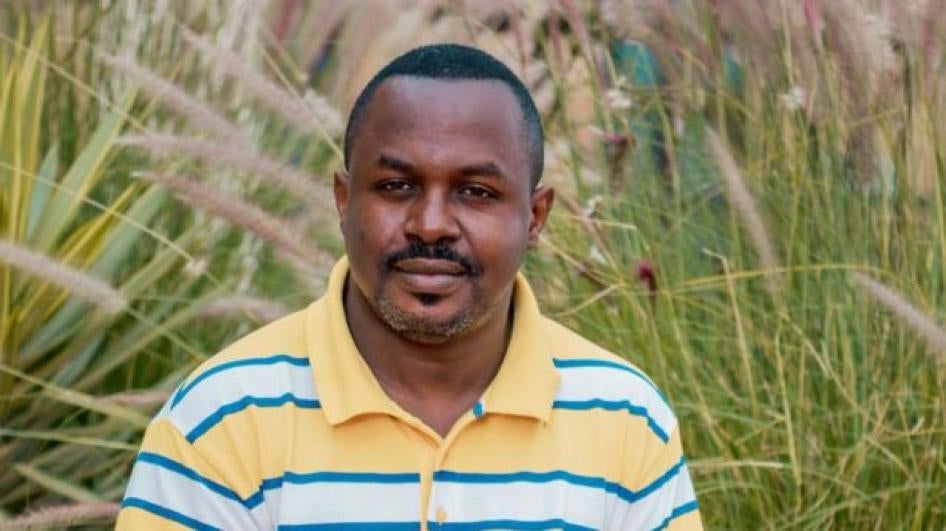
Human Rights Watch and others demand that the Rwandan authorities allow an effective, independent, and transparent investigation into the suspicious death of John Williams Ntwali, a leading investigative journalist and editor of the newspaper The Chronicles. Ntwali was regularly threatened due to his work as a journalist exposing human rights abuses in Rwanda and had expressed concern about his safety to Human Rights Watch and others.
“John Williams Ntwali was a lifeline for many victims of human rights violations and often the only journalist who dared report on issues of political persecution and repression,” said Lewis Mudge, Central Africa director at Human Rights Watch. “There are many reasons to question the theory of a road accident, and a prompt, effective investigation, drawing on international expertise, is essential to determine whether he was murdered.”
News of Ntwali’s death emerged in the evening of January 19, 2023. Police asked Ntwali’s brother to identify his body at Kacyiru Hospital morgue, telling him that Ntwali had died in a road accident the night of January 17 to 18. The police told the New Times website that Ntwali died in a motorbike accident in Kimihurura, Kigali, on January 18 at 2:50 a.m., but to date, have not provided details of the accident such as a police report, its exact location, or information on the others involved. Human Rights Watch is not aware of any reports about an alleged accident coming to light until the evening of January 19.
Ntwali was regularly threatened and attacked in the pro-government media for his investigative reporting. He played a leading role in covering and bringing attention to the plight of Kangondo neighborhood residents, who are in a long-standing dispute with authorities over land evictions. Recently, he also published videos on his YouTube channel about people who had suspiciously “disappeared.” His last video, posted on January 17, was about the reported disappearance of a genocide survivor who had spoken out about being beaten by police officers in 2018.
I don’t know what’s going to happen to me after CHOGM [the Commonwealth Heads of Government Meeting which took place in Kigali in June 2022]. I’m told that after CHOGM, they won’t play around with us anymore. I’ve been told five or six times. I receive phone calls from private numbers. Some [intelligence] people have come to my house twice to tell me. NISS [National Intelligence and Security Services] has told me: ‘If you don’t change your tone, after CHOGM, you’ll see what happens to you.’
On July 12, he told a friend he had survived a number of “staged accidents” in Kigali. “He was telling me about ordeals and threats he faces for his journalism,” his friend told Human Rights Watch.
Given these circumstances, Rwanda has a legal obligation to ensure a prompt, effective investigation that is capable of determining the circumstances of Ntwali’s death and identifying those responsible, with a view to bringing them to justice. An effective investigation must be independent, impartial, thorough, and transparent, conducted in full compliance with the Revised United Nations Manual on the Effective Prevention and Investigation of Extra-legal, Arbitrary and Summary Executions (The Minnesota Protocol on the Investigation of Potentially Unlawful Death).
Rwandan authorities have long targeted Ntwali. He was arrested in January 2016, in the lead up to the 2017 elections, and accused of raping a minor. Judicial officials later changed the charge to indecent assault and eventually dropped the case for lack of evidence.
At the time, Ntwali had been investigating several sensitive issues, including the death of Assinapol Rwigara, a businessman and father of would-be independent presidential candidate Diana Rwigara, whose candidacy to the 2017 elections was later rejected. The police said that Assinapol Rwigara died in a car accident in February 2015, but his family contested the authorities’ version of events.
Ntwali had also been arbitrarily arrested several other times and his website was blocked by a government regulator, apparently in retaliation for his reporting that was critical of the government.
“It is an embarrassment for the Commonwealth and a problematic message about its values that the country that presides over it is a place where the suspicious deaths of journalists and activists can be swept under the carpet,” Mudge said. “Rwandan authorities should not only not harm journalists but should be actively protecting them, and Rwanda’s partners should be holding the government to account in full for its obligations under international human rights law.”
On 22 January 2023 Freedom Under Law (FUL) said that the news that eSwatini human rights lawyer Thulani Maseko has been gunned down in cold blood comes as no surprise. The eSwatini government said Maseko was brutally shot and killed by unknown criminals at his home in Mbabane on Saturday night. See: https://www.trueheroesfilms.org/thedigest/laureates/03464020-c1e6-11ea-a3f7-933e766692a6
“A ceaseless and fearless human rights lawyer, an outspoken critic of the regime in his beloved eSwatini, Thulani had all too long suffered at the hands of a heedless regime. But he lived by the motto: ‘My head is bloody, but unbowed … I am the master of my fate: I am the captain of my soul’.
“Sadly, and to the shame of those engaged in the administration of justice in his country, all too often he was a lone beacon of light,” FUL chair judge Johann Kriegler said. He said no-one could be misled by the cynical message of condolence put out on behalf of the eSwatini government.
“His passing has not only left his family bereft of a loved one; his country has been left the poorer, its human rights conscience brutally stifled.”
FUL said in paying tribute to Maseko that it respectfully suggested it would be fitting if the Law Society of eSwatini were to mark his passing by observing January 21 every year as a day of mourning his death and rededication to the rule of law. “To his widow and family we express our grateful condolences. They have paid a bitter price on behalf of all who try to serve the principles for which their dear one lived.”
According to the eSwatini government, Maseko was shot by “unknown criminals”. “[His] demise is a loss to the nation, and his footprints as a human rights lawyer are there as proof of his contributions to the country. He will be surely missed,” it said in a statement. Spokesperson Alpheous Nxumalo said the country’s security forces had assured the government that they were already at work looking for the killers and would not rest until they have been brought to book. “Government also wants to warn against speculations and insinuations, peddled particularly on social media platforms in instances like these. Again, government distinctively disassociates… and the country’s authorities from these heinous acts.”
Maseko chaired the Multi-Stakeholders Forum, a collaboration of political parties and civil society groups working to amplify calls for democratic reforms.
In 2018, Maseko took Swaziland’s King Mswati III to court for changing the country’s name. He had argued that the resources to be channelled to the name change should rather go towards improving living standards of the poor, according to reports by City Press. In 2014, Maseko was sentenced to two years in prison, with the editor of news magazine The Nation, Bheki Makhubu, for contempt of court over articles critical of the government and judiciary. The Nation published articles co-authored by the two men which were critical of the chief justice and suggested that he may have abused his powers. See also: https://lawyersforlawyers.org/en/lawyers/thulani-maseko/
Today the three Martin Ennals Award Laureates 2023 were announced !
The 2023 Laureates — Delphine Djiraibé (Chad), Feliciano Reyna (Venezuela), and Khurram Parvez (Jammu and Kashmir) — have each dedicated over 30 years of their lives to building movements which brought justice for victims, accountability from leaders, or medicines to the marginalized. They have made human rights real for thousands of people in their communities, despite the ongoing, sometimes life-threatening, challenges they endure. For more on this award and its laureates, see: https://www.trueheroesfilms.org/thedigest/awards/043F9D13-640A-412C-90E8-99952CA56DCE
———————
Delphine Kemneloum Djiraibé was one of the first female lawyers in Chad and a pioneer of the human rights movement in one of the poorest countries in the world, fraught with corruption and human rights abuses. Convinced that her role is to “challenge the power”, Delphine has advocated on behalf of victims and the democratic process for over 30 years. She was a key figure in bringing the former dictator Hissène Habré to justice. Djiraibé heads the non-governmental organisation Public Interest Law Center (PILC), which trains volunteers and accompanies citizens seeking justice for violations of their rights. In recent years she has been particularly active in combating gender-based violence and is in the process of establishing the first women’s counselling center in Chad, which will include an emergency shelter for women affected by domestic violence. See also: https://www.trueheroesfilms.org/thedigest/laureates/5B701F71-12FD-B713-9F99-5E09B9AFD6DA
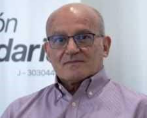
After the death of his partner Rafael from AIDS in 1995, Feliciano Reyna, then an architect, founded Acción Solidaria to provide much needed medication and treatment to Venezuelans living with HIV & AIDS. Feliciano and Acción Solidaria began advocating for access to health for the marginalised LGBTQI population in a country where healthcare was on the decline and corruption on the rise. They created the first national AIDS Help Line in Venezuela and ran a national awareness campaign on HIV & AIDS, which aired on TV and in movie theaters, and received radio and magazine coverage. Feliciano Reyna went on to found CODEVIDA, a coalition of Venezuelan organisations promoting the rights of Venezuelan citizens to health and life. As he put it: “We walked directly into the complex humanitarian emergency in Venezuela”. Despite ongoing threats, since 2006, he has worked closely with UN mechanisms to defend human rights in his country. In 2019 his advocacy was instrumental in establishing the Independent International Fact-Finding Mission on Venezuela.
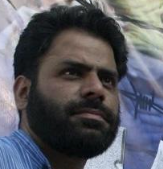
At the age of 13, when Khurram Parvez witnessed the shooting of his grandfather during a protest demonstration against the molestation of women outside his house in Kashmir, he chose to “not incite violence and become part of some revenge” , but rather to become a “nonviolent activist“. He founded the Jammu and Kashmir Coalition of Civil Society (JKCCS) and is the Chair of the Asian Federation Against Involuntary Disappearances. For 15 years he has travelled to the most remote parts of the region to sit with victims of abuse, collect documentation and report on their stories. Under his leadership, the JKCCS has been highly effective in translating the protections guaranteed in international human rights law into local realities. Despite continued attacks on his right to freedom of expression by the Indian government, being jailed in 2016 and losing a leg to landmines, Khurram relentlessly spoke the truth and was an inspiration to civil society and the local population. In November 2021, he was arrested under the Unlawful Activities Prevention Act (UAPA) on politically motivated charges. He remains detained without trial in India. See also: https://www.trueheroesfilms.org/thedigest/laureates/81468931-79AA-24FF-58F7-10351638AFE3
You can watch them take questions from the press at the Club Suisse de la Presse, livestreamed on February 14th, 2023 from 12h CET.
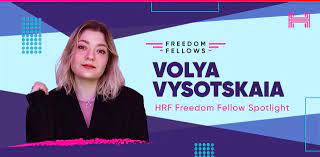
Meet HRF Freedom Fellow Volya Vysotskaia, a Belarusian human rights activist who exposes repression and torture by state officials.
Vysotskaia is currently part of the 2022 Freedom Fellowship, a programme of the Human Rights Foundation, a one-year program that provides hands-on, expert mentorship across seven critical areas: leadership, movement-building, organizing, fundraising, media, mental health, and digital security.
On September 27, the Investigative Committee of the Republic of Belarus announced that five people would be tried in absentia — Vysotskaia is one of them. She has since been denied information about the trial, and her request to appear virtually was rejected. Should she return to Belarus, a country where torture and inhuman treatment is routine, officials will likely detain her.
Learn more about Vysotskaia’s case.
Q: Can you tell us about your activism protecting democracy in Belarus?
A: From August 2020 to October 2021, I was an editor of the Telegram channel, the “Black Book of Belarus.” Our work “de-anonymized” or identified law enforcement officers and other government authorities who committed human rights violations, hiding behind their high-power statuses. We published the pictures and personal data of riot police officers, prosecutors, judges, and other officials to hold them accountable for their repression of Belarusian citizens demanding democracy and freedom.
Q: What led to the criminalization of the Black Book of Belarus’ editors and readers?
A: In October 2020, a special service agent infiltrated our team and leaked information about members. Previously, he was part of the special operation that hijacked a Ryanair flight in May 2021 to imprison Sofia Sapega, another team member. After we uncovered the agent, my team and I were chased down in Vilnius, and dozens of people in the Telegram group were also imprisoned.
Q: What is unique about your criminal case?
A: The case brought against my four colleagues and me is the first trial in absentia in the country’s history. We have been accused of “exasperation of enmity” and “social disagreement,” as well as illegal actions relating to private life and personal data. The Belarusian KGB has also added us to the list of individuals engaging in “extremist activities.” Belarusian courts recognize almost all civil society organizations as extremists, but we will be the first to be tried and sentenced without the opportunity to defend ourselves.
Belarusian authorities are undoubtedly denying us the right to a fair trial. Notably, I was denied access to information about my criminal case, and I never met the lawyer assigned to me, nor did the lawyer ever respond to my calls.
Q: What is the scope of legal harassment against Belarusian pro-democracy activists in exile?
A: The Lukashenko government changed the criminal procedural law back in July and invented a special proceeding for trying in absentia those who are engaged in “anti-state activities,” and living in exile. The addendum of this new procedural law provides that defendants are no longer aware of the content of their cases. It is sufficient for the legislative body to post this information on official websites, which clearly violates Article 14 of the International Covenant on Civil and Political Rights (ICCPR).
Q: What should the international community learn from your case?
A: The violations of the right to a fair trial, among other rights, didn’t start in Belarus with our case. It just brings back the attention of the international community to the fact that the repressions in Belarus haven’t stopped. They continue every day. The power, the judicial system, and the independence of Belarus with Lukashenko are fake. The regime represses and scares the Belarusians inside the country, and while the international community doesn’t react to the severe violations of human rights, the regime spreads its attention to those living in exile. Because silence allows them to do that.
The international community has to learn that there have to be efficient mechanisms for bringing perpetrators to trial until they destroy whole nations, as well as to guarantee the defense for the victims of violations. International justice can’t be built on the international ignorance of injustice. Being concerned doesn’t stop dictators.Repression in Belarus. HRF condemns the actions of Alexander Lukashenko’s regime and stands with Volya and all Belarusians who speak truth to power, even when their lives are at risk
The Freedom Fellowship is a one-year program that gives human rights advocates, social entrepreneurs, and nonprofit leaders from challenging political environments the opportunity to increase the impact of their work. Through mentorship and hands-on training sessions, fellows develop critical skills and join a growing community of human rights activists.
The International Service for Human Rights in Geneva (ISHR) calls for applications for a new hybrid version of the Human Rights Defender Advocacy Programme (HRDAP). This intensive course will take place remotely between 17 April and 7 June and will be followed by an in-person training from 14 to 24 June 2023 in Geneva. The course equips human rights defenders with the knowledge and skills to integrate the UN human rights system into their existing work at the national level in a strategic manner. It also provides an opportunity for participants to prepare for and engage in lobbying and advocacy activities at the UN with the aim to create change back home. Find out why you should join HRDAP23 from Bonnie, one of our HRDAP 2022 Alumni:
So if you are a human rights defender keen to use the UN to push for change at home, get a taste of the programme here and apply before 10 January 2023!

 Hans Thoolen on Human Rights Defenders and their awards
CESCR’s General Comment no. 26 on land rights defenders
February 8, 2023Vincent Ploton leads ISHR’s strategic engagement and litigation with the UN Treaty Bodies, and he drew attention to General Comment N° 26 of the Committee on Economic, Social and Cultural Rights, which spells out the obligations of States parties to the ICESCR in relation to land rights. This constitutes the first guidance wholly dedicated to land rights across the UN Treaty Body system. CESCR’s new resource provides a major opportunity for land rights defenders at a time when the global battle for natural resources is at a historical high, and those who stand to protect their land are on the frontline. In all world regions, people who resist the destruction and exploitation of their land are facing judicial harassment, threats and murders. Indigenous and peasant communities who defend their rights to cultivate and live on their ancestral lands are dispossessed and extorted by powerful actors. CESCR’s General Comment spells out the measures that States parties must take to uphold compliance with the obligations set out in the Covenant.
ISHR welcomes the dedicated section of the General Comment on land rights defenders, which echoes our inputs and calls on States parties to:
Speaking about this groundbreaking new guidance, the Committee’s Co-Rapporteur Rodrigo Uprimny said: “I hope that communities whose land rights are denied, including indigenous communities, can count on the force of international law, and the norms dictated by the International Covenant on Economic, Social and and Cultural Rights. The General Comment reaffirms and reinforces the concept of free, prior and informed consent and also recognizes the fundamental work of defenders of land rights.
See also: https://humanrightsdefenders.blog/2022/04/21/green-economy-and-human-rights-defenders-provide-data-denounce-attacks/
.https://ishr.ch/latest-updates/new-resource-for-land-rights-defenders/
Posted in Human Rights Defenders, ISHR | Leave a Comment »
Tags: Comment, Human Rights Defenders, ISHR, land rights defender, Rodrigo Uprimny Yepes, social economic and cultural rights, treaty bodies, Vincent Ploton