Cities of Rights – 75th UDHR Anniversary: The city of Utrecht wants to be city of human rights
Mohammadi Narges is one of the most recognised Human Rights Defenders in the world. She has received 8 major human rights awards according to THF’s digest of human rights awards but no media outlets got it right…
More on the toolkit (available on website) to create workshops for youth about filmmaking and human rights.
HURIDOCS 40th anniversary
More on ISHR‘s #Right2DefendRights campaign for the 25th anniversary of the UN Declaration on HRDs .
Responding to news that the Emirati authorities have begun a mass prosecution on trumped-up terrorism charges of more than 80 Emirati human rights activists – including renowned currently-jailed Emirati human rights activists who have already spent a decade behind bars – Aya Majzoub, Amnesty International’s Middle East and North Africa Deputy Director, said:
“To begin hearings in a new sham mass trial in the midst of what it billed as ‘the most inclusive COP ever’, is a jaw-dropping show of contempt for human rights by the Emirati authorities. The timing appears to be deliberately intended to send a clear message to the world that it will not tolerate the slightest peaceful dissent and that the authorities have no intention of reforming the country’s dire rights record. COP28 has already laid bare the barriers of fear and legalised repression that smother dissent in the UAE.
“The UAE must immediately release all arbitrarily-detained prisoners, drop charges against them and end their ruthless assault on human rights and freedoms.”
The new mass trial – first reported by the Emirates Detainees Advocacy Centre and confirmed to Amnesty by exiled Emirati activists – is a joint prosecution of more than 80 defendants, including victims of a past mass trial such as Mohamed al-Siddiq, father of the late exiled Emirati human rights defender Alaa al-Siddiq, prisoners of conscience such as Khalid al-Nuaimi, Hadef al-Owais, Nasser bin Ghaith and Sultan al-Qasimi, and longstanding human rights defenders such as Mohamed al-Roken and Ahmed Mansoor (see below).
Fresh charges against Ahmed Mansoor
Last month, Amnesty UK campaigners flew a protest plane over Manchester City FC’s Etihad Stadium carrying a large banner saying “UAE – Free Ahmed Mansoor”. Mansoor is a blogger, poet and leading Emirati human rights activist who has been in jail and kept in solitary confinement in the UAE since 2017 as a direct result of his campaigning activity. In 2017, Mansoor was convicted on charges which included “insulting the status and prestige of the UAE and its symbols”, “publishing false information to damage the UAE’s reputation abroad” and “portraying the UAE as a lawless land”. The following year, Mansoor was sentenced to ten years’ imprisonment, with the sentencing court also ordering that he be placed under surveillance for three years after release. His conviction and sentence were upheld by the country’s supreme court on 31 December 2018.
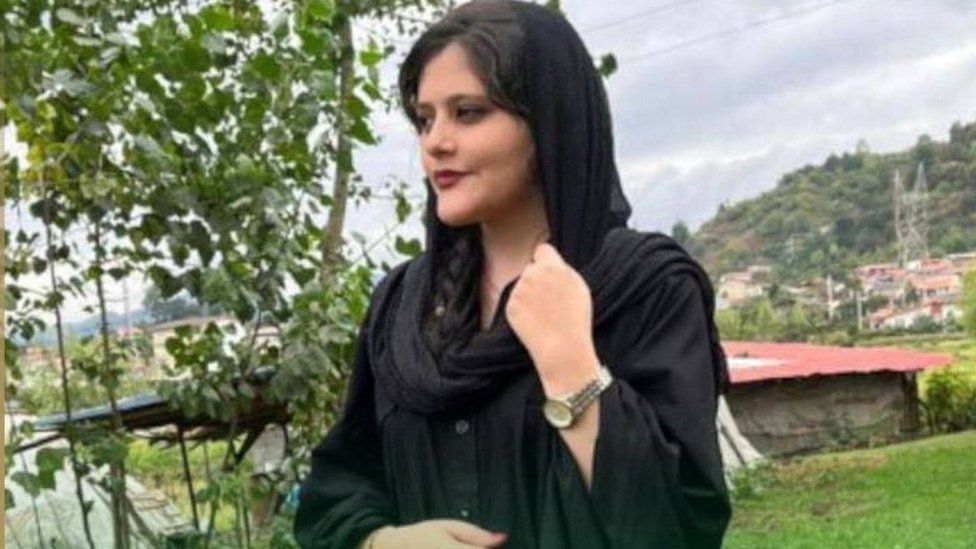
Ms Amini’s parents and brother were stopped from boarding their flight and had their passports confiscated, their lawyer said. They were banned from leaving despite having valid visas.
Speaking to the AFP news agency, the family’s lawyer, Chirinne Ardakani, said Ms Amini’s mother, father and brother had been “prohibited from boarding the flight that was to take them to France for the presentation of the Sakharov Prize”.
The president of the European Parliament, Roberta Metsola, called on Iran to “retract the decision” to ban the family from travelling. “Their place next Tuesday is at the European Parliament in Strasbourg to receive the Sakharov Prize, with the brave women of Iran,” she said on social media. “The truth cannot be silenced.”
AP reported on 2 December 2023 that protesters at the United Nations’ COP28 climate summit demonstrated Saturday for imprisoned human rights activists in Egypt and the United Arab Emirates, the past and current host of the negotiations.
However, just before the demonstration organized by Amnesty International and Human Rights Watch, protesters had to fold over signs bearing the Emirati detainees’ names — even after they already had crossed out messages about them. The order came roughly 10 minutes before the protest was due to start from the U.N., which said it could not guarantee the security of the demonstration, said Joey Shea, a researcher at Human Rights Watch focused on the Emirates.
“It is a shocking level of censorship in a space that had been guaranteed to have basic freedoms protected like freedom of expression, assembly and association,” Shea of HRW told The Associated Press.
Today, 9 December, marks 25 years of the United Nations Declaration on Human Rights Defenders (HRDs). It provides for the support and protection of HRDs, and for many HRDs it’s been a useful marking in legitimizing and supporting their work.
The anniversary is a good time to reflect on what’s working and what isn’t for HRDs, and we discussed some of these issues on a Human Rights First webinar a couple of days ago.
In many ways it was a different world in 1998. Celine Dion and the Backstreet Boys were the big rock acts then. The internet, mobile phones, and digital surveillance of HRDs, were all in their infancy.
For HRDs, much has changed, and it’s possible to see 25 years of success as HRDs have achieved some great things. They’ve changed laws, won the release of people from prison, distributed humanitarian aid, exposed corruption, documented and publicized human rights violations.
For some HRDs just keeping going despite pressure and threats is success in itself. Hundreds are killed every year for their peaceful work on behalf of others, for embarrassing corrupt officials, for making good things happen.
But there is now a greater recognition of the value of the work of HRDs than there was in 1998, and a better understanding of who they are. The family of HRDs has expanded in the last 25 years – back then NGOs discussed whether those working on environmental rights, or those documenting corruption, or medics working in war zones, really counted as HRDs. Now we know they do.
We better understand too the responsibilities of businesses to protect HRDs, and that defenders working on certain issues face specific threats, that those working on land rights, indigenous rights or environmental rights away from big cities are most likely to be murdered. We know too that many defenders are targeted not just for what they do but for who they are.
Women Human Rights Defenders experience added layers of harassment. They’ve always lived with pressure from society in terms of what they should get engaged in and not, pressure from their families on what a woman should do or not, and since 1998 there’s now added pressures in the digital sphere. They are targeted more than other HRDs with digital harassment, which we see very often leads to physical attacks offline.
Our organizations share a similar approach to working with HRDs. The NHRF supports HRDs working for NGOs outside big cities, often formed by people from the community that they work in. It supports organizations where women are in leaderships roles, and provides resources over the long term. For instance, the NHRF works with an NGO in Thailand originally formed by young women to organize their community in the face of a mining company. Most of these women are now grandmothers, but still keep up their human rights work.
The NHRF also works with organizations of HRDs in Indonesia made up of family members of those killed and tortured in in the 1960s who are now seeking redress and working against impunity.
Human Rights First, meanwhile, continues its decades-long work on Northern Ireland, also working with bereaved families of those killed during the conflict in the 1970s, 1980s and 1990s who are also looking for redress and working against impunity.
For many HRDs achieving success is a long road, requiring perseverance and allies. International standards and rules aren’t protecting them enough. Their work needs to be better understood, and better funded.
The picture for HRDs since 1998 is mixed, and no doubt will be for the next 25 years. HRDs will achieve more successes, but unless governments find the political will to implement the protections of the HRD Declaration, more defenders will be attacked, jailed and murdered.
So, what do the next 25 years hold for HRDs? The future is hard to predict, but one thing we can say for sure is that HRDs will continue to be, as the UN Special Rapporteur for HRDs Mary Lawlor says, ordinary people doing extraordinary things.
In these times, when many people from Gaza to Ukraine question the power of the human rights framework to actually protect people’s rights, everyone with power must ensure that HRDs can be funded, protected and supported. We will all be better off for it.
Cyrine Hammemi is a human rights defender and a project manager at the Association for the Promotion of the Right to Difference (ADD) in Tunisia. Her work focuses on the human rights of persons belonging to minority groups, through alerts on discriminatory situations and the violence they suffered.
Speaking to ISHR, Cyrine discussed her journey into activism and her vision for an inclusive future. She shared the personal triggers that led her to become an activist and emphasised her hopes for a world where every individual can fully enjoy their rights without discrimination based on identity, gender, religion, or sexual orientation.
On 5 December 2023, Mary Lawlor, the UN Special Rapporteur on the situation of human rights defenders concluded her visit to Algeria with the observation: “While I welcome the evident reforms which have taken place over the past four years and the new emphasis on public consultation, I regret that some human rights defenders who work on sensitive issues face continued restrictions”.
The UN expert observed four main patterns of violations used to suppress human rights defenders: ongoing judicial harassment, dissolution of key human rights organisations, limitations on freedom of movement and intimidation and surveillance leading to severely negative impacts on their mental health and that of their families.
“I was saddened that a handful of human rights defenders who attempted to travel to Tizi Ouzou, where I was holding meetings, were prevented from doing so and detained for 10 hours,” Lawlor said.
“Given Algeria’s recent history, robust laws relating to terrorism are clearly necessary,” the expert said. “However, it is disappointing that laws designed to prevent terrorism are instilling terror in human rights defenders through overly broad and vague definitions of what constitutes terrorism in the Penal Code.”
The Special Rapporteur noted that Article 87 bis of the Penal Code was one of the most frequently cited laws used to prosecute human rights defenders.
Despite this, the expert said there were many people working to protect and promote human rights with the full support of the government and the newly created consultative bodies in areas including women’s rights, children’s rights, healthcare, poverty relief and political participation. Based on this collaboration and experience, the Special Rapporteur believes the government is now better equipped to reach out to human rights defenders working on sensitive issues.
Lawlor welcomed the acquittal of three human rights defenders, Jamila Loukil, Kaddour Chouicha and Said Boudour, of terrorism charges in Dar El Baida court on Sunday.
“I hope this acquittal will kickstart a review process of Article 87 bis, and I stand ready to assist the Algerian government in any way I can in this regard,” she said.
11 human rights NGOs had publicly expressed their wish that this visit be an opportunity to free imprisoned activists and for reforms to see the light of day.
On 6 December, following the public report of this visit, NGOs support the main measures recommended by the Special Rapporteur, namely that: • The Algerian government must view Human Rights Defenders as allies and opportunities within society, not as threats. The signatories call for the repeal of all repressive laws and legislative provisions relating to the rights to freedom of association and peaceful assembly, and the adoption, on the basis of broad consultation with Algerian society, a regulatory framework complies with international standards notably respect for human rights in Algeria. • Many civil society organizations are in danger of disappearing. This is already the case of the Algerian League for the Defense of Human Rights (LADDH) and the Rassemblement Actions Jeunesse (RAJ). Civil society organizations must have the freedom to adequately play their role. • Several articles of law must also be reformed in accordance with international standards. This is the case of articles 79 and 87 bis of the Penal Code, relating to the attack on the integrity of the national territory and the fight against terrorism which are abusively used to imprison activists. The same goes for the Ban on Exiting the National Territory (ISTN) which is today used in a punitive manner to restrict the movement of human rights defenders in Algeria.
The signatories finally call on the Algerian government to release all prisoners of conscience and human rights defenders currently in prison
25 years ago, the United Nations adopted the Declaration on Human Rights Defenders. The declaration has been essential to protect those who defend human rights. It’s time to celebrate the Declaration, human rights defenders and all the contributions they have brought to our societies.
The Declaration is a landmark document that sets out the rights and responsibilities of States, human rights defenders, and all actors in society in ensuring a safe environment where defenders are recognised, valued, and encouraged to work for the promotion and protection of human rights.
As part of this celebration, Amnesty International, CIVICUS, Defend Defenders, FIDH, Forum Asia, Front line Defenders, Gulf Centre for Human Rights, ICNL, ILGA World, IM Defensoras, ISHR, MENA WHRD Coalition, OMCT, Peace Brigades International , Protect Defenders, Protection International and RFK Human Rights launched a collaborative project to analyse the contributions of the Declaration to defenders’ lives and work, as well as progress in international human rights law on the protection of defenders.
What do we want to achieve?
This project seeks to enhance the awareness of the Declaration and encourage greater dialogue on the protection needs of defenders
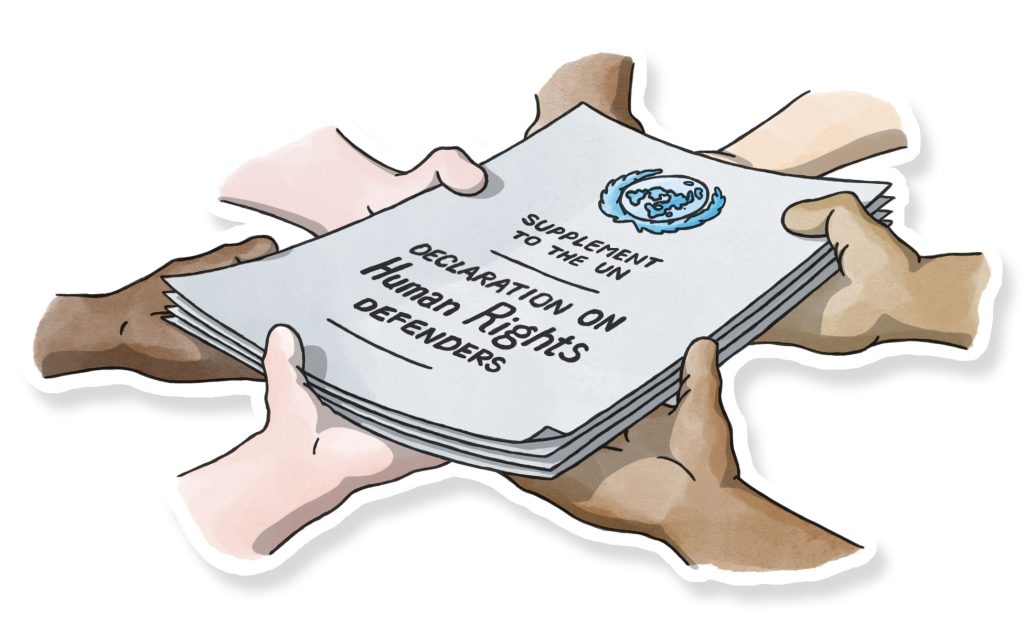
One of the outcomes of the project will be the creation of a supplement to the Declaration that will be a civil society-led document taking into account developments in international and regional jurisprudence relating to defenders over the past 25 years and evolutions of human rights movements, addressing key gaps and limitations in the Declaration, and reflecting defenders’ lived experiences and needs.
This supplement will guide change on the ground in the next 25 years, and beyond!
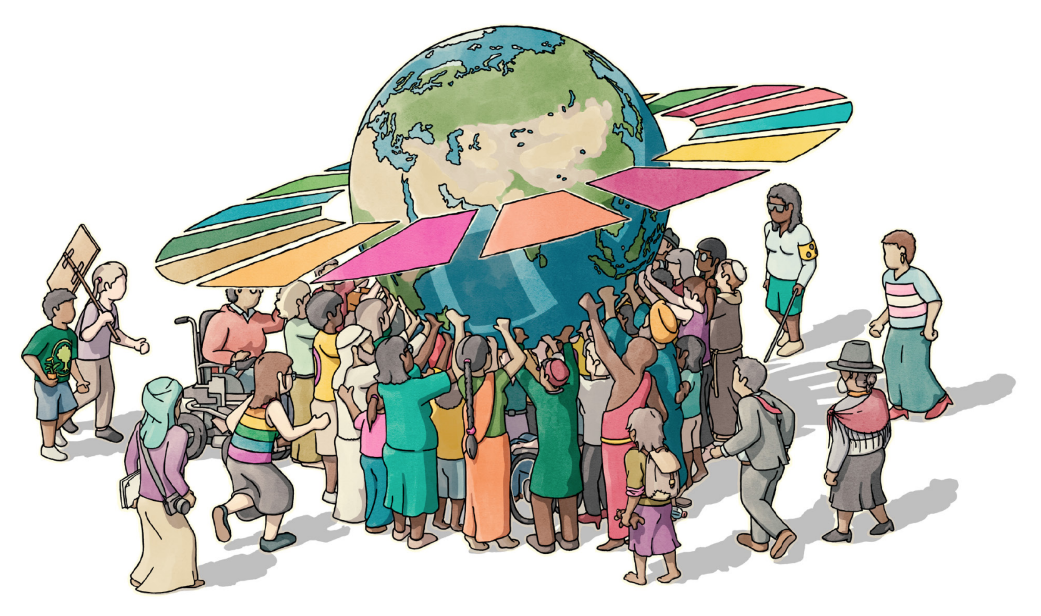
We need the input and voices from human rights defenders everywhere!
What can you do?
We are consulting online and offline with human rights defenders across the globe on changes in national, regional and global contexts in which they work, evolutions of human rights movements and activism, and defenders’ lived experiences and protection needs. We are also reviewing how international and regional jurisprudence in relation to human rights defenders has developed over the last 25 years.
1. Add your voice
By sharing your experiences, insights, and recommendations, you can help shape the future of human rights and contribute to the protection and promotion of defenders’ rights.
Are you a human rights defender and want to contribute to the project?
Help us raise awareness about the UN Declaration on human rights defenders. Join the #Right2DefendRights social media campaign.
Join the social media campaign!
Discover our #Right2DefendRights social media kit and post the content on your networks. Download the kit
3. Learn more about the Declaration
Learn more about the Declaration on Human Rights Defenders, its importance, content and application. Visit our online e-learning platform and take our 30 minutes course.
Take the e-course
Visit our online e-learning platform and learn more about the Declaration.Learn more
4. Get in touch!
Let us know if there are convening of HRDs happening anywhere that we could do consultations around. Drop an email to Tess Mcevoy: t.mcevoy@ishr.ch
—————
And on Monday 11 December (10:00 – 12:00 EST) there will be an event “UDHR75 + HRDS25 = 100% HUMAN RIGHTS” at Ford Foundation Center for Social Justice, New York with HRDs speaking about their lived experiences, with: Sukhgerel Dugersuren, OT Watch, Mongolia Karina Sánchez, IM Defensoras, Mesoamerican Intiative of Women Human Rights Defenders, LAC Sirley Muñoz, Somos Defensores, Colombia Brenda Kugonza, Women Human Rights Defenders Network Uganda Edita Burgos, Karapatan, Philippines Moderation: Tess McEvoy, International Service for Human Rights
On 5 December 2023 Amnesty International launched its global website as an .onion site on the Tor network, giving users greater access to its work exposing and documenting human rights violations in areas where government censorship and digital surveillance are rife.
In recent years, a number of countries including Algeria, China, Iran, Russia and Viet Nam have blocked Amnesty International websites.
“By making Amnesty International’s website available as a secure .onion site on Tor, more people will be able to read our human rights research and engage with the vital work of speaking truth to power, and defending human rights.”Donncha Ó Cearbhaill, Head of Security Lab at Amnesty Tech.
However, audiences accessing the Amnesty.org website through Tor will be able to bypass attempts at censorship.
An .onion site is a website that is only accessible through Tor, a volunteer-run network of servers which encrypt and route internet traffic through multiple servers around the world, providing users with an added layer of privacy and anonymity.
“The onion site provides a means for individuals around the world to exercise their rights to privacy, freedom of expression, freedom of peaceful assembly, and freedom of association in a safe and secure online environment,” said Donncha Ó Cearbhaill, Head of Security Lab at Amnesty Tech.
The Tor Project has a version of the Tor Browser for many common platforms, including Windows, Mac, Linux, and Android. Onion sites can also be accessed on iPhone through the Onion Browser app. In countries where the Tor network is blocked, visitors will also need to configure Tor bridges which help bypass attempts to block connections to the network.
Amnesty International is also making language-specific content published in Chinese, Farsi and Russian available on the Amnesty International Tor onion website.
“We are thrilled that one of the most recognized human rights organizations has adopted an onion service to provide greater online protections for those seeking information, support and advocacy. Amnesty International’s choice to offer an onion version of their website underlines the critical role of this open-source privacy technology as an important tool in our shared work of advancing human rights,” said Isabela Fernandes, Executive Director, the Tor Project.
What are .onion sites?
Onion services never leave the Tor network. Their location and IP addresses are hidden, making it difficult to censor them or identify their operators. In addition, all traffic between users and onion services is end-to-end encrypted. As a result, users leave no metadata trail making it impossible for their identity or internet activity to be tracked.
Both Tor and virtual private networks (VPNs) can help internet users bypass website blocking and censorship.
Tor routes connection through a number of volunteer run and randomly assigned servers preventing anyone individual or organization from being able to track both the identity and internet activity of users while a VPN connects through a single privately owned server.
The Tor software was first released more than 20 years ago and is now developed and maintained by the Tor Project, a US-registered not-for-profit organization which is focused on advancing human rights and freedoms by creating and deploying free and open-source anonymity software and privacy technologies.
On 1 December, 2023, at about 4 p.m., four or more unidentified men abducted Diallo, the secretary-general of the Collective Against Impunity and Stigmatization of Communities (Collectif contre l’Impunité et la Stigmatisation des Communautés, CISC) in Burkina Faso’s capital, Ouagadougou. Diallo had just left the government’s passport office after a meeting with officers to renew his passport. The CISC issued a statement the same day saying that men in civilian clothes pushed Diallo into a vehicle and drove off. His whereabouts remain unknown.
On December 2, the United Nations special rapporteur on human rights defenders, Mary Lawlor, raised serious concerns about Diallo’s abduction. In a December 3 statement, The People’s Coalition for the Sahel, an alliance of civil society organizations, said that “the abduction of a prominent activist in broad daylight […] demands an immediate government response,” and called on the military authorities to take action.
“Burkina Faso authorities should urgently and impartially investigate the abduction of Daouda Diallo and release him if he is in government custody,” said Ilaria Allegrozzi, senior Sahel researcher at Human Rights Watch. “We are deeply concerned for Diallo’s safety and the safety of everyone working to improve respect for human rights in Burkina Faso.”
Since it took power in an October 2022 coup, Burkina Faso’s military junta has increasingly cracked down on peaceful dissent and the media, shrinking the civic space in the country. National and international journalists, as well as civil society members, face increasing harassment, threats, and arbitrary arrests. On December 2, the military authorities announced the suspension of “all distribution methods” of the French newspaper Le Monde daily, claiming an article published on Le Monde’s website on December 1 about a deadly attack by an Islamist armed group on a military base in Djibo, Sahel region, on November 26, was “biased.”
On 4 December the Martin Ennals Foundation and several other NGOs addressed an urgent letter to the Représentant Permanent de Burkina Faso at the UN in Geneva.





 Hans Thoolen on Human Rights Defenders and their awards