Having just posted about Sandra Kodouda’s disappearance for 4 days [https://thoolen.wordpress.com/2015/04/17/human-rights-defender-sandra-kodouda-remains-missing-four-days-after-abduction-in-sudan/ ] I am happy to report that yesterday (16 April 2015), the Sudanese human rights defender was returned home after reportedly being held in custody by the National Intelligence and Security Service (NISS) although they had denied they held her. She suffered a dislocated shoulder and other injuries during her detention.
Archive for the 'organisations' Category
Joseph Bikanda, Coordinator of Pan African Human Rights Defenders Network, has the floor
April 16, 2015The Newsletter of International Service for Human Rights in Geneva gave on 2 April 2015 the floor to Joseph Bikanda, the Coordinator of the Pan African Human Rights Defenders Network (PAHRDN), a Network made up of 5 sub-regional networks of human right defenders (HRDs), including the East and Horn of Africa, the Central, the West, the Southern and the North African HRDs Networks.
Joseph first became involved in human rights as a university student. A group of students needed a voice to advocate on their behalf. Joseph became that voice. In doing so, Joseph learnt about human rights mechanisms existing at the time. ‘I found myself surrounded by the human rights world and knew that it was the right place for me. Since then I have been working in human rights in various capacities.’
Joseph stated that PAHRDN’s key focus is to strengthen the capacity and provide support to regional networks, civil society organisations and HRDs. ‘You are always stronger working together in a network, and if each element of the network is more capable and works together – you are even stronger’
‘..Regional and international human rights mechanisms support HRDs, but networks such as PAHRDN are essential to create local supporting mechanisms for HRDs’.. Joseph explains that PAHRDN has established local mechanisms to ‘fill the gap as best we can’. These mechanisms include providing emergency support, lawyers, trial observation and practical support for HRDs.
‘One of our key roles is to provide support for HRDs in emergency situations when they are being harassed, targeted or when their lives are in danger. We have also created urgent mechanisms which apply pressure to perpetrators of human rights abuses.’
Joseph commented on the essential role that HRDs played in initiating the development of the law for the protection of HRDs in Côte d’Ivoire. He shared his hope that each African country develops similar laws in the near future and, in particular, that each of those laws is effectively implemented. ‘I hope to see HRDs develop further as key actors combatting corruption and promoting transparency. Involving HRDs in decisions ensures that the views of civil society are raised and considered.’
In his discussion with ISHR, Joseph identified that his primary objectives of attending the March session of the Human Rights Council were to raise awareness of – the horrific situation in Burundi, in particular the persecution of journalists and HRDs; the continued fighting in South Sudan and the abduction of children for combat; and the concerning counter terrorism laws in Cameroon and Ethiopia, which lack differentiation between defenders and terrorists.
You can follow Joseph Bikanda on Twitter at @Bikjo.
Joseph Bikanda: Coordinator of Pan African Human Rights Defenders Network | ISHR.
Havel Prize for Creative Dissent awarded to Girifna, Sakdiyah Ma’ruf, and El Sexto
April 16, 2015- the Sudanese nonviolent resistance movement Girifna,
- the Indonesian stand-up comedian Sakdiyah Ma’ruf, and
- the Cuban graffiti artist and activist El Sexto.
Girifna, Arabic for “we are fed up,” is a nonviolent resistance movement founded in 2010 by pro-democracy youth activists. Thousands of Girifna members work together to monitor crackdowns on protests and defend dissidents in spite of constant surveillance by the Sudanese authorities. “While the international press focuses its attention on Sudan’s history of armed conflict, Girifna has challenged the al-Bashir regime in novel ways—from producing humorous commercials to teaching citizens the art of nonviolent protest…” said jury chairman Thor Halvorssen.
Sakdiyah Ma’ruf is a stand-up comedian from Indonesia whose comic routine advocates for individual rights and challenges Islamic fundamentalism. She grew up watching U.S.-based comedians and decided to use the same medium to talk about issues plaguing her own country. Television producers have asked her to censor her jokes, but Ma’ruf, who believes comedy mirrors a culture’s hypocrisy, has refused to be silenced. “Sakdiyah Ma’ruf is marshaling the use of parody to challenge oppression and extremism—no small risk for a woman in Muslim culture. She is an inspiration,” said Amnesty International Norway Secretary General John Peder Egenæs.
El Sexto, whose real name is Danilo Maldonado, is a Cuban graffiti artist and activist whose public work has turned him into a formidable dissident, evidenced by the ongoing repression he suffers. This past December, El Sexto was arrested on his way to put on a performance art piece called “Rebelión en la Granja,” with two pigs decorated with the names “Fidel” and “Raúl.” El Sexto was charged with contempt and remains in prison awaiting trial. “Through his art, El Sexto reveals the intolerance of the Cuban regime,” said former Romanian President Emil Constantinescu.
For more information on the award see: http://www.brandsaviors.com/thedigest/award/václav-havel-prize-creative-dissent
The ceremony on 27 May will be broadcast live online at oslofreedomforum.com beginning at 16:00 CET; for more info contact: Jamie Hancock, (212) 246-8486, jamie@thehrf.org
Morocco: military turned HRD sentenced to 6 months, while UN does still not monitor human rights in Western Sahara
April 16, 2015Easter is over and we resume our human rights defenders coverage with the story of Mbarek Daoudi in Morocco who was sentenced to 6 months. What makes it remarkable is that this human rights defender served loyally for 30 years in the Moroccan army. On 15 April 2015 Frontline posted this update:

On 9 April 2015, Mbarek Daoudi was sentenced to six months’ imprisonment by the Court of Appeal in Agadir. The decision came after the Public Prosecutor appealed the initial court decision [3 months imprisonment] against Mbarek Daoudi, and called for the stricter punishment of the human rights defender.
Since retiring from the Moroccan army in 2008, Mbarek Daoudi has peacefully advocated for the Sahrawi people’s right to self-determination. On 21 December 2014, the human rights defender ended a seven-week hunger strike he had began in protest at his conditions of detention and the delays in scheduling his trial.
In the meantime the Robert F. Kennedy Human Rights came out on the same day with a statement urging the UN to add a human rights monitoring mechanism to the mandate of the United Nations Mission for the Referendum in Western Sahara (MINURSO), the only active peacekeeping mission established after 1978 without a human rights monitoring mechanism! The Security Council must vote to extend the mandate by April 30, 2015.
“It is shameful that a small group of countries are denying the people of Western Sahara a basic human rights protection mechanism. The reports of abuses are undeniable, and the United Nation’s Security Council needs to respond by expanding MINURSO’s mandate,” said Kerry Kennedy. “The international community must not turn its back on reports of torture in detention, medical negligence towards ailing prisoners, unmonitored landmine blasts, violent dispersal of peaceful protests, and constraints on entry and travel within the region.”
In February 2015, Robert F. Kennedy Human Rights released a report tracking reported human rights abuse in Western Sahara.
Update: Morocco – Mbarek Daoudi sentenced to six month’s imprisonment | Front Line Defenders.
China’s new foreign NGO law bound to make things worse for ‘sensitive’ human rights defenders
April 8, 2015Maya Wang (twitter @wang_maya), a China researcher at Human Rights Watch, published on 8 April 2105 an interesting post under the title “China’s new foreign NGO law will help silence critics“.

Photo courtesy of Flickr user Willem Velthoven.
Some years back I participated in an interesting meeting with Chinese academics in Beijing about exactly this issue of the status of NGOs in China. The meeting resulted in a book ‘NGOs in China and Europe’ (exceptionally also published in Chinese!) edited by Yuwen Li and published by Ashgate in 2011 (ISBN: 978-1-4094-1959-4). Although almost all participants agreed that the current regime for establishing associations is too cumbersome and too heavy-handed for Chinese civil society to flourish, the Government made clear that its main concern remained with what Maya calls ‘sensitive’ NGOs. Those working on issue that are even faintly related to human rights or smack of possible activism, especially when funded from abroad, are seen as a danger and should be subject tot maximum control. That seems to be born out by the draft of the long-awaited ‘Foreign NGOs Administration Law’, likely to be adopted this year and of which Human Rights Watch obtained a copy.
As Maya states, it has never been easy to run an independent organisation in China. The risks of being arbitrarily shut down or harassed are high, as shown by the arrest on 8 March of five women’s rights activists and a 24 March raid on an NGO that supports their work in Beijing. But the absence of a national law governing NGOs, coupled with differences in attitudes towards NGOs by regional leaders, have afforded some leeway for those with creative strategies. It has been common for ‘sensitive’ NGOs to register as a business to bypass the wary eyes of the state, or not register at all. And over the years, some international funding to these organisations in China has been tolerated.
Especially ‘sensitive’ NGOs have been unable to access domestic funding sources because they are not legally registered as a nonprofit and anyway those who did want to fund would receive official harassment. The new Foreign NGOs Administration Law is bound to end the funding lifeline that allowed more outspoken NGOs to operate.
The draft law is likely to significantly tighten the Government’s control over civil society says Maya: “If approved, the Ministry of Public Security (not the Ministry of Civil Affairs) will now have the power to supervise and approve registration of foreign NGOs. That ‘supervision’ can entail entering the premises of the foreign NGO at any point, questioning its staff, and copying or seizing any document, all tactics more commonly reserved for a criminal investigation. Foreign NGOs will have to submit for approval annual work plans and funding allocations, and will be prohibited from engaging in a range of peaceful activities, from raising funds or accepting donations in-country to recruiting volunteers or trying to recruit members ‘directly or indirectly.’” Violations of these prescriptions mean that an NGO’s representative in China would be liable to punishments, including a 15-day detention.
“The draft law is another step towards the Chinese Government’s ‘differentiated management’ model of NGOs, in which domestic groups working on issues approved by the state, such as charities for people with disabilities, can register easily and are considered for increased state funding and support. But those engaged on rights or lobbying are stifled. The draft explicitly prohibits activities that ‘endanger…national security, unity and solidarity’ or that ‘go against China’s social morality’. These are vague terms, but ones frequently used to silence peaceful government critics and activists.”
Joint Inspection Unit on human rights: not so innocent as it sounds
April 7, 2015In a long but excellent post in Universal Rights of 23 March 2015, Subhas Gujadhur and Marc Limon dissect the issue of the Joint Inspection Unit‘s [JIU] report at the 28th session of the UN Human Rights Council (2 – 27 March) under the title: “The JIU report: what’s all the fuss about?”.
The background in short is that for years a number of countries – not by coincidence those that do not like the sometimes rather forthright pronouncements by the Office of the UN High Commissioner for Human Rights -have tried to get more ‘control’ over its management and resources. They are in fact using the ‘backdoor’ of the UN inspection unit to get there.
This is a very important issue but one that is too much cloaked in UN jargon to make it to mainstream media. In the words of the authors: “Casual observers of the Human Rights Council may have been forgiven.. for a degree of bafflement at repeated and sometimes quite excitable references to a three letter acronym: JIU.”
So let me quote liberally from the post in question:
The report on the ‘review of management and administration’ of the OHCHR [JIU/REP/2014/7] was produced by the JIU in response to a request by the Human Rights Council in March 2013 (resolution 22/2) and the report’s author, Mr. Gopinathan Achamkulangare, hoped to be able to present is to the Council at is 28th session.
This may all seem innocuous enough. However, resolution 22/2 and the JIU report touch upon fundamental and extremely sensitive questions about the role, prerogatives and independence of OHCHR, and its relationship with the member states of the Council; and are part of a long-running struggle between two groups of states with very different views on what OHCHR is, what it is there to do, and how it’s work should be overseen.
Council resolution 22/2 (adopted by a vote, with developed countries against and developing countries in favour) requested the JIU to ‘undertake a comprehensive follow up review of the management and administration of the Office of the High Commissioner for Human Rights (OHCHR), in particular with regard to its impact on the recruitment policies and composition of the staff.’ This resolution, like many previous ones with the same title, was pushed by Cuba and others in the belief that the staffing policies of the OHCHR favoured individuals from some regions (notably the West) over others.
In Cuba’s view, OHCHR had continuously failed to improve regional balance among its staff and thus, in order to strengthen accountability; it was asked to report and explain itself to the Council.
However, to others – especially Western states – asking the OHCHR to report to the Council on an administrative issue represented a worrying step towards making this supposedly independent entity answerable – and thus under the political oversight of – states sitting in the UN’s apex human rights intergovernmental body.
Similar differences of opinion have arisen, since the Council’s establishment in 2006, with regard to the financial resources of the OHCHR. Cuba and other developing countries have regularly expressed concern about where the Office’s money comes from (the UN’s regular budget or voluntary contributions from certain states), and how it is used and allocated (e.g. to certain field operations, to certain Special Procedures mandates). These concerns led Cuba and others to circulate a resolution in 2011, calling for greater financial transparency – though this was subsequently replaced by a Presidential Statement merely inviting the High Commissioner to provide more information on funding.
Central to the concerns of Cuba and others on both issues is a suspicion that the high proportion of individuals from Western states working at the Office (including at senior levels) together with Western financial support (especially where that support is ‘earmarked’ for certain purposes), gives the West undue influence over the OHCHR.
For its part, Western states, together with a number of states from other regions, suspect that Cuba and other leading countries of the Like Minded Group are intent on undermining the independence of the Office and bringing it under the political control of the Council (and thereby seeking to stop OHCHR criticism of states’ human rights records).
It should also be noted that the main author of the report is Mr. Gopinathan Achamkulangare, a former Ambassador of India to the Human Rights Council, who took position in the debates favoring the prerogatives of the Council over the OHCHR.
The report (more detail in the post itself) makes six recommendations:
- The GA should initiate an action-oriented review of the governance arrangements of the OHCHR through an open-ended working group/ad hoc committee […] so as to strengthen the capacity of member states to provide strategic guidance and to direct and monitor the work of OHCHR.
- …
- …
- The High Commissioner should update the existing action plan with specific measures, targets and timetables to broaden the geographical diversity of the professional workforce.
- The High Commissioner should develop a comprehensive strategy and related action plan to adapt specific circumstances and requirements of OHCHR’s human resource management strategy and policies.
- The Secretary General should, in the context of the Human Rights Up Front initiative, review the mandates of the different UN entities with human rights functions with a view of streamlining their work and mainstreaming human rights across the UN system.
The controversy even led to uncertainty that Mr. Gopinathan Achamkulangare would be allowed to present the report with some states (correctly, based on a legal analysis of relevant UN documents) arguing that discussing the management and administration of OHCHR is not part of the Council’s mandate as per GA resolution 60/251. In the end, the President of the Council and the Bureau announced that, as a courtesy, the JIU inspector would be allowed to present his report, but there would be no interactive debate with states.
By the time of the report’s presentation on 13th March, the Secretary-General had provided his comments on its findings and recommendations.[Note by the Secretary-General, A/70/68/Add.1] as follows:
- The Secretary-General in effect rejected recommendation 1, arguing that ‘existing governance arrangements strike an appropriate balance between independence and accountability.’ The Secretary-General noted GA resolution 48/141 (1993) creating the post of High Commissioner, which decided that the High Commissioner would be appointed by the Secretary-General (i.e. is part of the secretariat). He also rejected the notion (used to support the view that while the High Commissioner is independent, the OHCHR is not and should operate under the political oversight of the Council) that the High Commissioner and OHCHR ‘have separate mandates and perform separate functions.’
- …
- …
- Regarding recommendation 4, the Secretary-General noted that geographical diversity is a priority for the entire secretariat.
- The Secretary-General also rejected recommendation 5 which called for the UN secretariat’s human resource management strategy to be ‘adapted to the specific circumstances and requirements of OHCHR’, on the grounds that ‘OHCHR is part of the Secretariat…and its staff members are subject to the same regulations, rules and policies as other departments.’
- Finally, the Secretary-General welcomed recommendation 6 as a useful opportunity to strengthen the mainstreaming of human rights across the UN system.
There was some debate in which Western states, in line with the analysis of the Secretary-General, rejected key findings and recommendations in the report. For example, Norway noted that ‘existing governance arrangements strike an appropriate balance between independence and accountability,’ and underscored the importance of safeguarding the independence of the High Commissioner.
Countering this view, Pakistan on behalf of Like-Minded Group (LMG) states, expressed support for the JIU conclusions and recommendations, noting that oversight by a relevant intergovernmental body would contribute to ‘enhanced efficiency and effectiveness of the Office activities.’ LMG states therefore called for a clarification ‘of the respective roles of the different intergovernmental bodies with a view to streamlining the governance dynamics of OHCHR’ (i.e. in line with the JIU’s recommendations).
The post by Subhas Gujadhur and Marc Limon provides detailed and interesting background to the issue of imbalance in staffing and funding and rightly states that it “doesn’t take an international lawyer to understand that all these utterances are packed with possible political meanings, some subtle some less so, and have enormous potential implications for the functioning of the UN human rights system”.
——–
In this context, on 23 March a group of leading human rights NGOs (delivered by HRW, and supported by ISHR, Civicus, FIDH, FORUM ASIA, OMCT and EIPR), called in a statement to the Human Rights Council to resist Cuban-led attempts to micromanage and fetter the independence of the UN’s top human rights official.
The statement said that among its contradictory recommendations, the report proposes a mechanism to enable States to ‘direct and monitor’ the work of the High Commissioner and highlighted that creation of High Commissioner for Human Rights was one of the landmark achievements of the Vienna Declaration adopted by all States in 1994. For more than 20 years, successive High Commissioners have provided a strong and independent voice, committed to promoting and protecting human rights around the world, the statement said.
‘Today, that independence is under threat. The draft resolution, inaccurately titled “Composition of staff of the Office of the UN High Commissioner for Human Rights” seeks to affirm and encourage follow-up to the report of the Joint Inspection Unit (JIU), which reviews the “Management and Administration” said John Fisher of HRW delivering the statement.
‘The independence of the High Commissioner for Human Rights and his office is axiomatic to his effectiveness. The High Commissioner must be free to speak without fear and without favour, unconstrained by the political agenda of any State or group of States,’ said ISHR’s Michael Ineichen. ‘This report must not be permitted to be used as a subterfuge to constrain the High Commissioner and his office at a time when both their monitoring and reporting, and their advice and technical assistance, are needed perhaps more than ever before.’
See the full statement here.
http://www.universal-rights.org/blogs/128-the-jiu-report-what-s-all-the-fuss-about
Human Rights Council: Reject attempts to limit Office of the High Commissioner | ISHR.
What the Human Rights Council did on HRDs in March 2015
April 7, 2015For those (few, I hope) who do not regularly read the Human Rights Monitor of the ISHR, here is a wrap-up of the 28th session of the Human Rights Council in relation to human rights defenders:
5 Resolutions adopted: Read the rest of this entry »
‘La Lucha: The Story of Lucha Castro and Human Rights in Mexico’, new comics book out
April 4, 2015
Henry Chamberlain in his blog Comicsgrinder of 3 April reviews positively a new human rights book: ‘La Lucha: The Story of Lucha Castro and Human Rights in Mexico’

The border state of Chihuahua and its city of Juarez is like a war zone thanks to the inextricable link between drug cartels and official corruption. But thanks to human rights defenders, like Chihuahua lawyer and organizer Lucha Castro, fight back.

Edited by Adam Shapiro, head of campaigns at the human rights organization Front Line Defenders, and drawn by Jon Sack are a series of profiles and reportage that have the urgency of dispatches from the scene. Luca Castro wrote the preface.
“There are all compelling stories to be found here. One example is the story of Marisela Escobedo Ortiz and her daughter, Rubi Marisol. Rubi was murdered by her boyfriend, Sergio Barraza. It was a clear-cut case. However, Sergio Barraza would never be found guilty simply for the fact that he was a member of the Zetas drug ring and that made him instantly untouchable. Rubi’s mother, Marisela Escobedo Ortiz, led a fight to bring Sergio Barraza to justice. She was able to repeatedly track him down when authorities were not. Sergio Barraza was eventually slain in a shoot-out in 2012 with the Mexican Army. But during Marisela’s struggle for justice, the Mexican authorities, from the local level to the federal level, would not get involved. In the end, Marisela was killed for her efforts. This is quite an involved story ”

“La Lucha” is an exemplary example of the comics medium. A book like this one proves how complex issues can be presented in a clear and concise manner that can benefit people in a myriad of ways. It can jump start conversations that require a number of facts that are not always easy to follow. It can make a difference. It can even save lives.
“La Lucha: The Story of Lucha Castro and Human Rights in Mexico” is published by Verso Books and is available as of March 31, 2015. You can find it here, here, here, and here.
Review: ‘La Lucha: The Story of Lucha Castro and Human Rights in Mexico’ |.
Two Giorgis speak about Azerbaijan’s continued refusal to play fair
April 3, 2015From many sources including this blog [https://thoolen.wordpress.com/tag/azerbaijan/], we know that Azerbaijan is a leader in the category ‘crime does pay’. For a more general article on this topic see: https://www.linkedin.com/pulse/20140603192912-22083774–crime-should-not-pay-in-the-area-of-international-human-rights.
During the last 2 days of March 2015 it decided to detain a Georgian trial observer in the airport. As ‘non co-operation’ (to use a euphemism) tends to get underreported – which is exactly why it is so attractive – here in full the interview which Giorgi Lomsadze of EurasiaNet.org had with the Giorgi Godia, the Human Rights Watch’s South-Caucasus representative who is the one who came to observe the trials of imprisoned human-rights lawyer Intigam Aliyev and rights-activist Rasul Jafarov. [The Azerbaijani government, as yet, has not provided a reason for Gogia’s detention and subsequent deportation back home.] Azerbaijan may be willing to host sports events, but fair play is not part of it.
Mutabar far from her Uzbekistan continues her struggle
March 27, 2015Today , 27 March 2015, the FIDH published a moving portrait of Mutabar Tadjibaeva, the well-known Uzbek human rights defender, under the title “If I were told that I only have one day left to live, I would spend it fighting for human rights.” A statement that in her case is not an exaggeration!
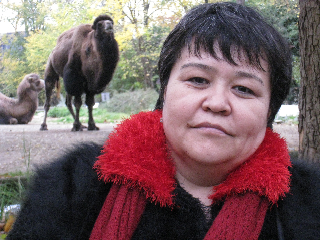
“If I were told that I only have one day left to live, I would spend it fighting for human rights,” says Mutabar Tadjibaeva, President of the organization Fiery Hearts Club. The 52-year-old Uzbek journalist and activist arrived in France in 2009 as a political refugee. She is no longer welcome In her native country, which has been governed for a quarter of a century by the dictator Islam Karimov. In Uzbekistan, Mutabar investigated drug trafficking, corruption and human rights violations. She endured threats, prison, torture and rape; her fight came at a high price.
In 2002, while this activist was fighting to make publicly known the case of Alimuhammad Mamadaliev, who had been tortured and killed by the police, she herself ended up behind bars for several days. In April 2005, was kidnapped by secret service agents and subjected to horrific treatment. These men would never worried about having to answer for their deeds. But even in the face of such injustice, Mutabar Tadjibaeva continued her activism and journalism until she was imprisoned three years later, on 7 October 2005, just before boarding a plane headed for Dublin where she was to participate in an international conference on human rights. She was arrested by police and, a year later, sentenced to eight years in prison, where she was subjected to torture. She was accused of engaging in illegal activities against the State during demonstrations where several hundred people had lost their lives in May 2005 in Andijan, an industrial city. It is clear to Mutabar that her arrest was for purely political reasons. She was one of many victims of State repression that followed the events of 2005.
“I know very well what prison in Uzbekistan is like and the torture. That is why I have decided to devote me life to fighting for human rights. When I was in jail, I dreamt that one day I would be free. I would tell the prison guards that I would get out of there and write a book on what I had lived through,” she recalls. On 18 May 2008, while still in prison, she was granted the Martin Ennals Award for human rights defenders. She was released a few months later and, on 10 December of that same year, Mutabar Tadjibaeva came to Paris where she accepted the Liberté, Égalité, Fraternité Award on behalf of the Fiery Hearts Club. Banned from Uzbekistan for almost ten years, the organisation took shelter in France in 2011. It will celebrate the 15th year of its existence this year. Every day, dozens of people come to her in search of assistance. She seeks out lawyers and funding, prepares reports and files individual complaints to the UN. Despite the modest means at her disposal and a state of health weakened by the torture she suffered, Mutabar wants to help those who are in same situation as she was in ten years earlier. Her wish is that human rights defenders take more of an interest in the situation in Uzbekistan. Mutabar Tadjibaeva has enjoyed the support of FIDH, and her organisation is now officially a member. “It is thanks to the support of the FIDH that I was able to keep my promise, that is, write my book entitled “Prisoner of the Island of Torture.” I worked with an Uzbek journalist and it is thanks to those recordings that I was able to tell my story. Otherwise, it would have been too hard psychologically,” Mutabar recalls. In the book, which has been published in Uzbek, Russian, French, and English, she shares her memories of prison and decries the cruelty of the regime.
For Mutabar, the challenge lies not in Karimov’s departure, but in regime change. “His departure could set off a war among the clans. The country is corrupt, there is no respect for the law. Karimov the dictator is not the only one to blame for the fact that people are being killed in prisons and tortured; the politicians who support the regime are also to blame. I want Uzbekistan to become a democratic country and dissidents like me to be able to return there and live,” she said. However, as Mutabar sees it, a return to her country is not within the realm of the possible.
On 29 March, Islam Karimov will be running for President for the fourth time, thereby violating Article 90 of the Constitution, which does not allow more than two terms. Mutabar Tadjibaeva and her friends have set up a virtual electoral commission to organise a vote on the Internet. This alternative platform has rejected the candidacy of the president.
“When I decided to come to France as a political refugee,” she concluded, “I was afraid that I would not be able to do anything for my country remotely. But, now I see that if you are motivated and supported, anything is possible.”
“If I were told that I only have one day left to live, I would (…).
for more on Mutabar, see: https://thoolen.wordpress.com/tag/mutabar-tadjibayeva/

