Archive for the 'HRW' Category

Council of Europe starts infringement process against Turkey

February 3, 2022
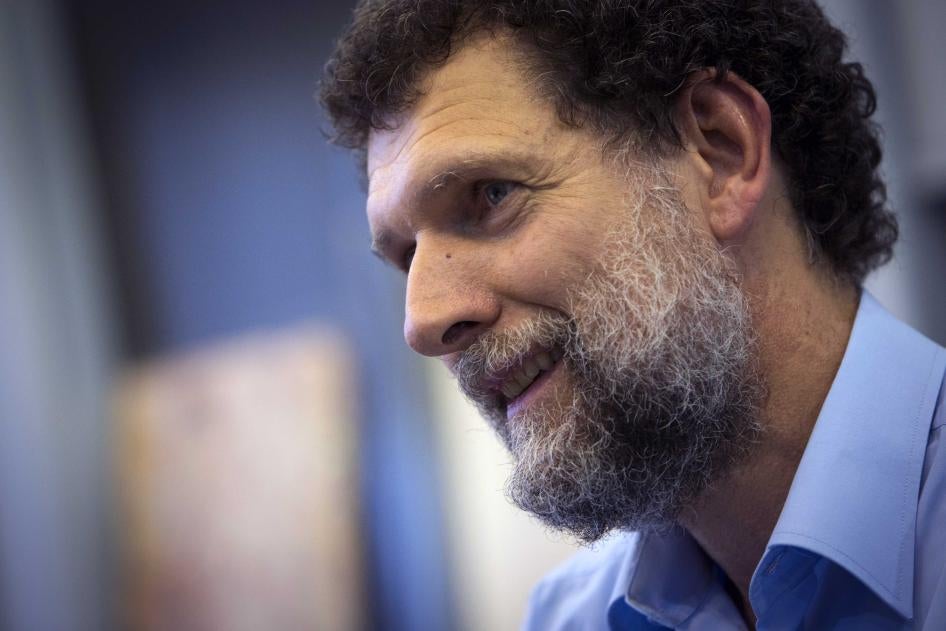
Osman Kavala © 2017 Private

The Council of Europe Committee of Ministers voted on 2 February, 2022 to begin infringement proceedings against Turkey. Human Rights Watch called it an important step to support human rights protection in Turkey and uphold the international human rights framework. The resolution concerns Turkey’s failure over the past two years to comply with the European Court of Human Rights’ judgment in which the Court ruled that Turkey should free human rights defender Osman Kavala and fully restore his rights. See also: https://humanrightsdefenders.blog/2022/01/18/kavala-saga-continues-turkish-court-keeps-philanthropist-in-prison/

The Committee of Ministers’ vote to pursue infringement proceedings against Turkey for its politically motivated, arbitrary detention of human rights defender Osman Kavala shows a resolve to uphold the international human rights law framework on which the Council of Europe is based,” said Aisling Reidy, senior legal adviser at Human Rights Watch. “The resolution sends a reminder to all Council of Europe member states that European Court of Human Rights judgments are binding, and it is an important acknowledgement of Turkey’s rule of law crisis.

The Committee voted to send the case of Kavala v Turkey back to the European Court of Human Rights for a legal opinion on whether Turkey has met its obligations to comply with the judgment. If the European Court confirms – as it is expected to do – that Turkey has failed to implement its judgment, the Committee of Ministers may then take additional measures against Turkey.

These could include ultimately suspending Turkey’s voting rights in the Council of Europe and could even jeopardize Turkey’s membership. Turkey is the second country in Council of Europe history to be subjected to the sanction process for breaching member states’ obligations to implement European Court of Human Rights judgments. (first time was in 2017 against Azerbaijan in the case of Ilgar Mammadov).

The Kavala judgment is legally binding, yet the Turkish authorities have snubbed the Strasbourg court and ignored the decisions of the Committee of Ministers, which represents the Council’s 47 member states, calling for his release and the full restoration of his rights. Ankara has already reacted as expexted: it has accused the Council of Europe of “interfering in an ongoing judicial process

The Turkish courts and prosecutors have engaged in a series of tactics to circumvent the authority of the European Court and the Council of Europe, using domestic court decisions to prolong Kavala’s detention and extend the life of baseless prosecutions. The courts have issued sham release orders, initiated multiple criminal proceedings against Kavala on the same facts, and separated and re-joined case files accusing him of bogus offenses.

In 2021, Turkey merged the proceedings against Kavala with an entirely separate and much older case against football fans and others charged with a demonstration during 2013 protests a few kilometers away from Istanbul’s Gezi Park.

Turkey’s international partners, in particular countries that supported the infringement vote, should make it clear that Turkey’s continued failure to implement the Court’s judgment and to release Osman Kavala would have consequences on their relations with Turkey. In particular, the European Union should tie its proposed “positive agenda” with Turkey to Kavala’s release and make respect for rights a prerequisite for opening talks on the Customs Union modernization that Turkey is seeking.

Turkey knows that the European Court’s judgments are binding but has chosen to defy its obligations and the rule of law,” Reidy said. “Through the infringement proceedings and engagement from other countries, that needs to change, and Turkey should free Osman Kavala immediately and restore all of his rights.

https://www.hrw.org/news/2022/02/02/turkey-council-europe-votes-infringement-process

https://www.hurriyetdailynews.com/turkey-slams-council-of-europe-for-intervening-in-ongoing-kavala-case-171229

Burkina Faso: Coup Puts Rights at Risk – Diallo asks military to respect international law

January 29, 2022

Burkina Faso military officers responsible for the January 2022 coup should ensure the protection of human rights and a swift transition to democratic rule, Human Rights Watch said today. The authorities should give priority to the humane treatment of people in custody, respect freedoms of the media and rights defenders, and ensure that counterterrorism operations respect basic rights. ..  

“The Burkina Faso military coup occurred in a country with weak democratic institutions amid a brutal armed conflict and a growing humanitarian crisis,” said Corinne Dufka, Sahel director at Human Rights Watch. “The military authorities now in control need to act urgently to protect people’s rights and ensure they don’t make a bad human rights situation even worse.”

During a January 24 news conference, the self-proclaimed Patriotic Movement for Safeguard and Restoration led by Lt. Col. Paul-Henri Sandaogo Damiba, announced the suspension of the constitution, the dissolution of the government and national assembly, and a nationwide curfew. The movement’s spokesperson said elections would be held “within a reasonable time frame” and pledged to respect Burkina Faso’s international commitments, notably including human rights.

The coup leaders claimed the coup took place “without bloodshed.” However, there is uncertainty about the safety of President Kaboré and his close associates, amid reports of potential injuries and deaths during the military takeover. The MPSR should publicly account for the whereabouts and condition of government officials in custody and allow the Office of the United Nations High Commissioner for Human Rights, the national human rights commission, and independent human rights monitors to visit Kaboré and any other detainees. All those detained should be promptly brought before a judge and charged or be released.

The coup occurred within the context of a marked deterioration in the country’s human rights and security situation over the past year as attacks and atrocities by armed Islamist groups surged and the humanitarian situation worsened. Burkina Faso was already struggling to ensure justice for hundreds of unlawful killings by all sides, and to uphold the civil and political rights of its population.

During 2021, armed Islamist groups killed at least 250 civilians and scores of security force members during attacks in several provinces. Since 2018, Human Rights Watch has documented that government security forces and pro-government militias allegedly summarily executed hundreds of suspects, mostly in the country’s northern regions. Virtually none of these attacks have resulted in investigations and prosecutions.

Burkinabé rights defender, Dr. Daouda Diallo, secretary-general of the Collective Against Impunity and Stigmatization (CISC), and laureate of the 2022 Martin Ennals Award for Human Rights Defenders, told Human Rights Watch that he hoped the military authorities would “address Burkina Faso’s deepening social divisions, and ensure crucially needed protection for all civilians at risk from conflict, while scrupulously respecting international humanitarian law.”  See also: https://www.trueheroesfilms.org/thedigest/laureates/ca7f1556-8f73-4b48-b868-b93a3df9b4e1

The military authorities should also ensure respect for freedom of expression. In late 2021 and early 2022, the government shut down internet services in a move to quell protesters who had taken to the streets to demand an end to the violence and to protest rising food prices. A 2019 law criminalizing some aspects of reporting on security force operations dampened media freedom, with journalists reluctant to report on allegations of abuses by pro-government forces. Further, in 2021, the government implemented a de facto ban on visits by journalists to internally displaced camps. After taking power, the MPSR issued a warning against the communication of “false news.”..

Military takeovers in Africa in the past year occurred in Chad, Guinea, Mali, and Sudan. Coup leaders have often taken advantage of social unrest, grievances about corruption, and the failure of governments to respect basic rights, uphold constitutional obligations, and carry out promised reforms. Democratically elected governments need to look beyond elections as a marker of democratic progress, and focus on upholding human rights, strengthening the rule of law, and building credible, independent institutions, Human Rights Watch said…

“Burkina Faso’s military leadership should not allow the political upheaval created by the coup to lead to a vacuum in the protection of basic rights,” Dufka said. “The military authorities need to maintain discipline within the security forces and ensure that the human rights of all Burkinabé are respected, including their right to vote freely in elections.”

https://www.hrw.org/news/2022/01/27/burkina-faso-coup-puts-rights-risk

Human Rights Watch World Report 2022: work to be done

January 18, 2022

Autocratic leaders faced significant backlash in 2021, but democracy will flourish in the contest with autocracy only if democratic leaders do a better job of addressing global problems, Kenneth Roth, executive director at Human Rights Watch, said today in releasing the Human Rights Watch World Report 2022.

From Cuba to Hong Kong, people took to the streets demanding democracy when unaccountable rulers, as they so often do, prioritized their own interests over those of their citizens, Roth said. However, many democratic leaders have been too mired in short-term preoccupations and scoring political points to address serious problems such as climate change, the Covid-19 pandemic, poverty and inequality, racial injustice, or the threats from modern technology.

In country after country, large numbers of people have taken to the streets, even at the risk of being arrested or shot, which shows the appeal of democracy remains strong,” Roth said. “But elected leaders need to do a better job of addressing major challenges to show that democratic government delivers on its promised dividends.

The Human Rights Watch World Report 2022, its 32nd edition, describes the human rights situation in nearly all of the approximately 100 countries where Human Rights Watch works.

World Report 2022, Human Rights Watch’s 32nd annual review of human rights practices and trends around the globe, reviews developments in more than 100 countries. READ IT HERE

In his introductory essay, Roth challenges the common view that autocracy is ascendent and democracy is on the decline. Many autocrats claim to serve their people better than democratically elected leaders, but they usually deliver mainly for themselves and then try to manipulate electoral systems so citizens cannot deliver a negative verdict. Autocrats typically try to divert attention with racist, sexist, xenophobic, or homophobic appeals, he said.

Covid-19 spotlighted this self-serving tendency, with many autocratic leaders downplaying the pandemic, turning their backs on scientific evidence, spreading false information, and failing to take basic measures to protect the health and lives of the public.

In an important and growing development that must worry some autocrats, a broad range of opposition political parties has begun to gloss over their policy differences to build alliances that prioritize their common interest in getting corrupt politicians or repressive leaders voted out of office, Roth said. 

In the Czech Republic, an unlikely coalition defeated Prime Minister Andrej Babiš. In Israel, an even unlikelier coalition ended the longtime rule of Prime Minister Benjamin Netanyahu. Similar broad alliances of opposition parties have formed for forthcoming elections against Viktor Orban in Hungary and Recep Tayyip Erdoğan in Turkey. A comparable tendency within the US Democratic Party contributed to the selection of Joe Biden to contest the 2020 election against Donald Trump.

Moreover, as autocrats can no longer rely on subtly manipulated elections to preserve power, a growing number, from Nicaragua to Russia, are resorting to overt electoral charades that guarantee their desired result but confer none of the legitimacy sought from holding an election. This growing repression is a sign of weakness, not strength, Roth said.

However, to persuade people to abandon the self-serving rule of autocrats, democracies need to do better in addressing societal ills, Roth said.

For example, the climate crisis poses a dire threat to humankind, yet democratic leaders are only nibbling at the problem, he said, seemingly incapable of overcoming national perspectives and vested interests to take the major steps needed to avert catastrophic consequences. The World Report 2022 includes assessments of the climate policies of the world’s top 10 greenhouse gas emitters, as well as more than a dozen other countries where there have been significant policy developments related to the climate crisis.

The Covid-19 pandemic also exposed weaknesses of democratic leaders. Democracies met the pandemic by developing highly effective mRNA vaccines with remarkable speed but have failed to ensure that the people of lower-income countries share this lifesaving invention. Some democratic governments took steps to mitigate the economic consequences of Covid-19 lockdowns, but have yet to tackle the broader and persistent problem of widespread poverty and inequality or to build adequate systems of social protection for the next inevitable economic disruption, he said.

Democracies regularly debate the threats posed by technology, he said. These include the dissemination of disinformation and hate speech by social media platforms, the large-scale invasion of privacy as an economic model, the intrusiveness of new surveillance tools, and the biases of artificial intelligence. But democratic leaders have taken only baby steps to address them.

Democracies fare no better when acting outside their borders. They frequently descend to the compromises of realpolitik, bolstering autocratic “friends” to curtail migration, fight terrorism, or protect supposed “stability” rather than defending democratic principles.

In contrast to Trump’s embrace of friendly autocrats when he was US president, Biden promised a foreign policy that would be guided by human rights. But the US has continued to provide arms to Egypt, Saudi Arabia, the United Arab Emirates, and Israel despite their persistent repression. In the face of an autocratic trend in Central America, Biden mainly prioritized efforts to curtail migration rather than autocracy.

Other Western leaders displayed similar weakness in their defense of democracy. Former German Chancellor Angela Merkel’s government helped to orchestrate global condemnation of the Chinese government’s crimes against humanity in Xinjiang. But while holding the European Union presidency, Germany helped to promote an EU investment deal with China despite Beijing’s use of ethnic Uyghur forced labor.

The government of French President Emmanuel Macron helped to coordinate broad condemnation of Beijing’s conduct in Xinjiang but was blind to the abysmal situation in Egypt.

If democracies are to prevail, their leaders must do more than spotlight the inevitable shortcomings of autocratic rule, Roth said. They must do a better job of meeting national and global challenges of making sure that democracy in fact delivers.

“Promoting democracy means standing up for democratic institutions such as independent courts, free media, robust parliaments, and vibrant civil societies even when that brings unwelcome scrutiny or challenges to executive policies,” Roth said. “And it demands elevating public discourse rather than stoking our worst sentiments, acting on democratic principles rather than merely voicing them, and unifying us before looming threats rather than dividing us in the quest for another do-nothing term in office.”

https://www.hrw.org/news/2022/01/13/future-autocrats-darker-it-seems

https://www.rferl.org/a/human-rights-watch-autocracy-democracy-rights/31652052.html

Ground breaking conviction of Syrian torturer in Germany

January 17, 2022
Group of framed portraits
Photos of Syrians who have been detained or disappeared set up by Families for Freedom, as part of a protest in front of the court in Koblenz, July 2, 2020. © 2020 Alexander Suttor

The conviction of a former Syrian intelligence officer for crimes against humanity by a German court is a ground-breaking step toward justice for serious crimes in Syria, Human Rights Watch said today. The judgment is a meaningful moment for civilians who survived torture and sexual abuse in Syria’s prisons.  

On January 13, 2022, a German court delivered its judgment in the trial of Anwar R., a former member of Syria’s General Intelligence Directorate, one of the country’s four main intelligence agencies commonly referred to collectively as the mukhabarat. Anwar R. is the most senior former Syrian government official to be convicted for serious crimes in Syria.  

German prosecutors accused Anwar R. of overseeing the torture of detainees in his capacity as head of the investigations section at the General Intelligence Directorate’s al-Khatib detention facility in Damascus, also known as “Branch 251.” 

The judges found Anwar R. guilty of committing crimes against humanity and sentenced him to life in prison. Following the verdict in the case, Anwar R. has one week to appeal.  

More than 10 years after the violations were committed in Syria, the German court’s verdict is a long-awaited beacon of hope that justice can and will in the end prevail,” said Balkees Jarrah, associate international justice director at Human Rights Watch. “Other countries should follow Germany’s lead, and actively bolster efforts to prosecute serious crimes in Syria.”  

Human Rights Watch issued a question and answer document and a feature article on the trial and how it is situated in the larger context of the Syrian conflict on January 6, 2022. The trial against Anwar R. and Eyad A., who was found guilty of aiding and abetting crimes against humanity in February, began in April 2020 and was the first anywhere in the world for state-sponsored torture in Syria. Eyad A.’s appeal against his conviction remains pending. 

Syrian survivors, lawyers, and activists have been central to making this trial a reality, not only pressing for justice but laying the groundwork that makes justice possible, Human Rights Watch said.  

More than 80 witnesses testified, including former detainees, former Syrian government employees, German police investigators, and experts in Syrian affairs. The testimony included well-documented accounts of torture and sexual abuse in Branch 251, descriptions of mass graves, and details of Syria’s government policy to violently crack down on peaceful protesters in 2011. Several of the witnesses were able to identify Anwar R. in the courtroom.  

One of the major challenges of this trial was witness protection. Several witnesses living in Germany and other European countries cancelled their appearance in court out of fear for their lives and safety, or that of their families. Several witnesses, some who were also victims, testified that they feared a risk to themselves and their families given their role in the trial. German authorities should ensure that witnesses and victims are sufficiently informed about their rights to protective measures, including to appear anonymously before the court. 

Tens-of-thousands of people have been detained or disappeared in Syria since 2011, the vast majority by government forces using an extensive network of detention facilities throughout the country. The Syrian government continues to detain and forcibly disappear thousands of people. 

Many of those detained have died from torture and horrific detention conditions. Comprehensive justice for these and other unchecked atrocities in Syria has been elusive. Syria is not a member of the International Criminal Court. And in 2014, Russia and China blocked efforts at the United Nations Security Council to give the court a mandate over serious crimes in Syria. 

The trial of Anwar R. and Eyad A. is possible because Germany’s laws recognize universal jurisdiction over certain of the most serious crimes under international law. That allows for the investigation and prosecution of these crimes no matter where they were committed and regardless of the nationality of the suspects or victims. Universal jurisdiction remains one of the few viable pathways to justice for crimes committed in Syria.  

Germany has several elements in place to allow for the successful investigation and prosecution of grave crimes in Syria. It has above all a comprehensive legal framework, well-functioning specialized war crimes units, and previous experience with prosecuting such crimes. Countries with universal jurisdiction laws should establish specialized war crimes units within law enforcement and prosecution services, and ensure that such units are adequately resourced and staffed. 

Germany’s trial against Anwar R. is a message to the Syrian authorities that no one is beyond the reach of justice,” Jarrah said. “The Koblenz case has shown that with other avenues blocked, national courts can play a critical role in combating impunity.” 

The first such reaction came immediately, see: https://www.ncr-iran.org/en/news/human-rights/after-german-conviction-of-syrian-official-focus-may-turn-to-swedish-trial-of-iranian/

https://www.hrw.org/news/2022/01/13/germany-conviction-state-torture-syria

https://www.fidh.org/en/region/north-africa-middle-east/syria/syria-landmark-ruling-offers-hope-to-regime-s-victims

https://www.ecchr.eu/en/case/first-criminal-trial-worldwide-on-torture-in-syria-before-a-german-court/

Iranian dissident Poet Baktash Abtin dies of Covid in arbitrary detention

January 10, 2022

On 8 January 2022 the Iranian poet Baktash Abtin died in Tehran after contracting COVID-19 in Evin Prison. Abtin, who died after being put into an induced coma while hospitalized, is the second known political prisoner to die in Iran in the first week of 2022. On January 1, Kian Adelpour died after going on hunger strike to protest being imprisoned without a fair trial.

This is a preventable tragedy and more prisoners’ deaths are inevitable because there is no accountability in the Iranian government,” said Hadi Ghaemi, executive director of the Center for Human Rights in Iran (CHRI). “Abtin was imprisoned in Iran because the government wanted to muzzle him with a jail cell; the state killed him.” Abtin had been serving a five-year prison sentence on the charge of “assembly and collusion against national security.

A group of main NGOs had addressed a joint letter to Ayatollah Ali Hosseini Khamenei on 7 January repeating their call that Abtin be given access to the best possible medical care as he battles for his life. In addition, we urge that: he and all those unjustly detained for their writing or expression be immediately and unconditionally released; that authorities refrain from summoning political prisoners to serve their sentences while the conditions inside Evin and other Iranian prisons remain unsafe; and that any who do contract COVID-19 or other serious illnesses while in jail be granted speedy access to all needed medical care or a medical parole on humanitarian grounds.

While offering condolences to Abtin’s family and friends, the Iranian Writers Association (IWA) where Abtin, 48, was a board member, released a statement on January 8 on the “injustice that was committed against Abtin”: “Baktash Abtin is alive because the spirit of freedom-seeking and the fight against tyranny and injustice is alive,” said the statement.

Fellow IWA board member Reza Khandan Mahabadi was also sentenced to five years in prison and Keyvan Bajan to three years and six months. An international chorus has condemned the IWA writers’ imprisonment, with dozens of high-profile writers and artistic figures including Nobel laureates calling for the writers’ acquittal.

At least 11 writers are known to be either currently imprisoned or living with an unserved prison sentence hanging over their heads in Iran as they await an appeal or to be summoned to jail, according to a list compiled by CHRI.

In an interview with CHRI in May 2019 after his trial, Abtin forcefully said the charge of “assembly and collusion against national security” was for statements published by the IWA, articles in the organization’s internal newsletter, and holding memorial ceremonies for IWA members Mohammad Mokhtari and Mohammad Jafar Pouyandeh, who were murdered in 1998 as part of a concerted state policy to eliminate political and cultural dissidents inside and outside of Iran.

“Nowhere in the world is it necessary to get a permit to gather around someone’s grave,” Abtin told CHRI. “But that’s what we’ve been charged with.”

https://www.hrw.org/news/2022/01/07/joint-ngo-letter-khamenei-baktash-abtins-condition

Egypt: Activist Patrick Zaki released following international pressure

December 22, 2021

While the recent harsh sentencing of 3 human rights defenders in Egypt made headlines [see: https://humanrightsdefenders.blog/2021/12/21/alaa-abdel-fattah-and-two-others-receive-heavy-prison-sentences-in-egypt/], and the Government decried foreign intervention, it may be interesting to note that not long ago the release of another human rights defender was attributed to international pressure and campaigning.

Patrick Zaki after his release on Wednesday 8 December 2021 (Screengrab/EIPR) By Areeb Ullah

Human rights activist Patrick Zaki was freed on Wednesday 8 December 2021, a day after Egypt’s Emergency State Security Misdemeanour Court ordered his provisional release. 

Zaki, a 28-year-old researcher at the Egyptian Initiative for Personal Rights (EIPR), had been studying at Italy’s Bologna University when he was taken into custody upon his return to Cairo in February 2020. Despite his release, he still faces a range of charges, including “calling for protests without permission”, “spreading false news” and “inciting violence and terrorism”. His trial will resume on 1 February 2022.

Tuesday’s hearing was the second time Zaki’s trial has been adjourned since the first session, on 14 September 2020. Human Rights Watch (HRW) told Middle East Eye that Zaki was subjected to physical torture in the days after his arrest.

Commenting on the court’s ruling for his release, Amr Magdi, Egypt researcher for HRW, described it as “rare happy news” for Patrick and his family. “Its a win with a bitter taste,” Magdi told MEE on Tuesday, pointing out that Zaki is technically still on trial as he has not been acquitted.

Zaki had been an outspoken campaigner for the truth about the 2016 murder of Italian student Giulio Regeni in Egypt. Zaki’s arrest sparked a solidarity campaign in Italy, with politicians and activists urging Egyptian authorities to release him.  Italian human rights campaigners have expressed concerns that Zaki could be at risk of torture and ill-treatment in Egypt’s notorious prisons, drawing parallels with the torture of Regeni.  Regeni’s family has also expressed solidarity with the detained activist.

In April, the Italian senate voted to approve a proposal by two lawmakers urging the government to grant Zaki Italian citizenship. Meanwhile, more than 50 Italian cities have announced the granting of “honorary citizenship” to Zaki. This was done, EIPR said, in order to show their appreciation for him as a human rights defender and to demand his immediate release in a campaign called 100 Cities with Patrick, launched by a group of human rights activists in Italy.

https://www.middleeasteye.net/news/egypt-patrick-zaki-released-italy-solidarity-regeni

https://www.middleeastmonitor.com/20220105-egypt-releases-3-prominent-political-prisoners-what-about-the-65000-others/

Alaa Abdel Fattah, and two others receive heavy prison sentences in Egypt

December 21, 2021

Egypt on Monday 20 December 2021 sentenced Alaa Abdel Fattah, a leading figure in the 2011 revolution, to five years in jail, with two others receiving four years, his sister Mona Seif and a judicial source said. [see also: https://humanrightsdefenders.blog/2020/08/06/re-issued-passionate-plea-for-help-in-open-letter-by-mona-seif-from-egypt-about-targeting-of-her-family/]

A computer programmer, blogger and high-profile activist who mobilized youths in the uprising that unseated autocrat Hosni Mubarak, Abdel Fattah had been in pre-trial detention since September 2019.

Abdel Fattah, his lawyer Mohamed al-Baqer and blogger Mohamed “Oxygen” Ibrahim were convicted of “broadcasting false news” in their trial in Cairo.

A judicial source, speaking on condition of anonymity, confirmed the verdict and sentencing to AFP.

Rulings in the court cannot be appealed. They require final approval by President Abdel Fattah al-Sisi.

Washington, which has already frozen 10 percent of its aid to Egypt over repeated rights violations, said it was “disappointed” by the sentence. “Journalists, human rights defenders, and others seeking to peacefully exercise their freedom of expression should be able to do so without facing criminal penalties, intimidation, harassment, or any other form of reprisal,” said State Department spokesman Ned Price.

The Committee to Protect Journalists decried Monday’s ruling as “unacceptable”.

The verdict “demonstrates the lengths to which authorities are willing to go to punish these journalists for their work”, said Sherif Mansour, CPJ’s Middle East and North Africa Coordinator. “Both journalists have already spent several years in prison on bogus charges, and authorities must release them immediately and unconditionally,” Mansour added.

Human Rights Watch on Sunday slammed “the government’s rush to use emergency courts… after holding people illegally for years in pretrial detention”. The New York-based rights watchdog then said that if Abdel Fattah and the other activists were to be sentenced, this would confirm “that fierce repression of peaceful critics remains the order of the day in Egypt”.

Abdel Fattah has spent most of the past decade in jail at Tora, one of the country’s most notorious prisons, after previous convictions. His mother, mathematics professor Laila Soueif, wrote in a New York Times opinion piece published on Saturday that “the outside world, once so inspired by the Egyptian revolutionaries, is looking away. His crime is that, like millions of young people in Egypt and far beyond, he believed another world was possible. And he dared to try to make it happen.

Prolific writer Abdel Fattah’s critically acclaimed essay collection “You Have Not Yet Been Defeated” was published in October.“At its fundamental core, his writing is attached to justice,” Soueif told AFP in October when the book was released.

Ahead of the trial session, Egypt’s foreign ministry lambasted the German government on Saturday for a statement calling for a “fair trial” and the release of the three dissidents. Cairo described the German foreign ministry’s call as “a blatant and unjustified meddling in Egyptian internal affairs”.

Rights groups say Egypt is holding some 60,000 political prisoners, many facing brutal conditions and overcrowded cells. See also: https://humanrightsdefenders.blog/2021/01/27/egypt-decade-after-arab-spring-amnesty-and-un-express-concern-over-detention/

In a 2019 interview with the show 60 Minutes on US broadcaster CBS, Sisi said there were no political prisoners in Egypt. And – of course – the official reaction to interventions was: Egypt’s foreign ministry stressed on Monday that it was absolutely not appropriate to comment on or in any way refer to an independent judicial process.

https://www.upi.com/Top_News/World-News/2021/12/20/Egypt-prison-sentences-three-activists-2011-uprising/9611640051667/

NGOs demand EU to impose sanctions on NSO Group

December 7, 2021

Dozens of rights groups are urging the European Union to impose sanctions on the Israeli NSO Group to ban the company’s Pegasus surveillance technology. The letter sent to the EU was signed by 86 rights groups and independent experts, including Reporters Without Borders, Amnesty International, Human Rights Watch, the Electronic Frontier Foundation and Privacy International, among others. A consortium of media revealed that this powerful spyware was used extensively by several governments to spy on lawyers, journalists, political opponents and human rights activists.

Several victims of illegal surveillance have been identified in Hungary, where the government initially denied being a client of NSO Group, before admitting to having purchased the software. See also: https://humanrightsdefenders.blog/2021/11/10/palestinian-ngos-dubbed-terrorist-were-hacked-with-pegasus-spyware/

A good resource is here: https://www.haaretz.com/israel-news/MAGAZINE-nso-pegasus-spyware-file-complete-list-of-individuals-targeted-1.10549510

Several victims of illegal surveillance have been identified in Hungary, where the government initially denied being a client of NSO Group, before admitting to having purchased the software. See also:

There is overwhelming evidence that Pegasus spyware has been repeatedly used by abusive governments to clamp down on peaceful human rights defenders, activists and perceived critics,” Deborah Brown, senior digital rights researcher and advocate at Human Rights Watch, said in a statement. “The EU should immediately sanction NSO Group and ban any use of its technologies.”

The EU’s global human rights sanctions would allow the EU to adopt “ “targeted sanctions against entities deemed responsible for violations or abuses that are “of serious concern as regards the objectives of the common foreign and security policy”, including violations or abuses of freedom of peaceful assembly and of association, or of freedom of opinion and expression,” the letter read.

According to Human Rights Watch, these rights have been “repeatedly violated using NSO technology,” and, as highlighted by the UN Special Rapporteur on freedom of opinion and expression, “the use of spyware by abusive governments can also facilitate extrajudicial, summary or arbitrary executions and killings, or enforced disappearance of persons.” See also: https://humanrightsdefenders.blog/2021/10/04/big-coalition-urges-un-to-denounce-abuses-facilitated-by-spyware-technologies/

NSO Group was blacklisted by the US State Department at the beginning of November, and slapped with a sanction that drastically limited the business relationships the US company had with US customers or suppliers, according to the French newspaper Le Monde. “The EU should unequivocally close its doors to business with NSO Group,” Brown said.

“Targeted sanctions are necessary to that end, and to add to growing international pressure against the company and the out-of-control spyware industry.”

In Europe, several investigations are ongoing, but no sanctions have been formally imposed on the company. In addition to Hungary, several other countries are, or have been, customers of NSO Group – although this does not mean that all these countries have made illegal use of Pegasus.

In addition to Germany, several EU countries have purchased access to the software, according to Le Monde.

See also: https://www.haaretz.com/israel-news/tech-news/.premium.HIGHLIGHT.MAGAZINE-citizen-lab-vs-nso-the-institute-taking-down-israel-s-mercenary-spyware-firms-1.10536773

https://slate.com/technology/2021/12/apple-lawsuit-nso-group-q-cyber-pegasus.html

https://www.euronews.com/next/2021/12/03/pegasus-spyware-ngos-urge-the-eu-to-sanction-israeli-group-nso

And the latest: https://marketresearchtelecast.com/spyware-sale-at-nso-group-the-end-of-pegasus/226205/

as well as

https://www.irishtimes.com/news/ireland/irish-news/concern-activist-s-phone-infected-with-spyware-during-dublin-conference-1.4778962

in 2022 the following items can be added:

https://www.hrw.org/news/2022/01/26/human-rights-watch-among-pegasus-spyware-targets

https://thewire.in/tech/nso-chairman-quits-says-departure-unrelated-to-recent-scandals

Greece’s mistaken deterrence: migrants and aid workers facing heavy prison sentences

November 17, 2021
An abandoned life jacket in the Aegean Sea in 2016 | Photo: Picture-alliance/AP Photo/L.Pitarakis

A post by Marion MacGregor published on 15 November 2021in ‘Infomigrants’ brings out an awful truth which I have to face up to even though Greece is my adopted country. In the face of Turkey ‘weaponsing’ migrants, it is trying its hands at deterrence in the hope that it will diminish the pressure of inflows

Greece and other European countries are increasingly using the threat of criminal proceedings against aid workers and those migrants who ended up being marked as migrant smugglers.

Hanad Abdi Mohammad is in prison, he says, because of something he was forced to do. The Somali is serving an impossibly long sentence of 142 years (!) after he was convicted last December for driving an inflatable dinghy carrying migrants to Greece. He says that he didn’t have a choice, because the smuggler hit him in the face and threatened him with a gun before abandoning the boat in rough seas. As 28-year-old Mohammad told journalists and members of the European Parliament who visited the prison last week, he “didn’t think saving people is a crime.”

In the same prison on the Greek island of Chios two men from Afghanistan, Amir Zaheri and Akif Rasouli, both in their 20s, are also serving sentences of 50 years for similar criminal offences. The men’s convictions and staggering prison terms show how far Greece is ready to go in order to stop migrants in their tracks.

On the day the smuggler abandoned them at sea between Turkey and Greece, Mohammad and nearly three dozen other migrants were only concerned about their lives. Mohammad says that he called the Turkish coast guard repeatedly, begging to be rescued. But when it arrived, the Turkish patrol boat circled the migrants’ dinghy sending water into the boat and gradually pushing it toward Greece. In the chaos, two women fell overboard and drowned, AP reports.

The survivors were finally rescued by the Greek coast guard, and Mohammad helped others onto the rescue boat. He admitted to having driven the boat after the smuggler left. It didn’t cross his mind that would lead to him being prosecuted as a smuggler.

It’s not possible that someone who comes to claim asylum in Greece is threatened with such heavy sentences simply because they were forced, by circumstances or pressure, to take over handling a boat,” one of the lawyers representing the three imprisoned in Chios, Alexandros Georgoulis, told AP. Greek authorities, he said, “are essentially baptizing the smuggled as the smuggler.”

From file: Sara Mardini and Seán Binder | Screenshot from Amnesty International Ireland

Greek authorities have also accused aid workers and volunteers helping migrants in Greece of serious crimes. In one widely publicized case, the Syrian human rights worker Sara Mardini, a refugee herself, and an Irish volunteer Sean Binder were arrested and detained for months in 2018 on suspicion of espionage, money laundering, human trafficking and other offenses. Due to face trial on the island of Lesbos alongside 22 other civil society activists later this week, Binder says he is “terrified.”

I’ve had a taste of life in prison on Chios. It was all scabies and bed bugs with 17 of us packed in a cell,” Binder told The Guardian. “The police holding cells were even worse, the most awful place on earth; squalid, windowless rooms full of asylum seekers just there because authorities had nowhere else to put them.”

Giorgos Kosmopoulos, a campaigner with an Amnesty International group which plans to monitor the trial in Greece, says that this is not only happening there. “Human rights defenders across Europe are being criminalized … for helping refugees and migrants,” he told The Guardian. See also: https://humanrightsdefenders.blog/2020/10/09/mary-lawlor-condemns-criminalization-of-those-saving-lives-in-the-mediterranean/

AP reports that, according to the European Union Agency for Fundamental Rights, Germany, Italy, Malta, the Netherlands, Spain and Greece have initiated 58 investigations and legal proceedings since 2016 against private entities involved in search and rescue.

I think it’s important to challenge these in the courts, to not at all sit back and accept that we should be cast as smugglers or spies because I offered CPR, (or) more often than not just a smile, to someone in distress,” Binder told the news agency. “It is preposterous that we should be cast as criminals. I don’t accept it….It doesn’t matter who you are, you don’t deserve to drown in the sea.

Binder told The Guardian that he has not bought a return ticket to the UK, where he has been studying. He and Mardini face a maximum eight-year sentence, convertible into a fine. They are still under investigation for offences which could carry 25-year sentences if they are convicted.

In my view, the problem can only be tackled in a European context [see e.g. https://ec.europa.eu/home-affairs/what-we-do/policies/legal-migration-and-integration_en%5D but it seems most member states cling to outdated notion of sovereignty.

Not directly related but possibly relevant is recent legislation in Greece, adopted on November 11, 2021, that makes it a criminal offence to spread “fake news.” Human Rights Watch said that the Greek government should immediately move to revoke the provision, which is incompatible with freedom of expression and media freedom. “In Greece, you now risk jail for speaking out on important issues of public interest, if the government claims it’s false,” said Eva Cossé, Greece researcher at Human Rights Watch. “The criminal sanctions risk making journalists and virtually anyone else afraid to report on or to debate important issues such as the handling of Covid-19 or migration or government economic policy.

While the trial began Thursday, it was almost immediately suspended. The court’s decision to adjourn, said 27-year-old Binder, a diver and German national, “is further proof of the absurdity of this case.”

https://www.commondreams.org/news/2021/11/18/drop-charges-greece-delays-trial-humanitarians-who-aided-refugees-sea

https://www.infomigrants.net/en/post/36487/greece-migrants-and-aid-workers-facing-decades-in-prison

https://www.independent.ie/regionals/kerryman/news/kerry-aid-worker-faces-trial-in-greece-41058865.html

https://www.hrw.org/news/2021/11/17/greece-alleged-fake-news-made-crime

https://reliefweb.int/report/greece/greece-guilty-verdict-migrant-rights-defenders-could-mean-more-deaths-sea-un-expert

https://www.ansamed.info/ansamed/en/news/sections/politics/2021/11/19/trial-of-aid-workers-in-greece-is-adjourned-amid-protests_5de29280-fde8-4c77-b7c2-ef878c497157.html

See also in March 2022: https://www.hrw.org/news/2022/03/17/ray-hope-fight-against-greeces-border-abuses,

and on 12 April: https://www.ohchr.org/en/press-releases/2022/04/un-committee-enforced-disappearances-publishes-findings-greece-and-niger

It had to happen: Russian Authorities Move to Shut Down Memorial

November 12, 2021
On the night before the infamous “foreign agents” law came into force back in 2012, unknown individuals sprayed graffiti reading, “Foreign Agent! ♥ USA” on the buildings hosting the offices of three prominent NGOs in Moscow, including Memorial. 
On the night before the infamous “foreign agents” law came into force back in 2012, unknown individuals sprayed graffiti reading, “Foreign Agent! ♥ USA” on the buildings hosting the offices of three prominent NGOs in Moscow, including Memorial.  © 2012 Yulia Klimova/Memorial

On 12 November 2021Tanya Lokshina, Associate Director, Europe and Central Asia Division Human RightsWatch, reported that the Russian authorities have moved to shut down Memorial, one of Russia’s oldest and most prominent rights organization, an outrageous assault on the jugular of Russia’s civil society.

Memorial, which defends human rights, works to commemorate victims of Soviet repression, and provides a platform for open debate, has two key entities: Memorial Human Rights Center and International Memorial Society.[ the winners of not less than 7 human rights awards, see : https://www.trueheroesfilms.org/thedigest/laureates/BD12D9CE-37AA-7A35-9A32-F37A0EA8C407]

On November 11, International Memorial received a letter from Russia’s Supreme Court stating that the Prosecutor General’s Office had filed a law suit seeking their liquidation over repeated violations of the country’s legislation on “foreign agents.”

A court date to hear the prosecutor’s case is set for November 25. According to Memorial, the alleged violations pertain to repeated fines against the organization for failure to mark some of its materials — including event announcements and social media posts — with the toxic and false “foreign agent” label, one of the pernicious requirements of the “foreign agents” law.

On November 12, Memorial Human Rights Center received information from the Moscow City Court that the Moscow City Prosecutor’s Office filed a similar suit against them and a court hearing was pending.  

For nearly a decade, Russian authorities have used the repressive legislation on “foreign agents” to restrict space for civic activity and penalize critics, including human rights groups. Last year parliament adopted new laws harshening the “foreign agent” law and expanding it in ways that could apply to just about any public critic or activist. The amendments were but a fraction of a slew of repressive laws adopted in the past year aimed at shutting down criticism and debate. See also: https://humanrightsdefenders.blog/tag/foreign-agent-law/

The number of groups and individuals authorities have designated as “foreign agents” has soared in recent months. This week the Justice Ministry included on the foreign agent registry the Russian LGBT Network, one of Russia’s leading lesbian, gay, bisexual, and transgender rights groups, which had worked to evacuate dozens of LGBT people from Chechnya. The ministry also listed Ivan Pavlov, a leading human rights lawyer, and four of his colleagues, as “foreign agent-foreign media.” See: https://humanrightsdefenders.blog/2021/11/10/ngo-lgbt-network-and-5-human-rights-lawyers-branded-foreign-agents-in-russia/

Even against this backdrop, to shut down Memorial, one of Russia’s human rights giants, is a new Rubicon crossed in the government’s campaign to stifle independent voices.

This move against Memorial is a political act of retaliation against human rights defenders. Russian authorities should withdraw the suits against Memorial immediately, and heed a long-standing call to repeal the legislation on “foreign agents” and end their crackdown on independent groups and activists.

https://www.hrw.org/news/2021/11/12/russian-authorities-move-shut-down-human-rights-giant#

https://www.themoscowtimes.com/2021/11/17/memory-and-memorial-will-prevail-a75588