It has been stated time and again that nowadays Latin America is the most dangerous region for human rights defenders, especially those working in the area of indigenous and environmental area [see e.g. https://thoolen.wordpress.com/2016/01/06/latin-america-philippines-most-dangerous-places-for-human-rights-defenders/]. Guatemala no exception: Read the rest of this entry »
Archive for the 'Front Line' Category
Ana Mirian Romero, environmental activist from Honduras, wins 2016 Front Line Award
June 10, 2016It comes too late for murdered human rights defender Berta Caceres [https://thoolen.wordpress.com/tag/berta-caceres/] but perhaps her fellow environmental activist in Honduras, Ana Mirian Romero, will receive the protective publicity she needs by being selected as the winner of the 2016 Front Line Defenders Award. Ana Mirian Romero had her home burned down and was beaten by police for protesting in her native country. Romero has been active in opposing the installation of the Los Encinos hydro-electric dam on indigenous land of the Lenca people in Honduras. She was presented with the award at a ceremony in Dublin’s City Hall this morning, 10 June 2016.

Ana Mirian Romero at the ceremony in Dublin’s City Hall with Front Line Director May Lawlor on the left – Image: Sean Defoe
Sources:
Imran Anjum in Pakistan called a ‘blasphemer’ for caring about brick makers
June 2, 2016
Imran Anjum is a human rights defender from the city of Sahiwal, Punjab province in Pakistan. He is the Founder and the Executive Director of Peaceful & Active Center for Humanity (PEACH), a non-governmental organisation working on the social and economic development of some of the most disadvantaged communities in Pakistan. Imran Anjum is directly involved in the provision of legal aid to people from these communities and carries out advocacy work on the rights of bonded labourers, including child labourers and brick kiln workers. Currently, PEACH is running a campaign across the Punjab province aimed at raising awareness among brick kiln workers about their rights.
On 20 May 2016, a group of brick kiln owners displayed banners around the city of Gojra, Punjab province, calling human rights defender Mr Imran Anjum ‘a blasphemer‘ and insisting on his execution. These threats follow an attack on 9 May 2016, when Imran Anjum, along with two of his colleagues, was travelling home to Sahiwal from a conference in Gojra devoted to the protection of the rights of brick kiln workers. Two people on motorbikes chased his car, forcibly stopped him, dragged him and his colleagues out of the vehicle and threatened them at gunpoint. They said that they would kill the human rights defender and his colleagues if they did not stop their labour rights work or if they went back to Gojra.
https://www.frontlinedefenders.org/en/case/case-history-imran-anjum
Ongoing harassment of Odhikar and Adilur in Bangladesh
June 1, 2016
 reports that on 25 May 2016, the Anti-Corruption Commission of Bangladesh (ACC) questioned human rights defender Mr Adilur Rahman Khan over an allegation of involvement of the human rights organisation Odhikar in money laundering. Similarly the Observatory for the Protection of Human Rights Defenders, a joint programme of the OMCT and FIDH called on 26 May for urgent intervention to step up campaigns in his support.
Adilur Rahman Khan [https://www.frontlinedefenders.org/en/profile/adilur-rahman-khan] is an Advocate of the Supreme Court of Bangladesh, and founder and Secretary of Odhikar. The human rights organisation was established in 1994 with the aim to advance the civil, political, social and economic rights of the citizens of Bangladesh, and to create a wider monitoring and awareness-raising system on the abuse of these rights. Odhikar also carries out advocacy to address the current human rights situation in the country, provides trainings for human rights defenders and conducts fact-finding missions in rural areas of Bangladesh. Adilur was a Final Nominee for the MEA in 2015.
As the links below show it is clearly a case of administrative and judicial harassment against the human rights organisation Odhikar and its Secretary in a further attempt to sanction and silence their human rights activities.
[On 25 May 2016, the ACC’s Deputy Director Mr Jalal Uddin Ahmed questioned Adilur Rahman Khan over Odhikar’s alleged involvement in money laundering as a part of an investigation opened in 2013. The Deputy Director informed the human rights defender that the inquiry into the allegation related to the the sum of € 97 000 that the ACC supposed had been deposited to the Standard Chartered Bank account of Odhikar, as part of money laundering activities. Adilur Rahman Khan denied all accusations made against Odhikar. He explained that the sum of €97 501,07 available on the organisation’s bank account was part of a contribution made by the European Union (EU) to help Odhikar implement a three-year project titled ‘Education on the Convention against Torture (CAT) and Official Protocol to the CAT Awareness Program in Bangladesh’, from 2012 to 2014.]

Also on 27 May the Asian Human Rights Commission published a press release about the members of families of 19 disappeared victims who once again took to the street 26 May 2016. They formed a “human chain” in front of the National Press Club in Dhaka to demand the return of their loved ones within the month of Ramadan. Prominent human rights defenders, members of the civil society, and academic scholars joined the families to express solidarity.
http://odhikar.org/human-rights-monitoring-report-may-2016/
http://www.omct.org/human-rights-defenders/urgent-interventions/bangladesh/2016/05/d23782/
http://www.humanrights.asia/news/press-releases/AHRC-PRL-013-2016
for other posts on Odhikar see: https://thoolen.wordpress.com/tag/odhikar/
In Somaliland lawyer has to choose: practicing law or human rights!
May 19, 2016reports that on 16 May 2016, human rights defender Mr Guleid Ahmed Jama received notification from the Somaliland Minister of Justice and Judicial Affairs that his licence to practice law had been terminated. Guleid Ahmed Jama [for profile see: https://frontlinedefenders.org/en/profile/guleid-ahmad-jama] is a lawyer and founder of the Human Rights Center, a human rights watchdog organisation in Somaliland.
He only learned about this when he saw on 16 May a letter (dated 10 April!) which was circulated to members of the Somaliland judiciary from the Minister of Justice and Judicial Affairs, Minister Ahmed Farah Adarre, requesting that the judiciary cease to allow Guleid Ahmed Jama to practice law, as his position as chairperson of the HRC and his work as a lawyer are incompatible. [The termination of the licence by the Minister of Justice is unprecedented as the duty of licensing permissions falls within the mandate of the Advocates Licensing and Disciplining Commission.]
Earlier harassment against him occurred in April 2015 when he was arrested, charged and detained in Hargeisa while working in his capacity as a lawyer at Hargeisa Regional Court. He was accused of ‘subversive or anti-national propaganda’, ‘instigation to disobey the laws’, ‘intimidation of the public’ and ‘publication or circulation of false, exaggerated and tendentious news capable of disturbing public order’. According to the Office of the Attorney General, the human rights defender had allegedly committed these offences through his work at the HRC. This case was later closed. <https://www.frontlinedefenders.org/en/case/case-history-guleid-ahmed-jama>
Seems to me to be a good case for (international) lawyers organizations.
Omar Barghouti; Palestinian human rights defender faces restrictions on freedom of movement
May 14, 2016reports on 13 May 2016 how Israel refused to give a travel document and could possibly revoke the permanent resident status of Omar Barghouti.
On 10 May 2016, human rights defender Mr Omar Barghouti received confirmation of the official refusal by Israeli authorities to renew his travel document. Moreover he was informed that the refusal to renew the travel document is a first step in the eventual revocation of his permanent resident status. Omar Barghouti is a Palestinian human rights defender and co-founder in 2005 of Boycott, Divestment and Sanctions [https://www.frontlinedefenders.org/en/profile/omar-barghouti]. Omar Barghouti has been living in Acre, Israel with his family since 1994, when he was granted permanent residency. His Israeli travel document allows him to travel back and forth to Palestine to carry out his advocacy work related to the promotion of Palestinian rights. The permit must be renewed every two years, and was renewed regularly without any difficulty.
On 10 May 2016, Omar Barghouti received official confirmation that renewal of his travel document and re-entry permit had been refused by Israeli authorities. In April 2016, he was informed by Israel’s Interior Ministry, who has responsibility for immigration, that his resident status was under review by the Attorney General. Officials have stated that the revocation of his resident permit is related to his work and international travel advocating “for the boycott of Israel”. Without travel document, Omar Barghouti will be unable to freely travel to and from Palestine; should the resident permit also be withdrawn, he will be unable to reside in Israel, where he has been living with his family for 22 years.
Prior to this incident, Omar Barghouti was prevented by Israeli authorities from traveling abroad on several occasions including to two conferences held by BDS in California, on nonviolent and strategic action against human rights violations.
Runners up for Front Line Defenders Award for Human Rights Defenders 2016 announced
May 11, 2016 has announced that the finalists for its 2016 award are human rights defenders from Azerbaijan, Burma/Myanmar, Colombia, Honduras, Palestine, and Tanzania. For more information on the annual Front Line Defenders Award for Human Rights Defenders at Risk: http://www.brandsaviors.com/thedigest/award/front-line-defenders-award.
The 6 finalists for 2016 are Read the rest of this entry »
World Press Freedom Day (3 May) very relevant for human rights defenders
May 4, 2016
Special Rapporteur on the promotion and protection of the right to freedom of opinion and expression David Kaye. UN Photo/Jean-Marc Ferré
On World Press Freedom Day, 3 May 2016, David Kaye, UN Special Rapporteur on freedom of expression, signalled concern that efforts to counter “violent extremism” may be construed as the “perfect excuse” for democratic and authoritarian governments to restrict free expression and control access to information. “By ‘balancing’ freedom of expression and the prevention of violence, the programmes and initiatives aimed at countering ‘violent extremism’ have – often purposely, sometimes inadvertently – put at risk or curtailed the independence of media”
Mr. Kaye and his counterparts from the African Commission on Human and Peoples’ Rights (ACHPR – Pansy Tlakula), the Inter-American Commission on Human Rights (IACHR – Edison Lanza) and the Organization for Security and Co-operation in Europe (OSCE – Dunja Mijatovic) raised concerns in their annual Joint Declaration that programmes to prevent or and/combat violent extremism risk undermining freedom of expression. “Some governments target journalists, bloggers, political dissidents, activists and human rights defenders as ‘extremists’ or ‘terrorists,’ criminalizing and detaining them, using legal systems to counter broad and unclear offences,” Mr. Kaye warned. “The harm is felt not only by journalists but also by their audiences, the public that deserves the right to know and to access information of public interest.” The Joint Declaration is available here.
The EU on this day wishes to recall the principle that “the establishment, maintenance and fostering of an independent, pluralistic and free press is essential to the development and maintenance of democracy in a nation, and for economic development”….The EU is committed to continue promoting and protecting freedom of opinion and expression worldwide, not only offline but also in relation to the cyberspace and other information communication technologies, as highlighted by the adoption in 2014 of the EU Human Rights Guidelines on Freedom of Expression Online and Offline. ..It condemns the increasing level of intimidation and violence that journalists, Human Rights Defenders, media actors and other individuals face in many countries across the world when exercising the right to freedom of opinion and expression online and offline.
on World Press Freedom Day 2016, Front Line Defenders lists 6 human rights defenders persecuted for bravely demanding rights for their communities:
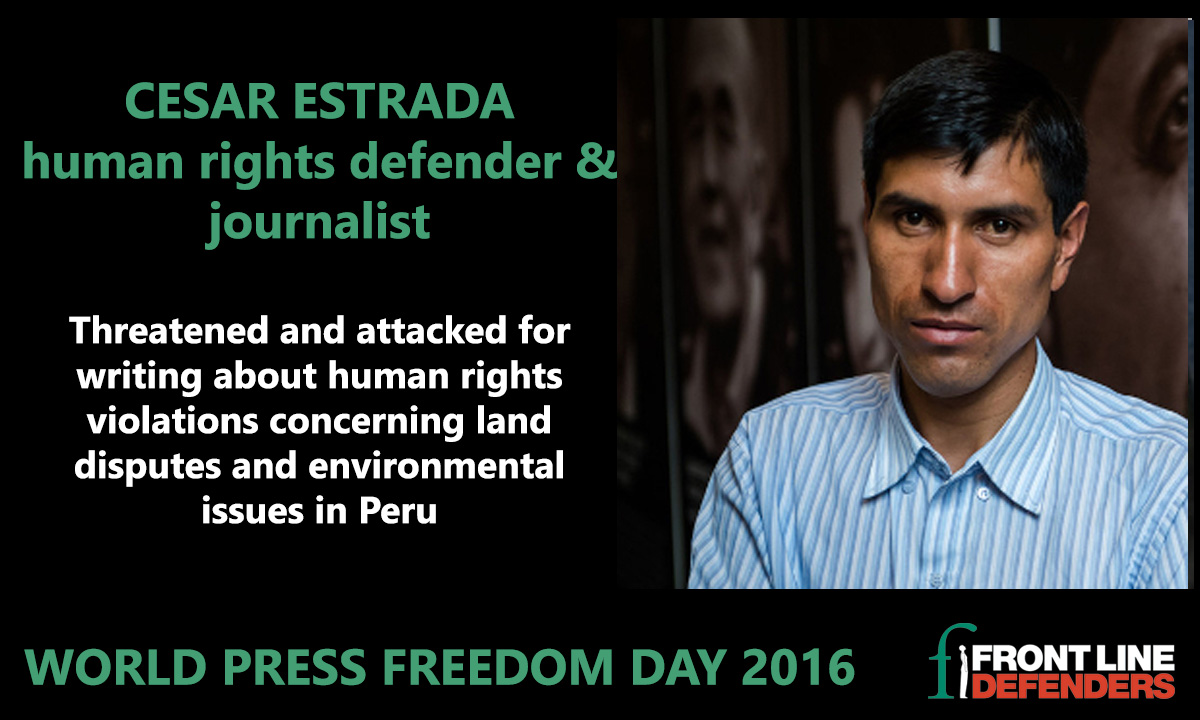
CESAR ESTRADA, PERU
Cesar Estrada Chuquilin is a journalist and member of the Red de Comunicadores Indigenas del Perú – REDCIP (Network of Indigenous Communicators in Peru). He has reported on several human rights violations concerning land disputes in the region and environmental issues related to the Conga Mining Project in the region of Cajamarca. In September 2015 Cesar survived an assassination attempt. He has also suffered severe persecution, intimidation, defamation, harassment, threats, attacks and thefts as a result of his peaceful and legitimate human rights work.
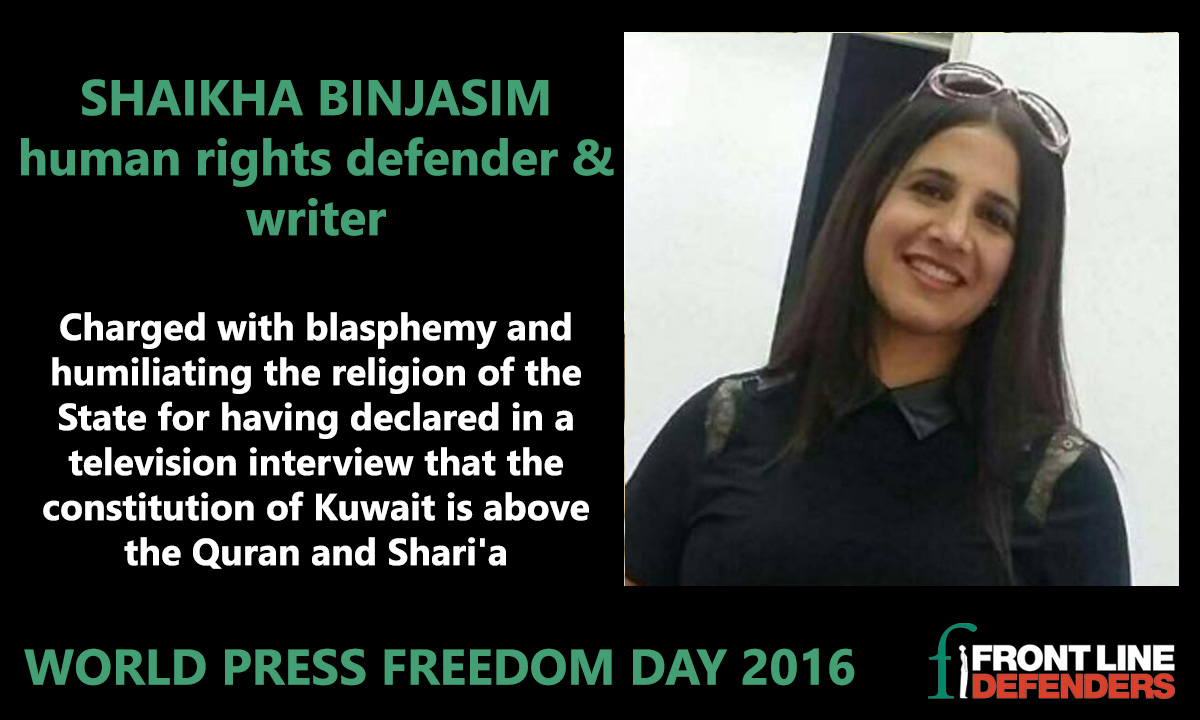
SHAIKHA BINJASIM, KUWAIT
Ms Shaikha Binjasim is a Kuwaiti human rights defender, writer and professor of philosophy at Kuwait University. She has been advocating on social media for freedom of conscience and freedom of speech in Kuwait. On 14 April 2016 she appeared before the public prosecutor, who charged her with blasphemy and humiliating the religion of the State for having declared in a television interview on the Kuwaiti channel Al-Shahed, that the constitution of Kuwait is above the Quran and Shari’a.
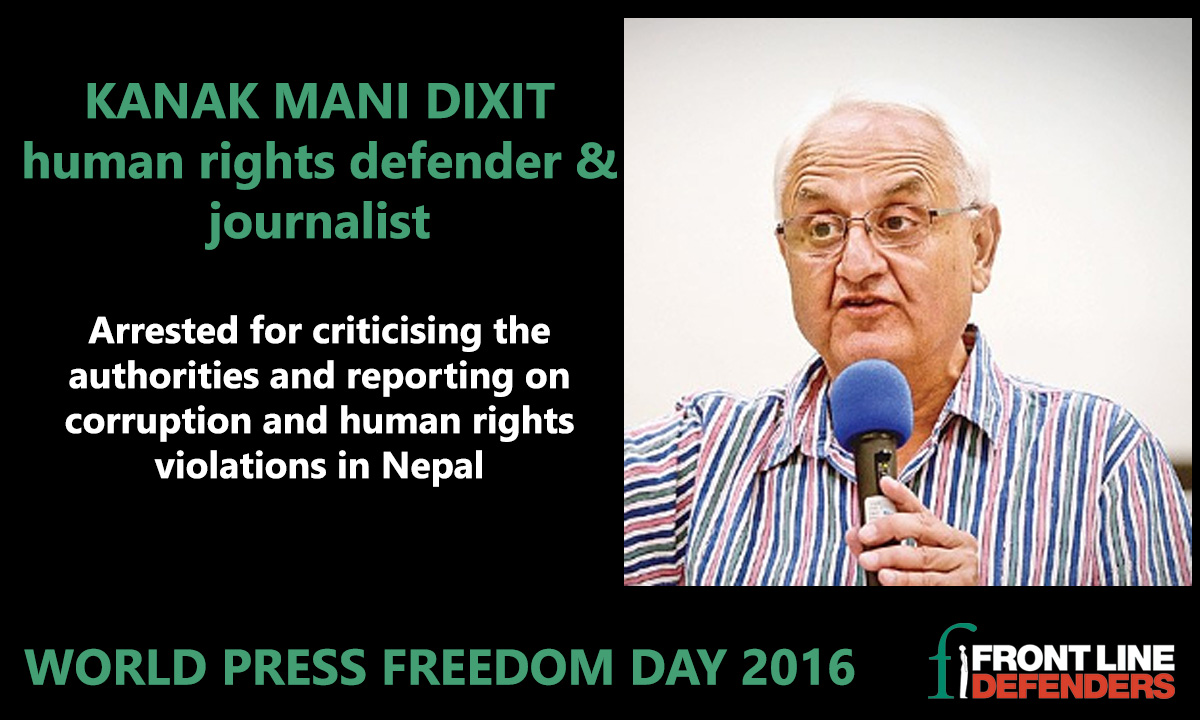
KANAK MANI DIXIT, NEPAL
Kanak Mani Dixit is a well-known journalist and human rights defender actively promoting the establishment of a democratic and secular government in Nepal. On 22 April 2016, Mr Lok Man Singh Karki, chairman of the Commission of Investigation on Abuse of Authority (CIAA), ordered his arrest. In 2013, Kanak Mani Dixit had published several articles criticising the appointment of Lok Man Singh Karki as Chairman, who had been found guilty of committing a series of brutal human rights violations when he was serving as Chief Secretary of the government.
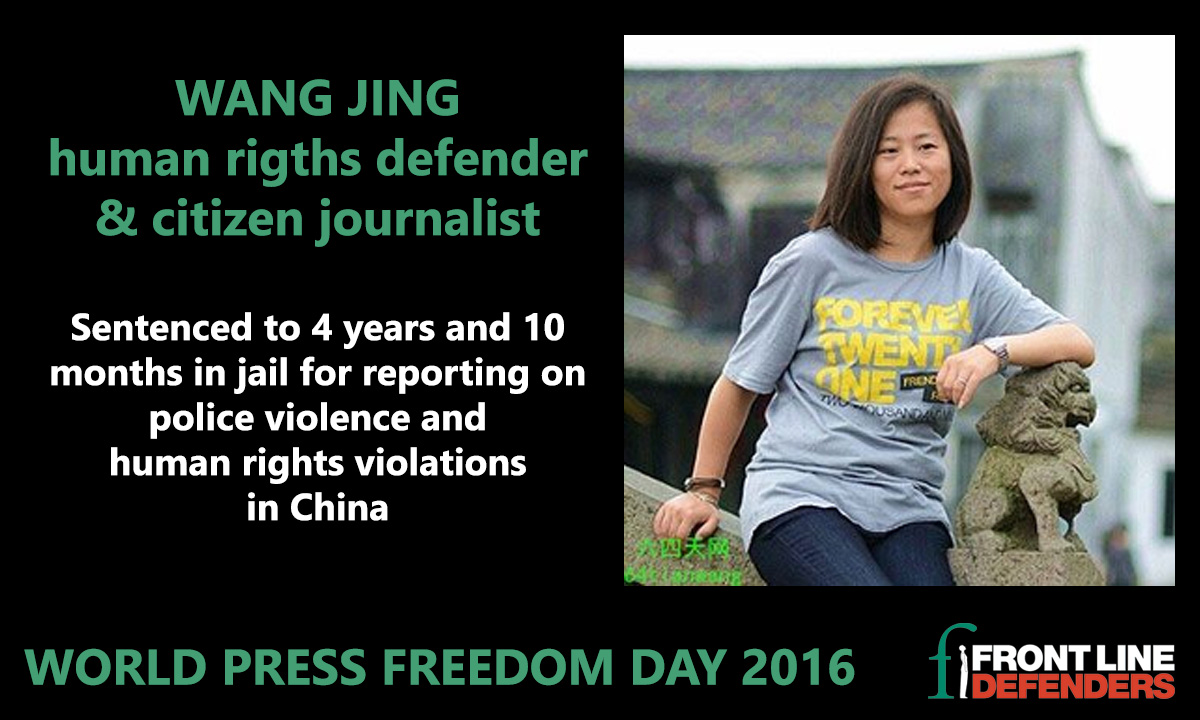
WANG JING, CHINA
Wang Jing is a citizen journalist who, amongst other reporting, has contributed articles to 64Tianwang, an independent human rights website operating in mainland China. On 24 April 2016 she was sentenced to four years and ten months in prison, for providing information about a self-immolation attempt which she witnessed in Tiananmen Square in March 2014. She was accused of sending pictures of the self-immolation to websites abroad, circulating them on social media and giving interviews to overseas media. It was also alleged that she reported on incidents where police had harassed, beaten and detained protesters and that such reports were defamatory.
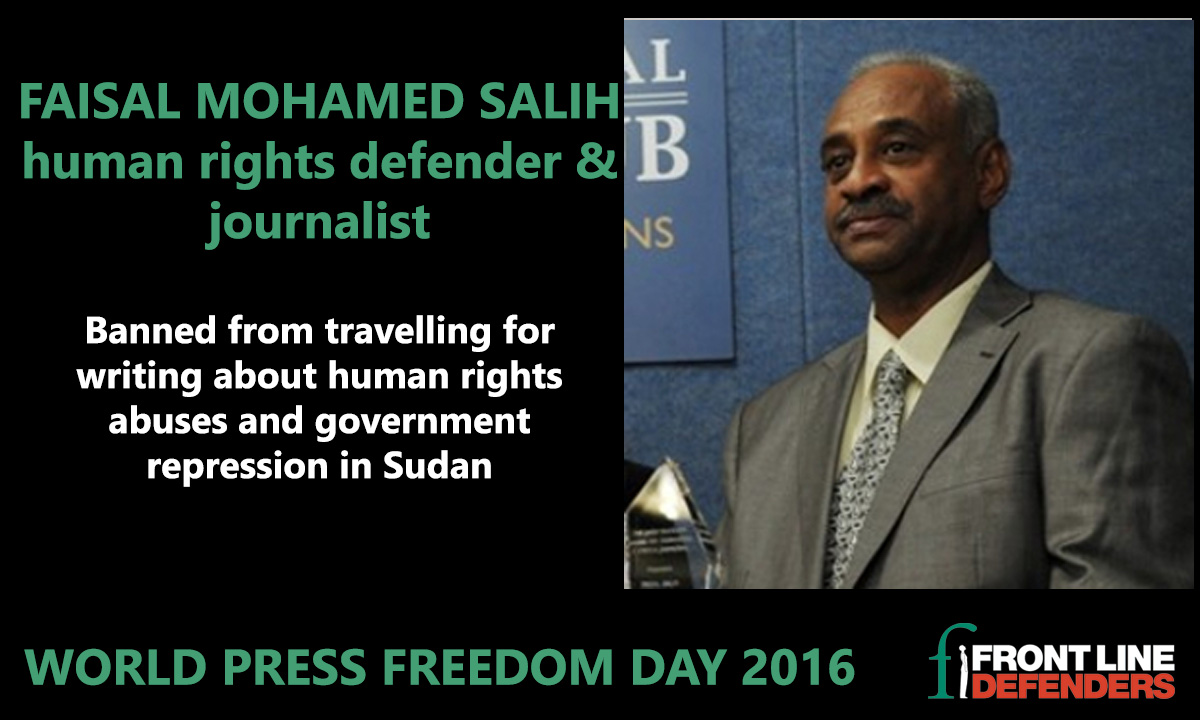
FAISAL MOHAMED SALIH, SUDAN
Faisal Mohamed Salih is a prominent Sudanese human rights journalist. He has extensively written about human rights abuses and government repression in Sudan, and also works on the promotion of freedom of expression and freedom of the press. On 25 March 2016, security agents from the National Intelligence and Security Services (NISS) prevented him from traveling from Khartoum International Airport to London. His passport was confiscated without any information being provided as to whether it shall be returned to him.
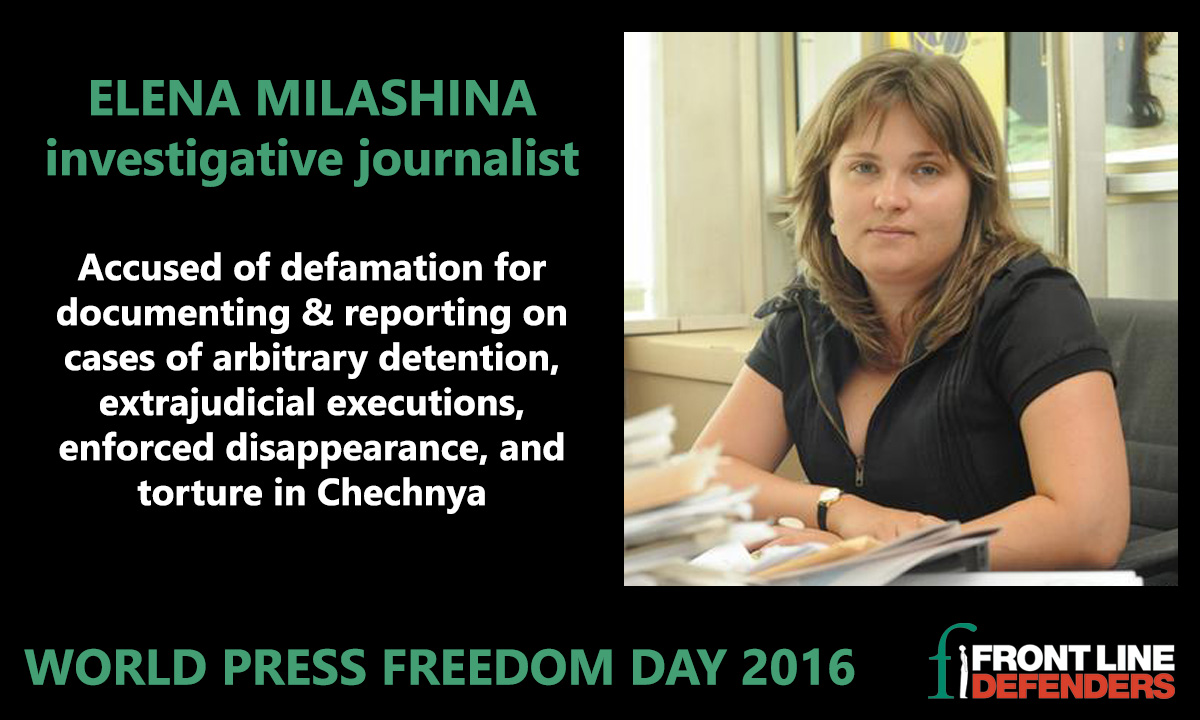
ELENA MILASHINA, RUSSIA
Elena Milashina is a human rights defender and an investigative journalist working for Novaya Gazeta, an independent Russian newspaper. Through her research and reports she has drawn international attention to the Russian government’s crackdown on civil society, as well as gross human rights abuses continuing in the Northern Caucasus. On 16 March 2016, the Ombudsman of the Chechen Republic announced that he had requested the Investigation Committee of the Russian Federation to initiate a criminal case against Ms Elena Milashina. She was accused of spreading false information, for an article where she described an attempt by the Chechen police to abduct a member of the human rights organisation “Committee for Prevention of Torture” on 22 February 2016.
Sources:
https://www.frontlinedefenders.org/en/statement-report/world-press-freedom-day-2016
From Dictatorship to Democracy – The Role of Human Rights Defenders. Streamed on 28 April 2016
April 27, 2016
in partnership with University College Dublin and Trinity College, Dublin, organize “Dictatorship to Democracy – The Role of Human Rights Defenders” a lecture by Professor Jan Sokol. He was one of the first signatories of Charter 77, a petition drawn up and signed by a number of brave Czechoslovakian writers and intellectuals in 1977 which demanded that the Communist government of Czechoslovakia recognise some basic human rights. He will give an account of his own experience of the Czechoslovakian transition to democracy and his current views on the appropriateness and efficiency of a “dissident” position.
The lecture will be accessible on-line too, as it will be live-streamed on Thursday evening 28 April @ 6.30pm (GMT+1) at the following link: https://www.youtube.com/watch?v=gijJmeidFzQ
Monday 25 April: what will happen in Egypt?
April 25, 2016Brian Dooley, Director of Human Rights First’s Human Rights Defenders Program, wrote in the Huffington Post that today, Monday 25 April 2016, could be a watershed day for Egypt‘s military leader. This day is a national holiday Egypt which marks the 1982 withdrawal of Israeli troops from Sinai. President Sisi‘s agreement to hand over the two uninhabited islands of Tiran and Sanafir in the Red Sea to Saudi Arabia may put a spark into the constantly simmering discontent in the human rights movement.
 Hans Thoolen on Human Rights Defenders and their awards