Archive for the 'EU' Category

Shackled Freedoms : what space for human rights defenders in the EuroMed?

September 7, 2016


cover-en-shackled-freedomThe recent report SHACKLED FREEDOMS : WHAT SPACE FOR CIVIL SOCIETY IN THE EUROMED? depicts the obstacles and repression against civil society in the region and showcases first-hand accounts from Turkey, Egypt, Algeria, Syria, Israel and the Occupied Palestinian Territories among others. The report also features recommendations by CSOs for joint action and seeks to influence EU policies to that effect. The report also focuses on the impact of security and anti-terrorist policies and lists the growing arsenal of repressive measures – both in law and practice – that civil society organizations (CSOs) face on a daily basis: judicial harassment, surveillance, arbitrary arrests, torture and assassination.

Despite legal safeguards and the human rights “shared values” rhetoric in the EU, EuroMed Rights argues that European civil society is under increasing pressure. Austerity measures and anti-terrorism laws are increasingly used to legitimise practices that go against individual freedoms and rights of assembly, association and expression, such as in France, Spain or the UK, for instance. The report – published on 7 September 2016 – is the result of a seminar organised in April 2016 as an open dialogue between EU representatives, South Mediterranean activists and Brussels-based CSOs.

 DOWNLOAD THE REPORT


Source: Shackled Freedoms : What Space for Civil Society in the EuroMed? – EuroMed Rights – Euro-Mediterranean Human Rights Network

Graduate Institute in Geneva celebrated human rights defenders with meeting and march

June 24, 2016
To mark the tenth anniversary of the Human Rights Council, the Graduate Institute, together with the European Union Delegation to the UN and the Geneva Academy of International Humanitarian Law and Human Rights, held an event on 15 June to honour Human Rights Defenders across the world. [see; https://thoolen.wordpress.com/2016/06/13/15-june-2016-human-rights-defender-berta-caceres-academy-geneva/]

The debate, moderated by Professor Andrew Clapham, featured Human Rights Defenders Taslima Nasrin and Aida Khemiri, as well as Stavros Lambrinidis, EU Special Representative for Human Rights.

“Too many people are dying for protecting human rights,” Mr Lambrinidis said, while promising that “the EU is committed to defending the defenders.”

“There is a price on my head,” revealed Taslima Nasrin, a Bangladeshi author and blogger who has been targeted by radical Muslim groups who have condemned her writing as blasphemous. “It’s been 22 years since I have been allowed to return to my country, not even in times of sickness and death of my closest family.”

Aida Khemiri, an LGBTI activist from Tunisia drew attention to the psychological challenge of having to lie to her friends and family for their protection. “As a Human Rights Defender, I have to live a double life. I cannot tell my family all I am doing, I have to protect them.

Following the debate, participants and panelists marched past the UN Palais des Nations to express their support to Human Rights Defenders who were not able to walk freely. The event concluded at the Ariana Museum, with a spectacular show of the Violonissima Duo, performing from a hot air balloon. A playlist with photos from the event can be found through the link below.

Source: Standing up for human rights defenders

European Parliament zooms in on human rights defenders in Cambodia, Tajikistan and Vietnam

June 9, 2016

A press release of 9 June 2016 reports that the European Parliament – in three resolutions voted on Thursday – focused on:

Opposition in Cambodia

MEPs deplore the worsening climate for opposition politicians and human rights activists in Cambodia and condemn all acts of violence, politically-motivated charges, arbitrary detention, questioning, sentences and convictions imposed on them. The Cambodian authorities should revoke the arrest warrant for, and drop all charges against, Sam Rainsy, President of the leading opposition party, the CNRP, and also immediately release the five human rights defenders still in preventive custody, namely Ny Sokha, Nay Vanda, Yi Soksan, Lim Mony and Ny Chakra. All politicians, activists and human rights defenders should “be allowed to work freely without fear of arrest or persecution”.

Given that the EU is Cambodia’s largest development assistance partner, with a new allocation of €410 million for 2014-2020, Parliament calls on the European External Action Service (EEAS) to make the “amount of EU financial assistance dependent on improvements in the human rights situation in the country”. EU member states, foreign policy chief Federica Mogherini, the EEAS and the EU Commission should also set out clear benchmarks for the forthcoming elections in Cambodia, consistent with international law on freedom of expression, association and assembly, it adds.

Prisoners of conscience in Tajikistan

Parliament is deeply concerned about increases in the detention and arrest of human rights lawyers, political opposition members and their relatives in Tajikistan. Restrictions on media freedom and internet and mobile communications, and restrictions on religious expression are also worrying in this country, it adds. MEPs call for the release of all those imprisoned on politically-motived charges, including, well-known businessman and government critic Abubakr Azizkhodzhaev, opposition figure Zaid Saidov, activist Maksud Ibragimov, opposition deputy leaders Mahmadali Hayit and Saidumar Hussaini, and 11 other members of the Islamic Renaissance Party of Tajikistan (IRPT).

The EU has a “vital interest in stepping up political, economic and security cooperation with the Central Asian region via a strong and open EU-Tajikistan relationship”, says the resolution. But “political and economic relations with the EU are deeply linked to the sharing of values relating to respect for human rights and fundamental freedoms”, adds the text.

Protesters in Vietnam

MEPs deplore continuing human rights violations in Vietnam, including “political intimidation, harassment, assaults, arbitrary arrests, heavy prison sentences and unfair trials, perpetrated against political activists, journalists, bloggers, dissidents and human rights defenders”, and call on the government of Vietnam to put an “immediate stop to all harassment, intimidation, and persecution” of these individuals. “The increasing levels of violence perpetrated against Vietnamese protesters” demonstrating throughout the country in May 2016 to express their anger over “an ecological catastrophe that decimated the nation’s fish stocks” are worrying, note MEPs. The Vietnam government should respect the right to freedom of assembly in line with its international human rights obligations, the findings of the investigations into the environmental disaster should be published and those responsible should be held accountable, they add.

The resolution also calls on the Vietnam government to put an end to religious persecution in the country, to amend legislation on the status of religious minorities and to withdraw the fifth draft of the law on belief and religion, currently being debated in the National Assembly, as it is “incompatible with international norms of freedom religion or belief”.

Source: Human rights: opposition in Cambodia, prisoners of conscience in Tajikistan, continuing violations of human rights in Vietnam

World Press Freedom Day (3 May) very relevant for human rights defenders

May 4, 2016

Special Rapporteur on the promotion and protection of the right to freedom of opinion and expression David Kaye. UN Photo/Jean-Marc Ferré
On World Press Freedom Day, 3 May 2016, David Kaye, UN Special Rapporteur on freedom of expression, signalled concern that efforts to counter “violent extremism” may be construed as the “perfect excuse” for democratic and authoritarian governments to restrict free expression and control access to information. “By ‘balancing’ freedom of expression and the prevention of violence, the programmes and initiatives aimed at countering ‘violent extremism’ have – often purposely, sometimes inadvertently – put at risk or curtailed the independence of media”

Mr. Kaye and his counterparts from the African Commission on Human and Peoples’ Rights (ACHPR – Pansy Tlakula), the Inter-American Commission on Human Rights (IACHR – Edison Lanza) and the Organization for Security and Co-operation in Europe (OSCE – Dunja Mijatovic) raised concerns in their annual Joint Declaration that programmes to prevent or and/combat violent extremism risk undermining freedom of expression. “Some governments target journalists, bloggers, political dissidents, activists and human rights defenders as ‘extremists’ or ‘terrorists,’ criminalizing and detaining them, using legal systems to counter broad and unclear offences,” Mr. Kaye warned. “The harm is felt not only by journalists but also by their audiences, the public that deserves the right to know and to access information of public interest.” The Joint Declaration is available here.

The EU on this day wishes to recall the principle that “the establishment, maintenance and fostering of an independent, pluralistic and free press is essential to the development and maintenance of democracy in a nation, and for economic development”….The EU is committed to continue promoting and protecting freedom of opinion and expression worldwide, not only offline but also in relation to the cyberspace and other information communication technologies, as highlighted by the adoption in 2014 of the EU Human Rights Guidelines on Freedom of Expression Online and Offline.  ..It condemns the increasing level of intimidation and violence that journalists, Human Rights Defenders, media actors and other individuals face in many countries across the world when exercising the right to freedom of opinion and expression online and offline.

Frontline NEWlogo-2 full version - croppedon World Press Freedom Day 2016, Front Line Defenders lists 6 human rights defenders persecuted for bravely demanding rights for their communities:


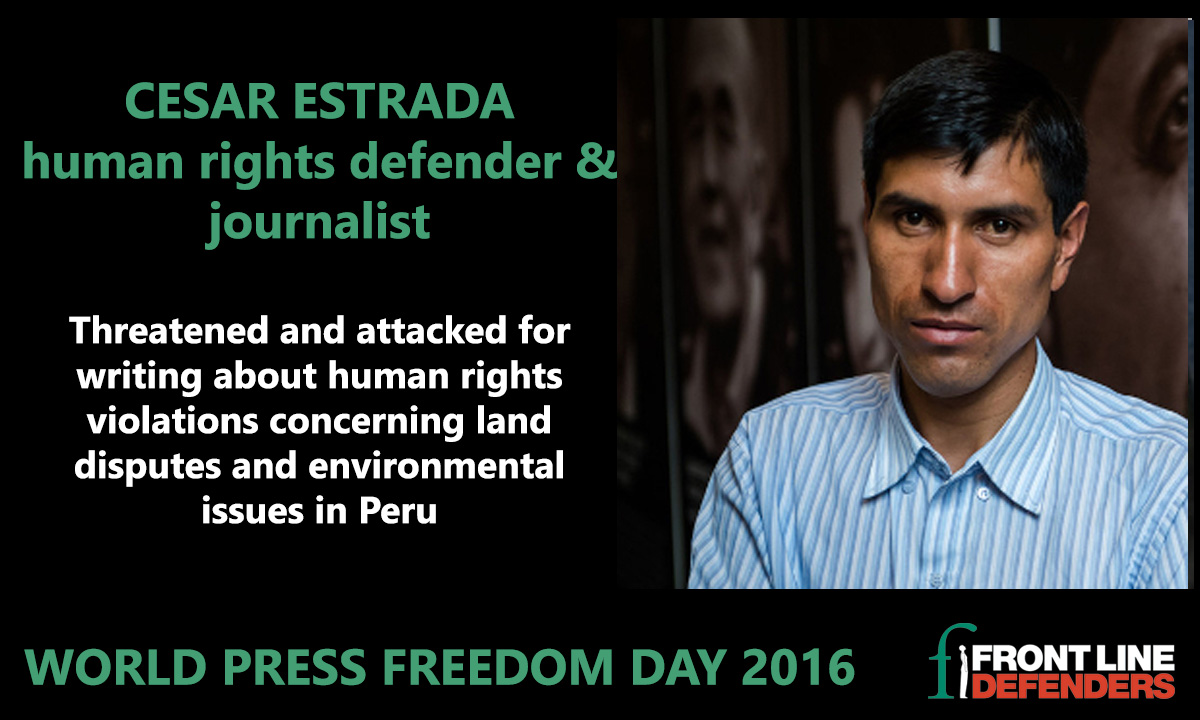
CESAR ESTRADA, PERU

Cesar Estrada Chuquilin is a journalist and member of the Red de Comunicadores Indigenas del Perú – REDCIP (Network of Indigenous Communicators in Peru). He has reported on several human rights violations concerning land disputes in the region and environmental issues related to the Conga Mining Project in the region of Cajamarca.  In September 2015 Cesar survived an assassination attempt. He has also suffered severe persecution, intimidation, defamation, harassment, threats, attacks and thefts as a result of his peaceful and legitimate human rights work.

Cesar Estrada WPFD

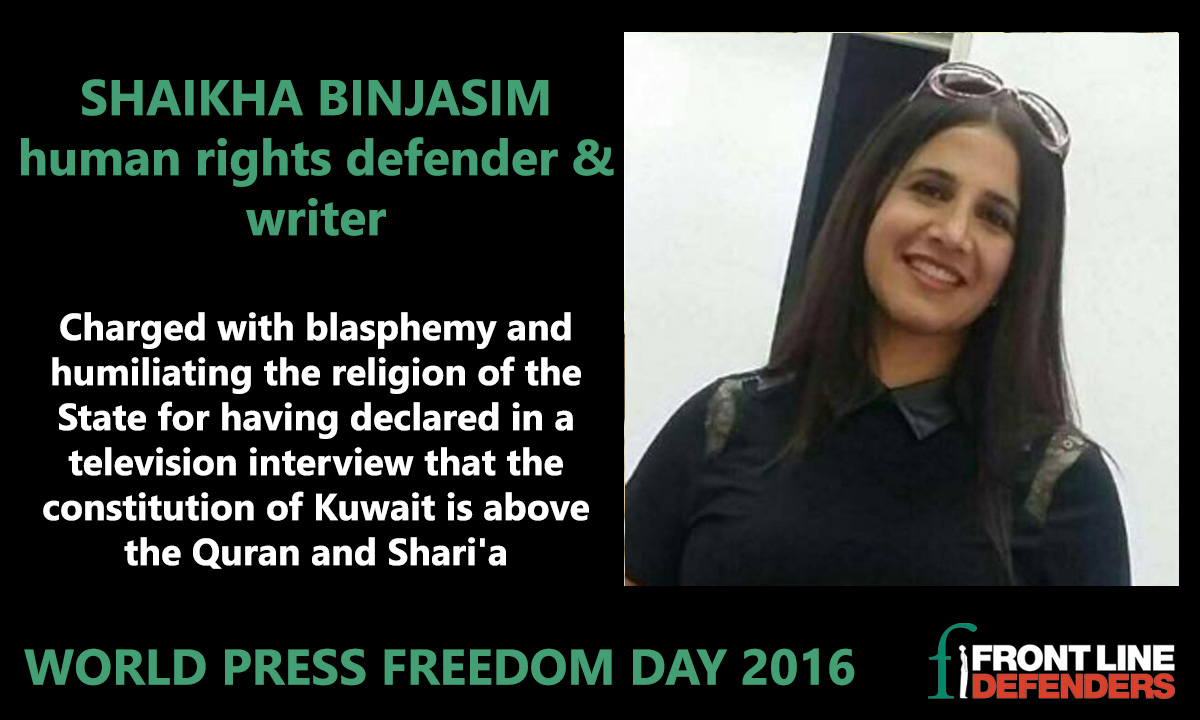
SHAIKHA BINJASIM, KUWAIT

Ms Shaikha Binjasim is a Kuwaiti human rights defender, writer and professor of philosophy at Kuwait University. She has been advocating on social media for freedom of conscience and freedom of speech in Kuwait. On 14 April 2016 she appeared before the public prosecutor, who charged her with blasphemy and humiliating the religion of the State for having declared in a television interview on the Kuwaiti channel Al-Shahed, that the constitution of Kuwait is above the Quran and Shari’a.

SHAIKHA BINJASIM WFPD

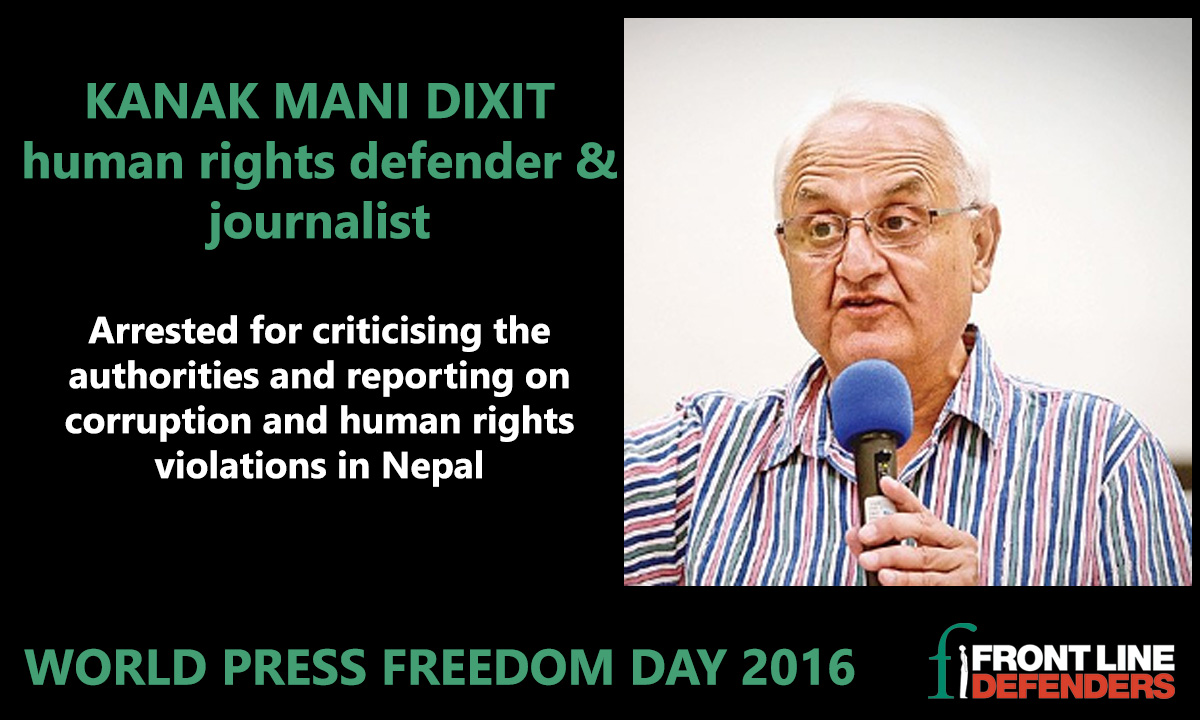
KANAK MANI DIXIT, NEPAL

Kanak Mani Dixit is a well-known journalist and human rights defender actively promoting the establishment of a democratic and secular government in Nepal. On 22 April 2016, Mr Lok Man Singh Karki, chairman of the Commission of Investigation on Abuse of Authority (CIAA), ordered his arrest. In 2013, Kanak Mani Dixit had published several articles criticising the appointment of Lok Man Singh Karki as Chairman, who had been found guilty of committing a series of brutal human rights violations when he was serving as Chief Secretary of the government.

Kanak Mani Dixit wpfd

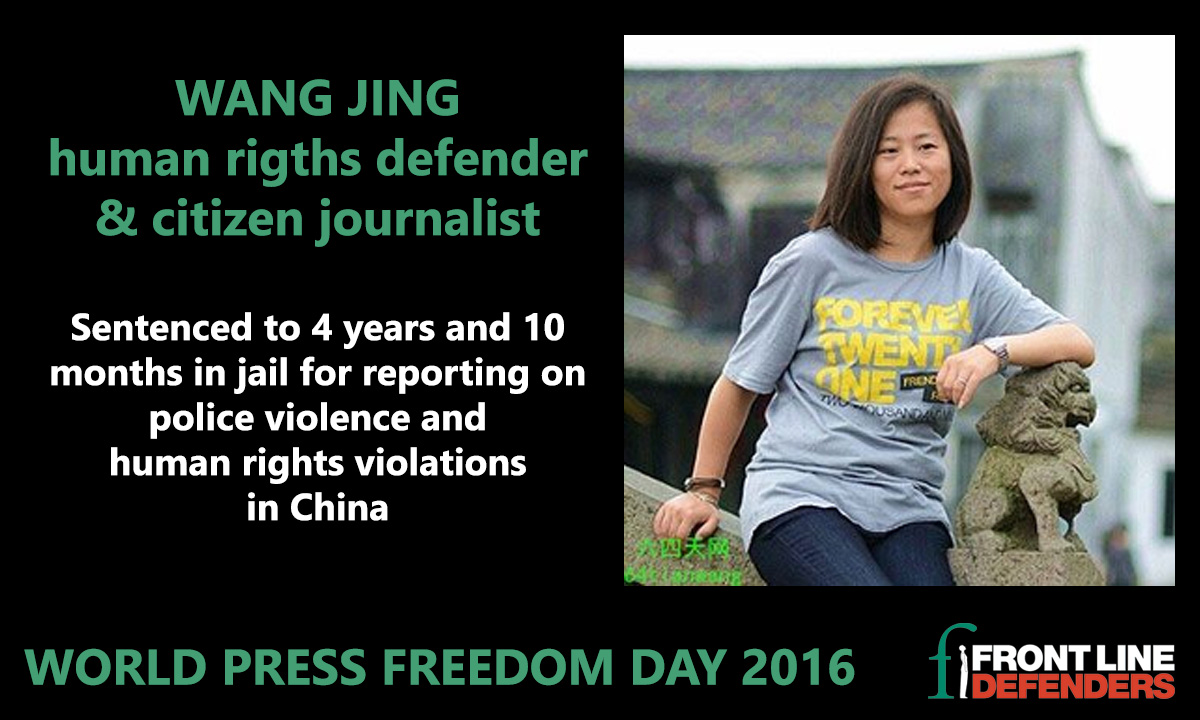
WANG JING, CHINA

Wang Jing is a citizen journalist who, amongst other reporting, has contributed articles to 64Tianwang, an independent human rights website operating in mainland China. On 24 April 2016 she was sentenced to four years and ten months in prison, for providing information about a self-immolation attempt which she witnessed in Tiananmen Square in March 2014. She was accused of sending pictures of the self-immolation to websites abroad, circulating them on social media and giving interviews to overseas media. It was also alleged that she reported on incidents where police had harassed, beaten and detained protesters and that such reports were defamatory.

wANG JING WPFD

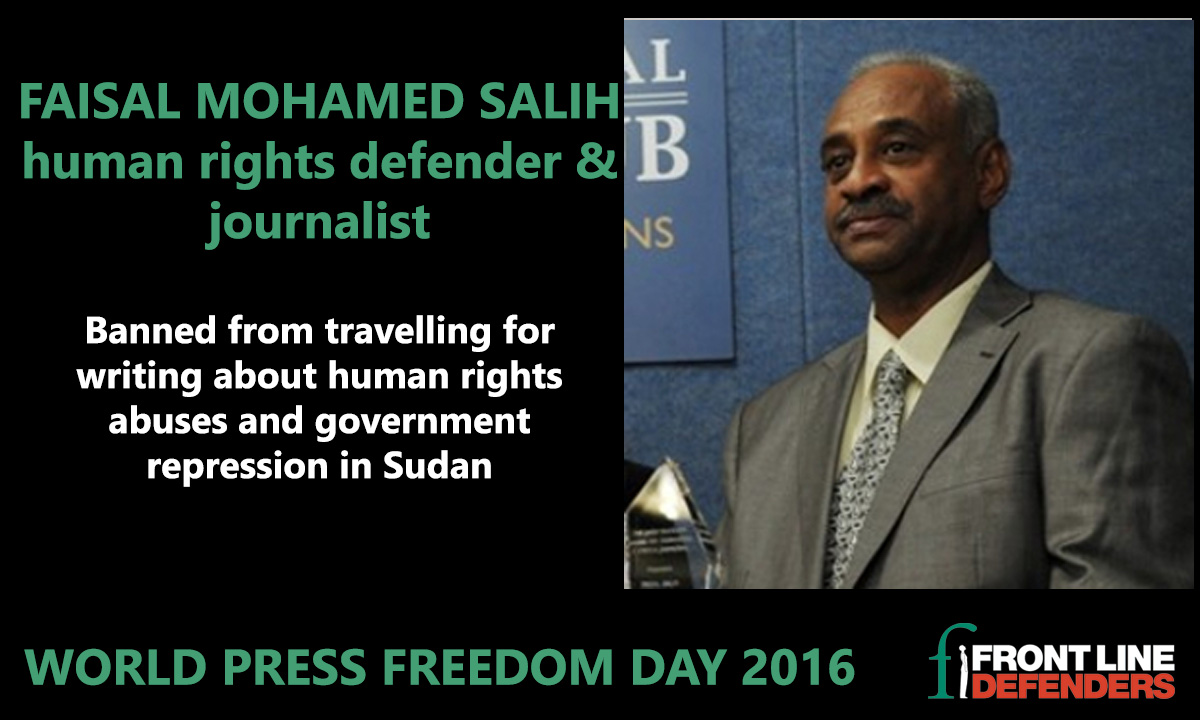
FAISAL MOHAMED SALIH, SUDAN

Faisal Mohamed Salih is a prominent Sudanese human rights journalist. He has extensively written about human rights abuses and government repression in Sudan, and also works on the promotion of freedom of expression and freedom of the press. On 25 March 2016, security agents from the National Intelligence and Security Services (NISS) prevented him from traveling from Khartoum International Airport to London. His passport was confiscated without any information being provided as to whether it shall be returned to him.

Faisal Salih

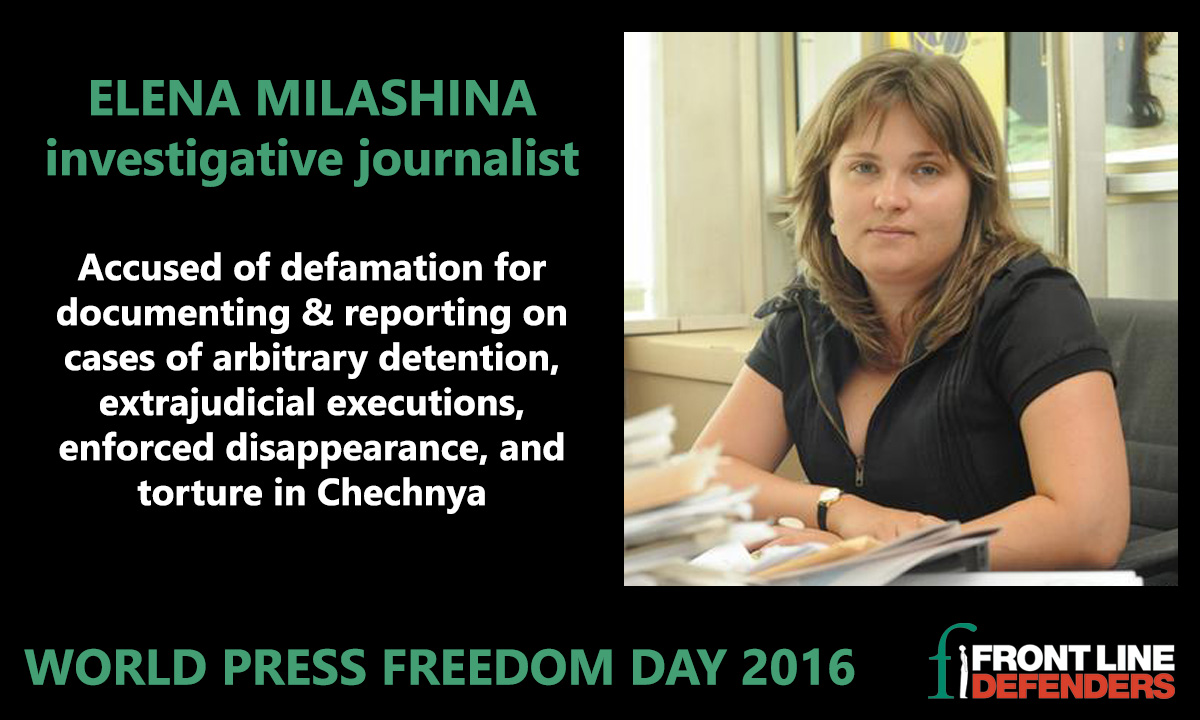
ELENA MILASHINA, RUSSIA

Elena Milashina is a human rights defender and an investigative journalist working for Novaya Gazeta, an independent Russian newspaper. Through her research and reports she has drawn international attention to the Russian government’s crackdown on civil society, as well as gross human rights abuses continuing in the Northern Caucasus.  On 16 March 2016, the Ombudsman of the Chechen Republic announced that he had requested the Investigation Committee of the Russian Federation to initiate a criminal case against Ms Elena Milashina. She was accused of spreading false information, for an article where she described an attempt by the Chechen police to abduct a member of the human rights organisation “Committee for Prevention of Torture” on 22 February 2016.

ELENA MILASHINA

Sources:

United Nations News Centre – UN expert warns combat against violent extremism could be used as ‘excuse’ to curb free speech

http://www.consilium.europa.eu/en/press/press-releases/2016/05/02-hr-declaration-world-press-freedom-day-3-may/

https://www.frontlinedefenders.org/en/statement-report/world-press-freedom-day-2016

Human Rights Day 2015: human rights defenders are main topic

December 10, 2015

International Human Rights Day is an occasion for many organizations to publish statements on human rights. For those who have not enough time to go through all of them, here a selection of four main statements that focus on human rights defenders:  Read the rest of this entry »

Short report by EEAS on the 17th EU-NGO Human Rights Forum, 3-4 December 2015

December 5, 2015

The 17th EU-NGO Human Rights Forum took place in Brussels on 3 and 4 December 2015, bringing together hundreds of civil society organisations from across the globe, representatives from international and regional human rights mechanisms and from the EU institutions and Member States. The Forum is a joint venture between the European External Action Service (EEAS), the European Commission, and the Human Rights & Democracy Network [http://www.hrdn.eu/index.php?menu_selected=122&language=US&sub_menu_selected=768].

The overarching theme for this year’s Forum is Protecting and Promoting Civil society Space. In her address to the Forum, High Representative of the Union for Foreign Affairs and Security Policy, Federica Mogherini, stated: I believe that the civil society has a crucial role to play in any policy and in our foreign policy. It is not only a key player, but a main driver for change in all societies, in terms of democracy, good governance, resilience, cohesion, promotion of fundamental human rights.   Freedom of expression is one of the most powerful weapons against radicalisation and terrorism. To better protect our citizens we need above all to build strong democratic institutions and a healthy democratic dialogue. I am very often asked whether security should not be the main focus, more than human rights. But there is no security without human rights”.

She also called for renewed efforts to fight attempts to control the work of civil society in many countries around the world: “During the last years, the space for civil society has shrunk in many countries”. “These trends demand a redoubling of our efforts in the human rights sphere. The European Union, the institutions and myself personally, will do all we can to protect civil society organisations fighting for human rights and protect human rights defender on an individual basis.”

The theme of this year’s NGO Forum – Protecting and Promoting Civil Society Space – reflects the EU’s strong commitment to put Freedom of Association and Freedom of Expression at the heart of the EU’s human rights policy as essential foundations for democracy, rule of law, peace, stability, sustainable inclusive development and participation in public affairs.

This year’s event saw contributions from the current UN Special Rapporteur on Freedom of Association, Maina Kiai; the UN Special Rapporteur for Human Rights Defenders, Michel Forst; Vice-Chair of the European Parliament Subcommittee on Human Rights, MEP Barbara Lochbihler; the Secretary General of the Community of Democracies, Amb. Maria Leissner; Sakharov Prize recipient Memorial, represented by Oleg Orlov; alongside many representatives from civil society, Human Rights Defenders, NGOs, the EU Institutions and many representatives from EU member states.

The forum looked at the recent EU Guidelines on Human Rights Defenders and the EU Guidelines on Freedom of Expression, as key tools enabling the EU to promote and protect freedom of opinion and expression and to counter the clear and disturbing trend over the last few years towards an increasingly restricted space for independent civil society as well as outright threats, intimidation and violence that civil society organisations and representatives, journalists, media actors and other individuals face in many countries across the world because of the exercise of their rights.

Given the scale of the problem and its constantly changing manifestations, urgent action is required not just to understand the scale and evolving nature of the threats, but particularly to identify ways to achieve effective and concerted policy responses and counter actions.

The EU is committed, as indicated in the EU strategy on human rights and democracy and its Action Plan (2015-2019), to address threats to civil society space, through actions that support laws and policies to protect human rights defenders; report on and counter threats to civil society space; and oppose unjustified restrictions to freedoms of assembly and association.

Engagement with civil society is essential for the ongoing work the EU is undertaking to help realise human rights, indivisible and universal for all people. The Forum discussions provided a significant opportunity for an interactive dialogue among representatives from the EU member states, the European Institutions (European Parliament, Council, European External Action Service, European Commission) and global civil society and human rights defenders from all over the world, working on the promotion and protection of human rights. The outcome of the Forum will be an important stepping stone for ensuring effective EU action and future policy developments in this field.

see also: https://thoolen.wordpress.com/2015/12/04/international-cooperative-consortium-protect-the-defenders-launched-on-2-december/


Source: European Union – EEAS (European External Action Service) | PRESS RELEASE: PROTECTING & PROMOTING CIVIL SOCIETY SPACE: 17th EU-NGO Human Rights Forum, 2015

Monday 2 March, start of the #idefend campaign

February 28, 2015

On Monday 2 March 2015 starts the “#idefend – Making sure civil society has its voice” campaign. It is an initiative of the Delegation of the European Union to the UN in Geneva in partnership with the Office of the High Commissioner for Human Rights and the Permanent Missions of Brazil, the Republic of Korea and Tunisia.

The #idefend campaign takes a public stance to support the voices of civil society.#idefend aims at expressing solidarity with all those human rights defenders and civil society actors, whose dedication and everyday work improve the human rights of people in every corner of the world. Join the campaign and help empower those who speak up for human rights!

Human rights defenders are not violent seditionists, criminals, nor bloody revolutionaries, as so many governments like to portray them. They are the best of us, all of us. And they have a message. To all governments, we say: focus on their message. Listen to what they are saying. Understand the message, talk to them about it, be persuaded or persuade, without violence, instead of silencing them, punishing them, their families, and their communities.
Zeid Ra’ad Al Hussein, UN High Commissioner for Human Rights

Sadly, over the past years, we have observed a worrying trend at the Human Rights Council: Human Rights Defenders and civil society representatives are hampered from speaking at the Council, sometimes they are harassed upon their arrival to Geneva, or subject to reprisals in their home country upon their return. This is not acceptable.
Peter Sørensen, Head of the EU Delegation to the United Nations

#idefend | Making sure civil society has its voice.

What Human Rights Day means in Bahrain and how the EU made it worse

December 11, 2014

On 9 December, on the eve of Human Rights Day, Zainab Al-Khawaja was sentenced to 4 years and 4 months in two separate court hearings in Bahrain. Front Line, Human Rights First and others have reported extensively on this courageous human rights defenders [see also: https://thoolen.wordpress.com/tag/zainab-al-khawaja/] .

She was sentenced to 16 months’ imprisonment for “sabotaging properties belonging to the Ministry of Interior” and “insulting a public official” to three months’ imprisonment and fined 3,000 Bahraini Dinar (approx. 6,400 Euro) for “tearing up a photograph of the King”.

Frontline NEWlogos-1 condensed version - cropped also shockingly reports that on the same day as her sentencing, the European Union presented a human rights award to Bahrain’s National Institution for Human Rights and the Ombudsman of the Ministry of the Interior! Although this concerns a relatively unknown regional award (the Chaillot Prize is presented annually by the Delegation of the European Union in Riyadh http://www.ambafrance-bh.org/Press-release-Delegation-of-the.) the state press has been making the best of it [http://www.gulf-daily-news.com/NewsDetails.aspx?storyid=391213] and it is hard to see this as in line with the EU policy on Human Rights Defenders.

‘Unsung Heroes’ – EU Tribute to Human Rights Defenders on 2 December in Geneva

November 28, 2014

Under the title “Unsung Heroes” the EU Delegation to the UN in  Geneva is organizing a Tribute to Human Rights Defenders on 2 December 2014 at 13h00 in the Palais des Nations in Geneva.

In light of the 10th anniversary of the EU Guidelines on Human Rights Defenders and ahead of the Human Rights Day, Stavros Lambrinidis, EU Special Representative for Human Rights, will discuss interactively with NGOs, Human Rights Defenders and International Organisations the challenges of speaking up for human rights. The event will also include the Geneva launch of a study conducted by the Kvinna till Kvinna Foundation on Women Human Right Defenders’ exposure to threats and violence.

The debate on questions such as “What does it take to stand up for human rights?”, “What risks do human rights defenders face, in particular if they are women?” and “What can we do to provide better support?” will be followed by the screening of the film documentary “Six Days”, portraying three women in three different countries, fighting for change in the wake of war and conflict.

I should add that the choice of the title ‘Unsung Heroes’ leaves to be desired as it has been used a lot by different organisations, including the US State Department, the Carter Foundation, the Martin Ennals Foundation for its 2001 study, the OHCHR, PBI, Freedom etc.

See also my post from two days ago: https://thoolen.wordpress.com/2014/11/26/tribute-remembering-women-human-rights-defenders/


Congolese gynecologist wins Europe’s Sakharov Prize in 2014

October 22, 2014

The 2014 Sakharov Prize goes to the Congolese physician Denis Mukwege for his treatment of the victims of gang rape in the Democratic Republic of Congo.

Congolese physician Denis Mukwege, will be awarded this year’s Sakharov Prize for Freedom of Thought, European Parliament President Martin Schulz announced in Strasbourg on Tuesday.

Mukwege has been treating rape victims at a clinic in Bukavu on the Rwandan border for decades. He has performed thousands of surgeries on women to heal their injuries sustained in violent attacks, often by local militias. The 59-year-old founded a gynaecology unit and maternity ward in Bukavu in 1996, the first of its kind in the area. He has since expanded the station to an entire hospital, which he runs. The Second Congo War began in August 1998, ravaging the region. Mukwege is said to have performed over 10,000 operations on rape victims ever since.

The other finalists were Ukraine’s pro-Western Euromaidan movement and Azerbaijani rights defender Leyla Yunus.[https://thoolen.wordpress.com/2014/10/16/more-on-the-sakharov-prize-and-the-arab-nominees/]

For more information on the award see: http://www.trueheroesfilms.org/thedigest/award/sakharov-prize-freedom-thought

The 2014 prize will be awarded at a ceremony in Strasbourg on 26 November.

Congolese gynecologist wins Sakharov Prize | News | DW.DE | 21.10.2014.

for our french speakers: http://www.lemonde.fr/europe/article/2014/10/21/le-docteur-mukwege-recoit-le-prix-sakharov-pour-son-soutien-aux-femmes-violees-en-rdc_4510098_3214.html