Archive for the 'EU' Category

World Press Freedom Day (3 May) very relevant for human rights defenders

May 4, 2016

Special Rapporteur on the promotion and protection of the right to freedom of opinion and expression David Kaye. UN Photo/Jean-Marc Ferré
On World Press Freedom Day, 3 May 2016, David Kaye, UN Special Rapporteur on freedom of expression, signalled concern that efforts to counter “violent extremism” may be construed as the “perfect excuse” for democratic and authoritarian governments to restrict free expression and control access to information. “By ‘balancing’ freedom of expression and the prevention of violence, the programmes and initiatives aimed at countering ‘violent extremism’ have – often purposely, sometimes inadvertently – put at risk or curtailed the independence of media”

Mr. Kaye and his counterparts from the African Commission on Human and Peoples’ Rights (ACHPR – Pansy Tlakula), the Inter-American Commission on Human Rights (IACHR – Edison Lanza) and the Organization for Security and Co-operation in Europe (OSCE – Dunja Mijatovic) raised concerns in their annual Joint Declaration that programmes to prevent or and/combat violent extremism risk undermining freedom of expression. “Some governments target journalists, bloggers, political dissidents, activists and human rights defenders as ‘extremists’ or ‘terrorists,’ criminalizing and detaining them, using legal systems to counter broad and unclear offences,” Mr. Kaye warned. “The harm is felt not only by journalists but also by their audiences, the public that deserves the right to know and to access information of public interest.” The Joint Declaration is available here.

The EU on this day wishes to recall the principle that “the establishment, maintenance and fostering of an independent, pluralistic and free press is essential to the development and maintenance of democracy in a nation, and for economic development”….The EU is committed to continue promoting and protecting freedom of opinion and expression worldwide, not only offline but also in relation to the cyberspace and other information communication technologies, as highlighted by the adoption in 2014 of the EU Human Rights Guidelines on Freedom of Expression Online and Offline.  ..It condemns the increasing level of intimidation and violence that journalists, Human Rights Defenders, media actors and other individuals face in many countries across the world when exercising the right to freedom of opinion and expression online and offline.

Frontline NEWlogo-2 full version - croppedon World Press Freedom Day 2016, Front Line Defenders lists 6 human rights defenders persecuted for bravely demanding rights for their communities:


CESAR ESTRADA, PERU

Cesar Estrada Chuquilin is a journalist and member of the Red de Comunicadores Indigenas del Perú – REDCIP (Network of Indigenous Communicators in Peru). He has reported on several human rights violations concerning land disputes in the region and environmental issues related to the Conga Mining Project in the region of Cajamarca.  In September 2015 Cesar survived an assassination attempt. He has also suffered severe persecution, intimidation, defamation, harassment, threats, attacks and thefts as a result of his peaceful and legitimate human rights work.
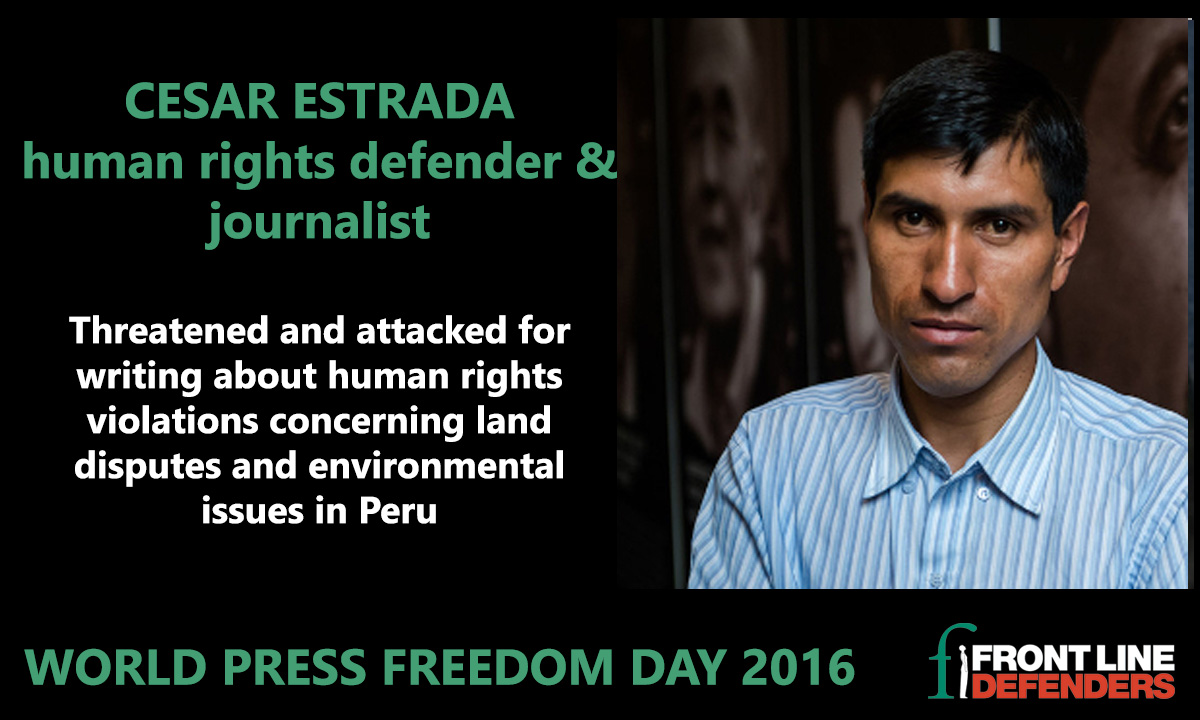
Cesar Estrada WPFD

SHAIKHA BINJASIM, KUWAIT

Ms Shaikha Binjasim is a Kuwaiti human rights defender, writer and professor of philosophy at Kuwait University. She has been advocating on social media for freedom of conscience and freedom of speech in Kuwait. On 14 April 2016 she appeared before the public prosecutor, who charged her with blasphemy and humiliating the religion of the State for having declared in a television interview on the Kuwaiti channel Al-Shahed, that the constitution of Kuwait is above the Quran and Shari’a.
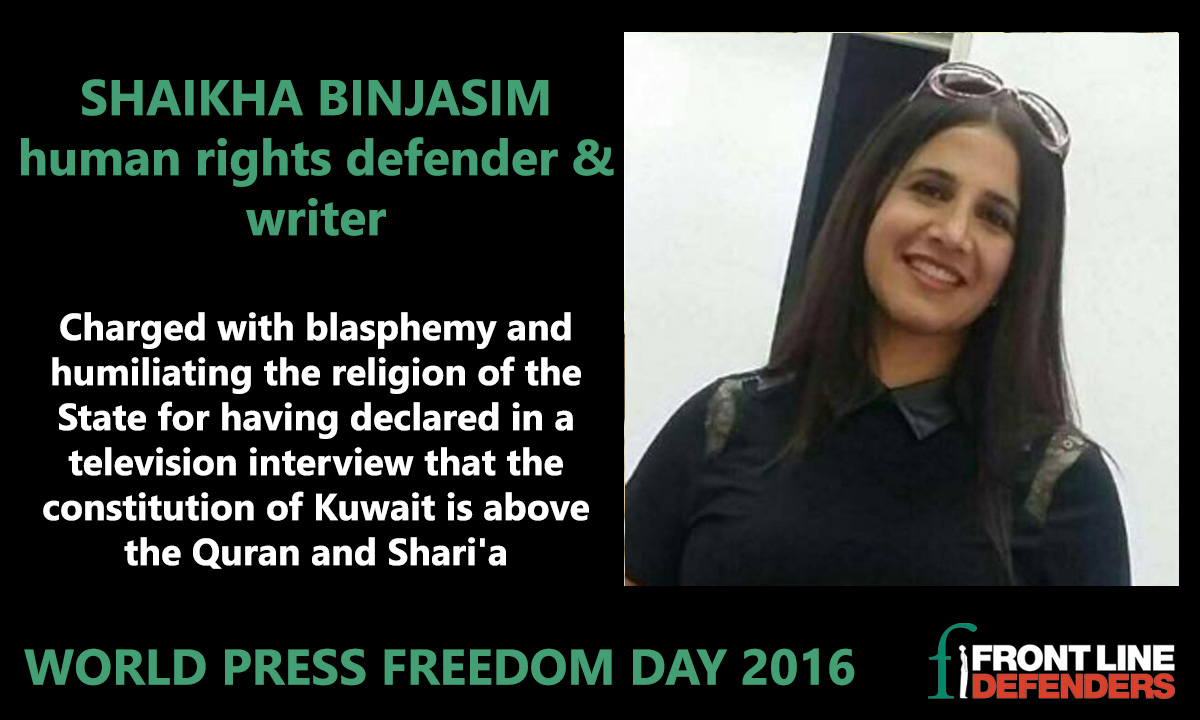
SHAIKHA BINJASIM WFPD

KANAK MANI DIXIT, NEPAL

Kanak Mani Dixit is a well-known journalist and human rights defender actively promoting the establishment of a democratic and secular government in Nepal. On 22 April 2016, Mr Lok Man Singh Karki, chairman of the Commission of Investigation on Abuse of Authority (CIAA), ordered his arrest. In 2013, Kanak Mani Dixit had published several articles criticising the appointment of Lok Man Singh Karki as Chairman, who had been found guilty of committing a series of brutal human rights violations when he was serving as Chief Secretary of the government.
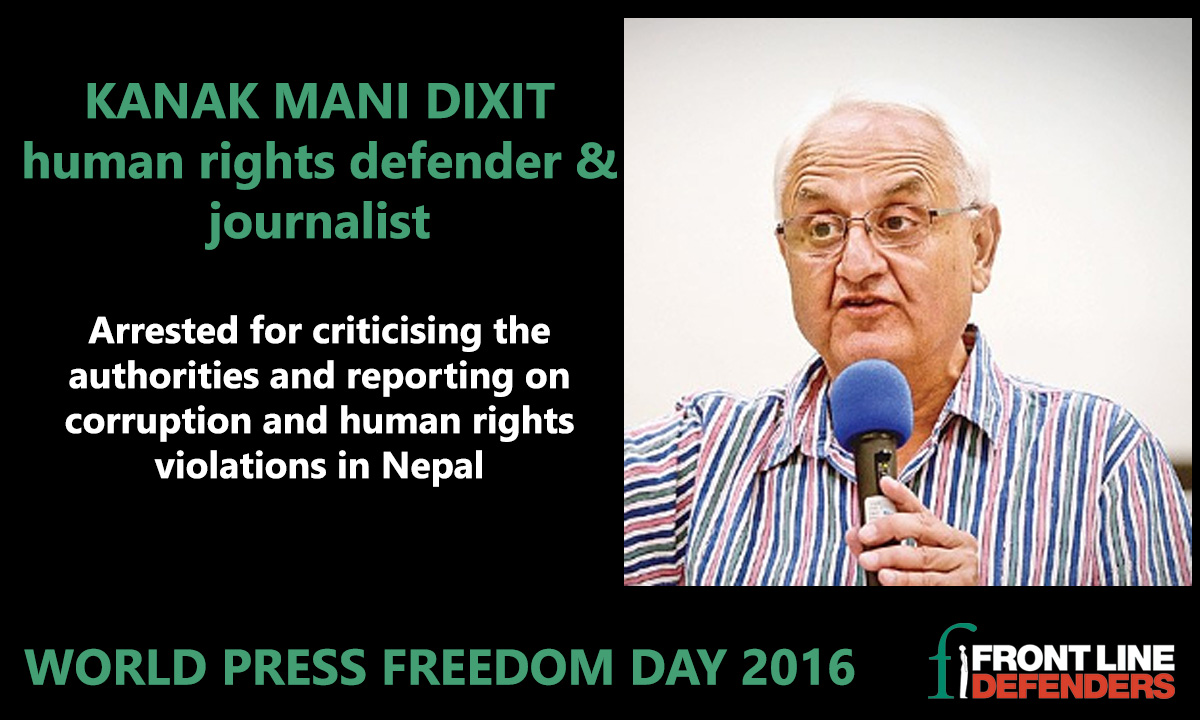
Kanak Mani Dixit wpfd

WANG JING, CHINA

Wang Jing is a citizen journalist who, amongst other reporting, has contributed articles to 64Tianwang, an independent human rights website operating in mainland China. On 24 April 2016 she was sentenced to four years and ten months in prison, for providing information about a self-immolation attempt which she witnessed in Tiananmen Square in March 2014. She was accused of sending pictures of the self-immolation to websites abroad, circulating them on social media and giving interviews to overseas media. It was also alleged that she reported on incidents where police had harassed, beaten and detained protesters and that such reports were defamatory.
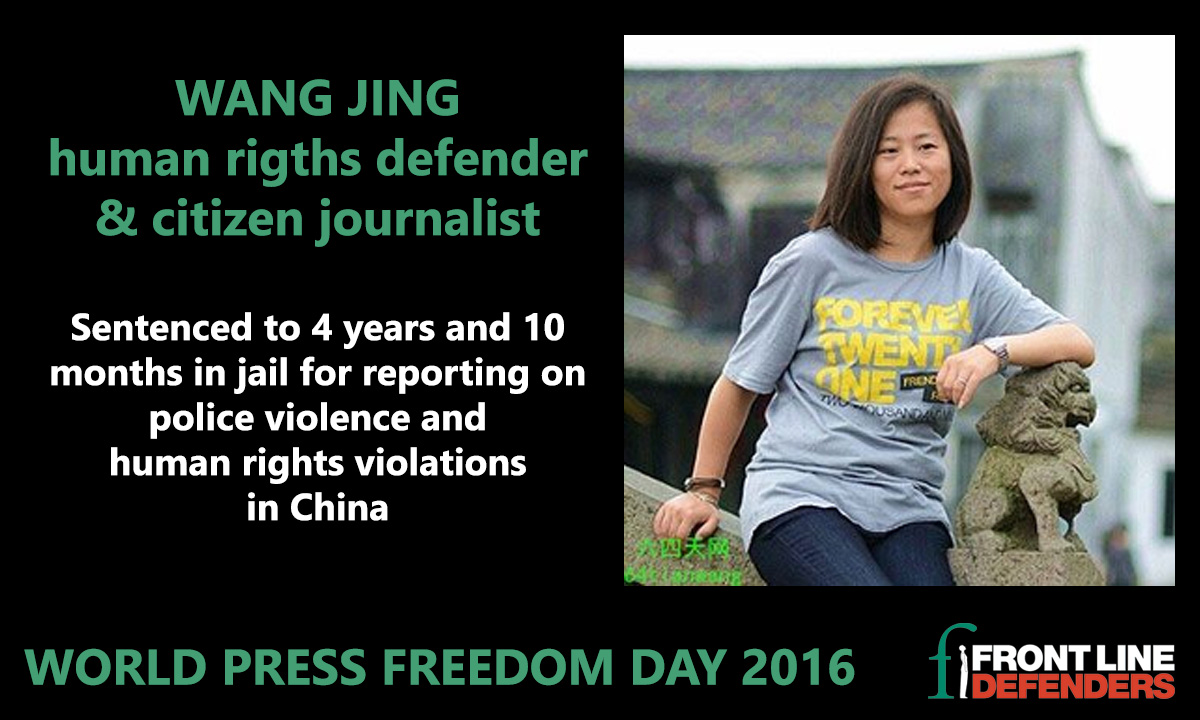
wANG JING WPFD

FAISAL MOHAMED SALIH, SUDAN

Faisal Mohamed Salih is a prominent Sudanese human rights journalist. He has extensively written about human rights abuses and government repression in Sudan, and also works on the promotion of freedom of expression and freedom of the press. On 25 March 2016, security agents from the National Intelligence and Security Services (NISS) prevented him from traveling from Khartoum International Airport to London. His passport was confiscated without any information being provided as to whether it shall be returned to him.
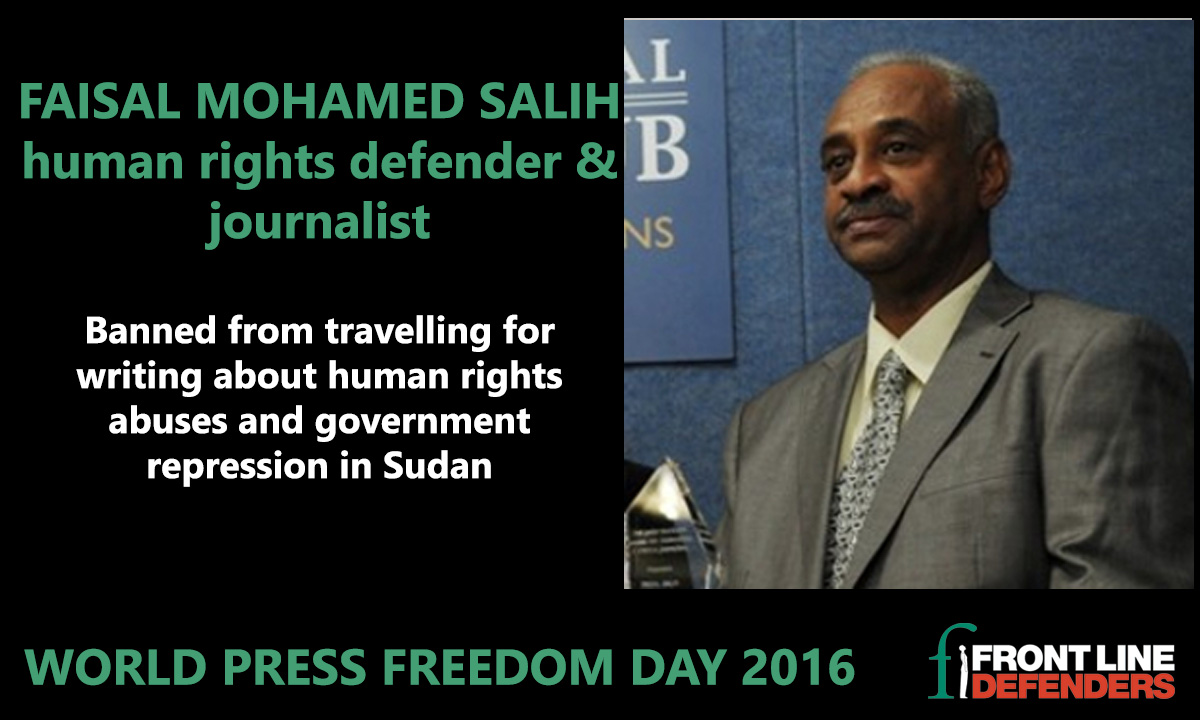
Faisal Salih

ELENA MILASHINA, RUSSIA

Elena Milashina is a human rights defender and an investigative journalist working for Novaya Gazeta, an independent Russian newspaper. Through her research and reports she has drawn international attention to the Russian government’s crackdown on civil society, as well as gross human rights abuses continuing in the Northern Caucasus.  On 16 March 2016, the Ombudsman of the Chechen Republic announced that he had requested the Investigation Committee of the Russian Federation to initiate a criminal case against Ms Elena Milashina. She was accused of spreading false information, for an article where she described an attempt by the Chechen police to abduct a member of the human rights organisation “Committee for Prevention of Torture” on 22 February 2016.
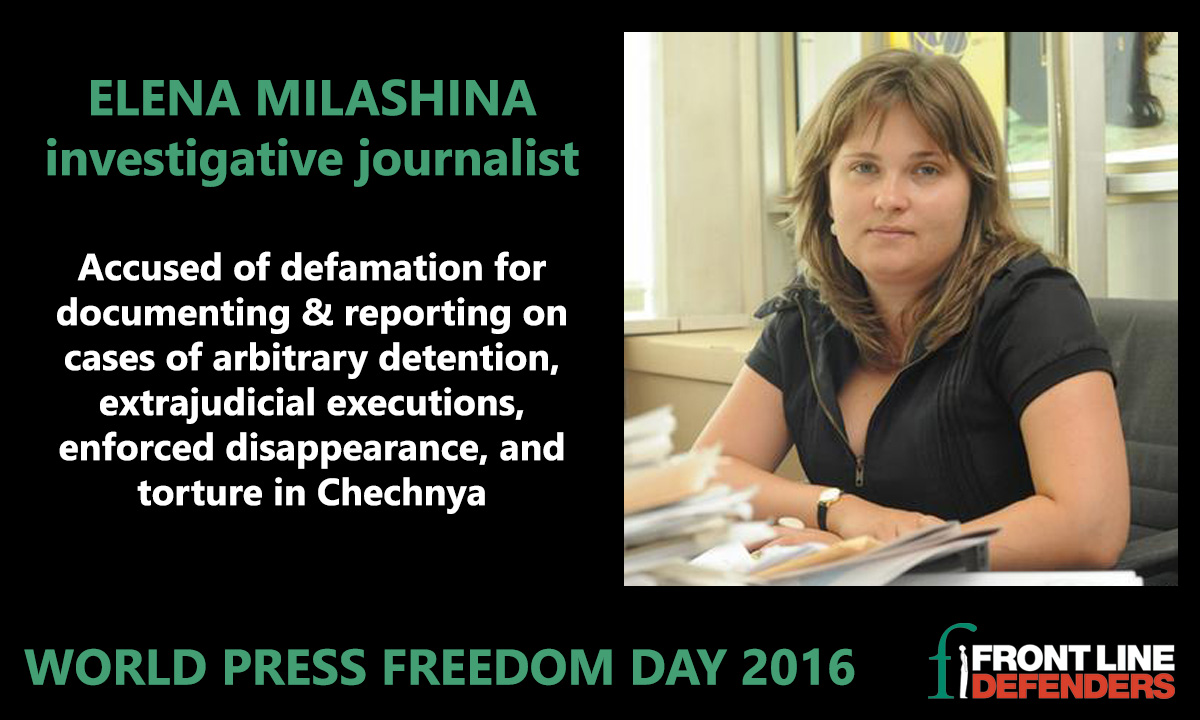
ELENA MILASHINA

Sources:

United Nations News Centre – UN expert warns combat against violent extremism could be used as ‘excuse’ to curb free speech

http://www.consilium.europa.eu/en/press/press-releases/2016/05/02-hr-declaration-world-press-freedom-day-3-may/

https://www.frontlinedefenders.org/en/statement-report/world-press-freedom-day-2016

Human Rights Day 2015: human rights defenders are main topic

December 10, 2015

International Human Rights Day is an occasion for many organizations to publish statements on human rights. For those who have not enough time to go through all of them, here a selection of four main statements that focus on human rights defenders:  Read the rest of this entry »

Short report by EEAS on the 17th EU-NGO Human Rights Forum, 3-4 December 2015

December 5, 2015

The 17th EU-NGO Human Rights Forum took place in Brussels on 3 and 4 December 2015, bringing together hundreds of civil society organisations from across the globe, representatives from international and regional human rights mechanisms and from the EU institutions and Member States. The Forum is a joint venture between the European External Action Service (EEAS), the European Commission, and the Human Rights & Democracy Network [http://www.hrdn.eu/index.php?menu_selected=122&language=US&sub_menu_selected=768].

The overarching theme for this year’s Forum is Protecting and Promoting Civil society Space. In her address to the Forum, High Representative of the Union for Foreign Affairs and Security Policy, Federica Mogherini, stated: I believe that the civil society has a crucial role to play in any policy and in our foreign policy. It is not only a key player, but a main driver for change in all societies, in terms of democracy, good governance, resilience, cohesion, promotion of fundamental human rights.   Freedom of expression is one of the most powerful weapons against radicalisation and terrorism. To better protect our citizens we need above all to build strong democratic institutions and a healthy democratic dialogue. I am very often asked whether security should not be the main focus, more than human rights. But there is no security without human rights”.

She also called for renewed efforts to fight attempts to control the work of civil society in many countries around the world: “During the last years, the space for civil society has shrunk in many countries”. “These trends demand a redoubling of our efforts in the human rights sphere. The European Union, the institutions and myself personally, will do all we can to protect civil society organisations fighting for human rights and protect human rights defender on an individual basis.”

The theme of this year’s NGO Forum – Protecting and Promoting Civil Society Space – reflects the EU’s strong commitment to put Freedom of Association and Freedom of Expression at the heart of the EU’s human rights policy as essential foundations for democracy, rule of law, peace, stability, sustainable inclusive development and participation in public affairs.

This year’s event saw contributions from the current UN Special Rapporteur on Freedom of Association, Maina Kiai; the UN Special Rapporteur for Human Rights Defenders, Michel Forst; Vice-Chair of the European Parliament Subcommittee on Human Rights, MEP Barbara Lochbihler; the Secretary General of the Community of Democracies, Amb. Maria Leissner; Sakharov Prize recipient Memorial, represented by Oleg Orlov; alongside many representatives from civil society, Human Rights Defenders, NGOs, the EU Institutions and many representatives from EU member states.

The forum looked at the recent EU Guidelines on Human Rights Defenders and the EU Guidelines on Freedom of Expression, as key tools enabling the EU to promote and protect freedom of opinion and expression and to counter the clear and disturbing trend over the last few years towards an increasingly restricted space for independent civil society as well as outright threats, intimidation and violence that civil society organisations and representatives, journalists, media actors and other individuals face in many countries across the world because of the exercise of their rights.

Given the scale of the problem and its constantly changing manifestations, urgent action is required not just to understand the scale and evolving nature of the threats, but particularly to identify ways to achieve effective and concerted policy responses and counter actions.

The EU is committed, as indicated in the EU strategy on human rights and democracy and its Action Plan (2015-2019), to address threats to civil society space, through actions that support laws and policies to protect human rights defenders; report on and counter threats to civil society space; and oppose unjustified restrictions to freedoms of assembly and association.

Engagement with civil society is essential for the ongoing work the EU is undertaking to help realise human rights, indivisible and universal for all people. The Forum discussions provided a significant opportunity for an interactive dialogue among representatives from the EU member states, the European Institutions (European Parliament, Council, European External Action Service, European Commission) and global civil society and human rights defenders from all over the world, working on the promotion and protection of human rights. The outcome of the Forum will be an important stepping stone for ensuring effective EU action and future policy developments in this field.

see also: https://thoolen.wordpress.com/2015/12/04/international-cooperative-consortium-protect-the-defenders-launched-on-2-december/


Source: European Union – EEAS (European External Action Service) | PRESS RELEASE: PROTECTING & PROMOTING CIVIL SOCIETY SPACE: 17th EU-NGO Human Rights Forum, 2015

Monday 2 March, start of the #idefend campaign

February 28, 2015

On Monday 2 March 2015 starts the “#idefend – Making sure civil society has its voice” campaign. It is an initiative of the Delegation of the European Union to the UN in Geneva in partnership with the Office of the High Commissioner for Human Rights and the Permanent Missions of Brazil, the Republic of Korea and Tunisia.

The #idefend campaign takes a public stance to support the voices of civil society.#idefend aims at expressing solidarity with all those human rights defenders and civil society actors, whose dedication and everyday work improve the human rights of people in every corner of the world. Join the campaign and help empower those who speak up for human rights!

Human rights defenders are not violent seditionists, criminals, nor bloody revolutionaries, as so many governments like to portray them. They are the best of us, all of us. And they have a message. To all governments, we say: focus on their message. Listen to what they are saying. Understand the message, talk to them about it, be persuaded or persuade, without violence, instead of silencing them, punishing them, their families, and their communities.
Zeid Ra’ad Al Hussein, UN High Commissioner for Human Rights

Sadly, over the past years, we have observed a worrying trend at the Human Rights Council: Human Rights Defenders and civil society representatives are hampered from speaking at the Council, sometimes they are harassed upon their arrival to Geneva, or subject to reprisals in their home country upon their return. This is not acceptable.
Peter Sørensen, Head of the EU Delegation to the United Nations

#idefend | Making sure civil society has its voice.

What Human Rights Day means in Bahrain and how the EU made it worse

December 11, 2014

On 9 December, on the eve of Human Rights Day, Zainab Al-Khawaja was sentenced to 4 years and 4 months in two separate court hearings in Bahrain. Front Line, Human Rights First and others have reported extensively on this courageous human rights defenders [see also: https://thoolen.wordpress.com/tag/zainab-al-khawaja/] .

She was sentenced to 16 months’ imprisonment for “sabotaging properties belonging to the Ministry of Interior” and “insulting a public official” to three months’ imprisonment and fined 3,000 Bahraini Dinar (approx. 6,400 Euro) for “tearing up a photograph of the King”.

Frontline NEWlogos-1 condensed version - cropped also shockingly reports that on the same day as her sentencing, the European Union presented a human rights award to Bahrain’s National Institution for Human Rights and the Ombudsman of the Ministry of the Interior! Although this concerns a relatively unknown regional award (the Chaillot Prize is presented annually by the Delegation of the European Union in Riyadh http://www.ambafrance-bh.org/Press-release-Delegation-of-the.) the state press has been making the best of it [http://www.gulf-daily-news.com/NewsDetails.aspx?storyid=391213] and it is hard to see this as in line with the EU policy on Human Rights Defenders.

‘Unsung Heroes’ – EU Tribute to Human Rights Defenders on 2 December in Geneva

November 28, 2014

Under the title “Unsung Heroes” the EU Delegation to the UN in  Geneva is organizing a Tribute to Human Rights Defenders on 2 December 2014 at 13h00 in the Palais des Nations in Geneva.

In light of the 10th anniversary of the EU Guidelines on Human Rights Defenders and ahead of the Human Rights Day, Stavros Lambrinidis, EU Special Representative for Human Rights, will discuss interactively with NGOs, Human Rights Defenders and International Organisations the challenges of speaking up for human rights. The event will also include the Geneva launch of a study conducted by the Kvinna till Kvinna Foundation on Women Human Right Defenders’ exposure to threats and violence.

The debate on questions such as “What does it take to stand up for human rights?”, “What risks do human rights defenders face, in particular if they are women?” and “What can we do to provide better support?” will be followed by the screening of the film documentary “Six Days”, portraying three women in three different countries, fighting for change in the wake of war and conflict.

I should add that the choice of the title ‘Unsung Heroes’ leaves to be desired as it has been used a lot by different organisations, including the US State Department, the Carter Foundation, the Martin Ennals Foundation for its 2001 study, the OHCHR, PBI, Freedom etc.

See also my post from two days ago: https://thoolen.wordpress.com/2014/11/26/tribute-remembering-women-human-rights-defenders/


Congolese gynecologist wins Europe’s Sakharov Prize in 2014

October 22, 2014

The 2014 Sakharov Prize goes to the Congolese physician Denis Mukwege for his treatment of the victims of gang rape in the Democratic Republic of Congo.

Congolese physician Denis Mukwege, will be awarded this year’s Sakharov Prize for Freedom of Thought, European Parliament President Martin Schulz announced in Strasbourg on Tuesday.

Mukwege has been treating rape victims at a clinic in Bukavu on the Rwandan border for decades. He has performed thousands of surgeries on women to heal their injuries sustained in violent attacks, often by local militias. The 59-year-old founded a gynaecology unit and maternity ward in Bukavu in 1996, the first of its kind in the area. He has since expanded the station to an entire hospital, which he runs. The Second Congo War began in August 1998, ravaging the region. Mukwege is said to have performed over 10,000 operations on rape victims ever since.

The other finalists were Ukraine’s pro-Western Euromaidan movement and Azerbaijani rights defender Leyla Yunus.[https://thoolen.wordpress.com/2014/10/16/more-on-the-sakharov-prize-and-the-arab-nominees/]

For more information on the award see: http://www.trueheroesfilms.org/thedigest/award/sakharov-prize-freedom-thought

The 2014 prize will be awarded at a ceremony in Strasbourg on 26 November.

Congolese gynecologist wins Sakharov Prize | News | DW.DE | 21.10.2014.

for our french speakers: http://www.lemonde.fr/europe/article/2014/10/21/le-docteur-mukwege-recoit-le-prix-sakharov-pour-son-soutien-aux-femmes-violees-en-rdc_4510098_3214.html


More on the Sakharov Prize and the Arab nominees

October 16, 2014

A few days ago I published a piece about the little ceremonial dropping of Arab nominees for the European Parliament’s Sakharov Prize for Freedom of Thought [https://thoolen.wordpress.com/2014/10/11/europes-sakharov-prize-in-trouble-with-regard-to-arab-nominees/]. The main actor in this story – Alaa Abdel Fattah – has given his own views in a piece  in Jadaliyya on 7 October, entitled “On the Sakharov Prize”. To do justice I copy it in its entirety below:

[Sculpture of Soviet nuclear physicist and human rights activist Dr. Andrei Dmitievich Sakharov. Photo by David via Flickr.]
[Sculpture of Soviet nuclear physicist and human rights activist Sakharov. Photo by David via Flickr.]

It was with joy that I received the news of my nomination for the Sakharov Prize for Freedom of Thought, the same joy any act of solidarity inspires.

Since my release from prison in Egypt on bail, with my fate still bound to the Special Terrorism Courts and the draconian Protest Law, I have been facing constant harassment from official and unofficial representatives of the regime. New trumped-up criminal charges pop up every few days. A horde of political talk show hosts on supposedly independent TV stations discusses old and out-of-context tweets, twisting my words and assigning sinister implications to them. There is an insistent tarnish campaign meant to prepare the general public for my eventual return to prison. Needless to say, I am banned from appearing on local TV stations, and I am forbidden to travel outside Egypt.

So it is solidarity such as that of European United Left/Nordic Green Left (GUE/NGL) that creates the pressure to keep me out of jail and out of harm. It was also a comfort to find comrades in unexpected places; GUE/NGL’s stance against neoliberal policies and against the distortion of European democracy seemed in line with the aspirations of persecuted revolutionaries in Egypt and the broader Arab context.

I was proud to be nominated along with Tunisian rapper, Ala Yaacoubi, and Moroccan rapper, Mouad Belghouate, both imprisoned for insulting the police in their popular songs. I was relieved that the European Parliament members (MEP) who nominated us understood the point of doing symbolic/verbal violence to the image of the powerful who consistently commit systemic actual violence to the bodies, souls and livelihood of the powerless; relieved that the MEPs understood the meaning of questioning the humanity of those who derive their power from dehumanizing their opponents.

I was not surprised when a new tarnish campaign was launched in reaction against my nomination. My family has faced such campaigns before by supporters of the Israeli occupation and Israeli apartheid. The latest when my sister, Mona Seif, was shortlisted for the Martin Ennals Award. But I was surprised when the president of the GUE/NGL decided to withdraw my nomination based on a two-year-old tweet taken out of context. And I was surprised that this was done without an attempt to contact me for clarification, and without any regard for how such public condemnation affects my safety and liberty. The president of the GUE/NGL has now sent a clear message to the Egyptian authorities that whatever international solidarity and support I have is fragile—easily destroyed with a tweet.

The GUE/NGL are of course free to form their opinion based on whatever sources of information they choose—including well-known neocons writing for the Wall Street Journal about an out-of-context tweet. However, since they made the nomination and made it publicly, it was their responsibility to ascertain how the manner of retreating from it would affect my safety. Other options were available to them; they could have asked me to withdraw, or they could have quietly dropped my name from the short-list.

The GUE/NGL’s president’s statement claims that I “called for the murder of a critical number of Israelis.” For what it is worth, here is what I would have said if anyone from GUE/NGL or any other MEPs had asked me to clarify.

The tweet in question is certainly shocking if taken out of context, but even then it cannot be framed as “a call” for anything. It was a “mention” to two friends, part of a private conversation—a thread spanning multiple tweets—that took place over a public medium (limited to 140 characters) on the first night of Israel’s 2012 attack on Gaza. A conversation between friends who already knew enough about each others’ views to make it unnecessary to clarify and elaborate, for instance, the distinction between civilians and combatants—as one would if one were making a public statement. As this was not a public statement, only those who follow all three of us on Twitter would have had this tweet appear on their timeline at two a.m. on 15 November 2012. And even after the tarnish campaign, it has only been retweeted four times.

To pretend that you can interpret this tweet two years later without consulting the people involved in the conversation, and to claim that it constitutes a call to action, is simply ridiculous. That I should now feel the need to explain and clarify what was not intended for a general public in the first place, and to be condemned for my thoughts, not my actions, in such a manner is clearly an attack on my personal liberty. The chilling effect of having to adapt to such harassment and condemnation should be perfectly clear for those honoring Andrei Sakharov’s legacy.

The conversation relating to the war on Gaza started with a friend expressing her doubt that the conflict would ever be resolved by local actors. The other friend in the conversation and I replied, insisting that like most such conflicts, it would be resolved locally. The tweet stated what seems to be the basic strategy of most national liberation movements, especially those that opt for armed resistance: To make the price of occupation/colonization/apartheid too expensive for the society that supports it. The strategy of the Palestinians is exactly that—via both violent and nonviolent means (boycott, divestments and sanctions, and armed resistance, for example). Since this was during a time of war, I had armed resistance in mind. Think of Vietnam or Algeria; many would say this is exactly what happened: After a critical number of casualties in asymmetric wars, the civilian population supporting the occupier refused to continue its support—despite the fact that the casualties suffered by the society resisting colonization were massively higher.

My tweet was not a call for anything; it was not even a statement of opinion. It was a statement of one of the facts of the conflict. If GUE/NGL had asked me about my views I would have directed them to my March 2012 debate on Deutsche Welle.

It should perhaps be remembered that the first laureate of the Sakharov Prize was Nelson Mandela back in 1988, when he and the African National Congress (ANC) were considered terrorists by many democratic governments. At the time, his views on the necessity of violence for resisting apartheid must have required and inspired complex debates on appropriate tactics and strategies, the rules of engagement, the moral, political and social limitations that should be put on revolutionary violence, etc. There would have been plenty of statements attributable to him or his comrades—including the famous Rivonia Trial speech in which he admits to planning sabotage—that would have looked pretty scary out of context.

Finally, I hardly ever call for any solution or action on my own. As an individual, I have always expressed my opinions and positions in the clearest and strongest language. But as an activist, I have always worked for any given cause with and through the largest united front possible. When it comes to calls for solutions or actions, and for the sake of consensus, I would make the very compromises I refuse to make when speaking only for myself.

More importantly, I do not call for anything when it is not a cause that I am directly engaged with. I stand in solidarity with the Palestinian people, but I never presume to tell them what to do.

If my views on violence—specifically against civilians—are what is in question, the answers can be found in my actions and my published views in my local context and my own struggle in Egypt.

 [This piece is co-published with Mada Masr]

On the Sakharov Prize.

Europe’s Sakharov Prize in trouble with regard to Arab nominees

October 11, 2014

Under provocative title “Can Arabs be Human Rights Defenders?”  the on-line newspapers Mada Masr and Jadaliyya published a piece setting out how 3 Arab nominees were suddenly dropped by their nominators in the European Parliament  over a few Israeli-bashing tweets that were indeed on the verge of acceptability (even in the context of rough twitter talk) especially when calling for or condoning killing of Zionist civilians.

I referred to the nominations in my post: https://thoolen.wordpress.com/2014/09/22/nominees-for-sakharov-prize-2014-announced/.

I consider the post’s title  provocative (or perhaps ironic) as even a cursory glance of human rights documentation – including this blog – shows that there are hundreds of human rights defenders in the Arab world whose credentials are not disputed or totally defensible.

Please read the whole piece for yourself as this is both a complicated and sensitive matter.

Read the rest of this entry »

Nominees for Sakharov Prize 2014 announced

September 22, 2014

7 nominees for the European Parliament’s 2014 Sakharov Prize for freedom of thought, chosen by political groups and groups of MEPs, will be presented at a meeting of the Foreign Affairs and Development committees and the Human Rights Subcommittee on 23 September. The laureate will be decided by political group leaders and Parliament’s President on 16 October. The award ceremony takes place in Strasbourg on 26 November. The nominees in alphabetical order are [for more information on human rights awards: http://www.trueheroesfilms.org/thedigest/awards]

  1. Mahmoud Al ‘Asali post mortem and Louis Raphael Sako, nominated by the ECR group, Anna Záborská and 66 other MEPs,
  2. Mouad Belghouate, Ala Yaacoubi and Alaa Abdel Fattah, nominated by the GUE/NGL group,
  3. CHREDO, Open Doors, Oeuvre dOrient and Aid to the Church in Need, nominated by Philippe Juvin and 60 other MEPs,
  4. EuroMaidan, represented by Mustafa Nayem, Ruslana Lyzhychko, Yelyzaveta Schepetylnykova and Tetiana Chornovo, nominated by Jacek Saryusz-Wolski and 52 other MEPs,
  5. Ayaan Hirsi Ali, nominated by the EFDD group,
  6. Denis Mukwege, nominated by the S&D and ALDE groups and Barbara Lochbihler, and
  7. Leyla Yunus, nominated by The Greens/EFA group and Alexander Graf Lambsdorff, Marietje Schaake and Ramon Tremosa.

via Nominees for Sakharov Prize 2014 announced.