Archive for the 'Amnesty international' Category

Afghanistan: human rights defenders targeted but fearless

November 26, 2019
Afghanistan’s top intelligence agency must immediately release two human rights defenders it detained after they exposed alleged sexual abuse against children. Musa Mahmudi and Ehsanullah Hamidi, both well-known human rights defenders from Logar province, were arbitrarily detained by the National Directorate of Security (NDS) on 21 November 2019 when they were on their way to meet with the European Union ambassador in Kabul.

The two human rights defenders began receiving threats, including from local officials in Logar, on Facebook after they gave interviews to The Guardian and Afghanistan’s TOLO News about the existence of a paedophile ring in the area. The human rights defenders uncovered more than 100 videos of the alleged abuse. Some of the victims of abuse have been murdered, according to The Guardian. “This is the latest case where human rights defenders have been targeted by the authorities for carrying out their important work. Faced with threats from both the state and non-state actors, they are operating in some of the most hazardous conditions anywhere in the world. There is impunity for attacks on these brave defenders, who have little to no protection.”

One day before he disappeared, Musa Mahmudi told a fellow Afghan human rights defender that he feared for his safety and that the NDS was planning to arrest him. He added that he was worried that he was under surveillance. Musa Mahmudi said that he had also received death threats, accusing him of “dishonouring the people of Logar.” In August 2019, Amnesty International published a briefing entitled, Defenceless Defenders: Attacks on Afghanistan’s Human Rights Community,” where the organization detailed how the Afghan government has persistently failed to investigate attacks on human rights defenders – sometimes accusing them of ‘fabricating’ their claims, declining to offer them protection; telling them to arm themselves instead. [on 26 november: https://www.rferl.org/a/afghan-president-orders-probe-into-alleged-pedophile-ring/30293787.html] and then; https://www.rferl.org/a/afghanistan-releases-activists-who-exposed-alleged-pedophile-ring/30294906.html

The same day AI continued with its series of 16 omen human rights defenders from Afghanistan16 Days of Activism against Gender-Based Violence” campaign [see: https://humanrightsdefenders.blog/2019/11/19/16-days-of-activism-against-gender-based-violence-start-on-25-november-2019/]. Untill December 10, their stories will be published one a day.

Day two: Maria Raheen

I am the director of the Journalism and Mass Communication Unit at Balkh University. I also head a non-governmental organization that works on human rights. For 20 years, as a women’s rights activist, I have pushed to address issues that prevent women from accessing their rights, not only in Balkh but also in other neighbouring provinces such as Samangan, Jowzjan, and Faryab.

One of my achievements is the establishment of the first private university in Balkh – Taj Higher Education Institute, which offers medicine, economy and law. Similar to Kabul, Herat and Kandahar, Balkh has some developments and achievements in terms of women’s rights. However, the province is still well known for the presence of armed groups, the local mafia and warlords, who have no respect for human rights. Due to existing challenges and the weak rule of law, self-censorship is embedded in the day-to-day lives of people in Balkh.

I am no stranger to tolerating injustices, especially when it is a matter of saving my life and my family’s lives. It gets challenging especially when it involves former war commanders who are now elected representatives of the area and, who would not hesitate to exert their power to commit crimes.

I hope in future like-minded women will join hands for the women’s revolution in Afghanistan, to reclaim the rights that we are entitled to.

Day one: Khawar Amiri

I am the Head of the Literacy Department of the Directorate of Education in Khost Province and have worked for many years as a mediator for women’s issues. As most women of Khost Province are illiterate, and some districts are yet to establish schools for girls, through the Literacy Department, I have conducted courses for women and girls above the age of 14 to enable their basic reading and writing skills. As a well-known human rights defender, I have worked in solving many of women’s issues through the Committee on Elimination of Violence against Women and tribal Jirgas (councils), with help of the police.

Women in Khost are exposed to discrimination and violence. Girls’ education is till grade six, after which they are sent off to marriage or asked to stay home. Forced marriages, being sold off, physical violence, lack of access to inheritance rights are some of the issues women face on daily basis.  Women don’t work in government posts in Khost, as most of the positions are held by men. Women are discouraged from applying for government positions as their posts are given to men and justified with unlawful reasons for not being appointed.

I have intervened in many cases of women being abused, sometimes solving the case with the help of local elders and at times through direct mediation. One of my biggest successes is organizing a Master’s Degree programme for women in Khost to study in India, funded by the US Embassy. Despite being threatened and attacked, I am continuing my activism.

I hope women are independent, have security, and have equal opportunities for studies, get to live a life free from violence. 

You can send a solidarity message to all of the 16 WHRDs in Afghanistan, or any one of them, and let them know that they are not alone. Please email your thoughts in a personal message to AfghanDefenders@amnesty.org and AI will share them with the activists.

https://www.amnesty.org/en/latest/news/2019/11/afghanistan-release-hrds-now/

https://www.amnesty.org/en/latest/news/2019/11/16-days-of-activism-afghanistan-whrds/
Amnesty’s Write for Rights Campaign 2019 – launched today – focuses on youth activists

November 18, 2019
Amnesty International launched its Write for Rights campaign which this year champions children’s rights and youth activists. “This year Write for Rights, Amnesty’s flagship human rights campaign, champions youth activists who are taking on the world’s biggest crises,” said Kumi Naidoo, Secretary General of Amnesty International. “From those campaigning for climate and environmental justice, to those challenging inequality, poverty, discrimination and political repression, young people have emerged as a powerful force for change who deserve the world’s support.”

Every December people around the world write millions of letters, emails, tweets, Facebook posts and postcards for those whose human rights are under attack, in what has become the world’s biggest human rights event.  Amnesty International is hoping to break last year’s Write for Rights record of nearly six million messages of support for activists and individuals from 10 countries whose human rights are under attack. [for last year’s campaign see: https://humanrightsdefenders.blog/2018/11/24/amnesty-starts-again-its-write-for-rights-campaign/]

Write for Rights 2019 features youth human rights defenders and individuals from in Belarus, Canada, China, Egypt, Greece, Iran, Mexico, Nigeria, Philippines and South Sudan.

Launching two days ahead of Universal Children’s Day on 20 November, a day to promote children’s rights, several of the featured activists had their rights violated as children.

They include José Adrián, who was 14 when he was brutally beaten by police on his way home from school in Mexico. He is now demanding reparations for his treatment and for the police to stop arbitrary detentions in the state of Yucatán. Among the other cases are:

  • Grassy Narrows Youth, a group of youth activists from an Indigenous community in north-western Ontario who have suffered one of Canada’s worst health crises. Their community has been devastated by 50 years of mercury contamination of their fish and river system. The Grassy Narrows youth are urging the government to address the mercury crisis once and for all, including by providing specialized health care and compensation for all;
  • Sarah Mardini and Seán Binder, two volunteer rescue workers from in Lesvos, Greece, who face up to 25 years in prison for their humanitarian work helping spot refugee boats in distress;
  • Yasaman Aryani, who defied her country’s discriminatory forced veiling laws and now must serve 10 years behind bars. Amnesty is campaigning for her immediate release;
  • Marinel Ubaldo, a youth activist from the Philippines who is urging her government to declare a climate emergency and protect future generations from the devastating impacts of climate change after her home was destroyed by typhoon Haiyan.

“The Write for Rights campaign epitomizes the ideals that Amnesty International was founded on – it’s about individuals helping other individuals. We are urging people to get behind these incredible young people who are campaigning for justice, equality and freedom,” said Kumi Naidoo.

“As we know from our work over the past five decades, writing letters works. Not only can it help free prisoners of conscience, but it makes a huge emotional difference to the people we support and to their loved ones.”

Monica Benício, the partner of Marielle Franco, a local politician in Brazil who was killed last year and was featured as part of the last Write for Rights, said of the campaign: “It helps me to get up in the morning and see some meaning, knowing that there is this big global network of affection.  All these demonstrations of love and affection are helping us to mobilize, to demand justice, to pressure for investigation and above all to fight so that there will be no more Marielles.

https://www.amnesty.org/en/latest/news/2019/11/write-for-rights-2019-puts-youth-activism-in-the-spotlight/

After two years, justice for 14 woman human rights defenders in Poland

October 30, 2019

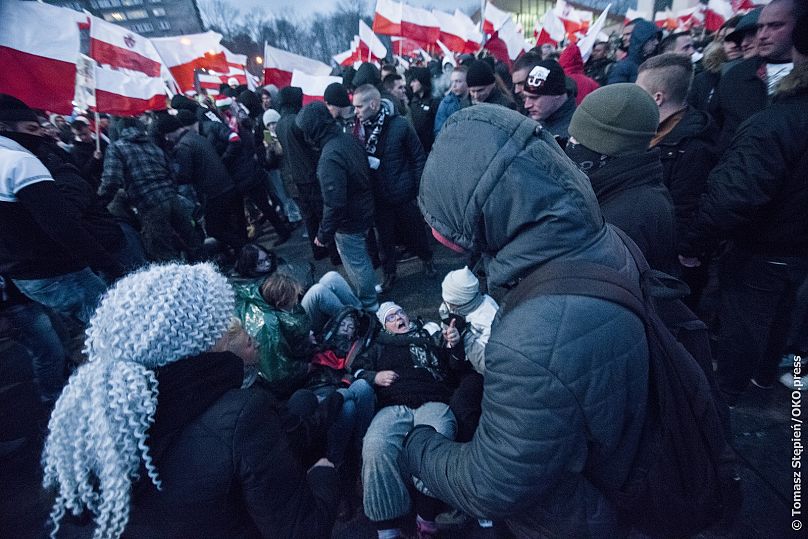
It was 11 November 2017 at the Independence Day march in Warsaw. For some years now this annual event, organised to mark Poland’s independence, had been tainted by the presence of some nationalist groups advocating “Europe will be white or deserted,” displaying racist and fascist symbols, while marching holding flares and throwing firecrackers on the streets of Warsaw. In 2017, these women decided it was time to act. As they unfurled a banner reading “Fascism Stop,” their peaceful protest against hate caused fury among the marchers. Video footage shows people reacting by kicking, spitting and screaming at them. They were called “sluts,” “lefty scoundrels” and “whores.” They were pushed, jostled, grabbed by the neck and dragged onto the pavement, suffering bruises and cuts. One of the women lost consciousness after being dropped on the ground and needed medical help. The authorities initially closed the investigation into the attacks with an absurd justification. But after the women appealed in February 2019, a judge ordered the investigation into the violence to be re-opened. However, adding insult to injury, the women were themselves charged with obstructing a lawful assembly and fined. And so their battle for justice began…..

Tomasz Stepien
The women being attacked at the Independence Day march in 2017.Tomasz Stepien

One by one the women stood up, said their full names and stated proudly that they wanted to be found ‘not guilty.’ Kinga, the last of them to speak, explained bluntly and movingly what compelled her to stand against hate on that night: ‘My grandfather was wounded in the battle of ’39. My mother went to the Uprising. My stepfather was in the home army in Kielce. My grandmother worked in a hospital. They are now dead and I am happy because I would not like them to see what is happening today.’

As the judgement was announced, suddenly I heard relieved sighs around the room. I turn to my colleague asking “what did he say?” and she confirmed: “They are not guilty! They are not guilty!” The judge upheld their rights to freedom of expression and freedom of assembly and, significantly, he told the women, “You were right.” As he finished, the room burst into a round of applause in celebration.

This case started with injustice but has finished with justice, and a message that fascism and hatred will not be tolerated in Poland.

https://www.euronews.com/2019/10/29/the-day-justice-was-finally-served-in-poland-for-vindicated-anti-fascist-campaigners-view

Egypt: all you can think of: widespread arrests, torture allegations, cyber attacks

October 19, 2019
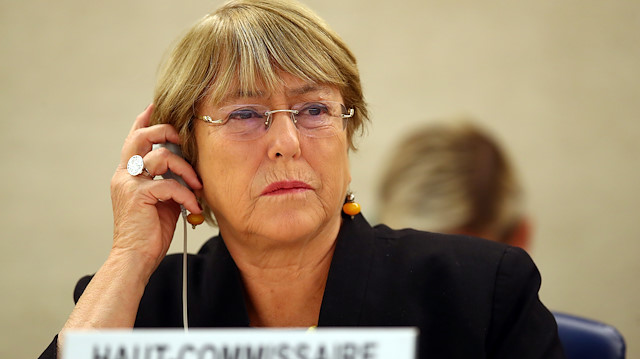
On 18 October 2019 the UN High Commissioner for Human Rights urged Egypt to immediately release scores of citizens who have been arrested in connection with recent anti-government demonstrations in several cities. Civil society groups report more than 2,000 people were detained before, during and after the protests on 20 September, which prompted the UN High Commissioner for Human Rights, Michelle Bachelet, to express concern about reports of lack of due process. On Friday her office reported that the arrests are continuing, with a number of well-known and respected civil society figures affected, some of whom have been accused of terrorism. “Once again, we remind the Egyptian Government that under international law people have a right to protest peacefully, and a right to express their opinions, including on social media. They should never be arrested, detained – let alone charged with serious offences such as terrorism – simply for exercising those rights”, spokesperson Ravina Shamdasani told journalists in Geneva.

The abduction, arbitrary detention and torture of human rights defender and journalist Esraa Abdelfattah is another indication that Egyptian authorities are stepping up brutality against human rights defenders in a bid to ‘terrorize’ critics and opponents, said Amnesty International today. Esraa Abdelfattah was assaulted and abducted by security forces in plainclothes on 12 October. The next day she described to the Supreme State Security Prosecution how she was tortured by officers who beat her, attempted to strangle her and forced her to stand for nearly eight hours. “Esraa Abdelfattah’s account of torture, coming just days after the prominent activist and blogger Alaa Abdel Fattah described a similar ordeal in custody, is an alarming indication that Egypt’s authorities are stepping up their use of brutal tactics to crack down on human rights defenders,” said Najia Bounaim, North Africa Campaigns Director at Amnesty International.

Prominent blogger Alaa Abdel Fattah as well as his lawyer, Mohammed El-Baqer are currently being held at the Tora Maximum Security Prison, south of Cairo. Both have been accused of belonging to a terrorist group, funding terrorism, spreading false news that undermines national security and “using social media to commit publishing offices”, the UN human rights office said. [see also: https://humanrightsdefenders.blog/2019/01/08/bloggers-and-technologists-who-were-forced-offline-in-2018/]

On 28 September the High Commissioner had already urged the “authorities to radically change their approach to any future protests’.

More than 2,000 people were detained, including lawyers, human rights defenders, political activists, university professors and journalists on 20-21 September, she said. The Egyptian Foreign Ministry spokesperson stressed that there no citizen in Egypt is arrested or prosecuted for carrying out legitimate activities or criticizing the Egyptian government, but for violating the law. He added that the right to peaceful demonstration is guaranteed in accordance with the Constitution and the law. Hafez stressed that the OHCHR report was based on undocumented information, which only leads to falsehoods as the allegations contained in it are based on wrong ideas, and this hasty judgment reflects a lack of professionalism. He added that any actions taken against any person is done in accordance with the law and through sound legal procedures, all carried out with transparency and clarity.

In addition on 3 October 2019 it was reported in the New York Times that a series of sophisticated cyberattacks targeting Egyptian journalists, academics, lawyers, opposition politicians and human rights activists has been traced to Egyptian government offices, a cybersecurity firm has found. The attackers installed software on the targets’ phones that enabled them to read the victims’ files and emails, track their locations, identify who they contacted and when, according to a report to be published Thursday by Check Point Software Technologies, one of the biggest cybersecurity companies in the world, with headquarters just south of San Francisco and in Tel Aviv.

The cyberattack began in 2016, according to the Check Point report. The number of victims is unknown but Check Point identified 33 people, mostly well-known civil society and opposition figures, who had been targeted in one part of the operation. “We discovered a list of victims that included handpicked political and social activists, high-profile journalists and members of nonprofit organizations in Egypt,” said Aseel Kayal, a Check Point analyst.

CreditAgence France-Presse — Getty Images

2019 Nobel Prizes for Peace and Literature: encouragement and disappointment

October 11, 2019
https://humanrightsdefenders.blog/2019/05/07/ethiopia-a-progress-report-by-defenddefenders-made-public-on-7-may/ and https://humanrightsdefenders.blog/2019/07/08/human-rights-defender-daniel-bekele-now-commissioner-of-the-ethiopian-human-rights-commission/].

Amnesty International’s Secretary General Kumi Naidoo said: “This award recognizes the critical work Prime Minister Abiy Ahmed’s government has done to initiate human rights reforms in Ethiopia after decades of widespread repression.” Since assuming office in April 2018, it has reformed the security forces, replaced the severely restricting charities and society law, and agreed a peace deal with neighbouring Eritrea to end two decades of hostile relations. He also helped broker an agreement between Sudan’s military leaders and the civilian opposition, bringing an end to months of protests.

However, Prime Minister Abiy Ahmed’s work is far from done. This award should push and motivate him to tackle the outstanding human rights challenges that threaten to reverse the gains made so far. He must urgently ensure that his government addresses the ongoing ethnic tensions that threaten instability and further human rights abuses. He should also ensure that his government revises the Anti-Terrorism Proclamation which continues to be used as a tool of repression, and holds suspected perpetrators of past human rights violations to account. ..“ow more than ever Prime Minister Abiy must fully espouse the principles and values of the Nobel Peace Prize to leave a lasting human rights legacy for his country, the wider region, and the world.”

Interestingly enough on the same day Ethiopian human rights blogger Befeqadu Hailu received the International Writer of Courage award. The Ethiopian human rights blogger who has been jailed four times over his activism has been awarded a literary prize set up in memory of playwright Harold Pinter. The Zone 9 blogging collective, which Hailu founded in 2012 alongside other Ethiopian activists, aims to hold politicians to account and protect the country’s constitution against corruption. He is also the deputy executive editor of Addis Maleda newspaper, a columnist for Deutsche Welle Amharic Service and a part-time programme co-ordinator for the Ethiopian Human Rights Project. Zone 9 bloggers were finalists of the 2016 MEA.

In the meantime the Swedish Nobel Prize Committee for Literature came in for widespread and harsh criticism for its ‘troubling choice’: of Peter Handke. Writers including Salman Rushdie, Hari Kunzru and Slavoj Žižek say the 2019 Nobel laureate ‘combines great insight with shocking ethical blindness’

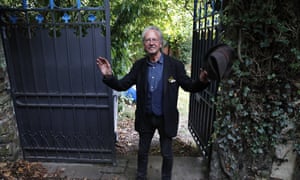
Austrian author Peter Handk greets the press outside his house in Chaville near Paris, on Thursday.
Austrian author Peter Handke greets the press outside his house in Chaville near Paris, on Thursday after his win. Photograph: François Mori/AP

The Guardian of 10 October writes: “Twenty years before Peter Handke would become a Nobel laureate, he won another title. In 1999, Salman Rushdie named him the runner-up for “International moron of the year” for his “series of impassioned apologias for the genocidal regime of Slobodan Milošević”….The Austrian playwright, whose Slovenian heritage had inspired in him a fervent nationalism during the Balkans war, had publicly suggested that Sarajevo’s Muslims had massacred themselves and blamed the Serbs, and denied the Srebrenica genocide. Seven years after Rushdie’s scorching condemnation, in 2006, he would also attend war criminal Milošević’s funeral….

Handke is a troubling choice for a Nobel committee that is trying to put the prize on track after recent scandals,” said author Hari Kunzru, who has taught the laureate’s work to his students. “He is a fine writer, who combines great insight with shocking ethical blindness.” Kunzru said he believed that Handke would have won the Nobel earlier, “had he not decided to act as a propagandist for the genocidal Milošević regime. He added: “More than ever we need public intellectuals who are able to make a robust defence of human rights in the face of the indifference and cynicism of our political leaders. Handke is not such a person.

Slavoj Žižek, Slovenian philosopher and longtime critic of Handke, told the Guardian: “In 2014, Handke called for the Nobel to be abolished, saying it was a ‘false canonisation’ of literature. The fact that he got it now proves that he was right. This is Sweden today: an apologist of war crimes gets a Nobel prize while the country fully participated in the character assassination of the true hero of our times, Julian Assange. Our reaction should be: not the literature Nobel prize for Handke but the Nobel peace prize for Assange.”

And in a statement issued on Thursday, novelist Jennifer Egan, president of literature and human rights organisation Pen America, said:  “We are dumbfounded by the selection of a writer who has used his public voice to undercut historical truth and offer public succor to perpetrators of genocide, like former Serbian President Slobodan Milosevic and Bosnian Serb leader Radovan Karadzic,” .. “We reject the decision that a writer who has persistently called into question thoroughly documented war crimes deserves to be celebrated for his ‘linguistic ingenuity.’ At a moment of rising nationalism, autocratic leadership, and widespread disinformation around the world, the literary community deserves better than this. We deeply regret the Nobel Committee on Literature’s choice.”..

——

https://www.amnesty.org/en/latest/news/2019/10/nobel-peace-prize-must-spur-prime-minister-abiy-ahmed-towards-further-human-rights-reform/

https://mailchi.mp/a7dbe1560660/hrf-in-the-washington-post-on-todays-nobel-peace-prize?e=f80cec329e

https://home.bt.com/news/showbiz-news/ethiopian-human-rights-blogger-scoops-prize-in-memory-of-harold-pinter-11364401760959

https://www.theguardian.com/books/2019/oct/10/troubling-choice-authors-criticise-peter-handke-controversial-nobel-win

https://www.vox.com/culture/2019/10/10/20907919/nobel-prize-literature-2019-2018-controversy-peter-handke-olga-tokarczuk

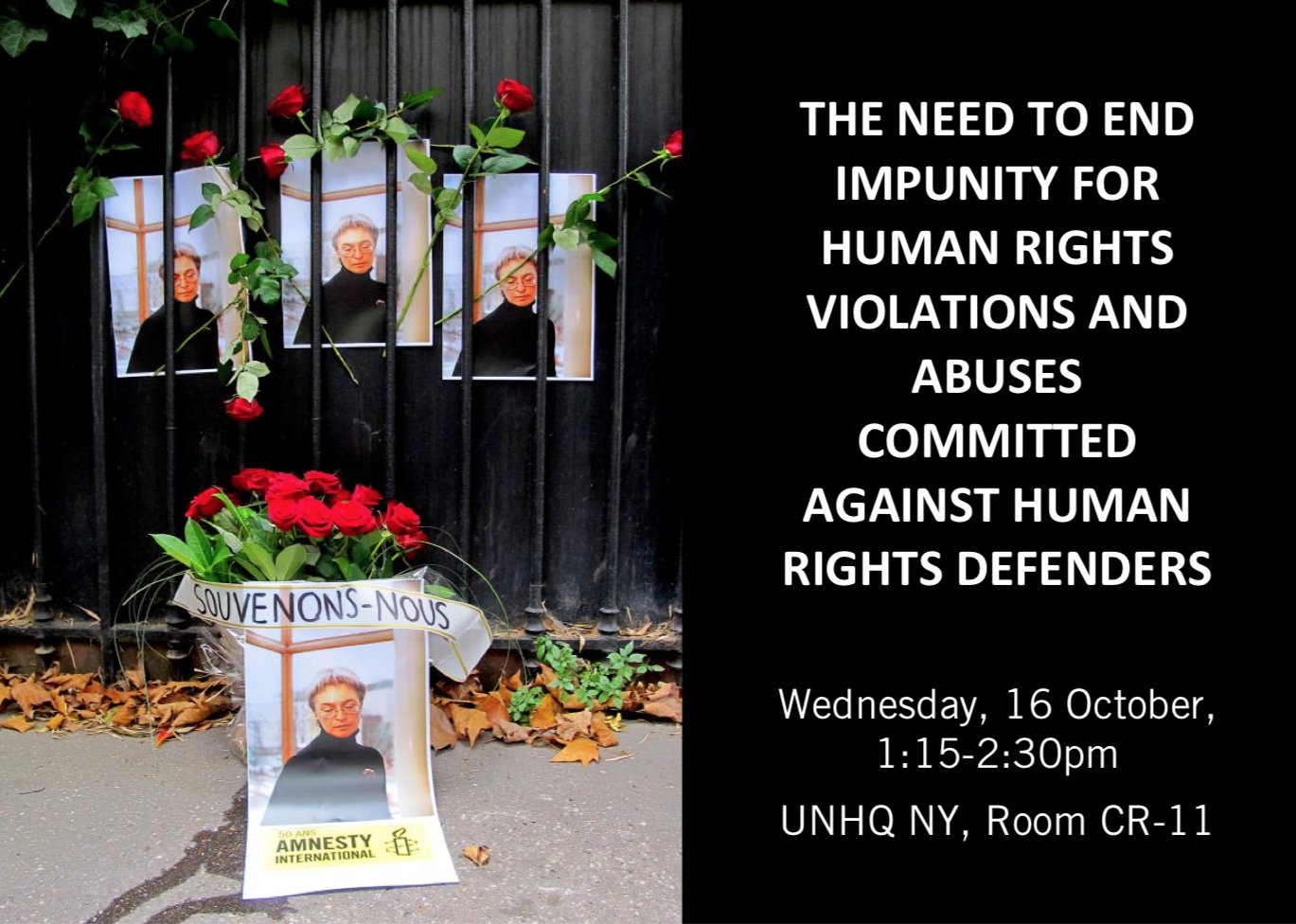
Panel against impunity for abuses against human rights defenders. New York on 16 October

October 9, 2019


Wednesday, 16 October 2019
1:15 pm – 2:30 pm
UN Headquarters, New York
Room CR-11

This event is organised by Amnesty International and the International Service for Human Rights with the kind sponsorship of the Permanent Mission of Norway to the United Nations.

Event with panellists:

  • Michel Forst, Special Rapporteur on the situation of human rights defenders
  • Radya Al-Mutawakel, Mwatana Organization for Human Rights, Yemen
  • Khin Ohmar, Progressive Voice Myanmar, Myanmar

Moderated by:

  • Sherine Tadros, Amnesty International

Welcoming remarks by:

  • Ambassador Mona Juul, Permanent Representative of Norway

Please RSVP by 11 October.

Download the flyer here

Greta Thunberg receives Amnesty’s Ambassador of Conscience award

September 17, 2019

The politics required to take on this crisis simply doesn’t exist today,” Thunberg said, standing on a step to reach the microphone. “That is why every single one of us must push from every possible angle to hold those responsible accountable and to make the people in power act.” “Even though it is slow, the pace is picking up and the debate is shifting,” she said, before concluding: “See you on the street!

Earlier, Kumi Naidoo, the secretary-general of Amnesty International, said that the organization was originally not going to give out the prize in 2019, following the unprecedented decision to withdraw it from Aung San Suu Kyi in late 2018. Amnesty rescinded the award from the Myanmar leader for “the shameful betrayal of the values she once stood for” over Suu Kyi’s “apparent indifference” to the suffering of the Rohingya population. But Naidoo was swayed by the impact Thunberg and other youth activists had already achieved and could achieve in future, adding that the U.K.’s Parliament declared a climate emergency after she met with British political leaders.

Naidoo added that the issue of climate change was increasingly a human rights issue, and touched upon every aspect of Amnesty’s work, from refugees to indigenous rights to the defense of rights defenders, with an ever growing number of environmental activists being killed. “These young, high school students are playing a very important role in educating their own parents.”

https://www.japantimes.co.jp/news/2019/09/17/world/social-issues-world/swedish-activist-greta-thunberg-wins-amnestys-top-human-rights-award/#.XYD87yVS9TY

Has NSO really changed its attitude with regard to spyware?

September 17, 2019

Cyber-intelligence firm NSO Group has introduced a new Human Rights Policy and a supporting governance framework in an apparent attempt to boost its reputation and comply with the United Nations’ Guiding Principles for Business and Human Rights. This follows recent criticism that its technology was being used to violate the rights of journalist and human rights defenders. A recent investigation found the company’s Pegasus spyware was used against a member of non-profit Amnesty International. [see: https://humanrightsdefenders.blog/2019/02/19/novalpina-urged-to-come-clean-about-targeting-human-rights-defenders/]

The NSO’s new human rights policy aims to identify, prevent and mitigate the risks of adverse human rights impact. It also includes a thorough evaluation of the company’s sales process for the potential of adverse human rights impacts coming from the misuse of NSO products. As well as this, it introduces contractual agreements for NSO customers that will require them to limit the use of the company’s products to the prevention and investigation of serious crimes. There will be specific attention to protect individuals or groups that could be at risk of arbitrary digital surveillance and communication interceptions due to race, colour, sex, language, religion, political or other opinions, national or social origin, property, birth or other status, or their exercise or defence of human rights. Rules have been set out to protect whistle-blowers who wish to report concerns about misuse of NSO technology.

Amnesty International is supporting current legal actions being taken against the Israeli Ministry of Defence, demanding that it revoke NSO Group’s export licence. In January 2020 an Israeli court ordered a  closed door hearing.

Danna Ingleton, Deputy Program Director for Amnesty Tech, said: “While on the surface it appears a step forward, NSO has a track record of refusing to take responsibility. The firm has sold invasive digital surveillance to governments who have used these products to track, intimidate and silence activists, journalists and critics.”

CEO and co-founder Shalev Hulio, counters: “NSO has always taken governance and its ethical responsibilities seriously as demonstrated by our existing best-in-class customer vetting and business decision process. With this new Human Rights Policy and governance framework, we are proud to further enhance our compliance system to such a degree that we will become the first company in the cyber industry to be aligned with the Guiding Principles.

https://www.verdict.co.uk/nso-group-new-human-rights-policy/

https://www.ynetnews.com/article/HJSNKJAeU

Amnesty International’s Global Assembly 2019 deserves more attention: big shifts coming up

August 5, 2019

This weekend Amnesty International’s 2019 Global Assembly (GA) took place on the edge of Johannesburg. In a world where all news should be equal, or a world less fixated on Busi Mkhwebane or Donald Trump, global gatherings of human rights activists ought to be headline news. Their debates and decisions should be reported; their accountability structures scrutinised. But the media was visible by its absence. This is what the Daily Maverick of 4 August 2019 wrote and its is worth reading in its totality!:

Amnesty International (AI) is probably the largest international human rights organisation in the world. It has more than eight million members and each of its 69 country sections sent three elected delegates to the GA, one of whom had to be a young person under 25. AI is worth watching because its membership is largely unpaid volunteers, people prepared to get on the streets to realise their hopes for a fairer world. Unlike many other civil society organisations it doesn’t take funding from governments or private corporations. And it’s still hungry for change. But in addition to the GA taking place in South Africa, our country lent some of its most famous sons to the deliberations. The keynote opening address was delivered by Justice Dikgang Moseneke, who movingly recalled how letters from Amnesty International sent to his mother began arriving within a month of the start of his 10-year sojourn on Robben Island. “It was an abiding lesson in global solidarity,” he told delegates, who gave him three standing ovations. He was complemented by seasoned South African activist Kumi Naidoo, who is entering his second year as AI’s secretary-general. Amid the buzz of arriving delegates, last-minute preparations and a pre-conference of its youth members, I persuaded Naidoo to surrender 45 minutes of his time for a short conversation about the challenges AI faces on making itself relevant and ready for some of the greatest challenges humanity has ever faced. Naidoo started our conversation by saying that AI understands that this is a watershed time for human rights activism. He pointed out that the movement is midway through developing a new strategy that aims to help it become “a bigger, bolder and more inclusive human rights movement”. “Bigger” because AI knows it needs numbers to have political clout – it aims to increase its membership to 25 million people in the next few years. “Bolder” because many of the methods activists have used successfully in the past have been tamed. In his address to the assembly, he warned that “Our ability to raise the political cost of human rights violations simply by exposing them and naming them is receding.” He talked of the need for widespread “civil disobedience”. This might come as a shock to many of AI’s traditional members who are more used to writing protest letters. “More inclusive”, because AI’s centre of gravity has to shift south and its demographic has to quickly encompass millions more young people and black people. These are big asks, but Naidoo argues that this is a critical moment for introspection by human rights activists. In the face of galloping climate change, rising populism and “Big Men” leaders with their fingers on weapons of mass destruction, it has to be an introspection on the run. In 2019 and the years ahead we cannot afford a demobilisation of civil society as it takes time out to think. This is because, warns Naidoo, “Humanity is at a critical point. The world in which AI was created in 1961 is now very, very different.” He talks a lot, in this regard, about the climate crisis, about how real the threat of human extinction is becoming. “The Special Report of the UN Intergovernmental Panel on Climate Change in October 2018 said we have 12 years to drastically reduce carbon emissions.” (The report said that to limit climate change to 1.5°C it will be necessary to reduce carbon emissions by 45% globally by 2030). As a result, Naidoo believes, Amnesty now needs “to climatise all our existing work”. Hear, hear, I thought, there’s a lesson for South African civil society there. For example, one pillar of AI’s core business has always been campaigning against the death penalty. And it has done very well. UN Secretary-General Antonio Guterres says that only 23 out of its 193 member states still carry out the death penalty. But now, Naidoo says, “Humanity is facing a mass death penalty as a result of climate change.” Bearing out the importance AI attaches to this “existential threat to civilization” AI’s 2019 Ambassador of Conscience Award has been given to Greta Thunberg and the Fridays for the Future movement. AI hopes it will be handed over by the US politician and activist Alexandria Ocasio-Cortez in Washington during the week of the great climate strike planned for 20 September.

Yet, Naidoo says, “The core DNA of Amnesty – defending human rights defenders – will continue.” The fact that the very notion of human rights is under attack makes them all the more important to defend. Thus, “Whilst last year the United Nations marked the 70th anniversary of the Universal Declaration of Human Rights with the necessary aplomb, if the UN were to try and pass such a declaration today it would not get out of the starting blocks.”

Sadly, with the current crop of leaders like Trump, Modi, Putin, Bolsanero, Johnson we know he’s right. Once again it falls to civil society to stand up and make the case for human rights. But that can’t mean just more of the same. Civil society’s methods, tactics and strategies have to adapt. For example, although AI was formed to protect what are known as first generation rights (exposing torture and the death penalty, supporting prisoners of conscience etc), Naidoo told the conference that it is socio-economic or second generation rights that matter most to billions of people – access to food, health services, basic education or water. And these days it is most often community protests to demand the fulfilment of these rights that leads corrupt and fragile states to unleash new waves of violations on the rights to peaceful assembly, freedom of expression or association. A recent report by Global Witness records the killing of three environmental or land activists a week in 2018. In this context the climate crisis again serves to hammer home the need for change. “If people think human beings currently treat each other badly, you haven’t seen anything yet,” Naidoo muses, echoing conclusions made in a recently published UN report on Climate Change and Human Rights. So in addition to gazing at its DNA, AI also discussed its campaign methods, and it’s here perhaps that it required the deepest introspection: “At best we are winning the battles, but losing the war.” “We have access to power, without influence.” “We have to get out of our silos.”… “The catastrophic error we made at the Rio Earth Summit in 1992 was to frame climate change as an environmental issue.” In fact, it’s an everything issue. Much the same can be said about many of the other fronts on which civil society wages its war for dignity. Health is an education issue. Education is a gender equality issue. Water is a dignity issue. Preventable hunger is a torture issue. Nutrition is a children’s rights issue, and so on. It’s time to rethink how we articulate rights and freedoms. At the end of 45 minutes, a polite young AI staffer ushered us out of the room. Naidoo looked tired even though the day was just beginning. We are living in what philosopher Slavoj Zizek calls “the end-times” and Kumi Naidoo is the captain of one of the few human rights movements that has to find it within itself to pull us back from the brink. And that’s why the Amnesty Global Assembly should have been in the news.

https://www.dailymaverick.co.za/opinionista/2019-08-04-bolder-and-more-inclusive-amnesty-international-holds-global-assembly-in-sa/

Interview with Guadalupe Marengo (“Guada”) of Amnesty International

August 2, 2019
Guadalupe Marengo: Human Rights Defender at Amnesty International

On 1 August 2019 of Geographical in the UK published an inteview with Guadaloupe Marengo (aka “Guada”), head of the Human Rights Defenders Team at Amnesty International:

..A 2017 Amnesty International report submitted to the UN points to the use of smear campaigns to delegitimise human rights defenders and undermine their work. In particular the report notes the stigmatisation of individuals and communities in Guatemala, Honduras, Peru and Paraguay who are fighting to protect their access to water and land, stating that ‘their work is delegitimised through public statements and false rumours’ and that they ‘face unfair and unfounded criminal proceedings’. In response to this issue, Amnesty International set up its Human Rights Defenders team, which works globally to highlight violence against HRDs and campaign for their rights. Geographical caught up with the head of the team, Guadeloupe Marengo, following a screening of Aruanas, a new drama focusing on environmental defenders in the Amazon. [for Aruanas see: https://humanrightsdefenders.blog/2019/07/17/aruanas-human-rights-defenders-in-fiction-series-playing-in-amazon/]. Aruanas is now available at aruanas.tv on vimeo

Aruanas

Aruanas has helped raise public awareness of the dangers faced by those working in human rights

How did you come to lead the Human Rights Defenders team at Amnesty?

I’m Mexican and I’ve been in Britain now for about 24 years. I previously worked with women ex-prisoners here in this country, and then I moved to Amnesty to work mainly on Latin America. For many years I worked researching race-relations and running campaigns on human rights violations. Then, in 2016, I became head of the global Human Rights Defenders programme.

Why did Amnesty deem it necessary to set up the HRD team?

Human rights defenders work at the forefront, so they are the ones that get attacked. Here we are, 20 years on from the UN Declaration, and statistics on how many human rights defenders have been killed, from many human rights organisations, are at least one every other day. So there’s still a lot to do.

Where are the biggest risk areas?

The HRDs who are the most marginalised are those working on sexual and reproductive rights, those working on the climate crisis and those working on Indigenous people’s rights, land rights, and migration in Europe. These are the topics of the moment and because there is an intersectional type of discrimination, depending on where you are, they are even more at risk. In particular, the world is getting far more aware of climate issues, so those in power are actually attacking human rights defenders more. I think we’re at a tipping point, the world is suddenly realising that actually, we need to do something about this. I’m hoping that series such as Aruanas are going to help win more hearts and minds. The fact is Amnesty can’t make a series like that because it’s too expensive. So it’s good that those with the money are trying to contribute positively to humanity.

Who are the perpetrators of this kind of violence?

A combination of businesses with a vested interests and also governments, which should be the ones sending a very clear signal that intimidation of human rights defenders isn’t going to be tolerated. It’s is the mix of those in power – state and non-state actors.

How does Amnesty work to protect HRDs?

What we do is show the world what’s going on. We then approach government and businesses, either lobbying through letters, or through conversations with them, or at the UN. Through our international offices we interview rights workers, we interview victims, we go to the places, we double check the information and then we publish reports.

Are there any HRD cases that stand out to you in particular?

The issue in the UK of the Stansted 15 stands out to me – how the UK accused 15 people who stopped a plane that was going to deport LGBT+ people. One, for example, was going to be deported to Nigeria – she was a lesbian, her ex-partner was waiting and was going to kill her. The UK accused the 15 of terrorism-related offences for stopping the plane. I couldn’t believe the UK was doing that. Some of the 15 were given community service. Two were given suspended sentences and they are appealing that because even though they didn’t go to prison, the charges stand.

What are your goals for the time you are head of the HRD team?

One thing I would like to do is work more in coalition with other charities, to open up to others and ensure that we’re all working together towards campaigning instead of in silos. We have more in common than we don’t. If we all work together on these issues, I think we will have more impact.

https://geographical.co.uk/people/development/item/3308-guadalupe-marengo-amnesty-international