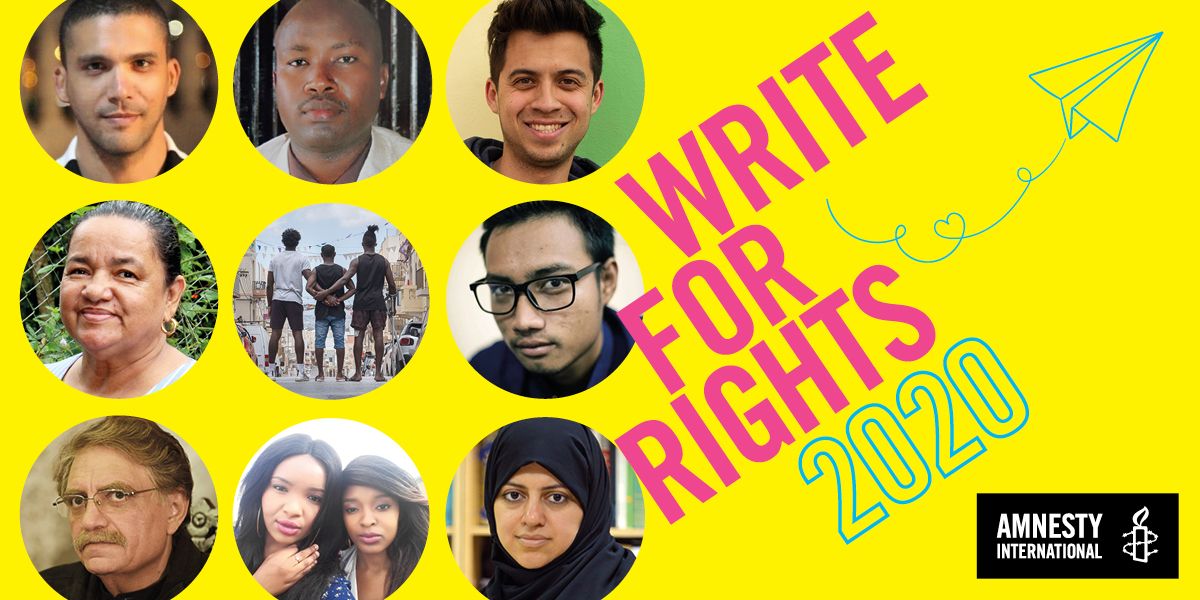
On 2 November 2020 Amnesty International has launched its flagship annual letter-writing campaign, Write for Rights, to help change the lives of people around the world who have been attacked, jailed, harassed or disappeared for standing up for their rights.
During Write for Rights – which takes place between November and December each year – people around the world will send millions of cards, emails and tweets of solidarity to individuals or groups of people whose freedoms are being denied, or write letters putting pressure on those in power to stop the abuses being committed against them.
This year, the campaign will support ten individuals who are suffering abuses, including:
Chilean Gustavo Gatica, a 22-year-old psychology student who was protesting against rising prices and inequality when he was struck in both eyes and blinded by police firing rubber and metal ammunition;
A group of Turkish university students known as the ‘METU Pride Defenders’, who are facing trail and a prison sentence for organising a peaceful sit in to protest the cancellation of their annual LGBTI+ pride march on campus.
Write for Rights goes back to the very roots of Amnesty International, which was founded in 1961, with Amnesty’s early campaigners writing letters of support to those affected by human rights abuses, as well as letters of concern to governments around the world.
On 29 October 2020, Amnesty International launched Amnesty Academy, a free human rights learning app which aims to educate the next generation of human rights defenders on a host of topics including freedom of expression, digital security, and Indigenous Peoples’ rights.
Learners around the world will be able to access courses ranging from 15 minutes to 15 hours in over 20 languages, including Urdu, Bangla, Hungarian, Korean, Russian, Thai, Czech and Turkish. All courses can be downloaded within the app, which is available on iOS and Android devices, allowing for offline learning.
“This app has been designed to empower and encourage everyone everywhere to learn about human rights. Sharing knowledge is a vital way to help us stand up for our own and for each other’s rights, and to struggle for justice and equality all over the world,” said Julie Verhaar, Amnesty International’s Acting Secretary General. This app has been designed to empower and encourage everyone everywhere to learn about human rights. Sharing knowledge is a vital way to help us stand up for our own and for each other’s rights, and to struggle for justice and equality all over the world.
Among Amnesty Academy’s key features is a flexible self-paced approach to learning, allowing users to start courses as and when it suits them. Learners who complete some of the longer courses will be awarded an official certificate signed by Amnesty International’s Secretary General.
The courses available on Amnesty Academy have been developed and fine-tuned over the past three years as part of Amnesty International’s human rights learning website. They have now been optimized for mobile use, making human rights learning more accessible than ever.
“Human rights education is the foundation of Amnesty’s work. Our overall goal is to ensure that people worldwide know and can claim their human rights. The Amnesty Academy app brings us closer to this goal by providing a simple and accessible platform for millions of people to access quality human rights education,” said Krittika Vishwanath, Head of Human Rights Education at Amnesty International.
Amnesty Academy will be regularly updated to accommodate learning in many more languages and with new course offerings in the months and years to come.
UN High Commissioner for Human Rights, Michelle Bachelet, has called for the Indian government to protect the rights of human rights defenders and NGOs in India. She praised India for being at the forefront of the fight for human rights but cautioned that vaguely worded laws may put that in jeopardy.
Her Tuesday 20 October 2020 statement comes as a response to worrying uses of the Indian Foreign Contribution Regulation Act (FRCA) which various UN bodies have been worried is overbroad and vague in its objectives. Additionally, it prohibits them from receiving foreign money for “for any activities prejudicial to the public interest.” This can and has had an impact on the right to freedom of association and expression and has prevented foreign NGOs from giving money to Indian causes.
“The FCRA has been invoked over the years to justify an array of highly intrusive measures, ranging from official raids on NGO offices and freezing of bank accounts, to suspension or cancellation of registration, including of civil society organizations that have engaged with UN human rights bodies,” Bachelet said. Most recently it led Amnesty international to close their Indian offices after they were raided and their bank account was frozen. [see: https://humanrightsdefenders.blog/2020/09/29/amnesty-feels-forced-to-shut-sown-its-india-office-amidst-govenment-pressure/]
Bachelet, also called for the Indian government to allow peaceful protest against the Citizenship Amendment Act. More than 1,500 people have been arrested because of their protests to this act and many have been charged with violations of the FCRA.
Finally, Bachelet,called for India to review the arrests of human rights defenders who have been arrested under the Unlawful Activities Prevention Act for exercising their basic human rights.
On 25 October 2020 Mariana Castro published on Polygraph.info an overview article showing that despite official denials torture does occur in Nicaragua’s Prisons.
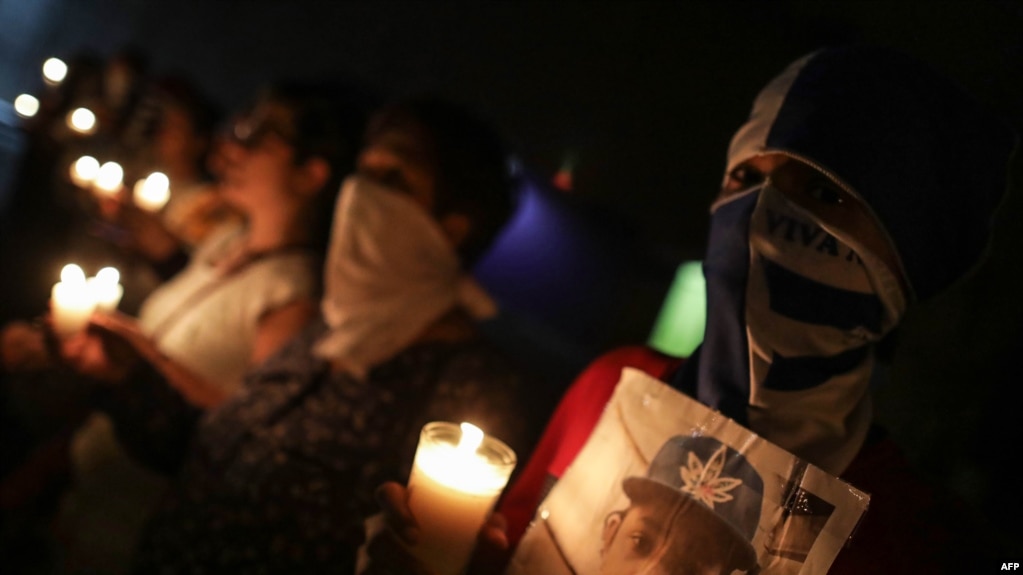
NICARAGUA – Anti-government demonstrators take part in a vigil to demand the release of political prisoners and justice for the victims of protests against President Daniel Ortega, outside the Metropolitan Cathedral of Managua on October 3, 2019.
“There are always prisoners who make up that they’re being tortured. …They invent things simply to create a negative image on Nicaragua before international organizations run by the yanquis…”
On October 15, the General Secretariat of the Organization of American States (OAS) publicly denounced persistent human rights violations in Nicaragua and urged the government to release political prisoners, restore fundamental freedoms and respect the separation of powers and rule of law: “The government’s has refused to comply with the recommendations of the Inter-American Commission on Human Rights, the Interdisciplinary Group of Independent Experts (GIEI), and the office of the United Nations High Commissioner for Human Rights and to fulfill its duties under the Inter-American Democratic Charter.”
Four days later, Nicaragua’s president, Daniel Ortega, dismissed allegations that political prisoners made of being tortured, calling them “lies” and an attempt to taint the country’s image.
“There are always prisoners who make up that they’re being tortured … they invent things simply to create a negative image on Nicaragua before international organizations run by the yanquis [referring to the United States], like the OAS,” Ortega said during a speech. (Source: El 19 Digital, October 19, 2020)
Based on multiple published reports, Ortega’s claim that torture accusations are invented is false.
Nicaragua under Ortega has faced extensive international scrutiny for violations of human rights. These include “targeting civil society, human rights defenders, including women human rights defenders, community and religious leaders, journalists and other media workers, students, victims and their family members, and individuals expressing critical views of the Government,” according to the United Nations Human Rights Council (HRC).
In April 2018, protests broke out in Nicaragua as fiscal reforms slashed social security. Protestors were met with a violent and lethal response from the government, fueling a civil uprising demanding Ortega’s resignation. More than 100,000 Nicaraguans have since fled the country.
Between the start of the protests and September 2019, 651 people died, nearly 5,000 were injured, 516 were kidnapped and 853 have gone missing, according to the Nicaraguan Association for Human Rights (ANPDH). Twenty-two police officers died, as stated by the U.N.
According to Human Rights Watch, many of those detained during the protests were subjected torture, including electric shocks, asphyxiation and rape. Detainees were also reportedly denied care in public hospitals.
The organization interviewed 12 former detainees, 11 of whom described suffering one of more forms of abuse, and seven who said they witnessed 39 detainees suffering abuses. It also interviewed three doctors and a psychologist who treated some detainees. They reported that many “showed signs of physical harm consistent with physical abuse and torture similar to that described by the 12 detainees.”
This week, Monitoreo Azul y Blanco (Blue and White Monitoring), a group that since 2018 registers and consolidates complaints of human rights violations in Nicaragua, published a video by Expediente Publico (an investigative journalism magazine in Honduras and Nicaragua) with testimonies from former political prisoners about their experiences of ill treatments and torture while incarcerated.
The testimonies mentioned the details of the event that resulted in the death of Eddy Montes, a Nicaraguan-American and U.S. Navy veteran who was shot dead in La Modelo prison in May 2019 after “a serious disturbance” inside of the prison, according to Nicaragua’s interior ministry.
The magazine also published an article on October 20 detailing testimonies of victims of abuse by the Nicaraguan police. They tell the story of J, an opposition protestor who between May 6 and May 13, 2019, was subjected to “constant questioning” and abuse by the police. Her complaint is one of dozens of cases.
Between April 2018 and June 2020, the Nicaraguan Human Rights Collective Never Again (Colectivo de Derechos Humanos Nicaragua Nunca+) registered complaints of five rapes, eight sexual abuses, seven threats of rape to detainees or their family members and three witnesses of rape to one or more fellow inmates, the article reported.
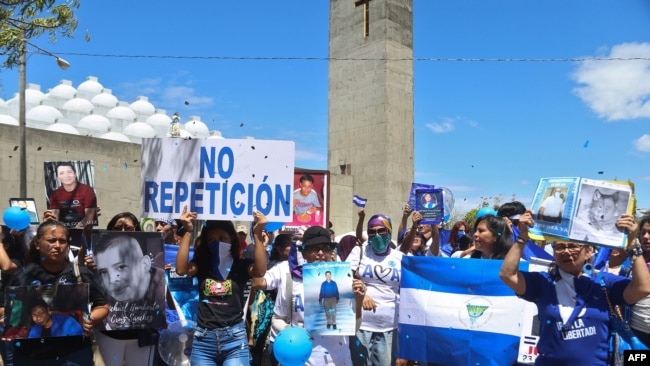
NICARAGUA – Members of the organization Mothers of April (AMA) hold portraits of their late loved ones outside the Cathedral in Managua on February 23, 2020.
On June 19, the Office of the United Nations High Commissioner for Human Rights issued a resolution to promote and protect human rights in Venezuela, and requesting the U.N.’s High Commissioner for Human Rights, Michelle Bachelet, to “enhance monitoring” and “continue to report on the situation of human rights in Nicaragua.”
Amid increased international pressure, Ortega’s government has released some political prisoners, including 91 people whose sentences were converted to house arrest in December 2019. But some 100 political prisoners (estimates vary slightly) remain in jails.
On September 30, more than 50 political prisoners went on a hunger strike as part of protests demanding their freedom. At least three of them sewed their mouths as part of protests and were then transferred to maximum security cells at the Jorge Navarro prison complex known as La Modelo. Amnesty International has described the complex as “one of the main destinations for those detained and punished for reporting human rights violations in the country.”
During his October 19 speech, Ortega said prison doors were open to those calling out the government, including relatives of prisoners, for them “to visit them when they say they’re being tortured, they are saying, they have sown their lips.”
But on the following day, representatives from the Permanent Commission on Human Rights (CPDH), one of Nicaragua’s oldest rights groups, went to visit the prison and were not allowed in, as La Prensa reported.
Allan Gomez, a member of the Union of Political Prisoners (UPPN), told Nicaragua Investiga that the denial of abuses is nothing new, “but human rights violations are fully visible.”
Earlier this month, the U.S. imposed its latest round of sanctions on top Nicaraguan officials, including the attorney general. According to The Associated Press, about two dozen people close to Ortega and his wife, Vice President Rosario Murillo, have been sanctioned – including Murillo and three of the couple’s children – since late 2017.
The European Union also recently renewed sanctions on Nicaragua – introduced in October 2019 – for another year, citing the “deteriorating political and social situation in Nicaragua.”
Effort 1: With women’s empowerment topping the agenda at next week’s B20 Summit, hosted by Saudi Arabia, Amnesty International is on 23 October 2020 reminding business leaders that many of the country’s bravest women’s rights activists are languishing in prison for daring to demand reforms. “Since assuming the G20 Presidency Saudi Arabia has invested heavily in rebranding its image.But Saudi Arabia’s real changemakers are behind bars” says Lynn Maalouf, Amnesty International’s Deputy Regional Director for the Middle East and North Africa
Loujain al Hathloul, Nassima al-Sada, Samar Badawi, Maya’a al-Zahrani, and Nouf Abdulaziz spearheaded women’s rights campaigns, including calling for the right to drive and an end to the repressive male guardianship system. But while Saudi Arabia talks up recent reforms such as the relaxation of social restrictions and the loosening of the guardianship system to court approval from the rich and powerful around the B20, women’s rights activists remain in detention.
Saudi Arabia has publicized the fact that this year, 33 percent of B20 delegates are women – the highest ever contingency. The B20 website states that “Women in Business” will be Saudi Arabia’s “signature topic” as President. “B20 leaders must not be fooled by this shameless hypocrisy, and we call on them to show they care about human rights as much as business opportunities. Any business operating in or with Saudi Arabia has a responsibility to ensure they are not contributing to human rights violations through their activities.”
The B20 is the official forum for business leaders to present policy recommendations to the G20, ahead of the main summit in November. This year high profile participants include representatives from HSBC, Mastercard, PwC, McKinsey, CISCO, ENI, Siemens, Accenture and BBVA.
Currently, 13 women’s rights defenders remain on trial facing prosecution for their human rights activism. Several face charges of contacting foreign media or international organizations, including Amnesty International. Some were also accused of “promoting women’s rights” and “calling for the end of the male guardianship system”. See also: https://humanrightsdefenders.blog/2019/03/13/saudi-arabia-persist-with-trial-for-women-human-rights-defenders/
Amnesty International has written to businesses participating in the B20 Summit raising serious concerns about the human rights risks of business operations in and with Saudi Arabia, and reminding them of their human rights responsibilities.
“We urge B20 delegates also to think carefully about how their brands could be legitimizing human rights violations and endorsing Saudi Arabia’s charm offensive,” said Lynn Maalouf. “If B20 Saudi Arabia was as progressive as it claims, the activists who did so much to secure more rights for women would have a seat at the table.”
Effort 2: Nineteen NGOs are calling on golf’s Ladies European Tour to reconsider the decision to hold a tournament hosted by Saudi Arabia. Pulling out of the tournament, they explain, would be ab act of solidarity with women’s rights campaigners detained in the Kingdom.
“While we acknowledge that such tournaments represent an important milestone in women’s golf, we are deeply concerned that Saudi Arabia is using this sports event as a public relations tool to sportwash its appalling human rights record, including discrimination against women and the crackdown on women’s rights defenders,” said the NGOs in a letter to the tour organisers.
The event is due to take place in Saudi Arabia from 12 to 19 November, with a cash prize of $1.5 million from the Saudi Public Investment Fund, which is chaired by Crown Prince Mohammad Bin Salman.
Saudi Arabia has faced sustained criticism that it uses major sporting tournaments to deflect from its human rights abuses. The arrest of prominent activist Loujain Al-Hathloul in 2018 and several others was highlighted as a serious concern.
In a letter penned to the top players on the Ladies European Tour, the 25-year-old described the event as a “grubby charade” as she argued that taking part was akin to giving “tacit endorsement to the Saudi regime and its imprisonment and torture of activists like my sister.”
Al-Hathloul’s imprisonment has been met with international outcry as concerns grow over her fate. Human rights organisations including Amnesty International have alleged that she and other women campaigners have been subjected to torture and sexual harassment, including threats of rape, while in Saudi detention.
The crackdown on female activists by the Saudi government reached its peak when the authorities arrested and detained Al-Hathloul, Eman Al-Nafjan and Aziza Al-Yousef on 15 May, 2018. Just weeks later, other leading women’s rights advocates and feminist figures were also arrested, including Samar Badawi and Nassima Al-Sadah.
“We remain concerned that they will not be able to exercise their right to a fair trial in accordance with the international human rights standards, to which Saudi Arabia is obliged to adhere,” wrote the NGOs. The only way to achieve true progress, they added, is to implement real reforms on women’s rights, and immediately release those arrested for defending these rights. “While we hope that Saudi Arabia can indeed develop its interaction with other countries around the world through hosting sports and other events in the Kingdom, we cannot ignore the country’s attempt to conceal its continued detention of women’s rights activists and discrimination against women by hosting a women’s sports tournament.”
Effort 2: The sister of jailed Saudi activist Loujain Al-Hathloul has called on European golf players to boycott the upcoming tournament in Saudi Arabic. In a letter sent to the Independent newspaper, Lina Al-Hathloul begged the top players on the Ladies European Tour to show support for her sister’s plight by not attending golfing events in Saudi Arabia scheduled for November.
In her letter, Lina wrote: “My sister is a women’s rights activist imprisoned and tortured by the Saudi regime. I understand the importance of sports to create links and bridges between different societies. “However, the current Saudi regime uses sports to whitewash its crimes, to have a window to the West, while maintaining and even worsening women’s conditions inside the country.
Don’t go to Saudi Arabia, don’t help that barbaric regime launder its reputation through your excellence. Stand in solidarity with women’s rights activists. Boycott the Ladies European Tour events in Saudi Arabia.
“I am begging you, as a woman, as a person of conscience and as a role model – please boycott the Saudi women’s tour event.”
The normally reliable Jerusalem (By SARAH CHEMLA) reports on 22 Ocrtober 2020 that US President Donald Trump may declare major international Human Rights NGO’s Amnesty International,Human Rights Watch and Oxfam as antisemitic in a soon-to-be released State Department declaration, voicing that governments should not support them any longer. If the declaration happens, it is likely to cause an uproar among civil society groups and might incite litigation. Critics of the possible move also worry it could lead other governments to further crack down on such groups, according to Politico.
T’ruah, a rabbinic human rights organization that represents over 2,000 rabbis, responded to the allegation on Wednesday, saying that “any US government declaration that these groups are antisemitic for criticizing the Israeli government is ridiculous, and contributes to the silencing of Israel’s human rights defenders.” It continued, adding that “the Trump administration’s smear of these three human rights organizations is yet one more example of this administration’s disregard for democracy and human rights at home and abroad.” “In casting aspersion on longtime respected human rights organizations, the Trump administration joins an ignoble list of autocratic governments that have discredited, smeared and even banned their own internal human rights organizations,” T’ruah said.”Actions such as these damage US democracy by threatening the transparency necessary to protect human rights. Human rights and civil society groups play a prophetic role, even if their words may not be ones governments want to hear.”Israel is a state bound by international human rights law, like all other members of the United Nations, and like other countries can be criticized when it fails to live up to these commitments,” it said.”By falsely smearing human rights organizations as antisemitic, the Trump administration only makes it harder to counter actual acts of antisemitism when they happen, while simultaneously harming these organizations’ effectiveness in reporting on all countries’ human rights abuses – including those of the United States.”
ACCORDING TO Politico, the declaration is expected to take the form of a report from the office of Elan Carr, the US special envoy to monitor and combat antisemitism. It would declare that it is US policy not to support such groups, including financially (NOTE: AI and HRW do not accept government funding as a matter of policy!) , and urge other governments to cease their support.The report would cite such groups’ alleged or perceived support for the Boycott, Divestment and Sanctions movement, which has targeted Israel over its construction of settlements on land Palestinians claim for a future state. The declaration is also expected to point to reports and press statements such groups have released about the impact of Israeli settlements, as well as their involvement or perceived support for a United Nations database of businesses that operate in disputed territories, Politico said. Contacted by Politico, the organizations named in the report denied any allegations that they are antisemitic. [In 2019, David Collier released a report into the work of Amnesty International after monitoring dozens of social media accounts maintained by the NGO and people who work for it, and concluded that the amount of hatred Israel receives is beyond any proportion, to a level that is, he said, antisemitic.“Targets are not chosen for their actions, but rather for their identity,” wrote Collier. “Persecuted Christians are blatantly ignored.”[see also: https://electronicintifada.net/blogs/asa-winstanley/how-racist-blogger-david-collier-infiltrated-labour-party]
For a second consecutive year, Amnesty International has documented how African governments are grossly undermining regional human rights bodies by failing to comply with their decisions, ignoring their urgent appeals, neglecting to report to them on national human rights situations and starving them of resources they desperately need for operations. Governments also neglected the rights of people with disabilities and older persons by failing to ratify treaties relating to their protection.
“Given the magnitude of gross human rights violations across the continent, regional human rights bodies play a critical role in providing justice and accountability,” said Netsanet Belay, Amnesty International’s Director for Research and Advocacy.
“These mechanisms must be protected and fully supported. They serve as vital alternative channels for people to seek justice and effective remedies when national systems are compromised or inadequate.”
Amnesty International’s report reviews and analyses the performance of Africa’s human rights treaty bodies: the African Commission on Human and Peoples’ Rights (African Commission); the African Committee of Experts on the Rights and Welfare of the Child (African Children’s Committee); and the African Court on Human and Peoples’ Rights (African Court).
Existential crisis for African human rights court
The report raises alarm that future of the African Court on Human and Peoples’ Rights is in jeopardy following decisions by three governments – Benin, Côte d’Ivoire and Tanzania – to withdraw the right of individuals and NGOs to directly file cases before the court. Rwanda withdrew this right in 2016 bringing to four the number of countries that are now restricting access to this vital pathway to justice.
Amnesty International found that Benin, Côte d’Ivoire and Tanzania withdrew this right in response to decisions they perceived as unfavorable, and amid rising intolerance towards human rights defenders and a general deterioration of human rights conditions nationally…..
Joe Parkin Daniels in Bogotá Colombia reports for the Guardian of 8 October 2020 on the latest Amnesty International study entitled “Why Do They Want To Kill Us?” and published on Thursday. It identified four areas of the country as particularly dangerous for activists: Buenaventura; the Amazonian province of Putumayo; the war-torn Catatumbo region on the Venezuelan border; and the Kubeo-Sikuani indigenous settlement in the eastern planes
Activists in Colombia have warned that they continue to face extermination despite the coronavirus pandemic, as Amnesty International accused the country’s government of doing little to protect them.
At least 223 social leaders – community activists defending human, environmental, and land rights – have been murdered this year, according to local watchdog Indepaz.
“We are being massacred, drop by drop,” said Danelly Estupiñán, who leads the Black Community’s Process (or PCN), an activist group dedicated to Afro-Colombian rights, in Buenaventura, an Afro-Colombian port city on the Pacific coast. Estupiñán has received countless death threats, been followed by suspicious men, and had her house broken into in recent months
“For years, Colombia has been one of the world’s most dangerous countries for people who are defending human rights, territory, and natural resources,” Erika Guevara-Rosas, Americas director at Amnesty, said in a statement to media on Thursday.
“Defenders will continue to die until the government effectively addresses structural issues such as the deep inequality and marginalization suffered by communities, ownership and control of the land, substitution of illicit crops, and justice,” Guevara-Rosas went on to say.
Human rights defenders across the country told Amnesty International’s researchers that the Covid-19 outbreak has also prompted authorities to reduce the protection arrangements – including state-provided bodyguards and armoured vehicles.
A historic 2016 peace deal between the Colombian government and what was then Latin America’s largest rebel group, the Revolutionary Armed Forces of Colombia (or Farc), was supposed to end decades of the bloodshed.
But though the accord formally ended five decades of civil war that killed 260,000 and displaced over 7 million, only a small fraction of its provisions have been implemented, while violence continues to rattle the countryside as Farc dissidents, other rebel militias, and cartels jostle for control.
In a strong worded report, Guterres recalled that the Office of the High Commissioner for Human Rights (OHCHR) has pointed out in multiple reports this year to the surge of “harassment, arrests and ill-treatment of bloggers, doctors and nurses” by the Polisario militias.
The Polisario used the Covid-19 pandemic to crackdown on dissent in a new wave of repression to silence critical bloggers, journalists, activists and anyone who challenges the authoritarian status quo in the camps.
Repression did not spare the medical staff and human rights activists in the Camps who exposed the cover up by the Polisario of the real scale of Covid-19 outbreak.
Last May, the UN Working Group on Arbitrary Detention said in a response to a complaint submitted by polisario opponent El Fadel Breica against the Algerian State, following his abduction by the polisario, that Algeria is responsible for the violations committed in its territory.
Similarly, the Human Rights Committee reaffirmed in its findings, in March 2020, the full responsibility of Algeria in the abduction and enforced disappearance of the Polisario dissident, Khalil Ahmed, whose case was raised in the Secretary-General’s report of 2019.
International rights watchdogs, including Human Rights Watch and Amnesty International, have on multiple reports drew attention to the plight of the population held against their will in Tindouf where the Algerian state has relegated the destiny of thousands of Sahraouis to the mercy of a separatist militia that trades in their suffering.
From humanitarian aid embezzlement by the Polisario officials to slavery and forced disappearances in the Tindouf camps, Algeria has abdicated its responsibilities and forsaken a civilian population to the mercy of a separatist militia.
The UN Security Council has repeatedly called on Algeria to uphold its responsibility and allow a census of the population held in the camps to enable them to enjoy full refugee rights including having the choice to return to their homeland Morocco.
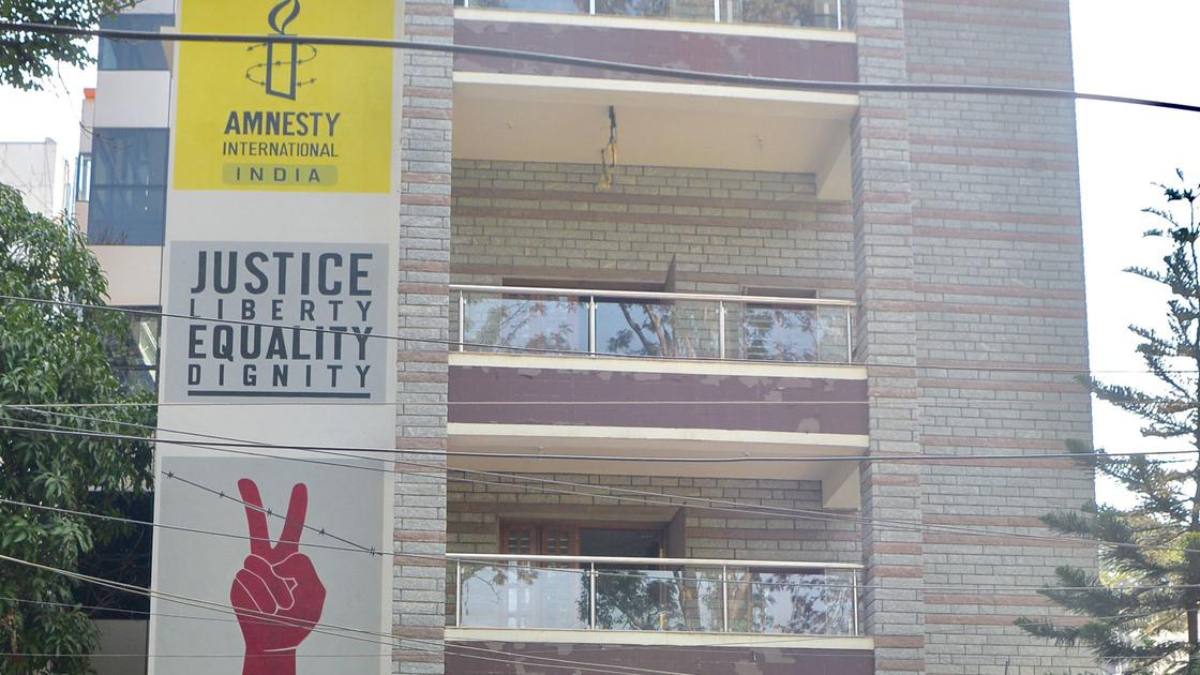
On 29 September 2020, it was announced that Amnesty International has shut down its India operations, alleging ‘a ‘witch-hunt’ by the Government
Amnesty India shuts operations
The complete freezing of Amnesty International India’s bank accounts by the Government of India which it came to know on 10 September 2020, brings all the work being done by the organization to a grinding halt. The organisation has been compelled to let go of its staff in India and pause all its ongoing campaign and research work. This is latest in the incessant witch-hunt of human rights organizations by the Government of India over unfounded and motivated allegations, Amnesty International India said today. See below the CHRONOLOGY OF ATTACKS AND HARASSMENT OF AI INDIA, starting in October 2018:
“The continuing crackdown on Amnesty International India over the last two years and the complete freezing of bank accounts is not accidental. The constant harassment by government agencies including the Enforcement Directorate is a result of our unequivocal calls for transparency in the government, more recently for accountability of the Delhi police and the Government of India regarding the grave human rights violations in the Delhi riots and Jammu & Kashmir. For a movement that has done nothing but raises its voices against injustice, this latest attack is akin to freezing dissent,” said Avinash Kumar, Executive Director of Amnesty International India.
Amnesty International India stands in full compliance with all applicable Indian and international laws. For human rights work in India, it operates through a distinct model of raising funds domestically. More than four million Indians have supported Amnesty International India’s work in the last eight years and around 100,000 Indians have made financial contributions. These contributions evidently cannot have any relation with the Foreign Contribution (Regulation) Act, 2010. The fact that the Government is now portraying this lawful fundraising model as money-laundering is evidence that the overbroad legal framework is maliciously activated when human rights activists and groups challenge the government’s grave inactions and excesses.
The attacks on Amnesty International India and other outspoken human rights organizations, activists and human rights defenders is only an extension of the various repressive policies and sustained assault by the government on those who speak truth to power. “Treating human rights organisations like criminal enterprises and dissenting individuals as criminals without any credible evidence is a deliberate attempt by the Enforcement Directorate and Government of India to stoke a climate of fear and dismantle the critical voices in India. It reeks of fear and repression, ignores the human cost to this crackdown particularly during a pandemic and violates people’s basic rights to freedom of speech and expression, assembly, and association guaranteed by the Indian Constitution and international human rights law. Instead, as a global power and a member of the United Nations Human Rights Council, India must fearlessly welcome calls for accountability and justice,” said Avinash Kumar.
BACKGROUND: CHRONOLOGY OF ATTACKS AND HARASSMENT OF AMNESTY INTERNATIONAL INDIA:
On 25 October 2018, Amnesty International India endured a 10-hour-long raid as a group of officers from the Enforcement Directorate (ED), a financial investigation agency under the Ministry of Finance, entered its premises and locked the gates behind them. Most of the information and documents that were demanded during the search were already available in the public domain or filed with the relevant government authorities. The residence of a Director was also raided.
Immediately after the raid, the bank accounts were also frozen by the ED. As a result, Amnesty International India was forced to let go of a number of its staff, adversely affecting its work in India including with the marginalised communities. Despite the ongoing investigations and before the framing of charges, the Government of India started a smear campaign against Amnesty International India in the country through selective leaking of documents gathered by the ED, to government-aligned media outlets. This resulted in a malicious media trial against the organization.
In early 2019, the Department of Income Tax started sending investigative letters to more than 30 small regular donors. Apparently, the department did not find any irregularities but the process adversely affected the fundraising campaigns of Amnesty International India.
In June 2019, Amnesty International India was denied permission to hold the press conference launch in Srinagar to release its third ‘Lawless Law’ report on the misuse and abuse of Public Safety Act in Jammu and Kashmir. It was forced to digitally release it.
On 22 October 2019, Amnesty International testified at the US Congressional hearing on the situation of human rights in South Asia with a specific focus on Jammu and Kashmir since the unilateral abrogation of Article 370 of the Constitution of India.
On 15 November 2019, two weeks after the testimony and amid rumours of impending arrests of the organization’s top officials, the offices of Amnesty International India and the residence of one of its directors were raided again by the CBI. The raids were conducted on the basis of a First Information Report filed by the Ministry of Home Affairs over unsubstantiated allegations of suspected violations of Foreign Contribution Regulation Act. It suggested investigations be launched under other laws like the Prevention of Money Laundering Act.
On 13 April 2020, Amnesty International India called on the Uttar Pradesh Government to stop its intimidation of journalists through use of repressive laws during a pandemic. On 15 April 2020, the Cyber Crime Police Station, Lucknow, Uttar Pradesh notified Twitter to furnish information about Amnesty International India’s Twitter account @AIIndia which the organization uses to monitor and analyse developments in international human rights law and Indian constitutional and criminal law related to human rights issues.
On 5 August 2020, marking the first anniversary of the abrogation of Article 370 of the Constitution of India, Amnesty International India released an update on the situation of human rights in Jammu and Kashmir.
On 28 August 2020, marking the six-month anniversary of the riots that took place in North-East Delhi in February 2020, Amnesty International India released an investigative brief on the complicity of Delhi police in the riots which claimed the lives of at least 53 people, mostly from the minority Muslim community.
The release of the two publications has provided fresh impetus to the establishment to harass and intimidate Amnesty International India through its investigative agencies.
On 10 September 2020 Amnesty International India came to know that all its bank accounts were completely frozen by the Enforcement Directorate bringing most of the work of the human rights organization to a grinding halt.

 Hans Thoolen on Human Rights Defenders and their awards