A coalition of human rights groups (such as Amnesty International, Gulf Centre for Human Rights, Human Rights Watch, International Trade Union Congress, Transparency International and the World Players Association) has sent an open letter to FIFA president Gianni Infantino to confirm that any country chosen to share World Cup 2022 games with Qatar will meet world football’s new ethical standards. The possible expansion of the next World Cup from 32 to 48 teams is top of the agenda at a meeting of the FIFA Council in Miami on Friday, with Infantino keen on an idea that would mean Qatar having to share the World Cup with other nations in the Middle East.
That idea would need Qatar’s approval, which is far from certain as it has been locked in a bitter diplomatic dispute with Bahrain, Egypt, Saudi Arabia and the United Arab Emirates since June 2017, but the more neutral Kuwait and Oman have been suggested as possible co-hosts.
The imposition of a criminal punishment that stems solely from the peaceful exercise of the right to peaceful assembly directly contravenes international human rights law and standards and is a blatant attempt to silence an outspoken human rights defender.
Activists and human rights defenders in Singapore regularly face harassment, investigation, and unfounded charges for no other reason than expressing their views and organising peaceful gatherings. The sentencing of Jolovan Wham on charges violating his fundamental rights is emblematic of the lengths to which the Singaporean authorities are willing to go to silence and punish peaceful dissent. …
Wham’s sentencing and the further charges he is facing for peaceful expression and assembly, reflect Singapore’s ongoing crackdown on these rights, which looks set to worsen ahead of possible elections. The cases below underscore the breadth of the crackdown.
In October 2018, the State Court of Singapore convicted artist and activist Seelan Palay for carrying out an “illegal assembly” under the Public Order Act, imposing a fine US$1,849.
In December 2018, Prime Minister Lee Hsien Loong filed defamation charges against blogger Leong Sze Hian, after he shared an article on his Facebook page, which alleged that the Prime Minister had links to the Malaysian 1MDB financial scandal.
That same month, the Attorney General’s Chamber charged Terry Xu, the editor of the internet news outlet The Online Citizen, with defamation for publishing an article in September 2018 that linked the government to corruption allegations.
These examples show the systematic harassment and intimidation faced by a wide spectrum of actors, including artists, journalists, bloggers, human rights defenders and political activists simply for the peaceful expression of their views.
In hope of reversing this alarming trend, we call on the Singaporean authorities to:
Quash the convictions against Jolovan Wham and Seelan Palay, who were prosecuted solely for peacefully exercising their rights to freedom of expression and peaceful assembly.
Drop the defamation charges pending against Leong Sze Hian, Terry Xu, and Daniel Augustin De Costa.
Repeal or substantially amend all repressive laws that unduly curtail the rights to freedom of expression and peaceful assembly, and put in place adequate legal mechanisms and procedures to ensure that these rights are enjoyed by all and not subject to unlawful restrictions.
End the intimidation and harassment of human rights defenders, including through the misuse of the criminal justice system, and ensure they can pursue their human rights work without fear of reprisals.
Shemin Joy, for DH News Service, New Delhi, reported on 21 February 2019 that a letter addressed by 3 UN Rapporteurs to the Indian government has now been made public as no reply was received. The letter will now be part of the report to be discussed in UN Human Rights Council as India has not responded to the charges. In the letter, the Special Rapporteurs referred to the raids and searches conducted at the offices of Amnesty International India and Greenpeace India as well as the blocking of foreign funding to these NGOs. ….concern is expressed at the alleged smear campaign against Amnesty International India, in what seems to be an attempt to tarnish the organization’s reputation in the absence of formal charges
“We reaffirm our position that the ability to access foreign funding is an integral part of the right to freedom of association, and reiterate our concerns at the highly detrimental impact of the FCRA, which has been increasingly used to obstruct Indi.reiterate our concerns at the highly detrimental impact of the FCRA, which has been increasingly used to obstruct Indian civil society’s access to international funding,” they said. [see also: https://humanrightsdefenders.blog/2013/11/05/india-should-end-funding-restraints-on-human-rights-defenders-says-hrw/]
The seven-page letter was written by Special Rapporteurs David Kaye (promotion and protection of the right to freedom of opinion and expression), Clement Nyaletsossi Voule (rights to freedom of peaceful assembly and of association) and Michel Forst (situation of human rights defenders) on December 20 last year and had said that they would make public the letter after two months with or without the government’s response.
The report lists 50 countries worldwide where anti-NGO laws have been implemented or are in the pipeline
Governments around the world are stepping-up their attacks on civil society organisations and human rights defenders, according to a new Amnesty International report. On 21 February 2019 RTE Ireland summarizes it as follows: It says governments are creating laws that subject non-governmental organisations and their staff to surveillance, bureaucratic hurdles and the threat of imprisonment.The international human rights group says the global assault on NGOs has reached a crisis point as new laws curb vital human rights work. The report, Laws Designed to Silence: The Global Crackdown on Civil Society Organisations, lists 50 countries worldwide where anti-NGO laws have been implemented or are in the pipeline.
Amnesty International says these laws commonly include implementing ludicrous registration processes for organisations, monitoring their work, restricting their sources of resources and, in many cases, shutting them down if they do not adhere to the unreasonable requirements imposed on them.[see also: https://humanrightsdefenders.blog/2018/12/07/global-statement-on-the-20th-anniversary-of-the-un-declaration-on-human-rights-defenders/]“We documented how an increasing number of governments are placing unreasonable restrictions and barriers on NGOs, preventing them from carrying out crucial work,” said Kumi Naidoo, Secretary General of Amnesty International. “In many countries, organisations who dare to speak out for human rights are being bullied into silence. Groups of people who come together to defend and demand human rights are facing growing barriers to working freely and safely. Silencing them and preventing their work has consequences for everyone.” SEE ALSO NAIDOO’S OP-ED: http://news.trust.org//item/20190220144717-jcwuf/https://www.amnesty.org/en/latest/news/2019/02/global-assault-on-ngos-reaches-crisis-point/
Danna Ingleton, Deputy Director of Amnesty Tech, said: “Novalpina’s executives have serious questions to answer about their involvement with a company which has become the go-to surveillance tool for abusive governments. This sale comes in the wake of reports that NSO paid private operatives to physically intimidate individuals trying to investigate its role in attacks on human rights defenders – further proof that NSO is an extremely dangerous entity.
“We are calling on Novalpina to confirm an immediate end to the sale or further maintenance of NSO products to governments which have been accused of using surveillance to violate human rights. It must also be completely transparent about its plans to prevent further abuses.
“This could be an opportunity to finally hold NSO Group to account. Novalpina must commit to fully engaging with investigations into past abuses of NSO’s spyware, and ensure that neither NSO Group nor its previous owners, Francisco Partners, are let off the hook.”
The signatories to the letter are:
Amnesty International
R3D: Red en Defensa de los Derechos Digitales
Privacy International
Access Now
Human Rights Watch
Reporters Without Borders
Robert L. Bernstein Institute for Human Rights, NYU School of Law and Global Justice Clinic, NYU School of Law
That human rights NGOs are severely criticized is nothing new but that it comes from its own staff is rare. Still here is a report that states that “Amnesty International has had a “toxic” working environment going back as far as the 1990s”. This does not mean that AI is specially bad compared to other larger NGOs, just that there are very few other such public reports.
reports that on 30 January 2019, Randy Felix Malayao, a human rights defender and peace consultant for the National Democratic Front of the Philippines (NDFP), was shot dead while he was asleep on bus in Aritao, Nueva Vizcaya.Randy Felix Malayao [https://www.frontlinedefenders.org/en/profile/randy-felix-malayao]was a human rights defender and peace advocate. Since 2008, he had served as a consultant on political and constitutional reforms for the NDFP, a coalition of groups that has long been engaging in peace negotiations with the Phillipine government. The human rights defender also participated in the peace talks in Europe in 2016, as a spokesperson during the formal negotiations. Other than his work with the NDFP, Randy Felix Malayao was also on the board of trustees of a local human rights organisation in Northern Luzon, the current vice president of the Makabayan coalition, and an active campaigner against human rights violations committed by the military in Cagayan Valley.
Following the death of the human rights defender, his work and character were targetted by a slew of unfounded allegationsfrom the Philippine National Police (PNP). They alleged that Randy Felix Malayao was a ranking officer of the Communist Party of the Philippines (CPP), that he embezzled funds from “the Party” and extorted money from the people, and that he had eloped with another activist who was already married. Randy Felix Malayao’s family denounced these allegations. Cristina Palabay, Secretary General of Filipino NGO Karapatan , also denounced the PNP’s allegations and reaffirmed that Randy Felix Malayao was not a member of the CPP.
Before his death, as a result of his human rights advocacy, Randy Felix Malayao had been hounded by suspected military personnel; abducted and tortured by political adversaries; spent four years in prison on trumped-up and politically-motivated charges; and was among the 650 individuals branded as terrorists by the Duterte administration in the proscription petition issued by the Department of Justice in February 2018. The eventual removal of his name from this list in January 2019 by the Manila Regional Trial Court Branch was supposed to have accorded Randy Felix Malayao a safer environment to carry out his work, but his murder proves that this was not the case. [see also: https://humanrightsdefenders.blog/2018/11/08/and-in-the-philippines-the-killing-of-human-rights-defenders-also-continues-with-benjamin-ramos/]
To show that harassment of HRDs continues unabated is shown by the Amnesty USA report that the Philippine Department of Justice has recommended ‘cyber libel’ charges against Maria Ressa, the editor of news outlet Rappler, together with one of its former reporters. Amnesty International’s Philippines Director, Butch Olano stated: “The latest harassment of Maria Ressa and her team comes as no surprise. Rappler’s fearless journalism has consistently exposed the so-called ‘war on drugs’ for what it really is: a deadly campaign that has led to thousands of unlawful killings of poor and marginalized people, including children. Critics, activists, and journalists alike have faced President Duterte’s wrath for speaking the truth”. It is all the more ridiculous given that the National Bureau of Investigation, which first reviewed the complaint, dismissed this claim as baseless last year.
Background: On May 29, 2012 Rappler published a story, written by former reporter Reynaldo Santos Jr., alleging that a car used by former Chief Justice Renato Corona during his impeachment trial belonged to a businessman, Wilfredo Keng, who has alleged ties to human trafficking and drug smuggling rings. On January 10, 2018, Keng filed a “cyber libel” complaint against Santos, Maria Ressa, and six members of Rappler’s board of directors under the Cybercrime Prevention Act of 2012. The National Bureau of Investigation subsequently dismissed the complaint because the report preceded the enactment of this law.
In a January 2019 decision obtained by Rappler this week, the Department of Justice revived the charges against Ressa and Santos, as well as Rappler Inc., on the grounds that the news article was updated in February 2014, and is therefore actionable. Maria Ressa and Rappler Inc are already facing charges of tax evasion which Amnesty has condemned as politically-motivated. Rappler has been a consistent critic of President Rodrigo Duterte and his administration, publishing detailed investigations into some of the thousands of extrajudicial executions committed by police and other unknown armed persons during drug-related operations.
Brent Patterson posted on Rabble.ca on 4 February, 2019 a piece entitled: “Impunity for human rights violations must be challenged from Guatemala to the Wet’suwet’en territories“. It looks at the concept of impunity, especially in the context of indigenous people in Latin America and..Canada.Read the rest of this entry »
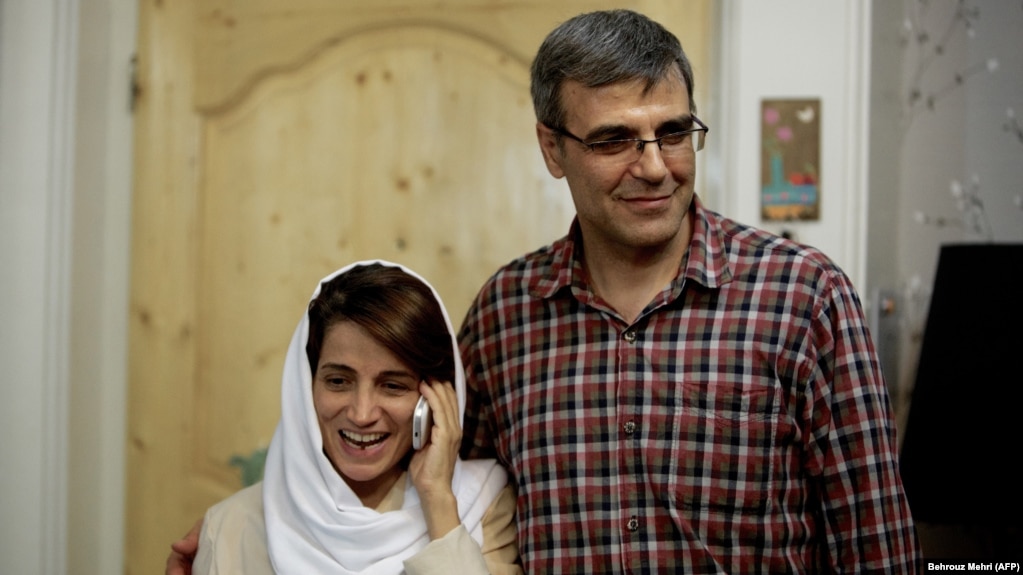
On 23 January 2019 RFE/RL reported that Iranian human rights defender Reza Khandan got a six-tear prison sentence. The next day Amnesty International issued a damning overview of the situation of human rights defenders in that country: Iran arrested more than 7,000 people in a sweeping crackdown against protesters and dissidents in the past year. See more below:
Rez Khandan with his wife, Nasrin Sotoudeh, in Tehran in 2013
he Russian authorities have for the first time used the repressive “undesirable organizations” law to open a criminal case against human rights defender Anastasia Shevchenko, exposing her to the risk of a six-year prison term. Until now, violations of this law were punished under administrative law.
This morning Anastasia Shevchenko, a Coordinator with the Otkrytaya Rossiya (Open Russia) movement, was charged with “repeated participation in the activities of an undesirable organization.” “In recent years, the Russian authorities have progressively suffocated and criminalized dissent. The Open Russia movement has become the latest victim of this crackdown,” said Marie Struthers, Director for Eastern Europe and Central Asia at AI.
It’s clear that the authorities are expanding their toolkit for imprisoning human rights defenders and activists, so if applied broadly this practice will have far-reaching implications for the right to freedom of expression.”In recent days, police have opened criminal investigations, conducted searches and arrests of Open Russia’s activists across the country. [see also my older post: https://humanrightsdefenders.blog/2015/05/21/russia-human-rights-ngos-likely-to-become-officially-undesirable/]
Background: On 17 January, Open Russia Coordinator in Pskov Liya Milushkina and her husband Artyom Milushkin were arrested and accused of selling drugs, an offense punishable by up to 20 years’ imprisonment. Artyom, who is also a political activist, previously reported that police officers threatened to plant drugs on him during his recent arrest in November. Amnesty International has interviewed several associates of the Milushkins all of whom are adamant that the criminal case against the couple is fabricated. Amnesty International has documented a number of cases in which activists in Russia have been prosecuted on trumped-up drug charges, including human rights defender Oyub Titiev who is currently standing trial in Chechnya. On 18 January, police filed a case against Open Russia Coordinator in Krasnodar Yana Antonova for posting a video about the shortage of schools in the region. She was charged with “participation in the activities of an undesirable organization”, an administrative offence when “committed” for the first time.
 on of human rights groups (such as Amnesty International, Gulf Centre for Human Rights, Human Rights Watch, International Trade Union Congress, Transparency International and the World Players Association) has sent an open letter to FIFA president Gianni Infantino to confirm that any country chosen to share World Cup 2022 games with Qatar will meet world football’s new ethical standards. The possible expansion of the next World Cup from 32 to 48 teams is top of the agenda at a meeting of the FIFA Council in Miami on Friday, with Infantino keen on an idea that would mean Qatar having to share the World Cup with other nations in the Middle East.

 Hans Thoolen on Human Rights Defenders and their awards