For a human rights movement dedicated to exposing abuses, positive communication does not come naturally. We in the human rights community are driven by a desire to make known the suffering and injustice we see in the world, yet what people need from us is not information about what is going wrong, but hope and a means of making it better.
To make the case for human rights, we need to promise a brighter future. At Amnesty International we have a saying: better to light a candle than curse the darkness. But in the human rights movement, we spend a lot more time cursing the darkness. We want to expose terrible suffering so that people are shocked into action. But when we only show the abuses, people start to believe that we live in a world of crisis with no alternative. They accept that reality, give up, or turn to people who preach division, fear and a false sense of safety.
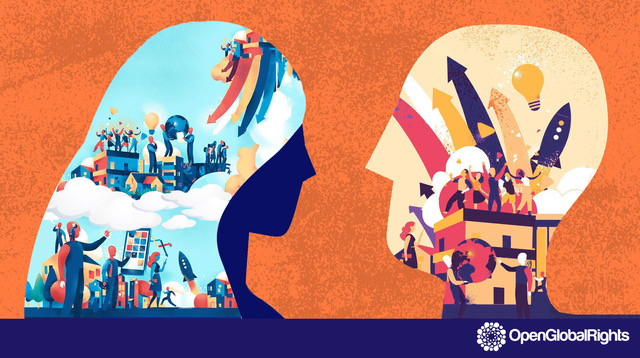
While the human rights movement will always have to expose abuses, we also need to give people a chance to unite behind a cause, challenge governments to live by their values and build support for our way of seeing the world. Hope-based communication is simply a smart strategy for shifting public opinion not by saying what is popular, but by making popular what needs to be said.
Hope-Based Communication is about illustrating what we want to see, not just what other people are doing. Because the human mind adapts easily to bad news, every dose of shock that we administer to the global conscience inoculates people. Without a tangible, believable alternative vision of how things should be, we risk reinforcing current rights abuses as a regrettable but inevitable reality.
Constant stories of crisis create an alarming picture of the world in our minds. When news is all about negative, sensational and exceptional events, it skews our view of other people, cultivates distrust and blinds us to important but unsurprising developments, as Rob Wijnberg, has argued in his manifesto for constructive news outlet The Correspondent. To break this cycle and sell hope to the media, we need two things: challenging ideas and surprising stories.
The environmental movement has already made that first step from dire warnings to big ideas that convince people that another world is possible. For example, in This Changes Everything, Naomi Klein writes about how promises of a bright green future offered a way forward: “What this part of the world has clearly shown is that there is no more potent weapon in the battle against fossil fuels than the creation of real alternatives.”
The human rights movement must now do the same thing, and new research offers us a way to completely reframe the way we talk about human rights. For example, Amnesty International Australia now says “Bring them here” of refugees, rather than asking the government to stop treating them like criminals. Anat Shenker-Osorio’s linguistic analysis of how advocates in Australia, the UK and USA make the case for human rights shows that we talk about human rights as an object that is given to individuals, rather than a tool for people to improve their communities and live together. It encourages us to be more specific about power relations and use the language of journeys instead of war.
We want to take society on a journey to a better place, but when we lean heavily on the language of conflict: we fight, recruit, mobilise, resist, defend, protect and counter. We build coalitions. We wage campaigns. We seek to win battles. We ask people to take sides. This language is divisive—it won’t power a constructive, unifying movement. Instead, we need to talk about building, growing and sticking together.
Research from the Common Cause Foundation shows that altruism is as great a motivator to good causes as self-interest, if not more. Successful movements are propelled forward by enthusiasm and passion. While Donald Trump united his base with the simple red baseball cap, ordinary people demanding women’s rights queued for hours to buy “Together for Yes” buttons in Ireland and thronged the streets wearing green scarves in Argentina.
More and more research points to the fact that fear and pessimism triggers conservative and suspicious views, while, hope and optimism tend to more liberal views. Joyful, inspiring content like Planned Parenthood’s Unstoppable campaign serves not just to inspire, it creates political momentum. Anger mobilizes, hope organizes.
New approaches to stories about people seeking refuge highlight not what they flee but what they create in their new home, how the act of welcome transforms the host, or the power of friendships that face adversity and politics.
The stories we tell become our reality, so we need stories of humanity and compassion, reinforcing the idea that human rights are about people standing up for each other
How do we talk about hope and opportunity when human rights defenders are under attack and we need to defend ourselves, to fight back? How can we be positive when it is our duty to document despair?
Human rights defenders have “long been on the front line”, as Kathryn Sikkink argues in Dejusticia’s Playbook for Human Rights Actors. She warns that the frame of crisis and peril inadvertently harms perceptions of the movement’s effectiveness and legitimacy.
The most urgent challenge is to rebrand what it means to do human rights. The space that we most need to create for civil society is a conscious space apart from today’s struggles in which we allow ourselves to envisage bold possibilities of a better world. Human rights should take pride in being the “slow change” movement, that brings about generational attitudinal and societal progress, offering the path out of the darkest times.
Check out this virtual guide for how you can make a shift towards hope based communications in your human rights work.
There is still a place for anger and sadness, if we balance them with a sense of how we make things better. For no matter how dark the story, there is always some glimmer of hope. And it is our job to kindle that flame. The darker the crisis, the more people exhausted by fear and anger will turn to extreme options. So, we have to give people what every human needs: hope. After all, you light a candle when it gets dark. Hope, like a candle, shines brightest in the dark.






A boycott of Brunei-owned luxury hotels was sparked last week in an opinion piece by actor George Clooney, who said a boycott of the high-end hotels — where rooms can start at $600 a night or more — is necessary to keep money from flowing “directly into the pockets of men who choose to stone and whip to death their own citizens for being gay or accused of adultery.” It is gaining support from celebrities including Ellen DeGeneres and Elton John as the country on Wednesday implemented what it called Islamic criminal laws including death by stoning for gay sex.
The nine hotels owned by Brunei are:
..In his opinion piece last week, Clooney noted that he’s stayed at many of the hotels owned by Brunei, a small nation located on the island of Borneo, but said he was unaware of their ownership “because I hadn’t done my homework.” He acknowledged that a boycott is unlikely to change Brunei’s laws, but said consumers must decide whether they want their money to support laws that violate human rights. “Are we really going to help fund the murder of innocent citizens?” he wrote. “I’ve learned over years of dealing with murderous regimes that you can’t shame them. But you can shame the banks, the financiers and the institutions that do business with them and choose to look the other way.”