Sadako Ogatathe first woman to head the UN High Commissioner for Refugees has died at the age of 92 on 22 October 2019. I served under her for many years and have the greatest admiration for her. Sadako Ogata worked on some of the largest crises of the decade during her time in service from 1991 to 2000, including the Kurdish refugees fleeing from Iraq after the 1991 Gulf War, the Balkans War and the Great Lakes region of Africa. Before joining the UN, she was an academic – serving as dean of the faculty of foreign studies at Sophia University in Tokyo in 1989, where she had been a professor since 1980. She was well respected by UN staff and world leaders alike, and was described by her colleagues as a “five-foot giant” for her formidable negotiating skills and ability to confront hostile factions. From 2003 to 2012, Ogata was the head of the Japan International Cooperation Agency, overseeing efforts to provide assistance to those in developing countries.
Back in Japan, she also criticised her country’s low acceptance of refugees. “Japan has to set up a situation to welcome people… those who are in need, in serious need… I think we should be open to bringing them in,” she said in a Reuters interview in 2015. “[To say] Japan does not have resources, that’s nonsense.”
She rightly received a lot of recognition while alive, including:
1994 Franklin Roosevelt Four Freedoms Award
1994 Prize for Freedom (Liberal Int’l)
1994 International Human Rights Law Group Award
1995 Liberty Medal
1995 Freedom Award (refugees)
1997 Ramon Magsaysay Award for Community Leadership
Botswana human rights defender Alice Mogwe, newly elected president of the FIDH, says: “The universality of human rights is under attack – we must fight back!”
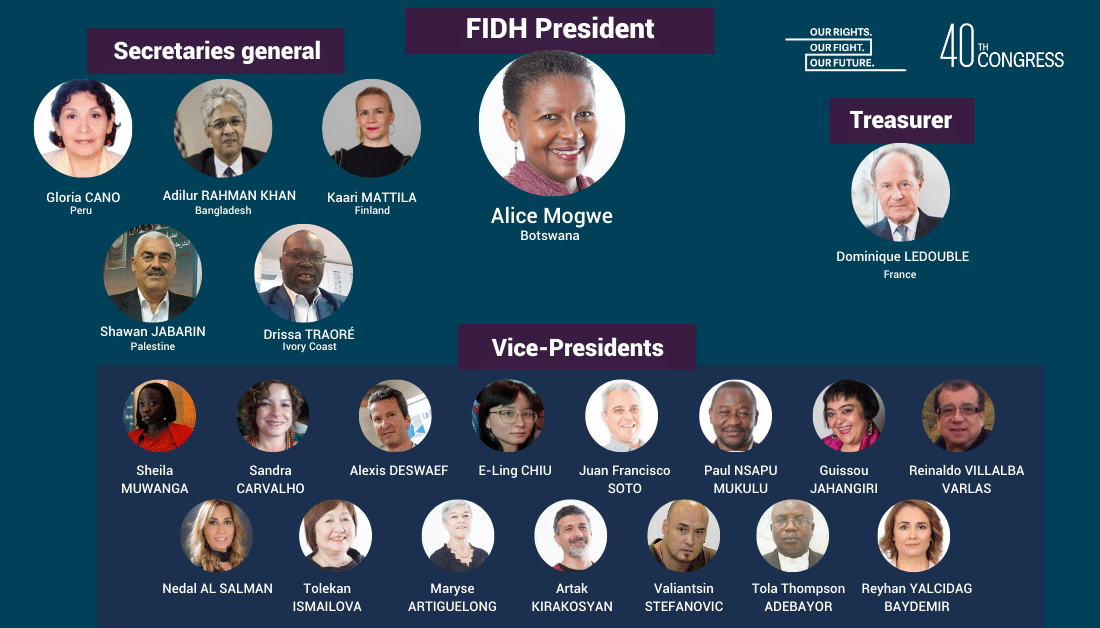
The member organisations of the International Federation for Human Rights (FIDH) elected their new president during its 40th Congress in Taiwan. Alice Mogwe, will lead the Federation for the next three years, ushering in its 100th anniversary in 2022. In December 2018 Alice Mogwe was the first civil society leader to address the United Nations General Assembly on behalf of over 250 human rights defenders from around the world. [https://humanrightsdefenders.blog/2018/12/17/tuesday-18-december-first-time-a-human-rights-defender-addresses-un-general-assembly/] As founder and director of DITSHWANELO – the Botswana Centre for Human Rights – she has spearheaded efforts to advance human rights in Botswana and its Southern African neighbours.“Our fellow human rights defenders the world over are criminalised, disappeared, threatened, and even killed. The space given to us to express ourselves is shrinking. It is thus more important than ever to emphasize that our values are universal and that we must fight back!” declared Alice Mogwe. Ms. Mogwe’s academic background in law, public policy, African studies, and mediation has served her well in advocating for the rights of indigenous peoples, women, LGBTI+ communities, children, migrants and refugees. She also fought for the abolition of the death penalty in Botswana and Africa, and for demanding accountability from the extractive industry in her native country. “We must amplify local voices at regional and international levels. Member organisations are the lifeblood of FIDH; our strength lies in our diversity.”
During her three-year mandate, Ms. Mogwe’s priorities will include: • Strengthening the work of FIDH to raise attention and protect human rights defenders, who face an unprecedented wave of attacks all over the world. Responding to the closure of civic space through programmes providing rapid and practical support for human rights defenders; • Protecting human rights defenders from digital surveillance and tracking, fostering safe and effective use of technology by human rights defenders, indigenous communities, ethnic, religious, linguistic minorities, and others; • Strengthening horizontal cooperation between the Federation’s members, both intra- and inter-regionally, to fully utilise their collective power and capabilities. During the Congress, 16 new organisations were approved to join FIDH, increasing its membership to 192. The newly elected International Board is composed of 22 activists from 21 countries.
At the end of the HRD World Summit 2018 in Paris, all defenders agreed on a landmark Action Plan, which was presented to the UN General Assembly in December 2018. As participants to the Paris Summit continue to spread this message around the world, this panel was an opportunity to remind the world of the essential work they do and the need to create a safe and enabling environment for all those who actively defend human rights.
The Action Plan calls on Governments, corporations, international financial institutions, donors and others to take practical steps to ensure human rights defenders are recognised and protected, including by adopting national governmental action plans and legislation, and protecting defenders as a key priority in foreign policy, particularly women human rights defenders, LGBT+, indigenous rights defenders and other marginalized defenders who face the most risk and exclusion.
Human Rights Defender of the Month (September 2019): Moses Kabaseke
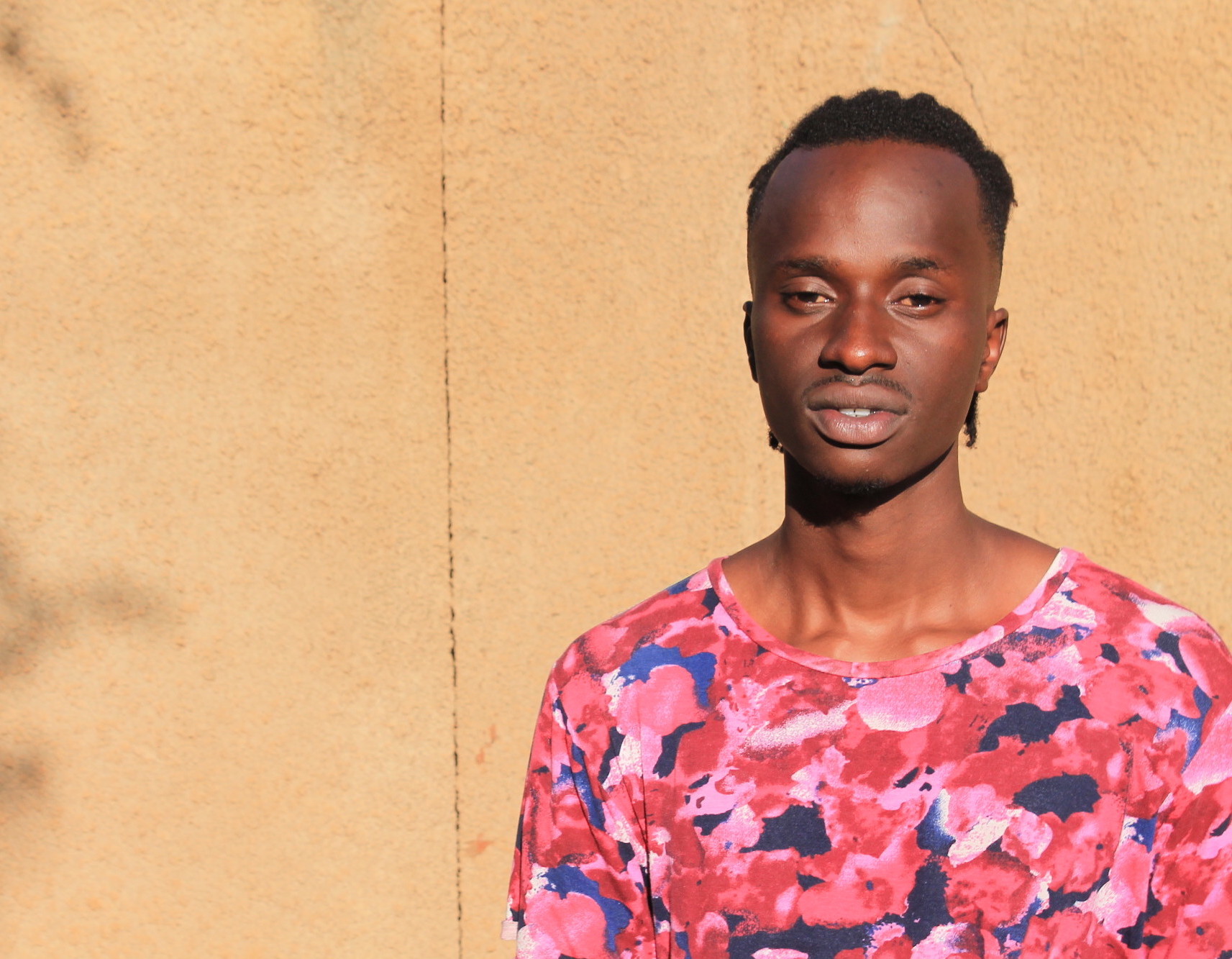
Moses Kabaseke, a talented hip-hop artist and activist from the Democratic Republic of the Congo (DRC), was forced to flee to Uganda in 2013 only 16 years old. Kabaseke, known by his stage name Belidor, has produced music since he was a child. “I use music as a weapon – music has power. I use music to promote human rights.”
Moses Kabaseke refers to DRC as the rich country with the poor people. “Back home a life means nothing. In Congo, life is something that can be taken from human beings easily – there’s no justice,” he states. “It’s difficult for people that have not experienced atrocities to understand how that feels like. With my music, I try to capture the trauma and injustices experienced by so many.” When he was only seven years old, his father was killed. “Every night when my mother was crying, I felt so bad. Since that age, I decided to fight for what was right.” In 2012, history repeated itself when his stepfather was killed before his eyes. At that point his mother had to make the difficult decision to leave home. In a quest to find safety, she brought her four children to Uganda.
“We don’t want to be here, but we are forced to be here,” he stresses, pointing out that life in exile is difficult. Being away from home, without external support and regular income, they face many challenges. “We need to look for ways to pay our bills. However, my siblings and I all have the blood of our father, so the thing we know how to do is music; so, we perform.”
In Uganda, Kabaseke continued his human rights promotion by composing music. After five years of hard work, often performing in Kampala’s bars, restaurants, and churches to finance his music, he recently finished his first autobiographical album. The album, ‘Les Mille Cris’ (Thousands of Cries), which contains ten songs written and produced by himself, conveys messages about human rights violations and injustices in DRC, and life as a refugee, among others. “Les Mille Cris is about breaking down the truth, sensitising Africans and victims of violations, and giving a voice to the voiceless.”
Through his music, he encourages people to tell their story, and moreover, urges the world to listen. Speaking the truth can come at a high cost. “As the number of my followers increase, my personal insecurity increase. Personal safety is essential as an artist talking about human rights,” he says. When asked what inspires him to continue despite the many challenges he is faced with, he states that “I promote human rights because I have been a victim of the system […] we are the main actors in the process of change. We have to stand for our rights.” Moses Kabaseke has partaken in several trainings organised by DefendDefenders, and performed at DefendDefenders’ events.
On 27 May 2019, the Jury of the 24th Ludovic-Trarieux International Human Rights Prize chose the Colombian lawyer Rommel Durán Castellanos, President of the Equipo Jurídico Pueblos (EJP), as the recipient of the 2019 Prize. The Prize will be officially presented to Mr. Durán Castellanos on 8 November 8 at 5 p.m. at the Salle D of the European Convention Center Luxembourg – ECCL. For further information please contact: uiacentre@uianet.org.
Rommel Durán Castellanos, 33 years old, is a human rights lawyer and a the president of the ‘Pueblos’ Legal Team (Equipo Juridico Pueblos) and a volunteer with the Committee for Solidarity with Political Prisoners (CSPP), in Bucaramanga, in the northern Cesar Department, as well as a member of the Santander branch of the Committee for Solidarity with Political Prisoners. Since 2007, Rommel Durán has been defending marginalized communities and victims of human rights abuses and carrying out grassroots training workshops on human rights and protection mechanisms. In particular, he provides legal assistance to victims of violations in rural areas, where forcibly displaced small-scale producers are attempting to return to their lands, and victims of such crimes as enforced disappearance, torture and killings, perpetrated by State agents and paramilitary groups.
Rommel Durán faces very serious threats to his life due to his work as a lawyer and has first-hand experience of the violence that he seeks to challenge through his work. He is subject to harassment, including to a campaign of threats, attacks and stigmatization because of his work accompanying small-scale farming communities who are claiming the restitution of their lands under the Colombian Victims and Land Restitution Law.
In his work as a member of the ‘Pueblos’ Legal Team, Rommel Durán supports members of the Pitalito community who maintain that they have been forced, at gunpoint, to sell their land at unfairly low prices. Alongside the Directing Committee of the National Movement of Victims of State Crimes (MOVICE), Rommel Durán accompanied those members of the community who have returned to their lands and has provided them with legal advice and protection during the difficulties they have encountered since their return.
Apart from being stigmatized and falsely (criminally) accused, assumedly by those who have ‘purchased’ the land, the returning members of the community and their (legal) supporters, including Rommel Durán, have also been shot at by armed men during an incident in December 2013 while attempting to verify the state of the community’s crops.
On 9 August 2014, Rommel Durán was arrested in the village Curumaní and detained in poor conditions. The only information given by these policemen at the time was that there was a warrant for alleged conspiracy. However they did not state which judicial office issued the order. His cell phone was snatched from him; he was filmed and photographed illegally and was prevented from calling his own lawyer. He was released after being detained for 20 hours on 10 August. The issue of this certificate suggests that there is no intention holding to account those responsible for Rommel Durán’s arbitrary detention.
On 15 October 2019, Ernie Suggs, reported in the Atlanta Journal-Constitution that the 12th Human Rights Defenders Forum in Atlanta had wrapped up and that former President Jimmy Carter said he’d like to see such defenders honored in a more permanent way at his namesake facility. According to the United Nations, 431 human rights defenders were killed worldwide in 2017. The Carter Center should tell those 431 stories, the former president said. Carter has been calling for the center to increase its presence in the human rights arena. “We ought to have a common place where we can get that information,” he said. “We ought to have a way to communicate with others so that, when people are abused or killed, their stories will be told.” However, there are already some serious projects on this area; see e.g. https://humanrightsdefenders.blog/2017/07/13/stop-the-killings-you-can-help-front-line/ and https://humanrightsdefenders.blog/2019/01/04/progress-report-on-i-defend-rights-project-in-2018/
Karin Ryan, the Carter Center’s senior policy adviser for human rights, said the narratives often get muddled. “The Carter Center has the ability to amplify the stories of human rights defenders, and the Carter Center has a reputation of speaking out and speaking truth to power,” Ryan said. “President Carter believes that we should be doing more and has challenged us to have a more comprehensive plan to get it done. When defenders start dying, what happens to society?”
About 50 activists, peacemakers and community leaders from 28 countries participated in the forum, which focused on “Building Solidarity toward Equality for All.” The group talked about global protection for activists, challenges faced by women fighting for human rights, and the best ways to support civil, economic, political and social rights. “Events like this are special because it makes us appreciate other agents and agencies that are doing good work around the world,” said Bashir Y. Mundi, a native of Nigeria and the director of the Development Initiative of West Africa. “This work can be under-appreciated and challenging, as evident by the stories you hear about the people who paid the ultimate sacrifice and lost their lives and freedom.”
Carter Center Statement from the 2019 Human Rights Defenders Forum:
Forum participants call on local and national governments and international organizations to:
1) Increase efforts to protect activists who are threatened and attacked. Offer activists political, moral,band physical support in times of crisis. Create robust programs to support women activists. Stop impunity for violators—hold accountable those who attack human rights and peace activists.
2) Increase meaningful long-term support for their work. Activists report that the difficult work of movements and civil society organizations is hamperedbydrastic funding cuts by previously reliable sources. In addition to issuingstrong statements about human rights abuses,governmentsshould also provide needed resources and other support. Philanthropic foundations also should increase flexible, long-term support. The Carter Center’s Human Rights Program has created a web-based platform to facilitate ongoing discussions and community building for human rights defenders and peacebuilders at forum.cartercenter.org
Asma Jahangir is rightly considered one of the foremost human rights defenders of our time [see: https://humanrightsdefenders.blog/2018/02/11/asma-jahangir-one-of-the-worlds-most-outstanding-human-rights-defenders-dies-at-age-66/]. So, the two-day ‘Asma Jahangir Conference 2019 – Roadmap for Human Rights’ which concluded in Lahore, Pakistan on 20 October 2019 is fully justified. The News carries a long report on the meeting in which some 120 jurists, politicians, human rights defenders and media people acted as panellists from Pakistan, England, America, Sri Lanka, Bangladesh, Ireland, Sweden and Afghanistan. Thousands of students, attended the sessions. They all resolved to carry forward the legacy of Asma Jahangir, who fought relentlessly against dictatorial forces and always sought due process of law, equality for women and protection of minorities in the country.
(Former) Politicians dominated the panels but other speakers at the sessions paid tribute to Asma Jahangir and appreciated her commitment to human rights with a resolve to uphold the rule of law and struggle for women’s rights. Munaza Hassan spoke of women’s right to inheritance. Daughter of Asma Jahangir and journalist Munizae Jahangir, who conducted the session, said: “It is a rare moment when all political parties are seen on the same platform.” She said that politicians conveniently forget to protect fundamental rights and right to expression when in they assume power. She said: “We are convinced that without freedom of the media, the rule of law and guarantees of security to human rights defenders, neither democracy nor justice, is possible. The main challenge to development of Pakistan and the rights of its citizens is a national security state. Until the national security is subservient, no other initiative in economy, health, education and rule of law can find success.
The day began with a short film on Asma Jahangir receiving the Right Livelihood Award, produced by True Heroes Films, where she spoke of growing expectations of citizens as far as what the governments should deliver. And governments falling ever further behind, internationally this gap of creative impulses of society on one side and governments dragging their feet on the other, has been the key engine of human rights challenges. Despite threats to her life, she spoke of never leaving Pakistan as it is a place where she has received most love and affection.
As a continuation of the discussion on ‘Art inspires politics’, Munizae Jahangir conducted a panel discussion on ‘How women can build bridges for peace in South Asia’. Former foreign minister Hina Rabbani Khar, Afghan politician Fawzia Koofi, human rights lawyer from Sri Lanka Bhavani Fonseka, Swedish Ambassador Ingrid Johansson and former Afghan ambassador to Pakistan Omar Zakhilwal opined that peace in South Asia was a prerequisite to securing women’s fundamental rights and the resources should be directed towards socio-economic areas rather than the military. Human Rights Ambassador of the Kingdom of the Netherlands, H. E. Dr Bahia Tahzib-Lie, Award-winning novelist Mohammad Hanif, Christian Caryl of the Washington Post, Wusat Ullah Khan, Ms Aisha Sarwari and Iqbal Khattak participated in the discussion on the role of social media.
Dr Bahia talked about the centrality of human rights in a thriving democratic society, and also the role of her government in supporting human rights initiatives all-over the world, including Pakistan. Aisha Sarwari talked about how women are systematically excluded from law-making process and, therefore, law-making concerning social media. She said it is essential for the social and economic development of all countries for women to be able to use the media as disruptive technology and end permission culture. Wusat Ullah Khan mentioned that the social media gives space to freedom, but also makes people extremely vulnerable. He said freedom of speech is part of a bouquet – you cannot talk about freedom of speech without talking about right to life and education and freedom of religion.
Iqbal Khattak, country representative of Reporters without Borders (RSF), spoke about the need for digital safety training and how one should protect oneself by disengaging with trolls. He particularly highlighted threats, accusations of blasphemy as threats that should be taken very seriously. He strongly encouraged use of PICA laws for individuals to seek online protection. He also highlighted Pakistan’s considerable investment in controlling social media spaces and vigilance on part of civil society. The Government of Pakistan should take social media as fundamental right.
On fighting the culture of shame and silence, woman rights activist Uzma Noorani, British professor of human rights Ms Siobhan Mullally, provincial Ombudsperson Khyber-Pakhtunkhwa Rukshanda Naz, Pakistan People’s Party leader Nafisa Shah, former chairperson of the Punjab Commission on the Status of Women Fouzia Viqar said that there should be universality of rights, for all excluded communities including women and marginalised remote communities.
..
On ‘Silencing civil society’, Ms Fareeda Shahid moderated the session of Knut Ostby, United Nations Resident and Humanitarian Coordinator for Pakistan. Ms Zohra Yusuf, human rights activist and council member of HRCP, Mohammad Tehsin, convener of Pakistan Civil Society National Forum, law expert Asad Jamal said registered civil society organisations should be allowed to function, 2013 policy of banning CSOs should be challenged. Mass communication needed to change narratives.
This new Amnesty International report, to be published annually, will serve as a regular audit of the performance of the three regional human rights institutions in Africa: the African Commission; the African Child Rights Committee; and the African Court. Beginning with this inaugural review, it will be published every 21 October in commemoration of the adoption of the African Charter on this day in 1981.
African rights bodies are frustrated at every turn by the lack of cooperation and support from African Union (AU) member states who desperately try to undermine their independence and autonomy, according to a new report published by Amnesty International. The new report, The State of African Regional Human Rights Bodies and Mechanisms, found that the continent’s rights bodies are working in harsh conditions whereby their decisions are blatantly ignored and their pleas for proper funding and human resources persistently fall on deaf ears.
“Africa’s human rights bodies are being wilfully subverted. The African Union’s Executive Council must resist these efforts and take its responsibility to monitor and enforce compliance with the decisions of the human rights mechanisms seriously,” said Netsanet Belay, Amnesty International’s Director for Research and Advocacy.
The report offers an assessment of the performance of three of Africa’s regional human rights institutions between January 2018 and June 2019: the African Commission on Human and Peoples’ Rights (African Commission); the African Child Rights Committee; and the African Court.
It found that out of the continent’s 54 countries, five (Comoros, Equatorial Guinea, Guinea Bissau, Sao Tome and Principe and Somalia) have not submitted a single report on the human rights situation in their countries since they ratified the Africa Charter for Human and People’s Rights. Many countries that submitted their human rights reports to the African Commission during the reporting period did so after delays in excess of a decade. Gambia and Eritrea set records by submitting their reports 21 and 19 years late respectively.
In the timeframe in review, the African Commission sent 83 urgent appeals to states over concerns of human rights violations. Of these only 26 (31 percent) received a written response. The African Commission further requested 27 country visits, of which only 13 were authorized in principle, and just five materialized.
Despite facing many stubborn challenges, African human rights bodies registered a relatively impressive record in developing new norms and standards including developing a draft treaty on the rights to social protection and social security. The African Commission also published seminal studies on transitional justice and on human rights in conflicts. The African Court on Human and Peoples’ Rights (African Court) issued 25 decisions. However, only Burkina Faso had fully complied with the court’s decisions by the end of the reporting period. Some countries, including Tanzania, partially complied, while Cote d’Ivoire, Kenya, Libya and Rwanda didn’t comply at all.
“Both the African Commission and the African Court face a chronic backlog problem because of a slow pace in determining cases. They must urgently develop plans to speed up determinations and ensure strict adherence to time limits for parties, especially state parties,” said Netsanet Belay.
The report also highlights an onslaught on human rights defenders in Africa. Between January 2018 and June 2019, appeals for protection of HRDs accounted for 71 percent of all appeals issued to state parties by the African Commission. HRDs in the Democratic Republic of Congo (DRC) and Egypt were the worst hit, the Africa Commission issuing 11 and 10 urgent appeals respectively to their governments. These were closely followed by Burundi with seven urgent appeals, Cameroon and Algeria each with six, and Uganda and Sudan, each with five appeals.
It is extremely alarming that governments across Africa have singled out human rights defenders to try to silence them and bring an end to their activism through brutal attacks, harassment, unlawful arrest and detention. Attacks on human rights defenders are an attack on the rights of all the people whose freedoms they are fighting for.
On 18 October 2019 the UN High Commissioner for Human Rights urged Egypt to immediately release scores of citizens who have been arrested in connection with recent anti-government demonstrations in several cities. Civil society groups report more than 2,000 people were detained before, during and after the protests on 20 September, which prompted the UN High Commissioner for Human Rights, Michelle Bachelet, to express concern about reports of lack of due process. On Friday her office reported that the arrests are continuing, with a number of well-known and respected civil society figures affected, some of whom have been accused of terrorism. “Once again, we remind the Egyptian Government that under international law people have a right to protest peacefully, and a right to express their opinions, including on social media. They should never be arrested, detained – let alone charged with serious offences such as terrorism – simply for exercising those rights”, spokesperson Ravina Shamdasani told journalists in Geneva.
The abduction, arbitrary detention and torture of human rights defender and journalist Esraa Abdelfattah is another indication that Egyptian authorities are stepping up brutality against human rights defenders in a bid to ‘terrorize’ critics and opponents, said Amnesty International today. Esraa Abdelfattah was assaulted and abducted by security forces in plainclothes on 12 October. The next day she described to the Supreme State Security Prosecution how she was tortured by officers who beat her, attempted to strangle her and forced her to stand for nearly eight hours. “Esraa Abdelfattah’s account of torture, coming just days after the prominent activist and blogger Alaa Abdel Fattah described a similar ordeal in custody, is an alarming indication that Egypt’s authorities are stepping up their use of brutal tactics to crack down on human rights defenders,” said Najia Bounaim, North Africa Campaigns Director at Amnesty International.
Prominent blogger Alaa Abdel Fattah as well as his lawyer, Mohammed El-Baqer are currently being held at the Tora Maximum Security Prison, south of Cairo. Both have been accused of belonging to a terrorist group, funding terrorism, spreading false news that undermines national security and “using social media to commit publishing offices”, the UN human rights office said. [see also: https://humanrightsdefenders.blog/2019/01/08/bloggers-and-technologists-who-were-forced-offline-in-2018/]
On 28 September the High Commissioner had already urged the “authorities to radically change their approach to any future protests’.
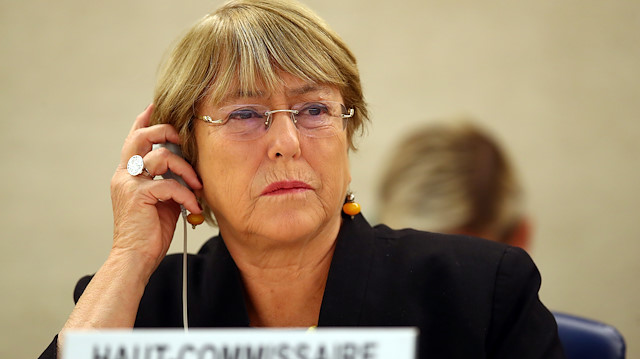
U.N. High Commissioner for Human Rights Michelle Bachelet Photograph: DENIS BALIBOUSE
More than 2,000 people were detained, including lawyers, human rights defenders, political activists, university professors and journalists on 20-21 September, she said. The Egyptian Foreign Ministry spokesperson stressed that there no citizen in Egypt is arrested or prosecuted for carrying out legitimate activities or criticizing the Egyptian government, but for violating the law. He added that the right to peaceful demonstration is guaranteed in accordance with the Constitution and the law. Hafez stressed that the OHCHR report was based on undocumented information, which only leads to falsehoods as the allegations contained in it are based on wrong ideas, and this hasty judgment reflects a lack of professionalism. He added that any actions taken against any person is done in accordance with the law and through sound legal procedures, all carried out with transparency and clarity.
In addition on 3 October 2019 it was reported in the New York Times that a series of sophisticated cyberattacks targeting Egyptian journalists, academics, lawyers, opposition politicians and human rights activists has been traced to Egyptian government offices, a cybersecurity firm has found. The attackers installed software on the targets’ phones that enabled them to read the victims’ files and emails, track their locations, identify who they contacted and when, according to a report to be published Thursday by Check Point Software Technologies, one of the biggest cybersecurity companies in the world, with headquarters just south of San Francisco and in Tel Aviv.
The cyberattack began in 2016, according to the Check Point report. The number of victims is unknown but Check Point identified 33 people, mostly well-known civil society and opposition figures, who had been targeted in one part of the operation. “We discovered a list of victims that included handpicked political and social activists, high-profile journalists and members of nonprofit organizations in Egypt,” said Aseel Kayal, a Check Point analyst.
Several activists targeted by the cyberattack were arrested as part of a crackdown on antigovernment protests. They include Hassan Nafaa, left, a political scientist at Cairo University, and Khaled Dawoud, a former journalist and leader of the secular Constitution Party. CreditAgence France-Presse — Getty Images
“We are witnessing an increase in xenophobia, hate speech, push-backs on women’s equality and the rights of minorities,” warned Michelle Bachelet, United Nations High Commissioner for Human Rights, also highlighting the ever-widening gaps in global wealth and access to resources. Moreover, underfunding has hampered the growing workload of the entire treaty body system, she said. Committees do not have adequate resources to carry out inquiries into grave or systematic violations. This results in a “credibility crisis” for all treaty bodies — and a denial of justice for the victims of human-rights violations.
Among the day’s three other briefers was Obiora Chinedu Okafor, Independent Expert on human rights and international solidarity, who focused on the issue of human-rights based solidarity in global refugee protection. The current refugee “crisis” was not caused by large numbers of refugees, but rather by States’ unwillingness to accept refugees into their countries — evading their responsibilities. Moreover, the rise of extremist political parties is complicating the issue, he said, as the “alternative right” and other racist civil society groups target any kind of solidarity with refugees. Echoing those words, the Russian Federation’s delegate noted that certain extremist political parties are impeding the entry of refugees into the European Union, and that the Independent Expert’s report lay the blame for this squarely at the feet of foreign interference in internal State affairs.
In his presentation, Michel Forst, Special Rapporteur on the situation of human-rights defenders, highlighted that 431 defenders were killed in 2017 and 2018. With that in mind, combating impunity is not only a legal obligation of States, but also a moral one. He further noted that “98 per cent of the killings of rights defenders remain unpunished” and that unless impunity is ended, the violence against them will continue. A zero-tolerance policy towards such attacks must be adopted, and the lack of political will — and of State recognition of rights defenders — addressed. Reacting to those comments, several delegates raised questions about digital attacks on human-rights defenders, with Germany’s representative underscoring that female defenders of human rights often face particular threats, such as the publication of private information. Mr. Forst responded that he has found research by the Special Rapporteur on freedom of association and the Special Rapporteur on freedom of expression helpful in this context, with a particular focus on advocating for social network businesses to provide better protections. To concerns raised by an observer for the State of Palestine and the representative of Georgia, he noted that his subsequent report will make specific proposals to assist defenders living in fragile States, as well as those living in conflict or post-conflict situations. On defenders who live in isolated areas, he said they are often not given sufficient attention by the international community. Ambassadors should leave their capitals and go into these far-flung areas to see where these defenders work, he said. Those who work on sexual and reproductive health and rights often bear the brunt of attacks, while those working on gender identity are harassed and threatened
The Special Rapporteur on the rights to freedom of peaceful assembly and of association, Clément Nyaletsossi Voulé, also presented his report.
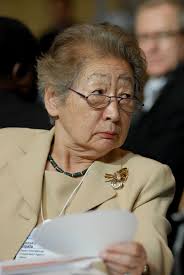 Sadako Ogata the first woman to head the UN High Commissioner for Refugees has died at the age of 92 on 22 October 2019. I served under her for many years and have the greatest admiration for her. Sadako Ogata worked on some of the largest crises of the decade during her time in service from 1991 to 2000, including the Kurdish refugees fleeing from Iraq after the 1991 Gulf War, the Balkans War and the Great Lakes region of Africa. Before joining the UN, she was an academic – serving as dean of the faculty of foreign studies at Sophia University in Tokyo in 1989, where she had been a professor since 1980. She was well respected by UN staff and world leaders alike, and was described by her colleagues as a “five-foot giant” for her formidable negotiating skills and ability to confront hostile factions. From 2003 to 2012, Ogata was the head of the Japan International Cooperation Agency, overseeing efforts to provide assistance to those in developing countries.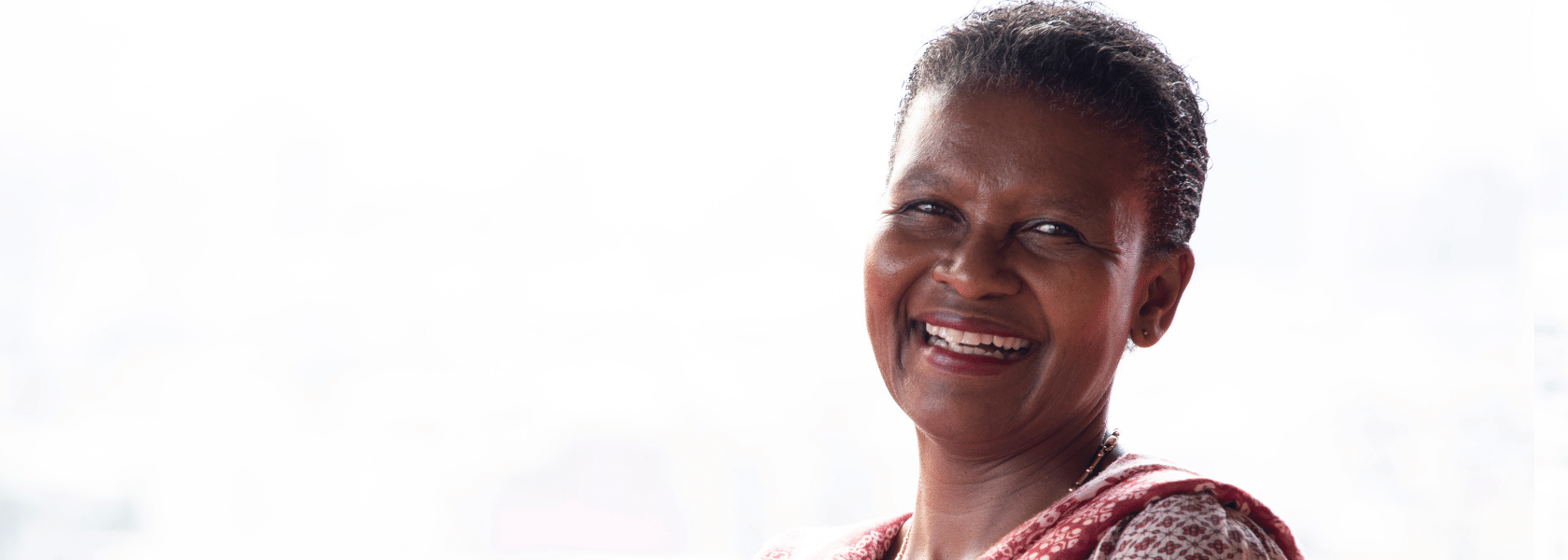





 Hans Thoolen on Human Rights Defenders and their awards