Archive for the 'human rights' Category

24 January, Day of the Endangered Lawye: ABA focuses on Pakistan

January 17, 2020
Pakistan is the focus of this year’s Day of the Endangered Lawyer (January 24) and the American Bar Association is organising a teleconference, in which panelists will provide a report of the current state of attacks on the judiciary, bar and other human rights defenders in Pakistan, as well as offering suggestions for how the ABA and other outside organizations can lend support. [see also: https://humanrightsdefenders.blog/2018/01/22/24-january-2018-day-of-the-endangered-lawyer-focus-on-egypt/]

Moderator:

  • Sara Sandford, Immediate Past Co-Chair, International Human Rights Committee

Speakers:

  • Jalila Haider, Founder of We the Humans
  • Farahnaz Ispahani, Senior Fellow, Religious Freedom Institute; Global Fellow, Woodrow Wilson International Center for Scholars
  • Hussain Haqqani, Former Ambassador to US
  • Raza Rumi, Director of the Park Center for Independent Media, Ithaca College; Visiting Faculty at Cornell Institute for Public Affairs; and Editor of Daily Times

Call for nominations for the 2020 Right Livelihood awards

January 16, 2020

The Right Livelihood Foundation has issued the Call for Nominations for its 2020 awards. For information on these awards, see: http://www.trueheroesfilms.org/thedigest/awards/right-livelihood-award. Note the new logo.

In every generation, there are groups of people and individuals around the globe who valiantly uphold these principles of right livelihood, often working in the face of adversity. The Right Livelihood Award exists to honour and support such people.” The deadline is 4 March 2020. For the form click the link at the bottom.

For last year’s awards, see: https://humanrightsdefenders.blog/2019/09/26/right-livelihood-award-2019-lauds-practical-visionaries/


https://rightlivelihoodawardfoundation.submittable.com/submit

Daniel Ravindran; a voice of reason in India’s human rights debate

January 16, 2020

A protest in Srinagar in December 2016.

A protest in Srinagar in December 2016.

With the evolution of international law in the last 100 years, the concept of unrestricted sovereignty has weakened

The human rights situation in Jammu and Kashmir (J&K) following the dilution of Article 370 and the passage of the Citizenship (Amendment) Act (CAA) have brought renewed international focus on India’s human rights practice. Responding to criticism made by the United Nations agencies and others, the Indian state asserted that both J&K and CAA are entirely internal matters and there cannot be any interference in such sovereign decisions.

What is remarkable about modern international human rights law is its recognition of individuals as subjects. Classic international law governed the conduct between states and did not recognise the rights of individuals. Countries made agreements on the premise that a sovereign state had the exclusive right to take any action it thought fit to deal with its nationals. Such a notion of absolute sovereignty was challenged in 19th century with the emergence of humanitarian intervention to protect minorities living in other states. Later, in 1919, the evolution of labour standards led to the establishment of the International Labour Office (ILO). In 1926, the Slavery Convention adopted by the League of Nations prohibiting slave trade heralded the first human rights treaty based on the principle of dignity of a human being. The Universal Declaration of Human Rights, adopted in 1948 by the United Nations, was the first comprehensive international human rights document. The Universal Declaration has acquired the force of law as part of the customary law of nations. It has provided the basis for binding human rights treaties and non-binding guidelines/principles that constitute a distinct body of law known as international human rights law.

Unsustainable claim

This progress of international law in the last 100 years makes the Indian state’s assertion of its sovereign right unsustainable. The evolution of international human rights law is also about the gradual weakening of the concept of unrestricted sovereignty. The Indian government has ratified several international human rights treaties and submits periodic reports to the respective treaty bodies. By doing so, it has acknowledged the principle that the treatment of its citizens is not entirely an internal matter, and such measures do not enjoy an absolute sovereignty.

The Indian government’s response to concerns about its human rights practice has always been that international scrutiny is unwarranted since the country is the largest democracy in the world with an independent judiciary, free media, and an active civil society. These claims sound less credible after the recent developments in J&K and the passage of the CAA.

Non–discrimination is a fundamental principle of human rights. Discrimination in various forms occurs in all societies, but what is of concern is institutionalised discrimination. Apartheid was pronounced as a crime against humanity since it institutionalised discrimination based on race. Similarly, for the first time in post–Independence India, a religious group has been excluded from the purview of a law dealing with citizenship.

The Office of the High Commissioner for Human Rights (OHCHR), which is the lead agency within the UN system on all aspects related to human rights, has expressed its concern stating that the CAA “is fundamentally discriminatory in nature”. It has also said that “although India’s broader naturalization laws remain in place, these amendments will have a discriminatory effect on people’s access to nationality.”

International human rights law includes safeguards against unwarranted foreign intervention and stresses the exhaustion of domestic remedies before an issue is considered by an international body. The Indian state always assured the international community that the judiciary, mainly its Supreme Court, would provide adequate remedies to victims of human rights violations. However, of late, the faith of the common people in the higher judiciary has been weakened. In the face of serious allegations about human rights violations in J&K, the Supreme Court has “ducked, evaded and adjourned”, as put across by advocate Gautam Bhatia.

Weakening of civil society

While responding to criticism against its human rights practices, the Indian government also refers to the role of free media and civil society in protecting the human rights of vulnerable groups. However, in the context of J&K and the ongoing struggle against the CAA, the media has not come out any better. As for civil society organisations, the government since 2014 has systematically targeted them, including by making it difficult for them to receive funds from foreign donors. Since 2014, the government has cancelled the registration of about 14,000 NGOs under the Foreign Contribution Regulation Act (FCRA). It has also mainly targeted its own critics.

Indian and international human rights groups are getting increasingly concerned about the actions of people associated with the ruling party who are engaged in the intimidation of critics, attacks against minorities, and restrictions on the freedoms of artistes. The brazen attack on JNU students on January 5 by armed goons and the total lack of response by the police is emblematic of free reign given to non-state actors in various parts of the country.

The international community is sympathetic to governments that are committed to upholding human rights but lack human and other resources to pursue it. In the case of India, it is not a question of resources but an unwillingness to uphold human rights. The government’s action in J&K, the passage of the CAA, and its response to protests on the CAA demonstrate that the present regime is not fully committed to upholding human rights and does not respect international human rights standards. Of course, it is possible for the Indian government, due to its diplomatic clout, to avoid robust intervention by the UN Human Rights Council and other UN human rights mechanisms. However, it would not be able to avoid scrutiny by the international community, which would complement the struggle of the Indian civil society to reclaim the Indian Constitution and advance human rights.

For transparancy reasons: https://humanrightsdefenders.blog/2013/12/14/who-should-be-the-new-un-rapporteur-for-human-rights-defenders-ravindram-is-my-choice/

https://www.thehindu.com/opinion/lead/human-rights-are-not-solely-an-internal-matter/article30537443.ece

Dakar Rally: sports washing par excellence

January 15, 2020
AlKhaleej Today on 14 January 2020 carries an interesting post by Anthony Harwood, a former foreign editor of the Daily Mail, entitled: Dakar Rally opens dark new chapter in Saudi sportswashing“. Here some long excerpts listing some of the many sports events which Saudi Arabia has been buying, but with the main focus on the Dakar Rally. [see also: https://humanrightsdefenders.blog/2020/01/04/dakar-rally-starts-on-5-january-in-jeddah-but-hrds-in-jail/ and https://humanrightsdefenders.blog/2020/01/13/saudi-arabia-finds-that-celebrities-are-easier-to-buy-than-human-rights-ngos/].

..But regrettable also that the organisers of the race, France’s Amaury Sport Organisation (ASO), have chosen not to say or do anything which might upset the host country, Saudi Arabia, and spark headlines around the world.  There was once a time when campaigners would call on sportsmen and women to boycott Riyadh when asked to play there, much as happened when “rebel tours” of South Africa were announced during the apartheid era. But that changed when the desert kingdom began offering huge sums of money that footballers, wrestlers, tennis players, snooker players and golfers were finding hard to turn down. 

Human Rights Watch and Amnesty International realised that calling for a boycott was never going to work when the lure of the Saudi riyal was so great and promoters could point to how companies like House of Fraser, Gucci, Chanel and Starbucks are already trading in Saudi Arabia, so what’s all the fuss?  Instead, campaign groups asked that anyone who went to Riyadh spoke out while they were there about the country’s appalling human rights abuses….

As Ines Osman, director of the MENA Rights Group, said: “These activists, and countless others, have paid the price of their freedom for the state’s ‘social change’ narrative. Competitors and sports fans must speak up, as silence allows Riyadh’s soft power tactics to wash away human rights abuses, shutting down the voices of Saudi human rights defenders.” 

The term ‘sportswashing’ has entered the lexicon as a way to describe how countries such as Saudi Arabia use sport to wash away the stains on their reputation and pretend everything in the garden is rosy.  To do this they lure sports stars and celebrities to their country with huge sums of money; only on Friday the manager of Barcelona, Ernesto Valverde, admitted that the only reason the Spanish Super Cup was being hosted in Riyadh was because of the money on offer.  Likewise, the British boxer, Anthony Joshua, got $86m to agree to last month’s world heavyweight title fight with Andy Ruiz Jnr in Saudi Arabia. 

..In November the Dakar director, David Castera, claimed there had been hesitation before choosing Saudi Arabia for the rally, but didn’t elaborate on what the “many guarantees” were which had held things up.  He also noted that Dakar was not the first sporting event to be held in Saudi, which of course is true, and is why the Saudis continue to spend a fortune attracting high-profile competitors: so it becomes normalised. 

The Saudi authorities have said they hope broadcasts of the race – showing the country’s beautiful expanses of desert, mountains and coastline – will provide a boost to its tourist industry. The sports minister, Prince Abdulaziz bin Turki al-Faisal, said accusations of sportswashing are wrong because his country was always criticised for “not opening up to the world”. What a crass thing to say. By opening up, we don’t mean gawping at the Saudi desert.  By opening up we mean having a transparent judicial system where a trial which allows the organisers of Khashoggi’s murder to escape punishment can be scrutinised.  By opening up we mean allowing a cross-party group of British members of parliament access to women’s rights activists detained in Saudi Arabia, as well as their guards, following claims they have been tortured and sexually assaulted while in jail.  By opening up we mean allowing an examination of how the Saudi-led coalition have carried out unlawful attacks in Yemen, restricted access to humanitarian aid, carried out arbitrary detention, enforced disappearances and child recruitment. 

It’s sad that not one of those drivers from 62 nations had so much as a pink armband between them when they set off from Jeddah on 5 January on what the Saudi media proudly call ‘Chapter 3’ in the race’s history.  If they don’t find their voices by the time they reach Riyadh on Friday – and I’m not holding my breath – the start of a five year contract to hold the race in Saudi Arabia will actually mark the most shameful stretch of the Dakar Rally’s history. 

For more of my posts on sports washing: https://humanrightsdefenders.blog/tag/sports-washing/

https://alkhaleejtoday.co/saudi-arabia/21704/Dakar-Rally-opens-dark-new-chapter-in-Saudi-sportswashing.html

Land rights defenders in Uganda face tough legal regime

January 14, 2020
DSC_0354 (1)
By witnessradio.org Team

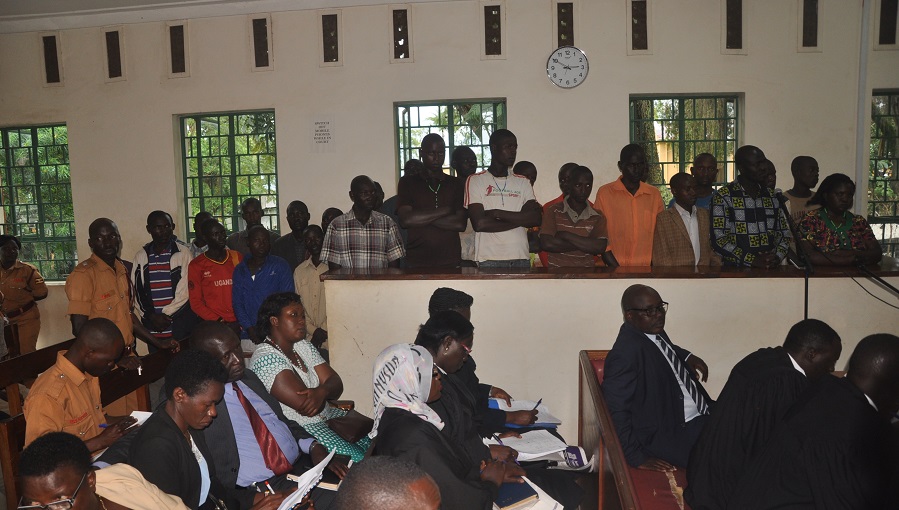
in Uganda reported about the criminal trial of the 28 land rights defenders.

…Grace Nantubiro and Ronald Mugwabya are among the 28 land defenders and also members of witnessradio.org. They were arrested because of being on the frontline defending over 3000 people from were being violently evicted by local businessman George Kaweesi.  Kaweesi was shielded by police and the due process was never followed. Their pleas fell on deaf-ears until a violent crash ensued between the communities and the workers of a businessman that claimed a life of one Yunus Kasajja. Kasajja had been tasked by Kaweesi to supervise the eviction exercise.

The land under dispute is registered on Block 168, Plot 19, 22 and 23 with over 322.5 hectares covering five villages namely, Kambuye, Kikono, Kyabaana, Kanseera and Lwensanga in East Division, Mubende Municipality, Mubende district. The land forcefully taken was hosting some of the families that were evicted by Kaweeri Coffee Plantation limited in the early 2000s. The 600 families are part of the 2000 families, relocated to that land as compensation for what they had lost to Kaweeri Coffee Plantation limited. That land was formerly owned by Emmanuel Kayiwa Bikko who has since passed on.

Lately, the land-grabbing elements have resorted to using the Penal Code to charge land defenders because the law is lethal.  It imposes harsher prison sentences than any other and also obtaining bail once charged under it is either legally hard or too expensive for the rural communities in Uganda. These persecutions are manifesting majorly in districts that host minerals including sub-regions of Karamoja, Bunyoro and Buganda. Essentially, the prosecution alleges that on October, 12th, 2018, the accused:  Nantubiro Grace and Mugwabya Ronald and others at Kambuye-Kanseera, Mubende district, robbed Yunus Kasajja Tabu of his three mobile phones and thereafter proceeded to end his life.  If found guilty of the murder charge, they stand a chance of facing the ultimate punishment which is death.

https://witnessradio.org/the-criminal-trial-of-the-28-land-rights-defenders-is-set-to-resume-today/

European judges demonstrate in Poland against the ‘muzzle law”

January 13, 2020

Not many of us would expect to see European judges demonstrating in the streets, but Al Jazeera reports that on Saturday 11 January 2020 many joined their Polish peers in protest against the ‘muzzle law’, a bill which proposes strict disciplinary measures against Polish judges critical of the government’s judicial overhaul.

The latest escalation came when the government introduced a bill to discipline judges who question its changes [Anadolu]

The office of Warsaw’s mayor said some 30,000 people took part in Saturday’s march to denounce a bill that would allow the Law and Justice (PiS) government to discipline judges who question its judicial changes. The introduction of the measure in December is the latest episode in a years-long squabble over courts reform in the country that has triggered a feud with the European Union. [see also: https://humanrightsdefenders.blog/2019/04/08/polish-judges-have-become-human-rights-defenders/]

Judges from more than 20 other European countries, many wearing judicial robes over their thick winter coats, carried placards with their countries’ names. As each delegation was announced, chants of “Thank you, thank you” rose from the crowd. About 1,000 Polish judges also joined the rally, with many travelling to Warsaw from all corners of the country.

We want to feel that we are safe at work. A judge cannot fear that if a ruling they hand down is inconvenient for the government, they will bear consequences. It takes a lot of courage to stand up to that,” said judge Halina Musial.

Background: Despite protests in some 200 towns and cities when first announced, the draft law passed the PiS-dominated lower house in late December. It is now being considered by the opposition-controlled Senate, which may delay its passage, but is unlikely to stop it. The draft law, which makes it easier to dismiss or fine uncooperative judges, is seen as a response to an earlier blow to the government’s reforms.  In early December, the Supreme Court ruled that its own disciplinary chamber, a body created by the government, is “not a court within the meaning of EU and national law”. The court also found that the constitutional body nominating judges, the National Council of the Judiciary (KRS), which has been reformed to be mostly appointed by parliament rather than other judges, is “not an impartial and independent body”. When first introduced in December, Małgorzata Gersdorf, Supreme Court chief justice, warned that the changes would “infringe EU treaties” and risked driving Poland out of the bloc. For its part, the government claims that the bill is necessary to stop judges from “undermining” the legal system.  Since taking power in 2015, PiS has been at loggerheads with the EU over its judicial meddling, including installing allies in the constitutional court, trying to force Supreme Court judges into retirement and politicising lower-level appointments.  The European Commission’s vice-president, Vera Jourova, has urged Poland to halt work on the legislation until it had been properly consulted, echoing calls by the Council of Europe and the United Nations’ High Commissioner for Human Rights

At Saturday’s protest, Irish Supreme Court judge John MacMenamin carried letters of support from Irish Chief Justice Frank Clarke and the Association of Judges of Ireland, according to the Irish Times. Murat Arslan, an imprisoned Turkish judge and winner of the 2017 Vaclav Havel Human Rights Prize, also sent a note of support to the protesters, Polish website OKO.press reported. At the request of the opposition Senate speaker, the Venice Commission, an advisory body of the Council of Europe, visited Warsaw this week to prepare its “urgent opinion”, but the government declined to meet the representatives. Deputy Prime Minister Jacek Sasin responded that “Poland is a sovereign country and shapes its own legal system, including the judiciary. These are not issues governed by European law”.

Civil Rights Defenders is looking for a controller with experience of working with projects

January 10, 2020

The Stockholm-based NGO Civil Rights Defenders wants to take its Finance Department to the next level and is now looking for a Controller to help develop processes and working methods. As a Controller, you are a key asset in the Finance Department. The main focus is to simplify and improve all financial areas in order to get the very best results out of our new ERP system Maconomy. As a Controller, you will be responsible for a number of departments and act as controller for important projects in close cooperation with your colleagues in Stockholm as well as the rest of the world.

Some of the key activities include

  • Setting up project budgets in consultation with our project and program managers.
  • Financial reporting of our projects to donors and auditors.
  • Supporting department managers in budgeting and forecasting.
  • Responsible for analysing projects and department results in connection with monthly, quarterly and annual reports.
  • Contact person for our departments regarding financial matters.
  • Contributing to our work with new reports and improved controlling processes.
  • Participating in improving the financial work.

We are especially interested in applicants with

  • A Degree of Master of Science in Business and Economics, or similar, with a few years working experience in controlling and project reporting.
  • Experience in a project-based work, preferably from a non-profit organisation or consultancy-driven work.
  • Strong interest in pursuing improvement, big or small.
  • Experience in managing ERP systems, such as Maconomy.
  • Good knowledge of Microsoft Office Suite and a very experienced Excel user.
  • Very good knowledge of Swedish and English, both written and verbal.

About the position

  • Permanent employment (100%) with an initial six months probation period.
  • The position is based at Civil Rights Defenders’ head office in Stockholm, Sweden.
  • The position may include some travel to Civil Rights Defenders’ local offices.

Application

To apply, submit your cover letter and CV to info@crd.org no later than 30 January 2020. Please state “Controller” in the subject line. Interviews will be conducted on an ongoing basis, meaning the position could be filled ahead of the deadline. Welcome with your application! For questions about this position, please contact Karin Ancker, CFO. Civil Rights Defenders has a local union club connected to Unionen. The union can be reached at crdunionclub@crd.org.

https://crd.org/2020/01/08/civil-rights-defenders-is-looking-for-a-controller-with-experience-of-working-with-projects/#

The annual Oxi Day Courage awards

January 8, 2020

A small but interesting award that must be close to my heart (as I live in Greece) is the Oxi Day Courage Award. For more information see: http://www.trueheroesfilms.org/thedigest/awards/oxi-day-courage-awards.

Philip Chrysopoulos in GreekReporter of 27 October 2019 recalls the strategic importance of the the Greek resistance (“What if the Greeks Did Not Say “Oxi” on October 28, 1940?”).

October 28 is a Greek national holiday, but not without its share of criticism, as there are those who argue that it commemorates the country’s entry into a war instead of a victory or a liberation day, as is typically the case with such holidays. However, if Greeks did not say “Oxi” and avoided the war, it is entirely possible that the consequences for Greece and the world would have been far more devastating. Greece likely would have lost portions of its territory and definitely would have lost its national pride.

On the contrary, the proud “Oxi” uttered by Prime Minister Ioannis Metaxas in the early morning of October 28, 1940, and a few hours later by the Greek people who went out on the streets celebrating, united the Greeks. The events of that historic night united the Greeks who had previously been divided into leftists and rightists, monarchists and republicans, communists and nationalists. The division was so intense that between 1922, the year of the Asia Minor disaster, and 1936, no government could remain in power for long. This brings us to 1940, where the man who said “Oxi” to the Italian ambassador was a dictator, who had been appointed prime minister by King George in early 1936 and who by August 4 of that year had established a military regime. Ioannis Metaxas was a monarchist who was accused of being a sympathizer of both the Nazis in Germany and the Italian fascists, yet he was a patriot first and foremost. But what would have happened if, on that night, Metaxas had said “yes” instead? The Greek prime minister was a highly educated military man and knew quite well that a war would cost Greece thousands of lives while causing tremendous damage. He could have surrendered and allowed the Axis forces to enter Greece in an easy and relatively bloodless occupation. France, under German rule since June of that year, was a good example of such a smooth occupation…..

In 2019 the laureate was Jamal Khashoggi [see e.g. https://humanrightsdefenders.blog/tag/jamal-khashoggi/ ]

In 2018 it was Vladimir Kara-Murza, vice chairman of the Open Russia movement and chairman of the Boris Nemtsov Foundation for Freedom.  Twice, in 2015 and 2017, he was poisoned with an unknown substance and left in a coma; the attempts on his life were widely viewed as politically motivated. Kara-Murza writes regular commentary for the Washington Post, the Wall Street Journal, World Affairs, and other periodicals, and has previously worked as a journalist for Russian broadcast and print media, including Ekho Moskvy and Kommersant. He directed two documentary films, They Chose Freedom (on the dissident movement in the USSR) and Nemtsov (on the life of Boris Nemtsov).

In 2017 Ji Seong-Ho who lived through North Korea’s “Arduous March,” the propaganda term used by the ruling Workers’ Party of Korea to describe the famine of the 1990s that killed an estimated 3.5 million people. He survived by eating grass and tree bark, and by foraging through garbage at street markets…In March 7, 1996, while jumping from one train car to another, he was so weak from malnutrition he passed out mid-jump. When he regained consciousness, he saw the back of the train disappearing down the track before realizing it had run over half of his body…Once able to walk on crutches, …In 2006, he and his brother escaped North Korea. Within a month of arriving in South Korea, he was provided prosthetics, and a few years later he founded a human rights activist group, NAUH (Now Action & Unity for Human Rights).  Ji has participated in several human rights symposiums and cultural events in a bid to improve North Korean human rights. Through his organization, Ji helps defectors plan escapes to South Korea and other countries and is involved in fundraising to secure financial stability for defectors. Ji is also involved in various activities reporting on the situation through Radio Free Asia broadcasts. [see also: https://humanrightsdefenders.blog/2015/05/29/north-korean-defector-ji-seong-ho-in-video-talk/]

https://www.oxidayfoundation.org/annual-celebration/the-oxi-day-award/

https://greece.greekreporter.com/2019/10/27/what-if-the-greeks-did-not-say-oxi-on-october-28-1940/

South Sudan’s President Salva Kiir has released two human rights activists

January 8, 2020

Garang Malak reports in the Kenyan newspaper the Nation that South Sudan’s President Salva Kiir has released two human rights activists who were jailed for criticising the government. The order, dated January 1, 2020, included a list of 30 inmates most of who had been imprisoned on minor offences and had shown good conduct while in detention. But it also included Peter Ajak Biar [see: https://humanrightsdefenders.blog/2019/03/30/seven-persons-charged-in-south-sudan-including-peter-biar-ajak/ ]and Keribino Agok Wol, critics of President Kiir’s regime. The two were detained in July 2018 before they were jailed in June 2019. Mr Biar, 35, a PhD student at Cambridge University, had called on top leaders in Juba to resign and give the younger generation a chance to lead the country.

https://www.nation.co.ke/news/africa/Salva-Kiir-pardons-key-critics-Peter-Biar–Keribino-Wol/1066-5405914-h4dloxz/index.html

Mexico: in eight years 99.5% of crimes against media workers have gone unsolved – time for something better

January 4, 2020
Protesters call for justice for a Michoacán journalist who was victim of an assault last September and then harassed by police. Protesters call for justice for a Michoacán journalist who was victim of an assault last September and then harassed by police.

In that context, National Action Party Senator Marco Antonio Gama Basarte last month presented a proposal that seeks to create a new, completely autonomous special prosecutor’s office to investigate crimes against both journalists and human rights defenders. Mexico needs a strong and independent prosecutor’s office in order to “guarantee the institutional commitment we have with journalists and people who defend human rights,” he said while presenting his bill on December 12.

The senator also said that an average of 23 journalists per month requested government protection last year, adding that the funds to provide such protection were cut in the federal budgets for both 2019 and 2020. President López Obrador has come under fire for contributing to a culture of violence against journalists by launching scathing verbal attacks on reporters and news outlets that are critical of his government. The president often dismisses reports with which he doesn’t agree by declaring that they come from the prensa fifi (elitist press) and has called journalists and news outlets “puppets,” “hypocrites” and “two-faced,” among other disparaging terms.

After López Obrador criticized a story published by the Mexico City-based newspaper Reforma in April last year, the paper’s editor received death threats and was a victim of harassment.

Article 19, a press freedom organization, said at the time that the president’s “stigmatizing discourse [against the media] . . . has a direct impact in terms of the . . . risk it can generate for the work of the press because [his remarks] permeate in the discourse of the rest of society and can even generate attacks.” The organization demanded that López Obrador “abstain from generating any act that inhibits the exercise of freedom of expression,” adding “this includes maintaining a stigmatizing discourse” against the media.

Source: El Financiero (sp) 

https://mexiconewsdaily.com/news/prosecutor-for-crimes-against-journalists-has-closed-4-of-803-cases/