Yen Palec on 6 June 2020 writes that a group of Facebook employees recently resigned. They do not agree with Mark Zuckerberg’s political stance. Some engineers are condemning the executive for his refusal to act on issues about politics and police brutality.
In a blog post, the engineers claim that Facebook has become a “platform that enables politicians to radicalize individuals and glorify violence.”.. Several employees, many of whom are working at home due to the pandemic, are criticizing the company. While some claim that the First Amendment protects these hate posts, many are arguing that it has gone too much…..
These criticisms are coming from some of Facebook’s early and tenured employees. Among those that vent their criticism are Dave Willner and Brandee Barker. They claim that the company’s policy may result in a double standard when it comes to political speech…..
In terms of political speech, Twitter’s action set the standard for tech companies to follow. Human rights activists and free speech defenders rally into Twitter’s side, one major platform did not: and that’s Facebook. As the biggest social media platform in the world, the company has the power to influence almost any political debate.
0n 4 June 2020 Sun Narin for the VOA reported that The Monk Council in Siem Reap province, Cambodia, expelled prominent activist monk and human rights defender Venerable Luon Savath based on leaked audio recordings purportedly between the monk and a group of women.
Venerable Loun Sovath, an award-winning human rights activist, attends the commemoration of the sixth anniversary of the violent crackdown on garment workers in Phnom Penh, Cambodia, January 3, 2020. (Hul Reaksmey/VOA Khmer)
This in not the first time that Loun Sovath is in trouble with the ‘authorities’ be they secular or religious, so there could be reasonable doubt about the veracity of the recordings. See:
The leaked audio recordings are purportedly between the monk and a group of women. In a decision dated June 3, head of the Monk Council in Siem Reap, Chum Kimleng, alleged that Luon Sovath had conversations about “deep love” with women, which were shared on Facebook. The statement added that the conversations were between the monk, a woman and her daughters, alleging that Luon Sovath indulged in sexual activity.
“If Luon Sovath wears monk robes from now on, related authorities take legal actions,” read the announcement, which defrocked the monk effective Wednesday.
The Monk Council claimed to have investigated the video recordings, but did not provide any evidence or forensic analysis with the statement to show the voice in the recordings belonged to Luon Sovath or if he had acted in violation of religious norms. VOA Khmer attempted to reach Luon Sovath on the phone and his social media accounts on Thursday, but the activist monk did not respond to requests for comment.
There are four videos circulating on Facebook, and seem to originate from one account, called Srey Da Chi-Kraeng that was created on May 30. The videos, according to the accompanying text on Facebook, are recordings with four women – a mother and three daughters.
The video recordings are of an unidentified person, or persons, sitting in a dimly-lit room and having Facebook audio conversation, ranging seven to 10 minutes each. The video is shot so that only the person’s hand holding the smartphone can be seen.
The Facebook account involved in the alleged call has a male voice and uses the image of Luon Sovath and his name in Khmer script. The conversations are flirtatious in nature and include discussions about giving each other massages.
VOA Khmer could identify two Facebook accounts and one page used by Luon Sovath in the past. One of the accounts, which seems to belong to the venerable monk was created in 2017, it has the same display picture as that seen in the videotaped Facebook calls.
However, VOA Khmer found another Facebook account, called Luon Sovath, using the same display picture and was created on May 29, a day before the Srey Da Chi-Kraeng account was created.
The Monk Council in Siem Reap could not be reached on Thursday to provide details of their investigation into the recordings.
Bor Bet, a monk and member of Independent Monk Network for Social Justice, received a call from Luon Sovath last week, with the activist monk alleging that “people wanted to mistreat me.”
“He told me that they want to frame him,” Bor Bet said. “[Luon Sovath said] it is a political case and done because we are human right defenders.”
A spokesperson for the Ministry of Culture and Religion, Seng Somony, said the ministry had received the decision to defrock Luon Sovath, rejecting the accusation that the development was politically motivated…
Luon Sovath has been internationally recognized for his work in documenting land rights abuses in Cambodia and was featured in the documentary, A Cambodian Spring. [https://www.theguardian.com/film/2018/may/20/cambodian-spring-review] In 2012, he received the Martin Ennals Award.
Today’s civil rights leaders have picked up the mantle once held by Martin Luther King Jr., Malcolm X, Roy Wilkins, and Dorothy Height. ……
Hristina Byrnes and John Harrington in 24/7 Tempo of 4 June 2020 have compiled a list of the most important civil rights leaders of the 21st century. They created the list after reviewing biographies and news stories from resource material, websites of organizations such as the National Association for the Advancement of Colored People, the Nobel Prize website, and media sites.
On 4 June 2020 Johannesburg-based NGO CIVICUS 2020 issued a statement saying that US law enforcement agencies and decision makers must respect the right to protest.
Global civil society alliance, CIVICUS, condemns violence against protesters by law enforcement officials over the past few days, and stands in solidarity with those protesting against deep-rooted racism and injustice…
CIVICUS reaffirms that the right to protest, as enshrined in international law, must be protected. We call for an end to police violence against Black communities. Earlier this week, as law enforcement agencies suppressed protests in Washington DC, President Trump threatened to deploy the National Guard to crush demonstrations:
“President Donald Trump is stoking violence by threatening to forcibly deploy military units in states and cities to crush the demonstrations and restore order in a constitutionally questionable manner,” said Mandeep Tiwana, Chief of Programmes at CIVICUS.
There are reports that over 10,000 protesters have been arrested since protests began. CIVICUS is concerned by the arbitrary arrests of thousands of protesters, including 20 members of the press. There are numerous cases of journalists being deliberately targeted by law enforcement agencies and at least 125 press freedom violations have been reported since the start of the protests.
CIVICUS’ recently released State of Civil Society Report 2020 highlights the importance of people’s movements in demanding change…Civic space in the United States is currently rated as narrowed by the research and ratings platform.
As a matter of urgency, CIVICUS calls on authorities to respect the rights of freedom of assembly and expression. We urge systemic reforms to address police impunity, militarisation and institutional racism. The deliberate targeting of journalists must also end, as must the incendiary language used by President Trump and other politicians.
We also call on law enforcement agencies to stop using violent methods to disperse protesters and call for an investigation into the unwarranted use of force.
The Philippines government has dismissed a UN human rights report which had claimed that the country had acted with impunity during its war on drugs, as “unfounded”. The UN High Commissioner for Human Rights Michelle Bachelet said the report found “deep-seated impunity for serious human rights violations, and victims have been deprived of justice for the killings of their loved ones. Their testimonies are heartbreaking“, reports Efe news.
The report said President Rodrigo Duterte’s tough anti-drugs campaign had led to human rights abuses including “credible accusations of extrajudicial killings”. In response, presidential spokesman Harry Roque said on Thursday that impunity had no place in the Philippines. “Law enforcers operate on strict protocols and transgressors of the law are made accountable,” he said in a statement.
The UN report also highlighted the issue of official language used by Duterte in the implementation of his war on drugs, noting the use of vocabulary such as “neutralization”.
“Such ill-defined and ominous language, coupled with repeated verbal encouragement by the highest level of State officials to use lethal force, may have emboldened police to treat the circular as permission to kill,” the report said. Roque dismissed the accusations. “We remain a nation that takes pride in protecting our people’s rights and freedoms, among which is the freedom of expression,” he said.
According to the UN, at least 8,633 people have been killed since the Philippines government launched its anti-drug campaign, while rights groups claim the tolls is more than 12,000. It added that among those killed between 2014-19 were 248 human rights defenders, social leaders, journalists, lawyers and union members.
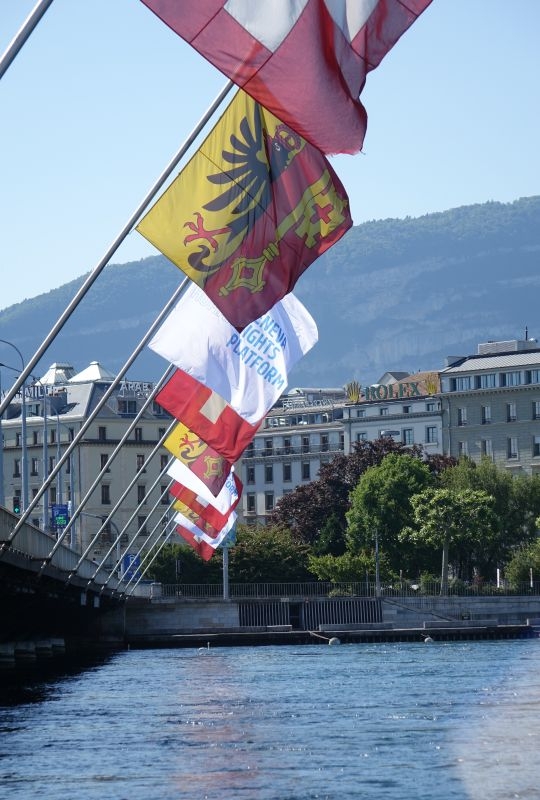
From today until Sunday 7 June 2020, flags with the Geneva Human Rights Platform (GHRP) logo will be flying on the Mont-Blanc Bridge. This should have coincided with the GHRP annual conference – an annual event open to all human rights actors in and outside Geneva that addresses current issues and challenges related to the work of Geneva-based human rights mechanisms. However, due to the COVID-19 situation, we postponed the conference to 15 October 2020.
‘As the space on the bridge was already booked in October, we decided to keep this slot to raise awareness about the platform in Geneva and beyond. This is also the occasion to announce the new date of the 2020 annual conference that will discuss the connectivity between the Geneva-based human rights system and regional human rights mechanisms’ explains Felix Kirchmeier, Executive Director of the Geneva Human Rights Platform..
On 2 June 2020 many media (here Natasha Kuma) wrote about the ‘hot potatoe’ in the social media debate about which posts are harmful and should be deleted or given a warning. Interesting to note that the European Commission supported the unprecedented decision of Twitter to mark the message of the President Trump about the situation in Minneapolis as violating the rules of the company about the glorification of violence.
The EU Commissioner Thierry Breton said: “we welcome the contribution of Twitter, directed to the social network of respected European approach”. Breton also wrote: “Recent events in the United States show that we need to find the right answers to difficult questions. What should be the role of digital platforms in terms of preventing the flow of misinformation during the election, or the crisis in health care? How to prevent the spread of hate speech on the Internet?” Vice-President of the European Commission Faith Jourova in turn, said that politicians should respond to criticism with facts, not resorting to threats and attacks.
Some employees of Facebook staged a virtual protest against the decision of Mark Zuckerberg not to take any action on the statements of Trum,. The leaders of the three American civil rights groups after a conversation with Zuckerberg and COO Sheryl Sandberg, released a joint statement in which they say that human rights defenders were not satisfied with the explanation of Mark Zuckerberg position: “He (Zuckerberg) refuses to acknowledge that Facebook is promoting trump’s call for violence against the protesters. Mark sets a very dangerous precedent.”
————-
Earlier – on 14 May 2020 – David Cohen wrote about Facebook having outlined learnings and steps it has taken as a result of its Human Rights Impact Assessments in Cambodia, Indonesia, Sri Lanka
Facebook shared results from a human rights impact assessments it commissioned in 2018 to evaluate the role of its services in Cambodia, Indonesia and Sri Lanka.
Director of human rights Miranda Sissons and product policy manager, human rights Alex Warofka said in a Newsroom post, “Freedom of expression is a foundational human right that allows for the free flow of information. We’re reminded how vital this is, in particular, as the world grapples with Covid-19, and accurate and authoritative information is more important than ever. Human rights defenders know this and fight for these freedoms every day. For Facebook, which stands for giving people voice, these rights are core to why we exist.”
Sissons and Warofka said that since this research was conducted, Facebook took steps to formalize an approach to determine which countries require more investment, including increased staffing, product changes and further research.
Facebook worked with BSR on the assessment of its role in Cambodia, and with Article One for Indonesia and Sri Lanka.
Recommendations that were similar across all three reports:
Improving corporate accountability around human rights.
Updating community standards and improving enforcement.
Investing in changes to platform architecture to promote authoritative information and reduce the spread of abusive content.
Improving reporting mechanisms and response times.
Engaging more regularly and substantively with civil society organizations.
Increasing transparency so that people better understand Facebook’s approach to content, misinformation and News Feed ranking.
Continuing human rights due diligence.
…Key updates to the social network’s community standards included a policy to remove verified misinformation that contributes to the risk of imminent physical harm, as well as protections for vulnerable groups (veiled women, LGBTQ+ individuals, human rights activists) who would run the risk of offline harm if they were “outed.”
Engagement with civil society organizations was formalized, and local fact-checking partnerships were bolstered in Indonesia and Sri Lanka.
Sissons and Warofka concluded, “As we work to protect human rights and mitigate the adverse impacts of our platform, we have sought to communicate more transparently and build trust with rights holders. We also aim to use our presence in places like Sri Lanka, Indonesia and Cambodia to advance human rights, as outlined in the United Nations Guiding Principles on Business and Human Rights and in Article One and BSR’s assessments. In particular, we are deeply troubled by the arrests of people who have used Facebook to engage in peaceful political expression, and we will continue to advocate for freedom of expression and stronger protections of user data.”
But it is not all roses for Twitter either: On 11 May 2020 Frances Eve (deputy director of research at Chinese Human Rights Defenders) wrote about Twitter becoming the “Chinese Government’s Double Weapon: Punishing Dissent and Propagating Disinformation”.
She relates the story of former journalist Zhang Jialong whose “criminal activity,” according to the prosecutor’s charge sheet, is that “from 2016 onwards, the defendant Zhang Jialong used his phone and computer…. many times to log onto the overseas platform ‘Twitter,’ and through the account ‘张贾龙@zhangjialong’ repeatedly used the platform to post and retweet a great amount of false information that defamed the image of the [Chinese Communist] Party, the state, and the government.”…..
Human rights defenders like Zhang are increasingly being accused of using Twitter, alongside Chinese social media platforms like Weibo, WeChat, and QQ, to commit the “crime” of “slandering” the Chinese Communist Party or the government by expressing their opinions. As many Chinese human rights activists have increasingly tried to express themselves uncensored on Twitter, police have stepped up its monitoring of the platform. Thirty minutes after activist Deng Chuanbin sent a tweet on May 16, 2019 that referenced the 30th anniversary of the Tiananmen Massacre, Sichuan police were outside his apartment building. He has been in pre-trial detention ever since, accused of “picking quarrels and provoking trouble.”
…..While the Chinese government systematically denies Chinese people their right to express themselves freely on the Internet, … the government has aggressively used blocked western social media platforms like Twitter to promote its propaganda and launch disinformation campaigns overseas…
Zhang Jialong’s last tweet was an announcement of the birth of his daughter on June 8, 2019. He should be free and be able to watch her grow up. She deserves to grow up in a country where her father isn’t jailed for his speech.
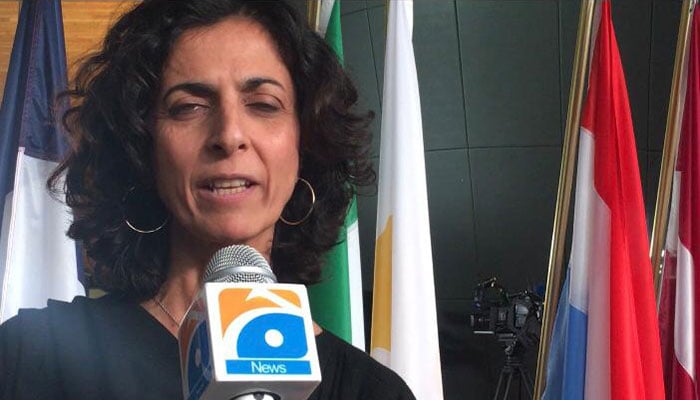
Maria Arena is the chairperson of the Subcommittee of Human Rights of the European Parliament member of Socialist and Democrats parliamentary group. Photo: Reporter
20 May 2020 the chairperson of the Subcommittee of Human Rights of the European Parliament sent a letter to Indian Home Minister Amit Shah, condemning the arrest of human rights defenders under the Unlawful Activities (Prevention) Act.
In her letter, Maria Arena said the European body has been closely following the arrests of human rights defenders Anand Teltumbde and Gautam Navlakha by the National Investigative Agency in India.
Academic and Dalit author Teltumbde and human rights defender Navlakha had surrendered to the police last month after exhausting their possible legal remedies.
Nine other defenders have been in jail since 2018 in the Bhima Koregaon case, where the charges relate to caste violence around an Ambedkarite event and an alleged Maoist plot to foment armed revolution and possibly assassinate Prime Minister Narendra Modi.
In 2018, the United Nations’ Office of the High Commissioner for Human Rights had issued a statement against terror charges being invoked against the activists.
“It is particularly alarming to note that human rights defenders cannot conduct advocacy activities, notably in favor of India’s poorest and most marginalised communities, without becoming subject to intimidation and harassment,” Arena said in her letter.
“Equally worrying is the fact that terrorism charges, including under the Unlawful Activities Prevention Act (UAPA) have been used to silence them,” she noted pointing out that by United Nations Special Procedures, this clearly represents a violation of international human rights standards.
“This is notably the case for human rights activists such as Safoora Zargar, Gulfisha Fatima, Khalid Saifi, Meeran Haider, Shifa-Ur-Rehman, Dr Kafeel Khan, Asif Iqbal and Sharjeel Imam, who were recently arrested by the police,” the letter noted.
Against this background, there are also increased fears that the legislation might confer discretionary powers upon state agencies. India, she said, should do much more to ensure a safe and conducive environment for civil society working in the country and consider enacting a law on the protection and promotion of human rights defenders.
In a similar vein, ProtectDefenders on May 26 2020 reports “Increasing attacks against human rights defenders in India and Guatemala”. …..
Over the past month, ProtectDefenders.eu has received a considerable and growing number of reports regarding attacks, threats, and alerts affecting human rights defenders in India. This information alerts to the numerous acts of police and judicial harassment in the repression of legitimate activities in favor of human rights. Among other incidents, police harassment and arbitrary detention of human rights defenders were reported in Manipur State, in relation to statements made to criticise the management of the current COVID-19 pandemic by local authorities.
Moreover, the Paris-based International Federation for Human Rights has written to Prime Minister Narendra Modi and home minister Amit Shah terming the detentions of several Indian human rights activists ‘arbitrary’. It says the activists have been arrested for “their participation in peaceful protests against the Citizenship Amendment Act 2019 (CAA)” in the last few months.
The letter highlights the cases of Devangana Kalita and Natasha Narwal, student activists who have been associated with the anti-CAA protests in Delhi and were arrested recently by the Delhi police.
On 29 May 2020 the UN Human Rights Council adopted a decision appealing to States to ensure human rights were at the front and centre of national responses to the pandemic and not side-lined while contending with the multiple ill effects of the virus on their societies.
“Today’s decision is a profound reminder of the far-reaching effects of this deadly virus on all aspects of our livelihoods and our rights which we cannot take for granted”, stated Council President Elisabeth Tichy-Fisslberger. “We are all in this together, and we must act together with a sense of purpose if we are going to achieve our common agenda to promote and protect human rights around the globe”, she added.
The President’s Statement, presented by Ambassador Tichy-Fisslberger, and adopted by the 47 member States of the human rights body by silence procedure, “calls upon States to ensure that all human rights are respected, protected and fulfilled while combatting the pandemic and that their responses to the COVID-19 pandemic are in full compliance with their human rights obligations and commitments”.
The adopted statement also calls on High Commissioner for Human Rights Michelle Bachelet to produce a report on the impact of the COVID-19 pandemic on the enjoyment of human rights around the world, including highlighting good practices and areas of concern, to be presented at the 46th session of the Human Rights Council scheduled to take place in February/March 2021. [One is to hope that it will include a hard look at the fragmentation of Covid-19 relate policy statements, see: https://humanrightsdefenders.blog/2020/05/27/proliferation-of-human-rights-bodies-guidance-on-covid-19/]
States also invited the High Commissioner to present an oral update on the human rights impact of COVID-19 at the 44th session of the Council which is still scheduled to start on 22 June, which is expected to set the tone for similar statements addressing the multiple human rights angles of the virus during the planned three-week meeting. Since suspending its 43rd session on 13 March due to coronavirus restrictions, the Human Rights Council has been conducting its business in a virtual manner holding regular Bureau meetings, with States and NGOs, and three “virtual informal conversations”, including with the High Commissioner and Special Procedures who have issued more than 90 press releases and statements addressing COVID-19.
Protection International Kenya (PIK) – a registered a non-governmental organization in Kenya with support from its headquarters in Belgium – seeks a Research Consultant for Protection strategies implemented by grassroots WHRDs Organizations. Closing date for applications 12 June 2020.
The research findings will be used for future capacity building of WHRDs, advocacy on the promotion and protection of WHRDs/HRDs at national, regional and global level and for dissemination purposes. PIK, with the support of Protection International Africa and Protection International Global, will publish the findings and disseminate among its partners, donors, government officials and all other stakeholders.





 Hans Thoolen on Human Rights Defenders and their awards