Archive for the 'human rights' Category
February 25, 2013

(High Commissioner for Human Rights Navy Pillay addresses the 22nd session of the Human Rights Council in Geneva. UN Photo/Jean-Marc Ferré)
As the United Nations Human Rights Council began its work today, 25 February 2013. the High Commissioner Navi Pillay stressed the importance of strengthening international processes that will monitor and prevent rights violations around the world as well as hold perpetrators accountable for their crimes.Addressing the opening of the 22nd session of the Human Rights Council in Geneva, UN High Commissioner for Human Rights Navi Pillay said that despite significant progress over the past two decades on issues such as the elimination of violence against women and tackling impunity for international crimes, there continue to be systematic human rights violations around the world. In her address to the Council, Ms. Pillay also noted that while the increased involvement of civil society in defending human rights is a welcome development, there have been an alarming number of reports of governments persecuting human rights defenders because of the nature of their work.“I continue to hear of brave human rights defenders, journalists or bloggers who have been threatened, harassed, arrested or killed because of their work on behalf of the human rights of others,” Ms. Pillay said. “Such intimidation has sometimes even occurred during the proceedings of this Council. We must never tolerate such pressure, or reprisals against those who rightly seek to engage the international human rights system.”
via United Nations News Centre – UN Human Rights Council opens with call to strengthen international justice system.
Posted in human rights, Human Rights Defenders, UN | 6 Comments »
Tags: Geneva, human rights, Human Rights Council, Human Rights Defenders, impunity, Navanethem Pillay, Office of the United Nations High Commissioner for Human Rights, Pillay, protection, United Nations, United Nations Human Rights Council
February 25, 2013
This interesting story starts in February 2011 with a peaceful demonstration against deaths of pregnant women at the Huruma Nursing Home, a hospital serving Huruma, one of the major slums in Nairobi. Two human rights defenders, Ruth Mumbi and Ms Victoria Atieno, were accused of incitement to violence. Their case has dragged on for 2 years with at least 5 adjournments triggered by the absence at the trial of the administrator of Huruma Nursing Home, both a key witness and complainant. During the latest hearing on 21 February 2013, the administrator of Huruma Nursing Home turned up at the Court. However, this was a new administrator who replaced the person who managed the establishment at the time when the protest took place. As the judge raised questions about this change of witness, the administrator responded that the sole purpose of his presence at Makadara Law Courts was to present Huruma Nursing Home’s desire that the case be dismissed! The judge interestingly decided to allow the accused human rights defenders to express their opinion on it. On 26 February 2013 (tomorrow), Ruth Mumbi and Victoria Atieno hope to tell how they were victims of malicious prosecution and file a lawsuit to claim damages. And on top of this a great occasion to alert the public about poor health services!
The case against Ruth Mumbi and Victoria Atieno was referred to in an urgent appeal http://www.frontlinedefenders.org/node/20473 on 30 October 2012. 
Posted in Front Line, human rights, Human Rights Defenders | Leave a Comment »
Tags: Advocacy Organizations, Africa, court, demonstration, freedom of assembly, Front Line Defenders, Human right, Human Rights and Liberties, Human rights defender, Human Rights Defenders, malicious prosecution, Nairobi, Nursing home, right to health, slum, women human rights defenders
February 25, 2013
The HURIDOCS network publishes a Newsletter with many items that are of importance to Human Rights Defenders. The latest issue carries e.g. interesting news on access to human rights case law from the Asian and American scene. In the future it should be possible to have on-line access to the case load of these regional systems which until now are very difficult to find. Connecting these two databases in the future will be possible, but only if they are built on common standards. Developing these is a core function of HURIDOCS as illustrated by an interview with Judith Dueck who has been involved in standard formats for almost 25 years (Judith Dueck looks back upon how it was done). One reason to refer to this article of course the youth picture of me (from 1988) they added!
To get the HURIDOCS newsletter free every 15 days subscribe via the homepage: http://www.huridocs.org/
Posted in human rights | Leave a Comment »
Tags: Advocacy Organizations, Africa, Americas, case law, documentation, documenting, Hans Thoolen, human rights, Human Rights and Liberties, Human Rights Defenders, HURIDOCS, information technology, internet, Judith Dueck, jurisprudence, Latin America, newsletter, Standard formats, technology
February 25, 2013
The Observatory for the Protection of Human Rights Defenders, joint programme of FIDH and OMCT, has been informed of the arrest and detention of human rights defender Abdi Osman, vice-president of the Ligue djiboutienne des droits humains (LDDH). On 21 February 2013 it seems that Osman has been arrested and brought to the police station. At the time of writing he seems not to be at this station anymore but his place of detention is worryingly unkown. Osman had on 20 February addressed publicly in the framework of an opposition meeting the torture and bad detention conditions of political prisoners. Action suggestions are in:
via Djibouti: Arrestation et détention au secret de M. Abdi Osman / 22 février 2013 / Interventions urgentes / Défenseurs des droits… / OMCT.
Posted in human rights | Leave a Comment »
Tags: Abdi Osman, arbitrary arrest, disappearances, Djibouti, FIDH, Human right, Human rights defender, illegal detention, International Federation for Human Rights, Observatory, OMCT, political prisoner, World Organisation Against Torture
February 25, 2013

Protection International (PI) is published on 23 February 2013 its first FOCUS report. To commemorate the 15th Anniversary of the UN Declaration on Human Rights Defenders (HRDs), the report presents the results from PI’s research on public government policies to protect human rights defenders internationally. It analyzes the development of public policy meant to protect human rights defenders. While acknowledging advances that have clearly enhanced existing regional and international mechanisms, the report adopts a critical approach since States are ultimately responsible for protecting Human Rights Defenders, starting with governments.PI hopes this report will contribute to the discussion on how to improve existing public policies and spur discussion between civil society organizations and governments of countries where protection of human rights defenders is far from being ensured.
The full report can be downloaded in several languages via: FOCUS Report 2013 : “Public Policies for the Protection of Human Rights Defenders: The State of the Art” | | ProtectionlineProtectionline.
Posted in books, human rights, Human Rights Defenders | 1 Comment »
Tags: 2013, Advocacy Organizations, annual report, Civil society, Focus 2013, Human right, human rights, Human Rights and Liberties, Human rights defender, Human Rights Defenders, PI, policies, politics, protection, Protection International, UN Declaration, United Nations
February 24, 2013
 A move by Egyptian authorities to prohibit national NGOs’ contact with foreign organizations without prior permission from security bodies represents a new low for freedom of association, said Amnesty International. In a letter to an NGO (Egyptian Organization for Human Rights) Egypt’s Ministry of Social Affairs stated that no “local entity” is permitted to engage with “international entities” in any way without the permission of the “security bodies”, referring to instructions issued by the Prime Minister.
Read the rest of this entry »
Posted in AI, human rights, Human Rights Defenders | 1 Comment »
Tags: AI, Amnesty International, Arab spring, Egypt, Egyptian Organization for Human Rights, freedom of association, Human right, human rights, Middle East, Non-governmental organization, Politics of Egypt, restrictions
February 23, 2013
 The InQuirer from Monrovia reports on 21 February 2013 that Search For Common Ground (SFCG) has launched a new project in Liberia. According to Oscar Bloh, Country Director of SFCG, the project is being launched in Lofa and Bong Counties, two of Liberia’s most populated counties, with the aim of encouraging the authorities to protect and promote human rights in the country. According to Bloh, now that the 14-year war has ended with a democratically elected government, the protection of human rights and access to justice should be key factors in promoting good governance in the country. The organization is working in partnership with the Independent National Human Rights Commission of Liberia, the United Nations Mission In Liberia UNMIL, the Government of Liberia (through the Ministry of Justice) and the European Union in implementing the project which targets about 80,000 citizens. He said the SFCG will work with county authorities, including the police, to engage society and stakeholders by explaining the rule of law. Giving an overview of the project, Mr. James Yarsiah, Executive Director of the partner NGO ‘Rights and Rice’ said the protection of human rights is cardinal to the national transformation in Liberia explained that the activities under the project include the training of local rights activists, providing skills for selected civil society organizations and empowerment of the citizens. The Executive Secretary of the Coalition of Human Rights Defenders, Daniel H. Allison, said over the past fifteen years Liberia has become a violator of human rights despite the election of a democratically elected government. He called on the Ellen Johnson-Sirleaf led administration to exert every effort to stop human rights violation in the country. This may not be earth-shaking news but is a nice example of the myriad of local projects that are going on.
via allAfrica.com: Liberia: SFCG Launches Human Rights Project in Lofa, Bong.
Posted in human rights | Leave a Comment »
Tags: Africa, Civil society, Ellen Johnson-Sirleaf, European Union, Human right, human rights, Human Rights and Liberties, Human Rights Defenders, Liberia, Monrovia, NGOs, projects, Search For Common Ground
February 22, 2013
The Gulf Centre for Human Rights (GCHR) on 16 February 2013 reported that it had received information that authorities in the UAE are targeting family members of human rights defenders (pictured above) currently in detention. Read the rest of this entry »
Posted in human rights | Leave a Comment »
Tags: detention, Emirates, family, GCHR, Gulf Centre for Human Rights, harassment, Human right, human rights, Human rights defender, Human Rights Defenders, judicial harassment, Middle East, Moza Al-Mansoori, Saleh Al-Dhufairi, UAE, United Arab Emirates
February 22, 2013
An impressive list of 20 human rights organizations have signed a statement regarding Omani human rights defenders who are currently in detention, especially those undertaking hunger strikes. 24 defenders and activists including Basma Al-Kiyumi, Bassima Al-Rajhi, Saeed Al-Hashemi, Hamad Al-Kharusi, and Bassam Abu Qasida undertook a hunger strike on 9 February 2013 in Samail Central Prison, protesting the delayed ruling on the appeals that they brought to the Supreme Court against the judgments that were passed against them. Confirmed reports reveal that the conditions of some of the hunger strikers have deteriorated seriously to the point that some are currently at risk of death. Saeed

Al-Hashemi was transferred to the Royal Hospital in Muscat, where a neurologist examined him and confirmed that he is in urgent need of physiotherapy or surgery as a result of an injury on his right side sustained when he was beaten by unknown assailants during peaceful protests in Oman in 2011. The same reports reveal that Hamad Al-Kharusi and Bassam Abu Qasida were transferred to the jail’s clinic due to exhaustion caused by their hunger strike.These human rights defenders were incarcerated following the decisions of the Appeals Court on 5, 12, and 19 December 2012 which upheld sentences of between 6 months and 1 year in prison issued against them by the Muscat Court of First Instance in July and August 2012.
Read the rest of this entry »
Posted in FIDH, human rights | Leave a Comment »
Tags: activists, Al-Haq, Arab Organization for Human Rights, Bahrain, Cairo Institute for Human Rights, coalition, FIDH, Human right, Human rights defender, Human Rights Defenders, hunger strikers, hungerstrike, illegal detention, illtreatment, International Federation, judicial harassment, Middle East, Oman, politics
February 22, 2013
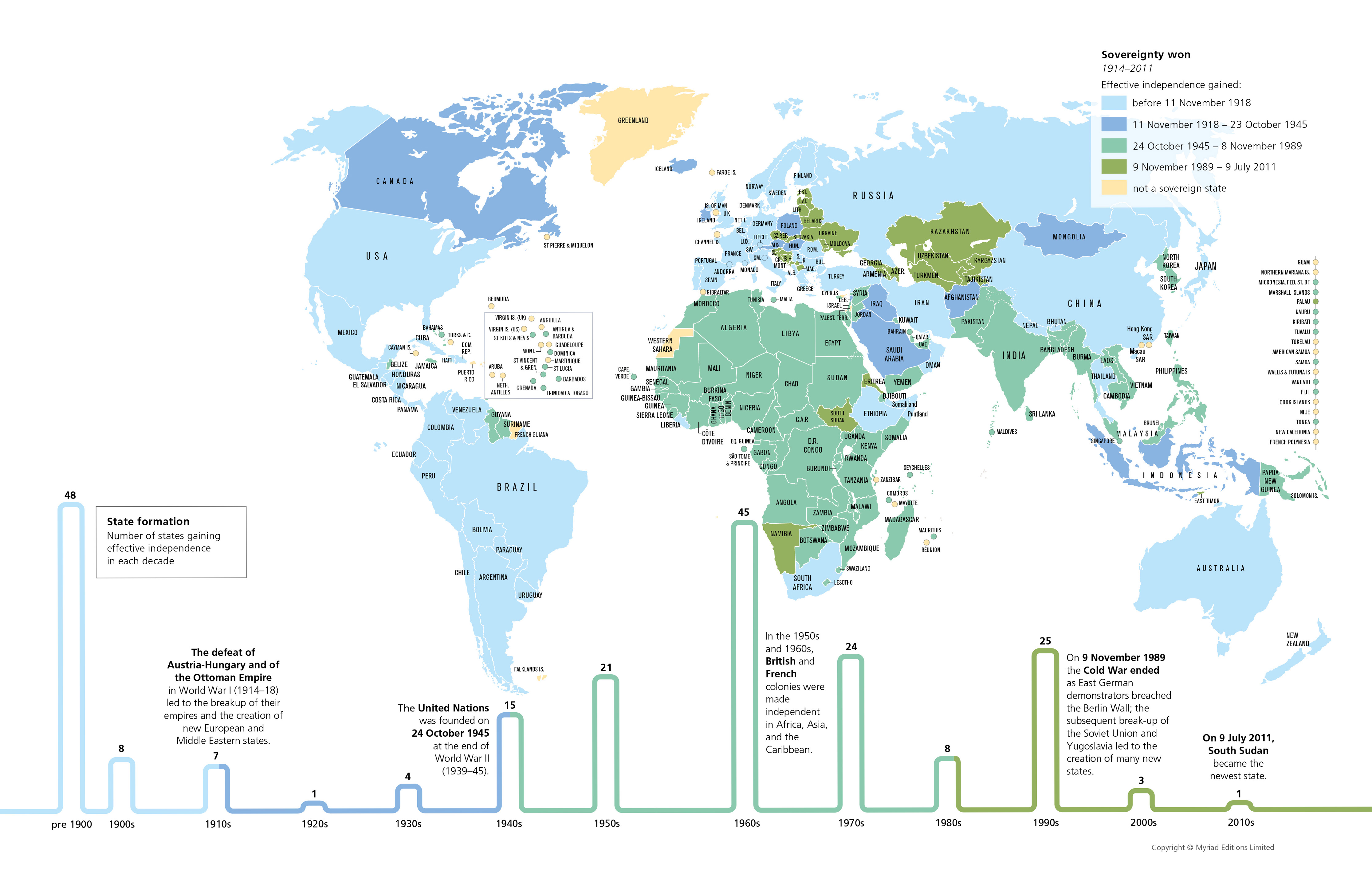
On 22 February 2013 Dan Smith published a post on his blog on the ‘state of States’. While not directly touching on human rights defenders, it gives in few words an excellent overview of the formation and deformation of States which provide much of the power and abuse that human rights defenders struggle against. I summarize some of the main issues here, but urge you to read the full text:
First he points out that most states are relatively new. By 1900 there were just 48 states in our modern sense of the term. In the years either side of World War I, with the break-up of the Ottoman and Habsburg Empires, there was considerable state-making. Even so, the UN was founded by just 51 states. Today, 193 states make up the UN, the newest being South Sudan in July 2011.

- From 48 to 193 (recognised states, that is) – from The State of the World atlas Read the rest of this entry »
Posted in human rights | Leave a Comment »
Tags: Afghanistan, conflict and peace, Dan Smith, Failed state, Fragile state, fragile states, historical perspective, Human Rights Defenders, Nigeria, non-state actors, Pakistan, politics, Somalia, South Sudan, sovereignty, state power, States, UN, ungoverned spaces, United Nations






 Hans Thoolen on Human Rights Defenders and their awards