I have long argued that we should take another look at the possibility of using the suspension clause when members of the UN Human Rights Council go too far (see e.g. in the case of persistent reprisals https://thoolen.wordpress.com/2014/03/13/zero-tolerance-for-states-that-take-reprisals-against-hrds-lets-up-the-ante/in the reprisals ). On Wednesday 29 June 2016, the two leading human rights NGOs, Amnesty International and Human Rights Watch, have urged UN member-states to suspend Saudi Arabia from the UN Human Rights Council over the killing of civilians in Yemen and repression at home. It will be a long shot but worth seeing how it works out: Read the rest of this entry »
Archive for the 'human rights' Category
North-South Prize 2015 of the Council of Europe goes to Greek and Mozambique organizations
July 5, 2016The North-South Prize is awarded to two candidates who have stood out for their exceptional commitment to promoting North-South solidarity. The 2015 Laureates are:

Ms Lora Pappa is the founder of METAdrasi, Action for Migration and Development. Through the creation of METAdrasi, Ms. Pappa aimed to address long-standing gaps in the area of refugee protection and migration management in Greece. METAdrasi’s main focus has been primarily community interpretation and the care for unaccompanied minors. METAdrasi and Ms Pappa personally, have based their work on the highest standards of professionalism and ethics, developing specialist training methods, recruiting dedicated and committed staff, bringing pioneering methods and approaches benefitting refugees and vulnerable groups in multiple ways. Biography

Chairperson of the Joaquim Chissano Foundation, an organisation that promotes peace, social and economic development and culture in Mozambique, Joaquim Chissano has campaigned for peace in the African continent through his work as an envoy and peace negotiator for the United Nations. He has received the highest awards from many countries and has received several prizes, including the Chatham House in 2006 and the inaugural Mo Ibrahim Prize for Achievement in African Leadership in 2007. He is the founding member of the Mozambique Liberation Front (FRELIMO) and played a fundamental role in the 1974 negotiations on the independence of Mozambique, between FRELIMO and the Portuguese Government. Biography
Source: Centre Nord-Sud – Prix Nord-Sud
Mongolia: human rights defender Beejin Khastamur on trial on 8 July
July 5, 2016According to Front Line Defenders a rather curious case seems to have been construed against a human rights defender in Mongolia. The trial of human rights defender Mr Beejin Khastamur will start on 8 July 2016 at the Songinokhairkhan District Court in Ulan Bator. He was arrested on 16 March 2016 and denied bail on 22 March. He was eventually released pending trial on 31 March. Beejin Khastamur is the founder of a non-governmental organisation Delhiin Mongol Nogoon Negdel (DMNN), which advocates for the protection of environment and the rights of the nomad people of Mongolia. The organisation has exposed many violations of Mongolia’s environmental laws by foreign and domestic mining companies, in which Mongolian politicians had a stake. It has also organised numerous workshops, public gatherings and demonstrations to educate the public on environmental issues. https://www.frontlinedefenders.org/en/profile/beejin-khastamur
According to the police Beejin Khastamur allegedly attacked the driver of another car using a knife. On 6 February 2016, Beejin Khastamur was indeed involved in a car accident, during which no one was killed or injured and the material damage caused was minimal. The human rights defender was driving in Ulan Bator when a Nissan car tried to pass him on the wrong side twice and eventually hit his vehicle. Its driver got out of the car and attacked Beejin Khastamur kicking him and hitting the human rights defender in his head. Subsequently, during the forensic examination it was revealed that Beejin Khastamur sustained bruises all over his body and had a brain concussion, while the second driver had only small scratches on one of his knees. When police arrived at the scene, they concluded that the accident had been the fault of the second driver and left. However, they subsequently returned and brought Beejin Khastamur to the police station for questioning. The actions of the police have given rise to the suspicion that the accident may have been used as a pretext to target Beejin Khastamur for his human rights work.
[On 21-23 December 2015, Beejin Khastamur organised a sit-down strike protesting the illegal permit given to a Canadian and Mongolian joint company enabling it to mine gold right on Onon River. Since then he has received multiple threats. On several occasions people came to his house, banging on his door at night, cutting his electricity, puncturing his car tires, threatening his wife and children. The human rights defender also received death threats on the phone.]

Two of three Turkish human rights defenders released awaiting trial
July 3, 2016A Turkish court on Thursday 30 June 2016 released a prominent press freedom advocate and leading human rights defender, two of three activists put under pre-trial arrest on June 20 for participating in a solidarity campaign with a pro-Kurdish daily newspaper. [see: https://thoolen.wordpress.com/2016/06/23/turkey-outcry-over-detention-of-human-rights-defenders-is-even-russia-too-much/]
Sebnem Korur Fincanci, president of the Human Rights Foundation of Turkey, and Erol Onderoglu, Turkey’s representative to Reporters Without Borders, are to remain free pending trial on charges of “propaganda for terror organization PKK,” or the Kurdistan Workers’ Party, according to the state-run Anadolu Agency. The first hearing is scheduled for November 8. A different court is handling the case against writer and journalist Ahmet Nesin and there has been no decision yet on the possibility of his release pending trial, according to Anadolu.
The three had participated in a solidarity campaign taking turns as co-editors in support of Ozgur Gundem, a pro-Kurdish publication subject to multiple investigations and lawsuits.
Source: Human rights and media activist released in Turkey – Watertown Public Opinion: Europe
Elie Wiesel, Nobel Laureate 1986, dies at the age of 87
July 3, 2016
ASSOCIATED PRESS Holocaust survivor and writer Elie Wiesel died on Saturday aged 87.
Activist and writer Elie Wiesel, the World War Two death camp survivor who won the 1986 Nobel Peace Prize for becoming the life-long voice of millions of Holocaust victims, has died, Israel’s Holocaust memorial Yad Vashem said on Saturday 2 July 2016. Wiesel, a philosopher, speaker, playwright and professor who also campaigned for the tyrannized and forgotten around the world, was 87.
The Romanian-born Wiesel lived by the credo expressed in “Night,” his landmark story of the Holocaust – “to forget the dead would be akin to killing them a second time.”
In awarding the Peace Prize, the Nobel Committee praised Wiesel as a “messenger to mankind” and “one of the most important spiritual leaders and guides in an age when violence, repression and racism continue to characterize the world.” Elie Wiesel went on to receive another 6 human rights awards, including one named after himself.
Source: Elie Wiesel, Holocaust Survivor And Nobel Laureate, Dead At 87
An early Save the Date: 11 October, 2016, Martin Ennals Award for Human Rights Defenders in Geneva.
July 1, 2016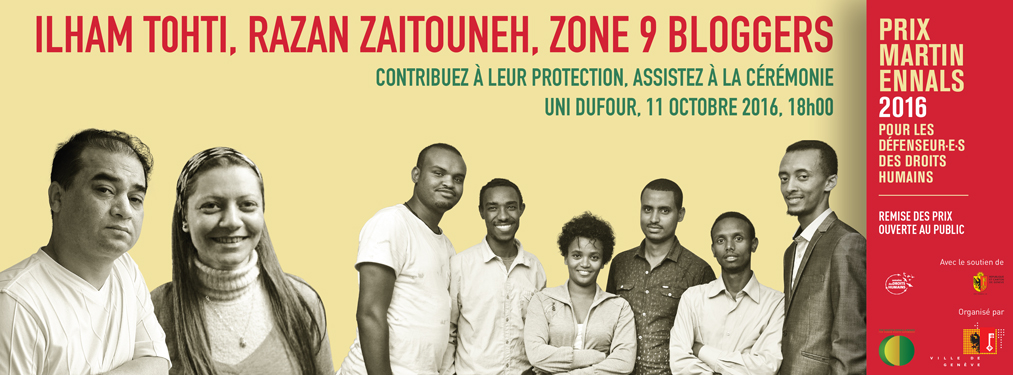
The 2016 Martin Ennals Award Ceremony, organized annually by the City of Geneva and the Martin Ennals Foundation, will this year take place on 11 October, 6.00 pm, at Uni Dufour, Geneva, as the the opening of the Human Rights Week hosted by the University of Geneva from October 11 to 14 and with the support of the Canton of Geneva.
The laureate will be selected from among three 2016 finalists:
Mr. Ilham Tohti (China) was sentenced to life imprisonment after working for two decades to foster dialogue and understanding between Uyghurs and Han Chinese.
Mrs. Razan Zaitouneh (Syria) was kidnapped after dedicating her life to defending political prisoners and documenting crimes against humanity in Syria.
Zone 9 Bloggers (Ethiopia) have been prosecuted for documenting human rights abuses in their country.
The finalists and laureate are selected by the Jury of the Martin Ennals Award, made up of ten of the world’s leading human rights organizations: Amnesty International, Human Rights Watch, Human Rights First, International Federation for Human Rights (FIDH), World Organisation Against Torture (OMCT), Frontline Defenders, the International Commission of Jurists, EWDE-Germany, the International Service for Human Rights, and HURIDOCS. The detailed programme of the ceremony will follow at the beginning of September.

Martin Ennals Award for Human Rights Defenders
For the conversation in the social media, use the hashtag: #Ennals2016.
You can register already now through: http://www.martinennalsaward.org/index.php?option=com_content&view=article&id=296%3Amea-2016-save-the-date&lang=en.
Two years after murder of Salwa Bugaighis in Libya, still no investigation
June 28, 2016Salwa Bugaighis was the first woman to call for the ouster of Libyan dictator Moammar Qaddafi. After she cast her ballot in the 2014 election, men in hoods and military uniforms stormed into her home and killed her on 25 June.[ https://thoolen.wordpress.com/2014/06/29/human-rights-lawyer-salwa-bugaighis-killed-in-libya/]
Two years later, her killers remain at large and the article by BANISH AHMED in Thinkprogress of 28 June 2015 “Activists Inspired By Libyan Human Rights Lawyer Want To Know Why No One Is Investigating Her Murder” remains as valid as it was last year.

Salsa Bugaighis CREDIT: KARAMA
The fear of violence made voters in Libya cautious about heading to the polls during elections last June, but Salwa Bugaighis, a human rights lawyer who returned to the country to fight for its democratic future after the fall of Muammar Qaddafi, insisted that the risk was worth it.
“My people, I beg of you, there are only three hours left,” she wrote to her Facebook followers at about 5:45 in the evening to urge Libyans to head to the polls before they closed.
Members of the armed militants groups vying for power stormed through her neighborhood. Gunshots from a skirmish between militants and the army troops sent to protect a polling station were audible in a telephone interview she gave to a Libyan TV network from her home.
Still, Bugaighis was not shaken.
“These are people who want to foil elections,” she told the al-Nabaa network of the militants. “Benghazi has been always defiant, and always will be despite the pain and fear. It will succeed.”
Despite these risks, Bugaighis ventured out to the polls, and, while there, posted an image of herself casting her ballot on Facebook.
It was back at her home after voting that the dangers she well knew caught up with her. Men in hoods and military uniforms stormed into Bugaighis’ home and opened fire on her. Shot several times, she was taken to a hospital in critical condition where she died.
There was an immediate outcry against her death, and scores of women inspired by Bugaighis’ fight for justice, stability, and gender equality in her homeland took to the streets.
While Hibaaq Osman was not among those who braved the violent streets of Benghazi to honor Bugaighis, she has continued to carried the torch for her friend and fellow activist.
“When the protests against Qaddafi started in Benghazi, it was Salwa who was with the first women to join the demonstrations in front of the courthouse,” Osman, who heads Karama, a Cairo-based rights organization, said in an email to ThinkProgress. “That was everything about Salwa — fearless, ready to go against the grain and do what she believed was right.”
Only two weeks after the ouster of Qaddafi in April 2011, Libya held its first conference on women’s rights, organized by Bugaighi. She landed a seat on the governing body established to steer the country towards democracy, and used it push for an electoral quota that would guarantee women’s inclusion in the legislative bodies that followed. She helped found organizations dedicated to human and women’s rights. Her mission was clear: Bugaighis wanted Libya to emerge as a true democracy, one in which women would have a voice, until then, been allowed only a marginalized role in their society.
All that she had worked for seemed to be falling apart in June 2014, however. Rival militant and political groups, plus a renegade general, were the cause of violent, and many Libyans were skeptical of that their country’s fledgling government could provide security – or that it would effectively manage the country’s wealth.
The growing disillusionment was evident at the polls: more than a million fewer had registered to vote than in country’s first election in 2012, and only half of them actually cast ballots. Five people were killed and 30 injured when Islamist militant attacked a security agency in Benghazi.
In the attack on Bughaighis’ home, her husband, an elected member of a local municipal council, was abducted during the attack on their home and is still missing.
No investigation has yet been conducted into the attack on Bughaighis, although rights groups including Amnesty International called one for one soon after her death.
“We believe that Salwa Bugaighis may have been targeted for both her political activism and her role in promoting women’s rights,” Hassiba Hadj Sahraoui, the organization’s Middle East and North Africa Director said in a statement at the time. “Attacks on security personnel and state institutions pose severe obstacles to the functioning of the justice system, but that is no excuse for Libya’s failure to protect activists. The authorities must put in place protective measures to prevent other critical voices being brutally silenced.”
The Libyan Women’s Platform for Peace made similar appeals. In an interview with the BBC, Zahra Langhi, with whom Bugaighis founded the organization, said that that her colleague had received pointed threats that forced her to leave the country for three months before the election.
“She had to evacuate all of her sons and take them to a safe place in Amman,” Langhi said, “because she was too much involved in the political process she had to pay a very high price, which she was aware of.”
Still, Langhi said she urged Bugaighis to try to protect herself.
“When I said, ‘Be careful, Salwa,’ she said, ‘We have to struggle inside Libya until the last moment. They will not threaten us and shut us all up. We will have to struggle for it.’” Langhi recalled. “And she was calling on everybody, until the last moment, [saying] ‘Please participate and protect the ballots.’”
When asked who she thought killed Bugaighis, Langhi said, “I think everybody is involved. Those who don’t want a peaceful Libya, who want Libya to continue as a militarized society. Those who do not want to see a democratic Libya are a part of it. Even if they’re against each other.”
One year later, various rights’ organizations have renewed their calls for an independent investigation into who killed Bugaighis.
The United Nations High Commissioner for Human Rights has taken note of the case, and will send a fact-finding mission to investigate human rights violations in Libya.
“That’s a good sign, but it needs to happen,” Shelby Quast of Equality Now said in a phone interview, adding that the delay in justice “is promoting impunity.”
According to Libya Body Count, which tracks the numbers of those killed by armed groups in Libya, nearly 900 people have been violently killed so far in June. More than 2,800 were killed in 2014.
While Bughaighis’ case is one of thousands, it stands out as a particularly egregious one.
“It [shows] the impunity with which people are acting,” Quast said, “because they can come in and so brutally assassinate someone who was a public figure, who did have a following. While we’re pushing for justice for Salwa, she represents a growing number of women and human rights defenders who are being targeted, threatened, and murdered.”
In May, Mark SImonoff, the Minister Counselor for Legal Affairs for the U.S. Mission to the U.N. said at a meeting of the U.N. Security Council, pointed to Bughaigis’ death as evidence of a broader phenomenon.
“Many of the individuals and institutions with the most critical roles to play in exposing and preventing violence against civilians –- including journalists, human rights defenders, judges and prosecutors, female activists, and the country’s human rights commission –- have been singled out for intimidation and brutal violence for simply attempting to provide key services to the Libyan people,” he said. “Other murders, such as the killing of prominent human rights leader Salwa Bugaighis last June on the day of national elections, have a clear political purpose, even as it has been impossible to identify those responsible.”
In investigating Bughaigis’ murder, many hope that similar cases can also see justice.

Hibaaq Osman poses with Salma Bugaighis at UN Commission on the Status of Women conference held in March 2014 in New York, NY. CREDIT: KARAMA
“The pressure that the Justice For Salwa campaigns has exerted is now building the political will to find not just Salwa’s killers, but to investigate and prosecute the many more politically motivated murders that Libya has suffered,” Hibaaq Osman said. “That is why we say that justice for Salwa is justice for all.”
Osman and many others continue the fight Bugaighis died fighting, though Libya has only become more unstable since its last elections. Militant groups have only promulgated in the last year and become more brazen in their attacks. ISIS, the Islamist group that calls itself the Islamic State, has gained a foothold in the country. Rule of law is in no better a state, with two parliaments vying for power against one another. A dramatic loss in oil revenue has put Libya “on the verge of economic and financial collapse,” according to one U.N. official.
And yet, those who worked alongside or were inspired by Salwa Bugaighis’ bravery and mission continue her fight.
The attack on her life made “Salwa a martyr to the cause of a free and just Libya,” according to Osman. “It showed the world the depths to which her killers would stoop – to murder in cold blood a women who had urged her supporters to ‘fight peacefully by using their votes.’ It has left me and Salwa’s colleagues more determined to work for her ideals in Libya and across the region, to honor her memory.”
Ivan Šimonovic appointed as UN special adviser on the responsibility to protect
June 28, 2016
Ivan Šimonović. UN Photo/Loey Felip
On 23 June 2016 United Nations Secretary-General Ban Ki-moon announced the appointment of Ivan Šimonović of Croatia as his Special Adviser on the Responsibility to Protect as from 1 October. Mr. Šimonović is currently Assistant Secretary-General for Human Rights and Head of the Office of the High Commissioner for Human Rights (OHCHR) in New York. “In his role as the Special Adviser on the Responsibility to Protect, Mr. Šimonović will work under the overall guidance of the Special Adviser of the Secretary-General on the Prevention of Genocide to further the political, institutional and operational development of the responsibility to protect principle, as set out by the General Assembly in paragraphs 138 and 139 of the 2005 World Summit Outcome document,” the statement said.
Mr. Šimonović succeeds Jennifer Welsh of Canada.
Translating Russia’s human rights defenders, UK charity looks for crowdfunding
June 28, 2016
Russia’s human rights organizations regularly produce reports about the human rights situation in their country. Too often these reports are not translated into English because of the cost involved, or because of the difficulty of finding good translators.The project aims to enable the reports published by Russia’s human rights groups to reach a wider, international audience by providing first-rate translations into English. The money donated will be used to pay for the translations, which will be provided at no cost to the authors. The reports in question cover all kinds of human rights issues, including freedom of expression, right of assembly, right of association, the prohibition on torture, liberty and security of person, right to a fair trial, and freedom from discrimination, including on the basis of gender, ethnicity, religion or belief, or sexual orientation. The reports form the basis for the vital work of awareness-raising and advocacy to combat human rights violations in Russia.
Source: Translating Russia’s human rights defenders, a Charities in UK on Crowdfunder
Graduate Institute in Geneva celebrated human rights defenders with meeting and march
June 24, 2016To mark the tenth anniversary of the Human Rights Council, the Graduate Institute, together with the European Union Delegation to the UN and the Geneva Academy of International Humanitarian Law and Human Rights, held an event on 15 June to honour Human Rights Defenders across the world. [see; https://thoolen.wordpress.com/2016/06/13/15-june-2016-human-rights-defender-berta-caceres-academy-geneva/]
The debate, moderated by Professor Andrew Clapham, featured Human Rights Defenders Taslima Nasrin and Aida Khemiri, as well as Stavros Lambrinidis, EU Special Representative for Human Rights.
“Too many people are dying for protecting human rights,” Mr Lambrinidis said, while promising that “the EU is committed to defending the defenders.”
“There is a price on my head,” revealed Taslima Nasrin, a Bangladeshi author and blogger who has been targeted by radical Muslim groups who have condemned her writing as blasphemous. “It’s been 22 years since I have been allowed to return to my country, not even in times of sickness and death of my closest family.”
Aida Khemiri, an LGBTI activist from Tunisia drew attention to the psychological challenge of having to lie to her friends and family for their protection. “As a Human Rights Defender, I have to live a double life. I cannot tell my family all I am doing, I have to protect them.”
Following the debate, participants and panelists marched past the UN Palais des Nations to express their support to Human Rights Defenders who were not able to walk freely. The event concluded at the Ariana Museum, with a spectacular show of the Violonissima Duo, performing from a hot air balloon. A playlist with photos from the event can be found through the link below.
 Hans Thoolen on Human Rights Defenders and their awards